
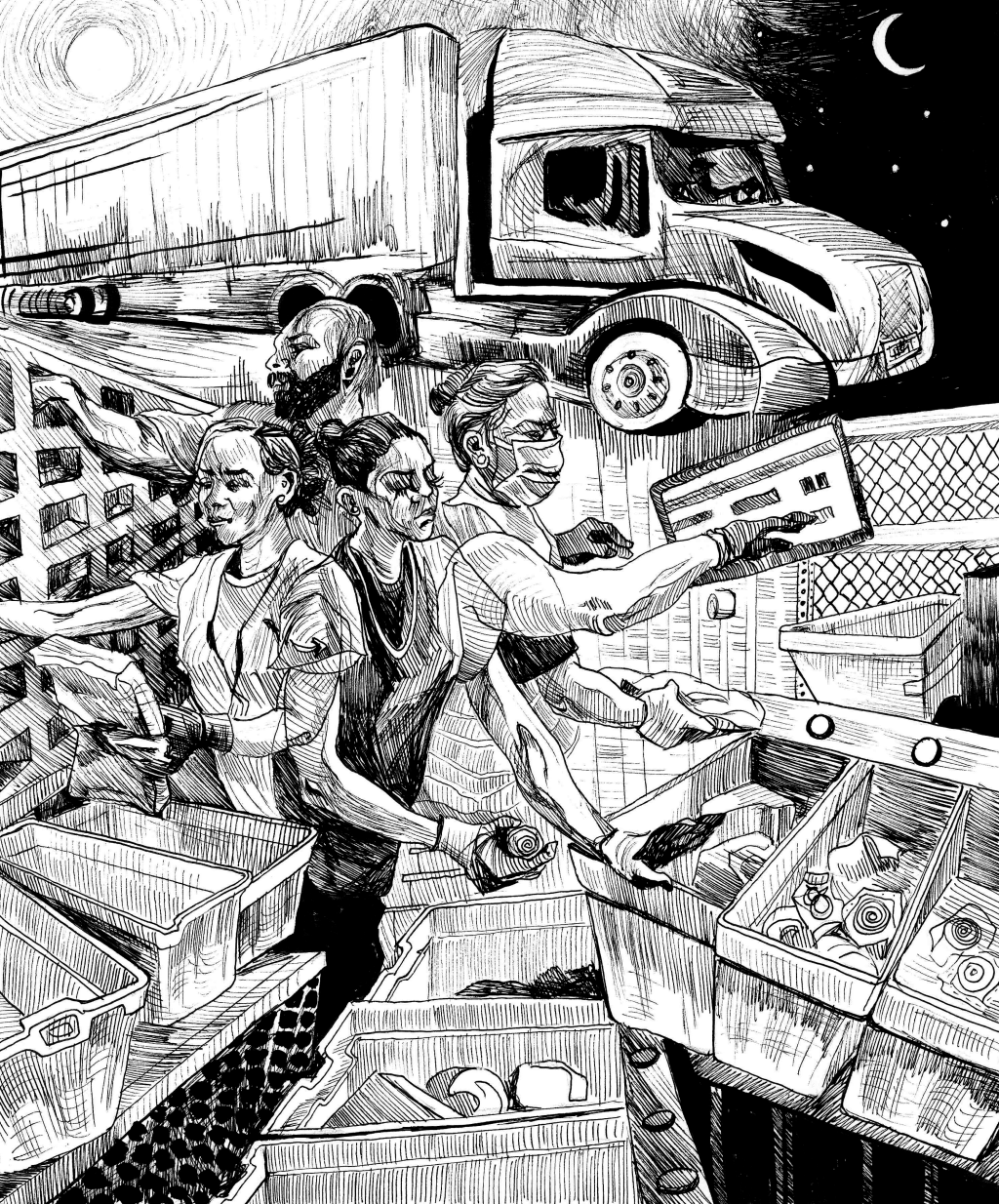
A social investigation of workers in the transportation and distribution industry, submitted by GATT readers in New England
In our area like so many others, deindustrialization has resulted in the closing of workplaces and loss of manufacturing jobs and other jobs that supported those industries. In this vacuum, there has been significant expansion in the warehouse, transportation, and logistics sectors. In the last five or so years, multiple Amazon facilities have cropped up, which has made it one of the largest employers in our area. Curious about the politics, sentiments, and revolutionary potential of people working in the warehouse, transportation, and logistics sector, a small crew of us decided to go out and talk to them. Our goal was to better understand their lives, their aspirations, their views of the world and its problems, and what they believe should be done about those problems.
We talked to people working at the newer Amazon facilities, as well as people working at one of the oldest FedEx warehouses in New England. In the transportation sector, we talked to truckers at a truck stop as well as third party Amazon delivery van drivers.
While the truck and van drivers were predominantly white men in their thirties to fifties, we found that people working in the warehouses are fairly diverse. As described by Chris, one of the warehouse workers we met during the course of our social investigation, “I work with people who are like twenty, and I work with people who are, like, sixty from all different walks of life and all it’s different, the way they came out to this particular point in their life. I joke around, like every bad decision you’ve ever made is, like, this moment right here. So do with that what you will, you know? But, yeah, it’s cool. I enjoy that aspect of it. It’s awesome.”
We met people of all genders and ethnicities, coming from an array of different backgrounds, and of all ages and tenure on the job. There were people who emphasized the back-breaking and dangerous work in the warehouse and the favoritism and retaliation for reporting injuries. We also met people who felt they are treated decently and appreciate the “exercise.” On just one trip to a warehouse, we met a woman in her sixties who was working there as a package handler loading tractor trailers, as well as an 18-year-old man. The woman in her sixties was hoping to make it a few more years so that she could travel cross country while living out of her van. On that same day, one of the first people we spoke to was a woman who had just started working there ten days prior. Shortly thereafter, we met a man and a woman who had each been working there for over twenty years.
The gravitational pull of the warehouse sector
When we asked people what motivated them to start working in these warehouses, we consistently heard that working there was one of the most accessible decent-paying jobs in the area. Most people we talked to had aspirations of moving on from working at the warehouse and viewed it as something to help them make it through in the short-term. One man in his thirties described his job at the FedEx warehouse as his “in-between-jobs job.” A majority of people who viewed their jobs in this way lamented that they had been working there for multiple years. It seems that the precarity that comes with a typical job in this country results in something like a gravitational pull back to places like warehouses. When people with aspirations beyond warehouse jobs are able to take off to different opportunities, many eventually fall back into the warehouse’s orbit.
In the broader context of the motions of capital towards the end of the 20th century and their effects on the masses of people, this experience makes sense. When the US bourgeoisie reconfigured global capitalism-imperialism through predatory structural adjustment programs, the governments of oppressed countries were forced to accept terms allowing corporations from the US to viciously exploit their workers. This resulted in corporations transforming the once-stable, well-paying manufacturing jobs that the working class in the US had enjoyed into highly exploitative and grossly underpaid jobs in oppressed countries. With deindustrialization, the closing of factories in this country, and production moving overseas, what was left in the US were jobs in the distribution of those cheaply and viciously-produced goods.
During the COVID-19 pandemic, the petty-bourgeoisie in the US made a point of virtue-signaling that they were staying home to “stop the spread.” Meanwhile, they parasitically depended on “essential workers” who were forced to continue going out into the world, risking their own safety and that of their loved ones, in order to maintain the functioning of society. These workers distributed consumer goods by loading and unloading, transporting, and delivering them to fuel peoples’ lifestyles, primarily the decadent ones of the petty-bourgeoisie. We heard from multiple warehouse workers that they feel unseen and underappreciated, and this feeling was exacerbated during the pandemic.
We spoke with James, a white man in his late twenties who said he feels warehouse workers don’t get enough recognition, especially after going to work every day during the pandemic, wearing masks in the summer heat and lifting heavy packages in hot trailers for hours, in a period of time where there was a significant uptick in the flow of packages. When asked what he’d like people to understand better about working in the warehouse, he said, “The job itself is very hard on the body, and people don’t understand just how much effort we put into sorting packages or how much time it takes to fill a trailer or unload a trailer.” James recounted how during the pandemic, despite going into work every day, warehouse workers like him weren’t considered “essential workers,” and for this reason weren’t able to get access to the COVID-19 vaccines earlier unlike other sectors.
When we asked people how they thought their jobs fit into the flow of goods in society more broadly, none of the warehouse workers we spoke to expressed thinking about things like this. When we asked if they felt their jobs were important, or if they felt their jobs were perceived as important, we found that generally, people didn’t feel any sense of collective pride in their role in a chain of people working to make and distribute goods, and that they don’t see themselves as integrated in a larger process in society. Carl, a man in his early thirties, said, “I’m just putting boxes in the trailer and then it’s going somewhere else. I don’t know, just in that moment I don’t really think about the grand scheme of things, about how something going somewhere else and then going to its destination, and how people depend on it.” Eric, a white guy in his late thirties, said, “I don’t think about that, because I think about what I need to do to finish my job so I can get on to my life. Like, I don’t really need someone else’s validation on my work.”1 He added, “In the sense of like a broader image, it is kind of interesting inside that warehouse, this is a physical representation of the internet, because mostly everything that we’re doing was processed online. Not even if you’re a residential person, even if you’re commercial, business to business. You probably had some sort of communication about this product.”
We sat down to interview Chris, a 50-year-old man we’d met at the FedEx facility, whose career had followed a typical pattern: he first started working at the FedEx facility when he was in his twenties until he found a better job with better benefits working on a local college campus. Years later, and with a young daughter at home to provide for, his job on campus was eliminated, leading him to return to FedEx. He now works the overnight shift as a package handler loading tractor trailers with packages that are fed to his trailer from a conveyor belt, or “chute”. We asked him about what struck him as the biggest change between when he worked at FedEx in the late 90s and early 2000s to now. Chris pointed to the drastically increased pace of work and the technology, noting how technology accelerates the overall cadence. Chris said, “Nothing was done by computer. Everything was written down by hand. Compared to how it is now, it was like a fraction of the work. There would be days when I wouldn’t fill a trailer from empty, it wouldn’t even fill up halfway. Now I fill up multiple trailers. When it comes right down to it, I’m up to my elbows in boxes all night.” He talked about how his trailers get filled with commodities that people order online, like subscription meal kit services and pet products from online stores like Chewy.
Tech not to benefit workers, but to force output and conduct surveillance
Beth, a social worker in her fifties, took on a third job as a “picker” at an Amazon warehouse for some additional income to go toward college tuition for her two sons. After being there for three months, she described the experience working at the modern, highly automated warehouse as “dystopian and creepy.” Each picker is stationed inside a cubicle. These stations line the perimeter inside the several-million-square-foot warehouse facility. Beth described the arrangement of the stations around the building perimeter as “minimizing human interaction.” At the center of the building, a sea of thousands of robots roll around managing item inventory. The robots bring packages arranged in a grid of shelves to the pickers at their stations. A screen tells the picker which packages to place in a bin and send down the chute when full. Beth said, “You have to meet a certain ‘rate’ and the computer will tell you your stats. It might tell you, ‘You’re number 274 out of 275.’ And then it’ll go on to tell you encouraging statements, even if you’re slow and about to be fired.” If you consistently don’t meet your rate, you’ll be fired. If you accidentally place a package in an incorrect bin, it can be traced back to you and you’ll be reprimanded.
We also spoke to Amazon van drivers returning to the delivery station at the end of their shift. Even though the vans they drove were labeled as “Amazon,” all the drivers operating from that warehouse were employed by third party delivery service partners, or DSPs. Similar to the warehouse setting, the Amazon vans also employed surveillance technology. We learned that AI generates the delivery routes, optimizing for efficiency and the expected range of the batteries of the vehicle. As they are driving, the drivers are on camera and being monitored for their attention, adherence to speed limits, whether or not they are tailgating, if they are stopping at stoplights, etc. If they break a rule or mess up, they get what’s called an “event,” which results in punishment. Under the guise of improvement to employees’ quality of life or safety, technology is being used to track and surveil workers. Opinions about this technology among the people we talked to were varied. Some people didn’t seem to mind it, while others could see with clarity through the bullshit. One person we talked to referred to driving these vans as “a sweatshop on wheels.”
Suppressing injury reports
Opinions also varied on how workplace safety and injury prevention at physically taxing warehouse jobs are handled. Chris, the package handler who left FedEx for a better job but ultimately ended up returning, also trains new hires on how to properly load trailers with safe techniques. On the one hand, Chris conceded that “safety and that aspect of the business has gotten better. There’s an emphasis on stretching before the shift, and there’s an emphasis on staying hydrated. But it was deplorable when I first worked there,” while noting that it should still be better. But even a trainer like Chris has suffered his fair share of injuries. There was the time he broke his finger at work doing something that he’d done “a hundred times.” And recently, he hit his head underneath a trailer door and nearly passed out. It was caught on camera, and he had to report the injury and follow the administrative process, which involves getting a “red folder” and calling the nurse hotline to be informed of the concussion protocol to follow. Chris said, “It’s the nature of the job. It’s a fast pace. Everything is heavy. It’s loud. It’s dirty.”
James has also been injured on the job, twice within the last year. The first injury was to his face. He was loading a trailer when the chute providing the flow of packages from above jammed. In these situations, package handlers slide “jam-breaking poles” in between the rollers of the chute to free up the jammed packages from clogging the chute. “Basically, I was breaking a jam, and I had raised the pole over my head to reach high enough, and it fell out of my hand and hit my face.” He reported it right away, and got a red folder. “I didn’t do anything different, just, it really hurt.” The second incident, he was picking up a box during what’s called “the prime,” which is the half hour before the shift actually begins. He said he would pick up a box and his back would start “tweaking out” and having spasms. After reporting the incident, he was assigned to light duty where he moved only lightweight items for a couple weeks to allow his back time to heal.
While management officially encourages employees to report their injuries, that isn’t always what happens. James told us about a time when management was “offering incentives for people to work safe.” He said that instead, when people got injured, they wouldn’t report it. They’d avoid reporting incidents when they were injured on the job “just to get those barbecues and pizza parties and all that.” He said especially among newer hires, there is a reluctance to report injuries. “For instance, the other day, someone I was working with accidentally hit their shoulder on something metal. And they’re like, ‘Eh, I don’t want to be a baby about it.’” When James encouraged them to report it per the policy, they just said, “I don’t want to complain.”
Despite the official policy and disingenuous attempts at promoting a safe work environment, hearing stories like the one told to us by Miguel, a Latino man in his early twenties, validate people’s hesitations. We met Miguel as he was walking into the building for the “twi” sort, the shift after the end of the day sort but before the night sort. When we asked him about work at the warehouse, he immediately responded by saying, “It sucks ass.” He told us about being treated like robots, having no or insufficient breaks, and being left alone in a trailer to lift thousands of heavy items. He said many items are 50-plus pounds, and that during the pandemic he was seeing a lot of trampolines coming through. During this time, he ruptured two discs in his back. He followed the policy and reported his injury. He got a red folder and treatment for his injuries. He said after that injury, he began to notice that he was being treated differently at work. “It feels like they are pushing me out the door. Like I am costing them money.” He said from that point forward, management were constantly nitpicking his performance and attendance. When he needs to take leave or go to appointments for his injuries, sensing the retaliatory treatment, Miguel is meticulous about providing doctors notes and documentation. In spite of this, he said that HR “loses” his doctors’ notes and hits him with unexcused absences from work.
Benefits and moving up the ladder
One of the favorable aspects of the industry that people consistently noted was the decent benefits and opportunities to move into higher positions. One woman in her sixties recounted her career path at the warehouse after being in the healthcare industry for 25 years. She began working as a package handler, four months later she became a truck dispatcher, and now she works in “QA,” or quality assessment for damaged packages. She said she wants to stay at the job and that there’s growth if people look for it.
Not everyone feels as optimistically. James has been at FedEx for eight years and has applied for a manager position seven times and still hasn’t gotten it. He said, “There’s definitely barriers to advancement. For instance, if you want to be a supervisor, you have to have good attendance, you have to have a car. And I feel like with all the times that I’ve applied and interviewed for manager, it’s like I’ve been here this long and know this much. It’s really just a popularity game.”
Carl feels that some of the people who become managers shouldn’t be leading teams. He said to become an operations manager, “Basically you just have to have a good attendance record and be there long enough and be likable, I guess.” It can be apparent sometimes when “the only reason that they applied to becoming managers is because they didn’t want to do any more physical work. You can tell, because some of the managers, they actually get in the trailers and help because they want their team to succeed. And others just stand there looking at their tablet like, ‘Why isn’t everyone going faster?’”
Union suppression
Maxx, an Amazon delivery driver for one of the third-party DSPs who is in his twenties, has been working in that role for four years. He noted he’s been in that job for much longer than he’d expected. Maxx likes to play guitar and enjoys music and poetry. He told us that even though it’s a decent enough job because it’s one where he can listen to music and muse on societal issues, the pay is “pretty low for all this work,” and that he’d leave this job for basically anything that pays better. We asked him what he thought it would take to get better pay and better protections. He said while he believes the owners are making so much money that it would barely make even a dent to pay workers more, he doesn’t think they’ll ever pay more. He said it would take “unionization, but that’d never happen”. At that one delivery station, there are three competing DSPs. He said if one were to threaten unionization, it would simply be ousted from operating out of that delivery station. He had even heard of a location where they somehow got the whole lot to unionize, but then they just shut down the building. Maxx said that everywhere he’s ever worked, the managers say, “If anyone talks about unionization, come to us,” so that they can squash any efforts.
James said he’s seen union suppression too. He said he has to sit through a training video “about how unions are bad and how they don’t belong in the FedEx workplace because you gotta ‘pay fees’ and ‘all they worry about is money.’” He said, looking back on it, he does wish there were some union benefits, for example a “full day’s worth of pay if they cut you early.” When we asked James what he thinks of unions, he said, “I think unions is more like a Marxist thing in a certain way, kind of like what they talk about in the Communist Manifesto. And, I think they do good. They stand up for the little guy and make sure they get compensated fairly for their work.” He went on to say, “My personal opinion is they’re, like, overall good. The anti-union stuff is strong. It’s like, well, why [is FedEx] trying so hard to get us not to unionize if it’s so bad for us?”
Aspirations for the future
When we asked people about their aspirations outside of work, we got a wide variety of responses. Some people were surprised and caught off guard by the question and didn’t really know how to answer. Other responses pertained to people’s personal goals and fulfillment, and others still had hopes and dreams for their children.
Eric had experienced precarity leading him to lose his white-collar job. His work in the warehouse was part of his quest to get back on track to a nicer lifestyle. About a year ago, his job in sales moved him, his husband, and their dogs up to the Northeast from the South. Six months later, “There was a reduction in the workforce. And so, because I’d only been in that job for six months, and the other guy had been in the same job for three years, they just cut me out and gave my stores to him. I went from getting a $16,000 check and an $11,000 check, to $5,000 checks to zero. And you know that I have a husband, and I have a house. I have a truck, and I have dogs, and real responsibilities, right?” So Eric started working part time at FedEx while he tried to get his own landscaping business off the ground. Eric hopes to fix up his lakeside house and rent it out to students at the local college and Airbnb guests during the summer, “For some passive income, get a second house. Grow the business, but, you know, I have all the essentials in life. So my goals now are really just, what can I do to make that more cushy?”
For James, his aspirations are to make music, and to continue writing his series of queer fantasy novels. Some of the characters James writes are based off of coworkers of his at the warehouse, and he’s sold copies around the building.
At a truck stop off one of the main highways, we met a trucker named YB, a 31-year-old Black man. Based out of Texas, he’d spent the last five years as a trucker in order to support his family. He said spending weeks at a time on the road and having to be away from his wife and daughters was the hardest part of the job for him. To help with this, he began traveling with his miniature poodle, Cinnamon. When asked about his aspirations for the future, YB said he wants to become an aircraft mechanic at the airport near his family’s home in Texas so he can be closer to his wife and daughters. We asked him what he wants for his kids. He said, “I want them to go to college so they don’t have to struggle like me.” He said he worries for the younger generations, and often asks himself, “Will there be anything left for them?”
“A cultural shift… like aliens or something”
People’s outlooks on the most pressing issues in society and what needs to be done about them were quite bleak.
One of the main problems YB identifies in society is the fact that the politicians who have so much control over our lives are “all about the money.” When we asked him what he sees as the solution to that, he paused and offered, “Maybe if we just vote for the right person?” When pressed further about whether he believes any politician has any real answers, YB said no. He said, “We need to find a way to remove the money from politics. How? I don’t know. I’m 31, and it probably won’t be in my lifetime. You just have to hope.”
James was concerned about technology and social media, sharing his observations that people are becoming more divided and isolated, and that the younger generation “are becoming more and more educated by brain rot videos.”
In Maxx’s opinion as well, social media and technology are the biggest issue in society right now. He lamented how technology is leading people to live increasingly isolated lives and that it’s so easy to exploit social media to divide people. He thinks it’s obvious that corporations are pulling the strings in society, that politics are bullshit, and that “this is a fucking play, it’s theater.”
Carl said he thinks the main problems in society right now are “propaganda and division.” When asked to elaborate, he said, “I mean, everybody’s just kind of emotional about things, and a lot of people don’t really understand what they’re getting emotional about, because they’re just listening to what they’re told. They kind of form an identity around a belief system, and at that point it’s more about loyalty than it is about critical thinking or understanding. People who support the two party system, they think, ‘Oh, my team’s in charge, I can ignore all the bad things that are happening.’ Like Obama having indefinite detention. A lot of people ignored that.” When asked why he thinks that is, he said, “I think it feels safe, and like they belong somewhere. It’s like they’re in a club. We haven’t moved on to, you know, being one club that works together.” When asked what he believes needs to be done about this, Carl said, “Probably just fundamentally change the way the government operates and get rid of the corruption and force accountability and transparency. I’m hoping we have basically another version of the Nuremberg trials, I think a lot of people should go to prison.”
For Chris, he said he feels “hopeless about the state of the world, I feel hopeless about the state of politics. You know? Because it’s the same thing, it’s like, everyone’s a lawyer and everyone finds a loophole. Although, like, the 15-year-old part of my brain is like, burn it all down. You know, like, I’m excited about the potential, but then the adult part of my brain is like, dude, that’s garbage. We shouldn’t just burn it all down because who’s going to probably take power back anyway? The rich and whoever’s in power right now.” When asked about what it would take to give him hope again, he said, “It’d have to be a cultural shift somehow. I don’t know how it would come about, you know, not like a left-wing, right-wing, it would have to be a world-changing event, like fucking aliens or something.” It was sobering to hear sentiments like Chris’s recognition that so much is wrong and that it would require a cultural shift of such an unimaginable magnitude that for him the only fathomable driving force behind it could be aliens, rather than a revolution.
From isolation and squandered potential to consciousness and striving for something better
The backdrop of many of our conversations with those working in the warehouse, transportation and logistics industries was a desire to move on from what many viewed as their “in-between-jobs job.” Whether that desire was motivated by family, dreams of staking out their own slice of a nicer life, or to produce art such as literature or music, it was apparent that the back-breaking work in the distribution of commodities primarily to fuel consumption habits was obstructing people from being able to realize their full potential. As one young man we briefly spoke with, Joshua, put it, “Working in these places, humans are not meant to be fulfilled to the best of our capabilities.”
Both within the workplaces and in daily life, people marked social isolation as a problem. Whether stationed in a warehouse or van, they recounted the isolation of interacting only with a screen and packages. They felt that technology and social media, as well as individualist culture, were driving fissures into their real-life social networks and support systems.
The overwhelming majority of people we talked to expressed being disillusioned by the current system and electoral politics’ inability to provide any substantive answers to their most pressing issues. They all agreed that something else is needed, but their ideas about what exactly that means varied widely.
Especially as the warehouse industry grows and continues to suppress struggles to improve working conditions, there are people who could be won over to revolutionary politics. However, significant work needs to be done by communists among workers in these sectors to build proletarian class-consciousness and to fight against the isolation and individualism people are inculcated with, resulting from factors such as the siloed nature of their jobs, workplace culture, and social media. The people working in this sector need to be shown how their position in society relates to imperialism and the exploitation of people in oppressed nations, and how moving in terms of collective action is the only way of addressing their problems. And without a communist vanguard party to elucidate and expose capitalism-imperialism as the source of their problems, people won’t be able to set their eyes on gaining wins beyond the day-to-day of their workplaces, or they will settle for the crumbs of being promised a small chance to ascend to the next level of manager or dispatcher.
1What we failed to make clear to Eric was that what we were curious about was how he views his own work and its role in society, or if he considers who produced the goods he handles and under what conditions.

