
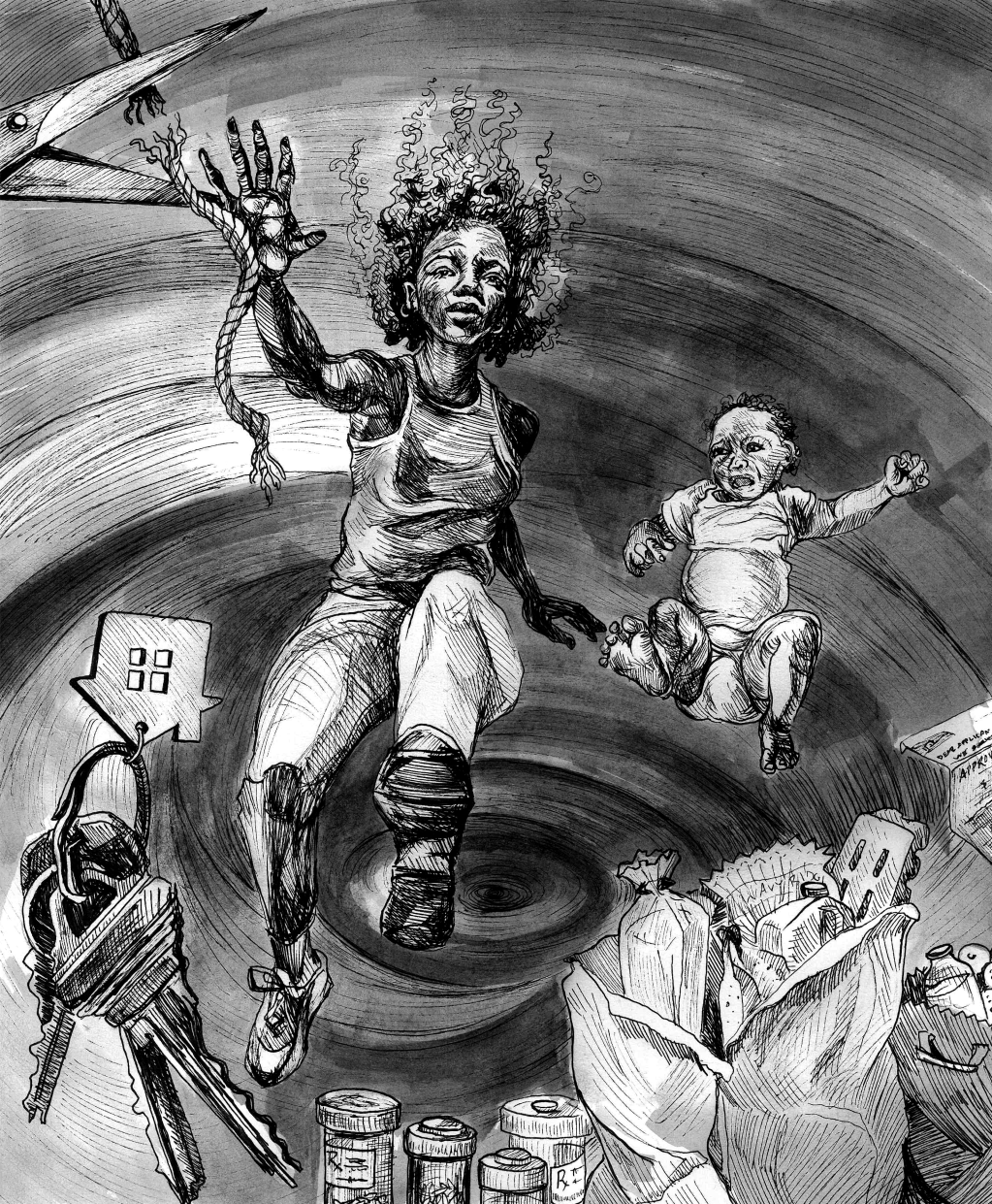
Written collaboratively by OCR members
October, 2026
Introduction
Today, a young mother might go to a hospital because of her chronic health condition and learn that she doesn’t have Medicaid coverage anymore. In the weeks after her visit, she would receive a bill in the mail. After a few more years of appointments and hospital visits, her medical debt balloons beyond her control. At every appointment, a man in a suit from a collections agency sits her down and tries to intimidate her into coughing up whatever money she has to her name. When she dies, the home she inherited from her grandparents doesn’t pass on to her kids. Instead, a court rules in favor of a collections agency so that they can take over the deed to her home as partial payment for her medical debt.
Today, a veteran who just finished his time in the military might learn that the tinnitus he developed does not qualify him for disability compensation through the Department of Veterans Affairs (VA). He might have first noticed the tinnitus after his drill instructor hazed him and his friend by pulling out their earplugs on the firing range. He finds out that he took too long to submit a claim and schedule an examination after his discharge, so there’s no way to appeal the denial. The tinnitus could worsen in his first year out of the military, leading him to develop vertigo, migraines, and severe depression.
Today, an immigrant from Senegal in his mid-fifties might learn that he lost his food stamps through the Supplemental Nutrition Assistance Program (SNAP). He usually receives, say, $200 per month. Just a month ago, he might’ve discovered his EBT card got skimmed through an elaborate fraud scheme. It had a $0 balance when he went to check out at a grocery store. Now, he’s kicked off his benefits entirely because of new work requirements. He has burns and scars all over his arms from ten years of working as a line cook, a job he lost at the beginning of the pandemic. After his unemployment benefits ran out, he struggled to get hired again. After his daughter moved out of their Section 8 apartment, his rent was overcharged for more than a year, and he now owes tens of thousands in arrears. Every night, his front door rattles from the wind that blows in through a broken window. He listens to the mice run through his walls as they scour his apartment for food.
On January 20, 2025, Donald Trump began his second term as President of the United States after the rotting corpse of Joe Biden handed him back the keys to the kingdom. Six months later, with control of both branches of Congress, Trump signed the One Big Beautiful Bill Act, permanently enshrining the tax cuts for the wealthy from his first administration, increasing funding for the US military and immigration enforcement, and slashing benefits for SNAP, Medicaid, and Medicare. For the Republican Party, Trump’s Big Beautiful Bill was the latest milestone in a decades-long public opinion campaign to demonize the masses who live poor, hungry, disabled, homeless, battling addiction, and fighting to survive. Their vilification is necessary for the bourgeoisie to morally justify minimizing any taxes and public spending allocated to support the poorest of the masses. Rabid condemnation of the people who exist on the lowest rungs of society has long been a lynchpin of the political platform of the Republican Party, buoying their legitimacy among a sizable section of the US population that rides their coattails and cheers on every attack against welfare, fueling waves of assaults against the meager and precarious benefits the masses are still able to receive from the government.
The Big Beautiful Bill, the signature piece of legislation from Trump’s second term, was another victory for the factions of the bourgeoisie that don’t want to foot any bills for social welfare programs, like the heirs to old-money family fortunes, or the ascendant tech billionaires fighting for the elimination of all government regulation and public welfare services.1 Welfare spending has long been one of the sharpest divides between the more reactionary and the more liberal sides of the bourgeoisie. Their tug-of-war battle over programs like SNAP and Medicaid—and the broader struggle over what role each level of government should play in providing basic needs to the lower classes of US society—helps them shepherd tens of millions of people in the US to participate in the electoral cycle with each go-round.
The impassioned speeches of Republicans and Democrats and rebukes of their colleagues across the aisle fill pages of the New York Times and Fox News segments every morning and every evening. Their losses help to amp up their voter bases and rev their engines for the next voting drive. Their legislative victories, like Trump’s Big Beautiful Bill or Obama’s Affordable Care Act, come in the form of sweeping policy adjustments that are rare in a perpetually and conveniently deadlocked Congress. Comprehensive federal legislation, when it does get through, serves a dual purpose: bolstering an I-get-things-done image for the sitting president and his party, and, more importantly, fortifying the conditions upon which all sections of the US bourgeoisie can continue and expand their bloody and destructive empires of capital accumulation within US territory and around the globe.
Trump’s Bill needs little explaining for how it serves the latter purpose. Its primary measure is to expand a tax cut estimated to total $4.5 trillion over ten years, the vast majority of which will benefit the upper classes of US society.2 As grandma always said, a trillion saved is a trillion earned.
Where Trump’s Bill was more sharply contested was in the aspects that have been at center stage for Republican-Democrat political theater and that carry life-and-death stakes for the masses: SNAP eligibility, healthcare coverage, and funding for Immigration and Customs Enforcement (ICE). New work requirements and other changes to eligibility for SNAP and Medicaid now written into law stand to throw millions of people off the rolls for each program and add to the administrative burden families face in retaining access to them. The Congressional Budget Office (CBO) estimates that cuts to SNAP and related programs will total $187 billion over ten years, and for Medicaid, new work requirements that will disqualify participants will total a $326 billion cut to the program over the same period. New funding for the US military and Department of Homeland Security will total $278 billion above what was already allocated.3
Beyond the devastating provisions of Trump’s Bill, he has refined his blitzkrieg approach to wielding executive power that he and his team devised in his first term, with aggressive and at times more sophisticated use of his tactics of choice: executive orders (nearly 300 signed since taking office) and gutting federal agencies. Executive orders churned out at a dizzying rate continue to generate clickbait headlines and feed our depression-inducing news cycle. These especially take aim at the social conflicts at the heart of US society’s “culture wars,” with executive orders posted with titles as incendiary as “Keeping Men Out of Women’s Sports” and “Defending Women from Gender Ideology Extremism and Restoring Biological Truth to the Federal Government.”4
While executive orders command attention and outrage, Trump isn’t able to gut social service programs through these alone. As an alternative tactic, and in addition to legislative measures, the Trump administration has waged successful attacks against public services by upending federal agencies. During the short-lived Department of Government Efficiency (DOGE) frenzy, the Trump administration succeeded in cutting 20,000 staff members from the United States Department of Agriculture (USDA), 7,000 from the Social Security Administration, and 2,300 from the Department of Housing and Urban Development (HUD).5 The staffing cuts caused massive upheaval to millions of people relying on government services to meet their basic needs, and the effects are still being felt among those waiting for housing and food vouchers, Social Security checks, and healthcare coverage to be processed.
The unfolding fallout of Trump’s second term will likely piss off enough Democratic voters to deliver significant electoral defeats for the Republican Party in the upcoming midterm elections. This will especially result from the masses’ vitriol against ICE agents for nearly two years as they have made a spectacle of terrorizing immigrants and attacking protesters across the country. But even if a midterm defeat comes to pass for the Republican Party, it will have been worth it, since the combination of new legislation, executive orders, and budgetary maneuvering will have delivered a massive tax cut to their wealthy puppet masters and a wave of new work requirements and other changes to eligibility that stand to throw millions of people off various social services. In tandem with record levels of detentions and deportations of immigrants, it’s the most significant, far-reaching, and uncontested combination of attacks on the proletariat in a generation. It’s a moral victory for America’s most depraved souls to relish in celebrating.
As communists, we have no interest in keeping up with the electoral circus in the way that so many people root for Democrats or Republicans like they’re rooting for their favorite football team. We also don’t read up on the machinations of these political parties and their appendages of think tanks, nonprofits, and lobbyists for the sake of becoming “policy experts.” The immiseration of the masses and the destruction of the planet’s ecology to serve the dictates of capital have always been, and will always be, the policy of the US government for as long as it exists. To insist otherwise is to run cover for America’s ruling class. There is no redemption arc to come for them.
We care about whatever moves the Trump administration is making because of how they affect the lives of the masses and present openings for us as communists to meet people where they’re at when they’re shaken to their core and inspire them to dedicate their lives to the revolutionary overthrow of the bourgeoisie and the destruction of capitalism around the world. With that as our starting point and ultimate goal, we want to assess the material impacts of Trump’s attacks on welfare services during his second term—including SNAP, Medicaid, housing assistance, homeless services, and programs administered through Veterans Affairs—to sharpen our understanding of what is happening in real time, read the tea leaves to consider what’s to come, and determine what we need to do about it.
What follows is bleak. It’s heavy on exposure and research into how the lives of the masses are being upended. This can be paralyzing, or we can take it as fuel. Deeper immiseration can throw more chaos into peoples’ lives and make it harder to organize a forceful response. It can also leave people with deeper indignation, less to lose, and a more expansive view of how different society should be when we see nakedly how society truly is today. With the contradictions unfurling before us, how we respond is always a choice. And that choice is always our own to make.
Let’s first run through how we got here.
A brief history of welfare services in the US
The Great Depression and the Hoover administration
The Wall Street stock market crash in 1929 was the beginning of a decade of economic depression that left millions of Americans destitute. The New York Stock Exchange lost 50% of its value, a loss which quickly developed into a banking crisis that spread into virtually all other sectors of the economy. Banks closed, and people lost their life savings overnight. As stocks became worthless, hundreds of thousands of businesses failed, and unemployment rose dramatically. Between 13 to 15 million workers lost their jobs. By 1932, one in four workers were unemployed, the worst unemployment crisis in US history.6
In rural small towns and large cities alike, men, women, and children gathered in bread lines and at soup kitchens, or resorted to digging through the garbage for vegetable scraps. Families squeezed into shared living spaces, with as many 10 to 15 people living in three-room apartments. Families who were evicted and made homeless were forced to build makeshift houses in public parks or vacant lots, constructing makeshift camps that were nicknamed Hoovervilles. President Herbert Hoover, who oversaw the start of the Great Depression, was widely blamed for the economic downturn, not solely because of timing, but also because of his refusal to admit the severity of the crisis and his opposition to administering federal aid.
Private local agencies were incapable of meeting the increasing needs of the hungry and homeless, and the majority of the country’s private agencies disappeared due to lack of funding. The widespread destitution and lack of aid sharpened the longstanding question of whether private or public agencies should be responsible for providing relief to the poor. Hoover was vehemently against direct federal aid, arguing that government handouts would ultimately stifle the restoration of prosperity in the country because it would destroy self-reliance and make people lazy. This blaming the poor as they starve—while invoking individualism as an American virtue—would continue for generations to come.
FDR and the New Deal
As governor of New York, Franklin D. Roosevelt sought state aid for the unemployed, arguing that unemployment should be treated the same as old age and widowhood, i.e. something that people had no control over especially during the Depression. This led to the State Unemployment Relief Act (Wicks Act) to be directed by a new agency, the Temporary Emergency Relief Administration. Although other states began to follow New York’s lead of providing unemployment relief and creating new state agencies to administrate aid, there was increasing contempt among the unemployed for these temporary measures. Though the Depression cast the broad population into terrible hardship, for those already at the very bottom of society, it simply represented a concentration of the crises they already knew intimately. Routinely cast aside when capitalism no longer had use for them, proletarians during the Depression were not only the first to be fired and the last to be rehired, but also benefited the least from aid. Growing desperation and contempt for the government gave way to revolutionary sentiments.
Though written out of American textbooks about the Great Depression, the Communist Party (CP) played a decisive role in mobilizing the unemployed to demand aid from the government. On March 6, 1930, over a million people nationwide participated in “International Unemployment Day” protests, with 100,000 people protesting in New York and Detroit and tens of thousands of protesters in other major cities. In New York, protesters fought back against police to deliver their demands to City Hall. In the South, Black and white proletarians came together to demand government relief despite white supremacist rule and segregation. Following the International Unemployment Day protests, Communist-led unemployment councils in cities across the country continued to hold demonstrations and defiantly helped move evicted people back into their homes. “Hunger marches” on Washington D.C. demanded unemployment insurance, with this and other rebellious action by the unemployed leading to the public welfare policies later implemented by FDR during his presidency.7
At the beginning of FDR’s presidential administration, many new government agencies were created to administer programs that provided people with jobs. The most significant measure was the creation of the Federal Emergency Relief Administration (FERA). FERA was created to allocate hundreds of millions of dollars in grants from the federal government to the states for work programs and direct relief (like cash payments for food and shelter). While FERA held authority over the creation and allocation of grants, the administration of funds remained the responsibility of the states themselves. This meant that people in desperate need of assistance were at the mercy of local officials tasked with designating jobs and funds, who, for example, discriminated against Black people in the rural South and elsewhere. These federal programs were designed to exclude some from employment, and “at least partial unemployment was considered desirable to keep down the salaries for those who were fortunate enough to be at work, and in fact, at their maximum effectiveness, all the New Deal work relief programs provided employment for only about one-third of the jobless.”8
Just as with New York’s Wicks Act that it was modeled after, FERA was always intended to be a temporary, emergency measure. The Social Security Act, passed in 1935, created programs that provided temporary compensation to the unemployed, pensions for the elderly, public assistance to the children of single parents, disabled children, and to the blind, along with federal funding to states for local public health work. The law didn’t cover millions of people, including those permanently disabled, as well as farm, seasonal, migrant, and domestic workers who were mostly Black men and women, in addition to their families who depended on them. By design, anyone in need who was excluded by eligibility categories had to rely on more limited state resources for their assistance. Pensions were based on taxes on wages and the employer’s payroll, leading to distribution of benefits depending on how much someone had earned and how consistently they remained formally employed.
This early stage of welfare benefits prefaced the work requirements that would be tied to later iterations of welfare. It also solidified key characteristics of the surplus population in the US, or the section of the population that is cast out of formal employment, either temporarily or permanently, both because they cannot be profitably exploited as laborers, and because their existence in a state of unemployment, precarity, and destitution disciplines those who have employment to accept less pay, longer hours, and harsher conditions. With payment of Social Security and pension benefits tied to how much taxes someone paid over their lifetime and their length of work tenure, stable and year-round employment became more desirable and necessary, and it could be reliably granted to white people and excluded from Black people and other oppressed nationalities. Designing social welfare programs to significantly exclude Black people and lock them in this surplus population would be refined over time to meet the needs of the bourgeoisie’s white supremacist social order.9
For those without employment, and because the existence of millions of unemployed people was proving too volatile to go unaddressed, a federal-state system of unemployment insurance was constructed, with the administrative burden falling to the states. State governments had control over the amount of cash benefits they paid, leading to disparities in the assistance received by minorities. The passage of Social Security meant that public welfare departments were established in nearly every county in America, and within these departments the specifics on benefits and eligibility were left to administrative discretion and discrimination.10
The 1940s and 50s
In the decade following World War II, as the US became the world’s top imperialist power, there was rising employment and income for many, thanks to spoils from the plunder of the rest of the world. From the outside, the US was the face of prosperity, and its poor were invisible. Mass media from this era indicates widespread propaganda projecting mass prosperity. In his 1958 bestseller The Affluent Society, influential economist John Kenneth Galbraith reduced poverty to a “uniquely minority problem” limited to a few areas, and went as far as saying that poverty in America was “no longer a massive affliction.” Meanwhile, the amount of people on welfare was actually increasing. From the mid-1930s through the early 50s, the elderly were receiving the majority of federal and state welfare funds. This shifted to recipients of Aid to Families with Dependent Children (AFDC) by the middle of the decade.
In the late 1950s, when the majority of those receiving these funds shifted to Black single mothers, states began to respond with specific administrative policies to reduce their numbers and deter new applicants.11 This included strict residency requirements that prevented Black people who were migrating north from the South from receiving assistance, as well as invasive and discriminatory “investigations” to determine eligibility. “Man in the house” policies made a home automatically ineligible for financial assistance if a man was discovered in a welfare recipient’s home, regardless of his financial status or relationship to the family. This led to welfare departments conducting random late night searches and invading homes to try to throw women off welfare. These policies were possible since states had authority over determining eligibility rules beyond what was in the Social Security Act.
Social Security benefits increased during this period, with the 1950 amendment to Social Security seeing the inclusion of the permanently disabled, disability insurance, and expansions of child welfare services, along with new programs like the G.I. Bill of Rights. Nevertheless, attacks on welfare and those receiving it continued alongside the suffering of the invisible poor, such as those with unsteady employment or no employment at all.
Johnson and the “Great Society”
In 1964, President Lyndon B. Johnson declared a “War on Poverty” and subsequently passed the Economic Opportunity Act. With the Johnson administration parroting an already well-established maxim that economic growth alone could end poverty, the Economic Opportunity Act emphasized training services over direct assistance, placing responsibility on individuals instead of acknowledging any societal problems (a trend that would continue). The Act was also barely funded, with Congress putting in “less money each year to combat poverty across the country than was necessary to finance an adequate healthcare program in any one of the nation’s leading cities.”12 City mayors, who exercised some authority over services, would use scant funds to provide high-paying jobs for their political supporters in order to strengthen their hold on office. The poor performance of the Economic Opportunity Act had the opposite effect intended, ultimately contributing to widespread rioting against white supremacy and police brutality in cities during this period.
When the Food Stamp Act was passed in 1964, many were unable to participate in the program because of eligibility requirements set by the state, or because it wasn’t available where they lived, as the program being optional meant many localities could choose not to participate. Most significantly, Social Security was again amended to include Medicare and Medicaid in 1965. Medicare was financed by Social Security taxes and covered some, but not all, medical bills for only the elderly. Medicaid was established for people already receiving federal public assistance to help them receive medical services through grants for the states from the federal government. These differences in funding between Medicare and Medicaid meant that Medicaid was stigmatized because of its association with public assistance. Rather than making it easier for patients to access the healthcare system, many were met with refusals from hospitals and doctors.
Under Nixon, growing antagonism against welfare
Welfare programs continued to expand after the New Deal, but in the late 1960s into the 70s, public sentiment about welfare began to change. Ideas about the poor being lazy and responsible for their condition, compounded by good old-fashioned American racism, resulted in the spread of reactionary ideas about welfare recipients and decreasing support for welfare programs. Americans increasingly favored job training programs that better served American values by encouraging people to work rather than receive welfare. This, of course, didn’t take into consideration that unemployment wasn’t a choice, or that many working people were still in poverty because of insufficient wages.
The division between the “deserving” and “undeserving” poor was deepening. Whereas during the Great Depression an individual on welfare was looked upon with empathy, and it was generally thought that they had a right to receive federal aid, now Black people on welfare, particularly single mothers, were being projected as freeloaders. Richard Nixon, who became president in 1968, appealed to conservatives by speaking of the need to control the “turbulent” youth and masses of the cities, along with propagating his suspicions of welfare fraud. In an initial move to alter the welfare system, Nixon proposed the Family Assistance Plan (FAP) to replace existing welfare programs. Under FAP, the government would provide the difference between a family’s wages and the income needed to live above the poverty line, a benefit that was to be discontinued once their income reached a certain level. In order to be eligible, recipients had to work or join a job training program. FAP was never passed into law, but other significant changes were made under the Nixon administration.
By 1971, all AFDC recipients had to work or register for training programs, except mothers with children under six years old. When Congress passed the Comprehensive Child Care Act to fund daycare and other programs for the children of mothers that were now obligated to work under these new requirements, Nixon vetoed it, claiming it would cause parents to renounce their responsibilities. In 1972, the federal government assumed all responsibility for the Social Security programs for the aged, blind, and disabled, taking control from the states and finally establishing consistent eligibility standards without work requirements. This standardized, federal program was now called the Supplemental Security Income Program (SSI) and was significant for the groups of people it affected. On the other hand, AFDC recipients—women and children—and the unemployed, who received assistance at the state level, were continuously attacked by administrators hellbent on dehumanizing them and discouraging them from applying for assistance through humiliation and stigmatization.
The Nixon administration proposed cuts to Social Security and SSI, most of which were unsuccessful (though not for lack of trying). They did succeed, however, in removing half a million people from SSI. This included many people with mental health disabilities who the administration claimed were capable of working.
Reagan, the “Welfare Queen,” and major cutbacks
She has 80 names, 30 addresses, 12 Social Security cards and is collecting veterans’ benefits of four non-existing deceased husbands. And she’s collecting Social Security on her cards. She’s got Medicaid, getting food stamps, and is collecting welfare under each of her names. Her tax-free cash income alone is over $150,000.
– Ronald Reagan in a 1976 campaign speech in North Carolina
Ronald Reagan was already voicing his disdain for welfare during his time as governor of California. During his 1976 presidential campaign, Reagan shared a story of an unnamed woman who had supposedly managed to defraud various government programs of thousands of dollars using an exorbitant amount of aliases. This was based on newspaper reports at the time from Chicago about a woman named Linda Taylor, who was slated to go on trial for fraud charges. But Reagan’s anecdote was wildly exaggerated. According to the Assistant State’s Attorney General who was prosecuting Taylor, she was charged with using only four aliases (not eighty), and the amount she received from her alleged fraud was $3,000, not $150,000.13
As presidential candidate, Reagan’s intentions were clear in sensationalizing and generalizing this one story to incense crowds of Americans against welfare recipients. Due to racist stereotypes, their own economic frustrations, and incendiary rhetoric from politicians, Reagan’s base of support already viewed welfare recipients as lazy people who were living off the taxes of the hardworking. Another poisonous weed gaining traction was the bizarre and deeply misogynistic idea that single Black mothers were having more children solely to stay on welfare and avoid work.
Reagan was crafting a narrative that every poor person was a potential fraudster and that welfare fraud was a nationwide epidemic that needed to be aggressively targeted. The reality was much different. According to Trattner, during this period, “there were approximately eleven million recipients of welfare in America, seven million of whom were children. Of the four million adults who received assistance, most were mothers of those children,” while others were working low-paying jobs or recently unemployed and searching for work. He adds that studies showed “the overwhelming majority of them remained on welfare for short periods of time, usually to cope with temporary unemployment, illness, or other crisis, and that they preferred work to public assistance.”14
Regardless of the misleading nature of Reagan’s rhetoric, the racist trope of the “welfare queen” has since been cemented into the American consciousness, with many presidents and politicians thereafter invoking her whenever they need to justify stripping people of the basic necessities of life. Even in the present day, intentional welfare fraud by recipients is relatively rare, with losses for the government largely due to improper payments caused by miscalculations or other administrative errors. In other words, it’s the fault of bureaucratic chaos. Moves by government administrations and agencies to “combat fraud” time and again are simply attacks on the poor, creating barrier after barrier for people trying to get the help they need and deserve.
After winning the 1980 election, it was no surprise that Reagan and his cabinet of conservative businessmen greatly reduced government spending on social programs, especially welfare, all while significantly increasing military expenditures. Some New Deal programs as well as programs from the Kennedy, Johnson, and Nixon administrations were dismantled. Many other programs, like AFDC, food stamps, and subsidized housing, were significantly cut. Meanwhile, unemployment was rising during the worst recession since the Great Depression. The situation was not only becoming worse for those that had already been suffering, but millions more were now living below the poverty line for the first time in their lives. Between 1980 and 1983, the poverty rate rose from 11.7% to 15.3%, the highest rate since the 1960s.15 Still, Reagan’s popularity stabilized and grew as he won reelection in 1984. As Trattner summarizes,
Reagan’s attractive personality, his “tough” foreign policy, his refusal to raise taxes, his glowing optimism, and, perhaps above all, his continued celebration of time-honored American values, especially the work ethic, rugged individualism, and hostility to public “handouts,” continued to strike responsive chords with the American people. To Reagan and to those who supported him, poverty was un-American; the poor therefore were responsible for their condition, and welfare was wasteful and counterproductive.16
The Clintonian overhaul of welfare
Bill Clinton campaigned for president in 1992 on the promise to “end welfare as we know it.” Public sentiment on poverty and welfare had long since shifted in reactionary directions, with many viewing poverty as an individual failure, rather than caused by systematic issues outside any individual’s control. Unsurprisingly, AFDC came in for heavy criticism, no doubt in part due to the Reagan administration’s smearing of it.
In another attack against women and children on welfare, Clinton granted waivers to states allowing them to end AFDC payments to any woman who gave birth to more children while on the program. Then in 1996, he signed into law the bill that would not only end AFDC but undo six decades of social policy: the Personal Responsibility and Work Opportunity Reconciliation Act. This bill replaced AFDC with a new system that granted states even greater control over the majority of eligibility rules, made work a condition of assistance, and limited lifetime welfare.
With AFDC’s replacement, Temporary Assistance for Needy Families (TANF), states were now required to impose a two year limit on welfare, ending services for recipients regardless of whether their economic situation had improved. A lifetime limit for assistance was set to five years. The new law also placed time limits on food stamps for adults without children who didn’t meet work requirements. Most immigrants were now ineligible to receive assistance such as food stamps and SSI.17 Changes in SSI eligibility for disabled children risked the removal of hundreds of thousands of children from SSI.18
Increased authority provided to the states meant that they could deny assistance to people who were eligible, they could kick people off before they reached the time limit, and they weren’t required to give benefits in the form of cash payments. While all these changes were effective in getting many people off welfare, as was the intention, the strict work requirements and time limits did not lead to people having steady employment or families rising out of poverty, instead pushing many further into hardship.
From Nixon to Clinton, changes to welfare programs principally took the form of vicious attacks on proletarians, laden with white supremacy and designed to make their lives more hellish. Another core characteristic of “welfare reform” was patriarchal attacks on women and children, who consistently made up a disproportionate percentage of the welfare rolls, with unwed mothers punished for having children. Any misfortune and lack of prosperity that single-mother households faced was brushed aside as their own fault. Delusions that there was a real attempt or progress being made to eradicate poverty only existed in the fantasies of American triumphalism. Politician-touted successes of “welfare to workfare” jobs and training programs served political jockeying and had no basis in reality, with unemployment remaining a permanent and persisting feature of US society. Any proclaimed successes of reducing the number of people on welfare rolls as some kind of reduction of poverty or state dependency only meant more people were going hungry, homeless, and lacking healthcare.
Heading into the 2000s, these trends would only continue across successive Bush, Obama, Trump, and Biden administrations. Before the turn of the century, with the full scope of the history of US welfare in mind, Walter I. Trattner wrote with pessimism and prescience, “While times change, and periods of conservatism usually are followed by periods of liberalism, there are few reasons for optimism at this time.”19
The onslaught of reactionary attacks on housing and homeless services
Homelessness has always existed in the US. The process of industrialization in the 1800s accelerated the transition from agricultural work to wage labor and pushed people en masse to cities and towns that were hubs of manufacturing. As we’ve detailed, poverty was viewed by the upper classes as a moral failure, and welfare was opposed with the justification that it rewarded bad behavior. While there were places for the homeless to find refuge—such as poorhouses, almshouses, and workhouses—these places were designed to be temporary and purposely had harsh conditions to avoid dependence and keep costs low. There were also vagrancy laws targeting the poor and homeless. During years of economic contraction, people cyclically lost their jobs and homes. The Great Depression alone caused anywhere between one to three million people to become homeless by 1933. In this period, with the issue of homelessness posing an increasingly existential threat to the stability of US capitalism, the federal government had to respond, and it did so with programs such as the creation of public housing in the late 1930s and into the 40s.20
Despite the New Deal and most of the country going back to work during WWII, homelessness and poverty didn’t simply disappear. Instead, it became concentrated in the “skid row” areas of cities, where affordable housing such as single room occupancies (SROs), shelters, flophouses, and roominghouses, as well as social services, were more readily available. Many skid row areas were grouped around around city centers. “Urban renewal” in the 1950s through the 60s demolished the majority of skid row neighborhoods as they became equated with urban blight. In New York City, the city government banned the construction of new SROs in 1955, at a time when there were about 200,000 such units, or over 10% of the city’s rental units at that time. Since then, 175,000 SRO units have been eliminated.21 While people deserved better living conditions than those offered in skid row centers, demolishing these units was far from any kind of a solution to homelessness.
In the 1980s, homelessness started surging, becoming more visible and receiving more public attention. There were many causes at play, including the mass release of patients from state mental hospitals as they closed, many of whom often had nowhere to go; the economic “stagflation” crises in the 70s when the price of goods started outpacing peoples’ wages; the elimination of many low-income housing options in skid row neighborhoods; the cutting of federal funds meant for building more affordable housing and maintaining current units; and the crack/cocaine and HIV/AIDS epidemics. The Reagan administration cut many social services, including slashing HUD’s budget for subsidized housing from $26 billion to $8 billion.22 This was also the decade in which federal homeless assistance began, most notably with the McKinney Act of 1987, which created funding for many programs such as emergency shelters, transitional housing, and job training.
Since the 1990s, the focus on addressing homelessness has shifted from the “staircase” approach to the “housing first” approach. The former method required individuals to meet goals such as sobriety or employment before progressing to independent housing, whereas the latter provides permanent housing without preconditions. Housing-first policies have been the norm since the Bush administration, focusing on providing rapid housing that’s not conditional on abstinence from substance use. This has proven to be a more humane, if still fundamentally lacking, approach to homelessness rather than attaching prerequisites to housing services. In addition, a whole a nonprofit industry serving homeless people has sprung up, at best providing limited housing to people desperately in need, and at worst deploying petty tyrants to harass and brutalize homeless and formerly homeless people. Rampant homeless is now an accepted fact of the social landscape in the US.
How the Trump administration tested and refined its attacks on homeless people, from first to second term
During Trump’s first term, his administration’s approach to homeless services boiled down to wreaking some havoc through rhetoric and empty threats, but ultimately not taking much action to change policy and how programs were funded and administered. This rhetoric was focused on reducing public spending on services for the homeless, along with tough-on-crime approaches to dealing with encampments and treating the homeless as a criminal element more generally.
In September 2019, Trump’s Council of Economic Advisers stressed greater use of law enforcement to remove homeless people from the streets. The report blamed recent increases in homeless people living outside on “more tolerable conditions for sleeping on the streets.” Despite efforts to spread this narrative, the Trump administration made no policy changes within HUD. For example, regarding Continuum of Care (CoC) funds—which are federal grants HUD sends to nonprofits or public agencies to house people or offer supportive services—the administration left in place the prioritization of applicants who detailed ways that they “prevent the criminalization of homelessness in the CoC’s geographical area.”23
In an attack against Democratic counterparts, in September 2019 Trump threatened to send a notice of environmental violation to the city of San Francisco for the pollution allegedly caused by homeless people. The administration also denied California 50,000 additional housing vouchers for rental subsidies and refused to increase the value of those vouchers to account for higher rent. HUD secretary and failed presidential candidate Ben Carson released a statement rejecting the request due to political disagreements over California’s policies on law enforcement, and he blamed the housing shortage on an “overregulated” housing market, as well as California’s immigrant population for driving up housing costs and increasing housing demands.24
In December 2019, the Supreme Court, with a 5-4 conservative majority, declined to hear an appeal to the April 2019 ruling of Martin v. Boise, effectively ruling against the criminalization of the homeless by stating it was not permissible to punish homeless people for sleeping outside on public property. While the Supreme Court ruling certainly didn’t eliminate or even reduce the targeting and brutalization of homeless people by police and sanitation departments, it does reflect a hesitancy to formally criminalize homeless people at the time. Despite Trump’s rhetoric against homeless people, housing-first policies continued to be the dominant model of addressing homelessness, and the criminalization of homelessness didn’t change substantially.
However, the criminalization of homelessness steadily gained ground between Trump’s first and second terms. In June 2024, during the Biden administration, the Supreme Court ruled 6-3 in City of Grants Pass v. Johnson that enforcing local anti-camping and public sleeping laws against homeless people doesn’t violate the Eighth Amendment prohibition on cruel and unusual punishment, regardless of the availability of shelter beds. This ruling has emboldened state and local governments, with 350 cities passing bills to criminalize the homeless in its wake. Many of these ordinances open up the homeless to thousands of dollars in fines, or even jail time for sleeping outside.25
In Trump’s second term, he and his administration have shown to be more serious about fulfilling promises to end the housing-first approach and to viciously expand the criminalization of the homeless population. In July 2025, Trump signed an executive order, “Ending Crime and Disorder on America’s Streets,” which stated that homelessness is a public safety issue for everyone else, that the overwhelming majority of homeless people are addicted to drugs or have a mental health condition, and that these are the root causes of homelessness—pushing the same lie blaming individuals instead of government policies. This lie allows the government to recuse itself from responsibility to those who cannot work to afford even the cheapest rents, which includes the elderly, disabled, and single mothers. The executive order advocates “civil commitment,” the involuntary, court-ordered psychiatric treatment of homeless people, and it encourages states to crack down on open drug use, encampments, and squatting. It also distills the US government’s longer-term approach to homelessness: it should be made invisible, not eradicated.
Two weeks after the “Ending Crime and Disorder” executive order, Trump placed Washington D.C. police under federal control, activating the National Guard and using federal agents to sweep homeless encampments. This was openly justified as removing the blight of human beings experiencing homeless near the capitol. Despite the dramatic effort and fanfare, encampment numbers in D.C. didn’t change, and there are still around the same number of people sleeping outside. The only differences were that there was more fear among homeless people, and that they were pushed farther away from the city center.26
In the Continuum of Care application for funds for fiscal year 2026, a new section appeared titled “Protecting Public Safety and Cooperation with Law Enforcement.” This instructed organizations and agencies applying to receive federal funds to demonstrate that they were coordinating with law enforcement in “clearing tents and encampments, decreasing the public use of illicit drugs, and utilizing standards to address danger to self or others (e.g. involuntary commitment).”27 This represented a dramatic escalation from the first Trump administration, where they previously credited CoC applicants who took steps to prevent the criminalization of homelessness (maybe just because they didn’t notice it was there).
HUD, under secretary Scott Turner, is attempting to restructure its budgeted $4 billion in federal funding for homeless people. HUD released a notice of funding opportunity that outlined significant changes to the CoC progam so that the majority of funding immediately goes to transitional housing and services, with work or service requirements, instead of permanent housing. In September 2025, Politico reported that more than half of the 2026 CoC funding designated for permanent supportive housing (PSH) would be cut or moved to transitional housing assistance, information originating from anonymous HUD employees and internal documents that reporters obtained. If this were to happen, these employees projected that over 170,000 people who rely on PSH would be at risk of becoming homeless. The new proposal also stated it would deduct points for service providers that have previously used “racial preferences” or “recognized transgender people.”28
In April 2026, this policy change was blocked by a federal judge who argued the changes were being introduced too suddenly. By this point, HUD had not released funding for recipients of 2025 CoC money, causing significant upheaval among those living in supportive housing. HUD then released another notice in June 2026 stating that a significant proportion of federal funds could only be used for new transitional housing, a policy change that was projected to disrupt rental assistance to 97,000 people who rely on PSH. In August, the same federal judge again struck this down for being introduced too suddenly, but notably not in opposition to the policy change itself. Despite these changes not taking effect this year, there’s increasing likelihood they can come to pass in 2027 or the near future.
While there are no major reports of closures, a report shows the effect this has had on administrators of homeless services: frantic calls to get local officials to help close funding gaps, layoffs of staff, and discontinued CoC participation. The biggest concerns from administrators were HUD’s rapid approach to shifting a significant amount of resources, vague guidelines on work requirements for their clients, and having their questions be ignored by HUD officials. The callousness is the point, with the Trump administration having long preferred a mask-off attack on proletarians at the bottom of society.
Even if the disruptions to housing service providers don’t take the full effect that the Trump administration proposes, the chaos they sow helps to achieve much of their aims. With the release of a single document, the Trump administration can throw housing nonprofits in complete disarray. They can put Democratic adversaries at lower levels of government in weak defensive positions. And, most consequentially, they can leave tens of thousands of people on the brink of homelessness and in fear of losing what little stability they’ve eked out in a PSH unit, laying the policy groundwork for throwing them out of their homes in the future.
Tech capital’s role in shaping policy and the mistreatment of homeless people
Over the last thirty years, we’ve seen the drastic changes that tech companies have had on many cities, especially gentrification. Cities like Seattle and San Francisco have seen soaring rents, followed by a soaring homeless population, followed by soaring criminalization and mistreatment of homeless people to get them out of city centers. After directly causing massive waves of displacement, tech capital has wielded broad influence over local homeless policies, both directly and indirectly.
An emblematic force is the Cicero Institute, founded by billionaire tech investor Joe Lonsdale in 2016. Lonsdale is know for being a Trump ally, the cofounder of Palantir, and a member of the original “PayPal Mafia”.29 The Cicero Institute has a $10 million annual budget that is funded by undisclosed donors, with a board mostly made up of Lonsdale’s family, entrepreneurs, and political staffers, with a goal of injecting “entrepreneurial thinking” into government.30
Since its founding, the Cicero Institute has been pushing to move state governments away from housing-first policies by pumping out claims such as homelessness persisting not because of poverty or a shortage of affordable housing, but because service providers enable poor behavior, and that there is a “homeless industrial complex” that is enriching itself.31 They have urged lawmakers to ban encampments, expand involuntary psychiatric commitment, add strict behavior requirements to housing programs, and dismantle key federal institutions designing homelessness policy.
Going beyond rhetoric, the Cicero Institute has used its advocacy department, Cicero Action, to directly lobby and push its model legislation in states like Florida, New Mexico, and Missouri and indirectly influence dozens of other states that reference its model legislation. In many states, camping on public properly has now been banned, with extreme cases such as Tennessee where someone could be charged with a felony and face up to six years in prison.32 As of 2023, towns and cities in Missouri are threatened with defunding by the state government if they don’t enforce this encampment ban, and the state has limited its use of government funds to build permanent supportive housing.33 Cicero even has their influence in Utah’s dystopian plan to move 1,300 homeless people to the outskirts of Salt Lake City, into a large-scale involuntary addiction and mental health treatment center, what many critics are rightfully calling a detention center for the homeless. These plans were announced towards the end of 2025, and the center is slated to open in 2027.34 In addition to legislation, lobbying, and Lonsdale’s enormous personal contributions to right-wing politicians, Cicero Institute also wrote up an amicus brief in support of the reactionary aims of Grants Pass v. Johnson, the ruling that emboldened many towns and cities to criminalize those sleeping outside.35
The sum of these efforts from the past several years have likely had significant influence on the Trump administration and agencies at the federal level, from Trump’s executive order on homelessness to HUD’s recent moves away from housing-first policies. Another important player is the Discovery Institute, a right-wing think tank that writes hit pieces against rent control, tenant protections, and more in the name of “free enterprise.” The Trump administration has appointed Discovery Institute staff to HUD, granting them treasured positions to influence federal policy and ultimately wield state power.36
HUD: An agency gutted as buildings crumble
Over several decades of Republican and Democrat administrations, government officials in lockstep with real estate capital have decimated HUD’s ability to deliver safe and dignified housing. With every presidency, HUD’s budget continues to fall below what is needed to maintain the agency’s basic functioning, especially with public housing developments. As an agency with broad jurisdiction, HUD is responsible for allocating funding, along with overseeing and inspecting the authorities that manage public housing, Section 8, and other federally-subsidized housing, including project-based and tenant-based rental assistance.37
Public housing was created in part to provide safe, affordable, and reliable housing for lower-income families, and most public housing recipients were white at the time of its creation. Its current state concentrates Black, Latino, immigrant, and rural white proletarians within these developments. The conditions of public housing have greatly deteriorated, with each US president either moving developments towards privatization and demolition or concocting new half-baked and temporary programs to keep public housing afloat.
In 1973, President Nixon enacted a moratorium on the construction of any new public housing units. Congress followed this up with the Housing and Community Development Act in 1974 that authorized the Section 8 program, providing housing vouchers to move federally-subsidized housing to the private market. By the 80s, the public housing stock was declining, buildings were falling apart, and rents in private developments were increasing while wages and job opportunities stagnated. Drugs flooded the projects, violence and crime were common, and the buildings’ state of disrepair heightened the social war among the masses living in public housing.
In 1992, under President George H.W. Bush, a new program titled HOPE VI was enacted to “revitalize” public housing by turning it into mixed-income housing and allowing private companies to manage the properties. The HOPE VI program’s “revitalization grants” were used to renovate run-down project buildings, with the goal of residents either returning to their renovated building, moving to other public housing developments, or receiving Section 8 vouchers. The reality was that 63,885 households were displaced, with only 22% of those residents actually returning to newly-repaired buildings. This was due in part to new regulations under the HOPE VI program which allowed public housing authorities (PHAs) to penalize and evict residents who had previously not paid rent or had a criminal background. By 2009, the “revitalization grants” were responsible for the demolition of 93,295 units of public housing.38
A turning point in HUD policy came under President Obama in 2012 when he signed into law the Rental Assistance Demonstration program, or RAD, which replaced the HOPE VI program. For PHAs, this swung the door wide open to allow any private management willing to operate their buildings through the Section 8 housing voucher program. It also kept the window open to continue with demolition schemes. For the millions of people living in underfunded public housing at the time, and in the years since, RAD has been presented as a trustworthy solution to their problems. If the gridlocked government won’t invest in public housing, maybe the private sector will if given the right incentives. In reality, with expand-or-die and profit-or-shutter logic driving every move of real estate companies, RAD has marked the death knell for hundreds of developments throughout the country with demolition and displacement proving too lucrative for developers and property managers to pass up on.
After Hurricane Katrina devastated New Orleans in 2005, real estate developers and the Housing Authority of New Orleans (HANO) pounced on the opportunity to privatize and wipe out the city’s public housing stock. The city had already demolished the Desire Projects, the site of a police assault on a Black Panther Party office in 1970, along with other scattered sites in the years before the hurricane.39 Post-Katrina, and as HOPE VI gave way to the RAD era of privatization, conversions of the city’s four biggest developments (“the bricks”) led to HANO razing buildings that had stood since 1941, leading to the permanent displacement of hundreds of families. The B.W. Cooper demolition project resulted in only 115 families returning by 2015 of the 1,015 that had lived there prior to the hurricane. With new regulations imposed by private managers, residents reported no longer being allowed to have vegetable gardens or barbecues, a heartless form of social control and thinly-veiled white supremacy visible at RAD conversions across the country.40
For the bourgeoisie, the voucher system has proved advantageous in controlling the housing market for proletarians in several ways. In large, gentrifying metropolises like New York City and Chicago, real estate companies have had easy money open up through RAD to manage and even own housing developments sitting on prime real estate. Section 8 contracts have proven profitable for property managers in rural and urban localities, in large part due to how reliably the federal government has funded billions of dollars in rental subsidies in recent decades. Through a voucher system, the government mires people in long waitlists with messes of paperwork, enforcing conditions of scarcity. Administrative burdens have also been offloaded to the nonprofit sector, which have built up their own cottage industry of case managers, claims processors, policy analysts, and fundraising specialists, all beholden to the mandates of their government of private funders. Taken in full view, housing vouchers have made the federal government less responsible for the massive housing operation it constructed in the 20th century while lining up new opportunities for capital accumulation in the process. The bureaucrats of the bourgeois state that architected and completed this hand-off have been paid handsomely.
In more rural towns and small cities, aging public housing has received much less attention from real estate capital, leaving HUD with the decision to either take over PHAs or shutter the entire operation, forcing hundreds or thousands of people to leave their hometowns. Under the Obama and Biden administrations, Democrats went along with plans to privatize public housing across the country with negligible resistance. Year after year, housing developments under HUD’s oversight have been allowed to deteriorate, including in years in which Democrats controlled each branch of government.
Fast forwarding to Trump’s first year in office, HUD secretary Ben Carson proposed a 13% cut to public housing’s operating fund, the main source of funding for building maintenance, the first of many threats to dramatically reduce HUD budgets in the midst of dire budget shortfalls. In East St. Louis, where the city’s PHA has been under a HUD monitorship since 1985 due to unsafe living conditions, Carson made a speech indicating HUD was returning the PHA back to the city’s control.41 He declared to a small crowd of local leaders, “The residents were at risk, and the future of our children was at risk. Not anymore.” As he made the speech, there remained thousands of code violations across the city’s housing projects for mold, vermin, fire safety issues, lead, and broken appliances.42
Budget cuts and declining public housing authorities only tell the story in fragments of numbers and statistics. While national news coverage of the decline in public housing has not matched the true character of the long-running disaster, ProPublica’s “House of Cards” series by Molly Parker provided an essential investigation into PHAs, mainly in smaller towns, along with some of the largest like those in New York City and Chicago. Parker’s exposés detail how HUD’s own accountability system has completely failed the people residing in public housing, leading to widespread displacement, and families continuing to face unlivable conditions in their homes.
In Cairo, Illinois, the southernmost city in the state, the Alexander County Housing Authority (ACHA) systematically neglected two of the town’s predominantly Black public housing complexes. In 2016, HUD officials decided to take over ACHA, years after the agency became aware of the corruption at the expense of residents, whose homes were filled with mold, lead paint, and infestations. HUD found widespread mismanagement of funds, with senior officials and employees pocketing hundreds of thousands of dollars in bonuses, contracts, retirement incentives, and travel expenses, the kind of shameless corruption that is familiar to many living in public housing in the US.43
In 2017, one year after HUD took over ACHA, the agency announced the demolition of two public housing complexes in Cairo. Just ten months later, they declared the same fate for two more complexes in the nearby town of Thebes. HUD offered no recompense for displacing nearly 500 residents in the process of demolishing their buildings. HUD spokesperson Jereon Brown said in a statement, “Experience tells us that despite our very best efforts, it’s difficult to anticipate everything relocating families encounter.”44
Parker’s reporting featured Myra Rayford, a Cairo public housing resident of 20 years, whose family’s experience reflects the widespread horrors and trauma that millions living in public housing have endured. Rayford’s apartment was so infested with roaches that she resorted to spraying Raid around her youngest child’s bed out of fear that they would terrorize him at night. She and two dozen of her neighbors sued ACHA in 2016, citing terrible living conditions and civil rights violations that they faced as Black residents. Ultimately for Rayford and more than a hundred other families, their only viable option was to relocate miles away from their tight-knit communities, where their children went to school, and where their friends and family had lived.
What happened to these rural towns in Illinois was not an anomaly, but rather indicative of the standards HUD staff hold themselves to in overseeing public housing across the country. Parker’s reporting exposed how HUD consistently gave passing inspection grades to some of the worst housing conditions in the country, in housing developments which contained black mold, peeling lead paint, rats and roaches, falling ceilings, and appliances that did not work.45 HUD’s inspection system allows PHAs to use funding to hire consultants who provide them passing grades for crumbling buildings, in the process allowing government executives to continue collecting bloated salaries while residents remain in rotting homes. When they’ve received prior notice of impending HUD inspections, housing authority officials have been caught bringing in workers to do last-minute repairs in units they knew would be inspected.46
During his second administration, Trump has picked up where he left off in attacking HUD’s funding and functioning. He appointed former NFL player Scott Turner to lead HUD, proving for the second time that in his eyes the only federal agency cut out for a Black man to lead is the one with “urban” in the title. Trump and Turner have continued peddling the narrative that federally-subsidized housing stunts peoples’ ability to be self-sufficient and move on from receiving government welfare. According to Turner, “Earning a paycheck is empowering. Getting a welfare check is not.”47
Having successfully engineered perpetual conditions of precarity for millions of proletarians in housing complexes across the country, HUD is now moving to make things even more unstable. The mechanisms are, of course, work requirements and term limits for rental subsidies. Back in May 2025, a cursed team-up of RFK Jr., Dr. Oz, Scott Turner, and Brooke Rollins published a New York Times op-ed touting the public benefits of work requirements: “This is about opportunity. We believe that work is transformative for the individual who moves from welfare to employment.”48 Then in March, HUD released a rule proposal encouraging public housing authorities and private landlords that receive Section 8 funding to set work requirements and term limits for residents in their developments. This could take the form, for example, of requiring all residents between the ages of 18 to 61 to work 40 hours per week to keep their rent subsidy.
Work requirements and term limits tied to rental subsidies aren’t new. President Trump previously proposed two-year term limits in his 2025 budget proposal for Congress, which was rejected, but not before sending a panic through public housing developments around the country who thought they might be imminently thrown out of their homes. Keene Housing, a housing authority in New Hampshire, tested a five-year term limit for its housing units before ditching the program.49 To date, a few dozen housing authorities have instituted work requirements, with no signs of improvements to public welfare (which was never the point, anyway).50
The Trump administration has made a cyclical game of proposing enormous cuts to HUD funding in their annual budget proposals prepared for Congress, which are much more bark than bite. For the fiscal year 2027 budget, the Trump administration proposed a $10.7 billion funding cut for HUD, including slashing funding for homeless services, housing for people with disabilities, and cutting grant programs like the Native American Housing Block Grant.51 To reiterate, none of these federal programs fundamentally resolve the various forms of housing instability in the first place that tens of millions of people face in the US, but to drastically upend them would achieve the intended purpose of throwing more people into homelessness, force more people into shitty low-wage work, and further dispossess the proletariat as a class, en masse. We can only say the most dramatic of funding cuts are unlikely to come to pass, even in a Republican-controlled Congress, because this has happened repeatedly in each of the two Trump presidencies.
Beyond the usual song-and-dance around funding cuts and work requirements, Congress has continued the more quiet and steady push to bolster HUD’s role in promoting private housing development and a private takeover of government housing. In July, Congress passed the 21st Century ROAD to Housing Act, a rare bipartisan housing package spurring headlines about Congress taking action to promote homeownership and new affordable housing development. A primary measure of the bill is to limit private equity’s role in buying up single-family homes and flipping them into rental properties, which has been a field day for real estate capital following the 2008 financial crisis that they caused. There’s been enough uproar among the petty-bourgeois home-owning class about private equity pulling single-family homes off the market and driving spikes in housing prices that Congress decided to take action to rein it in. But in the weeds of the bill’s provisions is a measure to lift the cap on public housing units eligible to enter the Rental Assistance Demonstration program by 100,000, demonstrating Congress’s continued bipartisan support for the destruction of public housing.52 In sum, the field day for real estate interests continues, petty-bourgeois homeowners get thrown a few bones, and proletarian renters are left with nothing.
How do homelessness and housing instability end?
With homeless services, the revanchist bourgeoisie has targeted housing-first policies to further punish and criminalize homelessness and reduce government funds spent in this area. This has also helped them maintain their ideological onslaught against the homeless, an all-time case of projection of their own crimes and failures onto the people most oppressed by and least responsible for them. When these reactionaries do muster a humanitarian veneer to their dependency narrative, it’s all for show, a useful way to indicate they want to actually end homelessness by “empowering” people to put the onus on them to pull themselves out of it, since it’s that simple and easy.
From the start of his second term, Trump has indicated his desire to forcibly relocate homeless people from city centers to tent cities and state-run encampments on city outskirts. Between Supreme Court rulings, executive orders, and recent moves from HUD, we are starting to see that play out. His open disdain for homeless people has opened a floodgate of reactionary rhetoric and increasingly real action to target this section of the US population, which numbered over 745,000 people nationwide by HUD’s latest count, a figure that is likely an underestimate.53
When it comes to the liberal bourgeoisie, much of their response has been from a tired playbook: denouncing Trump, filing lawsuits against HUD and the Trump administration, and fighting against local legislation introduced by think tanks to criminalize the homeless or that seek to defund housing-first approaches. Where Democrats hold office as mayors and governors, violent sweeps of homeless encampments still take place, pointing to how bleeding-heart Democratic rhetoric only goes so far when rubber meets the road and real estate developers and police departments wish to harass and brutalize the homeless into non-existence. The same goes for the destruction of public housing buildings nationwide, with Democrats needing to twist themselves into a pretzel and point figures at their adversaries in order to justify privatization, demolition, and waves of displacement of proletarians in cities and suburbs across the country.54
Trump the useful galvanizer has funneled various liberal and progressive forces into political battles that always renege on taking up the question of what it will take to end homelessness in our society. No policy tinkering or federal funding will be able to do this. It will take overthrowing the bourgeoisie as a class and expropriating their capital and resources—including seizing their half-empty buildings and rehabilitating the overcrowded housing they’ve allowed to rot—in order to eradicate the scourge of homelessness from our society.
From Food Stamps to SNAP to nothing
Somewhere in the United States right now, a mother is going hungry as her daughter is eating, putting on a brave smile so her child is protected from reality. A young couple is about to run out of food before they have money to buy more. A guy is watching “struggle meal” videos on YouTube, trying to make most of what little he has. Somewhere, a little boy is going to bed with an empty stomach.
In 2024, according to the USDA, more than 47 million people lived in food-insecure households, meaning they were at times uncertain of having or being able to buy enough food to meet the needs of all family members, including 7.3 million children.55 Precarious and volatile employment, low wages, and the continuous rise of costs of living are all factors that force millions of people to weigh between paying their bills or buying their next meal.
The Supplemental Nutrition Assistance Program (SNAP) is a federal government program that provides low-income individuals and families with benefits to buy food. As the name suggests, it’s intended only to supplement a person or family’s grocery budget, not cover it entirely, and it doesn’t cover other non-food essentials, despite most families on SNAP not being able to afford putting any additional money in their household’s food budget. Although it is the country’s largest nutrition assistance program, the benefits are barely enough to get families through the whole month without going hungry, with an average payout of around $6 per person per day in 2024.56 In nearly all US counties, the SNAP benefit per meal cannot cover the average cost for a moderately-priced meal.57
In 2025, there were 42 million people receiving SNAP per month. By April 2026, the number of participants had dropped to 37 million per month.58 Trump’s One Big Beautiful Bill Act (OBBBA) includes several provisions that impact SNAP, including changes to eligibility, benefits, and the way in which the program is administered. In order to be eligible or to continue receiving benefits, recipients now need comply with new rules regarding work requirements or job training. These requirements include, for the first time ever in the history of the program, people ages 55 to 64, parents of children 14 years and older, and people who were previously exempt from work requirements such as veterans and the homeless. Immigrants who were previously eligible under humanitarian protections, including refugees, people granted asylum, and trafficking survivors, have lost eligibility entirely.59
Work requirements for SNAP are not new, as they have existed prior to OBBBA for both general participants and for “able-bodied adults without dependents.” Work requirements for SNAP and other welfare programs have received bipartisan support throughout the history of social welfare in the US, centered around the idea that they encourage employment, improve the work force, and prevent the dependency many believe is inevitably caused by any kind of public assistance. Despite the rhetoric to the contrary, most people who receive SNAP do work. But work requirements are unforgiving to the precarious nature of the employment many proletarians have. Seasonal work, inconsistent hours, and bouts of unemployment can all render someone unable to satisfy requirements, through no fault of their own. Homelessness and lack of child care are also obstacles to the hourly requirements necessary to keep benefits. Likewise, job training programs are ineffective in helping most people find and keep steady employment.
Work requirements intentionally do not reflect the reality of the lives of the people who need benefits the most. Instead, work requirements penalize people in order to kick them off at the first opportunity, including when they struggle to report their hours in dysfunctional online portals or through archaic paperwork processes. Changes in eligibility, stricter work requirements, and time limits are meant to decrease participation in the program, saving billions of dollars while starving people. The Congressional Budget Office estimates that changes in work requirements alone from OBBBA will reduce SNAP participation by 2.4 million in an average month over a ten year window.60
Major changes in the way SNAP is administered account for much of projected federal savings. Historically, the federal government has covered all food benefit costs, with states covering half of administrative costs. With the enactment of OBBBA, the state’s designated share for SNAP administration costs was increased from 50% to 75%. A new provision requires that states with elevated error rates due to miscalculations or other bureaucratic messes share the cost of the food benefits. Far from just being numbers and policy jargon in a bill, this will impact the everyday lives of millions of people who rely on SNAP. These changes will likely cause states to modify their programs in order to keep costs down, including making changes to eligibility and benefits, and creating obstacles to keep enrollment down. Ultimately, people are going to be punished due to bureaucratic bullshit and administrative incompetence.
If putting more red tape around people’s ability to eat wasn’t enough, the Trump administration recently made an effort to police what people can and cannot buy with their SNAP funds. The Trump administration encouraged state governors to apply for food restriction waivers, which the USDA describes as a way for states to have authority in the way they manage their SNAP programs and to be able to restrict the purchase of “non-nutritious” items such as sodas and candies with SNAP benefits. According to the USDA, 23 states applied for waivers and 18 states had waivers approved, but a D.C. court ruling overturned the waivers.61 While the Trump administration and state politicians in support of the food restrictions claim they’re for the sake of people’s health, moves like this serve to deter participation in SNAP, moralize about people’s diets when groceries are more expensive than ever, and further degrade proletarians facing food insecurity.
The ironic backdrop to the Trump administration’s attack on SNAP benefits is the widespread theft scheme faced by program participants with increasing regularity. Electronic Benefit Transfer payment cards, known as EBT cards, are used in all states to issue food stamps and cash assistance to recipients. EBT cards are susceptible to theft via skimming, a scheme where an electronic device is placed over a card reader to record data when a user swipes their card in order to drain the benefits. For anyone relying on food stamps to feed themselves and their families, without any extra money to fall back on, having their benefits stolen can be catastrophic. Biden’s 2023 omnibus spending bill included a provision for the replacement of benefits stolen through skimming and other fraud using federal funds from October 2022 to September 2024, later extended to December of the same year. But the government can’t be bothered to pretend to care, or foot the bill, for long. Without a further extension, stolen benefits are no longer eligible for replacement. State agencies can choose to reimburse stolen benefits with state funds, but without any guarantee of federal reimbursement, even retroactively, it is unlikely most people will regain their stolen benefits.
In New York City, where more than a million people rely on SNAP, federal law enforcement has identified the city as a hotbed for skimming.62 Yet out of 34,532 claims of stolen funds, 93% were not reimbursed.63 States have since stopped accepting claims for stolen benefits. For all of the government’s obsessive rambling about welfare fraud, real or imagined, they’ve left actual victims of fraud to suffer without life sustaining benefits, while bragging about collecting skimming devices and throwing thieves in jail.
The other ironic cruelty to SNAP cuts is that this latest attack comes just six years after the first Trump administration marshaled the largest public welfare payout in US history at the onset of the COVID-19 pandemic. In March 2020, Congress passed and Trump signed the CARES Act, a $2 trillion economic stimulus package hastily thrown together to stave off a catastrophic collapse of industry and commerce. Included in the CARES Act were measures to prevent mass unrest and rebellion across the country through direct payouts and temporary expansions of unemployment insurance, SNAP benefits, and small business loans. Most adults received a $1,200 check, and many families received $500 checks per child in their household. Unemployment benefits were increased to $600 per week for four weeks on top of unemployment benefits that states were distributing. Federal student loan payments were paused. And food assistance programs like SNAP were allocated $25 billion in new funding.64 The night-and-day contrast between Trump’s emergency measures during the pandemic versus drastic cuts playing out now is a stark reflection of how welfare is wielded for social control. They turn on the spigot when it suits them, and shut it off when it doesn’t.
Medicaid: Making a desperate situation even worse
Medicaid, born out of an attempt to quell the righteous anger of the masses with the Social Security Amendments of 1965, has since been used by the bourgeoisie as a pressure valve, a money-maker, a political theater prop, and a deadly ideological weapon.
In the US, public health insurance coverage is made up of Medicare and Medicaid. Medicare is federal health insurance for the elderly and some people with disabilities, while Medicaid is health insurance for poor people that states supplement and administer. Medicaid and the Children’s Health Insurance Program cover more than 82 million people while Medicare covers nearly 63 million people.65
While government healthcare programs generate billions in revenue for the health insurance industry, people live with untreated chronic illness, or die without adequate care, every day. At every step of the way, people have to fight not only for coverage or adequate care, but also to protect themselves against predatory private interests and negligent healthcare providers. Over 27 million people of all ages in the US lacked access to health insurance in 2024, with Latino people lacking coverage more than any other demographic.66 Tens of thousands of people in the US die every year due to lack of access to health insurance, and millions are forced to endure debilitating ordeals from medical malpractice, denied coverage, bureaucratic messes, spiraling debt, and more when navigating the healthcare system.67
Both Medicaid and Medicare have been center stage for bourgeois political theater for decades. The liberal bourgeoisie constantly postures that they care about poor people’s health insurance, but this has never been anything but lip service, including after the 2022 Dobbs decision that overturned the right to abortion. Abortion access was difficult for poor people decades even before Dobbs, especially when the Hyde Amendment in 1977 banned Medicaid from covering abortions.68 Whether it’s abortion access or other basic healthcare services, the masses as patients have long been used as pawns in electoral games.
When welfare does expand, it’s never out of the goodwill of the US government—either the masses force their hand or the bourgeoisie sees opportunities for profit. The latter was the case in 2010 with Obama’s Affordable Care Act, or “Obamacare,” which expanded Medicaid’s reach to people whose income was previously too high for Medicaid but too low to afford private health insurance. Obama used expanded health insurance access to boost his progressive credentials while he oriented the Medicaid system towards privatization, expanding an industry built on illness that generates billions of dollars in profits for health insurance providers every year.
A denied claim a day keeps the patient away!
Privatized Medicaid involves the government contracting with “managed care organizations” (MCOs), which are private healthcare companies that receive fixed monthly premiums from federal and state funds. These middlemen make billions off of this setup, and they are now central to how states administer Medicaid. As of 2024, Fortune 500 companies like Centene, United Health Group, Elevants (formerly Anthem), Molina, and Aetna made up 77% of MCO contracts. From 1991 to 2003, MCO enrollment grew from 11% to 58%. Today, MCOs cover 78% of Medicaid recipients.69 With this growth, health insurance empires have made billions while steadily degrading the quality of care poor people receive in this country.
MCOs are incentivized to maximize their number of claims while minimizing the costs associated with administering healthcare services. Any way you spin this, it’s deadly for patients. It means providers make more when they use cheaper equipment or let hospitals degrade. Giving patients treatments they don’t actually need to hike up claims is profitable. Falsifying or beefing up claims for care that never happened is also extremely profitable. Providers rely on politicians they keep in their pockets and widespread bureaucratic malfunctions to make this possible. In the early 2000s, Maximus, a private consulting company notorious for making millions off of privatized welfare, worked as a “revenue maxxing consultant” in Arizona, Missouri, New Jersey, and Wisconsin to overdraw Medicaid funds. States paid Maximus “contingency fees” based on how much they received in Medicaid reimbursement. Between 2004 and 2006, for example, Wisconsin claimed $41.4 million for psychiatry services, $39.4 million of which was falsified.70 For patients, none of this treatment has to do with their wellbeing and health. Instead, it incentivizes doctors to give them improper treatment in a shoddy hospital, for state governments to game the system, and for healthcare companies to cash in.
Keeping patients coming back is also profitable. An especially glaring example of this is the dialysis industry in the US, which disproportionately serves Medicaid and Medicare patients suffering from poverty-induced kidney diseases. Industry experts estimate dialysis treatment generates between $30 billion and $40 billion in revenue annually, a vampiric industry in the most literal sense. Black, Latino, and Indigenous people disproportionately face diabetes and kidney disease, and have a harder time receiving kidney transplants, landing more of them in dialysis treatment centers. Dialysis is prescribed to people with diabetes or kidney failure as an important and necessary treatment, but it’s also often used to dissuade patients from other, better, treatments. A patient has to go three times a week, four hours a day, to sit in a room filled with people, to have their blood filtered outside of their body and pumped back in. It’s a grueling and nauseating process that can cause fevers, pains, chills, and exhaustion, and it kills people. 20% of patients die in their first year on dialysis, and six in ten die within five years. 40% of deaths among dialysis patients are related to heart problems because this process is exhausting for the heart. There’s high risk of infection when blood is moved out of the body and through machines. Companies like Davita and Fresenius, the two biggest private dialysis companies, make billions keeping people in those chairs. Davita made $10.6 billion off of dialysis operations in 2022, running an average of 92,506 treatments a day.71
On the flip side, when a patient’s issues aren’t profitable, MCOs can get away with denying claims. Iowa, for example, privatized Medicaid completely in 2005 and saw an 891% increase in illegal denials.72 That’s thousands upon thousands of people who couldn’t receive the care they needed, which undeniably exacerbated health conditions and caused people to die.
Deadly healthcare schemes in the Southwest
Where it’s not profitable to expand the program, cutting Medicaid serves as an ideological weapon for the bourgeoisie. In 1976, the Indian Health Care Improvement Act ruled Native Americans eligible for Medicaid insurance, but under a different, and more predatory, finance model. Native patients have to register through the American Indian Health Program (AIHP), which has a federally mandated fee-for-service model in which clinics and providers set the rates. Any other Medicaid recipient has fixed rates set up through premium payment programs. The fee-for-service model sets up the providers, the same MCOs who run the rest of Medicaid, to pump up prices.
Native American communities are ravaged by alcohol, drug addiction, and homelessness.73 For health insurance companies, this poses an opportunity. In Arizona, insurance providers have propped up predatory “sober homes” to lure Native people and others struggling with addiction. This sparked national attention in 2023 when unmarked vans would pull up to reservations pretending to be medical providers, snatching people who were passed out on the street to take them to these sober homes. When they weren’t kidnapping people, these sober homes would put up accounts on Instagram advertising free food, shelter, and care. The reality was far more dangerous. Dozens of people were left to die in these houses.74
From 2019 to 2023, thousands of unlicensed sober homes and behavior health centers promised treatment, housing, and transportation. They billed the Arizona Health Care Cost Containment System (AHCCCS)—the program that manages Medicaid reimbursements to managed care providers for Medicaid recipients in the state—for fake services. From 2019 to 2022, reimbursement claims from behavior health clinics in Arizona shot up from $53 million to $660 million. AHCCCS later admitted this scheme cost the state $2.5 billion. They have yet to acknowledge it also killed more than 40 Native patients in Phoenix. The real death toll is probably much higher.
AHCCCS has had nothing to say about these murders, instead stirring up outrage about the $2.5 billion in tax dollars lost to fraud, which is much more palatable for bourgeois political theater. Media outlets fixated on this “taxpayer burden” narrative as AHCCCS halted all new provider processing, stopped Medicaid reimbursements to providers, and terminated contracts with sober home facilities and medical providers as they “investigated” them. While all this political theater dominated the news cycle, people were dying. The Arizona Center for Investigative Reporting highlighted several of these tragic stories, including one about Hustito, a man from the Zuni Pueblo who had been on dialysis and was awaiting a kidney transplant before he died. He sought out treatment for alcoholism in 2021 and was pushed from sober home to sober home until he died in one on December 27, 2022. Just one day later, the sober home he stayed in received the letter from AHCCCS suspending their facility.
When AHCCCS suspended facilities across Phoenix, people in sober homes, legitimate or not, were kicked to the curb as these houses shut down. AHCCCS’s reaction to something they were responsible for put about 600 people on the street overnight.
What claims are delayed, providers cut back on services. Payment freezes interrupt care access for years. Withheld or delayed claims mean providers either front the cost, reduce services, or shut down completely. This undoubtedly killed more people, and did nothing to change the fraudulent and murderous system that is health insurance for Native Americans. Four months after the scandal broke, AHCCCS lifted suspensions on 30 facilities after fully “investigating” the situation.
In the wake of this tragedy, Arizona’s state legislature is pushing an oversight board manned with tribal and provider representatives. To this day, fake sober homes are kidnapping Indigenous people. Providers are still making money, with this oversight board doing nothing to stop it and business as usual continuing.75 Arizona’s Medicaid scandal and the lives it cost is a vicious example, far from unique, of the process that fuels the US healthcare industry.
Kicking people off Medicaid, a reactionary wet dream come true
Trump’s One Big Beautiful Bill Act targets Obamacare enrollees with work requirements that will go into effect on January 1, 2027. Nearly 20 million people are covered by Obamacare, with 45 million on traditional Medicaid, and roughly 18.5 million people will be subject to work requirements. People between ages 19 and 64 must complete 80 hours a month working, job training, studying, or volunteering, and they will need to recertify and prove this twice a year. Similar to SNAP, these recertification requirements are sweeps to kick people off Medicaid. Anyone above the poverty line will see increased fees. Parents with dependents who are under 14 will be subject to new work requirements. Caregivers are not exempt. These attacks are carefully aimed and relentless.76
This bill will also ruin small public hospitals, especially ones in rural areas or Native country. OBBBA limits provider taxes, which means huge tax cuts for private health insurance companies. These funds typically are funneled to public hospitals, and this tax cut means that small and rural hospitals will suffer. Where healthcare has not yet been privatized, these tax cuts are paving the way. In addition, OBBBA cuts the previous Medicaid minimum-staffing standards for long-term care facilities. This will be especially dire in poor rural areas as care centers shut down because of lack of staffing. Elders in Native country will be forced to move off the reservation to receive care.
The Trump administration further tightened the work requirement exemption list this June and added that states are banned from expanding the exemption list tied to work requirements. Exemption lists have historically left room for Democrats and Republicans to fight over the specifics, and states have expanded exemptions within federal guidelines, but the new guidelines are tighter. Exemptions providing eligibility to Medicaid recipients entangle them in bureaucratic red tape trying to prove their exemption worthiness, and with tighter restrictions this sets up more people to be kicked off Medicaid.
Trump’s June memo on Medicaid restrictions included a specific mention that homeless people are not considered to be exempt: “We are concerned that there may be some incentive for some States to include individuals who would not reasonably be considered medically frail… For example, we do not believe it would be reasonable for states to consider an individual who is homeless as medically frail solely on the basis that the individual is homeless, as that circumstance is not a medical condition.”77 The reality is that being homeless makes it extremely difficult to keep up with the paperwork that’s required to stay on welfare. This red tape is deadly. People have jobs under the table that are difficult to prove, or can’t get to the library to check their email, or they’re moved out of one shelter and Medicaid sends a notice to the wrong address.78 The “medically frail” definition sets up petty tyrants to deny homeless people healthcare.
The Congressional Budget Office (CBO) estimates that by 2034, 10.9 million people will lose Medicaid access because of OBBBA’s provisions, with 5.2 million thrown off solely because of the new work requirements.79 This estimate does not include people who can’t get through the red tape maze to prove they’re eligible, prove they have a disability, or prove they’ve completed the requirements. Smaller cuts across the board add up and overlap, too. Welfare programs build off of each other. For example, sometimes housing vouchers require recipients to prove they are receiving other welfare support, and if you’re kicked off one, you can be kicked off more. States are responsible for processing this incoming bureaucratic overwhelm, which they already are failing to manage, by design.
OBBBA Medicaid requirements officially kick in starting in 2027, but some states have already adopted work requirements. Arkansas began a six month “soft launch” in July. Within the first month, 63,792 people were marked “non-compliant” and will supposedly be notified.80 As with any other welfare service, whether or not people are notified depends on how stable their living situation is, if they have access to the internet, or whether the state cares to notify them at all. Back in 2019, Arkansas implemented work requirements that kicked 18,000 people off of their insurance. A federal judge ruled against this because the enrollment loss did not match unemployment rates, but this time around Trump has more federal judges to support his moves. Nebraska, Montana, and Iowa are all also getting a leg up on booting people. Georgia’s moves from before OBBBA was passed indicate the most about what the work requirement rollout will look like.
Georgia’s canary is dead
In July 2023, Georgia launched a program called “Pathways to Coverage” to kick people off of Medicaid and get them to work. They contracted with Deloitte Consulting, a private firm responsible for reconfiguring the state’s application and recertification system. 18 months after launching, only 25% of eligible people successfully re-enrolled in Medicaid. Technical glitches with the new enrollment software prevented thousands of applicants from ever finishing their applications. Deloitte’s software would crash constantly, freeze people out, and restart without saving progress. The company’s helplines led applicants to robots or voicemails. The entire process was hard to navigate for people who didn’t have access to reliable internet. 40% of applications started were never finished, and by early 2024, there was a backlog of 16,000 applications to be processed. Initially, Georgia planned to recerify every enrollee every month, but the state quickly backtracked to the original annual recertifications when thousands of people were booted off Medicaid.81
Georgia spent $100 million in two years implementing Pathways to Coverage. $55 million went to a recertification system contracted with Deloitte Consulting. Deloitte Consulting, on top of creating and managing the administration of the new system, was given a $107 million marketing contract to run a PSA campaign to let people know about the new work requirements. The effects of this campaign were never tracked. The money went directly to Deloitte’s consultants while Medicaid applicants were left without any support to navigate this online paperwork bomb. The entire process was set up to be impossible to navigate with a mix of shoddy programming, no real infrastructure, and no oversight.
MCOs have effectively taken over healthcare, but the OBBBA work requirements have created new privatization and revenue opportunities served up to the billion-dollar consulting industry. Trump is fortifying this bureaucratic industry with harsh requirements and by appointing judges who will turn a blind eye, all the while catering to his revanchist supporters. What’s left of government involvement in welfare bureaucracy went out the window in Georgia, and this will likely be the case elsewhere.
After a decade-long run, the Republican versus Democrat “Obamacare” debate became increasingly stale for the liberal bourgeoisie, but OBBBA has brought back the political stage the Democrats were waiting for. Similar to when the Supreme Court’s 2022 Dobbs decision allowed states to ban abortion, Trump has given Democrats something to posture against. Meanwhile, both parties continue to pour money into private consulting companies. As each new OBBBA attack rolls out, each wave tests how much people will tolerate. Healthcare CEOs, consultants, tech executives, and the pettier players like doctors who mistreat patients, kidnappers, nonprofit executives, and bullies working in Medicaid offices all have blood money in their pockets. People who have dealt with Medicaid see very clearly that it’s not set up for them, and it is our responsibility as revolutionaries to meet that sentiment with indignation and plans to fight.
The VA overhaul that is kicking veterans to the curb
For proletarian youth in the US, enlisting in the military is presented as a pathway out of extreme poverty. Military recruiters flock to poor and rural schools on the hunt for groomable candidates. They approach vulnerable youth by peddling illusions about how enlisting means you can get college paid for, or how you’ll be able to take care of your family, or how you’ll get to own fancy cars and travel the world. What ends up happening to proletarians who become ensnared in this trap? Overwhelmingly, they are subjected to trauma and injuries and then are spit back out into the general population to fend for themselves.
While the focus of this section is on the government’s treatment of veterans as disposable, and how the Trump administration is accelerating the dismantling of healthcare services for them, it shouldn’t be lost that the greatest devastation the US military inflicts is on those outside of its borders, as the most violent and oppressive institution on planet earth. The post-9/11 invasions and occupations of Iraq and Afghanistan in the 2000s and 2010s led to 4.5–4.7 million deaths of people from Afghanistan, Pakistan, Iraq, Syria, and Yemen, according to the Costs of War project at Brown University. US casualties made up less than one percent of this figure.
A brief history of the VA
While various programs that benefited veterans were consolidated into the Veterans Administration in the 1930s, the Department of Veterans Affairs (VA) was created as a cabinet-level department in 1989. The VA encompasses the Veterans Health Administration (VHA), which provides healthcare to eligible veterans; the Veterans Benefits Administration, which handles disability compensation, education, home loans, and more; and the National Cemetery Administration.
The VHA within the VA is the largest integrated healthcare system in the US, with 500,000 employees, 170 VA hospitals, and nearly 1,200 clinics. The VA provides healthcare to nearly 7 million veterans. Over 9 million veterans are enrolled in the VHA, which is roughly half of all veterans in the country. In order to enroll in the VHA, a veteran needs to qualify. This is based on a number of factors such as duration of military service, conditions of discharge from the military, income, and service-related conditions such as disability or military sexual trauma.82 Historical and current attacks on VA healthcare overwhelmingly impact veterans with disabilities and trauma.
In the 1990s, the VA had a reputation for limited and poor-quality care, but by 2000, it had improved, matching and in some areas exceeding standards of healthcare in the US. Still far from perfect, the VA accomplished this higher-quality care by leveraging its centralization and practicing longer-term planning. These were factors unique to the federally-funded VA, allowing it to be relatively insulated from shortsighted incentives tied to profit motives. It was at this time that service offerings were expanded for women veterans, homeless veterans, and veterans exposed to chemicals in the Vietnam War and Gulf War.83
But this progress was short-lived. Although funding to the VA increased under President George W. Bush, it was not adequate to keep up with the influx of veterans returning from Iraq and Afghanistan. By the early 2000s, the VA’s inadequate funding resulted in programs ending that supported mental health, as well as efforts to improve claims-processing times for veterans injured in combat. Instead, wait times were tracked with a new electronic system, and bonuses were tied to improved wait times in that system.
Following these changes, managers started gaming the tracking system to hide backlogs of patients. In Phoenix, the VA office made a practice of sharing a falsified waitlist with officials in Washington while maintaining a much longer waitlist that they kept secret. As a result, in 2014 at least 40 patients died while waiting for VA care. One 71-year old man was denied medical consultation for months while he was dying of Stage 4 bladder cancer.84
Laying the groundwork for VA privatization
The privatization of VA healthcare, and the shift towards the VA as a payer to private medical corporations rather than a direct medical care provider, has been an ongoing and concerted effort. This move is being driven by the bourgeoisie: the billionaires that own the medical corporations, the suits that run them, and the politicians and VA leaders that serve them. Nonprofit providers benefit from this shift to privatization, too, as they get a cut of the scheme by charging the VA for their services.
The VA is required to pay the (costlier) private providers first, and then the agency operates with the funding that is left. This starves the public, in-house VA services of funding, leading to increased wait times for veterans, higher caseloads for doctors, nurses, therapists, and other personnel, and cutting off entire programs and life-saving clinical trials. This results in attrition, which worsens the overall situation for veterans seeking care, and it makes the false promises of private-sector providers, who tout themselves as the solution, seem all the more enticing.
The move toward privatization of the VA began in earnest under the Obama administration when it established two regional third-party administrators (TPAs). These TPAs are giant government-contracted medical insurance corporations that manage all the private-sector medical providers that partner with the VA. The TPAs act as the middlemen to administer VA payments to those private-sector community care providers.85
The TPAs that are currently contracted to manage the different regions of VA healthcare are TriWest Healthcare Alliance and Optum (a subsidiary of UnitedHealth Group). These two corporations act as unimpeded monopolies, consistently overspending and continually seeking increases in funding for their administrative roles. To put this into perspective, on the list of the 100 costliest US government contractors for the fiscal year 2024, UnitedHealth Group is ranked number six, below military contractors Lockheed Martin, RTX Corp, Boeing, Northrop Grumman and General Dynamics. TriWest Healthcare Alliance ranks twelfth on the list. In 2024, these TPA companies had $18.8 billion and $8.4 billion obligated to them for administering VA payments to private healthcare providers.86
Under the first Trump administration, the process of VA privatization was further streamlined with an initiative called the “Veterans Community Care Program,” or VCCP. During this time, the number of private-sector medical providers being paid by the VA exploded, with significant resources being diverted away from the VA and into their pockets. Since 2019, VA private-sector care has grown by 410% whereas direct care from within the VA has only grown by 84%. And by 2028, private-sector care is projected to cost 682% above the 2019 level.87
Biden continued the expansion of privatization, even though during this time frame the landmark Promise to Address Comprehensive Toxics Act added much-needed VA personnel for veterans with disabilities and conditions due to exposure to environmental hazards such as Agent Orange during the Vietnam War and burn pits during the invasions of Iraq and Afghanistan.88 These improvements were rolled back, however, under the second Trump administration, and the VA was gutted of thousands of doctors, nurses, and therapists. The tech bourgeoisie entered into the fold with DOGE and the ensuing chaotic cuts. One scandal involved a DOGE software engineer, with no prior background in healthcare, using outdated and error-prone AI to identify what within the VA could be cut, under the guise of “efficiency.” Thousands of contracts were identified by the AI tool as “munchable,” and hundreds of contracts were cut per the AI guidance. One terminated contract was for a role that resolved glitches between VA systems that prevented vets from receiving their benefits. After the contract was eliminated, no one at the VA was left to do this, and it resulted in veterans being “locked out forever.”89
How is this affecting people?
Veterans who rely on the VHA for medical care are facing threats on multiple fronts. There are increased wait times, worsening care due to VA personnel losses from firings and attrition, and the elimination of vacant VA roles so they’ll never be backfilled. Veterans, especially proletarians and those who lack social support, are the ones experiencing the brunt of these attacks.
At the end of last year, the VHA had nearly 53,000 vacant positions, including 900 openings for psychologists, 2,600 for social workers, and over 11,000 for nurses. Of those empty slots, VA leaders have eliminated 14,400 medical vacancies, including for 1,500 physicians and 4,900 nurses. And since the start of Trump 2.0, whistleblowers working within the VA, including doctors and nurses, have been sounding the alarm that the hemorrhaging of staff and funding is making it impossible for them to provide ethical care at the most basic level.90
The result of this gutting is that veterans who rely on the VA for medical care are having to wait much longer to be seen, and when they are seen the appointments are often rushed so that more veterans can be seen by fewer doctors and psychologists. In July 2025, a disabled veteran was profiled, pepper sprayed and arrested by ICE, and detained for three days without any phone calls. Eight months later, he was still waiting for an appointment at the VA. Veterans with PTSD and substance abuse issues are being forced to meet less often with their therapists, rushed through shorter therapy sessions, and cycled through rotating casts of therapists.91
The situation is also dire when it comes to seeing medical doctors. In one account, a veteran had an infection develop post-surgery, and doctors determined the wound would need to be re-opened to be cleaned and biopsied as the infection had spread to his bone. There weren’t enough doctors at that hospital for the procedure, so he was transferred to another location where he waited for 15 hours until a bed was available. The morning of the surgery, the veteran was informed the surgery was canceled and rescheduled to the following month, and he was discharged. The initial surgery that had become infected was performed through “community care,” i.e. through private physicians.
While the VA has its issues, numerous studies show that veterans whose care gets outsourced to private-sector providers end up getting lower-quality treatment. Veterans who undergo surgery outside the VA are prescribed more opioids.92 VA provider medical records show the majority of providers check the drug monitoring databases before prescribing opioids, whereas the VA Office of Inspector General found that 79% of private providers had no documentation of checking the database before prescribing opioids.93 Veterans treated in private emergency rooms are twice as likely to die in the first 28 days after admission than if they had been treated at the VA.94
And, as with Medicaid, it’s in the private sector where doctors push more expensive treatments, procedures, and unnecessary surgeries in the pursuit of profit. Surgeons in the private sector are motivated by revenue from services they offer and are incentivized to recommend more expensive medical interventions and at a higher volume. As a result, veterans are subjected to invasive surgeries they might not need so that these providers can make more money. For example, multiple studies have shown that veterans with cancer undergo more invasive and unnecessary procedures and are charged more for chemotherapy drugs outside the VHA.95
Across the US, there are thousands of homeless veterans sleeping in shelters and on the streets. They were sold the snake oil of military recruitment as a path out of poverty and as a way to win respect, only to get disposed of over time. There are thousands more sitting on waitlists in need of urgent medical care who are forced to wait to ensure a bureaucratic nightmare continues and third-party administrators remain profitable. For proletarians who join the military and face these nightmares in the years after, the lie of military service takes full shape: to serve the US is to serve its ruling class, not some mystical set of ideals that have never been the reality for a single day in America’s existence.
Welfare don’t mean well for you96
Whoever oppresses the poor shows contempt for their Maker, but whoever is kind to the needy honors God.
– Proverbs 14:31
With the situation around government welfare now in full view, what conclusions should we draw?
First, we should recognize the cycle of enacting and undoing reform as one that Republicans and Democrats are happy to run back endlessly. With every iteration of government welfare programs, liberal policymakers are able to siphon off chunks of government spending for housing, food, healthcare, and other benefits that are conditional, precarious, and never ultimately allow people to live dignified and healthy lives. When securing funding and announcing new programs, Democrats and their supporters take victory laps as if we’re well on our way to solving every social ill, if only we can keep those pesky Republicans out of the way. But what exists that can be defunded and severed, reactionaries will always target and succeed in undermining. We ignore history at our own peril. After benefits are doled out, from the New Deal to the COVID stimulus, recipients are always painted as lazy, undeserving, conniving, and thieving. Then once the pendulum swings and they regain the upper hand in Congress and the White House, Republicans and their supporters get to gutting and take a victory lap of their own. Through all of it, the social media mill keeps churning, the bright lights shine on Fox News and CNN commentators, and the outrage industry keeps us locked in a rigor mortis of inaction. Through all of it, the same old shit continues for the masses. And the cycle keeps going.
Second, the combination of attacks on welfare, AI-driven displacement of low-wage gig workers, the continuation of informal employment in the drug trade and sex work, the steady erosion of public education, and the persistence of mass incarceration all point to the existence of a vast surplus population of unemployed proletarians in the US continuing for generations to come. There are no signs of the bourgeoisie gearing up to train and re-employ proletarians en masse that are currently locked out of stable employment into any emerging industries, whether it be manual or mental labor. The bourgeoisie is happy to keep proletarians hustling, from temporary retail work to working street corners to prison labor in order to survive. This section of the population could be folded back into the labor force if needed, as was the case during and after the Depression through massive investments in public education, infrastructure, and the expansion of production, but there is no sign of this on the horizon, and the overall trend has only continued towards informality and precarity. For addicts, felons, the homeless, and “untrained” and “unskilled” people, capital still has no need for them, and they’re still better served providing downward pressure on wages and disciplining the lowest rungs of the formally-employed workforce.
Third, we should recognize the contradictions posed for the lower-level administrators and foot soldiers of weflare services. Those operating in petty-bourgeois government and nonprofit positions hold a material stake in the status quo continuing (it pays their bills). A “public servant” image and sense of purpose is also cultivated for them in their government jobs, even through the flip-flopping agendas depending on who holds political office, so that they remain loyal to playing their part in the continued functioning of federal, state, and local agencies. With the Trump administration’s upheavals to government agencies taking hold, that sense of purpose has dimmed for many, but even through the tumult, and even as many have left their jobs or been laid off, the functioning of the government has kept chugging along.
From the perspective of building a united front under the leadership of the proletariat, an alliance of class forces with varying levels of commitment to transforming society, the ideological crisis that successive Trump administrations has sparked presents opportunities for communists to intervene among government and nonprofit workers. When ICE rampages and SNAP cuts unmask the brutal nature of bourgeois governance, including the complicity of the liberal bourgeoisie, we have an opening to push peoples’ outlooks in a more radical direction, to question the fundamental lies we tell ourselves about a redeemable, more just and equitable, somewhere-out-in-the-distance-and-hopefully-approaching US society. Since this window of opportunity tends to close quickly (usually by the time the next Democrat is in office), we shouldn’t mistake political work among this section of the population as deserving of as much attention as work among the proletariat. But with proletarians and disillusioned government and nonprofit workers often in close contact, these tasks and objectives aren’t necessarily separate.
Fourth, when thinking of HUD, the VA, and other federal agencies responsible for overseeing welfare services, we shouldn’t see them as either government-equals-good or government-equals-bad depending on who holds office. There isn’t a progressive HUD-in-utero that we can usher in under the noses of the bourgeoisie. The class that controls everything and benefits the most from the current arrangement has no reason to step aside and let something happen against their class interests. These welfare agencies serve the bourgeoisie and exist to ensure a certain minimum level of stability for proletarians, ensure a constant state of dispossession, and keep a surplus population of proletarians locked in place, both geographically and economically. This is the express purpose of welfare in a bourgeois state, and it can’t be changed. Though neither liberal nor reactionary heads of these agencies would state it, stabilized precarity is always the goal. Under proletarian dictatorship, welfare agencies would be gutted and smashed for good, and in their wake new institutions would be constructed to administer public services and make sure that basic human needs are met for everyone. In short, they would exist to serve the people and nothing else.
Lastly, across the country, there are homeless encampments facing sweeps, which become more deadly as we head into the winter months. There are residents facing displacement and dangerous living conditions in supportive housing, Section 8 housing, and Section 9 public housing developments. There are outpatient centers and clinics where people receive addiction treatment, mental health counseling, and other healthcare services. There are social service offices and other government buildings where people line up every morning and every afternoon, waiting for appointments to learn what’s going on with their food stamps, their disability check, their Medicaid, or their VA benefits. Wherever these exist in our towns and cities, we should go to them, and keep going to them, until we find ways to unite people in a fight against the destruction of welfare, against the domination of real estate capital, healthcare companies, think tanks and nonprofits, and all levels of US government, and against all the ways they toy with peoples’ lives and squeeze them for money.
You see the email we share in this journal to hit up the OCR. Send something to us about how you’re planning to get rolling. We’ll be in touch when you do.
1For more on the bourgeois political bloc we’ve called “billionaires for a leaner, meaner capitalism-imperialism,” see “The reactionary repudiation of a restorationist program and the ongoing tantrums of two petty-bourgeoisies,” published in GATT #3.
2Congressional Budget Office, “Estimated Budgetary Effects of Public Law 119-21,” cbo.gov (July 21, 2025).
3Ibid.
4It was bold of an Epstein cabal to put “defending women” in the title of an executive order. On a lighter note, maybe the most amusing executive order in Trump’s second term so far was the one titled “Ending Procurement and Forced Use of Paper Straws.”
5Rebecca Payne, “The USDA lost 20,000 workers to DOGE cuts. Then a flesh-eating parasite showed up in Texas,” finance.yahoo.com (June 17, 2026). Michael Sainato, “Democrats say cuts to social security have cause ‘customer service chaos’ for American seniors,” theguardian.com (April 23, 2026). Holden Walter-Warner, “Internal HUD memo warns of fraud, waste after DOGE cuts,” therealdeal.com (June 5, 2025).
6The historical narrative that follows largely draws from Walter I. Trattner’s From Poor Law to Welfare State: A History of Social Welfare in America, The Free Press, 1999.
7For more on the CP’s leadership of the mass movement of the unemployed during the Great Depression, see “The dawn of the red decade” from The CP, the Sixties, the RCP, and the Crying Need for a Communist Vanguard Party Today, from Going Against the Tide‘s reprints series.
8Trattner, From Poor Law to Welfare State, 283.
9This phenomenon of surplus populations was hardly new to capitalist society, and hardly unique to the US, even as it took unique forms in oppressing Black people. From Marx’s Capital Volume 1: “The over-work of the employed part of the working class swells the ranks of its reserve, while, conversely, the greater pressure that the reserve by its competition exerts on the employed workers forces them to submit to over-work and subjects them to the dictates of capital” (Penguin Random House, 1990), 789. The “reserve” refers to the “industrial reserve army of labor,” those who were cast out of work through successive waves of hiring and firing that accompanied cycles of economic expansion and contraction as the capitalist mode of production developed in Europe. In the US, Black people have always borne the dislocation and violence that have accompanied periods of expansion and contraction, most evident in the Great Migration and subsequent waves of deindustrialization and mass incarceration. The gentrification and dispersal from urban centers that is now unfolding has marked the latest wave of upheaval.
10Trattner, From Poor Law to Welfare State, 292–3.
11Ibid., 309.
12Ibid., 323.
13“‘Welfare Queen’ Becomes Issue in Reagan Campaign,” nytimes.com (February 15, 1976).
14Trattner, From Poor Law to Welfare State, 364.
15Ibid., 368.
16Ibid., 370.
17USDA, “A Short History of SNAP,” fna.usda.gov.
18Peter Edelman, “The Worst Thing Bill Clinton Has Ever Done,” theatlantic.com (March 1997).
19Trattner, From Poor Law to Welfare State, 400.
20 Annalies Winny, “A brief history of Homelessness in the U.S.,” Hopkins Bloomberg Public Health (April 6, 2026).
21Brian J. Sullivan and Jonathan Burke, “Single-Room Occupancy Housing in New York City: The Origins and Dimensions of a Crisis,” City University of New York Law Review (2013).
22San Francisco Examiner, “The Great Eliminator: How Ronald Reagan Made Homelessness Permanent,” sfweekly.com (June 29, 2016).
23See the CoC report from Fairfax County, Virginia, “Before Starting the CoC Application,” published in September 2019.
24Phil Helsel, “Trump threatens San Francisco with EPA violation because of city’s homeless,” nbcnews.com (September 19, 2019).
25See the ACLU’s report, “Two years since Grants Pass: Tracking the Criminalization of Homelessness,” published in June 2026.
26Annemarie Cuccia and Franziska Wild, “‘We’re just trying to live:’ The First two weeks of Trump’s crackdown on visible homelessness in D.C.,” streetsensemedia.org (August 27, 2025).
27See HUD’s guidance for CoC applicants in “FY 2026 Continuum of Care (CoC) Application,” published August 2026.
28Detail on the disruptions to CoC funding comes from reporting from Politico’s Katherine Hapgood and Shelterforce’s Garrett L. Grainger.
29Palantir is a software company that partners with an impressive list of clients that includes the CIA, ICE, local police, the Israeli military, and other government offices. The “PayPal Mafia” is the infamous network of early PayPal leaders and employees who went on to create and lead major tech companies, including Elon Musk.
30Garret L. Grainger, “A Tech Bro Think Tank is Trying to Roll Back Evidence-Based Homelessness Policy,” truthout.org (January 19, 2026).
31When you look at the six-figure salaries of nonprofit executives, you can concede there’s a grain of truth to the “homeless industrial complex” idea they’ve propagated. But an ironically true criticism originating from reactionary ends doesn’t change how these tech people are fucking evil.
32Alisa Chang, “A homeless man was charged with a felony for camping. He’s one of the first,” npr.org (July 21, 2026).
33Kyle Swenson, “The right’s war on ‘housing first’ lands in Middle America,” washingtonpost.com (December 22, 2023).
34Ellen Barry and Jason DeParle, “In Utah, Trump’s Vision for Homelessness Begins to Take Shape,” nytimes.com (October 29, 2025).
35An amicus brief is written by a party outside of the court case to provide extra info, specialized “expertise,” or a broader perspective that the parties directly involved might not mention.
36Garrett L. Grainger, “A Grim March Toward Death: What HUD’s New Homeless Policy Looks Like on the Ground,” shelterforce.org (April 20, 2026).
37An aside with some math involved: The historical trend for HUD’s funding, including its funding for public housing, is difficult to identify. From HUD’s archives, the oldest budget figure we could find is $21 billion back in 1996, compared to HUD’s $72 billion budget in 2023. Adjusting for inflation, this represents a 76% increase in HUD’s funding over nearly 30 years. Importantly, however, funding for public housing only increased from $5.3 billion to $8.5 billion over the same period, which actually represents a 21% decrease when adjusting for inflation. Section 8 funding—including voucher reimbursements paid directly to private landlords—increased from $4.6 billion to $45 billion over this time, reflecting the government’s priorities in handing money to private companies while letting the longer-term defunding of public housing continue. U.S. Department of Housing and Urban Development, “HUD Archives: Budget Summaries and Congressional Justifications,” archives.hud.gov (February 1, 2025).
38Maggie McCarty, “Hope VI Public Housing Revitalization Program: Background, Funding, and Issues,” congress.gov (January 6, 2012).
39For first-hand accounts from Black Panther Party members who lived to tell of the “Showdown in Desire,” check out WWLTV’s YouTube documentary, “50 years ago – Black Panthers standoff, shootout with New Orleans police,” posted in 2021.
40Pam Fessler, “After Katrina, New Orleans’ Public Housing Is A Mix Of Pastel And Promises,” npr.org (August 17, 2015).
41Prior to Trump’s first term, HUD had enacted 20 federal monitorships of public housing authorities, which resulted in HUD taking over the developments under the PHA’s purview when HUD deemed the local agency unable to maintain its buildings, or when it was responsible for serious mismanagement of public funds. Molly Parker, “HUD Took Over a Town’s Housing Authority 22 Years Ago. Now the Authority’s Broke and Residents Are Being Pushed Out,” propublica.org (December 14, 2018).
42Molly Parker, “Ben Carson Declared Mission Accomplished in East St. Louis — Where Public Housing Is Still a Disaster,” propublica.org (August 8, 2018).
43Molly Parker, “Afraid of ‘Political Repercussions,’ HUD Delayed Action on Crumbling Public Housing,” propublica.org (July 26, 2018). Molly Parker, “Alexander County Public Housing Authority in financial turmoil as employees lived it up and residents went without,” thesouthern.com (August 23, 2015).
44Molly Parker, “HUD Long Neglected These Residents. Now As They Move Out, Some Feel HUD Let Them Down Again,” propublica.org (April 6, 2018).
45Molly Parker, “’Pretty Much a Failure’: HUD Inspections Pass Dangerous Apartments Filled with Rats, Roaches, and Toxic Mold,” propublica.org (November 16, 2018).
46Molly Parker, “How a Consultant Said He Gamed HUD Inspections: Sweep Problems Behind a Wall,” propublica.org (December 21, 2018).
47U.S. Department of Housing and Urban Development, “Secretary Scott Turner Moves to Restore Self-Sufficiency and Dignity to Those Living in Public Housing,” hud.gov (March 2, 2026).
48Robert F. Kennedy Jr., Mehmet Oz, Brooke Rollins, and Scott Turner, “Trump Leadership: If You Want Welfare and Can Work, You Must,” nytimes.com (May 14, 2025).
49Jennifer Ludden, “HUD proposes time limits and work requirements for rental aid,” npr.org (February 27, 2026).
50U.S. Department of Housing and Urban Development, “A Review of Work Requirement Policies in HUD-Funded Assisted Housing,” huduser.gov (June 10, 2022).
51Shelby R. King, Miriam Axel-Lute, Lara Heard, Steve Dubb, and Lillian M. Ortiz, “Breaking Down the Numbers: The 2027 White House Budget Proposal Explained,” shelterforce.org (April 17, 2026).
52Emma Waters, “What’s in the 21st Century ROAD to Housing Act? A Section-by-Section Summary of the Final Law,” bipartisanpolicy.org (June 23, 2026).
53U.S. Department of Housing and Urban Development, “HUD Releases 2025 Annual Homelessness Assessment Report to Congress,” hud.gov (May 29, 2026).
54The latest example being New York City’s democratic socialist mayor, Zohran Mamdani, the final boss of Democratic slick-talking.
55USDA, “Household Food Security in the United States in 2024,” ers.usda.gov (December 30, 2025). “Press Release: USDA Terminates Redundant Food Insecurity Survey,” usda.gov (September 20, 2025). The USDA’s Household Food Security report, based on a standardized annual survey of families, had been used for 30 years to inform decisions on nutrition programs like SNAP, WIC, and others that provide food for kids in school and after-school. In 2025, the Trump administration announced the termination of future household food security reports without any planned replacement, condemning the report as costly and fearmongering. This could make it more difficult to track the impact of SNAP cuts.
56Catlin Nchako, “A Closer Look at Who Benefits from SNAP: State-by-State Fact Sheets,” Center on Budget and Policy Priorities (January 21, 2025).
57Urban Institute, “Does SNAP Cover the Cost of a Meal in Your County?” urban.org (July 16, 2025).
58Juliana Kim, “Over 4 million people are no longer receiving food aid amid sweeping changes to SNAP,” npr.org (August 3, 2026).
59It is not the first time immigrants have been kicked off of SNAP. Clinton’s Personal Responsibility and Work Opportunity Reconciliation Act of 1996 eliminated eligibility for most legal immigrants before restoring eligibility to some elderly, disabled, and child immigrants who were residing in the country when PRWORA was enacted. Bush’s 2002 Farm Security and Rural Investment Act once again made changes to immigrant eligibility in response to the declining participation in SNAP caused by PRWORA. Bush’s Act restored eligibility to “qualified aliens” (their term) who had been in the US at least five years, and for immigrants receiving certain disability payments and children regardless of how long they’ve been in the country. When the time comes for one administration or another to sort out the deserving and undeserving poor, in turn deciding who gets to eat, immigrants, legal or otherwise, are among the first to be cast aside.
60Congressional Budget Office, “Estimated Budgetary Effects of Public Law 119-21,” cbo.gov (July 21, 2025).
61USDA, “SNAP Food Restriction Waivers,” fna.usda.gov, updated September 16, 2026. Marcia Brown, “Judge scraps SNAP junk food rules, dealing a blow to MAHA” politico.com (June 22, 2026).
62“U.S. Secret Service New York Field Office Skimming Operation Nets 35 Illegal Devices, Saves $36.5 Million,” secretservice.gov (June 26, 2026).
63Daniel Parra, “Where Did New Yorkers Report Their Food Stamps Stolen Through ‘Skimming’?” citylimits.org (July 23, 2026).
64Sarah D. Wire, “Senate passes $2-trillion economic stimulus package,” latimes.com (March 25, 2020).
65The latest tally is as of 2025 from the Centers for Medicare & Medicaid Services, available at cms.gov.
66See data published by the National Center for Health Statistics, available at cdc.gov.
67Estimates vary on how many people die every year in the US due to lack of health insurance and access to care, with some studies estimating 20,000–40,000 and others calculating upwards of 200,000 annual deaths. Whatever the number, given how preventable these deaths are, it’s a reflection of the disposability of human lives in US society, and it’s a reflection of how fucking criminal insurance companies and all their business partners are. As a damning exposure of the predatory role of doctors, in September the New York Times exposed Kansas Senator Roger Marshall, who was an OB-GYN prior to becoming a politician. Senator Marshall made a regular practice of targeting women he had treated for their unpaid bills, a scheme through which he racked up 700 lawsuits and had 81 people arrested. This group included Meischa Zimmerman, a woman who was eight months pregnant the first time she was arrested for missing a court date tied to a medical bill she owed for a C-section procedure. Zimmerman was arrested two more times after that. Senator Marshall’s net worth is nearly $10 million. Sarah Kliff, “A Doctor Sued 700 Patients for Debts; 81 Were Arrested. Now He’s a Senator.” nytimes.com (September 8, 2026).
68For more on the Dobbs decision, see Opal Skinnider, “When do we get angry? Igniting a mass movement for abortion rights in a post-Dobbs world,” published in GATT #6 and available at goingagainstthetide.org.
69Anne Kim, Poverty for Profit, (The New Press, 2024), 121.
70Ibid., 131.
71Ibid., 136–139.
72Ibid., 121.
73For first-hand accounts on the oppression Indigenous people face on reservations, Pueblos, and in cities, see “‘We fought the US before, and will need to again, soon:’ Indigenous people, national oppression, and the struggle for culture,” published in GATT #6 and available at goingagainstthetide.org.
74Hannah Bassett and Mary Hudetz, “Dozens of people died in Arizona sober living homes as state officials fumbled Medicaid fraud response,” azcir.org (January 27, 2025). The narrative that follows pulls from Bassett’s and Hudetz’s reporting.
75Jasmine Demers, “Medicaid fraud targeting Indigenous communities continues despite AHCCCS reforms,” azcir.org (February 26, 2026).
76Elizabeth Hinton, Amaya Diana, and Robin Rudowitz, “A Closer Look at the Work Requirement Provisions in the 2025 Federal Budget Reconciliation Law,” kff.org (July 30, 2025).
77See “Medicaid Program; Community Engagement Requirement for Certain Individuals,” published on federalregister.gov on June 3, 2026.
78Ketheryn Houghton, “Medicaid Work Rule Leaves Homeless People in the Cold,” kffheathnews.org (August 6, 2026).
79See the Congressional Budget Office’s report, “Re: Estimated Effects on the Number of Uninsured People in 2034 Resulting from Policies Incorporated Within CBO’s Baseline Projections and H.R.1, the One Big Beautiful Bill Act.” published June 4, 2025.
80Nathan Ansel, “63,792 Arkansas Medicaid enrollees flagged as ‘non compliant’ with upcoming work requirement,” arkansasolnline.com (July 18, 2026).
81Margeret Coker, “Georgia Touts Its Medicaid Experiment as a Success. The Numbers Tell a Different Story,” propublica.org (February 19, 2025).
82The VA estimates 1 in 3 women in the US military face sexual assault or harassment during their enlistment.
83Adam Oliver, “The Veterans Health Administration: an American success story?” The Milbank Quarterly (March 2007).
84Mariah Blake, “Documents Show the VA Debacle Began Under George W. Bush,” motherjones.com (May 20, 2014). Scott Bronstein and Drew Griffin, “A fatal wait: Veterans languish and died on a VA hospital’s secret list,” cnn.com (April 23, 2014). This story is separate from the one we detailed earlier of at least 40 deaths of Native patients in sober homes in and around Phoenix from 2022 to 2024. The coincidence of the same location and similar death toll is unnerving and horrific.
85Steve Early and Suzanne Gordon, “Privatization Warning,” prospect.org (April 11, 2024). The parallels between the gutting of the VA, Medicaid, and HUD became more and more evident to us in the writing of this editorial. In each case, government agencies were made increasingly bureaucratic, nefarious behavior was incentivized, and billions of dollars in windfalls materialized for private companies, whether it was for third party administrators, managed care organizations, or housing developers—much of which accelerated rapidly during the Obama administration.
86See “Data Bank: Top 100 Contractor Reports,” sam.gov (2024).
87Russell Lemle and Suzanne Gordon, “Trump Kicks His Dismantling of Veterans’ Health Care Into High Gear,” prospect.org (June 4, 2026).
88During the Vietnam War, which resulted in the killing of 3.1–3.8 million Vietnamese people, the US military sprayed an estimated 74 million liters of chemical herbicides, known as Agent Orange, to destroy farmland and forest cover. Exposure to Agent Orange causes cancer and birth defects, with millions of Vietnamese people today still dealing with the consequences. See Dennis Normile, “The Fog of War,” science.org (April 24, 2025).
89Brandon Roberts, Vernal Coleman, “Senators Demand Transparency on Canceled Veterans Affairs Contracts,” propublica.org (June 11, 2026).
90Jasper Craven, “How Trump Put Veteran Care in Crisis,” prospect.org (February 18, 2026). Nicholas Nehamas, Andrea Fuller, Danielle Ivory, and Ellen Barry, “Despite Promises, Veterans Affairs Department Cut Thousands of Roles for Doctors and Nurses,” nytimes.com (March 3, 2026). Eric Umansky and Vernal Coleman, “Internal VA Emails Reveal How Trump Cuts Jeopardize Veterans’ Care, Including To ‘Life-Saving Cancer Trials,’” propublica.org (May 6, 2025).
91Vernal Coleman, Topher Sanders, Joel Jacobs, and Eric Umansky, “Veterans Who Depend on Mental Health Care Keep Losing Their Therapists Under Trump,” propublica.org (March 12, 2026).
92See Michael Buys, et al., “Postsurgical opioid prescribing among veterans using community care for orthopedic surgery at non-VA hospitals compared to a VA hospital with a transitional pain service: a retrospective cohort study,” Reg Anesth Pain Med (July 4, 2025).
93Russell Lemle, “VA Ignores Veteran Suicides in Private Facilities,” prospect.org (July 2, 2026).
94David Chan, “Mortality among US veterans after emergency visits to Veterans Affairs and other hospitals: retrospective cohort study,” British Medical Journal (January 10, 2022).
95Roy Xiao, “Hospital-Administered Cancer Therapy Prices for Patients With Private Health Insurance,” JAMA Internal Medicine (April 18, 2022). Bradley Erickson, “Location and Types of Treatment for Prostate Cancer After the Veterans Choice Program Implementation,” JAMA Network Open (October 19, 2023).
96Give Kendrick’s untitled unmastered. another listen if you haven’t in a while.

