
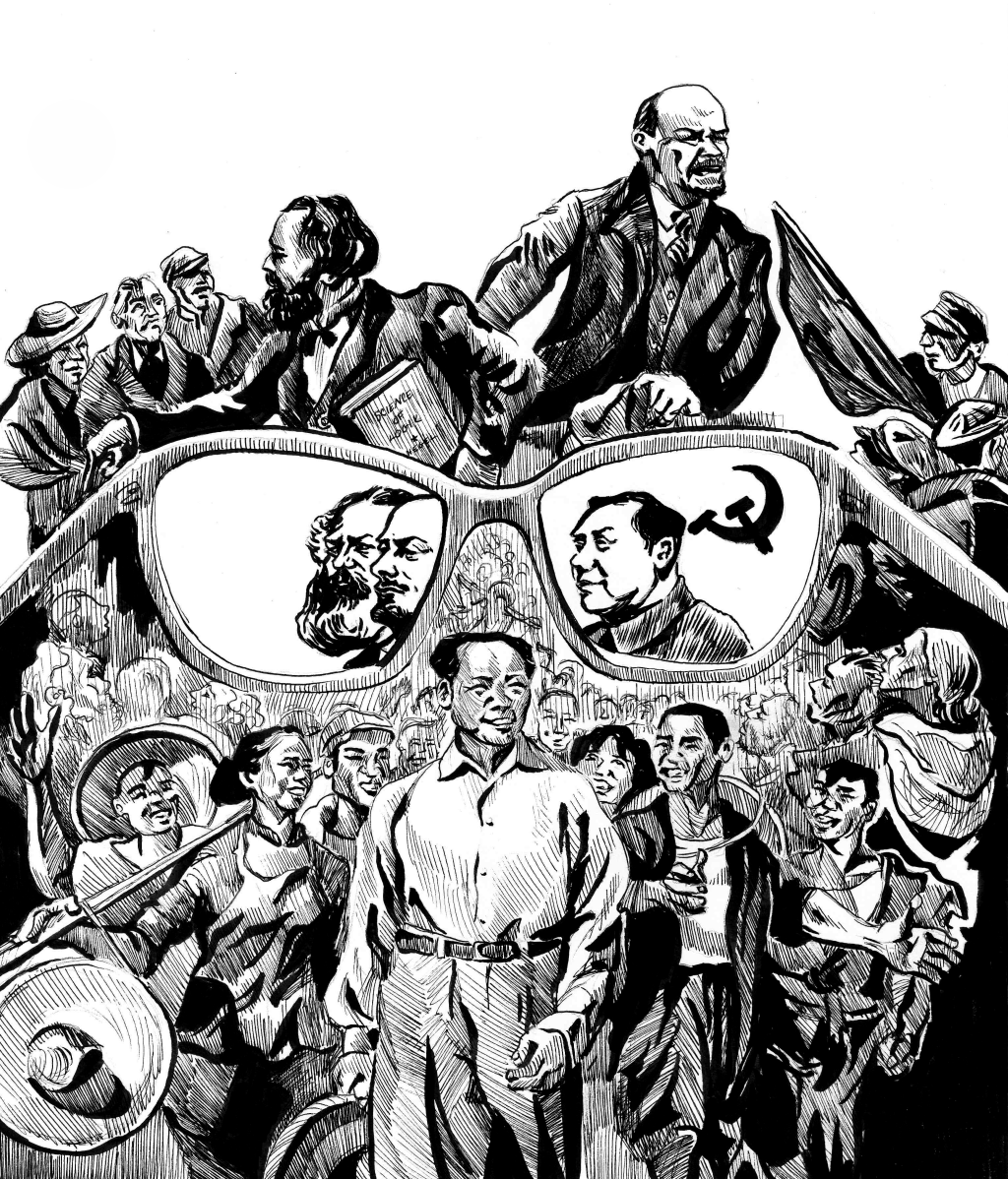
Kenny Lake, May 2026
Introduction: the cycle of creative development to rigidity and dogmatism
As communist ideology and politics have developed, from a small intellectual contingent within the 1848 revolutions in Europe to the guiding thought of revolutionary movements around the world and a few socialist states in the twentieth century, so too has the need to synthesize, systematize, and popularize communist ideology and politics. Synthesis and systematization are necessary to unite communists worldwide on the basis of principles proven by practice and articulated in the best intellectual work of communist leaders, and popularization is necessary to spread those principles broadly and train up a new generation of communists. However, it is by way of systematization and popularization that communist principles all too often get rendered into rigid dogma and deprived of their power to revolutionize the world, the very power that turned them into universal principles to begin with.
This problem, which we could call rigidification and dogmatization of communist principles, is evident practically in the schematic and often downright idiotic thinking that has dominated most communist parties throughout history, and led them to either give up on revolution in favor of reformism or spout revolutionary rhetoric with no ability to make revolution in practice. In the literary realm, this problem is evident in the weaknesses of most attempts at writing systematic presentations of communist ideology and politics and their historical development. The best popularization of communist principles remains the first one—Marx and Engels’ The Communist Manifesto—written in a beautifully poetic style, drawing on the mass energy of the 1848 revolutionary movement then sweeping Europe, and full of contempt for and acerbic analysis of the capitalist order then coming into being.
After the defeat of the 1848 revolutions and Marx’s political exile to England, Marx and Engels focused their efforts on carrying out the intellectual work necessary to more deeply ground the principles articulated in their Manifesto. Marx’s Capital is the greatest singular achievement of that intellectual work, a masterwork in materialist dialectics giving the communist movement a solid analytical grounding in the workings of capitalism. Beyond fulfilling their central task of analyzing capitalism’s inner workings, Marx and Engels provided us with a model of rigorous intellectual curiosity and productivity, taking in the latest developments in science, history, political events, colonial knowledge production (I’ll explain that one below), philosophy, and more to expand and refine communist principles. And, despite anti-communist proclamations to the contrary, they were not armchair intellectuals, but revolutionaries deeply engaged in the practical movements of their time, including from within the First International that brought communists throughout Europe together organizationally. Marx and Engels never hesitated to look up from their studies to provide analysis and guidance to the revolutionary movement, especially when the prospect for practical advances was on the horizon, as in Paris in 1871.
It fell largely to Engels to systematize and popularize the developments of communist ideology and politics made by way of his and Marx’s intellectual work and summation of contemporary experience and history. Following The Communist Manifesto, Engels’ Anti-Dühring stands as the second best systematization of communist principles, coming after three decades of collaborative intellectual work with Marx and written between 1876–78, when Marx was still alive and could help write it. Impressively comprehensive and intellectually challenging in the best of ways, Anti-Dühring explains communist principles dialectically and with historical gravitas, and without rigidity, reductiveness, or oversimplification. Aside from some of its propositions, especially concerning scientific thought, being out of date, its main weakness is an emphasis on the role of the productive forces in the development of human societies that can become mechanical materialism in the wrong hands. Marx and Engels had to argue vociferously for the fact that productive forces and production relations were crucial determinants of human societies against their obfuscation by bourgeois ideology. In Anti-Dühring, Engels’ emphasis on productive forces leads, among other things, to a deterministic articulation of military conflict that does not adequately make way for the potential subjective force of revolutionary people’s war, a task that Mao fulfilled decades later.
Whatever its weaknesses, Engels’ Anti-Dühring stands as the greatest synthesis of communist ideology and politics up to that point and is well worth studying in full. With that phrase “in full,” I am criticizing the intellectually lazy trend, favored by generations of Trotskyites, of only reading the excerpts of Anti-Dühring that have been published under the title Socialism: Utopian and Scientific. Furthermore, if you like that latter title in the year of our Lord 2026, you most likely prefer determinism and mechanical materialism over materialist dialectics.
Where Engels’ work of synthesis and systematization began to get a bit rigid is in his The Origin of the Family, Private Property, and the State, written in 1884, a year after Marx’s death. Communist ideology and politics, as they were articulated in the 1848 Manifesto, were initially largely the product of European revolutionary movements and philosophy. Especially in the last decade of his life, Marx increasingly turned to the study of non-European cultures and ancient history, expanding his scope of vision and discarding any previous presumptions about production and social relations based on the limitations of his knowledge. He grabbed every kernel of insight he could from what postmodernists today would call colonial knowledge production: nineteenth-century European intellectuals, especially anthropologists, analyzing non-European cultures. Among late-nineteenth-century European intellectuals, Marx was the greatest critic of colonial knowledge production, ridiculing, in his reading notes and correspondence, their bourgeois biases and the erroneous interpretations of non-European societies made on the basis of those biases. Moreover, in his final years, Marx began to revise his thinking about the basis for socialism, viewing the persistence of communalism, in South Asia, Russia, and elsewhere, as a potential basis for the communist future, in addition to the modern proletariat and the productive forces with which it worked in socialized production.1
Marx never got the chance to synthesize his study of colonial knowledge production, the differences between Russia and Western Europe, and ancient history, nor his thoughts on the implications of the persistence of various forms of communalism for revolutionary strategy, into published writing before his death in 1883. It fell to Engels, the following year, to draw on Marx’s notes and thinking to write The Origin of the Family, Private Property, and the State. Positively, Engels’ Origin… stands as (to my knowledge) the first written intellectual work to identify patriarchy and the oppression of women as the foundation of exploitative relations and class divisions. It also, in the main, analyzes non-European and ancient cultures with materialism rather than bourgeois ideology and Eurocentrism, stepping outside of biased value judgments based on contemporary European culture to look at the scope of human history and culture with historical sweep and the humble recognition that in the future communist society, our present social relations will have no bearing on how people decide to relate to one another.2 However, Engels failed, whether by default or intention, to take up the full implications of Marx’s study of non-Western-European cultures, ignoring some of Marx’s most insightful critiques of colonial knowledge production as well as the potential for communalism, where some forms of it remained, to be a basis for socialism.3
Worse yet, Engels’ Origin… interprets human history and cultures in such a way that suggests a somewhat schematic notion of stages of development, universalized beyond Europe, in contradiction to the late Marx’s acceptance of a greater diversity in the historical pathways humanity took in different places. While it was never articulated so rigidly in Marx and Engels’ intellectual work, Origin… gave license to the subsequent generation of European communists, organized into the Second International, to adopt a rigid and mechanical concept of stages of development and impose it on all of human history. They teleologically imagined that all of humanity must pass from “primitive communism” to slave society to feudalism to capitalism, and only thereafter to the socialist transition to communism. We shall return to the problems of this stages of development theory below. Here, the important thing to point out is how weaknesses in Engels’ systematization and popularization of communist principles gave way to their rigidification by the “socialists” of the Second International. Consequently, while the European parties of the Second International produced a vast literary output articulating supposed Marxist principles to large numbers of proletarians, they trained those proletarians in dogma. Perhaps more egregiously, their dogma increasingly betrayed the communist principles fought for by Marx and Engels, and was used as a rationalization for reformism in opposition to revolution.
The bankruptcy of the Second International is proven by the fact that most of its participant parties sided with their own bourgeoisies during World War I and attempted to justify national chauvinism with communist phraseology. Their justification for colonialism, which was part and parcel of contemporary European nationalism and the primary reason for World War I, was enunciated by way of stages of development theory, with the European colonial powers guiding non-European peoples to higher stages of development under colonial rule so that they could eventually move to socialism—after their European colonial overlords had, of course. While the national chauvinism that pervaded the Second International appears as a contemptible betrayal of communist principles to us today, it is important to understand that betrayal as, in part, an outgrowth of rigidification of communist principles. By failing to live up to Marx’s intellectual example and instead adopting simplistic, reductive systematizations and popularizing them to the European proletariat, and by failing to creatively analyze the implications of high colonialism and the split in the working class for revolutionary strategy, parties of the Second International could only wind up betraying communist principles.
Fortunately, communist principles were rescued and developed by Lenin and the Bolsheviks in the early twentieth century, who were treated as heretics out of sync with established Marxism within the Second International. Yet the successful Russian Revolution of 1917 and establishment of the world’s first socialist state turned out to be part of another time around the cycle of creative development of communist ideology and politics followed by their rigidification. Around the world, new communist parties were formed, largely by young, inexperienced revolutionaries, inspired by the Russian Revolution and on the basis of the ideology and politics that guided it to victory. Those new communist parties sought to mechanically apply the lessons provided to them by the Bolsheviks rather than creatively adapting them to their own circumstances. Lenin angrily responded to the problem of dogmatism by way of mechanical and erroneously selective application of communist principles in his 1920 “Left-Wing” Communism, an Infantile Disorder, but unfortunately passed away before making much headway in steering the international communist movement away from schematic thinking.
Stalin’s leadership wound up reinforcing schematic thinking in general even while combating some of its specific, doctrinal manifestations. We could elucidate numerous examples of bad advice based on rigid application of the lessons of the Bolshevik experience given, under Stalin’s leadership, to communist parties around the world to sometimes disastrous effects, most notably in 1927 China. More importantly, for our purposes, is the way that Stalinist rigidity4 trained generations of communists in rigid and mechanical thinking, from the codification of stages of development theory to a determinist emphasis on the role of the productive forces in the revolutionary process. More than any one specific manifestation of rigid and mechanical thinking, however, is the way of thinking itself. Telling examples of how that way of thinking was passed down are Stalin’s 1924 Foundations of Leninism and 1938 Dialectical and Historical Materialism, seductive to many young, would-be communists for their simplicity and clarity but disturbingly deficient in dialectics. If you like the way these two canonical writings by Stalin wrap communist principles up neatly and clearly—in reality, reductively and schematically—then you are well on your way to becoming a dogmatist unable to do anything revolutionary with those principles.
Mao led the Chinese Revolution to victory by breaking with Stalinist rigidity while upholding and applying the principles that had been rigidified under Stalin’s leadership of the international communist movement. Mao’s writings accomplish the difficult feat of clarity without reductiveness, applicability without being schematic. The impact of Stalinist rigidity does occasionally leave its mark on Mao’s writings in relation to their articulation of the role of the productive forces in the revolutionary process, but besides that, they are thoroughly imbued with and defined by dialectics and push the subjective factor to the foreground of communist ideology and politics. Yet again, when it came time to synthesize the developments to communist ideology and politics made under Mao’s leadership, their systematization and popularization were plagued by a new round of rigidification and dogmatization.
By contrast with Mao’s writings, all too many articulations of communist principles coming out of socialist China were tinged by a dogmatic style, overly declarative and lacking in intellectual creativity, both in form and content. During the Great Proletarian Cultural Revolution, the ultra-left line, whose leading adherents were concentrated among writers such as Wang Li and Chen Boda, cemented a stilted literary style manifest as start with quotations from Chairman Mao and then expound upon those quotations. Similarly to the new generation of communists around the world that came up after the Russian Revolution, the 1960s generation of Maoists all too often embraced the dogmatization of Maoism rather than the real, dialectical, thing, and consequently failed to use Mao’s development of communist ideology and politics to make revolution.
The great exceptions to this trend were concentrated in the Revolutionary Internationalist Movement (RIM), formed in 1984. Yet even there, rigidity and dogmatism in various forms persisted in style and substance, and held back communists from overcoming difficult challenges in the 1980s, 1990s, and 2000s, contributing to the defeat or betrayal of revolutionary people’s wars in Peru and Nepal, the stagnation and increasing irrelevance of RIM parties and organizations elsewhere, and the collapse of the RIM in the mid-2000s.
Notable for our purposes is the quality, or lack thereof, of most systematizations and popularizations of communist ideology and politics by Maoists in and outside of the RIM from the 1980s on. Lenny Wolff’s The Science of Revolution (1983) falls on the better end, drawing on developments by Lenin and Mao to make important dividing lines concerning imperialism, the split in the working class, economism, and what constitutes the socialist transition to communism, with enticing explanations of communist principles all along the way. But it suffers from a deterministic conception of objective conditions and grand crisis in the revolutionary process, and from presenting communism as a precise science which, if correctly applied, will lead to the desired result. Jose Maria Sison’s Basic Principles of Marxism-Leninism: A Primer, written from a prison cell in part to contend with growing revisionist winds within the Communist Party of the Philippines, fares worse. It has solid, if a bit rigid, explanations of core communist principles, some outdated ideas such as emphasis on industrial workers, and confusion concerning capitalist restoration in the Soviet Union and China.
The worst of MLM textbooks is the Marxism-Leninism-Maoism Basic Course, written by comrades in the Communist Party of India (Maoist). The comrades in the CPI(Maoist) have exemplified revolutionary heroism and dedication over the last two decades, persisting in revolutionary armed struggle through advances and setbacks and while facing vicious repression. It is unclear to me the circumstances in which their Basic Course was written, how it came together as a comprehensive work, how it is used in India, and whether it was intended for publication abroad. In any event, the dogmatic idiots who run Eurotrash Foreign Languages Press and appropriate revolutionary struggle outside imperialist countries to make themselves look cool on Leftist social media decided to publish it and promote it as a great exposition of communist principles, and even more idiotic dogmatists in imperialist countries using “Maoist” as a social media identity have eaten it up. Their attraction to the CPI(Maoist)’s Basic Course is its dogmatism and its teleological narrative of the development of communist ideology and principles that verges on religious hero worship. Sloppily written, poorly edited, and politically muddled, this Basic Course presents an at-best confused historical narrative on Albania, Cambodia, and the Soviet Union, only able to offer praise, condemnation, or vague criticism concerning communist leaders and history rather than critical summation. With due respect to the struggle and sacrifice of the true Naxalites, the publication and popularization of the CPI(Maoist)’s Basic Course outside of India has played a counterproductive role, giving justification for dogmatism among pretend “Maoists” in the imperialist countries.
That conclusion brings us to an overarching problem in the communist movement of the last sixty years: an arc that goes from ardently, if somewhat dogmatically, taking up communist ideology and politics by way of Maoist China; to going beyond youthful dogmatism, summing up the loss of socialism in China, and working to make advances in the revolutionary struggle; to sinking back into dogmatism and becoming irrelevant, leaving the 2010s generation without any mentorship and allowing opportunists among them to re-purpose Marxism-Leninism-Maoism as a dogma for (online) pageantry. That arc is evident in the RIM’s systematization and popularization of communist principles. The RIM’s 1984 Declaration does quite well at laying out key developments and dividing lines in the history of the international communist movement and contending with revisionist winds after the 1976 counterrevolutionary coup in China. The nicest thing I can say about the RIM’s 1993 document Long Live Marxism-Leninism-Maoism! is that it gives a clear articulation of larger developments and dividing lines in communist ideology and politics associated with the “three heads” suggested in its title. Beyond that, its schematic presentation of those developments, including as emanating from the brains of the “three heads” behind them, offers little of value to train up communists in how to understand, think about, and apply communist principles. Writing by RIM participants only got more dogmatic after the RIM’s mid-2000s dissolution.
Why has the communist movement been through three cycles of creative development of revolutionary ideology and politics to rigidification and dogmatization? Why, if Marx, Lenin, and Mao were such innovative, creative, and dialectical thinkers, have Marxism, Marxism-Leninism, and Marxism-Leninism-Maoism quickly become dogmas?
The most innocent reason is that youthful, inexperienced, and enthusiastic communists—who often bear the burden of creating communist parties in opposition to the generation that came before them—generally lack the intellectual sophistication and practical experience to take up communist ideology and politics in any other way. As human beings, we frequently take up new skills, intellectual or practical, by schematically copying the example set for us. This is fine so long as it is the beginning of a process of imitation, assimilation, and innovation, but too often communists have never gotten past the first step of that process. In other words, a little youthful dogmatism is okay and should be expected, so long as we work to get beyond it. Hopefully, there are some more experienced communists to guide the youth to get beyond it, but if there are not, those youth will have to put in the intellectual work themselves, without the benefit of mentorship.
A thornier reason for dogmatization is the nature of systematization and popularization. Part of why Engels’ Anti-Dühring fares better than other systematizations and popularizations is that it was written as a polemical response to an attack on Marxist principles by one Professor Dühring rather than in the abstract as a sort of textbook. Its articulation of communist principles is more living as a result. The very practice of systematization tends to breed rigidity and reductiveness, as it encourages schematic summation of principles, a search for definitions, and the division of thought into categories. Popularization in turn encourages simplification and reductiveness, or even dumbing things down to the lowest common denominator. Consider, from your high school experience, the fact that textbooks are likely the most boring thing you ever had to read, and you know what I am talking about. Furthermore, the act of systematization articulates the development of communist ideology and politics up to that point as a point frozen in time, in contradiction with the living, breathing quality of communist principles, their continual development, and (ironically) dialectics itself. Consequently, all systematizations are always already out of date when they are published.
Another cause of the dogmatization of Marxism-Leninism-Maoism is suggested by the appellation itself. Identifying developments in communist ideology and politics with the “three heads” (Marx, Lenin, and Mao), especially when those three heads become a literal iconography, breeds religiosity and divorces intellectual work from the problems it was trying to solve. The three heads were certainly great revolutionary leaders and intellectuals who deserve our reverence and, more importantly, our study of their works. But their contributions to communist ideology and politics were made in relation to and on the basis of the actions of the masses, in revolution, from 1848 Europe to mid-twentieth-century China, and by way of engagement with the intellectual life and history of humanity. Moreover, communist ideology and politics did not advance in three disconnected dots, but through an ongoing process involving many leaders and class struggles, punctuated at certain key moments around key developments, practical and intellectual. Without taking away anything from the three heads, our deification of them by calling communist ideology Marxism-Leninism-Maoism has cut against our ability to assimilate their dialectical method and intellectual approach, even if it served the productive purpose of distinguishing revolution from revisionism at key junctures. Do we need a communist Mount Rushmore, or can we treat our ideology more like a river rushing forth and dissolving dogmas before they become dams?
We might be stuck with the appellation Marxism-Leninism-Maoism for now, but regardless of what we call it, communist ideology and politics have to break out of rigidity if they are to guide us in making revolution. This last cycle of creative development to dogmatization has gone on far too long, as evident from the fact that no communist revolution has succeeded in seizing state power and building a new socialist state in the fifty years since the defeat of socialism in China. To break the cycle, we need to cast off dogma and rigidity, rescue and reinvigorate communist principles, and strike out in new directions, treating communist ideology and politics as both firm and flexible, neither a closed system of thought walled off from intellectual life outside itself nor as a system whose components can be easily discarded. Doing so requires careful deliberation, assimilation of intellectual developments outside the canon, and a little irreverence, the latter especially directed at stodgy systematization.
To that end, and at the risk of hypocrisy, in what follows, I will attempt to synthesize, systematize, and popularize some key developments in communist ideology and politics argued for or hinted at in the pages of kites and Going Against the Tide. While these developments are not, per se, ruptures with communist principles, they do go against the tide of some entrenched conventional wisdom within the communist movement, especially as articulated in systematizations and popularizations of Marxism-Leninism-Maoism. Hopefully, what follows can help break the impasse of rigidity and dogmatism that has increasingly blocked Marxism-Leninism-Maoism from being an intellectual force capable of guiding revolution in the present rather than becoming a deification of the past.
Stages of development, or of social degeneration?
When it comes to stodgy systematization, what is all too often meant by the term historical materialism is little more than a self-assured metanarrartive of humanity’s historical trajectory through neatly defined and delineated stages of development: “primitive communism” to (?) to slave society to feudalism to capitalism, followed by the socialist transition to communism. In substance, the problems with that narrative are that it universalizes European history beyond Europe; it promotes inevitability and teleology based on a mechanical materialist, determinist view of the role of the productive forces in historical change; and it treats “primitive communism” as a realm of human ignorance and inability. Strategically, it forecloses the potential contributions of persisting communal social relations and ideology to the contemporary revolutionary struggle. Intellectually, it revels in schematic thinking and self-assuredness, too content to fit human societies and historical periods into categories to recognize details and pathways that do not fit into the “stages.” Let us take these problems up one by one, starting with the last one.
As communists, we have to be able to cut to the essence of things and develop a sweeping understanding of human history and the world more generally in order to understand and change the world. The only right way to do so is through an ongoing process of learning as much as we can, as many details as we can pay attention to, centralizing what we learn, synthesizing it by grasping the key contradictions and their motion and development, and then repeating the process on the basis of the synthesis we have arrived at. Each time around that spiral of inquiry, we have to enrich and adjust our synthesis, or sometimes discard much of our previous synthesis based on new knowledge and interpretation.
In the first half of the twentieth century, historical materialist stages of development became a synthesis that broke that spiral, taking the insights of Marx and Engels concerning history and production relations and turning them into a reductive schema. As stages of development theory increasingly became conventional wisdom among communists, the communist movement failed to question its underlying assumptions or seek to enrich, modify, or overturn the theory based on new knowledge. Worse yet, all too many communists, including leading figures such as Stalin, articulated stages of development theory in authoritative and self-assured ways, popularizing a metanarrative as though it was an exact description of history. Lower down the hierarchy, communist cadre learned to proclaim this historical materialism with the certitude of religious zealots, as a revealed truth. Lost in the sweeping claims to know human history in its stages of development was the grounded historical sweep cultivated by communist leaders such as Marx and Mao, whose intellectual work drew on a breadth and depth of knowledge about ancient history. Lost on all too many “Maoists” is the fact that Mao’s writings and speeches are laden with references and analogies to the history and philosophy of ancient China.
In other words, beyond and perhaps more pernicious than the substantive problems with stages of development theory is the way that it inculcates certitude that stands on reductive thinking and fitting reality into categories. Consequently, all too many communists are incapable of dealing with the details of history, understanding the gray areas and the porous boundaries between different sets of production relations, and making specific analysis of the features that define a given society, which may or may not fit well into one of the historical materialist stages of development. What has passed for historical materialism is all too often devoid of specificity in its analysis and dialectics in its method.
In substance, stages of development theory only works, sort of, in describing Europe from Ancient Greece to the present day. Even there, the theory begins to fall apart when we consider the realities of European feudalism after the fall of the Roman Empire. A key premise of stages of development theory is that new, higher stages of production relations are arrived at based on the development of more advanced productive forces—more advanced because their use in production enables a greater productive output with less expenditure of human labor. However, from within this logic, Ancient Rome had more advanced productive forces and a “higher” level of political organization and culture than the parcellized feudalism that followed its collapse. From the slave society of Ancient Rome to the feudalism of medieval Europe was not, from the standpoint of productive forces and level of culture, an advance but a step backwards. Subsequently, it took hundreds of years and appropriating technology and science from beyond the continent for Europe to reach a level of productive forces, political organization, and culture on par with Ancient Rome. Feudal Europe developed a greater awareness of this fact than have advocates stages of development theory—an awareness which prompted the Renaissance, whose very moniker suggests the need to learn from Ancient Greece and Rome in order to advance European society.
Furthermore, what set feudalism in Europe apart from other societies, both ones that preceded it in Europe and ones that existed at the same time on other continents, was, as a crucial determinant, the Catholic Church. The Catholic Church provided feudal Europe with its dominant ideology and dominant ideological state apparatus, trained its intellectuals, bestowed legitimacy to its parcellized power centers, took an active role in land ownership, and worked to stamp out remaining communal social relations and culture. While you can argue that forms of feudalism existed elsewhere at the same time, such as in Imperial China, to flatten those diverse forms of feudalism into a singular stage of development misses the crucial role of the Catholic Church in shaping Europe’s dominant production relations, ideas, and culture. Even worse, stages of development theory has led to “feudalism becoming a catch-all for premodern and precolonial agrarian societies anywhere in the world,”5 forcing them to fit into an analytic category derived from the specificities of Europe in the millenium after the fall of Ancient Rome. Speaking of that millenium, another pitfall of stages of development theory is that it obfuscates the many quantitative and qualitative changes going on within a given stage of development, turning medieval Europe, not to mention the entire non-European world before colonialism, into a static society without much in the way of internal contradiction and transformation.
To the extent stages of development theory acknowledges internal contradictions within each stage, it reduces them to a contradiction between new productive forces emerging from within a given society in conflict with the existing production relations and dominant classes that correspond to the old productive forces. Gone from the equation are the subjective actions and agencies of different classes, the role of economic, political, and social organization, and the dynamic role of ideology in shaping and transforming production relations. In the standard historical materialist metanarrative, the productive forces occupy a Godlike position, as if those productive forces were not consciously created by human beings who then decided what to do with them.
Dismissing the subjective factor leads to a ranking, even if not always as a value judgment, of societies from lower to higher based on their level of productive forces and the presumption that those societies at a lower level are stuck in ignorance and lack of productive capacity until new productive forces come along to liberate them from their ignorance and lack of productive capacity. At its worst, this led the learned “Marxists” of the Second International to justify colonialism because it could deliver more advanced productive forces and production relations to the colonized. Beyond its worst interpretations, however, stages of development theory has consistently denigrated the knowledge and beliefs of “primitive communism” and the communal survivals that flowed from it. Even Marx and especially Engels were not immune to this view, though Marx in his later years moved to a greater appreciation for communal survivals and their potential role in the revolutionary struggle.
The reality of “primitive communism,” as understood by more recent anthropological and archaeological work, was not a desperate struggle for daily survival and an ignorance of nature that the historical materialist narrative tends to portray. Instead, gatherer-hunters had accurate and profoundly applicable intuitive knowledge and collectively developed wisdom concerning the workings of the natural world that enabled them to spend a small portion, relative to class societies, of their days getting their necessities from nature and then spend the rest of their time on culture. This state of affairs was/is evident in the ways of life of the indigenous peoples of Australia, arguably the closest to the original communism in recent history (besides small communities of people in other parts of the world). As one piece of colonial knowledge production, the journal of Captain Cook, described the indigenous people of Australia:
They appear to be in reality far more happier than we Europeans, being wholly unacquainted not only with the superfluous but the necessary. Conveniences so much sought after in Europe, they are happy in not knowing the use of them. They live in Tranquility which is not disturb’d by the inequality of Condition: the Earth and sea of their own accord furnishes them with all things necessary for life, they covet not Magnificent Houses, Household-stuff, etc., they live in warm and fair Climate and enjoy a very wholesome Air, so they have very little need of Clothing… In short, they seem’d to set no Value upon any thing we gave them.6
The happiness, collective spiritual attunement, and harmony with nature Cook described rested on a level of understanding of nature that allowed the indigenous people to find waterholes in the desert, accurately navigate vast distances on foot, and successfully use the natural material of the environment and spiritual practices for healing purposes, among other abilities that have eluded humanity the further it moved away from the original communism. Moreover, remaining in the state of original communism appears to have been a choice by the indigenous people of Australia, rather than a lack of knowledge about how to develop the productive forces, considering their ability to weave but lack of clothing, ability to make structures for ritual but rejection of architecture for dwellings and production, and artistic use of symbols without developing writing.7 More generally, archaeological discoveries have suggested that communal humanity could build impressive structures, for spiritual purposes, that were precisely aligned to the motions of the celestial bodies, displaying profound knowledge of the cosmos without the benefit of the observational tools of modern astronomy. We can conclude from these facts that gatherer-hunters and their communal successors were not held back from a “higher” stage of development by ignorance and lack of productive forces, but often chose not to “advance” because they were content living the way they did and with the profound wisdom, sensory and intellectual, that they possessed.
Consequently, the original communism persisted for millennia, either in its pristine form in some parts of the world all the way up to contact with outside, class societies, or as various forms of communalism. The latter include whole societies where property and production relations remain largely communal but some degree of class distinctions has emerged, as well as societies in which an exploiting ruling class incorporates communal cultures into its domain without radically altering their ways of life. Historical materialist analysis by the communist movement in the twentieth century largely failed to make sense of these societies, especially the latter ones, often mischaracterizing them as feudal to fit them within the categories prescribed by stages of development theory.
Marx, by contrast, recognized the persistence of communal forms of social organization within the Mughal Empire that British colonialism undermined in India, among the indigenous peoples of the Americas, among the Kabyles of Algeria, in the peasant communes of Tsarist Russia, and elsewhere. In the course of his studies towards the end of his life, Marx recognized the persistence of communalism amid the growing power of exploiting classes and the force of colonial conquest as generating antagonism and struggle, and began to view that struggle and the remaining forms of communal organization as a basis for socialism.8 Proof of concept for Marx’s theories, unpublished in his lifetime, is suggested by contemporary India’s communist movement, which has found in the Adivasis a firm social base for revolution whose communal ways of life entered into antagonistic conflict with the incursions of mining companies and the motions of capital into their historic lands.9
Whereas Marx was moving in the direction of studying contemporary communalism and its potential role in the revolutionary struggle, the dogmatization and rigidification of Marxism that became historical materialism largely foreclosed such strategic considerations by communists in the twentieth century. That foreclosure is likely one of the primary reasons the international communist movement failed to offer better leadership to the revolutionary struggle in twentieth-century Africa. While a diverse array of production relations and social organization existed in Africa before and during colonialism, communalism in various forms was prominent on the continent and in increasing conflict with emerging exploiting classes, the slave trade, and colonial rule. Rather than passing through a stage of feudalism where serfs were ruled by landlords, much of the African peasantry, whether individual or communal producers, became a cash-crop peasantry exploited by foreign capital via middlemen traders. Without much of a proletariat save for in coastal towns, working in mines, and in a few enclaves of industrial production, the peasantry was the main force for anticolonial struggle and revolution in mid-twentieth-century Africa, and the persistence of communalism among that peasantry was a material, social, cultural, and ideological basis for that anticolonial struggle to lead to socialism.
Various African revolutionary leaders recognized this potential in various ways, and Nyerere’s concept of ujamaa sought to build socialism in Tanzania on the basis of the village communalism that colonialism had failed to stamp out. Under Nyerere’s leadership, Tanzania made impressive developments in the cultural sphere and in uniting a diverse population, but failed to develop its productive capacity and a self-reliant economy to sustain its population’s material needs. The Tanzanian experience deserves deeper summation with communalism as a basis for socialism in mind, even if it falls short of some basic principles established by Maoist China, such as the need for a decisive rupture with imperialism through war rather than a mostly peaceful transition from colonial rule to independence. Whatever the strengths and weaknesses, achievements and shortcomings, of Tanzania under Nyerere’s leadership and of ujamaa as a concept, the international communist movement of the mid-twentieth century, while recognizing and supporting the anticolonial struggle in Africa as a storm center of world revolution, failed to creatively develop the necessary theory and strategic outlook to lead a breakthrough in revolution and socialism in Africa. Doing so would have required rupturing with the rigidity of stages of development theory, recognizing revolutionary potential in the persistence of communalism in Africa, and figuring out how to build socialism on the basis of fusing existing communalism with “modern” socialism.
In confronting the failures of the twentieth-century communist movement to recognize—in theory, strategic outlook, and practice—the persistence of communalism, in Africa and elsewhere, as a basis for socialism and the revolutionary struggle to achieve it, it is tempting to pin the problem on Eurocentrism within the communist movement, as the title of Robert Biel’s book suggests.10 To do so, however, is to take the postmodernist route of emphasizing internalized bias over political line, theory, analysis, and conscious practice. There was certainly internalized bias and Eurocentric thinking within the communist movement, which, after all, emerged first in Europe as the European powers were carrying out colonial conquest. There was also, and principally, the firm Leninist stand against imperialism and insistence that the anticolonial struggle and national liberation were part and parcel of the world proletarian revolution, and there was Mao and the Chinese Communist Party forging a path for national liberation leading to socialism and shifting the theoretical and practical center of the communist movement to the oppressed countries.
More than Eurocentrism, real or imagined, within the communist movement, what held back communists of the twentieth century from recognizing and acting on the revolutionary potential of persisting communalism was how rigid versions of (historical) materialism crippled their imagination. Bound up with historical materialism is the notion of progress, based on advances in the productive forces and consequent changes in the production relations. From the prism of that notion of progress, the persistence of communalism appears as something stuck in the past, out of sync with progress, that must be superseded to advance to socialism. Therefore, we can only fully embrace the revolutionary potential of persisting communalism, including in the ideological domain, if we reject the schema of progressive stages of social development and replace it, or at least synthesize it, with a different understanding of history.
As a consequence of each successive development of the productive forces and change in the production relations, there has been increasing social degeneration, with capitalism as the pinnacle of individualism, alienation, spiritual decline, and a destructive rather than symbiotic relationship with nature. From the original communism to the various forms of communalism that followed it, human beings lived by way of voluntary collective interdependence and deep social bonds, enshrined and entrained via communal social structures and spiritual knowledge systems. The more that communalism broke down and gave way to class divisions, the more that social structures and interdependence for needs and wants became exploitative, with spiritual knowledge systems transformed over time into oppressively hierarchical religions justifying exploitation. Social obligation broke down from one “stage of development” to another. Feudal lords still had some degree of social obligation to their serfs, but the bourgeoisie dispensed with any sense of duty to the proletariat, only relating to it through a naked form of exploitation without obligation: wage-labor, with labor power turned into an impersonalized commodity. From the standpoint of interdependence, collectivity, social obligation, spiritual attunement, and harmony with nature, capitalism is the worst set of production relations, social organization, and culture ever created. It has brought humanity out touch with itself, collectively and individually, and with nature, destroying the latter rather than cultivating a symbiotic relationship with it.
The only sense in which capitalism, and any other “stage of development,” could be considered progressive is in creating more of a material basis to return to a more communal existence, to use the productive forces it created to negate the existing production relations and develop new ones that restore the kind of collective interdependence and spiritual attunement of the original communism. In other words, I am willing to acknowledge that once class divisions were set in stone, humanity may well have had to pass through a few different sets of production relations, at least in some parts of the world, before finding its way back to communism, in a new form (long live the negation of the negation, but too bad this one had to take so long). However, within that process, the persistence of communalism offers a potential route back to communism in addition to the socialized production created by capitalism, and the struggle for communism will be strengthened by drawing on both routes.
Rejecting the reductive certitude of historical materialist progressive stages of development theory also opens up intellectual routes to a more accurate, more dialectical materialist, less mechanical teleologist, understanding of history and its strategic implications. For example, Silvia Federici’s Caliban and the Witch and other historical studies of patriarchy demonstrate that the status of women did not get progressively better from one mode of production to the next. Instead, capitalism and the Catholic Church stamped out communal survivals of equality between women and men, as well as ideological and cultural spheres in which women had authority, first in Europe and then, via imperialism, around the world. Engels’ proclamation of the world-historic defeat of the female sex, with the establishment of patriarchy as the world’s first antagonistic class division, turns out to be more a poetic than a chronological and literal truth, with the persistence of communalism as a counter to that defeat. Moreover, there were several stages of defeat, with the rise of capitalism within feudal Europe as the ultimate death blow.
Another theoretical and narrative problem with stages of development is the notion of mastery over nature as a progressive advance because it enables humanity to transform nature to serve its production needs. By the early twentieth century, this concept had become so bastardized that Trotsky offered the following utopian idiocy in his work on aesthetics, Literature and Revolution:
Faith merely promises to move mountains, but technology, which takes nothing “on faith,” is actually able to cut down mountains and move them. Up to now this was done for industrial purposes (mines) or for railways (tunnels); in the future this will be done on an immeasurably larger scale, according to a general industrial and artistic plan. Man will occupy himself with re-registering mountains and rivers, and will earnestly and repeatedly make improvements in nature. In the end, he will have rebuilt the earth, if not in his own image, at least according to his own taste. We have not the slightest fear that his taste will be bad.
Obviously the consequences of this kind of mastery over nature, fortunately without Trotsky’s apparently terrible artistic tastes, have been disastrous for humanity and the planet over the last century, a form of social degeneration that extends to humanity’s relationship with its environment and all the animate and inanimate objects within it. Marx knew better, and called attention to the metabolic rift created by capitalism between humanity and nature, and talk of mastery of nature in Marx and Engels’ work has a different meaning than its bastardization in historical materialist dogma: learning how nature works so we can live with it rather than against it.11
However, the notion of a struggle against nature pervaded communist theory throughout the twentieth century, making its way even into Mao’s writings, including by way of the presumption that in “primitive communism,” people were ignorant of the laws of the natural world and in a constant struggle to survive against nature. As suggested above, nothing could be further from the truth: gatherer-hunters had great intuitive and collectively accumulated wisdom about the workings of nature that puts our relation to nature, mediated by modern science and industrial production, to shame. Reversing our social degeneration in relation to the environment must be one of the central missions of proletarian revolution and the socialist transition to communism, and that reversal will require us to learn everything we can from the superior wisdom and practices of communal humanity.
Firmly implement Mao’s hundred flowers epistemic line, thoroughly and to the end, in addition tohis poisonous weeds ideological line
The wisdom of communal humanity is concentrated in spiritual knowledge systems which, according to historical materialist dogma, are expressions of their ignorance. If we set aside atheist arrogance for a second and take the time to consider how the workings of nature, the cosmos, and humanity’s interconnectedness with itself, nature, and the cosmos are articulated in those spiritual knowledge systems, we may start to recognize the weaknesses of empirical science and mechanical materialism as they emerged in Europe during the transition from feudalism to capitalism. Think, for example, of the Orishas in Yoruba spirituality and how, whatever their “idealism,” they are a way of understanding the energies at work in the material world and a way for humans to make connections with those energies. By contrast, Western science and mechanical materialism have privileged matter over energy, separated reality into categories, and lost sight of an earlier, more dialectical understanding of processes, connections, and taking in the totality of reality.
To gain insight from and limited access to the wisdom of communal humanity’s spiritual knowledge, besides learning directly from peoples who still have some working understanding of that spiritual knowledge, we often have to traverse back to it from religious scripture. That scripture draws on and departs from prior spiritual wisdom, appropriating its insights but putting them in service of justifying the exploiting class in power when the scripture was written. Consequently, generally speaking, the older the religious scripture, the more dialectical its method, and the more valuable its wisdom; in other words, Hindu and Buddhist texts are, arguably, more worthy of study than the New Testament. In any event, my point is not to rank religious texts, but to reject the “materialist” dismissal of the collective knowledge concentrated in them as expressions of ignorance or mere myth. After all, myths serve profound social purposes, and the most enduring ones, the ones that spread across different cultures in various forms, are likely based on some degree of actual historical events (consider how the flood myth we know as Noah’s Arc permeates across different cultures).
The broader lesson here is that what today are poisonous ideological weeds—religious scriptures and doctrines that articulate and fortify exploitative social relations—grew out of, while also negating, communal ideology rooted in communal social relations. More generally, most sources of formal knowledge in class society are poisonous ideological weeds, so as communists, we have to be able to learn what we can from them while spitting out their poison. Mao had a profound recognition of this necessity, advocating that when the communist party commands authority in socialist society, it must “let a hundred flowers blossom and a hundred schools of thought contend” in order to sift through scientific research and artistic creation to arrive at deeper truths, in the intellectual and poetic sense of the term. Unfortunately, what we have called Mao’s hundred flowers epistemic line12 was never really implemented in socialist China, except for by Mao and his closest comrades, and has been largely rejected by “Maoists” since then.
At this point, the only way out of the impasse of rigidity and dogmatism that has blocked Marxism-Leninism-Maoism from guiding the revolutionary transformation of society is to firmly implement Mao’s hundred flowers epistemic line, thoroughly and to the end. As a discursive formation, Marxism-Leninism-Maoism has become disturbingly stale and stuck over the last several decades. Its foundations, the past intellectual developments that gave it its transformative power, remain largely correct, if in need of some excavation and repair. But its declared adherents are mostly stuck in rigidity and dogmatism and unable to reinvigorate their thinking precisely because they view intellectual development as a linear rather than lateral process when we need both. Resting on the intellectual achievements of our communist predecessors, we need to widen our scope of inquiry and reinvigorate our dialectics by being willing to sniff some poisonous weeds. If my case for learning from communal spiritual knowledge did not succeed in getting dogmatists to stop reading this essay, let me go one step further and advocate assimilating some of the philosophical challenges to Marxism by postmodernism into our ongoing synthesis of communist ideology and politics.
As is well known, kites and Going Against the Tide have been the most vituperative and vicious critics of postmodernism, tying it to the rise of a highly parasitic, reactionary class (the postmodernist petty-bourgeoisie) and targeting it as the ideological and political poison that derailed and misled resistance against the injustices of capitalism-imperialism over the last two decades, especially in the US. Less understood is the fact that while we have been cutting down the poisonous ideological weeds of postmodernism, we have been sniffing its philosophical flowers. As Marxism’s greatest critic over the last fifty years, postmodernism gained an ideological foothold in part by seizing on philosophical weaknesses within Marxism that emerged by way of its rigidification and dogmatization. As such, postmodernism offers us a way to recognize and overcome those weaknesses by engaging its criticisms and assimilating their degree of truth, no matter how small, into our synthesis of communist ideology and politics. The trick is doing so without taking in even an ounce of postmodernist class outlook or political practice, as that would lead to a betrayal of communist principles, and of the masses.
Philosophically speaking, what we can learn from postmodernism is a skepticism of totalizing metanarratives, economic determinism, objectivity, and categories; a skepticism that postmodernists have been unable and unwilling to apply to themselves and their own intellectual work. As explained above in relation to stages of development theory, when totalizing metanarratives become schematic, rigid, and supposedly scientifically precise, rather than sweeping, poetic, metaphorical guides to investigating the particularity of contradiction, they become bullshit. Communist ideology and politics are, indeed, totalizing, with our principles and dialectical method able to engage with and produce insight into all spheres of human activity and history. Communism is a world outlook in addition to a goal we are striving toward, and that outlook has the whole world in its sight of vision. But it only remains a truth-generating world outlook if it zeroes in on particularity, not just panning out for a bird’s eye view. In other words, as Mao insisted, combine the general and the particular, in a back and forth dialectical process to understand them both better.
Postmodernism, by contrast, insists on separating the particularities and then perhaps looking at their connections. Politically, this is how we get “intersectionality”—the separation of different forms of oppression and identities into unique categories that then intersect with each other as discrete phenomena. It is why the postmodernist critique of Marxist class analysis is purely additive, in the sense of insisting that we need to add other, discrete, forms of exploitation and oppression (gender, race, etc.). The communist view, in opposition to the postmodernist caricature of Marxism, is to comprehend the entire totality of exploitative and oppressive relations as a totality and, from that totalizing understanding, analyze specific aspects of that totality in their motion and development and in their relation to the totality. When we add new dimensions to our analysis, as, for example, with Pat Grant’s “Capitalism can’t tolerate trans people, so let’s overthrow it: class divisions, third genders, and proletarian revolution” in Going Against the Tide #5, we do so to and within an ongoing synthesis.
Where Marxism is wielded in economic determinist ways, with agency given to productive forces over the human beings who operate those productive forces through production relations, postmodernism has a point, and the totalizing metanarrative quickly becomes rigid and one-sided. Our communism needs much more emphasis on subjective agency in its understanding of human societies, and in that sense we need to draw in the correct aspect of the postmodernist critique of “Marxist” economic determinism. However, we must give no quarter to the political conclusions that postmodernism draws from its emphasis on agency, namely the Foucauldian proposition that we are all trapped within power relations and our agency takes place only within those power relations. Our aim, the subjective agency we are seeking to cultivate, is the agency of the masses to overthrow the power relations of the capitalist order, not to find a better position within them (what the postmodernist petty-bourgeoisie has been doing the last few decades).
In embracing the subjective agency of communist revolution, we ought also to embrace the subjectivity of communist ideology and politics. What purpose does it serve to pretend that our ideology is purely objective, in contrast to all other ideologies? What kind of arrogant nonsense is that? We are partisan to the class interests of the proletariat and the goal of communism, and how we see the world is shaped by that partisanship. That does not mean we should distort reality or play loose with facts—quite the opposite—but nor should we pretend that our ideology does not shape how we interpret the facts. To utter a very postmodernist-sounding phrase followed by a communist one, being aware of our ideological biases would help us avoid our fervent fight for communism blinding us to our mistakes and shortcomings, something that the Soviet Union under Stalin’s leadership failed to do, in some instances to the point of absurdity.
In renouncing claims to purist objectivity, we should come to see how the impulse to fit reality into categories—categories which, as any halfway intellectually astute postmodernist can point out, are our subjective creations—so often gives rise to rigid, schematic thinking and downright dogmatism. Categories are only helpful insofar as they identify similarities between different things and provide us with a starting point (not an end point!) to understand things we are encountering for the first time. If we make them into anything more than that, they become straitjackets with which we force reality to fit into our preconceptions. They let us avoid doing the hard intellectual work of investigating the particularity of contradiction. It is only through that kind of intellectual work that we can make subjective interventions with a shot at transforming the contradictions in a revolutionary direction. So if you consider yourself a communist and your first analytical instinct is to say whether a group of people are a nation or not, whether a country is semicolonial, semifeudal or not (whatever the fuck those words mean today), etc., maybe Marxism is a hobby you should keep to yourself and leave the revolution to those of us willing to and interested in understanding people and conditions as they are in their shades of gray. The categories that communist theory has developed might remain, but let them be loose guidelines for further study rather than rigid impositions on reality.
With those beginning confrontations with the postmodernist critique of Marxism in mind, let us turn to what else, besides stages of development theory, we might have to leave behind if we are to understand and change the world.
Discarding broken mirrors
We…took a materialistic view of the thoughts in our heads, regarding them as images [Abklatsch] of real things instead of regarding real things as images of this or that stage of the absolute content.
– Engels, Ludwig Feuerbach and the
End of Classical German Philosophy (1886)
Recognition of the external world and its reflection on the human mind form the basis of the theory of knowledge of dialectical materialism.
– Lenin, Materialism and Empirio-Criticism (1909)
Man’s consciousness not only reflects the objective world, but creates it.
– Lenin, Philosophical Notebooks
on Hegel’s The Science of Logic (1914)13
…while we recognize that in the general development of history the material determines the mental and social being determines consciousness, we also—and indeed must—recognize the reaction of mental on material things, of social consciousness on social being and of the superstructure on the economic base. This does not go against materialism; on the contrary, it avoids mechanical materialism and firmly upholds dialectical materialism.
– Mao, On Contradiction (1937)
Mao stressed the profound truth that matter can be transformed into consciousness and consciousness into matter, further developing the understanding of the conscious dynamic role of man in every field of human endeavour.
– Declaration of the Revolutionary
Internationalist Movement (1984)
Reflection theory—the idea that material reality exists independently of and outside individual human beings, and that materialists gauge the correctness of our ideas by how accurately they reflect this external world—has been the dominant epistemology (theory of knowledge) in the international communist movement for over a century. It was articulated in Engels’ late-nineteenth-century writings, especially Ludwig Feuerbach and the End of Classical German Philosophy (1886), became the standard orthodoxy in the Second International, and was vociferously argued for by Lenin in Materialism and Empirio-Criticism (1909), his polemic against his philosophical rivals, especially Bogdanov, within the Bolshevik Party. In the Comintern and under Stalin’s leadership, reflection theory became even more entrenched and dogmatic within the international communist movement and was used as the basis on which to contend with various forms of “idealist” philosophies and political programs.
Reflection theory has been the epistemological underpinning of a whole host of sacred principles and theories for communists, among them: objective truth; matter is principal over and determining of consciousness; the economic base is principal over and determining of the superstructure; historical materialism demonstrates a progressive development of a succession of modes of production that eventually leads to communism; revolutions depend on a change in the objective situation, namely a revolutionary crisis, brought about by events external to the actions of communists; and nations are defined by objective criteria (common language, territory, economic life, and culture). In my view, reflection theory has reinforced mechanical and deterministic ways of thinking that have led to rigid analysis and an erroneous elevation of objective conditions and externally-caused crisis over subjective actions in the revolutionary process. Moreover, the rigidity and shortcomings of communists adhering to reflection theory have, in recent decades, aided the ascendance of postmodernist philosophy and politics. If, as Lenin once put it, anarchism is in part payment for the sins of right-opportunism by communists, today postmodernism is in part payment for our sins of mechanical materialism and determinism.
While reflection theory has led to dogmatism and dead-ends, the greatest advances by the international communist movement—namely the 1917 Russian Revolution, the 1949 victory of the Chinese Revolution, and the subsequent Great Proletarian Cultural Revolution within socialist China—depended on substantial ruptures with reflection theory. In the years preceding the Russian Revolution, Lenin turned to Hegel’s dialectics, and this study of “idealism” enabled him to see the basis and provide the necessary leadership for making the leap to proletarian state power amid the crisis that arose from Russia’s losing position in World War I.14 Mao’s leadership, both of the protracted people’s war that brought the Chinese Communist Party to power and of the radical transformations that took place in China during the Great Proletarian Cultural Revolution, depended on a rupture with Comintern orthodoxy and a far greater recognition of the role of consciousness and the subjective factor, over dependency on productive forces and objective conditions, in making revolutionary advances.
Though the quotations above point to conceptual ruptures with reflection theory undergirding these advances in practice, such advances were never matched with theoretical elucidations. Lenin’s own break with his previous epistemological line was not codified into any theoretical treatise—he was pretty busy following these philosophical ruptures, and focused his theoretical attention on the question of state power—so Materialism and Empirio-Criticism remained the gold standard on communist epistemology. Mao’s speeches and writings, along with those of some of his fellow revolutionaries in the CCP, notably Zhang Chunqiao, do offer a better model emphasizing the dynamic and transformative role of consciousness and the subjective factor over matter and objective conditions, but still often articulate many of the principles, enunciated above, that reflection theory underpins.
Following Mao’s death and the counterrevolutionary coup that overthrew socialism in China, participants in the Revolutionary Internationalist Movement (RIM) moved in opposite directions in theory and practice concerning reflection theory. In theory, they tended to move backwards from the trajectory of Lenin and Mao, defending reflection theory as it was articulated in Lenin’s Materialism and Empirio-Criticism with increasing rigidity. Bob Avakian and the Revolutionary Communist Party, USA took this move backwards in theory the furthest, making a defense of “objective truth” their main philosophical argument, essentially circling the wagons around materialism against its postmodernist critics rather than reinvigorating materialism by engaging their critics’ arguments. But the rigid retrenchment to reflection theory and the “objective truth” its application supposedly resulted in pervaded the theory of Maoists in and outside the RIM.
Paradoxically, the greatest advances made in practice by those very same Maoists, in revolutionary people’s wars in Peru from 1980 to the early 1990s and in Nepal from 1996 to the mid 2000s, were made against the precepts of reflection theory. Both the Communist Party of Peru (Shining Path) and the Communist Party of Nepal (Maoist) launched revolutionary people’s wars against conventional wisdom, among their fellow Maoists, that the objective conditions for doing so did not exist. And let’s be honest: launching a Maoist revolution in 1980, when Maoist China had been turned capitalist and the communist movement was in disarray and retreat, was fucking nuts. Through a lot of will power, confidence in the masses, and strategic and tactical smarts, the Peruvian and Nepalese comrades went against the odds and changed the objective situations through their subjective actions. In Peru, they seized on the growing poverty, dislocation, and proletarianization caused by imperialism-imposed structural adjustment, radically altered the strategy of protracted people’s war to bring red political power and revolutionary warfare to the slums that surrounded Lima, and forced dramatic changes in the bourgeoisie’s exercise of state power, resulting in President Alberto Fujimori’s self-coup and heightened repressive measures. By the early 1990s, if not sooner, the revolutionary people’s war was the principal factor shaping the objective situation in Peru—the subjective was increasingly determining the objective.
In Nepal, the people’s war was launched with a few bootleg rifles, a little training in guerrilla warfare from the Maoist Communist Centre in India, and a deep knowledge of the conditions of the poorest peasant masses in the countryside. The subsequent dramatic growth of the revolutionary armed forces and red political power in rural Nepal, along with impressive mass actions in Kathmandu, took the world, and the Nepali ruling classes, by storm. The Nepalese comrades’ daring military actions, step-by-step (but quite rapid) build-up of a People’s Liberation Army, and finesse in playing off contradictions among the enemy (between the monarchy and bourgeois-democratic forces, and between different parliamentary parties) allowed them to deliver big blows to some state repressive apparatuses, eventually forcing the monarchy and the armed forces it directly commanded to enter the fray. After that point, a capitulationist argument—consistent with reflection theory—emerged among some leaders of the Communist Party of Nepal (Maoist), especially Prachanda. In light of the very real, objective, military difficulties fighting the Royal Nepal Army and the growth of a mass movement against the monarchy, they advocated submerging communist subjective agency within an alliance with bourgeois-democratic political forces. Consequently, they settled for a bourgeois-democratic overhaul of the Nepalese government rather than fighting for socialism, ultimately giving up the arms and organized force of the People’s Liberation Army.
In both Peru and Nepal, communists relied on a keen understanding of the conditions of the masses and the potential weaknesses of the ruling classes, and in that respect accurately “reflected” the objective situation in their analysis. However, launching people’s wars in objective conditions that others declared unfavorable required a profound force of will more than an accurate reflection of objective conditions, and advancing those people’s wars to the point of threatening the existing state power was a matter of subjective agency in dialectical relation to the moves and missteps—the subjective responses—of the ruling classes to the people’s wars. In other words, any summation of the people’s wars in Peru and Nepal needs to recognize the principal, determining role of the subjective factor, not just or mainly favorable objective conditions, and the interplay between the subjective actions of communists and their enemies.
So to bring communist epistemology in line with understanding how the greatest practical advances have been made by communist-led revolutions from 1917 on, and to make more such advances, we need to discard reflection theory. Replacing it with a more thoroughly dialetical understanding of the relationship between objective and the subjective will rescue materialism from mechanical determinism. As Lenin put it in his 1914 philosophical notebooks on Hegel’s The Science of Logic, “The paradox of the ‘transition from idealism to materialism’ does not consist in ‘removing’ the idealism, but, on the contrary, of ‘adding more.’”15 Heeding Lenin’s realization, let us excavate the underpinnings of reflection theory and add more idealism to arrive at a more correct, more dialectical, materialism.
Matter and motion, structure and agency
Reflection theory relies on three assumptions: (1) There is a material reality that exists independently of and outside individual human beings. (2) We arrive at truth by reflecting, “objectively,” that material reality. (3) In the process of arriving at truth, matter is principal over ideas or consciousness. These assumptions have been defended with the claim that they match up with scientific knowledge and scientific methods; in Materialism and Empirio-Criticism, Lenin’s defense of a materialism grounded in reflection theory is often that it is “showed by the natural sciences.” Yet developments in science, especially but not only in physics, over the last century have increasingly shown a reality that is out of sync with all three fundamental assumptions of reflection theory. And as Engels correctly pointed out, “with each epoch-making discovery even in the sphere of natural science…, materialism has to change its form.”16
The concept of a reality divided into atoms was central to many ancient Greek philosophers’ understanding, though they could not prove it empirically at the time given the technical means on hand. In nineteenth-century Europe, scientists developed the technical capabilities to identify molecules and eventually the atoms that make up these molecules. For this reason, Engels praised the intuitive ability of the ancient Greeks rooted in a philosophy of dialectics to comprehend reality on a deeper level than subsequent European societies. In this respect, the physical discovery of the atom was an example of the “negation of the negation,” returning to previous scientific understandings on a new foundation, in this case with greater empirical proof but a less comprehensive and dialectical philosphy.
Lenin’s Materialism and Empirio-Criticism was in part a response to the “crisis in physics” prompted by the increasingly smaller divisions of the fundamental particles of matter comprehended by physicists. Lenin’s answer to this crisis was to point out that dividing reality into increasingly smaller components only showed the limits of previous understandings of reality, not a fundamental weakness of materialism. Since Lenin’s time, the constituent components of matter have only gotten smaller. As Jim Baggot puts it, “In the mid-1930s we would have explained that all the material substance in the world is made of chemical elements and that each element consists of atoms,” with each atom made up of negatively-charged electrons orbiting around a nucleus of neutrons and positively-charged protons. Over the last several decades, scientists have found that “the protons and neutrons in the nucleus are not, in fact, elementary particles. They are composed of fractionally charged quarks.”17
So far, so good for Marxist materialism. Mao emphasized the principle of “one divides into two,” and the further division of what were previously thought to be the fundamental particles of material reality into even smaller fundamental particles is perfectly compatible with one dividing into two. However, as physicists explored the properties of these even smaller fundamental particles, they developed two important principles out of sync with the reflection theory conception of matter: (1) particles also function as waves; and (2) mass is an expression of energy rather than a thing-in-itself.
The second principle inverts the typical materialist understanding of matter. As Baggot summarizes the consensus in contemporary physics, “Mass, we now believe, is not an inherent property or ‘primary’ quality of the ultimate building blocks of nature. In fact, there is no such thing as mass. Mass is constructed entirely from the energy of interactions involving naturally massless elementary particles.”18 Since the declaration that there is no such thing as mass will likely worry many self-described materialists, it is worth clarifying that, as Baggot puts it, “far from undermining the concept of mass, the notion that mass represents a vast reservoir of energy somehow made it even more substantial.”19 This understanding of mass as an expression of energy fits well with a communist understanding of human societies as expressions of their production and social relations. However, definitionally, it does throw a wrench in our notion of reality as matter in motion, or inverts this notion.
Given the consensus in physics that mass is constructed from energy, it would be more correct to say that reality consists of motion manifest as matter. Such a definition fits with a basic property of the physical universe, as explained by Baggot: “Matter (in the form of material substance) is not conserved, but mass-energy is. No matter how hard we try, we cannot make or destroy energy. We can only convert it from one kind to another. In every physical interaction of every conceivable description, energy is conserved.”20 Energy can thus no longer be treated as “somehow locked away like some vast reservoir inside material substances,”21 and the mass of an object can be interpreted “as a behavior rather than a property; something the object does rather than something it has.”22 This understanding of the physical universe buttresses the Maoist emphasis on the relations of production and can help move us away from deterministic notions about the role of the productive forces in the revolutionary process.
Those deterministic notions rest on dualistic rather than dialectical separations between underlying structures and exercises of agency free-floating above those structures. The most infamous of such notions in Marxist theory is the idea of economic base and superstructure, where the latter arises, temporally and spatially, on the basis of the former. As a metaphor for analyzing the different components of a social totality and as a polemic against bourgeois distortions of the role of production and labor in class societies, Marx and Engels’ base/superstructure concept served its productive purposes. But as it was taken literally and rigidified by the communist movement, it gave rise to flat analysis and idealist idiocy, such as the notion of “the relative autonomy of the superstructure.” What is meant by the superstructure—culture, politics, ideological apparatuses, etc.—is never in any way autonomous from the economic base. It is part of the same social whole, with all components of that whole always in relation to each other. Rather than autonomy, there is agency within those different components. Historically, elements considered “superstructural” often played the dynamic role in developing a new economic base, in contrast to the temporal implication of the superstructure arising on the basis of transformations in the economic base.
Clinging on to the base/superstructure metaphor as a literal truth, rather than a metaphor, has been justified, implicitly and sometimes explicitly, with the notion that it matches up with how reality is comprehended by the natural sciences, especially the science of evolution. Dogmatic interpretations of Darwin’s work have insisted that evolution takes place by accident, with the some predefined genetic structures predisposing some species and individuals within a species to better survive their environments, and those structures surviving in subsequent generations due to reproduction (whereas those that did not survive do not get the chance to reproduce). With the discovery of DNA, genes added empirical detail to the idea of an underlying structure determining the survivability of a given species and individuals within species. Some biologists took the empirical understanding of genes in disturbingly determinist directions, seeking to identify one-to-one relationships between underlying genetic structure and social behavior. However, evolutionary biology has increasingly come to recognize purposiveness in evolution, with species evolving to adapt to their environments and better survive in changing conditions, not by accident, but by agency, albeit over generations rather than within individual lifespans. In other words, thinking of DNA as a fixed, predetermined structure and the survival of some genes over others as a matter of accident is being discarded by science.23
It would behoove communists to consider the implications of contemporary evolutionary biology for the base/superstructure metaphor, and for our summations of why revolutions happen in some places and specific times. The impact of dogmatized Darwinism within the communist movement has transcribed the role of accident in evolution to crisis in the success of revolutions, with crisis treated as a variable arising from structure and leaving out subjective agency from the picture. Whether biology or physics, the communist movement has been operating, philophically, on science that is over a century out of date (see the publication year of Lenin’s Materialism and Empirio-Criticism). Deeper study of developments in science and their implications for materialist dialectics than I am capable of is necessary intellectual work for the contemporary communist movement. For that work, we have the example of Marx and Engels, who consistently put in effort to learn the latest scientific developments, an approach that has largely eluded the communist movement of the last century. With our deficiencies in mind and having explored more contemporary scientific understandings of mass and underlying structure that were not available to Lenin, let us turn now to the philosophical dimensions of reflection theory, namely its purported objectivity.
Observer and observed, object and subject
In the opening of Materialism and Empirio-Criticism, Lenin wrote: “Recognition of the external world and its reflection on the human mind form the basis of the theory of knowlege of dialectical materialism.” Later in the book, he elaborated that “the fundamental premise of materialism is the recognition of the external world, of the existence of things outside and independent of our mind.”
Philosopher Slavoj Zizek subjects this notion of an observer-independent reality to the following critique:
The problem with Lenin’s “theory of reflection” lies in its implicit idealism: its very compulsive insistence on the independent existence of material reality outside consciousness is to be read as a symptomatic displacement, destined to conceal the key fact that consciousness itself is implicitly posited as external to the reality it “reflects.” The very metaphor of reflection infinitely approaching the way things really are, the objective truth, betrays this idealism; what this metaphor leaves out of consideration is the fact that the partiality (distortion) of “subjective reflection” occurs precisely because the subject is included in the process it reflects—only a consciousness observing the universe from the outside would see the whole of reality “the way it really is,” that is, a totally adequate “neutral” knowledge of reality would imply our ex-sistence, our external status with regard to it (so much for Lenin’s theory of cognition as “mirroring” objective reality). The point is not that there is independent reality out there, outside myself; the point is that I myself am “out there,” part of that reality. So the question is not whether there is a reality outside and independent of consciousness, but whether consciousness is outside and independent of reality; so, instead of Lenin’s (implicitly idealist) notion of objective reality as existing “out there,” separated from consciousness by layers of illusions and distortions, and cognitively approachable only through infinite approximation, we should assert that “objective” knowledge of reality is impossible precisely because we (consciousness) are always-already part of it, in the midst of it—the thing that separates us from objective knowledge of reality is our very ontological inclusion in it.24
Consequently, Lenin’s insistence on a reality outside of and independent of its observer is an inverted form of idealism, because the observer cannot somehow take themself out of reality, unless, of course, they are the God that materialists do not believe in. Lenin went so far as to pose the difference between idealism and materialism as contingent on this recognition of a reality independent of us when he asked the rhetorical question: “Was Plekhanov right when he said that for idealism there is no object without a subject, while for materialism the object exists independently of the subject and is reflected more or less adequately in the subject’s mind?”25 Perhaps Plekhanov was right when it came to the mechanical materialism of the Second International, but we can and must do better. For the very determination of an object relies on a subject to determine that it is an object—there is no one without the other. To say otherwise is dualism rather than dialectics.
This mutual dependence of object and subject—reality and its observer—does not mean we need to lapse into agnosticism concerning the existence of the object in question. But we do need to acknowledge that the recognition of the object depends on a subject to make the act of recognition, and the object and subject are part of the same reality. Consequently, the examination of that reality will always bear the stamp of that subject. As Zizek emphasizes, “consciousness is thoroughly included in the observed objects” and “the distorting partial perspective is inscribed into the very material existence of things.”26
The mutual interdependence of observer and reality raises a further question concerning the nature of reality, namely: can objects (including subjects) be definitively separated from one another? As Eknaath Easwaran puts it in his introduction to the Bhagavad Gita, a “physicist would remind us that the things we see ‘out there’ are not ultimately separate from each other and from us; we perceive them as separate because of the limitations of our senses. If our eyes were sensitive to a much finer spectrum, we might see the world as a continuous field of matter and energy.”27 Our own limited sense perceptions, especially as they have degenerated due to humanity’s move away from the greater sensory intelligence of people living in the original communism, are in part to blame for the dualistic separation of object and subject implicit in reflection theory, as we cannot perceive particle entanglement or the energy fields such as gravity that bind and bridge the observer and reality.
Flowing from the separation of reality from observer is the notion that truth is arrived out when the observer accurately reflects the reality outside of themself. In Ludwig Feuerbach and the End of Classical German Philosophy, Engels asked “in what relations do our thoughts about the world surrounding us stand to this world itself? …Are we able in our ideas and notions of the real world to produce a correct reflection of reality?” His answer, implied in the second question, was that “We…took a materialistic view of the thoughts in our heads, regarding them as images [Abklatsch] of real things instead of regarding real things as images of this or that stage of the absolute content.” Lenin’s Materialism and Empirio-Criticism is in many ways a relentless defense of this position, unforgiving towards anyone who questions it. The error of this reflection view of truth is that it presumes there is a reality untouched by our perception of it, what Nietzche mocked as the “immaculate perception,” which can be properly reflected once we remove any (ideological) bias.
Quantum physics has increasingly revealed the error behind this picture of a pristine reality untainted by perception. As Brian Greene summarizes,
according to Bohr and the Copenhagen interpretation of quantum mechanics he forcefully championed, before one measures the electron’s position there is no sense in even asking where it is. It does not have a definite position. The probability wave encodes the likelihood that the electron, when examined suitably, will be found here or there, and that truly is all that can be said about its position. Period. The electron has a definite position in the usual intuitive sense only at the moment we “look” at it—at the moment when we measure its position—identifying its location with certainty… It’s not that the electron has a position and that we don’t know the position before we do our measurement. Rather, contrary to what you’d expect, the electron simply does not have a definite position before the measurement is taken.
This is a radically strange reality. In this view, when we measure the electron’s position we are not measuring an objective, preexisting feature of reality. Rather, the act of measurement is deeply enmeshed in creating the very reality it is measuring.28
Besides the subjective act of measurement impacting the position of the object measured, our perceptions of the world are shaped by our predictions and pre-existing conceptions of the objects we encounter. As Lisa Feldman Barrett points out in her book on the theory of constructed emotion, “Scientific evidence shows that what we see, hear, touch, taste, and smell are largely simulations of the world, not reactions to it.”29 Barrett goes on to explain that:
Emotions are not reactions to the world. You are not a passive receiver of sensory input but an active constructor of your emotions. From sensory input and past experience, your brain constructs meaning and prescribes action. If you didn’t have concepts that represent your past experiences, all your sensory inputs would just be noise. You wouldn’t know what the sensations are, what caused them, nor how to behave to deal with them. With concepts, your brain makes meaning of sensation, and sometimes that meaning is an emotion.30
In other words, our sensations are not reflections of the external world, but creations using the concepts we have for understanding that world and predictions based on our past experience of it, confirmed and corrected by our perceptions. None of that makes what we perceive as being external to us any less real, it simply means there is no such thing as a purely objective or reflective experience of it in our minds, as our minds cannot but use our subjective knowledge to perceive the reality.
Beyond specific developments in science that point away from a dualistic separation between subject and object, perception and perceived, is the fact that science itself requires theory to investigate the natural world and make sense of what it finds. The notion of scientific “discovery” is a bit of an anachronism that carries with it the misinterpretation that science advances by stumbling upon new things in the world. In the communist movement, the notion of scientific discovery has given rise to idiotic characterizations of advances in communist ideology and politics, such as the idea that Lenin “discovered” the vanguard party (he and his comrades created it) or that Mao “discovered” the persistence of class struggle under socialism (he embraced it and led it on the side of the proletariat). All the way back in 1962, Thomas Kuhn’s landmark book The Structure of Scientific Revolutions made clear that revoutions in scientific theory are not brought about principally by discovering new facts, but through shifts in paradigm. In other words, instead of better mirrors reflecting reality in more detail, new lenses through which to see the same reality differently are what spur transformations in the scientific understanding of reality.
It is long overdue for communists to catch up with developments in science on the relation between subject and object and the nature of the reality we are part of and trying to comprehend from the position of being inside it. To that end, I urge us all to study some science, philosophy, and spirituality, with this essay and its engagement with science, philosophy, and spirituality as only an introduction to what must be an ongoing, collective process. If we fail to do so, we will be embarrassingly behind postmodernism, clinging to an idealist notion of objective truth that denies the observer’s role in reality and the role of interpretation in arriving at truth from facts. It is not that the postmodernists are correct in their embrace of total relativism and denial of anything but purely subjective truth, and postmodernism itself has failed to bring its philosophy in dialogue with scientific developments. But trying to circle the wagons around materialism by denying any subjectivity in the process of getting to truth only betrays the worst kind of subjectivity and makes us look like fools.
Rethinking communist theory from the standpoint of the subjective factor
Acknowledging the role of subjectivity in arriving at truth must go hand in hand with rethinking communist theory in ways that give greater emphasis to the role of subjective agency, something that both Lenin and Mao did to great effect (see the 1917 Russian Revolution, the 1949 revolutionary victory in China, and the Great Proletarian Cultural Revolution). Such rethinking has been articulated in the pages of kites and Going Against the Tide (GATT), but given our avoidance of grandiose proclamations, it has sometimes gone unnoticed or underappreciated, especially considering the ways that dogmatism and the overall low intellectual level (to put it mildly) in the Left and in American society inhibit many people’s abilities to think critically. Therefore, let us review and systematize some of that rethinking, with greater attention to where it has gone most unnoticed.
The more well-known emphasis on subjective agency in our theory production concerns our rejection of “grand crisis theory” as an explanation for why revolutions happen and succeed when they do, in favor of an insistence on the decisive role of the subjective forces for revolution in whether a revolutionary crisis emerges and whether it can be seized on to seize power. Articulated most directly and forcefully in the OCR’s summation of the Revolutionary Communist Party, USA,31 but appearing as a consistent thread in kites and GATT, this line of thinking busts the mythology of the Russian Revolution that has been told for a century. That mythology downplays the decisive role of Lenin’s leadership, the organized strength of the Bolsheviks, and the initiative of revolutionary masses in seizing on the conjuncture in the late stages of World War I to seize power in Russia, while in other countries going through that same conjuncture in their own specific ways, communists failed to do the same.
Less understood is that our strategic perspective on the roles of crisis and subjective agency in the success of revolutions flows out of our epistemological rupture with reflection theory. Under the rubric of reflection theory, the task of communists is to correctly grasp the objective situation, which is conceived as purely external to us, dualistically separated from the subjective factor, and then know when is the right moment to go for the seizure of power (or when the right conditions exist for starting protracted people’s war). By rejecting that supposedly scientific (in reality inverted idealist) approach to revolutionary opportunity, we have not only given greater weight to the step-by-step build-up of the subjective forces for revolution, but also better comprehended opportunities for making leaps forward through our subjective interventions. Moreover, we have come to see ourselves not as actors external to objective conditions, but as insurgents who are fully a part of those objective conditions, whose actions, if they are worth a damn, are part of shaping those objective conditions. (That begs the question of whether the term “objective conditions” is accurate or productive, even if we might be stuck with the term for now given its common usage in the communist tradition.)
To better understand those “objective” conditions that we are part of, our method of class analysis has been more relational than structurally fixed. Less a rethinking of communist theory than a rehabilitation of the kind of class analysis done by Marx and other communist leaders in relation to contemporary and historical events, a more relational class analysis has enabled us to understand how classes move and change their positions over time. Our “masterwork” in relational class analysis is the GATT #3 post-2024 election editorial, “The reactionary repudiation of a restorationist program and the ongoing tantrums of two reactionary petty-bourgeoisies,” which stands in stark contrast to the conventional Leftist wisdom of ascribing crusty, same-old labels and demographic percentages to the various classes in society, usually without much nuance or shades of gray, and confidently calling that a class analysis.
Focusing our attention on the motion and development of classes and their exercise of subjective agency within the existing economic and political structures and under the overall class dictatorship of the bourgeoisie forces us to give greater weight to ideology, culture, and political action than has often been the case in the communist tradition. It also gives us a better sense of the role and potential of different classes in relation to proletarian revolution—who are our friends, who are our enemies?—based on how they are moving at any given time, with class interests not fixed for all eternity but changing based on the changing position and actions of a given class. For example, industrial workers in imperialist countries, who demonstrated great revolutionary potential at various moments in the early twentieth century, were, for the most part, moved into the well-paid working class after WWII, not just objectively in their structural position but also subjectively in their class outlook and by way of their collective actions as a class.
The term well-paid working class suggests another consequence of our relational class analysis: moving beyond old labels and creatively coming up with new ones, or modifying existing ones, to better apprehend the specificities of different classes and better understand contemporary reality. Our more nuanced labels—postmodernist petty-bourgeoisie, revanchist petty-bourgeoisie, grifter wannabe bourgeoisie, etc.—may get a bit cumbersome (just like the title of the GATT #3 editorial that introduces many such labels), but they are more accurate and nuanced than sticking with those of the past. Most importantly, our labels link ideology and class interests, and capture the motion of classes rather than impose a fixed position on them. Of course, as with all new theory, there is the danger of people taking these labels and applying them dogmatically or incorrectly, which we have already seen among some GATT readers. Therefore, it is all the more important to grasp the method behind our relational class analysis, the emphasis on motion and development, subjective agency and shifting positions, rather than learning a new set of fixed categories (down with categories, up with dialectics!).
If classes can only be properly understood in relation to each other, then capitalism needs to also be understood more relationally, with the system only functioning through the unfolding of contradictions playing out through interactions between classes, with the bourgeoisie at the top and with capital accumulation as its defining, but not exclusive, logic. For this reason, you will not find the phrase “laws of capitalism” in the pages of kites and GATT, even though it was used frequently, and, in context, correctly, by Marx and Engels to explain how capitalism functions through definite processes. The way that the concept of “laws” in relation to the economics of capitalism has been used since Marx and Engels’ time has generally been to buttress mechanical determinism and deny subjective agency. Those “Marxists” who like talking about the laws of capitalism the most seem not to have noticed how often capitalism breaks its own economic laws. For example, anytime there is a crisis of overproduction (and it is a law of capitalism that were will be periodic crises of overproduction), capitalism has to break the law of value and sell products for less than the value of the labor embodied in them.
Our terminological discomfort with the term “laws” and adoption of the term “logic” instead to explain the economic workings of capitalism is part of a larger move to look at capitalism less abstractly, as a set of predetermined laws of economic functioning, and more concretely, historically, and all-sidedly as a social totality. That leads us away from tendencies towards historical inevitability that have been quite prominent within communist theory, and instead towards emphasis on how the subjective actions of the bourgeoisie in relation to those of other classes, concentrated in government policies, as well as cultural, social, and historical specificities, have shaped and continue to shape how capitalism functions. Note the avoidance of labeling any of these factors “contingencies,” another term that treats concrete conditions and subjective agency as secondary and accidental rather than at the heart of how contradictions unfold. None of our emphasis on specificity and subjective agency causes us to question the fact that the dominant relations of production—in today’s world, capitalism—are totalizing, that there is no escaping their totalizing effects without creating a new set of dominant production relations by way of revolution. But it does give us a better grasp of exactly how the logic of capital accumulation and the class dictatorship of the bourgeoisie is totalizing and of how we can exercise our subjective agency to overcome it.
A key dimension of how capitalism unfolded was through the creation of nations. Nations, as such, did not exist prior to the development of capitalism. Before nations, humans organized themselves in various political and social formations in different parts of the world and in relation to different modes of production. As the bourgeoisie’s class power developed, it required a social formation that guaranteed it a stable home market, which in turn required a common territory, language, and culture. Therefore, wherever it became, and in order to become, the ruling class, the bourgeoisie had to carve out clear territorial borders defining its home market and protecting that home market from the incursions of others, and bind the labor and consumer market together linguistically and culturally in order to carry out socialized production and get people to buy products (think of instructions at work or the words used in advertisements). The more that territorial boundaries and common language and culture were impositions from outside, the more that violence was required to force them on a given population (think of the foundations of the United States, for example). Since, as Gramsci taught us, class hegemony can only be achieved through a combination of force and consent, the bourgeoisie relied on pre-existing political territories, cultures, and languages wherever it could while transforming them to create nations.
Communist theory, as articulated in Stalin’s 1913 essay Marxism and the National Question, has emphasized those pre-existing characteristics to argue that nations are objective phenomena. Over the last few decades, professional intellectuals studying the national question, most notably Benedict Anderson in his 1983 book Imagined Communities: Reflections on the Origin and Spread of Nationalism and EJ Hobsbawm in his 1990 book Nations and Nationalism since 1780: Programme, Myth, Reality, have argued for foregrounding the subjective construction of nations rather than treating them as political formations preordained by objective conditions. Anderson pointed out the role of print media and the newspaper in particular as creating a common discourse, communicated through a common language, throughout a given nation.
In the creation of nation-states throughout Europe in the nineteenth century, the subjective construction of nations is most clearly evident in those that were late to the game, such as Germany and Italy. There, political unification was driven by nationalist movements (Risorgimento) and dynamic, dictatorial leaders (Bismarck) that brought different political domains together into a unified political territory and flattened differences in culture and language by forcing multiple dialects into a standardized language. Similar processes of assimilation of a diverse population into unified subjects required to speak the same language and engage in the same culture occurred elsewhere, if less dramatically, in places where Stalin’s objective criteria for what constituted a nation were more readily available. For example, England’s borders were mostly defined by the seas that surrounded it, and England and France both had longstanding political territory ruled by dynastic monarchies to transform into bourgeois nation-states.
In other parts of the world, nation formation was dependent on imposition from outside, through settler-colonialism or by way of administrative colonialism creating common territories and forcing the diverse people within colonial borders together as colonial subjects, and by the rise of a bourgeois class from within (albeit often more an aspiring one in the case of many anticolonial movements). The nations that were then formed in the twentieth century are products of the contradictions involved. Many African nations, for example, put one cultural group in a dominant position of a multicultural social formation within borders established by colonialism, with a national bourgeoisie that depends on attachment and subordination to foreign imperialism for its class power, resulting in nations with less stable governments and more potential for internal conflict and power struggles than in imperialist nations. Stages of development theory, buttressed by the trend, among communists, of tailing nationalism, ideologically and politically, since the 1960s, has resulted in the idea, often unspoken, that oppressed people have to become a nation before they can begin, or as part of, developing socialism, without considering how socialist states might skip the (bourgeois) process of nation formation.
The nineteenth-century bourgeoisie theorized the nations they created, much like they did their mode of production, as natural expressions of inherent human nature. In the work of philosophers such as Johann Gottfried Herder, nations were conceived as political formations based on the inherent culture of “the folk” (meaning the peasants). Ironically, the nineteenth-century bourgeoisie enshrined this conception through artificial means, constructing high art on the basis of elements from folk culture, such as peasant melodies being used in symphonic compositions.
Unfortunately, the emphasis in communist theory on the objective criteria that make a people a nation uncritically echoes the bourgeoisie’s treatment of nations as natural phenomena while adding the economic component. The corrective we need is to give greater emphasis to how nations are subjectively constructed, principally by the bourgeoisie, by carving out borders through conquest, cohering and protecting the “home market” within those borders, and forcing the populations within those borders to assimilate into a common culture and speak the same language. Furthermore, we need to analyze the ways that nations are ongoing constructions, not fixed entities. For example, the oppressed Black nation within the US has undergone a succession of transformations since it was forged after the Civil War. It has gone from geographic concentration in the Black Belt South, forced attachment to agrarian feudal exploitation, and being subjected to legalized segregation; to the Great Migration out of the rural South and away from agrarian feudal exploitation to concentration in urban ghettos and exploitation as proletarians, alongside growing class stratification; to the end of legalized segregation and the deterioration of proletarian life by way of deindustrialization and unemployment, alongside new (or newly emphasized) mechanisms for social control (police brutality and prisons), increasing class separation of Black proletarians from those above them in the class hierarchy, and increasing geographic dispersal. The result, as of 2026, is far less internal cohesion as a nation and far more class antagonism between different classes among Black people.
Whatever the nation in question, the larger point is that to understand the historical and contemporary conditions of a given people, we have to look at the motion and development, including the role of (bourgeois) subjective agency in that motion and development, to understand a nation. Dealing with the specificity should move us away from treating the objective criteria of what constitutes a nation as our starting and end point, as if the purpose of analysis is whether or not to fit a people into a category (nation, national minority, etc.). We may lose the seduction of certitude that such categories provide us with, but we gain a deeper understanding of the particularity of contradiction.
From nations and classes to crisis and the workings of capitalism, analysis that presupposes a rigid structure and seeks out categories will always fail to see the specificity and the subjective agency involved in the motion and development of a given phenomenon. If reflection theory is a broken mirror, then the objective phenomena it purports to reflect are distorted, still images we have created for ourselves, in reductive categories and with structural rigidity, and lacking the subjective agency and internal contradiction that make them move.
A subjective teleology and the social forces for communist revolution
Motion, according to the kind of mechanical materialism that reflection theory results in, requires a push from an external force. In grand crisis theory, this external force is capitalist crisis, which is used as a religious article of faith to affirm that even though the masses are not moving in a revolutionary direction now, they eventually will when the inevitable, eventual, coming crisis compels them to. This form of idealism takes the fact that capitalism does generate crises and people have to respond to the changing conditions around them in one way or another and turns it into a dogma, a dogma that has allowed communists to evade the question of how our actions, how our build-up of the subjective forces for revolution and subjective interventions, can determine the outcome of a crisis.
Communist faith in inevitability rests on the belief that the contradiction between the means of production and the mode of production will eventually and inevitably be resolved by a change in the mode of production that corresponds with, and can most productively put to use, the means of production. It is a faith in things (means of production), not people, a faith in mechanical materialism rather than a confident subjective application of materialist dialectics. Losing that faith is a daunting prospect for dogmatists, but for thoroughgoing dialectical materialists, it is liberating to fully embrace our subjective agency and fully rely on the masses rather than machines to bring about communism.
Stages of development theory, as the scripture that articulates mechanical materialist faith in inevitability, is a teleology that presents higher stages of development as preordained by the productive forces (which replace God in Hegel’s teleology), with communism as destiny. In its place, we should fully embrace a subjective teleology, with communism as our goal, grounded in both the present-day contradiction between the means of production and mode of production and the original communism of our ancestors as a superior mode of existence. That will make us no less goal-directed, but fully aware that our goal is not the inevitable outcome of centuries of class struggle. Rather, communism can only be brought about through the conscious revolutionary initiative of the masses, using every material basis (to use a perhaps outdated term) we have to bring it into being through our subjective agency. Since communism is the only way to end all exploitation and oppression, it is a necessity that must drive us to give everything in our souls to the goal of communism. Consequently, when it comes to our attitude towards revolutionary victory, it must be that we’re gonna win, not because it’s eventually inevitable, but because we have to, because we cannot tolerate this capitalist hell, because the masses need to no longer live like this.
The most important material basis for proletarian revolution and the socialist transition to communism is the masses—the masses who feel in their bones the weight of centuries of exploitation and oppression, who, as soon as they get the inkling that the world does not have to be this way, yearn for liberation. As subjective teleologists with the goal of communism, among the masses of exploited and oppressed people, we privilege the proletariat as a class whose conditions of existence (dispossession from any ownership over the means of production; working collectively in processes of socialized production; having no choice but to be subjected to wage-labor exploitation to survive; being cast off from employment when the bourgeoisie has no profitable use for their labor) give it a class interest in proletarian revolution and communism. However, that should not stop us from recognizing the contributions that other social forces and contradictions, besides that between the proletariat and the bourgeoisie, can make towards achieving the goal of communism at different steps in the process, and from harnessing those potential contributions.
Our goal of communism should compel us to seek out all possible routes for getting there32 and mobilizing all possible social forces to take those routes. Moreover, the routes will need continual adjustments to navigate towards our goal, as the ground we are walking on changes beneath our feet and as we encounter new terrain. In early-twentieth-century Russia, Lenin identified the “lower and deeper,” most exploited sections of the industrial proletariat as the main social force for revolution, perhaps incorrectly dismissing the peasant communes as a basis for socialism. He did, nonetheless, pay considerable attention to the peasantry, recognizing the ways that agrarian reforms were undermining collective relations among them as a deliberate attempt by the Russian ruling class to encourage individual proprietorship and a petty-bourgeois outlook among the peasantry, and the resulting class differentiation. With that class differentiation in mind, Lenin forged a political program aimed at mobilizing the dispossessed sections of the peasantry, the “poor peasants,” under proletarian leadership as a social force for establishing and building socialism. As the opening for revolution widened during WWI, Lenin identified soldiers as a key social force for revolution, and the Bolsheviks put great emphasis on winning over soldiers to its leadership. To secure victory, both in the military sense and in the sense of a victory in line with communist principles, Lenin and the Bolsheviks also had to mobilize the various nations and nationalities that had been oppressed under the Russian Empire, bringing them into the revolutionary fold through upholding their right to self-determination and fighting for their unity within a multinational socialist state.
Mao went against communist conventional wisdom and Comintern leadership to identify China’s vast poor peasantry as the main social force for revolution, and then, in further defiance of dogma, led that peasantry under socialism to radically transform the production relations in the countryside before mechanized means of production could do so. In revolutionary struggles in other parts of the world in the second half of the twentieth century, their leaders also had to innovate when it came to locating and mobilizing the social forces for revolution, from Cabral and the cash-crop peasantry in Guinea-Bissau, to Gonzalo and the slum populations surrounding Lima. Moreover, in none of these struggles was the revolutionary subject singular, except insofar as it was forged, by revolutionary leadership and through the course of the class struggle, into a singularity from different sources. For example, in socialist China, the oppression of women, the rebelliousness of youth, the critiques of radical intellectuals, etc. all became fuel for the revolutionary fire that kept China moving forward on the socialist transition to communism, against opposition from leaders and social forces that stood in the way.
In all of the examples cited above, especially in socialist China, determining which social forces to rely on to advance the revolution with the goal of communism in mind proved to be a matter of locating a moving target. When land to the tiller makes the masses of peasants able to own and work their own land instead of toiling for exploiting landlords, some advance their class position as individual producer-proprietors while others do not, and the former develop a vested interest in maintaining a petty-bourgeoisified status quo while the latter develop a class interest in the collectivization of agriculture. When a socialist state provides stable, well-paid employment to urban workers (the so-called “iron rice bowl” in socialist China) and brings newly educated proletarians into positions as administrators and technical experts to counteract the bourgeois influence of the old guard of administrators and experts, those workers and new administrators and experts can wind up defending their newfound privileged positions against those below them.
As Mao emphasized, the resolution of one (in this case class) contradiction opens up new contradictions. Leaving aside the contradictions of the socialist transition period, under capitalism, in contrast to previous class societies where class position was more or less hereditary and proscribed, there is considerable fluidity in who occupies what class position at any given time. That fluidity presents the difficulty, to us communists, of adjusting our analysis of who has nothing to lose but their chains at any given time.
These challenges can only be met by sticking firmly to our goal of communism, not to a rigid, fixed analysis of the proletariat or other social forces for revolution. Every advance we make in bringing forward the social forces for revolution will pose new challenges, as every comrade who has ever mobilized class struggle with the masses knows, having experienced the way that victories make some people more convinced we need revolution and others content to settle for what has already been won. What remains forever fixed is the existence of contradictions and, until we reach our goal of communism, class and social contradictions in which one side of the contradiction can be pushed on towards our goal.
More on the moronization of Maoism33
Seeing and seizing on those contradictions requires a thoroughgoing rupture with all the rigidity that has infected the ongoing synthesis of communist ideology and politics that we know today as Marxism-Leninism-Maoism. Integrating with the masses, plunging into the class struggle, and genuine communist collectivities are all necessary, bedrock foundations for that rupture. But the rupture cannot be made without also engaging in ardent and ongoing intellectual work, and intellectual work that is driven by genuine intellectual curiosity and the humility and desire to learn from rather than dismiss developments in science, philosophy, spirituality, and the arts that contradict dogmatic certitude.
Unfortunately, the Maoists who emerged from the 1960s and the subsequent generations they trained were either hostile to that kind of intellectual work or stopped doing it decades ago. The best they can do now would be to support those who are willing to move beyond dogmatism and rigidity to make revolution in the real world, instead of quoting their scripture against the heretics. The internet-brained idiots who donned Maoist as a social media identity and brand within the Left in imperialist countries in recent years never had any desire to do that kind of intellectual work to begin with. If discussing the problems of Marxism-Leninism-Maoism is a conversation within the family, they do not even get a seat at the kids’ table.
The forces adhering to Marxism-Leninism-Maoism that have been the best revolutionary fighters over the last couple decades have failed to carry out the kind of intellectual work required to advance their struggles beyond the impasses they have reached or to guide others around the world to follow their example. I have criticized the dogmatism articulated in the Communist Party of India (Maoist)’s Marxism-Leninism-Maoism Basic Course above. In regard to the Communist Party of the Philippines (CPP), in addition to dogmatism is the problem of intellectual dishonesty. Their ARAK (commonly referred to as “Activist Study”) compiles five excellent essays by Mao and shrouds them with commentary that opposes Mao’s emphasis on contradiction and struggle. The printed commentary in, and the CPP’s use of, ARAK is an articulation of the longstanding revisionist emphasis on all unity, no struggle.34 While promoting Mao’s essay Combat Liberalism to anyone who encounters them, the CPP has consistently practiced everything Mao criticizes in that essay. Worse yet, no one who follows the CPP’s leadership seems to have noticed the glaring contradiction.
Consequently, reinvigorating the communist movement and leaving dogmatism behind in order to fulfill our obligation to the masses to make revolution will require setting out on a different path than those available as “Maoism” today. The dogmatisms (plural because there are multiple varieties) that today’s “Maoists” have embraced are largely self-serving, at best justifying their inability to advance the revolutionary struggle beyond a certain point and at worst crassly masquerading as revolutionaries online and in Leftist circles with no relevance to the masses or the revolutionary struggle. However, within the best of dogmatic defenses of Marxism-Leninism-Maoism, there is a legitimate concern for how not to throw out communist principles while opening up our ideology and politics to critique and transformation (i.e., how not to wind up betraying those principles, in the name of “creative development,” in favor of revisionism—another unfortunate word to describe something important that we are stuck with).
GATT’s recently published Groundings in the Communist World Outlook (2025) offers one answer to that concern by articulating basic communist principles with firmness and open-endedness, specificity and historical sweep, and always as an invocation to continue learning rather than resting on certitude. Another answer to legitimate concern about holding onto communist principles is to confront the fact that the dogmatization of those principles has proven to be a disaster, and has increasingly turned away the critical thinkers who can reinvigorate our principles from Marxism-Leninism-Maoism to begin with while attracting ever more dogmatic adherents. We have an urgent task before us to remove the piles of dogmatic shit that have come to surround our ideology and politics. And we must do so knowing that arriving at truth, developing our principles, and applying those principles to make revolution is an ongoing process where what appears to be profoundly correct today will prove inadequate tomorrow, especially if it becomes rigid and stale. This is nothing to be afraid of. As Mao said with his characteristic irony and historical sweep, “ten thousand years from now, we will all look rather foolish.” That does not mean we need to look foolishly dogmatic today.
Adding some more idealism to remove some piles of shit
Crystal core
Your mind has been divided from your soul
Now you say you are that stranger on your shore
Grief, it brings need, the naked freeze caught in the frost
Numb, unbearable thoughts, your inner need, fire not lost
No way, not lost
I’ve just come from the Reindeer King
He says “your purity of soul: crystalline”
Gotta get you back to you
Get you back to you
– Tori Amos, “Reindeer King”
Those of us who have successfully gone through a spiritual healing process experienced a moment when we realized that all our built up resentments, attachments to the past, anger, ego, and other blockages were all just standing in the way of what we already knew and what we already are, but was buried under a pile of shit. Buddhists refer to this as the True Self. Maybe we remembered our childhood, before all our negative attachments had become blinders, or some time we stood in awe at the beauty and vastness of nature and forgot for a moment about our ego and its attachments, or some experience of pure unconditional love for another person during which all our negative energy was either swept away or converted into its opposite. And we realized that all the “techniques of self” (to quote Foucault) that we were learning and using to heal ourselves were just attempts to come to an awareness we already had inside us. Then we laughed at how silly this all was to go through just to get back to who we were. And then we started to heal.
Call this idealist, but I like to think of communism as something like that but on a collective rather than individual level: a way of returning humanity to itself. That before the mountains of shit piled up over humanity during the course of centuries of class society, we existed in a state—the original communism—in which we truly knew ourselves, knew our place in nature, and didn’t have to oppress each other or destroy our world. We communists are used to explaining how there is a material basis for communism in the means of production and in the propertyless class that operates them through its collective labor, but on a deeper level, I believe there is a spiritual basis for communism in what was implanted inside humanity by way of our ancestors living in original communism. The future communism will not be a literal return to the state of humanity before class society, but it will be that sublation, that negation of the negation, that Hegel talked about. On a spiritual level, I believe it will have that sense of returning to what we already know and what we already are, not just on an individual level, but on a humanity level. And in this sense, we can conceive of time as cyclical in the ways that so many of the great spiritual modes of thought do.
We have many blockages—many piles of shit—to clear before reaching that return, and none of us today will see it in our physical lifetimes. And so we subject ourselves to all sorts of sacrifices and all sorts of arduous struggle. We integrate with the masses and deal with all the ways they have been covered in this shit. We build vanguard parties and subject ourselves to the stress of two-line struggle, of leaders going in the wrong direction, of comrades losing their fire and breaking our hearts, and of these very vanguards sometimes (most of the time) turning into shit. We get in the trenches and fight, many of us dying, to remove only that first pile of shit that is the state power of the bourgeoisie. And then, before we’ve had time to really celebrate, we have to deal with even bigger piles of shit: all kinds of entrenched fucked up ideas that have centuries of weight behind them, all kinds of oppressive relations among the people that are fertilized by the shit that still remains, and a historical division between mental and manual labor where some people get to talk shit and others have to shovel it.
But hopefully us communists can look at ourselves in this process, step back, and laugh at ourselves when we realize that this process we put ourselves through is, also, shit. That all the struggles we have to wage among ourselves to stay on the revolutionary road, that all the hours we spend making plans, carrying out those plans, often fucking up those plans, often realizing those plans were wrong to begin with, but summing up our practice so we can then make more (often still wrong) plans, and then eventually getting it right for a brief period of time, also become part of the piles of shit to be removed. For as the socialist transition period, on a world scale, reaches the precipice of communism, people will then have to remove the piles of shit that are vanguard parties, dictatorships of the proletariat, and all the theories guiding the revolutionary struggle that are right now so important to learn and fight for. And then, after they have shoveled away those last blockages, those last piles of shit standing in the way, humanity will be able to return to itself.
But right now these things—vanguard parties, proletarian dictatorships, and our present understanding of communist principles—are not our piles of shit; they are our shovels.
1These developments in Marx’s thinking have been the subject of several studies by academic Marx scholars, with Kevin Anderson’s The Late Marx’s Revolutionary Roads: Colonialism, Gender, and Indigenous Communism (Verso, 2025) offering a helpful synthesis and example of these studies. As a disclaimer, I hate the division between “early Marx” and “late Marx” that many of these studies make, as that division usually winds up being a justification for opposing revolution. Moreover, Marx, like anyone who is not a dogmatist, was always learning and always developing his thinking, not in opposition to his earlier self but as part of the process of life.
2As Engels put it, the character of sexual relations under communism “will be settled after a new generation has grown up: a generation of men who never in all their lives have had occasion to purchase a woman’s surrender either with money or with any other means of social power, and of women who have never been obliged to surrender to any man out of any consideration other than that of real love, or to refrain from giving themselves to their beloved for fear of the economic consequences. Once such people appear, they will not care a rap about what we today think they should do. They will establish their own practice and their own public opinion, conformable therewith, on the practice of each individual—and that’s the end of it .”
3See Anderson, The Late Marx’s Revolutionary Roads, chapter 2 for commentary on the differences between Marx’s notes and letters and Engels’ The Origin of the Family, Private Property, and the State.
4I use that term cautiously given it could easily be interpreted in anti-communist ways, and because Stalin would have rightfully refused the appellation Stalinism.
5Anderson, The Late Marx’s Revolutionary Roads, 123.
6As quoted in Robert Lawlor, Voices of the First Day: Awakening in the Aboriginal Dreamtine (Inner Traditions, 1991), 70.
7Lawlor, Voices of the First Day, 61, 65, 105.
8Anderson, The Late Marx’s Revolutionary Roads, chapter 5.
9For more on how the CPI(Maoist) mobilized Adivasis in communist revolution, see part 3 of The Specter That Still Haunts (2015), republished by Going Against the Tide in 2024.
10Robert Biel, Eurocentrism and the Communist Movement (Kersplebedeb, 2015).
11Marx and Engels’ work on humanity’s relation to nature is a whole topic worthy of study that has been taken up by a number of academic Marxists; see, for example, John Bellamy Foster’s Marx’s Ecology: Materialism and Nature (Monthly Review Press, 2000), which promotes Marx’s concept of metabolic rift.
12See Continuing the Revolution After the Revolution: Socialist China, 1949–1976, part 2, “Reconceptualizing socialism,” published by Going Against the Tide in 2025.
13Quoted in Stathis Kouvelakis, “Lenin as a Reader of Hegel,” in Lenin Reloaded: Toward a Politics of Truth, edited by Sebastian Budgen, Stathis Kouvelakis, and Slavoj Zizek (Duke University Press, 2007), 192.
14Read Stathis Kouvelakis’s excellent essay, “Lenin as a Reader of Hegel,” in Lenin Reloaded: Toward a Politics of Truth, for a deeper understanding of how Lenin’s study of Hegel changed his thinking.
15As quoted in Kouvelakis, “Lenin as a Reader of Hegel,” in Lenin Reloaded: Toward a Politics of Truth, 194.
16As quoted in Lenin, Materialism and Empirio-Criticism.
17Jim Baggot, Higgs: The Invention and Discovery of the “God Particle” (Oxford University Press, 2012), 220.
18Ibid., 3.
19Ibid., 12.
20Ibid., 20.
21Baggot, Mass: The Quest to Understand Matter from Greek Atoms to Quantum Fields (Oxford University Press, 2017), 84.
22Ibid., 92.
23See the edited collection Evolution “On Purpose”: Teleonomy in Living Systems (MIT Press, 2023) for perspectives from scientists leading the paradigm shift in the science of evolution.
24Revolution at the Gates (Verso, 2002), 179–80. Zizek’s The Parallex View (MIT Press, 2006) is also worth reading for its critique of reflection theory.
25Quote from Materialism and Empirio-Criticism.
26Zizek, Revolution at the Gates, 181.
27The Bhagavad Gita (Nilgiri Press, 2007), 24–25.
28The Fabric of the Cosmos: Space, Time, and the Texture of Reality (Vintage Books, 2005), 94.
29How Emotions Are Made: The Secret Life of the Brain (Houghton Mifflin Harcourt, 2017), 27.
30Ibid., 31.
31First published in kites #8 (2023) and subsequently reprinted in 2025 by GATT under the title The CP, the Sixties, the RCP, and the Crying Need for a Communist Vanguard Party Today.
32To be clear, it is a well-established fact that all routes presently possible involve the violent overthrow of bourgeois rule and the dictatorship of the proletariat.
33Credit where credit is due to the person who came up with the title that I am re-purposing. The wordplay is too good not to use in something that gets published.
34For a more thorough critique of the CPP’s opportunism, see the OCR’s “Pageantry or plotting world proletarian revolution? On the state of the international communist movement today” in GATT #4 (2025).

