
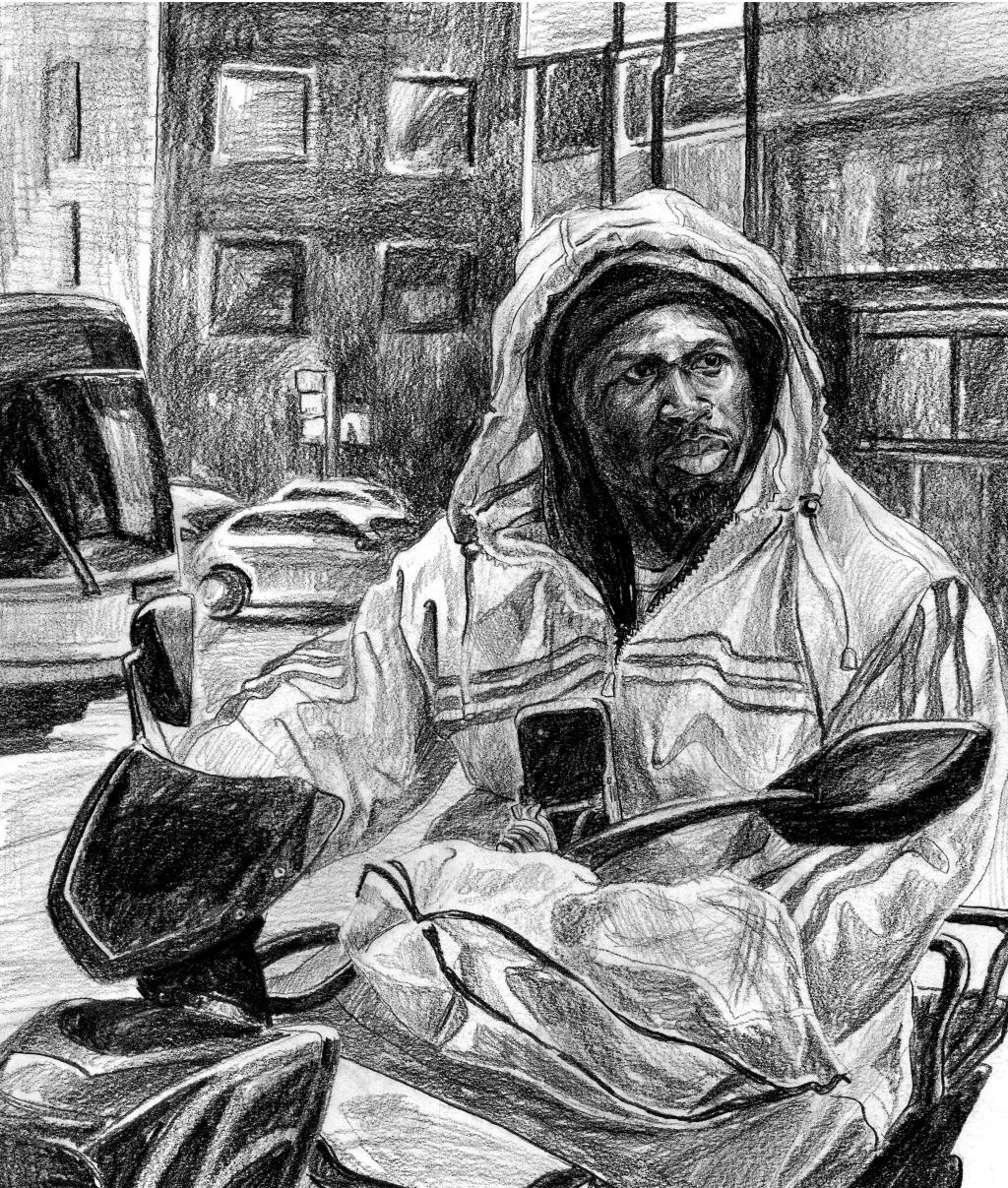
A social investigation report from GATT readers in NYC
We present this social investigation into a section of the immigrant proletariat in a global city, more precisely, into recently arrived migrant delivery workers in New York City, to deepen our understanding of the different sections of the proletariat in the US today. In the last three years, there’s been a change in the makeup of migrant arrivals in NYC, with an increased number coming from countries outside of Latin America. Also in the past few years, the streets of New York have become saturated with delivery drivers on bicycles and e-bikes. We decided to get to know this fast-growing section of the proletariat, and to focus specifically on West African delivery drivers due to the language abilities of our crew (French speakers) and the high concentration of recently arrived West African migrants working in this occupation.
Especially since the pandemic, the gluttonous American petty-bourgeoisie has become accustomed to relying on all different kinds of delivery apps, such as DoorDash, to facilitate the parasitic overconsumption that they use to fill the void in their souls created by the perverse social relations of capitalism-imperialism. This boom in app-driven consumption has created the need for a semi-invisible servant underclass to deliver treats and toys to the petty-bourgeoisie. However, there has been a serious dearth of fresh communist analysis and social investigation both on the lives and struggles of this servant underclass, and on the precariousness of the gig economy overall. We wanted to know more about this section of people forced into the shadows: their stories, their struggles, and how we can better relate to them to bring them forward into the light. We’ll be referring to them as “dashers” after the DoorDash app that many of them work for, and we use this term as an indictment of the way that tech capital has pioneered new ways of exploiting delivery workers while subjecting them to greater precarity.
We knew heading into our social investigation that we would face challenges due to language barriers, the mobile and individual nature of “app employment” jobs, and the lack of a natural geographic concentration of delivery workers, but we hope that by sharing our experience and initial strategic thinking, other GATT readers will be able to take up this project in different cities and across different languages to fill in the picture. All interviews were conducted in French and then translated into English.
Where to look?
In recent years, with the help of electric bikes flooding the market and some limited improvements in cities’ bike infrastructures, there’s been a growing number of delivery drivers switching from using cars to electronic bicycles. This enables recently arrived migrants who may not have the ability to buy and operate a car to have a means of income with a lower barrier to entry.1 In New York City, start-up company Joco has tried to take advantage of this by offering an e-bike rental service and 55 rest stops throughout the city (and counting) to delivery drivers. These bike concierge shops are a place to service bikes, recharge phone batteries, and get some shelter from the cold. To our advantage, they provided us with a central location where we could go and talk to drivers. We also looked for other natural resting spots marked by high numbers of parked e-bikes out in the streets. We found fast food chains like Dunkin’ Donuts, McDonald’s, or Taco Bell, as well as mosques, to be good starting points.
We also noticed that many of these gathering places were located on the border between gentrified petty-bourgeois neighborhoods and proletarian neighborhoods. Dashers want to congregate in areas where many people will be ordering food, ideally places where they’ll be able to make the best tips, but also near their own shelters or apartments, cultural centers like African mosques, and places where they can get a cheap bite to eat or coffee.
Taking the long way up: a common migration route
We first met Hamidou, 29, from Guinea, outside of a Joco shop as he was finishing up his day. He used to be a semi-professional soccer player in Abidjan before he moved to the US one and a half years ago, fleeing ethnic persecutions from the military. He talked to us about his journey on foot through Central America to cross the southern border. His smile faded as he recounted passing through Mexico. He escaped with a couple of his fellow travelers from the hands of a cartel who was supposed to show them the way to the border. He explained that the cartel was harassing them, not giving them food, demanding high sums of money, and left them with no choice but to flee. After he made it to NYC he stayed in a homeless shelter and was able to get a pro-bono attorney and an interpreter who are helping him with his asylum case.
We ran into Papise, in his late thirties, from Senegal, at a flea market while he was trying to hustle us some goods. He’s been in the US for two years and while he’s only been at this market for a week, he says he has delivered food before, which explains why he had the food bag on him to store his things. He took the same southern route as Hamidou and stayed with family in Atlanta, until moving to NYC one month ago. He said he wanted to come to NYC because he knew there was a Senegalese community here. He added that it was easier to get around here because of the transit system, in contrast to in Atlanta, with its car-centric infrastructure.
The specific immigration route that Papise and Hamidou took was the first thing that came up in many of our conversations with West African delivery workers, who for the most part all took the same route. We are intentionally redacting the particular details of the route because we don’t want to blow up the spot. That said, as revolutionaries looking for opportunities to unite the immigrant proletariat across linguistic and cultural barriers, it occurred to us that the common experience of crossing the southern border is shared by immigrants from many different countries and is therefore a potential basis for building up the class-consciousness of the immigrant proletariat.
Socially integrating in the US
We wanted to get a better understanding of people’s social lives, how they were staying in touch with their families back home, and how they saw themselves fitting in as part of this country. Hamidou burst out laughing when we asked him where he liked to hang out when he was done with work, saying that “I don’t have any friends, it’s you my friend. You are my first friend here. I live simply, I don’t talk too much, I work with my phone.” Jokes aside, he is sending money home once a month and contacting his immigration attorney on a weekly basis to get help ranging from legal advice to emotional support.
Adam, twenty, from Chad, moved here by himself two years ago. He was in a little huddle with three other men who had come from Sudan in the last year, escaping the war, and he helped translate our conversation into Arabic for them. Adam still has family back home and calls them regularly, but he doesn’t have much free time, and doesn’t see his NYC friends outside of when he’s working. We found that people usually happen to run into each other at rest stops, but it varies depending on the day or what part of town they are in. He goes to school on the weekends to learn English, and the rest of the days, he works as a dasher.
A young man we met outside Dunkin’ who came from Mauritania three years ago said that he tries to go to Masjid on Fridays, or organize get-togethers for iftar during Ramadan, but that otherwise it is pretty difficult to have time off. To this point, our conversation was cut short because he needed to run a delivery.
The demanding work schedule is one barrier to dashers paying attention to and participating in the political life of the US. For example, when we asked Hamidou if his deliveries were disrupted by Palestine protests shutting down roads in the last year, he answered candidly: “Since I came I’ve been overwhelmed. My family called and my mom got sick, it perturbed me! She even wanted to leave the world, so I needed to figure out how to make money to cure her. My head was full, so all that, me I don’t even know how this country functions. You see even women hit on me et je m’en fous maintenant [laughs]. It’s not the right time! It will come later.”
He seemed genuinely surprised too when hearing about instances of police brutality and killings in the country, citing that luckily up until now he has not had to deal with this. He shared that it was difficult for him to understand at first when someone in the homeless shelter explained to him that if cops were to look at him, they would not be able to see his African side, all they would see is a Black man. This is part of a contradiction that we will need to work through in bringing forward the revolutionary potential of the immigrant proletariat: recently arrived immigrants are getting accustomed to new social norms and the particular forms of oppression in the US, and as a result their view of the US is different from that of people (immigrants or not) who have spent most or all of their lives living here.
Three-front class war: clients, restaurants, and the application
We asked Hamidou about his main concerns and worries on the job. DoorDash, which was founded in 2013, is the dominant platform for food delivery. They boasted having 42 million active users and 8 million dashers, and clocking 2.5 billion orders for the year in December 2024.2 But the exorbitant $10.5 billion revenue made by DoorDash in 2024 did not trickle down to dashers like Hamidou. He was stressed about his ratings, saying that he’s always scared that someone would dislike his service, or that he’d be late on the road due to traffic, and that his account would get deactivated. If he was able to find a better-paying job he would absolutely take it, but as of now he is stuck in this position (“we don’t have a choice hein”). In the off season he makes as little as $300/week, but during the holiday period it could go as high as $800/week; what he makes fluctuates greatly depending on the time of day and people’s moods.
Amidou Lamine, in his early thirties, from Mali, was resentful about DoorDash. He’s lived in the US for the last three years, and we met him in a Dunkin’ Donuts in Hell’s Kitchen. We asked him what kind of problems he was facing on the day to day and listened to his story while the notifications for new orders blared what felt like every thirty seconds:
Oh la la, the problems are enormous. Firstly, not only does the application with which we work not pay us how they should, according to the laws. But secondly, the restaurants where we pick up the orders have no respect for the drivers. No respect for the drivers when we go pick up the orders. There are others who insult us, who demand that we wait outside when it’s thirty degrees (F); I don’t know how to say a form of, a form of harassment. A form of racism, of detesting someone. And thirdly are the clients. We go to certain buildings, they demand that we wait outside. When buzzing the door to give the order to the client, we write messages, we tell them we’re on the way, but even with that you arrive, you call, they don’t come. We have a seven-minute timer; some come during the seven minutes, others wait till the end. We are forced to wait. When the client complains against you, they are always right. Even when we send messages, we take pictures, everything, the client is always right.… Us the delivery drivers, the client is right over us, the application is right over us, and the restaurants are right over us. Sometimes we ask ourselves among each other, what is there against us? Everywhere we go we are segregated, we are mistreated.
The fear of being deactivated was common across our conversations, is discussed in the current body of literature about app work as a problem other dashers across the country face, and is revealing itself to be a key class antagonism to mobilize around.3 A vicious aspect of this abuse is that it happens digitally behind closed doors, and sometimes the deactivations will happen randomly because of the algorithm’s fault. We need to find ways to expose and combat it.
Amidou Lamine chalked up the disrespect he was facing purely on the grounds of the language barrier. He’s observed a few delivery drivers who are American and speak English—there’s not many, but there are a few. The minute they walk into a restaurant he happens to be in, the restaurant worker will start being disrespectful, but as soon as they hear the driver speak English, they’ll quiet down. As he recounted this story we could feel his indignation rise:
When someone comes up to you and you can’t answer, what are you gonna do? You can’t answer because of the language, you are forced to be quiet, you are forced to take it in. That’s it. We have nowhere to go to complain. We have no one to defend us. They steal our bikes, we went to the police to get help, and nothing. We went to the police and they started yelling at us, so we left. You know, in all communities, there are good ones and bad ones. But to us, the delivery drivers, without lying to you, 90% of the people we meet are bad people. They don’t behave well with us. They are evil against us. They do not want to see us. This you understand.
Talla, in his early twenties, from Senegal, also seemed to relate to what Amidou Lamine described, being antagonized and treated as lesser by people from every level of society. He shut down after we asked how people treat him when he’s outside in the streets delivering, if any passerby ever look at him or make eye contact. He just looked away, down, and quietly said no. He had worked as a dasher for two years but he was describing his aspirations to become a security guard or work at an Amazon Warehouse to get out of the cold. He had conflicted feelings about it because he took pride in being self-employed (as he said, “I am my own boss”), and liked the flexibility of setting his own schedule, while at the same time he wanted more stability.
We heard others share a similar aspiration to work at an Amazon Warehouse. We met Apha, twenty, from Senegal, who worked at one for half a year before being fired and needing to dash. He’s in school doing his GED, and works the rest of the time, but his story illustrates the revolving door employment that many proletarians experience, alternating different jobs in the gig economy at different times of the year.
No legal options and no illusions
Mamadou Traoré, in his late forties, from Guinea, sitting across from Amidou Lamine in the Dunkin’ Donuts, jumped in to talk more about the lack of a union for delivery drivers. He was vice president of a national trade union in his home country (CNSIG: Conféderation Nationale de Syndicats Indépendent de la Guinée), and has lived in America for three years. He looked into starting a union but he stopped in his tracks because of fear of retaliation. “If they detect you, you will be deactivated. And we don’t have other means of income other than those applications. They will cut you! So that’s it.”
Another man who had briefly walked in to Dunkin’ shared that the problem as he saw it was also the lack of recognition as an employee. It’s true that dashers get the worst aspects of being independent contractors and none of the benefits. The Protect the Right to Organize Act (PRO Act), which would legally recognize a path for platform workers to form a union, passed in the House of Representatives in 2021 but it has since stalled and died. Similarly, at the state level, the state of California passed Prop 22 in 2020, which denied app-based gig workers the ability to bargain collectively or become members of unions to represent their interests. Due to the fact that dashers have been totally locked out of seeking recourse or upward mobility through official channels, and are not receiving any help or attention from any other organized forces in society, we believe this group of people is a reservoir of revolutionary potential that communists should make an effort to tap into.
As an aside, we heard from Hamidou and a couple other people about the positive and morally supportive relationships they’ve been able to build with their attorneys and the crucial role that courtroom interpreters played to help them navigate their case. Seeing as there are so few of them, their services are in high demand, and by the nature of their job they have established lines of communication with recently arrived migrants, they struck us as an important group of people to get to know more. The role they can play as individuals working within the immigration system is extremely limited, which, if they really care about helping the people they claim to help, gives them even more incentive to take action outside the courts. As organized ties operating under communist leadership, they could make significant contributions to the realizing the revolutionary potential of the immigrant proletariat.
Contradictions among the people
We set out to better understand the struggles that delivery drivers faced, and Hamidou’s story brought many to life (taking care of family back home, dodging deactivation, facing social isolation, etc.). What we wanted to probe, too, was how the delivery workers saw and were seen by other sections of the American population, including but not limited to: the other proletarians that they worked alongside or in parallel with at times (restaurant workers and bike maintenance/rental people), and the overwhelmingly petty-bourgeois customers placing the orders. The contradiction between the lower-and-deeper migrant gig workers and those one or two steps above them on the class ladder reared its head when we attempted to talk to delivery workers inside a Joco concierge shop. It was a very cold day, and people were gathering in there between deliveries, which at first let us strike up a conversation.
However, when we started talking with a dasher about a recent ICE raid on Canal Street in lower Manhattan that had targeted West African migrants, a Joco worker perked up and came over to see what we were doing. We told him we were independent journalists working on a report. At first, he seemed to be trying to maintain a veneer of neutrality, but as we got into explaining our goals at understanding the lives of the delivery drivers, it became clear that he’d deduced our that we were coming from a perspective sympathetic to the dashers—and he was unhappy with it.
“They make trouble, they don’t listen, they don’t speak English on purpose, they don’t follow orders,” he told us with gratuitous eye-rolling. “I don’t know why they complain about the work conditions. They’re not employees, they’re contractors, so they just don’t deserve all the same rights as employees!” He said that since they’d filled out their paperwork, they knew what they were getting into, and “they shouldn’t complain.” All of this was said with the men we had been talking to within earshot, and contrary to what he told us, many of them did speak a little English and undoubtedly understood the sentiment of what he was saying.
His attitude towards these immigrants—that they were a nuisance, that he resented their lack of English fluency, that they were “troublemakers”—is similar to what right-wing propaganda sounds like. However, it would be a mistake to chalk it up purely to propaganda. This man didn’t strike us as someone who was a full-on, committed revanchist, though he certainly was influenced by the winds of revanchism in society. His class position had just as much to do with the shit he was spouting. He’d worked his way here, he told us, from an Amazon warehouse position. He was an employee, unlike the men he kept interrupting himself to yell at, and he clearly saw it as his role both as a Joco worker and as an American citizen to keep those foreign delivery drivers acting right by acting as a petty tyrant over them.
As we left, one of us was able to catch a sign with the rules that he and his coworkers were designated to enforce. It reminded the workers to keep quiet, not stay any more than fifteen minutes, to check out the official Joco merchandise for sale, and to “sip and savor” at the water fountain rather than drinking too much water. Later, at a different shop, we got kicked out by a Joco employee who threatened to call security on us within minutes.
Mamadou downplayed the disrespect by restaurants as something he didn’t experience particularly acutely, citing only a minor annoyance of not being able to use the restroom unless you are a customer. He was more passionate about the antagonism between African immigrants and Black Americans: “On the idea of racism and harassment that he was talking about [referring to Amidou Lamine], in any case to specify for me, here, I never received that from people with a different color skin than me. I’ve always had Blacks more racist than whites. And this is not a discussion, everyone agrees on this point. If there is racism here, it’s with Black Americans.” As he went on he described dreading and ultimately not wanting to deliver food in the Bronx because he knew he would get treated poorly. He wouldn’t even dare ring a doorbell to a customer’s door or buzz downstairs by fear of retaliation or being treated poorly. He was extremely bitter about the situation and described other instances of virulent anti-migrant sentiments and facing harassment and abuse from Black Americans.
Amidou Lamine got agitated and bitterly added on: “There’s people when you walk in to restaurants who pinch their noses and look away from you. I don’t smell! I wash myself. I know what soap is. I know what perfume is. I am not a savage, I am African. I am civilized!”
Under capitalism-imperialism, Black Americans and Africans have been taught to hate each other, and that fact is inseperable from both Black Americans and Africans being taught to hate themselves. For example, in her autobiography, Assata Shakur writes about growing up Black American and being taught to hate herself:
Behind our fights, self-hatred was clearly visible…. We would call each other “jungle bunnies” and “bush boogies.” We would talk about each other’s ugly, big lips and flat noses…. We had been completely brainwashed and we didn’t even know it. We accepted white value systems and white standards of beauty and, at times, we accepted the white man’s view of ourselves.4
Later on in the same book, she describes in similar terms how she had been taught to see Africans:
When i was a little kid, if you had asked me what Africans ate, I would have answered, “People!” … Only a fool lets somebody else tell him who his enemy is. I started remembering all the stupid stuff people told me when I was little. “Don’t trust West Indians because they’ll stab you in the back.” “Don’t trust Africans because they think they are better than we are.”5
Another contradiction among the proletariat that the drivers talked about was crime, particularly theft. Amidou Lamine had two of his bikes stolen where he lived in Harlem, and another dasher we talked to outside of Joco had three of his stolen. For these recent immigrant delivery workers, bike theft has serious ramifications on their lives. One man we talked to told us that bike theft can get the driver in tons of trouble with Joco—it’s not just days of lost time and money, it’s an endangerment of their jobs and of their very ability to stay in this country at all.
Out of the cities, into the suburbs!
New York City is a unique setting for food delivery drivers, but it is only one piece of the puzzle. We would be interested in seeing what a similar investigation in a city without rental bikes looks like, and in suburban settings—do migrants aiming to do delivery work have to build up more capital and get their own vehicle? Does this barrier lead to migrants looking for jobs elsewhere, such as in domestic labor or the informal economy? Is there a similar sense of solidarity between bikers who have their own bikes and do they also have shared resting stops? How do they handle the even greater degree of isolation that comes with suburban geography?
On another note, we were struck that we only ran into young men when we especially focused on West African migrants. When we asked about their interactions with migrant women from West Africa, a few responded that they had traveled together before going on separate paths after crossing the border, but not much more. More investigation is needed into the gendered breakdown of West African immigrants. As far as language barrier goes, we found that having just one strong and one intermediate speaker was enough to convey what we were doing, reminding us that it’s better to get out there and occasionally stumble on a few words, and to strengthen your language skills along the way, than to do nothing at all.
Most of all, we wish we had gotten the chance to investigate much more deeply the ways in which these gig workers can be mobilized towards collective struggle, and ultimately, towards a leading role in proletarian revolution. While the bikers we met had sharp understandings of the contradictions that led to their current position and treatment, we still heard a somewhat pervasive individualism and a wavering between fighting for a better life and chasing the American Dream. Far more work among this section of the proletariat than a few interviews is necessary to start to answer the question of how these workers can be organized and mobilized for revolution.
1E-biking has also become a bit of a trend online, with some dashers recording their routes for hours on end. Look up Biker LA on YouTube for a view through a dasher’s point of view in downtown Los Angeles.
2Human Rights Watch, The Gig Trap: Algorithmic, Wage and Labor Exploitation in Platform Work in the US (May 2025).
3Ibid.
4Assata Shakur, Assata: An Autobiography (Zed Books, 1987), 30–31.
5Ibid., 150–52.
 Going Against the Tide: A journal charting a path for communist revolution in the US