
Capitalist roaders seize the commanding heights of state power
On September 9, 1976, Mao Zedong passed away. China lost the revolutionary leader who had guided the masses to victory and charted the stormy waters of the socialist transition to communism, and the world lost the greatest communist leader of the time who had pioneered pivotal breakthroughs for the international proletariat, in theory and practice. Impressive new leaders had come forward through the course of the Great Proletarian Cultural Revolution, but there was no replacing Mao. Moreover, at that particular juncture, Mao’s authority served as a bulwark against the capitalist roaders seeking to replace his revolutionary line with their own, counterrevolutionary, politics and program. With Mao out of their way, capitalist roaders in the Chinese Communist Party moved quickly and decisively to seize power.
The October coup and its reactionary accomplishments
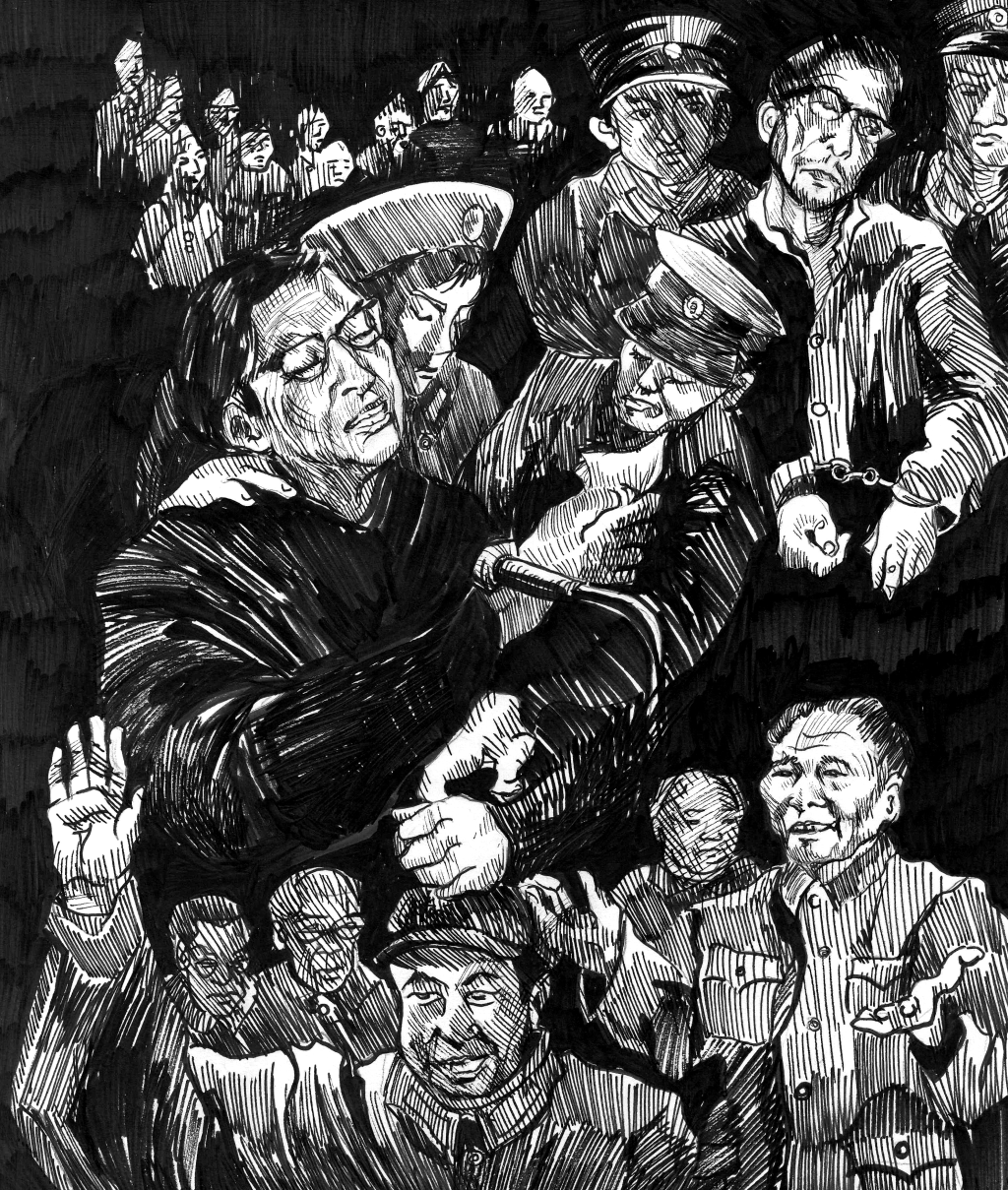
Just a month after Mao’s death, units of the People’s Liberation Army in coordination with Hua Guofeng, who officially replaced Mao as Chairman of the CCP, carried out a coup. Beginning October 6, 1976, many of the firmest defenders of Mao’s revolutionary line and the advances of the GPCR were rounded up by the military and arrested, including Zhang Chunqiao, Yao Wenyuan, Wang Hongwen, and Mao’s widow, Jiang Qing. Top Party leadership and state administration were purged of many of those who had risen up the ranks, or been on the revolutionary side, during the GPCR. About a fourth of the Central Committee, six members of the State Council, and over a third of top provincial and regional Party officials were deposed.1
The ease with which the initial arrests took place owed to the fact that many revolutionary leaders were gathered in Beijing after Mao’s death, and the PLA unit responsible for guarding Party leadership in the capital, led by Wang Dongxing, was firmly on the side of counterrevolution. Moreover, PLA leadership had been stacked with rightists in the wake of Lin Biao’s 1971 betrayal. As the threat of war with the Soviet Union loomed, there were few solid revolutionaries in the military hierarchy available to fill the void amid socialist China’s need to shore up its national defenses. The Maoist side of the CCP had attempted to win over more of the PLA to its revolutionary line in the mid-1970s, with Zhang Chunqiao becoming head of the PLA General Political Department for that purpose. But their efforts failed to build a sufficient bulwark against counterrevolution in the military. Capitalist roaders within the Party worked hand in hand with PLA commanders in carrying out the October coup, but the murky moves behind closed doors, via back channels, and through longstanding counterrevolutionary connections mean we may never know exactly how the coup was planned and who made what decisions.
We do know that there was resistance from the masses to the coup. In Shanghai, a bastion of GPCR militancy, the revolutionary militia took up arms against the no-longer-People’s Liberation Army, but could not defeat their better-equipped adversary. Additional incidences of armed resistance, by soldiers on the side of revolution and by rebel masses, as well as strikes, worker absenteeism, student unrest, and other disruptive actions occurred from Fall 1976 well into 1977.2 Given the new counterrevolutionary government’s seizure of the media and use of censorship, mass arrests, and repressive measures, it is difficult to know the full extent and exact details of mass refusal to go along with the counterrevolution. Unfortunately, beyond the coordinated revolt in Shanghai, resistance remained scattered, as those who could have provided strategic leadership to it had already been locked up.
What started in October 1976 proved to be the opening salvo—though a decisive, victorious one—in a rolling counterrevolutionary coup and consolidation of capitalist roader power that reached its thorough conclusion in September 1982. At the beginning of that rolling coup, Hua Guofeng took the reins of state power. Hua had shot up the Party hierarchy in the mid-1970s as a middle-of-the-roader when neither revolutionaries nor rightists could prevail over each other in securing a commanding position at the top of the CCP. Officially designated as Mao’s successor by virtue of his position as Vice Chairman, Hua assumed chairmanship of the Party after Mao’s death while also occupying China’s premiership. Hua was decidedly unremarkable in his leadership capabilities, and served above all as a transitional vessel through which more cunning counterrevolutionaries, especially Deng Xiaoping, could take center stage. Whereas Deng represented the old guard of capitalist roader Party leaders and technocratic administrators who had been knocked down during the GPCR, Hua was among those mid-level Party cadre who had replaced them, becoming bureaucrats themselves but ones untarnished by the struggles of the late 1960s. That position gave Hua and his fellow rising bureaucrats greater legitimacy than Deng and his ilk to begin rolling back the gains of the GPCR while claiming lineage to Mao and his revolutionary line. Indeed, Hua’s only real skill was in claiming fidelity to Mao while destroying his revolutionary legacy.3
A telling example of proclaimed fidelity to Mao while destroying his legacy was Hua’s use of the slogan “let a hundred flowers bloom” to encourage the publication of bitter tirades against the social transformations and politics of the GPCR years and to welcome the celebratory revival of literature and art that had been criticized as bourgeois during the GPCR. The flowers that were not allowed to bloom in 1977 were the writings and art of GPCR revolutionaries, who were imprisoned (for example, Yu Huiyong, the chief composer behind the GPCR’s yangbanxi, which were no longer performed) and/or purged from the ideological state apparatuses, especially the mass media, where they had occupied leading positions. Hua’s counterrevolutionary government knew the importance of controlling the narrative, and went beyond repression to concoct a conspiratorial narrative which labeled Mao’s now imprisoned revolutionary successors—Jiang Qing, Zhang Chunqiao, Yao Wenyuan, and Wang Hongwen—as a “gang of four” at the head of a conspiracy to usurp power for themselves.
This conspiracy narrative went far beyond the official stories about Liu Shaoqi, Wang Li, or Lin Biao’s betrayals in its absurdity and widespread promulgation. China’s newspapers and other mass media were filled with invective at the “gang of four,” including rather clownish cartoons, while studiously avoiding saying much of substance about their politics beyond labeling them as ultra-left. More than attacking the politics of these four revolutionary leaders, the smear campaign made them look like petty careerists trying to take over the CCP to stroke their own egos, when in reality they were models of selfless dedication to the masses and to advancing the revolution. Jiang in particular came in for vilification, with no shortage of misogyny, as the new rulers of no-longer-socialist China went to ridiculous lengths to justify locking up Mao’s widow while claiming continuity with his politics. Hua’s CCP used real and invented instances in which Mao criticized the “gang of four” in the mid-1970s to try and politically sever the former from the latter. Anyone honest about Mao’s methods of leadership and lines of demarcation knows that he did not hold back from criticizing his closest comrades and insisted on an atmosphere of critical evaluation and line struggle among communists, and that Mao’s criticisms of genuine revolutionaries had nothing in common with his condemnation of capitalist roaders.
Resting on repression and censorship, the ideological offensive on the GPCR and its leaders was essential to the consolidation of capitalist roader power. Its relentlessness in the mass media made public challenges to the official narrative virtually impossible. Its effects were long-lasting, with anecdotes and attitudes about the so-called gang of four’s careerist ambitions continuing to pervade popular consciousness in China down to today. The Hua government’s anti-GPCR ideological offensive and repressive onslaught paved the way for material transformations, beginning in 1977, that reversed the socialist transformations of the previous decade. Rather than serving the masses and remedying inequality between cities and countryside as it had during the GPCR, the education system returned to its mid-1950s and early 1960s focus on “key schools” in the cities that served the creation of a new elite. In economic development, the Hua government adopted the policies advocated by Deng Xiaoping in 1975, with “modernization” devoid of socialist content used to justify bolstering managerial authority in factories (and giving workers in state enterprises a wage increase to bribe them to go along), putting emphasis on productive forces over the masses’ conscious initiative, and sacrificing self-reliance to slavishly covet foreign technology. Modernization became the mantra recited to justify dismantling all things socialist in the subsequent decade. What Hua started, ideologically, politically, and economically, was completed over the next several years by more adept and experienced counterrevolutionaries.
The rehabilitation of the worst anti-GPCR reactionaries, with Deng in the driver’s seat
To carry out “modernization” and to shore up counterrevolutionary state power, Hua and his cohort of rising “middle-of-the-roader” bureaucrats began allowing capitalist roaders who had been exposed and deposed during the GPCR back into positions of authority, beginning with the economic planners who had opposed Mao’s reconception of socialist economics in the 1950s. But since their rise to power had come in part through the GPCR and depended on it for their legitimacy, Hua and his comrades kept a few outer trappings of GPCR politics going for a few months after the October 1976 coup, including the campaign to criticize Deng Xiaoping. Whatever Hua’s intentions, however, counterrevolution gained a momentum of its own after the coup, relying as it does on unleashing the most reactionary elements in society. Those reactionary elements found their leader in Deng Xiaoping, who, in Summer 1977, regained the positions of authority he held before Maoists deposed him in April 1976.
Rather than organizationally depose Hua, Deng methodically raised up his own well-trained followers into positions of authority without seeking the Party chairmanship or the state premiership for himself. Deng came to be called China’s “paramount leader,” and counseled his fellow counterrevolutionaries in the art of capitalism restoration. In addition to PLA commanders and Party officials, Deng found fervent supporters among the technocratic experts and administrators—the intellectual elite knocked down during the GPCR—who were eager to take back their class privilege and put the masses of proletarians and peasants back in check.4 The reactionary ranks were bolstered by the June 1978 release from prison of 100,000 rightists who had been locked up during and after the 1957 anti-rightist campaign.
The Deng-led rehabilitation of reactionaries touched the living and the dead. Peng Zhen, the first capitalist roader to be knocked down at the onset of the GPCR, was welcomed back into the CCP. Liu Shaoqi and Peng Dehuai were posthumously restored to the CCP’s good graces, and lionized as mistreated revolutionary heroes by Deng in speeches that bristled with revanchism against the Maoists who had knocked them down. Beyond matters of present personnel and gilded ghosts, Deng led an ideological campaign to reverse the correct verdicts of the previous decade. The April 1976 reactionary Tiananmen Square incident, which used public mourning for Zhou Enlai as a pretext for counterrevolutionary provocation, was rebranded as a revolutionary event. The capitalist roaders now in power loved to claim China’s beloved and conveniently deceased premier Zhou as one of their own and used him as an icon to justify their turn to “socialist modernization” and emphasis on reactionary stability.
Anyone who got in the way of that stability was subject to harsh repression. In the late 1970s, a movement for democratic reforms emerged among sections of the urban petty-bourgeoisie, especially former Red Guards who, as young adults, still retained some of the rebellious spirit of their youth, if not their former political clarity. They organized themselves outside the official channels of the CCP and state apparatus, and wrote critiques of both the GPCR and the post-1976 government, disseminated in their own, independent, publications. In 1979, their publications were banned, their organizations dismantled, and their leaders imprisoned. Beyond the specific repression of disgruntled petty-bourgeois intellectuals, the Dengists in power rolled back the culture of mass participation in political debate and decision-making that had been central to the GPCR. The “four bigs” (or “four greats”)—great airing of opinions, great freedom, big character posters, and great debate, which the masses exercised during the GPCR—were abolished and replaced with strict censorship and the imposition of reactionary law and order. It fell to the rehabilitated Peng Zhen to craft the legal codes that justified the new atmosphere of repression.
The rolling coup of repression of revolutionaries and rebels and rehabilitation of reactionaries increasingly sidelined Hua Guofeng and his comrades and put Deng Xiaoping in the driver’s seat. Along the way, Deng’s crew purged all their potential opponents—centrist, revolutionary, or reactionary—from any positions of Party leadership and state authority, from Beijing’s mayor Wu De in 1978 (who had suppressed the April 1976 counterrevolutionary demonstration) to Dazhai model production brigade leader Chen Yonggui and counterrevolutionary coup co-conspirator Wang Dongxing in 1980. Rather than install himself in the topmost organizational positions, Deng played the role of architect, advisor, and ultimate authority—the “paramount leader” whom the old guard capitalist roaders and technocratic administrators, managers, and experts trusted to advance their bourgeois class interests. Hua Guofeng’s authority became largely ceremonial by the end of 1978, and in 1980, Deng’s loyal lieutenant Zhao Ziyang took over the premiership while Hu Yaobang, another Deng loyalist, was appointed General Secretary of the Party. Hua’s position as Party Chairman became redundant, and was officially jettisoned at the CCP’s Twelfth Congress in September 1982. By that point, Deng’s comrades occupied all key leadership positions in the Party, state administration, and military command, and the Twelfth Party Congress rubber stamped Deng’s economic “reforms” that fully dismantled socialism in China.
Throughout the rolling coup, Hua and then Deng and their compatriots had to master the art of contradiction—not revolutionary dialectics, but the hypocrisy of maintaining the mantle of socialism and the moniker Communist Party while betraying their principles. As Mao had predicted before his death by looking at what happened in the Soviet Union, keeping the socialist and communist labels was an easier way to restore capitalism than was renouncing them outright, as those labels had mass legitimacy in post-1949 China. Indeed, the founding myth—in this case one based on reality—of the People’s Republic of China was one that revered the revolutionary heroism of the masses and the leaders who guided them to victory. Laying claim to those leaders, especially Mao and Zhou Enlai, and saying that socialist modernization would benefit those masses became the modus operandus of China’s new bourgeoisie in power. Since the contradiction between professed fidelity to Mao and actual reversal of everything he fought for is an antagonistic one, Deng’s counterrevolutionary government had to carry out two final cleaning up operations at the dawn of a new decade of capitalist triumphalism.
Revanchism and discursive deception as counterrevolutionary consolidation
After languishing in prison and unable to defend themselves from a vociferous vilification campaign in the press, Jiang Qing, Zhang Chunqiao, Yao Wenyuan, and Wang Hongwen, along with Chen Boda, were subjected to a two-month-long show trial that began November 20, 1980. Orchestrated and stage-managed by top CCP leadership under the cover of Peng Zhen’s new legal codes and carried out by 35 judges, the trial put forward a litany of ridiculous allegations, laden with conspiracy theory logic, including a purported plot to assassinate Mao (?!). Its main focus, however, was on painting the Great Proletarian Cultural Revolution and its aftermath as a terrible decade of unjust persecution, with handpicked “victims” brought to testify to the horrors they endured at the hands of the “gang of four” (i.e., revolutionary mass struggle). Selections from the proceedings were broadcast nightly to the nation via television in a curated attempt to create public opinion for reactionary revanchism, whipped up to ideologically consolidate capitalist roader power.
In the face of relentless persecution and the prospect of execution as the outcome of the show trial, Yao Wenyuan and Wang Hongwen wavered, and were sentenced to twenty years and life in prison, respectively. By contrast, Zhang Chunqiao and Jiang Qing remained defiant throughout the trial. Zhang, known for his ability to give hours-long impromptu speeches, stayed silent the whole time but persistently gave his accusers the coldest stare anyone has ever seen, as if laser beams seared through his glasses. Jiang took what little opportunity she had to firmly uphold her role in the GPCR, declaring “I was Chairman Mao’s [attack] dog. Whomever he told me to bite, I bit.”5 (Woofasté, comrade Jiang. The attack dog in us bows to the attack dog in you, and we vow to see your revolutionary defiance through.) Both Jiang and Zhang were sentenced to death; their sentences were subsequently commuted to life in prison, where they developed health problems and passed away years later, the whole time deprived of a platform to freely communicate their views to the masses.
Deng’s drive to discipline and punish the “gang of four” served as a model for similar trials around the country that condemned GPCR partisans to prison. Beyond its punitive and public relations purposes, the show trial of the “gang of four” served to give a verdict on Mao’s revolutionary leadership of the socialist transition period. It painted his most brilliant innovation—the need for cultural revolution during the socialist transition period to knock capitalist roaders from positions of authority by unleashing the masses in class struggle—as a terrible mistake of horrific proportions. The Deng-led CCP followed up this show trial with its greatest (in the sense of most terrible) theoretical work, the June 27, 1981 “Resolution on Certain Questions in the History of Our Party Since the Founding of the People’s Republic of China.”
The 1981 Resolution was an evaluation of Mao’s leadership of the socialist transition period from the perspective of victorious capitalist roaders. It condemned every move Mao made from 1957 on, especially the Great Leap Forward and the GPCR, and heaped blame on him for any hardships the people of socialist China endured in the difficult struggle to develop the nation’s productive capacity by radically transforming its production relations. Conveniently, blaming Mao left capitalist roaders, especially Deng Xiaoping, off the hook for their role in carrying out repression and mismanaging the economy in the late 1950s. Furthermore, by presenting the GLF and the GPCR as economic disasters, the dramatic advances in China’s productive capacity made during them were whitewashed from history, allowing Deng to take credit for China’s growing (capitalist) economic prowess in the 1980s.
According to the Dengist 1981 Resolution, at the root of Mao’s errors was that he believed that subjective agency—the conscious revolutionary initiative of the masses—could defy the objective laws of historical development. In other words, for Deng and his ilk, Mao’s combination of revolutionary dialectics and faith in the masses was not the brilliance that all communists must aspire to, but a heresy to be purged in favor of being realistic and only demanding the possible. In Deng’s rise to power in the late 1970s, he used Mao’s insistence that practice is the ultimate gauge of truth to promote pragmatism, justifying modernization along capitalist lines by bastardizing Mao’s philosophy. The rolling counterrevolutionary coup of 1976–1982 was a crime of epic proportions. The twisted and deliberately deceptive denunciation of Mao’s revolutionary teachings has arguably done even worse damage, and those responsible for both have yet to meet their day of reckoning.
Communism, the goal that socialist China strove for, is a society without classes, and as such without a need for a state, the instrument by which one class rules over others. Until that goal is reached, after the overthrow of capitalism, the socialist state serves as an intermediary between revolutionary leadership and the masses, including by taking ownership over the economy and directing it towards the elimination of classes and of commodity production and exchange. The socialist character of the state is defined, among other things, by how the revolutionary leadership, concentrated in the vanguard party, relates to the masses, and in which direction the production and social relations, culture and ideas, are moving. Beginning in October 1976, the character of China’s state power was fundamentally transformed, with capitalist roaders assuming all the key leadership positions, imprisoning revolutionary leaders and exercising a bourgeois class dictatorship over the masses, and reversing the direction of society towards capitalism instead of communism.
Every form of state power has its commanding heights: in a socialist state, the leadership of the communist party; in a capitalist parliamentary democracy, the executive branch; in a feudal monarchy, the royal court; in a military dictatorship, the military high command. Those commanding heights are the decisive lever of state power, and whoever holds them gets to determine the character of state power, provided they have the support of the military and the bureaucracy. In 1976 China, once the commanding heights of state power decisively passed from genuine communists to capitalist roaders by way of a counterrevolutionary coup, the state was no longer a socialist one, but a bourgeois dictatorship.
That fact, however, does not mean that everything socialist about China was dismantled in one month. Instead, it means that a new bourgeoisie had the state power with which to dismantle socialism, step by step and leap by leap. To do so, they used the existing forms of the formerly socialist state, from the Communist Party that led it to the PLA and state administration to the economic planning commissions and state ownership of economic enterprises, while transforming their character. For this reason, we can recognize the October 6, 1976 counterrevolutionary coup as the decisive loss of socialism in China and firmly condemn the counterrevolutionaries who seized state power while also acknowledging that the capitalist restoration that followed involved a lengthier process, including struggle among the new bourgeoisie over how to implement it.
Anyone who fails to recognize the counterrevolutionary coup as the end of socialist state power and the start of capitalist restoration is left with no choice but to support a new bourgeoisie against the masses of people, and side with counterrevolutionaries against the genuine communist leaders they overthrew, such as Jiang Qing and Zhang Chunqiao. What is needed in today’s China to get back on the socialist road is nothing short of another revolution that overthrows the existing state power and the bourgeois class it serves. To more deeply understand that conclusion, let us turn to how Deng Xiaoping and other CCP leaders went about using the state power they seized to establish capitalism throughout China.
Dismantling socialism and establishing capitalism
From 1949 to 1976, the Chinese people overcame material deprivation and poverty, which were generated by centuries of feudalism and a century of foreign domination, and created an impressively productive economy that met their needs and made socialist China a formidable power on the global stage. They did so not with the motivation of profit and individual enrichment, but guided by socialist aims in an economy that was planned to serve the people and owned by the masses, via state and collective forms. Even more impressive than the amount of grain produced and the rapid industrialization was the radical transformations in production relations, ones that brought the masses forward as the conscious masters of production rather than as workhorses whose labor was under the command of, and benefited, landlords or capitalists.
Under Deng Xiaoping’s leadership, the post-1976-coup Chinese government set about “reforming” those relations of production by putting profit, and a new bourgeois class, in command, dismantling state and collective ownership of the economy in favor of privatization. They justified their drive to privatize by claiming it would boost China’s production outputs and develop its productive forces and thus, somehow, in the distant future, advance socialism. While they succeeded in boosting production in some sectors of the economy and delivering more consumer goods to the privatized market, they did so by creating a new class of hundreds of millions of exploited workers and unemployed, who could not afford the benefits of “socialist modernization” and were brutally repressed anytime they dared to stand up against the new capitalist order.
In the 1980s, old forms of exploitation returned to China, but capitalist restoration, as it has often if somewhat erroneously been called,6 largely came by way of new forms of exploitation, from capitalist agriculture to export-processing manufacturing to a construction boom relying on a vast reserve army of labor thrown out of agricultural production. But imposing those new forms of exploitation on the masses was no easy task. While capitalist roaders had state power firmly in their hands after October 1976, they faced a population that had thrived under socialist relations of production and had a living or generational memory of the horrors of feudalism and imperialist exploitation. Moreover, the socialist structures created over the previous three decades, from communes in the countryside to state-owned industrial enterprises concentrated in the cities to healthcare and education systems that served the people, buttressed the class power and collectivity of the peasantry and proletariat and the class alliance between them. Therefore, the Dengist government had to break up those socialist structures, discredit and defeat the communist ideology that guided the masses within those structures, create substantial consensus for its “reforms” through material rewards and a propaganda offensive, and break the class power and alliance of the proletariat and peasantry. They did so in one sector of the economy after another, beginning with weak links and by creating new economic forms and eventually encompassing the entirety of China’s economy, polarizing the masses into beneficiaries of privatization and its exploited and unemployed victims in the process.
Destroying the communes, privatizing the countryside
The communes created in China’s countryside during the Great Leap Forward in the late 1950s were bold building blocks towards communism. Rather than waiting for mechanization to alleviate the need for arduous labor in agriculture by the majority of China’s people, the masses of peasants collectivized their land, labor, and tools, and also collectivized the administration of daily life and social relations. The initial creation of the communes was uneven and full of unforeseen problems in accounting, administration, and distribution, which could only be worked out through trial and error. And the communes remained contested following the GLF: in the early 1960s, many were shorn of socialist content, whereas during the GPCR, they were further revolutionized through mass initiative and the overthrow of Party leaders incapable of or unwilling to lead them in the direction of communism. Nevertheless, whatever their weaknesses, the communes were a great feat of accomplishment that eschewed the path of individual proprietorship, which had steered most societies coming out of feudalism into capitalism rather than collective liberation.
By the late 1970s, many communes were models of egalitarian social relations and effective agricultural production, others were poorly run by corrupt or indifferent Party officials, and still others fell somewhere in between. Moreover, while inequality within communes was minimal, inequality between communes remained due to ineffective management or natural differences in land and resources across China’s vast countryside that made crop cultivation difficult in many places. Since overcoming the serious production problems during the GLF, collective agriculture had steadily boosted grain yields and the communes began to conquer a wide variety of sideline production activities, from orchards and raising livestock to mining and small-scale industrial enterprises. However, mechanization had yet to predominate Chinese agriculture, so increases in crop yields tended to be incremental rather than dramatic, and collective agriculture required large numbers of laborers. Those laborers had their basic needs met by the socialist structures that governed their lives, and they lived and related to each other in ways closer to the communist future that the present capitalist hell, but without widespread availability of consumer goods or modern conveniences.7
The remaining inequalities between communes, the mismanagement and inefficiency of some communes, and the lack of mechanization and accompanying boost in labor productivity were a material basis for the Dengist government to gain support for privatization among some sections of the peasantry. Simply put, some peasants did not see their lives materially improving through collective agriculture and, in mismanaged communes, saw privileged Party officials lording over them rather than joining with them in labor and the revolutionization of rural life. Therefore, soon after the 1976 counterrevolutionary coup, capitalist roaders could successfully encourage some disgruntled peasants to retract themselves from collective agriculture in favor of crop cultivation by individual families who could reap the rewards of their own labor rather than sharing in the successes and failures of their collective production teams. Those initial shoots of individual proprietorship were then used by the capitalist-roader-run Chinese Communist Party to declare the communes hurdles to peasant productive enterprise and begin dismantling them.
In September 1980, the Dengist government promulgated the household responsibility system (HRS) as the new relations of production to supersede the socialist communes in the countryside. Under the HRS, collectively owned land was broken up into individual plots assigned to families that were part of the production teams in the communes. Those plots of land were still officially collectively owned, but contracted to individual families, becoming de facto individual ownership that could be passed on to the next generation, especially when the contracts for private plots were extended to fifty years. In addition, the farming tools and draft animals that belonged to the production teams, brigades, and communes were divvied up among peasant families, becoming privately owned means of production along with the land.8
Some peasants embraced privatization and grabbed up the best land and tools they could, with rural Party officials and production team leaders often taking advantage of the process to dole out the best land and tools to themselves and their relatives. The feeding frenzy by the selfish put pressure on the skeptical to join in or get left behind with the worst land and no tools to farm it. Other peasants, especially in successful communes and among those families who did not have sufficient labor power to fend for themselves (including due to the sacrifice of a family member in the War to Resist US Aggression and Aid Korea), resisted the privatization of agriculture as long as they could.9 However, once the direction was firmly set, by central leadership, in the direction of privatization, the collective ethos that had defined socialist China quickly deteriorated. As Joel Andreas puts it,
Despite the fervency it had once inspired, the collectivist ethic ultimately proved to be quite fragile. It had depended on the goal of a classless society; once this goal was abandoned, collectivism could not but collapse, for if some were to reap the rewards of others’ hard work and sacrifice, the latter would not be heroes, but fools.10
While the Dengist government painted decollectivization as a bottom-up process demanded by the masses of peasants, the Party in fact had to impose privatization on many unwilling communes and replace resistant rural Party cadre with compliant ones. To create public opinion for privatization, a propaganda offensive ensued, decrying the supposed horrors and inefficiencies of collective agriculture and extolling the virtues of getting rich via individual family farming, and the media distorted reality and history to whitewash the achievements of a collectivized peasantry in socialist construction.11
A telling example of that propaganda offensive and the imposition of decollectivization from above was what happened to the Dazhai production brigade that Mao had heralded as a model of collective agriculture. As stated above, Dazhai’s impressive peasant leader Chen Younggui was removed from Party leadership in 1980. Even with Chen knocked down, the peasants of Dazhai refused privatization, and the CCP installed a village Party Secretary from the outside, who was on state payroll with a good salary, to impose decollectivization. The decollectivization of Dazhai was preceded and accompanied by a nationwide propaganda campaign that falsely claimed the model production brigade’s achievements were inflated and the result of state funding and PLA labor. After decollectivization, the propaganda campaign used 1986 income figures that were not adjusted for inflation—which had been out of control in the mid-1980s—to paint a picture of peasants prospering under privatization.12
The reality of Dazhai under decollectivization was increasing class polarization and even exploitation of wage-labor. The harvest in 1983, the year of decollectivization, was impressive in its yield, but rested on the land improvements done by collective labor in the preceding decades. After 1983, crop quality, which had been robust in Dazhai under collectivization, began to decline, as did quantity, with the village failing to produce the grain its residents needed to eat by 1987 and villagers having to purchase grain on the market. Under collectivization, Dazhai had expanded its productive activity to include various forms of sideline production. Among them were fruit orchards and a coal mine that reached their fruition in 1983, fortuitously for the Deng government, which appropriated their successes in its propaganda for privatization. Most of Dazhai’s existing sideline production activities, however, were scrapped under privatization, as they could not be run without collective labor. Those that remained or expanded, such as coal mining, began to exploit wage-laborers to turn a profit for their proprietors.13
Dazhai’s fate under decollectivization is the particular expression of the more general consequences of agriculture privatized in 1980s China. The first few years of privatization unleashed the entrepreneurial energy of profit-minded peasants and broke up inefficient collective agricultural production brigades, resulting in some boosts in agricultural yields.14 How great those yields were is questionable, given that they included the divvying up of grain stores that had been built up under collective agriculture. Whatever the true yield, individual peasant proprietors were paid handsomely for their produce in the early 1980s by large increases in the price paid by the state’s grain procurement, not the workings of the private market as the Dengist propaganda offensive claimed. In other words, the capitalist-roader-run state inflated peasant income under privatization out of its own coffers in order to incentivize and propagandize decollectivization. Consequently, peasant income increased up through 1984, making the Dengist maxim “to get rich is glorious” seem true for those that did well within the household responsibility system while leaving those without adequate laborers in their family or entrepreneurial skill behind (as another Dengist maxim put it, “some will get rich first”).15
However, after 1984, the productive capacity of privatized agriculture began to crash on its own contradictions. The infrastructure projects, such as irrigation and reservoirs, produced by collective labor beginning with the Great Leap Forward, were left to fall apart, and the dismantling of the communes made new improvements in agricultural infrastructure impossible unless some individual had the capital to pay for them. Breaking the land up into individual family plots made mechanization of agriculture inefficient if not impossible, and few households had the money to purchase tractors and other expensive equipment. Those that did could force those that did not to pay for the usage of their privately owned means of production, deepening class polarization. Whereas grain yields increased annually by an average of 3.51% from 1965 to 1978, after decollectivization was completed, the average annual increase was only 1.09% from 1984 to 2008. Quality of yields generally declined.16
Aside from the inefficiency of small-scale grain farming, another reason for the decline in grain production was that in the privatized rural economy, many turned away from staple crops to more lucrative cash crops, or away from agriculture altogether. Township and village enterprises (TVEs) took the rural industrialization that had set up numerous small factories and industrial enterprises in the countryside during the GLF and the GPCR in a decidedly capitalist direction. Under ostensibly collective ownership, the TVEs became exploiters of wage-labor, employing 125 million workers by 1995, often in deplorable conditions that profited a rising new rural bourgeoisie.17 In addition to the TVEs, labor exploitation in rural enterprises and in agriculture was made possible by legal changes that permitted individuals rent out their contracted land and to hire wage-workers—first no more than eight who were relatives of the employer, but quickly expanded to allow for hundreds.18
The class polarization that came with decollectivization was made possible by dismantling the socialist structure that stood in the way of capitalist restoration in the countryside: the rural commune. County governments took over the administrative tasks that had been in the hands of the communes, and China’s peasants lost the form through which they had learned to govern themselves.19 Without the communes, the rural masses no longer had healthcare provided to them by a collective form resting on their contributions, and rural children no longer had egalitarian access to education—or even schools in many cases. As Joel Andreas points out, “[b]etween 1977 and 1983, over 105,000 rural middle schools were closed and the total number of middle school students dropped from 67,799,000 to 43,977,000.”20 No longer able to rely on collectivity for education and healthcare, school fees and paying for private doctors became a burden on the masses, with the infirmed, the elderly, and the poor lost the social safety net and collective care necessary to prevent them from a life of begging, deepening poverty, and early death.
Beyond material deprivation, the breakup of the communes had profound ideological effects, encouraging individualism and competition, and the rehabilitation of the feudal customs and ways of thinking went alongside the rise of crime, addiction, and prostitution in the countryside. That countryside itself was ruined by the pursuit of profit, with ecological destruction resulting from individual peasant proprietors and a growing rural bourgeoisie chopping down trees, overusing chemical fertilizers, and ruining the land to boost their yields. As Bill Hinton summed up, by “making each family responsible for its own profit and loss, the new [household responsibility system] policy changed the goal of economic effort from the long-term maximization of yields and other outputs through the mobilization of all skills, talents, and resources to the short-term maximization of family income.”21
In the game of cutthroat competition that privatization created in the countryside, many families achieved modest success in farming and increased their incomes, at least temporarily. A smaller number of peasants, usually those who were better off to begin with and/or connected to CCP patronage networks, advanced their class position through monopolizing land and resources, appropriating the productive forces amassed through collective labor, and exploiting wage-workers to become a new rural bourgeoisie. Those whose labor they exploited became a new proletariat, no longer in power, toiling on the fields or in the TVEs. An even larger mass of peasants could neither sustain themselves on individual family farms nor find wage-work, and roamed the country in search of means of survival. Capitalist restoration in China’s countryside created a new surplus population, a reserve army of labor, growing to 100 million strong in the 1980s and only increasing since then.22 Some among that surplus population turned to criminal(ized) activity to survive, while others moved from city to city in search of temporary work; their labor has powered China’s construction booms from the 1980s to today. Called migrant workers or the “floating population,” this new, viciously exploited section of China’s proletariat was used by the capitalist roaders in power as a pressure valve against the empowered proletariat socialist China had created in the cities—to exert pressure against their wages, social safety net, and class positions as masters of socially planned, collective production.
Putting profit in command of industrial production
Whereas the communes were building blocks for communism in the countryside, in urban areas, large state enterprises in heavy industry were a bulwark of proletarian power and a key productive link in socialist construction. The Dengist government made moves to subject them to market forces in 1979, threatening the stable wages and provision of social welfare, known as the “iron rice bowl,” of the workers in industrial state enterprises, but backed off when it quickly became clear those workers would not acquiesce to losing their class power without a fight.23 Heavy industry remained important to China’s economic power, whether that power served capitalism or socialism, and the capitalist roader regime could not risk instability in that sector of the economy. Furthermore, the central economic planners, such as Chen Yun and Bo Yibo, who were part of the capitalist roader coalition resisted moves to dislodge heavy industry from centralized control via state-owned and regulated enterprises.
Therefore, the Dengist government whittled away at state-owned industry from around the edges by facilitating the growth of alternative industrial enterprises, using the growing reserve army of labor as a pressure valve on state-employed industrial workers, and letting market forces exert the coercion of competition on state enterprises. A brilliantly evil innovation, in this respect, was the creation of special economic zones (SEZs) beginning in 1979 along China’s southern coast. What made these zones “special” is that the rules of socialist economic governance did not apply to them. Foreign capital was allowed to invest quite freely in setting up industrial production without the protections and wage guarantees for workers that existed in state enterprises, solving China’s growing problem of unemployment with exploitative production relations. Production in SEZs was geared towards sale on the global “free market” rather than planned to serve socialist construction. In the 1980s, SEZs spread from southern China up north along the country’s coast and even into inland urban areas. Production in SEZs supplied consumers around the world—especially in imperialist countries—with an abundance of cheap consumer goods, and supplied the international bourgeoisie, including its growing new Chinese contingent, with massive profits extracted from Chinese labor. Manufacturing firms in SEZs benefited from the high degree of training, education, and collective discipline socialist China had created, in effect appropriating the achievements of socialism.24
As with the privatization of agriculture, the SEZs were promoted by a government propaganda campaign, with Deng Xiaoping touring them and praising the Shenzhen SEZ as a great economic achievement—which it was for China’s billionaires of later years. But the SEZs, existing outside the still powerful state-owned economic sector, were not Deng’s only means of supplanting the socialist productive apparatus. A variety of urban-centered industrial enterprises took hold throughout the 1980s, some privately owned and others state-owned but with capitalist-oriented managers calling the shots. Perhaps most integral to supplanting state-owned enterprises and socialist relations of production were industrial firms that were ostensibly collectively owned but operated according to capitalist imperatives and employed wage-labor in exploitative conditions. Such “collectively” owned enterprises proliferated as the 1980s wore on. In addition, state agencies, defunded by government austerity, began setting up functionally capitalist enterprises in manufacturing, services, and commercial activity, exploiting wage-labor to fund themselves and their bureaucrats’ bloated salaries. The PLA took the lead in these endeavors.25
The various types of industrial enterprises proliferating in the 1980s existed within a national economy increasingly determined by market forces, with the prices of products, the wages of workers, and decisions about what to produce subjected to the cutthroat competition of commodity production and exchange. That competition increasingly impinged on state-owned enterprises in heavy industry, to the point that Deng could make good on his slogan “smash the iron bowl” by discontinuing it for the new generation of state employees. Due to the popular opposition, older workers in state enterprises were allowed to keep their “iron rice bowl” of higher, non-market wages, guaranteed employment, and social benefits while new hires and younger workers were refused the iron rice bowl and had to take what wages the “invisible hand” of the capitalist market decided to pay them.26
Beyond diminishing the wages and the power of workers, marketization of China’s economy had profoundly destabilizing effects. The early 1980s boom cycle of expanded capitalist production, spurred in large part by opening China to foreign investment and trade and relinquishing central economic controls, gave rise to inflation and economic bust in the later 1980s. The Chinese people could no longer count on guaranteed low prices for their necessities, and the imported and domestically produced consumer goods that became more widely available in the 1980s became unaffordable to many. Beyond industrial production, marketization affected urban life more generally and turned cities into sites of stark polarization of wealth and poverty. As historian Maurice Meisner summed up, “Peddlers, hawkers, and tiny open-air restaurants were soon followed by high-rise hotels, nightclubs, and luxury boutiques—as well as by beggars and prostitutes.”27
A new bourgeoisie, and a class dictatorship over the masses
The beneficiaries of China’s 1980s capitalist marketization and modernization included foreign capitalists, from overseas Chinese investors to Japanese and American corporations, allowed to exploit China’s labor and resources for the first time since 1949. At first glance, the SEZs and penetration of foreign capital and trade might suggest a return to China’s semicolonial days, with CCP officials and state administrators, along with their counterparts in the private sector, taking on the role of the bureaucrat-capitalist compradors of the past. Yet those new bureaucrat-capitalists had a greater bargaining chip on the world market than their treaty port and Guomindang predecessors possessed: a quarter-century of socialist construction. The labor of the Chinese masses had created an impressive industrial base, a strong centralized state apparatus, and a skilled workforce. Furthermore, due to following the Maoist principle of self-reliant socialist development, China was free of foreign debt, unlike most other countries that emerged from the period of high colonialism with political independence but economic dependence.
Consequently, the rising new bourgeoisie in China gained the class power to make foreign capital and imperialist exploitation serve their class interests far more than did national bourgeoisies in other nations that had been oppressed by foreign imperialism. They used that class power to build up an all the more powerful national capitalist economic base beginning in the 1980s. The new bourgeoisie in China included a variety of constituent elements, such as well-paid managers, technical experts, and administrators in a variety state, collective, and privately-owned enterprises; high officials profiting from state contracts and corruption; and entrepreneurial individuals who seized on privatization, marketization, and state connections to gain bourgeois class positions. Arguably the most adept and insidious fraction of the new bourgeoisie was the princelings—the children of high CCP officials who used the patronage of their parents to gain leverage in the marketization of the Chinese economy, often enriching themselves as intermediaries between foreign capital and state enterprises before going on to become financiers and investment bankers. The children of Deng Xiaoping and Zhao Ziyang were among the princelings profiteering from the nexus of central state power and private capital. While the princelings were best positioned to benefit from CCP patronage and corruption, the Deng-led Party and state apparatus greased the wheels and functioned as the ideological and political leadership for the new bourgeoisie as a whole, shaming the monikers communist and socialism in the process.28
The new bourgeoisie in power found supporters among prosperous peasants and petty proprietors, CCP cadre embracing the careerism encouraged by capitalist roader leadership, and a section of intellectuals whose petty-bourgeois privilege became further entrenched in the 1980s and who supported whatever repressive measures the Dengist government took so long as it protected their privilege. However, the new bourgeoisie found itself in growing class antagonism with many sections of the Chinese people, from the exploited laborers in the cities and countryside, to the mass of migrant workers roaming from one city to another in search of employment, to a section of intellectuals, young and old, who thought that the Dengist economic reforms should go along with greater bourgeois-democratic freedoms for themselves. By 1986, those discontent with the Dengist regime began to manifest in resistance, with a short-lived student movement spreading across the country and drawing in proletarians, which was met with repression in the form of movement leaders losing their jobs and an official campaign against “bourgeois liberalization.”29
Splits within the ruling class over how to deal with growing class antagonisms, with some advocating bourgeois-democratic reforms as a means to appease disgruntled sections of the petty-bourgeoisie, were dealt with by purges and strengthening the repressive state apparatus. The CCP further consolidated around a rather sycophantic worship of Deng Xiaoping, with Hu Yaobang deposed from his position as Party General Secretary in January 1987 and replaced with marketization enthusiast Zhao Ziyang, and Deng loyalist Li Peng taking over the position of premier from Zhao. Behind the scenes, Deng regularly met with his trusted cohort of elder capitalist roaders, who relinquished formal positions of leadership to the next generation while continuing to direct policy by way of their prestige and connections within the capitalist roader CCP.30
The latter half of the 1980s was marked by growing immiseration for sections of the masses exploited under or left behind by privatization, exacerbated by increasing instability in the marketized economy, from rampant inflation making basic necessities unaffordable for many to businesses going under when they were not profitable enough to compete. For example, many township and village enterprises folded in the late 1980s, resulting in an additional fifty million people being thrown into the reserve army of labor in Spring 1989.31 The Dengist government’s response to growing immiseration was austerity, a far cry from the dedication to solving the masses’ problems and quickly overcoming any economic calamities through state intervention and mobilizing the masses in the socialist years.
By Spring 1989, mass discontent was growing and taking organized expression among university students, who had set up “democracy salons” that ideologically cohered their resistance around bourgeois-democratic principles. The April 1989 death and funeral of Hu Yaobang, whom many students and intellectuals liked to imagine had been on their side against Dengist repression, was used as the pretext for mounting public demonstrations of opposition to the Deng regime, spearheaded by students but drawing in other sections of society, in Tiananmen Square and throughout Beijing.32
The mass movement that raged in the capital and spread throughout China in Spring 1989 was the popular explosion of two related contradictions: (1) between the masses of proletarians and dispossessed peasants, on the one hand, and the new bourgeoisie in power, on the other, and (2) between a section of the petty-bourgeoisie, specifically democratic intellectuals and rebellious university students, and the government of the capitalist roaders. The second contradiction generated the ideological and political leadership of the movement owing to the rebellious students and democratic intellectuals’ ability to cohere themselves into an ideological bloc leading up to the mass protests. This explains why the movement centered demands for bourgeois-democratic governance in opposition to the capitalist roader CCP’s rule—demands that were further emphasized in the Western media. However, the masses of proletarians and dispossessed peasants, and Beijing residents more generally, were the ones who faced the worst repression and fought back the hardest.
The first attempt at repression of the mass movement was a May 19 declaration of martial law by Premiere Li Peng, which was brazenly ignored by students and the masses, who gathered in Tiananmen Square in massive protests in the days that followed the declaration. Firm counterrevolutionary response to mass protest was delayed by the fact that some in CCP leadership opposed a military crackdown, including Zhao Ziyang, who was outvoted on the Central Committee and, following the crackdown, replaced as General Secretary with Jiang Zemin. After the martial law declaration, young soldiers in the capital fraternized with protesters rather than cracking their skulls, and it took the Dengist government two weeks to shore up its ranks in favor of repression and move 200,000 loyalist PLA troops from to surround Beijing. Meanwhile, the masses in Beijing prepared for a military assault by erecting barricades on the city’s streets and organizing themselves to repel the impending attack.
That attack came on the night of June 3 in the form of a military invasion and occupation of the capital, with unbridled brutality meted out to the masses. Soldiers shot down angry crowds, using bullets that exploded on impact and caused severe internal injuries.33 Thousands were killed that night and over the following days, though the exact number of dead remains a mystery due to government whitewashing and many unclaimed bodies owing to fears of arrest. Dozens of soldiers were righteously killed by rebellious masses, whose defiance proved that the People’s Liberation Army no longer lived up to its name. Deng Xiaoping personally and officially celebrated the repression that he had orchestrated and insisted upon, and over the subsequent two months, the repressive state apparatuses arrested tens of thousands across the country, imprisoning thousands of leaders of the mass movement and executing several hundred.
Repression of the Spring 1989 mass movement was a brutal declaration that the capitalist order established by the Dengist government was here to stay. In the decades since, the new bourgeoisie in power has further enriched themselves by gobbling up state assets through privatization and extending its exploitation of labor and resources throughout China and, more recently, around the world. Socialism and the Communist Party are nothing more than empty signifiers used by those in power in China today to claim lineage to a revolutionary past that they and their predecessors decisively broke with beginning in October 1976. A further analysis of the development of capitalism in contemporary China, and of China’s growing imperialist role in the world, is beyond the scope of this book, though it is a necessary task for the masses in China today to reclaim their great revolutionary legacy and overthrow those who have betrayed it.
Our summation has shown, beyond a doubt, that socialism was overthrown in China and that, as Mao warned they would, the capitalist roaders indeed took the capitalist road. Among those capitalist roaders, Deng Xiaoping stands out as the greatest betrayer of revolution and the masses, deserving denunciation far beyond what he received during the Great Proletarian Cultural Revolution. For Deng not only brought China back into capitalist hell; he also played a crucial role, alongside Ronald Reagan, Margaret Thatcher, and other reactionary political leaders across the globe, in restoring the international bourgeoisie’s class power in the 1980s after it had been shaken by the revolutionary storms of the 1960s.
Deng’s successors in contemporary China—from the billionaires lapping up luxury on the backs of the masses to the political leaders like Xi Jinping defending and extending their bourgeois power—may be basking in the triumph of capitalist restoration, but their days are numbered. New revolutionary storms are coming, and the masses in China have a reservoir of revolutionary experience to draw on. Mao Zedong did not fail, revolution will prevail, and due to the struggles and sacrifices of the Chinese people, the masses around the world can consciously chart their way through the contradictions of the socialist transition to communism. Wherever and whenever a section of the international proletariat manages to start that transition anew, let us all vow to prevent whatever capitalist roaders emerge from seizing power, and use all our collective energy to bring socialism to greater advances. Nothing in this world is impossible if we dare to scale the heights.
Suggested further reading:
Joel Andreas, Rise of the Red Engineers: The Cultural Revolution and the Origins of China’s New Class (Stanford University Press, 2009).
Bill Hinton, The Great Reversal: The Privatization of China, 1978–1989 (Monthly Review Press, 1990).34
Maurice Meisner, Mao’s China and After: A History of the People’s Republic (Free Press, 1986), part 6.
Zhun Xu, From Commune to Capitalism: How China’s Peasants Lost Collective Farming and Gained Urban Poverty (Monthly Review Press, 2018).
1Joel Andreas, Rise of the Red Engineers: The Cultural Revolution and the Origins of China’s New Class (Stanford University Press, 2009), 213; Raymond Lotta, “Introduction: Mao Tsetung’s Last Great Battle,” And Mao Makes 5: Mao Tsetung’s Last Great Battle (Banner Press, 1978), 49.
2Lotta, Introduction to And Mao Makes 5, 48–49.
3In what follows, most of the factual information can be verified by Maurice Meisner, Mao’s China and After: A History of the People’s Republic, third edition (The Free Press, 1999), chapter 22.
4For an account of what led to the convergence of class interests between capitalist roader Party officials and technocratic experts, who had often been competitors during China’s socialist years, see Joel Andreas’s book Rise of the Red Engineers.
5We have added “attack” to this quote, as that is its intended meaning and it does not work so well in American culture without it.
6The capitalist character of this restoration is unquestionable, but the term restoration obfuscates the way that the overthrow of socialism has generally paved the way for new forms of capitalism rather than a return to the pre-revolution imperialist, capitalist, and feudal forms of exploitation that socialism had done away with. We continue to use the term capitalist restoration, including in the title of this part of our summation of socialist China, as it has become the accepted term among genuine communists and captures the reactionary nature of what happens after the overthrow of socialism. But we would be remiss if we did not point out the factual inaccuracy, or at least incompleteness, of the term. To put it in philosophical terms, capitalist restoration is a Hegelian negation of the negation rather than a literal return to the past, pre-socialist, state of affairs.
7Zhun Xu, From Commune to Capitalism: How China’s Peasants Lost Collective Farming and Gained Urban Poverty (Monthly Review Press, 2018), 72–73, 92–99.
8Xu, From Commune to Capitalism, 41; Meisner, Mao’s China and After, 461–62.
9Meisner, Mao’s China and After, 463; William Hinton, The Great Reversal: The Privatization of China, 1978–1989 (Monthly Review Press, 1990), 150.
10Andreas, Rise of the Red Engineers, 219.
11Xu, From Commune to Capitalism, 58–65, 73–75.
12Hinton, The Great Reversal, 124–28.
13Ibid., 26, 129–37.
14But as Bill Hinton pointed out, production teams that resisted decollectivization continued to do well in the early 1980s, in contradiction with Dengist propaganda. See The Great Reversal, 99–106.
15Hinton, The Great Reversal, 22; Xu, From Commune to Capitalism, 44.
16Hinton, The Great Reversal, 14–17; Xu, From Commune to Capitalism, 14–15, 41–42, 100.
17Meisner, Mao’s China and After, 465.
18Hinton, The Great Reversal, 19.
19Meisner, Mao’s China and After, 463, 466–67.
20Andreas, Rise of the Red Engineers, 226.
21Hinton, The Great Reversal, 21.
22Meisner, Mao’s China and After, 486. Xu, From Commune to Capitalism, 36 puts the ranks of this class at 280 million in 2016.
23Meisner, Mao’s China and After, 470.
24Ibid., 457–58.
25Ibid., 471, 478.
26Ibid., 472.
27Ibid., 455 (quote), 473.
28Ibid., 475–77.
29Ibid., 485.
30Ibid., 487–88.
31Ibid., 492.
32Factual information used in our account of the Spring 1989 mass movement and the repression it was met with can be found in Meisner, Mao’s China and After, 489–511.
33Hinton, The Great Reversal, 183.
34Hinton’s The Great Reversal contains great insight into the reactionary destruction of the rural communes and their replacement with privatization and class differentiation, but suffers from its author’s failure to firmly self-criticize for not condemning the 1976 coup that paved the way for that privatization. Unfortunately, while Hinton did correctly condemn Dengist capitalist restoration in The Great Reversal, he repeated the Dengist condemnation of the “gang of four,” echoing the counterrevolutionary Chinese government’s idiotic and slanderous conspiratorial narrative—a sad contrast to Hinton’s otherwise impressive record of critical analysis partisan to the masses and revolution. RIP Bill, we’ve learned a lot from you, and it’s good you came to your senses about the counterrevolutionary order constructed in the 1980s, but you don’t get a pass for getting the counterrevolutionary coup and comrades Jiang, Zhang, Yao, and Wang wrong.
 Going Against the Tide: A journal charting a path for communist revolution in the US