
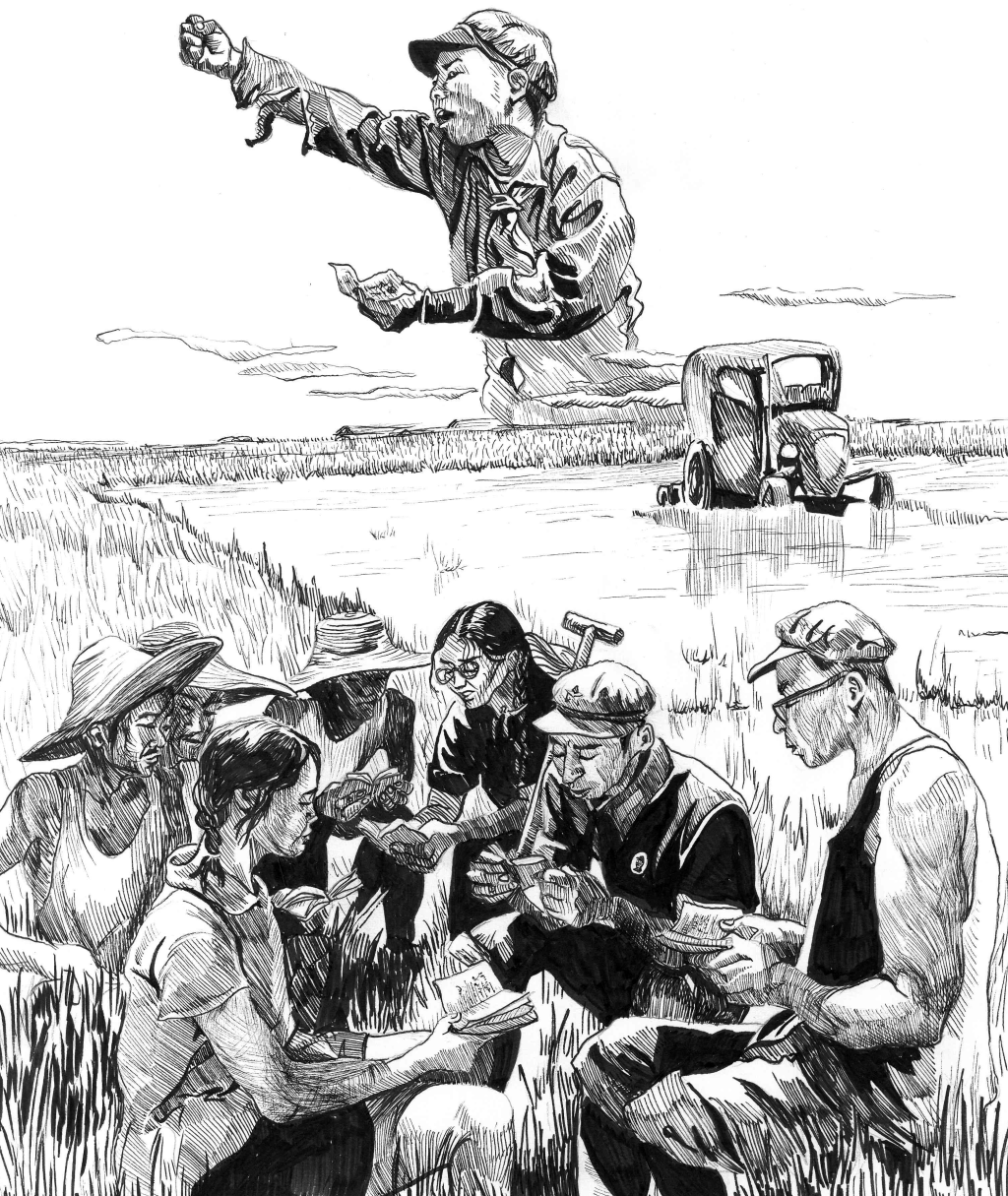
Preparation
In the early 1960s, the socialist transition to communism in China was being turned backwards. Liu Shaoqi, Deng Xiaoping, and their ideological compatriots in the Chinese Communist Party were rolling back the gains of the Great Leap Forward and curtailing the initiative of the masses in favor of top-down plans for stable economic development. Mao and his comrades had lost the initiative, but by no means gave up. Instead, they planned and prepared the ground for a new round of struggle, one they increasingly sensed would have to be more decisive and more risky than those of the previous decade. In the early 1960s, Mao advanced a deepening analysis of the contradictions of socialism, both as they stood in China and as they had moved in the Soviet Union to the full-blown restoration of capitalism. That analysis emphasized struggle and transformation in the cultural sphere, broadly understood to include education, artistic creation, force of habit, and ideological disposition. Mao continued his practice, which had become blatant beginning in 1955, of going around the Party leadership to make his critique and (re)conceptions of socialism known to Party members and the masses, giving speeches and issuing statements that got more and more scathing about the shortcomings of socialist society. Reaching the masses with a revolutionary line proved difficult in the early 1960s, as repeated attempts at launching mass campaigns to rectify problems were effectively thwarted by authorities within the CCP. The one key institution where the revolutionary line held greater sway in the early 1960s was the People’s Liberation Army (PLA).
PLA style for when things get hazardous and dangerous
An important tactical victory within the strategic defeat of the revolutionary line at the end of the Great Leap Forward (GLF) was the dismissal of Peng Dehuai from his leading position in the military. Peng was the most vitriolic critic in the Party leadership of GLF policies and the most ardent advocate of top-down stability against mass initiative. Peng was replaced with Lin Biao, whose leadership of the PLA emphasized loyalty to Mao’s revolutionary line, for better and worse. Lin set the PLA on a course of intensive study of “Mao Zedong Thought” beginning in 1960, leading to the publication, in May 1964, of Quotations from Chairman Mao, a distillation of Maoist ideology, politics, and methods that came to be known as the Little Red Book and inspired a whole generation of revolutionaries worldwide.
Positively, Lin’s campaign meant that PLA soldiers were steeped in the most advanced revolutionary theory, the military was a deeply politicized institution, and the PLA got trained to evaluate its actions based on the rubric of revolution, not military efficiency. Negatively, Lin’s leadership of the PLA’s study of Mao Zedong Thought bred a stilted and dogmatic approach to revolutionary theory, in contrast to Mao’s intellectual methods. Lin’s emphasis on memorizing short quotations from Mao “to get quick results” rather than studying Mao’s essays in full, along with other classics of communist theory, encouraged obedience to revolutionary authority over thoughtfully assimilating a revolutionary line.1 By 1967–68, the study-short-quotations approach pioneered by Lin was buttressed by ultra-leftist lines and leaders that gained strength in those years, often making quoting Mao a rote routine devoid of critical thought and creative application. Careerist ambitions were undoubtedly part of the motivation for using Mao’s quotations to inculcate obedience to opportunist leaders. As will become evident later in our narrative, Lin likely cultivated a dogmatic approach for self-serving reasons, attaching himself to Mao’s authority to bolster his own authority.
In the early 1960s, however, bolstering the authority of Mao and his revolutionary line throughout the PLA was absolutely correct and necessary for the coming struggles, even if it came with some dogmatic excess. The Party apparatus was dominated by leaders who were increasingly rejecting Mao’s insistence on advancing the socialist transition to communism by continuing the class struggle and bringing forward the masses to further revolutionize society. That apparatus had a lot of organizational weight, was getting ever more stuck on the wrong side of the contradictions of socialism, and had consolidated within itself a social base for conservatism and the capitalist road in the form of urban-based technical experts and administrators enjoying the privileges of city life—the Party cadre carrying out the directives of Liu and Deng.
The PLA, by contrast, drew its soldiers from the peasantry and embodied the communist spirit of selfless devotion, simple living, and revolutionary sacrifice. The PLA’s decades of experience in revolutionary warfare continued to impact its functioning after the revolution, even as Peng Dehuai and others had sought to transform it into a more routinized military apparatus emphasizing rank, efficiency, and reliance on advanced weaponry. The PLA’s revolutionary spirit was further strengthened by its role as a bastion of proletarian internationalism under socialism, beginning with the early 1950s campaign to Resist America and Aid Korea, where Chinese soldiers fought alongside the national liberation struggle in Korea against US imperialist intervention. As national liberation struggles advanced around the world through the course of the 1960s, the PLA continued its proletarian internationalist role ideologically, politically, and materially. It sent military aid and rotated hundreds of thousands of Chinese troops into North Vietnam in the late 1960s to enable the Vietnamese revolutionary army to deploy its forces south to fight US imperialism and its local lackeys.2
Turning the PLA into a bulwark of revolutionary politics, firmly loyal to Mao’s leadership and with a command structure that could be mostly relied on to stand with the revolutionary side of a mass struggle over the direction of socialist society, was an essential part of preparation for the coming Great Proletarian Cultural Revolution. Stability within the PLA on the basis of a revolutionary line allowed for the society-wide chaotic mass struggle necessary to upend those in authority taking the capitalist road without proletarian state power collapsing amid the chaos. Challenging the existing Party apparatus and orderly functioning of the state bureaucracy was possible because another crucial pillar of state power—the military—was in the hands of revolutionaries and could counterbalance the collapse of other pillars.
Even before the PLA had to provide revolutionary authority and stability during the high tide of struggle and a fair amount of chaos in the late 1960s, it asserted revolutionary ideology and politics throughout Chinese society when the Party was failing at that task. Over a three year period beginning in 1964, the Political Department of the PLA printed “nearly a billion copies of the Quotations [of Chairman Mao] along with some 150,000,000 copies of Mao’s Selected Works,”3 making Mao’s revolutionary line directly accessible to the masses. In the 1960s, the Political Department of the PLA acted, to some extent, as a substitute for the revolutionary leadership that the Party apparatus was failing to provide, and Mao’s position as Chairman of the Central Military Commission gave him authority over the PLA that he no longer had, organizationally speaking, over the Party. By the mid-1960s, the PLA was being increasingly mobilized to provide a model of ideological and political leadership to civilian society, conducting political education, joining in productive labor, and developing its own institutional power in various fields, including culture and education, integrating the PLA with the masses in the process.
The flop that was the Socialist Education Movement
By contrast to how the PLA was moving, the Party apparatus was becoming more resistant to rectification and revolutionary ideology. Mao attempted multiple interventions to transform the Party and reverse the steps backward after the Great Leap Forward. In a speech given on January 30, 1962 to a conference of 7,000 cadre, Mao expounded on ideas that previously led to the Hundred Flowers movement, calling for an approach to democratic centralism and methods of leadership that embraced mass criticism and critical thinking.4 In September of that year, Mao’s speech at the Party’s Central Committee meeting made explicit the danger of capitalist restoration before China and insisted on the persistence of class struggle under socialism. Mao’s invocations were concretized into a plan for a Socialist Education Movement (SEM), started in Fall 1962 and continuing, in fits and false starts, to 1965–66, when its failures gave rise to the need for something more drastic.
The Maoist conception of the SEM, articulated in a May 1963 “Draft Resolution of the Central Committee on Some Problems in Current Rural Work” (later known as “First Ten Points”), was one of rectification and revolutionization in the countryside. It sought to counter the moves backward from communization after the Great Leap Forward, transform Party cadre through political education and criticism, and bring forward a new wave of mass initiative from the peasants, especially the poorest among them. What actually transpired, however, was at best a top-down campaign against corruption using bureaucratic methods. Implementation of the SEM was in the hands of the Party apparatus, which was in the hands of Liu Shaoqi, Deng Xiaoping, and their ideological compatriots. They carried out the SEM by sending Party Work Teams—cadre, mainly from urban areas, organized, trained, and led by central leadership—to rural areas to supervise, or more accurately, circumvent, the movement. The use of Party Work Teams was a commandist method that failed to rely on rural cadre or the masses, offering judgment from above and using the authority of Party leadership rather than unleashing mass debate and sorting out correct and incorrect ideas through discussion and struggle.
In addition to targeting former landlords, rich peasants, and corrupt officials, the Party Work Teams treated rural Party cadre en masse as the problem, rather than as comrades to be embraced and transformed to serve the masses and advance the revolution. Essentially, the Liu/Deng approach was the “communist” version of the blame game in capitalist corporate office culture, where “the shit flows downstream.” Whether intentionally or not, putting all the blame on rural cadre for political problems in the countryside was a way for higher Party leadership to absolve themselves of guilt for the sins of revisionism. As the Maoist critique of the way the SEM was carried would later put it, capitalist roaders in the CCP were “hitting at the many [rural cadre] in order to protect the few [themselves].”5
While the SEM was an abject failure, and rural China in the early 1960s continued to move backwards from the gains in collectivization in the previous decade, it did expose the increasingly divergent approaches between revolutionaries and capitalist roaders within the CCP. The latter even articulated their bureaucratic, maintain stability rather than unleash the masses, approach in a document known as “Later Ten Points,” drafted by Deng Xiaoping and published in September 1963.6 They also revealed their vehicle of choice for diverting a mass campaign away from unleashing the masses and targeting those in authority taking the capitalist road: the Party Work Team. Revolutionaries in the CCP could conclude from this experience that the normal workings of the Party and its chain of command via democratic centralism were in the wrong hands, and would have to be usurped by revolutionary leadership and mass struggle from below. In that sense, the SEM was a socialist education, by negative example, that pointed to the kind of all-out struggle that would be required to prevent capitalist restoration.
A ruthless critique of capitalist restoration and socialist society’s shortcomings
A further lesson in the danger of capitalist restoration came from afar. After Stalin’s death in 1953, Khrushchev and other leaders of the Communist Party of the Soviet Union (CPSU) consolidated power in their hands and transformed the world’s first socialist state into a state-capitalist country. A number of questionable compromises, bad methods, pragmatic decisions, and wrong political lines, especially preceding, during, and after World War II, had created fertile ground for capitalist restoration in the Soviet Union. The growth of bureaucratic management, reliance on technical experts and administrators, emphasis on heavy industry and developing the productive forces over reliance on the masses and their conscious initiative, backing off from the internationalist responsibility to advance the world proletarian revolution, and treatment of class struggle as finished rather than ongoing—all of which took place under Stalin’s leadership—were seized on by Khrushchev to dismantle socialism itself.
The loss of socialism in the Soviet Union is a story for another book, however, so here let us focus on what it meant for socialist China. Mao had already recognized glaring problems with the Soviet model for socialism at least as early as the mid-1950s. In response to Khrushchev’s infamous 1956 speech denouncing Stalin at the Twentieth Congress of the CPSU, the Chinese Communist Party published On the Historical Experience of the Dictatorship of the Proletariat on April 5, 1956.7 In this document, the CCP on the one hand welcomed the opportunity to criticize errors and weaknesses in Stalin’s leadership of the first attempt at building socialism, but on the other hand recognized that the CPSU was using criticism of Stalin’s leadership to cast off communist principles, overthrow the dictatorship of the proletariat, and develop a state-owned form of capitalism in the shell of the socialist state. Nevertheless, the CCP was careful not to give ultimate judgments on developments in the Soviet Union too soon, and instead took the path of attempting to open up a debate in the international communist movement on a whole host of questions, with state power and the nature of socialism at its core. From 1956 through the early 1960s, Chinese Communists took the time to write lengthy essays identifying the differences among socialist states and communist parties around the world, upholding communist principles against those betraying them, and breaking out of dogmatic molds.8 All along the way, they took the high road of trying to win over comrades around the world to a revolutionary line through reasoned argumentation and appeals to communist principles, free from arrogance and looking to unite rather than split.
Split proved unavoidable as the CPSU sunk further into revisionism (in communist parlance, revisionism means cutting out the revolutionary heart of Marxism and betraying communist principles). The Soviet Union became, in the CCP’s words, a social-imperialist power—socialist in name, imperialist in fact—using national liberation struggles around the world for its own benefit. The debate that led to this split culminated in several important documents from Chinese Communists, perhaps most notably 1963’s A Proposal for a General Line of the International Communist Movement and 1964’s On Khrushchev’s Phony Communism and Its Historical Lessons for the World. These documents had important international impact, delineating, for experienced communists and a new generation of revolutionaries emerging in the 1960s, the path of revolution and class struggle under socialism from the path of “peaceful coexistence” with bourgeois rule in general and with the new bourgeoisie that had seized power in the Soviet Union. They delivered an analytical deathblow to Soviet revisionism and articulated an ideological and political basis to unite the world’s genuine communists.9
Within China, the polemical debate against Soviet revisionism and its counterparts around the world provided greater clarity on the danger of capitalist restoration. Seeing a new bourgeoisie come to power from within the leadership of the Communist Party of the Soviet Union revealed the same process at work in China. Liu, Deng, and their ilk looked all too similar to Khrushchev and his clique, with both emphasizing developing the productive forces and efficient management over making the masses the masters of society and continuing to revolutionize the production and social relations and the culture and ideology of the people. Furthermore, when capitalist roaders within the CCP opposed Mao’s revolutionary line, they often did so by pointing to or objectively supporting the Soviet model, whether explicitly or in veiled forms.
For example, in 1964, a philosophical debate raged over dialectics. Yang Xianzhen, an ideological comrade of Liu Shaoqi who was in charge of the Higher Party School that trained CCP cadre, argued against Mao’s insistence that the unity of opposites is always temporary, relative, and unstable and gives rise to struggle between the two aspects of a contradiction. Sometimes simplistically and idiotically reduced to an argument over whether “one divides into two” or “two combine into one,”10 this debate over dialectics—whether to emphasize struggle or unity in relation to contradictions—had resounding parallels with the early-1960s debate between the CPSU and the CCP. The former emphasized peaceful coexistence between socialist states and capitalist countries and the amelioration of class struggle within socialist societies, while the latter emphasized the persistence of class struggle under socialism and the fundamental antagonism between the socialist camp and the capitalist powers.
Fortunately, Yang’s view of dialectics did not determine how socialist China dealt with its antagonistic contradiction with the social-imperialist Soviet Union. However, embracing the struggle of opposites between genuine communism and revisionism had consequences. Severing political ties with the Soviet Union and the “Eastern Bloc” it led meant that socialist China became more isolated internationally in the 1960s, facing threats from both the US-led and Soviet imperialist blocs. Consequently, shoring up state power in the hands of genuine communists rather than those all too eager to trade revolution for economic prowess became an increasingly urgent task, as the latter could easily find powerful allies abroad. Therefore, the scathing polemics against Soviet revisionism, far from a distraction or a foreign problem, were a crucial part of the struggle brewing over what road China would take: capitalist restoration or further revolutionizing society in the direction of communism.
In that struggle, on the practical level, Mao and his comrades did not have the initiative in the early 1960s, as was made evident by the failure of the Socialist Education Movement. Faced with the negative weight of inertia within the leadership and functioning of the CCP, and thwarted at every turn in their practical efforts, mounting a ruthless critique of the problems within socialist China became the best option for laying the ground for seizing the initiative in the future. That ruthless critique took aim at the unresolved contradictions of socialist society whose negative aspects had become principal, such as the gap between city and countryside, the class differences between those who carried out mental labor and those who carried out manual labor, and the persistence of obedience to authority rather than the critical spirit and creative capacity of the masses in general and of youth in particular.
When it came to the rural vs. urban divide in healthcare, Mao did not mince words in a June 1965 “Directive on Public Health”:
Tell the Ministry of Public Health that it only works for fifteen per cent of the total population of the country and that this fifteen per cent is mainly composed of gentlemen, while the broad masses of the peasants do not get any medical treatment. First they don’t have any doctors; second they don’t have any medicine. The Ministry of Public Health is not a Ministry of Public Health for the people, so why not change its name to the Ministry of Urban Health, the Ministry of Gentlemen’s Health, or even to Ministry of Urban Gentlemen’s Health?11
Mao’s “directive” went on to criticize medical education for the way it trained health professionals to be bourgeois “experts” divorced from the masses, going so far as to describe the situation as “the more books one reads the more stupid one gets.” While Mao, despite being Chairman of the Communist Party, did not have the ability to radically transform China’s healthcare system in 1965, his critique went after both the bourgeois ideology governing healthcare and training healthcare professionals and the effects of this state of affairs on the masses. To the peasants in the countryside, Mao’s words would have resonated, as they described their lives and struggles with striking accuracy, genuine concern, and revolutionary indignation. Critique of the inequalities and bourgeois ideology in command of the healthcare system laid the basis for a radical transformation in subsequent years that dramatically decreased the gap between urban and rural, elite and mass, healthcare.
Mao was no less critical of other institutions of the socialist state, calling them out for serving the existing elite and the creation of new elites rather than the masses of people and the further revolutionization of society. In the education system, Mao ridiculed the emphasis on rote book learning and studying for examinations. He called for students to spend less time cooped up in classrooms listening to lengthy lectures or studying books, often irrelevant to their lives and labor, as atomized individuals. Instead, Mao believed students should take part in productive labor while they studied, master subjects through collectivity and without so much pressure to pass exams from memory, and have enough time for recreation. Mao’s critique of the education system could not move the entrenched authorities in that system in the mid-1960s, but it was taken up by rebel students in the following years to radically transform education and close the gap between rural and urban access to schools.
In the realm of arts and culture, Jiang Qing, Mao’s wife and a revolutionary leader in her own right, took the lead in critiquing the persistence of stale artistic forms from the old feudal society and the colonial mentality of uncritically adopting European artistic forms—both forms were alienating to the masses of people. At a talk given to theater workers during the June–July 1964 Festival of Beijing Opera on Contemporary Themes, Jiang decried how “at present the stage is dominated by emperors, princes, generals, ministers, scholars, and beauties; by feudal and bourgeois stuff.” She noted how peasants, proletarians, and soldiers, the overwhelming majority of China’s population and the masses that China depended on for production and protection, were rarely depicted on stage in opera and theater. The festival that Jiang was speaking at was part of her beginning efforts to transform this situation by calling on artists to get to know the masses and to revolutionize their cultural creations in content and form.12 In the mid-1960s, Jiang got to know the work of theater groups and other cultural creators and began the process of revolutionizing Chinese opera that later resulted in the model works (yangbanxi) of the Great Proletarian Cultural Revolution.
The emerging ruthless critique of socialist society’s shortcomings went beyond targeting individual institutions to identifying the principal contradiction at the core of it all. Mao’s analysis, as articulated, for example, in his “23 Articles” submitted to a national work conference in January 1965, increasingly insisted not only that classes and class struggle continue to drive socialist society, but that a new bourgeoisie of “capitalist roaders” emerged within the leading levels of socialist society, inside the communist party. He began to speak of “persons in authority taking the capitalist road” and called for unleashing the masses to struggle against such authority. In this way, the dividing lines in the struggle within the CCP and in society broadly were being spelled out for all to understand, with growing urgency.
Innovative in Mao’s analysis is the implicit recognition that capitalist restoration, from within the form of a socialist state, would not occur, at least at first, through a bourgeoisie in the “private sector” gaining economic power and then seizing state power. Instead, it would occur through the rise of a new bourgeoisie within the leading levels of the communist party, which controlled the “commanding heights” of state power, and through that state power, the state-owned production apparatus (the economy). That new bourgeoisie transformed itself from communist party leaders to a new bourgeoisie by adopting bourgeois ideology and habits, pursuing policies that objectively put the profit motive in command of economic planning, usually by way of appeals to economic efficiency, and becoming alienated from the masses as technocratic administrators convinced they know best.
There was, of course, a class position, or, more accurately, class positions, that bolstered the adoption of bourgeois ideology: technical experts, administrators and managers, professional intellectuals, rich peasants and petty-bourgeois elements who succeeded in the remaining realms of private enterprise, and even sections of skilled industrial workers for whom socialism provided stable, well-paying jobs. The Party officials who relied on people in those class positions to administer society and foster stable, efficient economic productivity in turn represented their class interests in the form of political line, becoming the objective and subjective leadership of those who stood to materially benefit from capitalist restoration. Nevertheless, prior to capitalist restoration and the solidification of antagonistic class differences that it results in, the new bourgeoisie that emerges within socialist society is an ideological bloc more than a class in the narrowly materialist sense of the word.13
Consequently, preventing that new bourgeoisie from seizing power, and preventing the further generation of new bourgeois elements, required a revolution in the ideological and cultural domain, in how the Party leadership related to the masses, and in what policies were pursued and whether they led in the direction of communism or capitalism. And that revolution could not be just another internal rectification campaign within the Party, but had to involve and transform the masses if it was to overthrow those persons in authority taking the capitalist road and create deeper, more radical change throughout society. The question before socialist China was not state ownership over the economy, which had already been largely resolved, but what political line was in command of production and state power, and how the masses were part of evaluating and determining that political line.
While Mao continued to argue for his analysis within the leading levels of the CCP in the form of debates over the direction of the Socialist Education Movement, his arguments gained greater traction elsewhere, and Mao spent lots of time outside of Beijing in the mid-1960s getting to know the alignment of class forces beyond the capital. Among the early and most ardent adherents of Mao’s critiques of the shortcomings of socialist China and theories on the struggle against capitalist restoration were revolutionary intellectuals working in the cultural sphere, especially in Shanghai, where Jiang Qing maintained close connections. In Shanghai, a writer named Yao Wenyuan emerged as the Great Proletarian Cultural Revolution’s greatest polemicist, taking the capitalist roaders to task even before the wind was to his back.
Suggested further reading:
Central Committee of the Chinese Communist Party, A Proposal Concerning the General Line of the International Communist Movement, June 14, 1963.
Editorial Departments of the People’s Daily and Red Flag, On Khrushchev’s Phony Communism and Its Historical Lessons for the World, July 14, 1964.
Mao Zedong, “Talk at an Enlarged Central Work Conference,” January 30, 1962, published in Chairman Mao Talks to the People, edited by Stuart Schram (Pantheon Books, 1975).
Stuart Schram, “The Cultural Revolution in Historical Perspective,” in Authority, Participation, and Cultural Change in China, edited by Stuart Schram (Cambridge University Press, 1973).
Opening salvo and false start
The GPCR’s first Wu Han incident
In the battle to prevent capitalist restoration and further revolutionize socialist China in the direction of communism that came to be called the Great Proletarian Cultural Revolution, the opening salvo was a literary one. Like all reactionary classes, capitalist roaders in 1960s China could not accept any defeat, large or small, and viewed the demotion of any of their class brethren, such as Peng Dehuai, as an outrageous crime of epic proportions. So they wrote an allegorical play about it.
Wu Han’s Hai Jui Dismissed from Office was ostensibly about an official in the sixteenth century during the Ming dynasty, Hai Jui (Rui in pinyin transliteration), who was dismissed from office by the emperor for speaking out against landlords who took peasants’ land. Written soon after the 1959 Lushan conference, where Peng Dehuai was dismissed from his position in CCP and military leadership for his vitriolic opposition to the Great Leap Forward and Mao’s leadership of it, Wu Han’s play made no attempt to veil its meaning. Mao was the emperor, the communes of the Great Leap Forward were being painted as stealing peasants’ land (to capitalist roaders, individual peasant ownership was preferred to collective ownership), and Peng Dehuai was metaphorically the virtuous hero of the story.
In revolution, there are the major events and decisive moments that generally transpire quickly, and then there is the battle for summation that follows and often drags on, with past events returned to when the struggles they concentrated recur in the spiral-like motion of class struggle. Different class forces interpret historical events according to their class interests and ideological outlook, and their summations of those events are articulations of their political line, on the events themselves and on what to do moving forward. Opportunists generally avoid comprehensive summation or in-depth theoretical exposition, as that forces them to reveal their counterrevolutionary views more openly and honestly. In early 1960s China, literature, especially historical allegory, whether in plays or novels, was the preferred form for capitalist roaders to “speak bitterness” against the attempts at advancing the socialist transition to communism in the late 1950s, with Wu Han’s play as one among many examples. The authors of such literature were not disparate individuals, but found support and leadership for their work among the emerging bourgeois headquarters within CCP leadership, including Peng Zhen, a top Party official and the mayor of Beijing, and within the Party’s culture and propaganda apparatus. They preferred historical allegory likely because it appealed to their class brethren, who imagined themselves as the learned ones who understood the obscure references14 and related to the feudal elites who were usually the main characters in historical allegory.
Mao and his comrades were certainly aware of the capitalist roader literary movement—Mao even made reference to it in his speech to the CCP’s September 1962 Central Committee meeting—but were unable to hit back hard given that the cultural apparatus, including publications, was largely in the hands of capitalist roaders. They bided their time, gathered and trained their forces, and had to go around Party leadership in Beijing and the cultural apparatus under its control to mount their counterattack. That counterattack came from Shanghai, whose revolutionary intellectuals were a bastion of support for Mao’s line, in the form of a November 1965 article by Yao Wenyuan titled “On the New Historical Play Hai Jui Dismissed from Office.” In addition to addressing questions of historical accuracy and interpretation, Yao’s article took Wu Han to task for, by historical allegory, opposing the communes built during the Great Leap Forward and promoting private ownership—adopting a bourgeois oppositional line against the further revolutionization of Chinese society.
Yao was a strong writer and a compelling polemicist who could craft an article explaining the ideological and political stakes of the struggle in the literary field. But could his literary work reach an audience? That question had little to do with the merits of his writing, but with the gatekeepers in charge of China’s journals and newspapers at the time and the cultural apparatus as a whole, who were by and large capitalist roaders. It was only with Mao’s backing and Jiang Qing’s assistance that Yao’s article got published, but not, at first, in Beijing. Instead, its debut was in the Shanghai newspaper Wenhui Bao on November 10, 1965, and it was blocked from seeing print in Beijing until the PLA’s Liberation Army Daily published it. Shoring up the PLA as a bastion of Mao’s line in the first half of the 1960s, consolidated with the purge of PLA Chief of Staff Luo Ruiqing in early 1966, proved crucial for connecting a revolutionary line with the masses, even to something as seemingly simple as getting an article published so that people could read a critique of capitalist roader literature.
Ideological struggle and ideological state apparatuses
What could be called, with historical hindsight and a little English-language chauvinism, the first Wu Han incident of the GPCR (the second Wuhan incident is coming later in our narrative) is revealing of how the Maoists and how the capitalist roaders were approaching the ideological battlefield. The Maoists recognized that class struggle in the ideological realm was in many respects the central battle that had to be won, and that even if political, material, and organizational gains were made, world outlook had to change if China was to stay on and move forward in the socialist transition to communism. Their conclusion from analyzing capitalist restoration in the Soviet Union and the shortcomings of socialism in China was that the forms of proletarian dictatorship, from the central state apparatus to the rural communes, from the Party to the mass organizations, could be transformed into bourgeois institutions if bourgeois ideology came to command them. And they saw bourgeois ideology in the commanding position in many institutions of Chinese society in the mid-1960s, especially the ideological and cultural apparatuses. Those institutions shaped the way the masses think through what and how they were taught in schools and universities by teachers and professors, what they read in newspapers, journals, and books and how it trained them to understand the world, and what art, music, and theater they experienced and how it entrained them to feel.
Therefore, with the failures of the SEM in mind and months before Yao’s infamous article was published, Mao began advocating a cultural revolution. Following the January 1965 Central Committee Politburo meeting, during which Mao argued for his analysis of the persistence of class struggle under socialism, a Cultural Revolution Group (CRG) was established consisting of five Party leaders. Among the five, Kang Sheng stood as the lone Maoist, a comrade with a long history of revolutionary reliability stretching back at least as far as the Yan’an days when he bore the burden of ferreting out counterrevolutionaries and enemy agents from the Party. Peng Zhen, appointed chair of the CRG, was, by contrast, a capitalist roader through and through who commanded the Party apparatus in Beijing. The remaining three members of the CRG were ideological comrades of Peng, not Kang. The CRG essentially did nothing until Yao’s article began to cause a stir in Winter 1965–66, proving that a cultural revolution would have to be conducted around, not through, the Party apparatus.
The CRG’s failure to carry out a cultural revolution was indicative of the capitalist roaders’ view that the cultural field was more or less neutral, with literature, academic work, and artistic creation standing above class struggle and its ideological expression. Capitalist roaders such as Peng Zhen sought to guard against the “impositions” of communist ideology and political struggle into these realms. They treated their rule over cultural and ideological institutions, from universities and schools to publications and artistic production, as a matter of neutral administration rather than being defined by class outlook and political line. And they sought to protect the class position of professional intellectuals working in those cultural and ideological institutions, especially from any judgment by the masses and according to political line, so long as those intellectuals worked for and politically supported the capitalist roaders.
In reality, the cultural field, its institutions, and the professionals working within them were anything but neutral, and the capitalist roaders acted on that reality with a vengeance even if they would never admit that reality. Yao’s article punctured a hole in the notion of neutrality in the cultural field, showing that Wu Han’s play, and by extension all artistic creation, did not stand above the class struggle but took a stand with one class or another, articulated the class outlook of one class or another. Hai Jui Dismissed from Office expressed the class outlook of the capitalist roaders, the new bourgeoisie, in 1960s China.
The capitalist roaders initially tried to use their positions of authority in ideological state apparatuses to suppress Yao’s critique. When that did not work, they sought to steer the ensuing debate away from questions of class outlook towards academic matters of historical accuracy and literary questions divorced from political content. The CRG issued a document, presumably authored by Peng and without the input of Kang, titled “Outline Report on the Current Academic Discussion” on February 12, 1966, whose boring title indicates Peng’s attempt to treat the debate over Wu Han’s play as an academic matter, to be discussed by experts rather than the masses. This report placed Yao, and, by extension, revolutionaries in the CCP who insisted on evaluating the ideological and political content of cultural work, on the wrong side of the debate. And it called for an openness to differing views as cover for suppressing revolutionary views and promoting petty-bourgeois ones, denying the fact that how we arrive at truth is conditioned by class outlook.
Debate over Wu Han’s play and Yao’s article only intensified that Spring. Mao had left Beijing in November 1965 for a six-month tour around China, a tour undoubtedly used to assess the balance of class forces in the country and build support for the coming collision with the capitalist roaders. Upon his return to Beijing in Spring 1966, the Central Committee of the CCP issued what came to be considered the founding official document of the Great Proletarian Cultural Revolution, the May 16 Circular.15 The May 16 Circular demolishes Peng Zhen’s arguments in the “Outline Report on Current Academic Discussion” point by point, ups the ante of the two-line struggle in the CCP by calling attention to the existence of authorities in the Party with bourgeois and reactionary politics, and calls on the masses to take part in cultural revolution. While the May 16 Circular starts by officially revoking the Peng-authored “Report,” it ends by calling for Party Committees to study the “Report” and the May 16 Circular together and discuss which articulates a correct line and which does not, in line with the Maoist principle of discussion and debate over opposing lines rather than the capitalist roader practice of suppressing opposing lines.
Ideological struggle was joined by changes in the ideological state apparatuses and Beijing Party leadership, as they had proven through the first Wu Han incident to be obstacles to cultural revolution. Peng Zhen was dismissed from office, and unlike with Peng Dehuai, no one wrote a play about it. Peng’s comrades in the Beijing Party apparatus were likewise dismissed, as were capitalist roaders in charge of central ideological state apparatuses, such as Lu Dingyi, head of the Party’s Propaganda Department, and cultural authority Zhou Yang. The dismissed officials were replaced with comrades on the Maoist side of the sharpening two-line struggle in the Party, giving revolutionaries a beginning organizational foothold in the capital Beijing, where they had been blocked from leadership, and editorial control over key publications. As Mobo Gao points out, the latter was crucial in order to go around a Party apparatus that was substantially controlled by capitalist roaders and communicate a revolutionary line and revolutionary leadership directly to the masses. Henceforth, the Beijing-centered newspaper People’s Daily (Renmin Ribao) joined together with the newspaper Liberation Army Daily and the journal Red Flag (Hongqi, which was founded during the GLF under the editorship of Chen Boda) as the “two newspapers and one journal” whose (often jointly signed and simultaneously published) editorials provided revolutionary leadership during the GPCR.16
Since you cannot defeat decepticons just by using lexicon, leadership of the cultural revolution had to go beyond literary authority. To that end, the May 16 Circular decreed the dismantling of the Peng-led Cultural Revolution Group, and a new one was established. In the second incarnation of the CRG, Kang Sheng was not a lone revolutionary surrounded by capitalist roaders, but a leader, side by side with Jiang Qing and Chen Boda, of a committee of Maoist comrades. Beginning in Summer 1966, the CRG acted as a parallel leadership body to the CCP’s Central Committee, which, even after several dismissals, was still stuck in the ideological rot of revisionism. With Mao’s assistance, the CRG sorted out correct from incorrect lines through the twists and turns of the Great Proletarian Cultural Revolution and dispatched its members to parts of China where class struggle was most intense. Once the Party apparatus could no longer prevent mass upsurge, the CRG had to navigate the flood of initiative from below and no shortage of chaos. In the process, two-line struggle broke out within the CRG, and some of its members went in ultra-leftist directions. Nevertheless, the CRG had a crucial role to play as the revolutionary leadership and authority that the Party’s normal functioning could not provide to the masses during an all-out battle over the future direction of socialist China.
As Spring turned to Summer in 1966, the battle lines were drawn, the immediate obstacles to mass participation and revolutionary leadership were being removed, and a revolutionary leadership was taking shape and able to speak directly to the masses through its command of key publications, all with the PLA’s backing. How the ensuing battle developed, however, was not controlled from the top, but determined by how different sections of the people took up the struggle. What started as an attempt to affect revolutionary change within the cultural institutions of socialist China in order to transform world outlook more broadly became a bitter two-line struggle within the CCP, especially in its leading levels, that called forth an intense mass struggle among the people. The genius of what became the Great Proletarian Cultural Revolution was that the future direction of socialist society was not to be determined just by the decisions of the Party leadership, but by the conscious initiative of the masses, in a struggle that, in Mao’s words, would touch people to their very souls.
Suggested further reading:
Kung Chung-wu (Wang Gungwu), “Cultural Revolution in Modern Chinese History,” in China’s Uninterrupted Revolution: From 1840 to the Present, edited by Victor Nee and James Peck (Pantheon Books, 1975).
Bill Hinton, Turning Point in China: An Essay on the Cultural Revolution (Modern Reader, 1972).
Rebel students storm the stage, along with their careerist and counterrevolutionary classmates
Despite the clarity of the May 16 Circular and the dismissal of several top capitalist roaders in the Beijing Party apparatus, the first couple months of the Great Proletarian Cultural Revolution were another false start, this time set off by a pithier opening salvo that was met with even heavier suppression organized through the Party apparatus. On May 25, 1966, Nie Yuanzi, a young philosophy instructor at Beijing University, put up a big character poster together with a few of her comrades. (Big character posters emerged in the 1950s as a way for the masses to express their views in public debates. They are exactly what their moniker suggests: large posters with Chinese characters written on them—the less characters and pithier the message, the better.) Nie’s poster drew on the May 16 Circular to criticize the way that debate over Wu Han’s play was suppressed at her university, with Party authorities turning it into an academic discussion rather than class struggle in the cultural and ideological sphere.
Nie’s poster provoked two diametrically opposed responses.17 People’s Daily published it on June 2, and Beijing Radio broadcast its content—the recent shake-up in the ideological state apparatuses provided a platform for student rebellion in the mass media. Students, first in Beijing and then throughout China, at both universities and secondary schools, responded to Nie’s poster by forming rebel student organizations and criticizing the authorities, whether Party cadre or bourgeois academics (sometimes the same people), at their schools. Pent up frustration with the capitalist roader education system and its emphasis on rote memorization, passing exams, obedience to academic authority, and study that was isolated from practical life and too time consuming to allow for the rounded development of youth burst out in Summer 1966, and those seeking to hold it back faced the wrath of student rebels.
In June and July, however, those seeking to hold it back or misdirect it were mostly successful. The response of the Party apparatus, with Liu and Deng at its head, to student rebellion was their favored tactic to prevent mass upsurge: send in Party Work Teams. At universities, Party Work Teams branded student rebels as counterrevolutionaries for challenging Party leadership at their schools, sometimes going so far as to claim that any challenge to Party authority meant a challenge to Mao and the Central Committee. They directed debate away from substantive political questions and especially from challenges to “those in authority taking the capitalist road,” and insisted that the student movement, to the extent they allowed one to take shape, follow an orderly path. Maintaining stability over all else was their internal mantra, and they had a free hand to do so for nearly a couple months with Mao, the one person in top Party leadership who could curtail their actions, away from Beijing until late July.
Complicating matters was the fact that in Summer 1966, counterrevolution became a family affair, with the children of capitalist roaders in the CCP taking the stage, claiming to be student rebels but acting as junior partners in an intergenerational reactionary alliance. The educational culture that had developed in China by the 1960s involved Party officials sending their children to elite universities, where the “princelings,” as they have come to be derisively described in China, could pursue a path to the top of the class hierarchy. That explains why Mao’s critiques of the way the education system in China, with its devotion of resources to “key schools” in the cities that trained a new elite rather than the masses, who lived mostly in the countryside, fell on deaf ears. Those with the power to transform education did not want to because their children were benefiting from the existing set-up.
The children of capitalist roaders in the Party played a dual role in Summer 1966. On the one hand, they were their parents’ eyes and ears, and their intimate knowledge of the student movement, including who its genuine revolutionary leaders were, helped to make their parents’ suppression of that movement more surgical and more effective. On the other hand, they dove into the student movement, forming their own student organizations to pursue their own class interests. They directed student rebellion not against “those in authority taking the capitalist road” (the new elite), but against the children of the old elite (landlords, rich peasants, and capitalists), whose privileged upbringing enabled them to do well on university entrance exams and gain admission to key schools. Essentially, the children of the old elite were competitors with the children of the new elite for acceptance into top universities and the best jobs after graduation. In addition, the older generation of professional intellectuals—the established professors at universities—tended to be from old elite backgrounds.
The princelings saw the emerging student movement as an opportunity to knock down their competition and the gatekeepers holding them back. Not only did they politically aim the movement’s fire in the direction that would help their careers, but they mobilized violence against their targets, including beatings, extrajudicial detention, torture, and even murder.18 The violence sowed chaos and, whether through conscious coordination or not, gave the princelings’ parents the excuse they were looking for to crack down on the student movement in general. Furthermore, by taking student rebellion to excesses in rhetoric and action, the princelings presented themselves as the most radical within the mass movement. For anyone who has observed the rise of the postmodernist petty-bourgeoisie in contemporary imperialist countries and its posturing as the most radical in various mass movements and on various social questions, from police brutality to Palestine, the actions of the princelings will be familiar as the opportunist efforts of a rising reactionary class to gain radical credentials that they can use as clout to cash in on in their subsequent careers.
Sorting out and giving guidance to the mass movement
The first couple months of student rebellion were another false start for the GPCR in two senses: suppression (by the Party apparatus) and misdirection (by the princelings). When Mao returned to Beijing in late July, he and his comrades worked to sift through the confusion created by the chaos and give genuine revolutionary leadership and guidance to the real rebels. Immediately, Mao, likely keenly aware of the lessons of the failed Socialist Education Movement, ordered the removal of the Party Work Teams from the universities, over the objections of Liu Shaoqi and in effect challenging his authority, which gave the student movement the space it needed to develop. Unlike the capitalist roaders, Mao and his comrades sought to learn from the student movement, meeting with representatives from the rebel student organizations that had formed that Summer and making clear that they embraced their rebellious spirit whether or not they agreed with all of their criticisms.
The great contribution of the student rebels to the Great Proletarian Cultural Revolution was opening up the struggle, making it a mass struggle rather than a debate about a reactionary play (as important as that debate was), making the struggle over the direction of society an unavoidable question, including in the Party leadership, and beginning to point the spearhead of that struggle at those in authority taking the capitalist road. The class of ’66 had grown up after the victory of the Chinese Revolution in 1949, within a socialist society where the exploitation and brutal oppression of the feudal and semicolonial past was no more. Their parents’ generation, who knew the suffering of the old society firsthand, had grown complacent with the gains of socialism and the genuinely better life it created for them. The youth, by contrast, were more aware of socialism’s shortcomings, perhaps especially the obedience to (a new) authority that had set in through a combination of habit (centuries of feudalism and a century of foreign domination) and the force of inertia within the Party and state bureaucracy. Furthermore, as students, they were confronting what their place in society would be, which was dependent on what kind of society they would inhabit, a revolutionary or a capitalist one. With impatient indignation, they insisted that the leadership and authorities of their society answer to their concerns and justify themselves to the masses.
Consequently, owing to the student rebels, the stage was set for a decisive two-line struggle at the CCP Central Committee’s early August 1966 meeting. Capitalist roaders in the Party leadership could no longer dodge the criticism coming up from below. They certainly tried to, and in response, on August 5, Mao posted his own big character poster on the door of the Central Committee’s meeting room, which read: bombard the headquarters!
Mao’s wonderfully pithy invocation to “bombard the headquarters” was the rightfully bombastic expression of his developing analysis that not only does class struggle persist under socialism and generate a new bourgeoisie, but that the new bourgeoisie became concentrated (at least in historical experience thus far) in the leading levels of the communist party, where it constituted a bourgeois (or, in communist parlance, revisionist) headquarters. Standing at the top of the Party apparatus, the revisionist headquarters had the power and organizational ability to lead capitalist restoration, cohering ideologically and mobilizing politically the Party cadre and the classes that stood to benefit from overthrowing the dictatorship of the proletariat and turning back socialism. Consequently, the revisionist headquarters had to be bombarded from below, by the masses, exposed, and overthrown (kicked out of leading positions in the Party and the state bureaucracy).
Out of the August Central Committee meeting came the key document of the GPCR: Decision of the Central Committee of the Chinese Communist Party Concerning the Great Proletarian Cultural Revolution, officially released on August 8, 1966. The “16-Point Decision,” as it has sometimes been called for brevity, welcomes the student movement and insists that Party leaders and members must not fear it and must not fear criticism, but embrace the daring of the youth and be daring themselves: “boldly arouse the masses” in struggle. It affirms confidence in the masses to sort out right from wrong, learn from their mistakes, and emerge as masters of socialist society through the course of class struggle, declaring “Let the masses educate themselves in the movement.” Point 7 is a direct rebuke of the Party Work Team approach of labeling rebel activity as counterrevolutionary and claiming criticism of a Party unit or work team is criticism of Party Central Committee and opposition to socialism. Furthermore, the “16-Point Decision” greenlights the recently formed rebel student organizations and “cultural revolutionary groups” to go forward in their mass initiative and draw from the spirit, and some of the practices, of the Paris Commune, the first attempt at proletarian revolution a century prior. While the “16-Point Decision” drew from and spoke to the particularities of the student movement then unfolding, the principles it articulated had far broader application as the GPCR went beyond its initial student upsurge.
One such principle is the Maoist level-headed, nuanced, but clear and decisive approach to distinguishing “who are our friends, who are our enemies.” The “16-Point Decision” makes clear that only a small number of Party members are reactionaries; some have embraced the mass upsurge and are seeking to lead it in a revolutionary direction, while many (the majority) are confused or afraid of the movement. In the universities, the “16-Point Decision” distinguishes between “bourgeois reactionary scholar-tyrants” who must be overthrown and intellectuals with wrong or even bourgeois ideas who should be criticized but not made the targets of the struggle. And it cautions against criticizing people by name in the press, insisting on approval from the appropriate Party Committee before publicly branding anyone a class enemy. In this respect, the “16-Point Decision” seeks to guide the student movement away from its excesses and (indirectly) rebukes the princelings who misled it.
The strategic approach of uniting all who can be united, transforming Party cadre stuck in bad methods of leadership and bourgeois thinking, and removing those in authority who stood as irredeemable obstacles would prove difficult in practice, though the “16-Point Decision” articulated the right orientation. In any event, the August 1966 Central Committee meeting and the “16-Point Decision” that came out of it were an important victory for the class struggle, impossible without the student rebels “bombarding the headquarters” from below, even if it was a victory won over the objections of many Party leaders. The Great Proletarian Cultural Revolution was no longer an inchoate mass movement, a good idea in Mao’s head without buy-in from the Party, or a revolutionary approach suppressed by the Party apparatus. It was a powerful mass movement from below with its own dynamism, with the student rebels on the frontlines, led by Mao and his comrades, that had a name befitting its significance as an all-out battle between the capitalist and socialist roads playing out in the Party and throughout society. The Great Proletarian Cultural Revolution was a revolution because it overthrew capitalist roaders and determined which class ruled society; it was cultural because its larger objective was to transform world outlook and revolutionize the production and social relations, ideas and culture, of the people; it was proletarian because the class outlook and interests of the proletariat were in command and the proletariat as a class was unleashed to take history into their hands; and it was great because it was a monumental struggle throughout socialist China with world-historic significance in paving a path for advancing the socialist transition to communism through the very contradictions generated by that transition period.
August 1966 was a turning point in getting the Party apparatus out of the way of the revolutionary masses. Beginning with Liu Shaoqi, Party people in authority taking the capitalist road were named, shamed, and removed from their leadership positions. Genuine revolutionary leaders emerged, within the Party, from the masses, and from the PLA, whose energy and initiative could no longer be contained by the revisionists in the CCP and their organizational inertia, and such leaders were catapulted into higher positions and propped up as models to follow. An overall situation was created throughout China that encouraged and supported mass criticism from below and mass initiative in revolutionizing society, beginning with the student movement.
Rebel student groups began calling themselves Red Guards in Summer 1966, and that name stuck and spread among youth all over China eager to join the revolutionary upsurge. All sorts of different individuals and groups came to call themselves Red Guards for various reasons and serving divergent purposes, from those genuinely committed to the goals of the GPCR, to those led by revisionists inside the Party, to others who were rebelling for a wide variety of reasons. The Red Guard movement swept up a whole generation during a high tide of struggle, so sorting out the exact nature of each Red Guard group is far beyond the scope of this summation. Summations after the fact by Maoists around the world have tended to be far too simplistic about the Red Guard phenomenon, heralding the Red Guards as the vanguard of rebellion during the GPCR that maybe went in factionalist and ultra-left directions in the late 1960s. Professional historians as well as sympathetic Chinese intellectuals who grew up during (and were part of) the Red Guard movement have painted a more nuanced portrait in recent decades, recognizing how deep factionalism went and how much opportunist leadership there was among various Red Guard groups from their beginnings.
None of that should come as a surprise to anyone remotely familiar with Mao’s insistence that all phenomena are full of internal contradiction, with positive and negative aspects. In Summer 1966, it was essential to the development of the GPCR to embrace the student rebels and give them support to develop without overbearing leadership from above—exactly what the capitalist roaders refused to do. So as Red Guards from around China flocked to Beijing and held mass rallies on Tiananmen Square, Mao and other CRG leaders made appearances at those rallies to let the rebels know they supported them. At an August 18, 1966 rally in Beijing, Mao went so far as to don the armband that was an essential Red Guard fashion accessory.
Beyond moral support, the revolutionaries in the CCP made travel and accommodations free for the Red Guards and encouraged rural youth to visit the cities and urban youth to go to the countryside, even if the latter first took the form of pilgrimages to revolutionary historical sites such as Yan’an and Mao’s birthplace in Hunan. As Dongpin Han points out, traveling on trains and bunking alongside youth from other parts of the country gave youth, especially those coming from the rural areas, a broader perspective, including getting a sense of the persistence of inequalities between rural and urban China. It also enabled Red Guards from different places to interact with each other, exchange experiences from the struggles in their locales, and debate out different political lines among themselves.19
Mao’s writings, which were studied intensively in the Red Guard movement, provided young rebels with a rubric to judge policies, political lines, and the Party leaders they looked up to and/or criticized. There was certainly plenty of dogmatic excess in the ways that many Red Guards studied, quoted, and (mis)applied Mao’s writings, and since Mao Zedong Thought was promoted as the official guide of the GPCR, opportunists claimed it as their own while distorting it for counterrevolutionary purposes. But the Red Guard movement was intellectually richer with Mao’s leadership, and Mao’s authority empowered rebel youth against Party authorities taking the capitalist road.20
In addition to travel, exchange, and studying Mao’s writings, the culture of mass participation during the GPCR took effect through the widespread use of big character posters, the “four bigs,” and the proliferation of publications produced by the masses. The practice of big character posters, where people literally wrote their criticism, slogan, or opinion in large Chinese characters on a big poster and posted it in a public place where everyone could see it, had started in the 1950s as a way for the masses to criticize the Party, but spread prolifically during the GPCR, first among students and then more broadly. As Dongpin Han summarizes, the “big character poster was a very flexible, effective, and convenient political instrument. All it took was some ink, some paper, a brush, and the ability to write,” and if someone could not write, they could find someone to write their message for them.21
The “four bigs,” perhaps better translated as “four greats,” referred to a great airing of opinions, great freedom, big character posters, and great debate.22 Enshrining the “four bigs” as official policy during the GPCR did not prevent persons in authority taking the capitalist road from trying to suppress the masses, but it did give official backing to the masses to exercise the four bigs, and when they did, it often knocked capitalist roaders on their asses, figuratively and maybe sometimes literally. Better than formal bourgeois-democratic procedures, the “four bigs” were means for the masses to learn how to articulate their viewpoints, hear each others’ views, and struggle out correct from incorrect ideas among themselves with the assistance of revolutionary leadership, but without relying on someone in authority to give them the answer or tell them what to think.
Especially among the Red Guards, publications made by the masses proliferated during the GPCR, with over 100,000 different “unofficial” newspapers and pamphlets published.23 Some articles written “from the bottom up” made their way into the mass media and some remained localized in their impact, but regardless, the culture of writing one’s views with passion and urgency was indicative of the mass revolutionary upsurge throughout society. The point is not whether the articles written were all of high quality or entirely politically sound, but that people were empowered and able to articulate themselves.
The revolutionary role and limitations of student and youth rebellion
The Red Guards played a pivotal role as the first to dare challenge Party authority, becoming the initial frontline fighters of the GPCR. Their rebel spirit and youthful audacity, however, was not enough to lead a complex class struggle, with large numbers of opportunists in the fray and competing class interests at work, amid the need to keep agricultural and industrial production flowing and transportation and infrastructure functioning for China’s population. It could easily become disruptive in negative ways if students aimed their rebellion at the wrong places or tried to draw the masses into factional fights, and the capitalist roaders were all too eager to sow chaos in order to draw the fire away from themselves and then demand the restoration of order on a reactionary basis.
Perhaps the worst actions of the Red Guard movement involved how it took up the struggle against the “four olds”: old ideas, culture, customs, and habits. From the perspective of the CRG leading the GPCR, mass struggle against the “four olds” was an important part of overcoming the ideological vestiges of the old society and knocking down the elites who embraced them. However, for many Red Guards, the struggle against the “four olds” became a witch hunt, uncovering feudal and bourgeois cultural items in perceived class enemies’ homes and indiscriminately branding people as class enemies for the slightest ideological association with the four olds. At its most extreme, this witch hunt included extrajudicial detentions, with prisoners taken by some Red Guards subjected to torture or even murdered, often to settle personal scores or just out of petty cruelty rather than serving any legitimate political purpose.
Undoubtedly, the princelings among the Red Guards are much to blame for the widespread excesses and cruelties in the struggle against the four olds, which included burning books and smashing statues (some statues did deserve to be smashed). The princelings stood to benefit the most from purging established intellectuals with “bad class backgrounds” and real or imagined ideological predilections for the four olds, as they wanted to gain the jobs and class positions of those purged through purity campaigns. But the puritanical approach to the struggle against the four olds went beyond the princelings, and is indicative of a widespread dogmatic streak in the Red Guard movement. The worst excesses of Red Guard dogmatism, especially in the struggle against the four olds, have provided the fodder for “shocking” anecdotes and imagery in the bourgeoisie’s anti-communist ideological assault on the GPCR, which exaggerates real, correct and incorrect incidents and practices to paint a picture of widespread book burnings, statue smashings, and dunce cap parades as well as a purported ban on all Western music.24
As the student movement unfolded, the Red Guards, especially from the elite universities and in the urban centers, tended to widen the scope of the GPCR’s targets far beyond those in authority taking the capitalist road. “Suspect all, overthrow all” became the ultra-left ethos that rejected the need for genuine revolutionary leadership and a proletarian vanguard party in favor of rebellion against anything and anyone tainted by the shortcomings of socialist society. Indeed, Mao added a suffix to his popular-during-the-GPCR invocation “it’s right to rebel” in light of its misuse, and the slogan became “it’s right to rebel against reactionaries.” Party leaders close to Mao, such as Jiang Qing, a favorite among Red Guards for her revolutionary fervor, and Zhou Enlai, a veteran top Party leader who long functioned as Mao’s right-hand man and was a convincing diplomat (not to mention being the most handsome man in socialist China), had to intervene to prevent Red Guards from overthrowing too many Party cadre and disrupting the state apparatus too much.
Intervention was also necessary when Red Guard groups descended into factional fighting with each other, as documented in Bill Hinton’s 1972 book Hundred Days War: The Cultural Revolution at Tsinghua University. That factional fighting at times reached the point of armed violence, and the PLA and contingents of class-conscious proletarians had to step in to put a stop to the conflicts and sort the students out. Factionalism is a petty-bourgeois disease within the revolutionary movement, guided by a class outlook of putting self and small group interests over the masses and the ego of focusing on proving oneself correct over collectively arriving at a correct line. Given the student social base of the Red Guard movement, it is no surprise that factionalism reached a fever pitch within it, especially among Red Guards at elite universities.
While the problem of princeling and revisionist-led Red Guards is present in all of the movement’s worst excesses, many student rebels who started out as genuine, if young and inexperienced, revolutionaries in Summer 1966 moved increasingly in ultra-left directions. They were understandably frustrated with the stubborn obstinance of all too many Party leaders and cadre to transform, and with the weight of bourgeois inertia that had built up in the Party and state apparatuses in the 1950s and 60s. Their impatience, especially when refracted through the prism of a petty-bourgeois world outlook and bolstered with arrogant overconfidence and dogmatic zeal, began to isolate them from the masses and make their primary concern not how to revolutionize society, but how to knock everything down they did not like and replace existing authority with their own. Some even started stealing weapons from the PLA and advocating and using armed violence rather than debate and mass struggle to get their way. Consequently, the Maoist leadership of the GPCR looked less and less to the Red Guards to revolutionize society, selectively repressing them when they went to excesses and more generally seeking to channel the energy of rebel youth away from disruption and towards integrating with the peasantry in the countryside so that those youth could transform themselves into disciplined proletarian revolutionaries.
During the high tide of the GPCR, universities and much of the education system were more or less shut down to make way for, and because of, the Red Guard movement. Positively, given how bourgeois education in socialist China had become, putting a pause on instruction for a couple years or so allowed for a thorough evaluation of the problems and a reboot of education on revolutionary foundations, a subject we will explore below, especially in relation to rural schools. Furthermore, it gave the Red Guard generation the freedom to participate in a revolutionary movement, an education in class struggle that no formal schooling could provide, and empowered them to spread the GPCR throughout society as a whole. Negatively, shutting down the universities and schools was necessary because of Red Guard factionalism, excessive violence and excessive targeting of purported class enemies, and the growing petty-bourgeois outlook and ultra-left political line of many Red Guard organizations. Had the universities stayed open, they would have become a hothouse where these problems intensified and ultra-left lines were consolidated organizationally.
Given that ultra-leftism, factionalism, and other serious problems in the Red Guard movement spread beyond the students to struggles over urban governance (see below), and parts of China were engulfed in violence and chaos verging on civil war in 1967 and early 1968 (see below), the Maoist leadership of the GPCR decided to break apart the Red Guard movement in 1968. The worst perpetrators of factionalist violence and ardent advocates of the “suspect all, overthrow all” line were suppressed and organizationally dissolved, with PLA intervention if necessary. Revolutionaries in CCP leadership worked to convince Red Guards who were willing to debate out the issues to repudiate ultra-left political lines and withdraw from factional fighting. The longer term solution, however, was to “go to the countryside,” where the majority of China’s population, the peasantry, lived and labored.
Going to the countryside has a deep meaning in Chinese revolutionary history—integrating with the masses of peasants was what made CCP cadre into revolutionaries in the 1930s and 40s. From the onset of the Red Guard movement, Mao and his comrades encouraged the students to live out the spirit of Yan’an and temper and strengthen their revolutionary enthusiasm by going to the rural communes and getting to know peasant life. In the late 1960s and early 1970s, going to the countryside became a revolutionary imperative for China’s youth, a way to steer them away from factionalism and ultra-leftism and to the masses. From 1967 to 1976, seventeen million urban youth spent months or years in the Chinese countryside.25
Many youth went enthusiastically and spent years working alongside peasants in agricultural labor, purging themselves of petty-bourgeois attitudes in the process. Others went begrudgingly, disappointed that participation in the GPCR did not result in career advancement and not expecting to have to do the proletarian part of the Great Proletarian Cultural Revolution. In the decades since the GPCR, the international bourgeoisie has mobilized the disgruntled among the “sent-down youth” to paint going to the countryside and having to do a few years of manual labor as a great crime against humanity that deprived budding intellectuals of their college years. Mobo Gao has rightfully asked whether it is also a crime for the peasants to have to labor in the countryside their entire lives because they happened to be born there.
In any event, the need to send youth en masse to the countryside after their advanced role at the beginning of the GPCR had run its course and was turning into its opposite points to the strengths and weaknesses of youth and students in the revolutionary process. The youth are indeed the most daring, the most willing to challenge existing authority, and the first to jump into the revolutionary struggle, unburdened by the weight of conservatism that gets heavier as we get older. On the other hand, the youth are too impatient, too inexperienced, and sometimes too reckless to see the revolution through to its goals, unite all who can be united, and persist through the twists and turns and difficulties, unless of course they transform themselves into farsighted communist cadre and firm proletarian revolutionaries. That necessary transformation points to two crucial, interrelated challenges of the Great Proletarian Cultural Revolution: the continued need for the leadership of the communist vanguard party during the socialist transition period, including during the GPCR itself, to prevent it from going off track or descending into competition between factions and narrow interests, and the need to bring forward the proletariat itself as the class capable of moving the struggle beyond factionalism and narrow interests to the deeper revolutionization of society. In other words, putting the proletariat in Great Proletarian Revolution, in outlook and material fact.
Suggested further reading:
Decision of the Central Committee of the Chinese Communist Party Concerning the Great Proletarian Cultural Revolution, adopted August 8, 1966.
Mobo Gao, Constructing China: Clashing Views of the People’s Republic (Pluto Press, 2018), chapter 6.
Bill Hinton, Hundred Days War: The Cultural Revolution at Tsinghua University (Monthly Review Press, 1972).
Putting the proletariat in Great Proletarian Cultural Revolution
What started as a student movement soon spread throughout cities and China’s vast countryside, drawing peasants and proletarians into the battle over China’s future. The Red Guard movement fanned the flames of revolt by taking the politics of the GPCR, however they understood them, to the masses of proletarians and peasants, who responded with pent-up grievances against capitalist roader policies. In the countryside, rebel peasants deposed or placed under mass supervision Party leaders who had become divorced from labor and the masses, advancing their own critiques of life in the rural communes. Ultimately, the GPCR’s revolutionization of production and social relations and culture in the countryside was perhaps more thoroughgoing than in the cities, and we will explore rural transformations in a subsequent chapter.
However, the struggle that opened the door to those transformations in rural areas tended to be less chaotic and contentious than class conflict in urban areas. It would be no exaggeration to say that in many Chinese cities, the GPCR almost became a full-blown civil war in 1967. Different sections of the urban population were mobilized by both rebels and reactionaries in fights over who would hold power over industrial production and urban governance. To understand how the proletariat mounted the political stage and reshaped city life during the GPCR, the struggle in Shanghai provides the best example and the most advanced experience.26
The January Storm in Shanghai
When Red Guards went to the proletariat in Shanghai, they found that many proletarians there had already taken up the GPCR, responding to Nie Yuanzi’s big character poster with their own ones. In Summer and Fall of 1967, the same dynamic that played out on college campuses played out in Shanghai’s factories. Rebel workers, including many lower-level CCP cadre, articulated sharp critiques of Party leadership at their workplaces and got met with suppression and accusations of being counterrevolutionaries by those in authority whom they were criticizing. Undaunted and displaying a high level of class-consciousness and understanding of the GPCR’s objectives, proletarians in Shanghai formed rebel worker organizations and hit back, politically, against those who stood in their way. Revolutionary leaders emerged from this upsurge, from the lower ranks of the Party and from non-Party members in the factories, such as Wang Hongwen, a worker and CCP member at Shanghai’s No. 17 Cotton Mill, who would play a crucial role in the struggles to come.
The struggle in Shanghai only got sharper in the Fall, in the factories and in the ideological state apparatuses, where the city’s revolutionary intellectuals followed Yao Wenyuan’s example and penned polemics against capitalist roaders. Several journalists at Wenhui Bao, the Shanghai newspaper that had been the first to publish Yao’s opening salvo of the GPCR, formed a group called “The Spark that Sets the Prairie Fire” to revolutionize their institution and ensure that it articulated a revolutionary viewpoint. As rebels in Shanghai began to “bombard the headquarters”—the municipal government headed by Cao Diqiu and his fellow capitalist roader Party officials—they had the support and leadership of the central Cultural Revolution Group in Beijing, which included Yao Wenyuan and Zhang Chunqiao. The latter was a local Party leader in Shanghai close with Jiang Qing and a strong writer who had served as head of the city’s newspaper Liberation Daily. Zhang had demonstrated his theoretical grasp of the contradictions of socialism during the Great Leap Forward period, when an article he wrote on the ideology and persistence of bourgeois right impressed Mao and was published in People’s Daily. In Summer and Fall of 1966, Zhang and Yao bounced back and forth between Beijing and Shanghai, summing up developments in the latter, consistently siding with the rebels, and stepping in to lead the developing class struggle.
As that class struggle heated up, Cao Diqiu and his capitalist roader compatriots supplemented suppression with misdirection, forming the General Headquarters of Red Guards from Shanghai Schools and Colleges to lead student rebellion away from confronting persons in authority pursuing the capitalist road (themselves), instead seeking to mobilize students against rebel workers. The latter were not fooled by bourgeois Party officials attempting to camouflage counterrevolution in the GPCR’s organizational forms. In defiance of the local Party apparatus, rebel workers united and consolidated their budding organizations into the Shanghai Workers’ Revolutionary Rebel General Headquarters, which we shall call the Workers’ Revolutionary Headquarters or WRH for short. Formed with 20,000 members who, together, had a presence in a fourth of Shanghai’s factories, the WRH mounted a challenge to the municipal government with a mass rally on November 9, 1966.
When local Party officials rejected the demands raised at the November 9 rally, the next day, 2,500 rebel workers boarded a train bound for Beijing to appeal directly to Mao. Their train was stopped in Anting, just north of central Shanghai, by capitalist roaders. Summing up developments in Shanghai, a pivotal port city and hub of industrial production for China as a whole, the CRG decided that workers leaving Shanghai’s factories en masse would wind up disrupting production too much and thereby play into the capitalist roaders’ hands. Whereas rebel students could leave their studies to make revolution because no one was depending on their schoolwork for the necessities of daily life, rebel workers had the obligation to China’s population to carry out revolution and production simultaneously—in Mao’s words, “grasp revolution, promote production.” Otherwise, China’s economy would shut down, transportation would grind to a halt, and everything from food to industrially produced goods would become unavailable, something that the capitalist roaders knew and took tactical advantage of (while ultra-leftists acted willfully ignorant of, a problem we shall return to later).
So in this particular incident involving a large contingent of rebel workers held up in Anting and refusing to turn back, the CRG dispatched Zhang Chunqiao to speak with the workers, sign their demands, thereby letting them know they had the support of the GPCR’s top leaders, and encourage them to return to Shanghai and continue the revolution—and production at their factories—there. Unlike the capitalist roaders, revolutionary leaders like Zhang did not just pay lip service to rebel demands, but took the time to listen to them and synthesize their revolutionary fervor into a strategy for advancing both their just demands and the GPCR as a whole.
Back in Shanghai, the next flashpoint in the struggle over state power was a takeover, by rebel students, of the production facilities of Liberation Daily newspaper on November 30. Those students stopped the presses and demanded the newspaper give revolutionaries an equal mass media platform by printing and distributing their Red Guard Dispatch. The battle over a key ideological state apparatus drew out both sides of the citywide struggle in large numbers, with the Workers’ Revolutionary Headquarters sending its members to the rebel student-occupied Liberation Daily and bourgeois Party officials organizing workers under their leadership to oppose them. Violent clashes erupted between the two sides on December 3 and 4. The newspaper takeover wound up a victory for the revolutionary side, with Shanghai’s leading Party officials forced to sign the demands of the rebels.
The capitalist roaders in charge of Shanghai did not give up, however, and mobilized sections of people who were attracted to their bourgeois politics in a counterattack that December. The Workers’ Scarlet Guards for the Defense of Mao Zedong Thought was cynically organized under capitalist roader leadership (claiming the mantle of Mao Zedong Thought was done by all sides at this time), and it sent workers into literal battle with the the WRH, whose numbers had grown considerably by late December. Fierce fighting broke out December 28 and 29, and when the Scarlet Guards were physically defeated by the WRH, tens of thousands of them tried to head to Beijing to appeal to the CCP Central Committee. They were stopped by rebel workers in a village northwest of Shanghai, where more fighting ensued, with the WRH side victorious.
The attempted exodus of Scarlet Guards was part of a wider strategy employed by Shanghai’s capitalist roaders in late December and January of disrupting production and the city’s functioning by getting workers and administrative personnel to leave their posts. They offered work leaves under the cover of encouraging travel to “exchange revolutionary experience,” cynically misusing a GPCR practice for their own opportunist purposes. They covertly organized “a walkout strike of cadres, technicians, and workers still loyal to the old party leadership.”27 In addition, capitalist roaders gave out bonuses, wage increases, and even cash handouts to workers in an attempt to bribe them not to participate in the revolutionary struggle. The Maoist side would later brand the material incentives and reactionary strike as economism in service of sabotaging the GPCR in Shanghai.28 Considering that Shanghai’s docks and train stations were more or less shut down and many factories were not functional by early January 1967, sabotage is by no means an exaggeration of capitalist roader tactics.
The situation in Shanghai in Winter 1966–67 defies simplistic interpretations of class struggle as the workers against the bosses or revolutionary masses against a tiny bourgeois minority, and of the GPCR as the broad masses against a small handful of capitalist roaders. In truth, Shanghai’s population was split along ideological and class lines. The working class itself included many newcomers from the countryside working in temporary, contractual employment, with little to lose and much to win in the GPCR. There were also workers for whom socialism provided stable employment and a relatively prosperous life, especially in comparison to before 1949, and many such workers were inclined to fear rocking the boat. Skilled workers, engineers, technicians, and managers tended to side with capitalist roaders, looking to preserve their privileged positions against GPCR attempts to break down class divisions.
The larger point here is that there were competing class interests at work in Shanghai that created a social base for revolution and a social base for the capitalist roaders. The former were mobilized on the basis of revolutionary ideology and objectives, with their practical grievances becoming part of a larger struggle over the very direction of society as a whole. The latter were mobilized on the basis of narrow appeals, material incentives, and defending privileged positions. Over the course of several months involving battles between the two sides, the revolutionaries worked to win over more of Shanghai’s population to their side by doing patient ideological and political work, with rebel students, revolutionary intellectuals, and rebel workers publishing their views and going out among the people to discuss the struggle and train people to distinguish between different political lines. Time was on the side of the revolutionaries, as the capitalist roaders avoided honest debate, discussion, and the masses in general, and their political line only got more exposed as reactionary through the course of events, provided the revolutionaries were sharp at exposure and convincing in their analysis. In Shanghai, the GPCR benefited from a strong, and deeply class-conscious, rebel spirit among many workers and lower-level Party members in combination with the experienced leadership of several revolutionary intellectuals in the Party, most notably Zhang Chunqiao and Yao Wenyuan, who were able to navigate the twists and turns of the struggle and unite all who could be united.
It was that combination that defeated the capitalist roader counterattack in early January 1967. Rebel journalists and staff took over Wenhui Bao newspaper on January 3, coordinating their actions with the CRG and receiving the blessing of Zhou Enlai. They used their control of this ideological state apparatus to publish a “Message to All the People of Shanghai,” signed by the Workers’ Rebel Headquarters and other rebel organizations, that gave a scathing indictment of the reactionary strike and economist bribes and urged workers to return to work to prevent further disruption of production and the city’s daily functioning. One disruption—of the revolutionary variety—was required, however, and on January 6, a million workers gathered at a rally that was broadcast on television to any of Shanghai’s residents who stayed home that day. Zhang, back from Beijing along with Yao to lead the January Storm in Shanghai, led the rally, which declared the dismissal from office of local Party officials, such as Mayor Cao Diqiu, who had governed the city, and called on them to make self-criticism. The January 6 rally signaled nothing short of a seizure of power in Shanghai from below, by rebel proletarians, students, and intellectuals, under genuine revolutionary leadership from the Cultural Revolution Group.
The initial seizure of municipal power was followed up with further ideological, political, and organizational work. On January 9, Shanghai’s newspaper published an “Urgent Notice,” written with Mao’s approval, calling for an end to further disruption of the city’s economy. It invoked the slogan “grasp revolution, promote production” to urge workers who had left Shanghai under the capitalist roaders’ pretend game of “exchanging revolutionary experience” to return to their city and their jobs; rescind the economist wage increases and looting of government funds that was bankrupting the city; insist that students who had taken factory jobs not be paid more than other workers (canceling a capitalist roader policy intended to breed resentment against rebel students); and insist on no more disruptive seizures of government buildings. The “Urgent Notice” was an articulation of proletarian authority and GPCR objectives, and made clear that further sabotage of production would not be tolerated.
On January 8, the day prior to publication of the “Urgent Notice,” the revolutionaries who seized power in Shanghai established the Fighting Line Command to “take charge of the economic management of the city.” Workers’ Revolutionary Headquarters representatives, staffers from the municipal finance bureau, and professional intellectuals from the economics departments of local universities figured out how to get Shanghai’s economy back up and running while keeping administrative staff to a minimum and spending time among the masses working in production, learning and problem solving with them. As Victor Nee sums up, “With its nonbureaucratic operational style, its compact size, and its emphasis on ‘on-the-spot’ problem solving, the new municipal organ was a prototype of the reformed administrative structures later to be born out of the Cultural Revolution.”29
The new leadership of Shanghai quickly proved that not only could they overthrow the capitalist roaders who had ruled the city, but that they could also run the city in a revolutionary way that served the people and the advance of the class struggle. Mid-January was spent relying on the masses to get the trains and docks back up and running after they had been shut down by strikes, in which skilled workers in particular, such as engineers, left their posts. The lower ranks of workers were the force that reopened the railways and docks, taking on and mastering tasks that had been the preserve of more privileged workers. Shanghai’s students and teachers showed true GPCR spirit and came out en masse to assist these rebel workers, volunteering to take up whatever post they could at the train stations or docks. Without this mass initiative, Shanghai could not have continued to function, as it was powered by coal that came in on trains. Furthermore, as a pivotal industrial production center and port city for all of China, goods needed to be unloaded on Shanghai’s docks and transported from its factories and then put on trains headed all over the country, or nationwide shortages might ensue.30 As Mao summed up, “power seizures in the January Storm were accomplished by the masters of our time,”31 and in Shanghai, those masters of socialist time proved willing and able to run society themselves.
Besides getting Shanghai back up and running with revolutionary politics in command, the revolutionaries who seized power also had to figure out how to unite all who could be united among the rebel workers. From the Fall through early January, the various rebel workers organizations that emerged were united in the face of their collective suppression at the hands of the capitalist roader municipal government and in their collective efforts to overthrow that government that culminated in the January 6 seizure of power. However, soon after that seizure of power, confronted with the question of what would replace the old power, factionalism among the rebel organizations emerged by the third week of January 1967.
In addition to different views on revolutionary governance, careerist ambitions among rebel leaders led to competition among them over who would occupy top positions in the new revolutionary order. Furthermore, many rebel workers were deeply skeptical about involving, in the new municipal government, old Party officials and administrative personnel who stood on the sidelines in December and early January, even as their skills were needed. Some rebel workers were also resentful towards privileged and conservative workers who had been on the wrong side of the class struggle. Throughout January, groups of rebel workers regularly forced dozens of their adversaries from the previous months of struggle onto trucks holding signs meant to embarrass them and drove those trucks around the streets of Shanghai. These local practices and sentiments were an expression of the “suspect all, overthrow all” line that many Red Guard students took up, and some in the CRG likely supported them.
Contending with the growing factionalism, Zhang, Yao, and leaders of the Workers’ Revolutionary Headquarters such as Wang Hongwen set out to forge a “great alliance” of the various rebel organizations that had emerged in the preceding months. Zhang in particular spent hours meeting with representatives from different rebel groups, showing great skill as a revolutionary leader with the mass line method. Through these efforts, Zhang convened meetings, beginning on January 26, that brought together representatives of various rebel organizations to consolidate a new form of government—the Shanghai People’s Commune—that drew on the principles of the Paris Commune, such as direct elections, the masses’ ability to recall officials, and no higher wages or privileges for administrators and leaders.
Not all rebel groups were on board with Zhang’s strategy and leadership, however. The largest rebel worker faction resistant to attempts by the Workers’ Revolutionary Headquarters and Zhang and Yao to forge a new revolutionary government was the so-called Northern Expedition, a split from the WRH. Its principal leader, Geng Jinzhang, claimed a mass following of half a million workers, whom he mobilized to attack Zhang’s attempts to consolidate the Commune. Geng led a violent assault on the WRH in South Shanghai on January 30 and 31. This assault was repulsed, and Geng and other factionalist leaders failed to derail the mass meetings where the Commune government was put together.
On February 5, 1967, Zhang Chunqiao declared the formal start of the Shanghai People’s Commune, a victory and consolidation of the January Storm made possible by mass upsurge from below, thwarting the sabotage efforts of the capitalist roaders, and overcoming factionalist disunity. Proletarian CCP member Wang Hongwen emerged as an important mass leader who quickly rose up the ranks of the Party. Zhang was widely recognized as a brilliant, visionary communist leader, who worked methodically, away from the spotlight, to unite the various rebel groups rather seeking to win personal popularity contests (like Geng did). The leadership of the Shanghai People’s Commune included CCP cadre committed to Mao’s revolutionary line who had stood with the masses during the January Storm, PLA representatives who could ensure the city’s protection and stability, and representatives from rebel organizations, with the door open to future participation from those who had not yet been won over to the new model of revolutionary governance. Zhang’s successful leadership and firm sense of principle, however, made him a target of those who remained committed to factionalism and small-group interests rather than revolutionary unity, and a later target of capitalist roader revanchism. But in early 1967, the rebel masses of Shanghai, together with genuine communists in the CCP, paved the revolutionary path forward in the struggle in the cities between the socialist and capitalist roads.
Communes, chaos, counterrevolution, factionalism, and how to govern: the 3-in-1 Revolutionary Committee
The January Storm in Shanghai stood out as the most advanced example within a broader trend of attempted revolutionary seizures of power in cities across China in early 1967. Confronting local Party leaders and government officials who had become divorced from the masses and adopted privileged lifestyles, it made logical sense that in the struggle to overthrow them, revolutionaries looked to the Paris Commune for inspiration and practical guidance on what revolutionary governance should look like. The 1871 Paris Commune has been heralded as the first victorious, though short-lived, dictatorship of the proletariat, a revolutionary seizure of power that was subsequently drowned in blood by counterrevolutionary military assault. For a brief but monumental moment, the Communards of Paris implemented a system of governance where administrators and leaders were chosen through direct elections and subject to immediate recall if the masses desired it, and had no privileges or special pay beyond that of an average worker.
In the preparatory and initial phases of the GPCR, the Paris Commune became a subject of study and praise. The political culture at the time included reading and discussing Marx’s summation of the Paris Commune (The Civil War in France), as well as Lenin’s The State and Revolution, in which proletarian dictatorship is conceptualized in ways arguably closer to the practices of the Commune than those later adopted by the Soviet Union. The journal Red Flag, which became the theoretical center of the GPCR, published an article in April 1966 by a historian offering a mass-line inflected interpretation of the Paris Commune and praising how it revoked officials’ privileges. The August 1966 “16-Point Decision” from the CCP Central Committee that had provided the GPCR with its political program referenced the Paris Commune and suggested its approach to mass participation in selecting revolutionary leaders and administrators. Red Flag also published an article in December 1966 by Wang Li, a member of the CRG, articulating a radical attitude towards power seizures inspired by the Paris Commune. So it should be no surprise that in January 1967, owing to the theory being studied, the political guidance being given, and the practical challenge of overthrowing a system of city governance fraught with the problems of official privilege and lack of government accountability to the masses, power seizures sought to emulate the Paris Commune, in name and policy.
Implementing the Commune model in China’s cities, however, proved challenging, if not impossible. Shanghai had the advantages of rebel worker groups that were strong ideologically, politically, and organizationally, mass experience successfully navigating a stormy class struggle for several months, and the exemplary leadership of several CCP revolutionaries. Other cities did not have such advantages, and capitalist roaders were able to maneuver to prevent power seizures and the development of the commune form, or factionalism prevented the various rebel groups from coming together into a commune government rather than competing with each other for administrative control. Furthermore, the violence in Shanghai paled in comparison to some cities, where the struggle over urban governance descended into chaos and bloodshed without much revolutionary clarity of purpose.
In a few locales, local state power was radically transformed without much violence or disruption. Such was the case in Heilongjiang Province, where Zhou Enlai, Mao’s steady hand through revolutionary storms, was involved in forging a new form of socialist governance: the 3-in-1 Revolutionary Committee. Mass struggle in Heilongjiang resulted in the formation of a new provincial government on January 31, 1967 with a five-person leadership committee consisting of the Provincial Party Committee leader, two PLA leaders, and two rebel mass leaders. While this particular configuration depended on a Party leader who took part in the GPCR on the revolutionary side, its combination of the strength and skills of Party leadership, the stability and serve-the-people spirit offered by the PLA, and the revolutionary fervor and supervision of leadership from the masses was potentially applicable beyond Heilongjiang. With a tight leadership core consisting of the most advanced among Party cadre, soldiers, and masses who had proven their revolutionary resolve through the crucibles of the GPCR, the 3-in-1 Revolutionary Committee as a form was poised to provide strong central leadership while drawing on the initiative and ideas of the masses, institutionalizing mass supervision in its very structure and avoiding excess administration and bureaucracy.
On February 10, People’s Daily published an editorial upholding the 3-in-1 Revolutionary Committee and pointing to it as a model for the rest of the nation. In Beijing, Mao and the CRG were analyzing the class struggles and power seizures breaking out across China and summing up how to move from the chaos of mass upsurge, counterrevolutionary suppression, and no shortage of factionalist fighting to a new revolutionary order with sufficient stability to keep China’s economy running and the Chinese population united to face threats from its external enemies. Undoubtedly, there were differing views in the CRG on how to proceed, as events would later prove, and perhaps different members of the CRG encouraged different approaches in different places. But the 3-in-1 Revolutionary Committee emerged as the form that, at least in public, the leadership of the GPCR agreed was best suited to consolidate the revolutionary initiative of the masses in the cities.
Zhang Chunqiao and Yao Wenyuan spent mid-February in Beijing, meeting with Mao and the CRG to discuss developments in Shanghai. Based on comments made during these meetings that were later published, Mao clearly concluded that the Commune, as a form of revolutionary governance for China’s cities, was not then a viable lasting option, as it would lead to administrative, diplomatic, and practical problems and would diminish or obliterate the necessary revolutionary leadership role of the vanguard party. More to the point, Mao summed up that “Communes are too weak when it comes to suppressing counterrevolution,”32 a pronouncement proven not just by events in Paris a century prior, but also by how capitalist roaders in 1967 China had all too easily suppressed or subverted commune-inspired attempts at power seizures in many cities.
Consequently, Zhang and Yao returned to Shanghai with the unenviable task of walking back the Commune as a form of governance and arguing for the 3-in-1 Revolutionary Committee in its place. At a February 24 rally with one million people in attendance that was broadcast on television to millions more, Zhang gave a two-hour speech33 where he used his genuine powers of rhetorical persuasion to explain the weaknesses of the Commune form, argue for the need to find the good Party cadre who could be involved in revolutionary governance (against the “suspect all, overthrow all” view then gaining ground), and suggested, but did not impose, renaming, reconceiving, and reorganizing the Shanghai People’s Commune as the Shanghai Municipal Revolutionary Committee. Undoubtedly assisted by invoking Mao’s authority, Zhang was successful in convincing the revolutionary masses of Shanghai—or at least most of them—to adopt the model that the leaders of the GPCR had summed up was best for moving the struggle forward.
In Shanghai, the 3-in-1 Revolutionary Committee model was applied not just to the top leadership and administration body, but also to factory management, neighborhood governance, and running healthcare, education, and other institutions. It succeeded in bringing forward revolutionary leaders from the masses and recruiting many into the Party, such as Tang Wenlai, a woman weaver who worked alongside Wang Hongwen at No. 17 Cotton Mill and rose up the ranks of Party and city leadership. In contrast to other cities, the PLA was less involved in Shanghai’s 3-in-1 combinations, as there was sufficient revolutionary authority coming from genuine communist Party cadre and revolutionary masses. Therefore, the PLA focused its presence on where factionalism remained a problem in Shanghai, such as on the docks, where PLA soldiers loaded and unloaded ships to keep the docks operating while spending hours talking to dockworkers to convince them to abandon factionalism rather than their position in production.
Factionalism, as well as the refusal of some Party cadre and former Scarlet Guards to follow revolutionary leadership and fulfill their work obligations in production and administration, did remain a problem in Shanghai. But considerable progress was made in forging unity, with the “great alliance” of rebel organizations growing over the course of 1967 and into 1968 and a unified Red Guard organization of students—among whom factionalism had been stronger than any other section of people—established in November 1968.
The socialist new things that emerged through the 3-in-1 Revolutionary Committee form of governance in Shanghai wound up not too far off from the ideals of the Paris Commune. A Workers’ Armed Militia formed in Summer 1967 claimed, at its inception, 20,000 members drawn from industrial workers, trained by the PLA but under the leadership of the Municipal Revolutionary Committee. This militia was mainly a political force, and its members stayed at their jobs, only called upon when needed to defend revolutionary authority (a call they heroically answered in response to the 1976 counterrevolutionary coup).
“Mass-dictatorship organs” were formed in Spring and Summer of 1967, connected to 3-in-1 Revolutionary Neighborhood Committees. They dealt with public security and held neighborhood trials of criminals and counterrevolutionaries in 1967 and 1968. To make sure mass dictatorship did not get out of hand or descend into revanchism, neighborhood trials generally resulted in public shaming and subsequent mass supervision rather than jail time, and serious cases demanding more severe punishment were sent up the chain to higher leadership for approval of the decisions of the masses, with Zhang personally reviewing the most serious cases. Consequently, in Shanghai, there were far less excesses of extrajudicial punishment during the GPCR than in other parts of China.
Leadership became far more drawn from the masses and accountable to the masses in Shanghai. Party committees were reconstructed in Summer 1968, with the best among the revolutionary masses recruited into the Party and a rectification campaign for existing cadre in which a few were thrown out of the CCP while most transformed enough to remain in. The Revolutionary Committees themselves held periodic open-door rectification meetings, where the masses could come and criticize Committee members. Shanghai’s overall administration was proletarianized during the GPCR, and by “May 1973 more than 40,000 industrial workers were reported to be holding leading positions in factories, plants, and higher-level municipal organs in Shanghai.”34
Where Shanghai succeeded in implementing the 3-in-1 Revolutionary Committee form, many other cities struggled to get them off the ground and, when they finally did, struggled to make them effective. Factional fighting and counterrevolutionary suppression of attempted seizures of power was so intense across China in early 1967 that the PLA was instructed, on January 23, 1967, to enter into the mass struggles intensifying in urban areas, support the genuine revolutionaries, and maintain order. Previously, the PLA had been purposely kept out of a direct role in the mass struggles in order to let the masses sort things out themselves without the heightened authority of soldiers with guns deciding which side was correct. In late January 1967, however, the PLA’s main role in the GPCR moved from propaganda and political education work and setting an example of serving the people to preserving order and keeping production going, working in the factories if need be. But by virtue of its direct involvement in mass struggles that pit different sections of people and different Party cadre against one another, the PLA had to decide which side to support. With so much factionalism and opportunist intrigue, sometimes it was difficult to discern which side was advancing the GPCR, which side was opposing it, and which sides were fighting for their own narrow interests. Moreover, PLA soldiers are only human, and the PLA was not a monolithic force, so sometimes its units decided to stand with genuine revolutionaries and other times they decided to suppress them, depending on who, within the military command, was doing the deciding. Over time, PLA leaders increasingly favored order over mass revolutionary initiative, breeding resentment from many Red Guards and rebel workers as a result.
After many fledgling and failed power seizures across China in January 1967, the following month capitalist roaders attempted to reinstall themselves in positions of authority in what came to be called the “February Adverse Current.” That reactionary February was met with more disruptive rebellion by workers and students the subsequent Spring and Summer, with government offices attacked and factions contending for power. Amid the disruption and disunity, in many cities, it proved difficult to establish 3-in-1 Revolutionary Committees with sufficient popular legitimacy and genuine commitment to the ideals and objectives of the GPCR. In some cases, the PLA played the principal role in steering the Revolutionary Committees, while in others, Party cadre who had not really rectified in line with GPCR ideological imperatives were effectively back in charge. With all these difficulties, it took well into 1968 to consolidate 3-in-1 Revolutionary Committees as the new form of governance throughout urban China, despite the model being put forward on February 10, 1967, and the Committees established were of markedly uneven quality.
The successes and failures of implementing the 3-in-1 Revolutionary Committees should come as no surprise to anyone who has read and understood Mao’s essay On Contradiction. Uneven development is the nature of the revolutionary process, and a good model with universal application is bound to work in some places better than in others owing to differences in objective and subjective conditions. The difficulties in establishing 3-in-1 Revolutionary Committees and making them live up to their intended purpose was indicative of the fact that the very problems the GPCR was initiated to solve, including the contradiction between leadership and led bound up with the socialist state, ran deeper than perhaps even Mao had realized. Moreover, when the question of city governance was thrown up for grabs, revolutionary mass initiative, capitalist roader intrigue, petty or not so petty grievance-based anger, stick-with-stability conservatism, and factionalist fighting all flooded in with their answers. Ultimately, force, in the form of PLA deployment, played far more of a role in arriving at an answer than was desirable for the purposes of achieving the GPCR’s objectives, as indicated by the GPCR’s second Wuhan incident.
The GPCR’s second Wuhan incident
Coastal Shanghai’s GPCR success story formed a unity of opposites with events upstream in Wuhan. A major industrial center sitting alongside the Yangtze River, Wuhan stood in counterrevolutionary contrast to Shanghai in 1967. Wuhan’s rebel workers, organized into the Wuhan Workers’ General Headquarters, had neither the strength nor the revolutionary leadership needed to overcome a formidable obstacle in the form of capitalist roaders in power backed up by their local PLA pals and able to mobilize their social base among the people into a fighting force. When the rebels tried to seize power, they were repulsed by the Million Heroes, a mass organization of skilled workers, militia members, and municipal government staffers, led by local Party officials and given guns by the military. Outnumbered and outgunned, the rebels found themselves besieged by well-organized reactionary forces, taking many losses. Zhou Enlai, who was still China’s premier, tried to intervene and get the local PLA forces to come to the rescue of the rebels, but their commander, General Chen Zaidao, defied Premier Zhou’s order, continuing to back the Million Heroes.
On July 16, the CRG tried to intervene in the situation by sending two of its members, Wang Li and Xie Fuzhi, to Wuhan. A few days after they arrived, Wang and Xie were arrested, beaten up, and held prisoner by the PLA. So China’s best diplomat boarded a plane for Wuhan, but when Zhou looked down from his plane at his intended landing spot, he saw it surrounded by hostile PLA troops, likely intending the same fate for him as Wang and Xie. Seeking to avoid his likely detention provoking a civil war, Zhou had his plane land close to friendly troops, whom he mobilized to surround General Chen’s forces. Only when the balance of forces was shifted—by Premier Zhou’s full use of his top government authority and the connections at his disposal—decisively against the capitalist roaders in Wuhan did General Chen stop his counterrevolutionary mobilization and admit defeat.
Wang and Xie were released from captivity and returned to Beijing as heroes, but the Wuhan incident is hard to describe as a victory for the revolutionaries. The capitalist roaders in command of the city were deposed, but only through strong outside intervention led by the second greatest authority in socialist China—the country’s most handsome man prevented the ugliest episode of the GPCR from descending into all-out war. Through their actions, Wuhan’s capitalist roaders demonstrated their power to disrupt industrial production in ways potentially crippling to China as a whole. And with reactionary leadership able to mobilize a large social base among the people to put down revolutionary upsurge from below, it is hard to imagine a 3-in-1 Revolutionary Committee in Wuhan sustaining itself through popular legitimacy and strong collaboration between Party leaders and revolutionary masses—the only viable option was for the PLA to play an outsized role in governance and preserving stability.
Wuhan signaled the limitations and weaknesses of the revolutionary forces in Summer 1967, and the real possibility that those forces could lose if China descended into civil war, or in any event not achieve a victory that resulted in broad enough popular legitimacy and national unity. The second Wuhan incident proved to be a pivot to a new phase in the GPCR, where restoring order and consolidating the advances that had been made became principal over continuing with the high tide of revolutionary struggle and all the risks that accompanied swimming in waves of mass rebellion amid counterrevolutionary adverse currents and factionalist floods.
Suggested further reading:
Victor Nee, “Revolution and Bureaucracy: Shanghai in the Cultural Revolution,” in China’s Uninterrupted Revolution: From 1840 to the Present, edited by Victor Nee and James Peck (Pantheon Books, 1975).
If it is to be a communist revolution, there must be a communist party leading it
From disunity and disorder to discipline and unified direction
The July counterrevolutionary incident in Wuhan was answered with an ultra-left August. Among many Red Guards, there was anger at the ways in which the PLA had moved to provide order and stability the previous Spring, in the process sometimes siding with conservative mass organizations and Party officials against more rebellious contingents in the cities. The Wuhan incident demonstrated that there were leaders and soldiers in the PLA who not only curtailed rebellion in favor of stability, but openly sided with and even fomented counterrevolution. Consequently, the “suspect all, overthrow all” ultra-leftist line previously applied to Party cadre was extended, by some militant rebels, to include the military. Some within the central Cultural Revolution Group egged on efforts to knock down military authority and suggested that rebel masses should take arms into their own hands, in contradiction with official statements by the CRG insisting that the GPCR should be struggled out through persuasion rather than violence. Red Flag published an article titled “The Proletariat Must Firmly Grasp the Barrel of the Gun” at the end of July, and Wang Li, back in Beijing where he was lauded as a hero for his intervention and arrest in Wuhan, gave speeches where he called for dismissals of counterrevolutionaries in positions of authority in the PLA.35
Red Guards took up the “suspect all, overthrow all” line in August 1967 by besieging government offices in Beijing with massive demonstrations, threatening to seize Central Committee files and even targeting Zhou Enlai. The premier of the People’s Republic of China, whose office was literally surrounded by protesters, had to use his diplomatic skills to convince hundreds of thousands of rebel students to disperse rather than disrupt state functioning.36 State functioning was disrupted at the Foreign Ministry, which was taken over for two weeks by Red Guards, who put it under the unauthorized leadership of Yao Dengshan, a diplomat idolized for his heroic role at the Chinese embassy in Jakarta during the counterrevolution in Indonesia that massacred that country’s communist movement. From the occupied Foreign Ministry, dogmatic diplomatic decrees based on the political line of Lin Biao’s essay “Long Live the Victory of People’s War” were dispatched to Chinese embassies around the world before Red Guard control was ended.
Beyond ultra-left incidents in Beijing, factions of rebel students and workers and some irate peasants targeted Party officials, government offices, and even the PLA with increasing violence, including by using arms seized from the military. The worst excess of factionalist arming up was when weapons on their way to Vietnam—proletarian internationalist material support for the Vietnamese national liberation struggle—were stolen by rebel groups to serve their own power plays.
As far back as February 1967, Mao and his most trusted comrades started moving to bring discipline and unified direction to the struggles of the GPCR, emphasizing the need to overcome factionalism by building “great alliances” and extolling the 3-in-1 Revolutionary Committee as the means to consolidate power seizures from below. In August, they confronted a new wave of disorder from below and increasing disunity within the Cultural Revolution Group. Some of the CRG’s members, especially revolutionary intellectuals such as Wang Li and Guan Feng, provided ideological and political, if not organizational, leadership to the ultra-left rebel factions and encouraged the disruptions. In response, Mao, his trusted comrades, and (negatively) forces in PLA and Party leadership favoring stability in general led a crackdown on ultra-leftists, inside and outside the CCP, and relied on the PLA to model discipline and impose order.
On September 5, 1967, a statement personally signed by Mao and issued jointly by the CCP Central Committee, the CRG, the State Council, and the PLA’s Central Military Affairs Committee in a show of unity between Party, GPCR, state, and military authority called for the PLA to go beyond its role thus far and answer disruption with military might as needed. Rebel masses who had seized arms from the PLA were called on to return them, making clear that only the military was authorized to be the armed force of proletarian dictatorship. Ultra-leftist Red Guards and rebel workers who defied the September 5 directive were met with violent repression by the PLA, beginning in Beijing and spreading throughout China until order was restored.37
Ultra-leftists in the Party, beginning with CRG leaders such as Wang Li and Guan Feng, were arrested starting in September, and the journal Red Flag, which had been the theoretical hotbed of GPCR radicalism, ceased publication for several months, with Yao Wenyuan brought on to its editorial leadership for its relaunch. The CRG, which had been (re)formed on the basis of the 1966 May 16 Circular, had united a few veteran high-level Party leaders personally trusted by Mao, such as Kang Sheng, with revolutionary intellectuals and cadre whose revolutionary fervor had never fit within the Party apparatus of an orderly socialist state centered in Beijing, such as Yao Wenyuan, Zhang Chunqiao, and Jiang Qing (revolutionary Shanghai represent!). As the GPCR developed through twists and turns and revolutionary storms, it should come as no surprise that different lines emerged within the body tasked with leading it. Some of the revolutionary intellectuals within the CRG, who, unlike Zhang, did not have or gain the experience dealing with the practical challenges of uniting all who could be united and consolidating the gains of mass revolutionary upsurge, could only “grasp revolution” abstractly and were unable to “promote production” in practical advances of the class struggle. They excelled at espousing rather than implementing political line and found their social base among radicalized students, to whom they promoted ideals of revolutionary purity and displays of disruption.
Beyond their petty-bourgeois ideological and political limitations, ultra-leftists in the CRG and more broadly had careerist ambitions, hoping to cement positions at the top of CCP leadership and in other institutions and using mass rebellion to knock down their potential competitors in the PLA and Party hierarchies. As Charles Bettelheim summed up, “the ultra-left resorted whenever possible to personal attacks, humiliation sessions, and even physical violence.” They used the “biographical” method of struggle because
personal attacks tend to direct the attention of the masses to facts that are not essential, such as a person’s past, and divert their attention from what is essential—false and correct ideas and their origins, the social relationships and social practices in which these ideas are rooted and which must be transformed.38
Diverting ideological struggle in a personal direction served the ultra-left’s careerist goal of “the replacement of experienced and dedicated revolutionary cadres with its own people.” To justify that diversion, it “advanced the notion that it is more important to replace one person with another than to revolutionize prevailing social relationships.”39 Similar to the postmodernist petty-bourgeoisie in the contemporary US, socialist China’s late 1960s ultra-left “further evidenced the bourgeois character of its views when it tried, often successfully, to establish political attitude as the criterion of payment for members of people’s communes. This was a kind of ‘material incentive’ to take a political position,” which inevitably resulted in lots of performative political opportunism.40 The ultra-left brandished quotations from Chairman Mao, much like the contemporary postmodernist petty-bourgeoisie uses a set of Foucauldian slogans and buzzwords, to prove itself on the right side of political struggles and browbeat its enemies, opposing studying and critically thinking about the full works of Chairman Mao or the real struggles of the masses.
In the early stages of the GPCR, the genuine revolutionaries and the emerging ultra-left shared a common enemy—the capitalist roaders in positions of authority in the CCP—whom they opposed for opposite reasons. As the GPCR made headway and as it became time to move from the political struggle for power to using that power to transform the social relations of society, the ultra-left increasingly revealed its intentions by opposing real social transformation and insisting on knocking more people in authority down in order to seize their positions. Therefore, the genuine revolutionaries in the CCP decisively split with the ultra-left, worked to win over those under its sway, and had to figure out new alliances to decisively defeat the ultra-left.41
Tactically, Mao clearly decided it was necessary to prop up PLA leadership as a counterweight to the ultra-leftists who had become the bigger obstacle to consolidating the gains of the GPCR. On National Day (October 1) in 1967, Mao stood side by side with many old guard military generals at the public celebration in Beijing, symbolically supporting stability by steady hands over disruption. Ideologically and politically, the genuine Maoists worked to win over rebel youth and proletarians who had gone the ultra-left route. Jiang Qing, a GPCR leader with a reputation for revolutionary fervor and no shortage of ideological invective for capitalist roaders, publicly admonished Red Guards for taking up arms and firmly rebuked the “suspect all, overthrow all” line beginning in July 1967.
Maoist efforts at persuasion unfortunately began to rely increasingly on constructing official narratives of conspiratorial betrayal. In those official narratives, the various conspirators were all linked together rather than being careerist competitors, and the conspiracy they were engaged in stretched back years or decades rather than the reality of their betrayal being bound up with a specific conjuncture in which they were unable to move beyond ideological and political limitations that had not put them in the counterrevolutionary camp previously. In Fall 1967, ultra-leftist disorder was blamed on a “May 16th” secretive faction with Wang Li at its head, with its name meant to symbolize fidelity to the GPCR’s ideals by brandishing its official start date. The leaders of the May 16th conspiratorial group were said to have orchestrated most of the previous year’s ultra-left disturbances, including seizures of arms by Red Guards, from behind the scenes.
There was more than a grain of truth to this particular conspiracy theory, as ultra-leftists within the CRG had begun to function as a faction that had political and organizational ties to rebel factions throughout China by virtue of their official leadership positions in the GPCR. But the official narrative went beyond the grains of truth to allege ties between Wang and none other than Liu Shaoqi, directly tying ultra-leftist leaders to the revisionist headquarters within the CCP rather than explaining how, ideologically, ultra-leftists always wind up proving themselves rightists in essence. The bigger problem with this official narrative, however, was that it at best downplayed and at worst whitewashed the fact that the ultra-left “suspect all, overthrow all” line had a strong popular basis in petty-bourgeois class outlooks, small-group interests, and legitimate grievances against official authority regardless of any leadership from above it received. We must acknowledge that while, as stated previously, factionalism is a petty-bourgeois disease, it is a disease that infected the broader masses during the GPCR, with plenty of proletarians and some peasants in addition to many students forming themselves into organized factions and fighting with other factions, against PLA soldiers, and against not just revisionists within the CCP but vanguard party leadership in general.
After well over a year in which, with Mao’s encouragement, everything under heaven (“tian”42) was in chaos, the situation was not fine, and it was time to restore stability or risk losing the gains of the GPCR. Stability required moving forward with “great alliances” among the masses, production back up and running smoothly to serve China’s population and proletarian internationalism, and a Party radically transformed by the masses and better able to lead the socialist transition period. Not surprisingly given the popular basis for the “suspect all, overthrow all” line, and in contradiction to the “May 16th” conspiracy narrative, among rebellious masses there was considerable resistance to that more orderly forward motion that lasted well beyond the ultra-left August of 1967. The discontented rebels critiqued the restoration of order as a betrayal of GPCR ideals, and foremost in advancing that critique was Shengwulian, an organization in Hunan made up of disaffected Red Guard radicals.
In a pamphlet published in early 1968, Shengwulian argued, in contrast to Mao’s analysis, that the vast majority of CCP cadre were irredeemable, constituting a new bureaucratic bourgeoisie with Zhou Enlai, not Liu Shaoqi, at its head. Rejecting the 3-in-1 Revolutionary Committee model, Shengwulian advocated the Paris Commune model for all of China, and waging a protracted people’s war against the existing socialist state to bring it into being. Though publicly rebuked by Kang Sheng as anarchist and neo-Trotksyite, Shengwulian’s January politics were a sign that the show of unity, attempts at persuasion, dismantling of the real or exaggerated May 16th conspiratorial group, and use of the PLA for selective repression had not succeeded in overcoming ultra-leftist opposition to efforts at consolidating the GPCR.
In Spring 1968, a new wave of disorder swept across socialist China when an attempt at a mass campaign, by GPCR leadership in the CCP, to counteract the strengthening of “rightists” over the previous months of restoring stability was taken by sections of the masses in the direction of disruptive rebellion. The PLA crackdown that followed was far bloodier than the previous Fall, further strengthening rightists in the military, including some who later played key roles supporting Deng Xiaoping’s program of capitalist restoration (such as Wei Guoping, who distinguished himself for the level of repressive, restore order violence under his command in 1968). Summer 1968 saw factionalist fighting reach new extremes of armed violence on college campuses, and contingents of class-conscious proletarians under PLA leadership, organized into Workers’ Mao Zedong Thought Propaganda Teams, had to enter the campuses to end the battles. Student rebellion came to an end in Summer 1968, with Mao meeting with Red Guard leaders to personally deliver the message that it was time to go to the countryside and remold themselves through living and laboring with the peasants in the rural communes rather than continue fighting with each other to prove who was more revolutionary and creating disorder in the process.
If the above portrait of ultra-leftist rebellion met with PLA repression paints the Summer 1967 to Summer 1968 phase of the GPCR in a negative light, then let us use some materialist dialectics to explain the course of events. First off, amid the disorder and imposed discipline, there were socialist new things developing, from the rural communes to the urban factories and neighborhoods, where the class struggles of the GPCR’s initial stages had opened the door to radical transformations in production and social relations, with peasants and proletarians taking charge of their society in profound new ways. We shall explore these socialist new things and new relations below; for now, keep in mind the contrast between the great advances made in Shanghai with the above picture of great difficulties.
Second, all revolutions go through twists and turns, with victories opening up new challenges and some social forces unleashed and playing an advanced role in one phase changing character and playing a negative role in another phase. The GPCR was arguably far more complex than any other revolution in this respect, as it was a revolution within the revolution. It took place within the context of having a socialist state, a state that needed to be revolutionized rather than destroyed. Its enemies were difficult to decipher, for they had played heroic roles in the revolution that created the socialist state in which they occupied leadership positions. And beyond the immediate need to overthrow the small number of persons in authority pursuing the capitalist road, the Great Proletarian Cultural Revolution had, as its ambitious primary objective, the transformation of world outlook throughout society. As Mao summed up, “the problem is that those who commit ideological errors are mixed up with those whose contradiction with us is one between ourselves and the enemy, and for a time it is hard to sort them out.”43
Third, beyond the context of a revolution within a socialist society, the GPCR took place in an international context where if disorder within China were to spin out of control, foreign enemies could easily take advantage, whether with invasion or by propping up capitalist roaders to restore order on a reactionary basis. In the late 1960s, US imperialism was expanding its war on the people of Southeast Asia, amassing more and more troops not far from China and displaying its ability—and eagerness—to carpet bomb entire populations. To the north, China faced another imperialist aggressor, but one cloaked in the garb of socialism—the Soviet Union—which was quickly going from ideological and political enemy to military threat, with escalating border clashes between the two countries in 1968 and 1969. Launching the GPCR in 1966 and welcoming the necessary disorder it resulted in was a calculated risk that strengthened China’s ability to defend itself from imperialist aggression by strengthening the revolutionary character of Chinese society and bolstering proletarian internationalism.
The GPCR inspired oppressed people and conscious revolutionaries around the world to further their struggles in opposition to Soviet revisionism and US imperialism. For example, the Naxalites in India were inspired by the GPCR to split with the revisionists in their country and take up revolutionary armed violence.44 But the GPCR’s positive effect on revolutionary struggle around the world had a contradictory effect on China’s national defense: on the one hand, it galvanized revolutionary forces to its side, but on the other hand, it made socialist China a greater threat to and target of its enemies. The border clash between the Chinese and Indian militaries in Fall 1967—amid considerable disorder within China—signaled the potential dangers that ultra-leftist disruption posed to China’s national defense. In other words, the international context had to be taken into consideration by Mao and his comrades when figuring out how much disorder and rebellion could be allowed and how long it could go on for. Unlike the Communards of 1871 Paris, revolutionaries in the CCP were not about to let the Thiers45 of their time march a counterrevolutionary army on a Commune that lacked the necessary centralized leadership, unity, and collective discipline to successfully defend itself.
Fourth, and finally, all the centrifugal forces unleashed by the GPCR, from factionalist fighting to counterrevolutionary adverse currents to competing class interests among the people, are indicative of the necessity for the vanguard leadership of the Communist Party. The GPCR confronted the fact that the character of the Chinese Communist Party had substantially degenerated away from serving the masses and being guided by the communist world outlook and objectives. In the preceding pages, we have condemned the Party officials responsible for that degeneration and lambasted the Party apparatus that was under their control. But we never negated the Communist Party as such, nor did we suggest that the GPCR did not require revolutionary leadership in combination with mass initiative, as demonstrated, positively, by events in Shanghai.
Because contradictions in the CCP and especially its leading levels had reached the point of fundamental antagonism between the capitalist and socialist roads by 1966, it was necessary to overthrow revisionist leaders in the Party and radically transform the Party membership more generally. And doing so involved going around the regular channels, in this case constituting a parallel leadership body to the Party’s Central Committee (the central Cultural Revolution Group), taking charge of the press to articulate a revolutionary line directly to the masses, unleashing the broad masses, beginning with student rebels, in revolutionary struggle from below, reconstituting government structures in the form of 3-in-1 Revolutionary Committees, and relying on the PLA as a force of ideological and political authority—in effect as a substitute for the Party—and to ensure the whole process did not get out of hand. As Mao summed up,
In the past we waged struggle in the rural areas, in factories, in the cultural field, and we carried out the socialist education movement. But all this failed to solve the problem because we did not find a form, a method, to arouse the broad masses to expose our dark aspect openly, in an all-round way, and from below.46
By 1968, the question became how to reconstitute the Party after that monumental struggle, after its dark aspect had been exposed by the broad masses, so that it could reclaim its role as the vanguard in the socialist transition to communism.
Reconstructing the Party on the basis of GPCR politics, advances, and shortcomings
Reconstructing the Chinese Communist Party on the basis of the advances of the GPCR involved expelling the leaders and cadre who had proven to be obstinate capitalist roaders, unremolded bourgeois elements, or unrepentant ultra-leftists; rehabilitating, through rectification efforts, the mass of cadre who had played an intermediate role during the GPCR; and bringing forward, into leadership positions, Party members, including newer recruits from rebel mass organizations, who had been in the vanguard of the GPCR as well as PLA personnel. Capitalist roaders in positions of authority, such as Peng Zhen and Liu Shaoqi, had been knocked down early on in the GPCR to make way for mass struggle from below. But formal expulsions from the Party, a serious matter for people who had dedicated their lives to the Revolution and been members of the vanguard party for decades, generally did not come until it was time for consolidation. Even then, relatively few were kicked out of the CCP.
The biggest name and highest ranking figure to be purged from the Party was Liu Shaoqi, which the CCP Central Committee decreed at its October 1968 meeting. Liu’s expulsion was an important public statement that the GPCR had achieved victory in overthrowing persons in authority pursuing the capitalist road and the CCP was ready to clean its ranks. However, Liu’s expulsion came with the construction of an official narrative of conspiratorial betrayal stretching back well before 1949. Liu was painted as a secret Guomindang agent, and his every past move was read through the lens of his becoming a leading capitalist roader by the early 1960s. When a revolutionary leader goes bad, it is always possible to trace how they got there by scrutinizing their past actions and decisions. The problem is that this method of analyzing betrayal presents the betrayal as inevitable and conspiratorial, rather than as the outcome of pursuing a wrong political line and failing to make necessary ideological ruptures that resulted in being in the counterrevolutionary camp as the revolution advanced beyond previous stages.
For Liu and others like him, they got on board with the Chinese Revolution to overthrow imperialism and feudalism and build a strong, self-reliant China, but they were never fully committed to the socialist transition to communism. Consequently, as the socialist transition period advanced and as the contradictions of socialism deepened, they would have had to get fully on board, ideologically and politically, with the goal of communism to keep playing an advanced role. Failing to go beyond the narrow horizons of nationalism, they increasingly embraced bourgeois methods for building a strong China, widening class distinctions and getting stuck on the capitalist road in the process. It was entirely correct to expel Liu and others like him from the CCP, and perhaps more of their ilk should have been booted (Deng Xiaoping, for instance). But the official narrative that emerged, emphasizing conspiratorial betrayal, identified an enemy but distorted how that enemy came to be, doing a disservice to the masses by decreasing their ability to understand the contradictions of socialism with simplistic answers.
As explained above, Party leaders and cadre who emerged as ultra-leftists in 1967 were purged as part of restoring order. Then in 1968–69, the CCP waged an internal campaign to “purify class ranks” in the Party, essentially looking at the social background of its cadre. Positively, this campaign paved the way for more lower peasants and proletarians to come into and take leadership positions within the Party. Negatively, it emphasized class origin over ideological outlook and political role during the GPCR, which allowed many of the old guard cadre to stay in the CCP even though they had not truly ruptured with revisionism or jumped into the GPCR on the right side of the struggle. That old guard likely used the campaign to “purify class ranks” to shift the blame away from themselves towards intellectuals who had joined the Party after 1949, as well as up and comers whom they feared might push them aside.
A more sound measure to rectify the Party ranks was the creation, in 1968, of an ongoing, institutionalized mechanism to prevent cadre from getting divorced from the masses, from labor, from the countryside, and from the revitalizing force of studying revolutionary theory: the May 7th Cadre Schools. In a May 7th, 1968 directive, Mao wrote that “Going down to do manual labor gives vast numbers of cadres an excellent opportunity to study once again; and this should be done by all cadres except those who are old, weak, ill, or disabled.” The May 7th Cadre Schools put this directive into practice by sending, voluntarily in most cases but with no shortage of peer pressure, millions of urban cadre to spend months or even a few years on specially-designated farms in the countryside. There, “sent-down” cadre worked the land, learning from peasants how to carry out the arduous labor required to grow crops and raise livestock. They lived collectively without the privileges of city life, and they spent time studying revolutionary theory, especially Mao’s writings, and discussing it with each other.47
Among the contradictions of socialism that the GPCR confronted was the inequality between cities and countryside, with Party cadre, many of whom spent years waging revolutionary warfare in the countryside, embracing urban life after 1949 and the superior healthcare, education, and consumption habits it provided them. Adding to that contradiction was the fact that many technical personnel necessary for China’s industrialization drive had joined the Party’s ranks in the 1950s and early 1960s, and they came from or embraced urban privilege. The May 7th Cadre Schools were an excellent way to reconnect, or connect for the first time, urban cadre with peasant life, simple living, and manual labor. Taking time away from their usual positions and routines, breathing the same air as the peasantry (literally and metaphorically), and prioritizing study and discussion of revolutionary theory to sharpen their communist outlook had a humbling effect on those who embraced the challenge. Others went grudgingly, longed to return to their privileged positions in the cities, and later told tales of the brutal horror of having to having to do farm work and smell pig shit—tales that the international bourgeoisie promoted as proof of the horrors of communism, for there is no greater horror for the bourgeoisie than having to work and live like the masses do.48 Bourgeois narratives be damned, the May 7th Cadre Schools were a brilliant innovation aimed at consolidating the gains of the GPCR, a recognition of the fact that Party members need to continually reconnect with the masses and with manual labor to prevent them from becoming a new privileged elite.
With purges and rectification efforts, of the time-limited campaign and institutionalized variety, having made headway, the Chinese Communist Party convened its Ninth Party Congress on April 1, 1969, more than a decade after its prior Congress in 1958. The main political report from this Congress was delivered by Lin Biao on its opening day, debated out during the Congress, and then adopted April 14 for publication. That report takes a victory lap, summing up the struggles up to and during the GPCR and celebrating its achievements. Positively, it synthesizes Mao’s analysis of the contradictions of socialist society and the means for leading and unleashing the masses to move through those contradictions towards the goal of communism. Negatively, it tends to identify the advances of the GPCR and socialist China too much with the genius of Mao the individual rather than with the dialectical unity between Mao’s revolutionary leadership and the conscious initiative of the masses. And Lin’s report spins the narrative of Liu Shaoqi’s conspiratorial betrayal to ridiculous extremes. Notably, with the exceptions of Liu and Peng Zhen, the Ninth Party Congress report does not fixate on capitalist roader individuals, which positively helped focus on line and outlook rather than personalities, but negatively allowed Liu and Peng’s junior partners to stage comebacks in the coming years.
In hindsight, Lin’s Ninth Party Congress report, even as it is overall correct from the standpoint of political line, was likely imbued with Lin’s own careerist ambitions. Propping up Mao as a great genius and associating himself with Mao, including by having it written into Ninth Party Congress documents that “Comrade Lin Biao is Comrade Mao Zedong’s close comrade-in-arms and successor,” served the purpose of elevating Lin’s stature within the Party as a close second to Mao’s deserved authority. Painting an exaggerated conspiratorial narrative concerning Liu Shaoqi implicitly suggested that by putting the right individuals at the top (Lin), the masses could rest easy and avoid repeating all that cantankerous class struggle of the previous years. Lin Biao’s speeches and writings, and his later betrayal, feed all too easily into anti-communist narratives that paint the GPCR as nothing more than palace intrigue, with the masses as pawns in fights over power at the top of the Party apparatus. Those palace intrigue narratives are, more than anything else, an indictment of the fact that the international bourgeoisie and its faithful ideologues cannot conceive of politics as anything other than careerist competition and cannot fathom the idea of the masses being involved in determining the direction of their society as a whole.
Bourgeois bullshit aside, the CCP’s Ninth Congress settled decisive questions of political line in favor of the GPCR’s objectives and on the side of the revolutionary masses. It finalized a new Party Constitution that institutionalized the lessons of the GPCR into the functioning of the Party and was far more honest than previous Party Constitutions, in both China and the Soviet Union, about the institutionalized leadership role of the vanguard party in socialist society. It also settled the decisive question of who would lead the Party.
Political line, in a sense, exists independently of individuals as an abstract truth articulated in documents, such as the CCP’s Ninth Party Congress report. However, as the term political line suggests, it has to go somewhere, it has to be taken up by people and applied to the real world and all its contradictions. And for that to happen, leaders, and the communist vanguard party, become the personifications and institutionalization of political lines, for better or worse. After the monumental struggles of the GPCR, choosing who would lead the CCP at its Ninth Party Congress was a decisive question concerning what political line would be carried out over the following years.
The Central Committee elected at the CCP’s Ninth Party Congress included far more cadre from proletarian and lower-to-middle peasant backgrounds than any previous Central Committee (CC) in the CCP’s history. It also included far more women. While a portion of old guard Party leaders remained on the CC, many newcomers who had emerged as impressive mass leaders during the GPCR took their rightful places at the top of the Party hierarchy, such as Shanghai’s rebel worker leader Wang Hongwen and peasant leader Chen Yonggui of the Dazhai production brigade (see the next chapter on Dazhai’s significance).49 Nearly half of the new CC came from the PLA’s ranks, indicative of the important role of the army and its serve-the-people spirit in the GPCR and of socialist China’s reliance on the military to provide stability amid the storms of mass struggle.
At the top of the CC, in its Standing Committee, was Mao, Lin Biao, Zhou Enlai, Chen Boda, and Kang Sheng, a mostly older guard who had played leadership roles on the right side of the GPCR. The CC’s Politburo, the larger body immediately below the Standing Committee, included many revolutionaries who had previously been kept out of key official decision-making positions, such as Jiang Qing, Zhang Chunqiao, and Yao Wenyuan. Out of the leadership shake-up at the Ninth Party Congress, over time, key positions in the state apparatus were taken over by genuine revolutionaries. For example, Yu Huiyong, a musician from a peasant background who played a central role in the cultural production of the GPCR (see below), rose up the ranks of the CCP beginning with the Ninth Party Congress and eventually became socialist China’s Minister of Culture. The larger point here is that who was leading socialist China, via the Communist Party, was decisively and formally changed at the Ninth Party Congress, in both class origins and proven ideological and political commitments, which enabled the further revolutionization of society based on Mao’s revolutionary line and the principles established through the struggles of the GPCR.
Relying on Mao’s authority, for better and worse
Without Mao, there would not have been a Great Proletarian Cultural Revolution. There was certainly a strong material basis for the GPCR in the contradictions of socialist society and how those contradictions gave rise to mass discontent with capitalist roaders and their policies. But it was Mao who analyzed those contradictions with great incisiveness and strategized the means to seize the positive side of the contradictions and unleash the mass discontent in a revolutionary direction. Moreover, Mao’s great prestige, popularity, and authority, based on his decisive leadership role in the Chinese Revolution and establishment of socialism, gave him the unique ability to go around a Party apparatus that was becoming hostile to revolution and launch the GPCR, and win over hesitant Party members and masses to at least go along with it.
Given that the GPCR was launched with considerable reliance on Mao’s authority, it should come as no surprise that virtually all sides of the GPCR, from the genuine revolutionaries to the recalcitrant reactionaries and the ultra-leftists, claimed the authority of Mao and fidelity to Mao’s revolutionary line. On the one hand, Mao’s writings could be used for the positive purpose of evaluating each side’s actions with the rubric of the most advanced revolutionary theory. Furthermore, making Mao’s writings widely accessible through large print runs by the PLA was important to arming the masses, ideologically and politically, to wage the GPCR. On the other hand, opportunists could twist Mao’s words for their own purposes, claim a special connection to Mao’s leadership, and promote cultish obedience to dogmatic use of Mao’s authority for their own purposes. Over the course of the GPCR, that latter aspect grew stronger, in part because all the disorder necessitated the assertion of Mao’s authority as an anchor in stormy seas.
By 1968, Mao’s authority was increasingly used as a literal icon, with his profile emblazoned on everything from posters, newspaper mastheads, and buttons to everyday household items. Fidelity to Mao’s revolutionary line was expressed in the literary output of the GPCR with increasingly ubiquitous use of Mao quotes, ritualistically placed at the top of articles, which bred a stilted, dogmatic style of writing. Much as we love Mao, we must admit that a dogmatic culture of Mao worship emerged in the course of the GPCR, in China and among young revolutionaries around the world, as the negative excess of the necessary and important promotion of Mao as the greatest communist leader of his time. Consequently, much of the theory and intellectual work that developed in early 1970s China, and in the Maoist movement internationally, has the stamp of dogmatism on it, in style and substance, even as it made important and pathbreaking analysis and strategic doctrine.
While Mao clearly made tactical use of his authority to carry out the GPCR and made his revolutionary line a dividing line within the CCP, he was also deeply uncomfortable with the “cult of personality” that emerged. As Mobo Gao points out, Mao wrote a letter to Jiang Qing dated July 8, 1966 “expressing his skepticism about Lin Biao’s promotion of the Mao personality.” Party leadership took corrective measures as Mao worship reached new extremes in the late 1960s:
On December 6, 1969, a document titled “On Several Issues Concerning the Propaganda of Mao Image” was issued in the name of the CCP Central Committee which instructs that just as it was instructed in a decree issued July 13, 1967 no statue of Mao should be erected without approval, that no Mao badges should be made without approval from the center, that newspapers should no longer use Mao’s portrait as the head picture, that no product packages including porcelain vases should have pictures of Mao, and that “loyalty” activities such as “morning instructions from Mao and evening report to Mao,” [as well as] Mao quotations before a meal[,] should be stopped.50
The fault for the extremes of Mao worship lies significantly with Lin Biao. The PLA took the lead in studying, printing, and promoting Mao’s writings before the GPCR even started. Unfortunately, within the PLA and throughout society, Lin curated a cultish culture that placed Mao on a pedestal of individual genius over and above the masses of people. The acceptance of this cultish culture by wide swaths of people had much to do with the fact that looking to established authorities for salvation, with slavish obedience, has a long history in China’s feudal past, just as it does in all class-divided societies. The solution to this problem is not to jettison the need for revolutionary leadership, but to use the great revolutionary leaders that emerge from the masses to enable the masses to develop the intellectual capacity to critically evaluate political line and become part of the process of forging it. That was Mao’s approach, and his talks and writings consistently combine deep humility and learning from the masses with authoritative argumentation for revolutionary principle and display a great faith in the masses to figure things out through an admittedly difficult process of debate and struggle. And it is that intellectual approach of Mao’s, that embrace of the critical spirit, that we should take from the GPCR rather than its aesthetics of Mao worship.
Suggested further reading:
Lin Biao, Report to the Ninth Congress of the Chinese Communist Party (delivered April 1, 1969 and adopted April 14, 1969).
Constitution of the Chinese Communist Party, adopted April 14, 1969 by the Ninth Congress of the CCP (commonly referred to as the “Ninth Party Congress Constitution”).
Socialist new things, new relations, and new people
Analyzing the twists and turns of the class struggle and the dramatic shake-up within the Party during the Great Proletarian Cultural Revolution can be a dizzying endeavor. One minute, rebel students are in the vanguard, knocking down entrenched capitalist roaders and challenging contentment with socialism’s shortcomings; the next, those very same students are fighting each other and derailing the further revolutionization of socialist society. Some Party leaders who played an advanced role at the onset of the GPCR turned out, a year later, to be motivated by careerist ambitions and ultra-left lines that would have prevented consolidating the advances made in the class struggle. Others were knocked down from positions of leadership in 1966, only to be brought back into those positions in 1969. The revolutionary process of 1966–69 was full of contradictions and shortcomings. But it was most timely and absolutely necessary to removing the obstacles in the way of advancing the socialist transition to communism and unleashing the masses of Chinese peasants and proletarians to further revolutionize their society.
The drama in the foreground gave way to thoroughgoing changes throughout socialist China, from the way people work and live to how people think and feel. In what follows, we will sum up some of these changes, though our account can by no means encompass the full scope of them. We strongly suggest further reading, especially first-hand accounts that can give the full flavor of what the changes wrought by the GPCR meant for the masses. It is difficult to capture with words how the GPCR changed people to their very souls. The calculation of “what’s in it for me?” was no longer operative in the minds and actions of millions of socialist China’s people. Instead, “serve the people” defined their spirit, and informed how they related to each other and the world as a whole. From sacrificing to support national liberation struggles around the world with foreign aid to solving practical problems of agricultural and industrial production, the masses made miracles happen with their daily decisions.
Some of those miracles had drastic effects on Chinese society as a whole, such as the collective efforts that altered the countryside and boosted agricultural production by building irrigation and dams and bringing electricity to remote villages. Others may have only affected a few people, such as when a postal worker in Heilongjiang Province used a dialectical materialist understanding of how to analyze and resolve contradictions and a rely-on-the-masses practical approach to track down the long-lost relatives of a woman forced to leave her home in 1944 during the Japanese imperialist occupation.51 Whatever the scope of their impact, putting GPCR principles in practice not only improved people’s lives, but empowered them to determine how their whole society would function. Furthermore, the masses did not just think about what was going on where they lived and worked. They followed, with great enthusiasm and intellectual curiosity, revolutionary struggles around the world, debated out different lines in the international communist movement, studied philosophy and applied materialist dialectics to their daily lives, and engaged with and created revolutionary art and culture.
The struggle for production remained important, as China was still coming out of centuries of feudalism and a century of foreign domination that had held back the development of its productive forces and left the masses of people in a state of material deprivation. Socialism had made great strides in remedying this situation in its first couple decades, but more work remained to be done, and the GPCR starkly posed the question of how that work would be done. Would it be done in a way that led to communism, or would it strengthen tendencies towards capitalism via the growth of commodity production and class divisions?
To answer that question in favor of communism, revolutionary ideology and politics had to be in command of every decision. As important as innovations like the 3-in-1 Revolutionary Committees were, there was no organizational or administrative form or official policy that could guarantee that GPCR principles would define daily practice. There was only the masses, getting ever more class-conscious in their thinking and ever more daring in their actions. Indeed, a telling indication of the success of the GPCR is how foreigners who visited China in the late 1960s and early 1970s universally reported a greater confidence, a critical spirit, a firm sense of revolutionary resolve, an inspiring selflessness, a collective ethos, among the masses broadly. The GPCR created new people.
To arm those new people with the most advanced, revolutionary experience in socialist China, models were put forward that exemplified GPCR principles in practice. Some of those models had emerged, in factories, rural communes, and artistic creation, before the GPCR, especially out of the Great Leap Forward. They were heralded and popularized by Mao, but were held back from becoming models for the rest of China to follow by capitalist roaders in positions of the authority. The capitalist roaders had their own models to promote—ones that put production outputs and profit above the question of “for whom and for what?” In opposition to capitalist roader models, other models for the revolutionization of society emerged during the GPCR itself. Whenever they came about, “socialist new things,” as they came to be called in China, spread throughout society and supplanted prior, bourgeois and feudal, ways of living, producing, and relating to one another.
Putting revolutionary politics and revolutionary masses in command of industrial production
In revolutionizing industrial production, the GPCR had two models of socialist new things to draw on that had emerged out of the Great Leap Forward: the Anshan Constitution and oil production at Daqing. When the Soviet Union pulled its technicians and industrial production equipment out of China in 1960, one especially difficult problem facing the PRC was how to acquire oil to power industrialization. In comparison to the Soviet Union, China had far less known oil in its territory, and without much of its own drilling equipment, even less ability to access it. Workers at Daqing took it as their responsibility to socialist China to figure out a way to get the oil in their area out of the ground. The work brigades at Daqing brought together proletarians with technical experts in a collective effort to create the equipment and develop the processes for extracting oil. They did so without the kind of material incentives offered by capitalist roaders, motivating themselves purely with the serve-the-people ethos to perform extraordinary feats of innovation and labor. In the spirit of “learn from Daqing,” a slogan popularized during the GPCR, China’s crude oil production increased annually by 30%, and China stuck with self-reliance in energy production, avoiding dependence on foreign powers.52
Where Daqing provided a model for making miracles in production by relying on the conscious initiative of the masses, the Anshan Constitution constructed a blueprint for how to run industrial production with the masses and revolutionary politics in command. As Paoyu Ching characterizes it, in “1958, spurred on by the calls of the Great Leap Forward, the workers of the Anshan Metallurgical Combine had taken the initiative to lay out new rules to change the existing operation of their workplace.” In the Anshan Constitution, these new rules were concentrated into five principles: “(1) Put politics in command; (2) Strengthen the Party leadership; (3) Launch vigorous mass movements; (4) Systematically promote the participation of cadres in productive labor and of workers in management; and (5) Reform any unreasonable rules, assure close cooperation among workers, cadres, and technicians, and energetically promote technical revolution.”53
Mao, applying the mass line method of leadership he created, recognized the Anshan Constitution’s transformative potential for all of China and declared, on March 22, 1960, that it should be taken up in industrial enterprises throughout the nation. However, there was little uptake because Party officials in management positions at factories in the early 1960s were not interested in revolutionizing their workplaces, having gained an ideological and material stake in keeping the masses consigned to their role as laborers in production. Even in the Anshan municipality, it was not until May 22, 1968 that the Anshan Constitution was adopted for the entire area, and only by the Revolutionary Committee that had replaced the previous local government.54 The power seizures from below in 1967–68 and the entrance of the proletariat into the GPCR paved the way for the principles of the Anshan Constitution to be put into practice in factories throughout China, where they became a material force in revolutionizing factory life.
French communist intellectual Charles Bettelheim observed the revolutionization of factory life firsthand during his 1971 visit to China. In his 1974 book Cultural Revolution and Industrial Organization in China, Bettelheim described the incredible degree of mass participation in how factories were run after the struggles of the GPCR. In addition to the institutionalization of the 3-in-1 Revolutionary Committee to replace the previous practice of factory administration and leadership concentrated in the hands of a manager and the Party Committee, mass participation pervaded every factory workshop and every decision. Mass meetings were held to make major decisions, and everyday problems were addressed in meetings of individual production units. Worker-management teams ensured the constant supervision of administrators, and public criticism of Party cadre kept them accountable and often succeeded in transforming them to live up to the duties of Party members to the masses. Childcare facilities located at the worksite and adjustments in the production tasks and working hours of pregnant women and those who had recently given birth allowed for the fuller participation of women in factory life and for healthier, and more collective, child rearing and raising.
Beyond forms fostering mass participation, factory workers engaged in collective study of communist theory, applying its lessons to their productive labor and also to understanding the larger world and taking a side in larger struggles over the direction of socialist society. In other words, they did not just revolutionize their workplaces, they took part in a larger effort to revolutionize society as a whole, transforming their world outlook in the process and developing the intellectual skills to understand philosophy, assess world events, and discern different political lines. CCP members in the factory took on the responsibility of providing ideological and political leadership to the masses rather than focusing on how to manage them in production. As Bettelheim summed up, factory management became “primarily political management, which gave priority to the political objectives of socialist construction and not to narrow economic objectives.” Getting factories to produce better, faster, and more economical results for the socialist transition to communism rather than simply for increased outputs, with the profit motive objectively in command, was only “possible by the politicization of the masses and the increasing prevalence of a proletarian morality.” The factories became political units, not just production units.55
In those political-productive units, the spirit of conquering the world for the international proletariat spread to the process of technical innovation to solve problems in the production process, increase output, curtail pollution, and make life better for the masses of laborers and consumers. Technical problems were no longer the preserve of experts to solve, but the purview of the masses, who drew on their direct experience with the machinery to improve it. In this way, not only was output increased, but concern for how working with the machinery affected the health and well-being of the laborers entered into the engineering process to make machines that did not subject proletarians to unnecessary repetitive motions or excessive physical strain. Furthermore, experts and laborers carried out social investigation among consumers of their products to assess their strengths and weaknesses, and what they learned through that investigation entered into subsequent product designs, for example, making raincoats that better served peasants working in rice fields during rain storms.
Mass participation in technical innovation was made possible by collective study, including of the philosophy of materialist dialectics, as well as institutionalized changes. The 3-in-1 approach was applied not just to factory governance, but also to engineering, with teams consisting of proletarians, technical experts, and Party cadre working together to solve mechanical problems and improve or create new means of production. While the ultra-left line that gained prominence in 1967 would have cast technical experts to the wind (and maybe subjected them to public humiliation or beatings on their way out of the factories), the revolutionary line in command of factory life figured out ways to integrate technical experts with the masses and transform their world outlook in the process. Party cadre and experts had to take part in productive labor alongside the masses, in line with the Anshan Constitution, but their political and technical skills remained valuable and were put to use in a way that did not turn those skills into privileges to lord over the masses.
Factories and rural communes became increasingly self-reliant in their ability to fix and improve equipment, beginning to do away with the need for a lager-scale division of labor in which some industrial enterprises were devoted to repairing factory equipment and mechanical tools. Most factories developed an in-house workshop for repairing their tools and means of production, which was also the place for working out innovations on the machinery. Showing the emphasis on technical mastery and self-sufficiency at all levels, in “rural districts, the general machine shop is always among the first to be established,” providing the means to service and repair farm and factory equipment that was new to the countryside.56
Who became a technical expert and the place of technical expertise in production was radically transformed. As Bettelheim explained,
The new technicians and engineers come straight from production; after completing the general course they spend two or three years as workers, peasants, or members of the People’s Liberation Army… Their fellow workers then select those who are to continue their studies (with their consent, of course); the choice is based on the candidate’s overall practice and not only on intellectual criteria. The basic criterion is willingness to serve the people—to acquire knowledge not for personal advantage but for use in the service of the people. Admission to university involves three steps: an individual request for admission, the designation of fellow workers, and a determination of the course of work in terms of the student’s capacity and the needs of his or her production unit. Students keep in close contact with their workplace.57
Mass participation in technical innovation combated “the conservative character of technique,” where technicians and experts block workers’ innovations because they violate theory cooked up in textbooks and divorced from production (i.e., dogma) and belittle the intellectual capacities of laborers to find technical solutions to the problems they confront in production. As Bettelheim summed up, the “notion of the primacy of theory, which reflects bourgeois concepts and the capitalist division of labor…tends to render ‘unacceptable’ any production method or technical change that is considered ‘technically invalid,’ thereby fostering theoretical conservatism.”58 With radical GPCR theory and practice in command, technical innovations that escaped the narrow bounds of textbooks at technical colleges revolutionized the production process in ways big and small.
A telling example of GPCR technical innovation that boosted production output and diminished pollution took place in Liaoning, a province that seemed to provide many advanced models of socialist new things (see below on their socialist big fair). In Liaoning, Fouchoun’s Oil Refinery No. 3 took the “residual gas, waste water, and slag” it wound up with and converted them from pollutants to “nineteen chemical products and rare metals.”59 Socialist China by no means solved the problem of pollution created by industrial production. But the masses, working together with technical experts and guided by revolutionary politics, did develop impressive means to curb the creation of waste and the damage caused by pollution by reducing their production in the first place, diverting pollutants away from damaging rivers and ground water, and reusing what would have been cast off as garbage and toxic waste in creative new production processes. Of course, it should go without saying that the transformations of factory life that came out of the GPCR were uneven and depended on ongoing struggle, with some areas like Liaoning at the forefront and others lagging behind, and some factories making the masses the masters of production and others stuck in the old ways of emphasis on managerial authority and technical expertise. The point here is not to paint a rosy picture, but to highlight the principal aspect in the ascendance at the time, and yes, celebrate the achievements.
On the basis of the GPCR’s advances, innovation characterized industrial production not just at the individual factory level, but also in how it was organized throughout China. Socialist economics in the Soviet Union, and to some extent in the early 1950s and early 1960s in the People’s Republic of China, had suffered from over-centralization that stifled the creative energy of the masses and from overemphasis on heavy industry that required lots of centralization in the management of large factories and in state appropriation of agricultural production and resource extraction to serve heavy industry. Recognizing this problem, Mao pioneered a new approach to socialist economics, theorized in his 1956 talk On the Ten Major Relationships and put into practice, with lots of contention over it in the Party, in the latter 1950s, especially during the Great Leap Forward. That approach was mostly abandoned under the leadership of Liu Shaoqi and Deng Xiaoping in the early 1960s.
The GPCR restored the Maoist approach to socialist economics and refined the relationship between central planning and decentralized initiative that the Great Leap Forward had not quite gotten right. In contrast to the concept of centralized planning, unified planning became the term used to describe the approach of socialist cooperation. Different production units in local areas, regions, and in the country as a whole worked together in mutual support with the overall goal of raising the production output and better meeting the needs of the people. The central state directed key industries and provided overall coordination, but did not impose plans from above and encouraged regions and locales to develop their economies in ways that were self-reliant and based on their initiative and ingenuity. The unified planning approach succeeded in decentralizing economic activity so much that in “1970 only 6.8 percent of the value of industrial output originated in enterprises controlled by the central government, whereas 93.2 percent of value of industrial output originated in locally managed enterprises.”60
In addition to decentralized economic initiative, the unified planning approach resulted in “the extraordinary proliferation of small and medium-sized enterprises” which succeeded in self-expansion by creating their own productive capacity, including means of production, through collective labor and technical innovation. These small and medium-sized enterprises brought women into socialized, proletarian labor processes in large numbers—some were referred to, and not derisively, as housewives’ factories. In the countryside, small enterprises fulfilled important local needs by making nitrate fertilizer and other boosters of agricultural production.61 The masterfully dialectical approach to economic development articulated in Mao’s On the Ten Major Relationships went from theory to practice through the combination of a revolutionary line with bottom-up mass initiative. Beyond bolstering China’s productive capacity without one-sided emphasis on heavy industry, the burgeoning of small and medium-sized enterprises served the political purpose of creating production forms that were far easier to be run by the masses, far more conducive to their participation in decision-making, than large, complex factories that necessitate more centralized administration and management.
Nevertheless, it is important to emphasize that decentralization in and of itself did not make for a more socialist economy. In fact, in the Soviet Union and after capitalist roaders came to power in China, decentralization of the economy served the purpose of empowering factory managers to take initiative in putting profit in command, with decentralization fostering individual units of commodity production and overall market relations rather than socialist cooperation. GPCR-inspired decentralization, by contrast, was carried out with the serve-the-people spirit, and the masses were empowered to make miracles in production that served the socialist development of society. They were not motivated by reaping profits from their economic initiative, but put their labor in service of an overall plan for overcoming weaknesses in China’s productive capacity. The question is not centralization vs. decentralization, but what purpose, what class interests, what kind of economic development, both serve in their dialectical relationship.
Economic decentralization in combination with the movements of cadre and youth, by the millions, to the countryside at the end of the GPCR led to industrialization in China being “accompanied—undoubtedly for the first time in history—by a process of disurbanization.”62 Unlike under capitalism or during the first attempt at building socialism (in the Soviet Union), large numbers of people moved from urban to rural areas rather than vice versa, and industry developed in the countryside. The latter served an important military-strategic purpose in the context of growing imperialist aggression pointed towards China, from the Soviet Union to the north and from the US’s bombing and invasion of Vietnam and its neighbors. Socialist China consciously built up what it called “third line” industry in its interior territory so that if its coastal cities were invaded and/or bombed, it would still have an industrial base to serve its defensive capabilities.63
Anti-communist narratives of the GPCR, spouted by the Chinese bourgeoisie now in power and by their class compatriots around the world, would have us believe that the GPCR was an unmitigated economic disaster, with industrial and agricultural production disrupted by all that unnecessary business of class struggle, ideological remolding, and mass participation. While there was certainly some disruption of production during the high tide of struggle, that disruption soon gave way (after a lot of repression of ultra-leftists) to impressive increases in productive output. We have insisted, throughout our summation of socialist China, that we must evaluate socialism by how it transforms the people, production and social relations, ideology and culture, in the direction of communism, but we need not cede ground to the bourgeoisie on the question of production. For the GPCR proved that unleashing the conscious initiative of the masses guided by a revolutionary line can produce economic miracles—in other words, it proved true Mao’s invocation to grasp revolution, promote production.
Historian Maurice Meisner, whose own summation of the GPCR comes drenched in petty-bourgeois cynicism at, and even downright hostility towards, the socialist new things, admits as much even if he would disagree with our reasoning. Despite his hatred and misunderstanding of the GPCR, Meisner endorsed the economic data for China given in Zhou Enlai’s report to the January 1975 National People’s Congress:
Total industrial output for 1974…was 190 percent greater than in 1964, including a 120 percent increase in steel production, 91 percent in coal, 650 percent in petroleum, 200 percent in electric power, 330 percent in chemical fertilizers, and a fivefold increase in tractor production. Agricultural output in 1974 was estimated to be 51 percent higher than ten years before… These claims are generally supported by the estimates of most foreign economic specialists…64
For the masses of peasants and proletarians in socialist China, the GPCR made life better, materially, politically, and ideologically, especially when judged with the goal of getting to communism in mind.
Rural life transformed, away from commodity production and towards communism
Where industry had Daqing to emulate and the Anshan Constitution to adopt, in agriculture, “learn from Dazhai” was the slogan urging peasants to cast off individualism and the economic incentives that encouraged it and work collectively to transform the Chinese countryside and the rural communes in which they lived and labored. Prior to the launch of the GPCR, a production brigade in Dazhai of Shaanxi Province had made great leaps forward ideologically, organizationally, and productively. Up against a rugged landscape where it was difficult to effectively cultivate crops, the Dazhai production brigade took inspiration from Mao’s 1945 speech The Foolish Old Man Who Removed the Mountains. An old myth told of a seemingly foolish elderly man in mountainous northern China who, together with his sons, worked with nothing but simple digging tools to remove two mountains obstructing the path from his home. Mao, in his closing speech to the CCP’s Seventh Congress, used the myth as a metaphor for how the Chinese Communist Party could do the impossible and remove the two mountains of imperialism and feudalism by relying on the masses.
The Dazhai production brigade applied Mao’s metaphor to their own, post-Revolution, predicament. Undeterred by their lack of equipment, they organized Herculean collective labor efforts to move earth and transform the land. They dug into rocky, rugged terrain to create terraced agricultural plots and built stone walls to store water in reservoirs, all so they could effectively grow more and better crops. Through self-reliance, a selfless spirit, and a lot of hard work, they dramatically increased their land’s productive capacity.
Making miracles happen would not have been possible without the Dazhai production brigade rejecting the system of measuring work points that had become entrenched in peasant production teams and brigades, especially under Liu and Deng’s leadership in the early 1960s. Under that system, a peasant’s individual income was determined by the work points they earned each day laboring as part of a production team, with team leaders, who were Party cadre, responsible for awarding and recording the work points. As Bill Hinton summed up, this system
involved a great deal of record keeping, a great many value judgments, and a great many disagreements regarding the relative merits of various jobs and various workers. The system led to a scramble for work points with everyone vying for those jobs where points could be easily earned and slighting those jobs where points were hard to come by. It led to arriving late on the job and leaving early. It led to cadres evolving into straw bosses riding herd on team attendance and quantity and quality of work and keeping endless records instead of joining their comrades in productive labor. All this created contradictions between cadres and peasants, between peasants and their fellow peasants, and between peasants and the state.65
Moving mountains through collective labor would have been impossible under this work point system, wherein peasants were always calculating “what’s in it for me?” rather than judging their labor by how it advanced the socialist transition to communism and improved life in the long run for their commune. Therefore, the Dazhai production brigade scrapped it in favor of the principle “work wholeheartedly for the public interest, self-assessment of work points confirmed by public discussion.” Not having reached communism, work points remained in effect, but were awarded after lengthier periods of collective labor rather than daily, and in a meeting of the whole production team, with each individual saying how many points they thought they deserved and the whole team weighing in, confirming or modifying the individual’s self-assessment. This collective approach to determining income distribution fostered more productive labor from each individual and a culture of cooperation rather than petty competition. It resulted in smaller pay differentials among peasants and diminished the time spent doing accounting, as well as the power of the Party cadre doing the accounting.66
In 1964, Mao heralded the Herculean efforts in labor, ideological motivations, and collective organization of the Dazhai production brigade as a model for all of rural China to follow, but as with Daqing and the Anshan Constitution, the entrenched power of capitalist roaders in the Party and state apparatuses prevented the Dazhai approach from being universalized. It took the GPCR for “learn from Dazhai” to become actionable. Even though many of the rural communes created during the Great Leap Forward remained in effect as organizational forms in the early 1960s, the political line carried out by the Party cadre in charge of them was more often than not Liu Shaoqi’s and Deng Xiaoping’s, with an emphasis on individuals earning work points and the enlargement of private plots and selling commodities on the market. In the late 1960s and early 1970s, all that changed, and in rural communes throughout China, Dazhai’s red flowers bloomed everywhere.67 Moreover, the leader of the Dazhai production brigade, Chen Yonggui, was elected to the Central Committee of the Chinese Communist Party in 1969 and then to its Politburo in 1973. He continued to labor alongside his fellow production brigade members while taking on higher leadership responsibilities.
In the rural communes, the struggles of the GPCR took place without the level of factionalism, violence, and ultra-left misdirection that occurred in the cities and among students. Nevertheless, removing or transforming Party leaders who had become overlords of peasant labor and encouraged commodity relations, and challenging the masses to overturn centuries of reactionary culture demanding obedience and passivity from peasants, required mass struggle from below. As Dongpin Han’s account of the GPCR in rural China in general and in his family’s county in particular describes, “During the initial period of the Cultural Revolution in Jimo, mass associations debated with one another and with party leaders—in public.”68 These initial mass actions were crucial for empowering the peasants, who learned to formulate their own opinions rather than accepting the dictates of people in authority, gained confidence expressing themselves in public speeches, and figured out how to assess different viewpoints and arrive at collective resolutions to problems of leadership, political line, and production.
In the late 1960s, 3-in-1 Revolutionary Committees were formed at all levels of rural China to govern communes and lead production brigades and teams, as well as administer various forms of social and cultural life. Decisions about what to grow, what collective labor projects to take up, and how to organize production and daily life became the responsibility of the masses more broadly rather than the exclusive preserve of Party cadre. Beyond being increasingly involved in deciding how they would labor and live, peasants were drawn into discussing philosophy and world events, and the mid-1970s Campaign to Criticize Lin Biao and Confucius (explained in the next chapter) was embraced by many rural masses, for whom anti-elitism had great appeal. Peasants who had only recently learned to read studied Mao’s works and used them as a rubric to judge the actions of local Party leaders and the correctness of political lines being pursued. The rural masses, even in remote villages, became deeply engaged in learning about the national liberation struggle in Vietnam and the Black liberation struggle in the US, seeing the exploited and oppressed around the world as their class brethren and eagerly seeking ways to support them.
A spirit of volunteering to advance collective projects for the long-term improvement of the communes pervaded among the rural masses. Taking further the collective efforts of the Great Leap Forward, peasants worked together to build dams, reservoirs, and roads, to better irrigate the fields, and to flatten strips of hills and create terraced agriculture. Taking part in this collective labor was not worth whatever individual, immediate remuneration in wages may have been awarded, but from the standpoint of the future, these public works brought much improvement to the lives of Chinese peasants and to the country as a whole. They could not have been carried out without binding masses of people together as a collective, especially since large construction equipment was still lacking and, in an indication of socialism’s success, lagging behind the changes in the relations of production.
Mechanization of agriculture did increase during the GPCR, and often through the development of small, local factories in the rural communes producing tractors and other mechanical farm tools. The serve-the-people spirit in agricultural production did pay off for the people carrying out that production, with standards of living in rural China improving during the GPCR, including because the masses were able to eat more meat and vegetables, in addition to more grain, due to their arduous efforts to improve the quantity and quality of cultivatable land. Dongpin Han notes that in his native Jimo county, life expectancy doubled from 1949 to 1986, from 35 to 70.69
In the new rural relations of production, CCP cadre and production brigade and team leaders worked alongside the masses in the fields for at least a minimum designated number of days a year. Rural Party membership was relatively stagnant during the first two decades of socialism, becoming a privilege to prevent others from accessing rather than a responsibility to expand among the masses. As the CCP’s revolutionary character was restored through the GPCR and the Party returned to its ideological and political position as a communist vanguard, rural Party membership increased substantially, perhaps nearly doubling in some rural areas.70 A larger Party membership drawn from the most dedicated peasant masses meant more and better supervision of rural Party leaders.
Another structural change was the contraction of commodity production and exchange in the countryside. Private plots, encouraged in the early 1960s for individual cultivation of cash crops for sale on the market, decreased from 15% to 5% of cultivated land over the course of the GPCR years.71 Rural markets diminished in economic importance, and were sometimes transformed in character to celebrate socialist cooperation rather than encourage commodity exchange. To avoid a repeat of the Great Leap Forward’s grave problems, the production brigades and teams remained the basic units of accounting, while the communes they were part of took responsibility for larger public work projects and industrial development. The GPCR moved rural China away from differentiations in income and use of private plots towards a higher level of collectivity, but not too fast or too much so as not to make the mistakes of the GLF.
Scientific experiment and technical innovation were increasingly defined by mass participation, with the study of materialist dialectics philosophically arming peasants to analyze the contradictions of crop cultivation and find ways to resolve them in favor of higher yields. An example from before the GPCR, (mentioned in Part Two) became a model to follow in the late 1960s and early 1970s. As described in part two, in Nanwang Commune of Shandong Province, a peasant named Yao Shichang began studying how to get the best peanut yields on his commune’s hilly land. Studying Mao’s works on dialectics and spending the early morning hours observing how peanuts sprouted, he sifted through his accumulated data, found the best ways to plant and grow peanuts with the support of his production brigade, and dramatically increased its peanut yield. Recounted in the 1972 Foreign Languages Press publication Serving the People with Dialectics: Essays on the Study of Philosophy by Workers and Peasants, Yao Shichang’s approach was taken up by many peasants all over China during the GPCR and into the early 1970s, who proved their ability as thinkers and doers by finding innovative ways to improve crop yields, applying a dialectical materialist understanding to their direct experience in agricultural production.
Educated youth, who were sent to the countryside by the millions in the late 1960s and early 1970s, also played a role in improving scientific knowledge of rural conditions to elevate production and daily life, especially if they drew on the knowledge of the peasant masses. At a weather station in Kwangsi Chuang Autonomous Region, a team of seven educated young people who had acquired their meteorological knowledge in classrooms found that their weather forecasting was often inaccurate, with potentially disastrous consequences for the peasants depending on that forecasting to decide when to plant seeds. These young weather forecasters identified their inaccuracies as flowing from following Liu Shaoqi’s line that placed technical expertise over and above the masses.
To rectify their work, the weather forecasters went out to the masses and learned, especially from elderly peasants, how to interpret wind patterns, temperature changes, and other weather shifts. They combined the data gathered through their social investigation, including many old folk sayings, and a dialectical approach to understanding weather shifts as a unity of opposites with their book knowledge and began making far more accurate weather predictions. They refused the privileges of expertise, did not confine themselves to their weather station, and continued to talk to the masses in order to keep improving their predictions, motivated to serve the people and improve production without receiving any pay raise or bonus in return, and respecting the wisdom of the peasantry. Recounted in Serving the People with Dialectics, the story of how educated workers at a weather station in Kwangsi Chuang Autonomous Region integrated with the peasants and produced better forecasts is telling of how GPCR politics improved people’s lives and broke down class divisions. You do not need a weatherman to know which way the wind blows, but you did need the wisdom of those who work the land and materialist dialectics to predict which way it blows tomorrow.
Scientific experiment, combining book knowledge with peasant wisdom, and improved technique in agricultural production went alongside another radical change in China’s countryside: industrialization. Beginning with shops to produce and repair farm tools and manufacture fertilizer and centers to develop better seeds and crop cultivation techniques, industrial production in rural China expanded in the early 1970s to include the manufacture of cement, pig iron, chemicals, and pharmaceuticals. Industrial production in China’s countryside was oriented to local needs, and by 1976 “half of China’s chemical fertilizer was being produced by local rural industries.” But rural industrial production also expanded to the point of exporting industrial goods from rural communes to other parts of the country. Beyond production yields, industrialization radically transformed rural life, with twenty million peasants becoming industrial workers.72
The dichotomy between rural and urban China decreased because of the GPCR. The rural masses who still made up the majority of China’s population began to experience production relations, technologies, and ways of life that had previously been the preserve of city dwellers. “From 1966 to 1977, 56,000 middle- and small-sized electric stations were built that connected 80 percent of communes and 50 percent of production brigades with electricity,” substantially electrifying the countryside and dramatically increasing the amount of irrigated land with electric-powered wells and irrigation.73 As Bettelheim summed up, the rural “districts, people’s communes, and production brigades have established thousands of small and medium-sized enterprises that provide the villages with electricity, cast iron, steel, construction materials, various metals, wire, farm implements, cultivators, fertilizers, textiles, and various chemical and pharmaceutical products, as well as daily necessities.”74 The development of rural China’s productive forces rested on the revolutionization of its relations of production due to the GPCR, and on the collective efforts of millions of peasants motivated by communist ideology. The resulting new relations of production not only changed what tools were used to carry out production, but also how people were educated to use them and how their lives and well-being were valued and taken care of as the masters of the means of production.
Doing away with the rural vs. urban divide in education and healthcare
One of socialist China’s stated goals was to get beyond the division and inequalities between city and countryside—a goal articulated, by Marx and Engels, all the way back to the beginnings of the international communist movement. Yet the divide between urban and rural continued to plague China after the 1949 Revolution, with its overwhelming peasant majority toiling without much in the way of mechanized tools while workers and intellectuals in the cities lived modernized lives without material deprivation. The contrast was particularly stark in education and healthcare, with the rural masses having inadequate access to primary schooling, let alone higher education, and doctors, hospitals, and medicine few and far between in the countryside. Moreover, rather than diminishing, the urban vs. rural gap between education and healthcare was getting wider in the years preceding the GPCR. In the early 1960s, “more than 200,000 of China’s 280,000 rural health clinics were closed, while the number of urban clinics nearly doubled.”75
In addition to building and staffing hospitals and clinics in cities rather than the countryside, capitalist roaders in the CCP emphasized “key schools” in the urban areas, and poured resources into them, to train up future generations of experts. Not coincidentally, those key schools were where capitalist roaders sent their children, creating a new system of inherited class privilege. Socialist China succeeded in training an impressive number of sorely needed experts, from engineers and technicians to doctors and scientific researchers, in its first fifteen years. But the experts created became contemptuous of the countryside and the lowly peasants who lived there, seeking to stay within the cities and bask in the more privileged lifestyles provided to them there.
Mao was incensed by this state of affairs and, as explained above, hurled invective on the state of education and rural healthcare. That criticism changed little until the GPCR came along. Student rebellion in 1966 was crucial to overturning established (capitalist roader) authority in education and shaking up acquiescence to the status quo. But the deeper transformation in education over the next decade was its expansion and revolutionization in the countryside.
From 1966 to 1976, rural enrollment went from 116 million to 150 million in primary school and 15 million to 58 million in middle school.76 Youth from peasant backgrounds began to attend college in greater numbers, and rather than escaping rural life after graduation, many returned to their communes in the countryside in the spirit of serving the people, providing needed expertise to improve production or expanding rural education by becoming teachers. The millions of “sent-down youth” from urban backgrounds who spent years in the countryside beginning in 1968 likewise aided the expansion of rural education, with many serving as teachers in their new rural setting.
Besides benefiting from higher enrollment numbers and the influx of teachers, rural education was radically reorganized to better serve the peasant masses. Rather than imposing curriculum worked out by urban-based experts, rural schools exercised greater initiative to determine what was taught, in line with the Maoist insistence on self-reliance. Textbooks were rewritten, at first by trial and error and bottom-up initiative, and then more systematically, and school graduates gained better knowledge of the best production processes for agriculture and budding industrial production. Rote memorization to pass archaic examinations was dropped in favor of critical thinking and collective problem-solving.
The revolutionization of rural education did not happen without struggle, with educators trained in the old ways sometimes having a hard time relinquishing the previous system of tyrannical teacher authority. Proletarians, peasants, and soldiers who had proven their selflessness and deepened their revolutionary consciousness through the course of the GPCR were dispatched to rural schools to help transform the relations among and between students and teachers. They patiently worked through problems, devoting time to understand why some students were struggling in class by getting to know their life situations as a whole and finding practical solutions rather than castigating them as problem children. They mediated conflicts among school staff, whether petty grievances or political differences, to draw forward the fullest contributions of all educators. A lot of teachers, especially the younger generation who had taken part in the Red Guard movement, and students joined with the advanced masses sent to their schools to collectively figure out how to revolutionize rural education.77
In healthcare, the nature of expertise shifted, with medical school reduced to three years instead of six, curriculum giving more emphasis to practical and preventive measures, and many medical students drawn from rural areas. Beyond training more doctors more quickly, healthcare reached rural masses by training up vast numbers in the basics and deploying them throughout the countryside, building hospitals and clinics in the rural areas, using mobile clinics to reach remote areas and bring healthcare directly to peasants where they lived and worked, and having urban healthcare workers do rotations in rural clinics and hospitals. Rural healthcare went through an institutionalized transformation on all levels, from the availability of experts and medicine to the development of medical facilities. The integration of healthcare workers with the masses where they lived and labored was at the center of these transformations, making healthcare practically available for, and deeply responsive to the needs of, rural people.78
The dramatic expansion of “barefoot doctors” was the bedrock and basic level of integrating healthcare workers with the masses. The youth and peasants who became barefoot doctors were trained in basic medical care and stocked with basic medicines and first-aid equipment. Rather than work out of clinics, they labored in the fields alongside their fellow peasants, which is how they got their moniker—in southern China, peasants in the rice fields typically worked barefoot. By being stationed in the fields, barefoot doctors could solve many medical problems where and when they emerged and treat their patients as peers. If treatment beyond their capabilities was required, they had the know-how to make a judgment call and send those that needed it to hospitals. By the mid-1970s, there were over a million barefoot doctors working in rural China, bringing the mass participation approach of the GPCR to the health and well-being of the rural population.79
Healthcare remained mostly free for the rural masses, with a village insurance system footing the bill, the central state pouring financial resources into training healthcare workers and establishing clinics and hospitals, and the production of medicine locally by way of rural industrialization reducing the cost of pharmaceuticals. The dramatic expansion of rural healthcare was part of a total paradigm shift, spurred by the GPCR, in how to theorize and practice healthcare. Preventive care, rather than specialized treatments, became principal in socialist China’s healthcare system. Acupuncture, a centuries-old Chinese method of holistically and dialectically understanding the body and treating ailments without pharmaceuticals or invasive surgery (well…sometimes the acupuncture needles go deep!), alongside Chinese herbal medicine, were put on par with Western medical science. When surgery and/or pharmaceuticals were called for, they were often administered alongside acupuncture and herbal remedies, with acupuncture successfully used as an anesthetic during operations. Healthcare became far more holistic and more caring by relying on the masses and on longstanding Chinese and more recent Western knowledge systems.
Women’s health received specific attention, and birth control pills became widely available beginning in the mid-1960s, with mass education to assist women in making decisions about how and when to become pregnant and bear children. Motherhood was neither an individual burden nor put on a pedestal as the highest aspiration for girls to aspire to, and Chinese women prided themselves on being workers and full participants in society. While the emphasis in socialist China’s healthcare was on raising the bottom up and achieving a baseline of well-being for the entire population, medical research continued and some specialized treatments made miracles happen. For example, socialist China made breakthroughs in re-attaching severed fingers, hands, and limbs with specialized surgery as well as in remedying injury-caused paralysis through comprehensive treatment. Both targeted injuries suffered disproportionately by those who work in manual labor—the masses of peasants and proletarians—and made many people able to overcome what would have otherwise been crippling handicaps for the rest of their lives.80
There was certainly more work to be done in healthcare and education, and the gap between rural and urban access to them remained to some degree, even as it had been drastically reduced. Whatever their shortcomings and ongoing struggles, GPCR-inspired healthcare and education in socialist China stand in stark contrast to what the masses experience in the most powerful capitalist country in history, the present-day United States. To those of us who grew up memorizing information to pass standardized tests and got slotted into either a dull, disciplinary education or an elitist pseudo-intellectual one, to those of us saddled with obscene medical bills, struggling to find doctors who care about our health, misdiagnosed, and prescribed pills by aloof experts quick to deny our experiences of severe side effects, healthcare and education in revolutionary China seem like a fantasyland beyond our wildest dreams. As Lenin wrote in his seminal 1902 essay What Is To Be Done?,
The rift between dreams and reality causes no harm if only the person dreaming believes seriously in his dream, if he attentively observes life, compares his observations with his castles in the air and if, generally speaking, he works conscientiously for the achievement of his fantasies. If there is some connection between dreams and life then all is well.
It helps us figure out what is to be done when our dreams are based in the reality of what has already been done in the socialist past, to be continued and taken further in the socialist future.
The cultural production of the Great Proletarian Cultural Revolution
The Great Proletarian Cultural Revolution unleashed the rebellious spirit and creative initiative of students, soldiers, proletarians, and peasants to revolutionize socialist China from top to bottom, in how people labored, learned, and lived. But it began in the realm of culture, with the more modest, albeit radical, intention of shaking up the existing cultural institutions and putting communist ideology in command of those institutions and the culture they created. Beginning a couple years before the official May 16, 1966 launch of the GPCR and continuing into the mid-1970s, a series of cultural creations emerged, in the form of operas, ballets, and musical compositions, thoroughly imbued with the spirit and politics of the GPCR and corresponding artistic innovations. These model works of the GPCR, as they came to be called, emerged through a process of struggle against capitalist roader authority in the arts as well as entrenched conservatism among artists, and via creative direction and initiative from Jiang Qing and musicians, mostly young, who embraced the GPCR.
Jiang was an artist in her own right, having learned to play musical instruments as a child, joining a theater troupe as a teenager, becoming a prominent actress in Shanghai in the 1930s, and joining with Communist-led cultural work in Yan’an upon her arrival there in 1937. Her marriage to Mao included a strong bond over mutual love for the arts, with Mao’s poetic sensibility complemented by Jiang’s theater experience and sharp knowledge of and participation in radical urban culture, including her advocacy for women’s equality. Even as far back as the Yan’an days, many leaders in the CCP (with Zhou Enlai as an important exception) saw Jiang’s radical sensibility and cultural sophistication as threatening, with no small amount of sexism guiding their attempts to block her from leadership positions. Jiang suffered health problems in the 1950s and spent time in Moscow getting treatment, where she took in the artistic creativity of the Soviet Union, including its socialist continuation of the Russian opera and ballet traditions. Back in China in the mid-1960s, and developing, together with Mao and her fellow Shanghai revolutionary intellectuals, a ruthless critique of the shortcomings of socialism’s culture and art, Jiang spearheaded efforts to develop new operatic works.81
Chinese opera (sung drama) is a centuries-old tradition, entirely separate from and starting well before the Italian-initiated European opera tradition, that has gone through many changes from one historical period to the next, and includes a variety of regional styles. Beijing opera became the dominant form even before 1949, and was the main stylistic basis for Jiang’s opera reforms. Among the invective Mao hurled at the state of socialist China’s culture, he sharply criticized the elitist and archaic characters, stories, and ideological proclivities that made their way onto the theatrical stage. Given the content of China’s theater, he sarcastically suggested that “the Ministry of Culture should be renamed the Ministry of Emperors, Kings, Generals, Ministers, Scholars, and Beauties, or else the Ministry of Foreign Things and the Dead.”82
Opera companies in China took Mao’s critique as a call to produce new works based on modern, revolutionary themes, whether heroic stories from the Chinese Revolution or depictions of contemporary struggles in socialist society. To institutionalize this initiative, a five-week Festival of Beijing Opera on Contemporary Themes was held beginning June 5, 1964 in Beijing. In 200 performances by 29 opera companies of 35 different operas, audiences adding up to 200,000 in person and hundreds of thousands more via television broadcast experienced attempts to update opera for contemporary socialist China and give it appeal beyond the elite audiences it had traditionally been intended for. Among the operas performed were three that Jiang Qing was deeply involved in the creating: The Red Lantern, Shajiabang, and Taking Tiger Mountain by Strategy.83
Preceding the 1964 Festival, Jiang attended innumerable opera performances in southern China and read over a thousand libretti (opera scripts), sifting through performances and literary compositions to find operas with potential to turn into models for a new revolutionary culture. In addition to the operas The Red Lantern and Shajiabang, Jiang found the novel The Snowy Forest to be fodder for the revolutionary stage, and its storyline became the basis for the opera Taking Tiger Mountain by Strategy. These three operas are all set during the pre-1949 period of warfare against Japan and the Guomindang, and foreground individual revolutionary heroes willing to sacrifice their lives for the revolution, and the masses of peasants who support them. In contrast to feudal traditions that relegated women to lesser or stereotyped roles, women characters played prominent roles either as brave young revolutionary successors (Li Tiemei in The Red Lantern) or as peasant elders counseling young revolutionary fighters in the importance of collectivity and making wise strategic decisions (Granny Li in The Red Lantern and Granny Sha in Shajiabang). Musically and dramatically, under Jiang’s directorship, increasingly innovative choices were made to bring revolutionary heroism and moral contemplation to life in singing and staging.84
The innovative operas Jiang presented were among the most well-received at the 1964 Festival. Jiang also delivered an important talk during the Festival advancing a Maoist critique of the way that opera remained divorced from the masses, failing to depict their stories and struggles on stage. As previously mentioned, this talk was published in English in 1968 under the title On the Revolution in Peking Opera. In 1964, however, it received little attention beyond its immediate audience, with capitalist roaders dominating the media and publication apparatus, and Jiang’s contributions to the Festival were barely mentioned in the press. It was not until May 1967 that her talk was published in Red Flag.85
Determined to revolutionize socialist China’s cultural production, Jiang continued to advance her concept of opera reform and united like-minded musicians to further develop the concept in theory and practice. Chief among them was Yu Huiyong, then working as a music professor at Shanghai Conservatory focused on collecting and analyzing Chinese folk music. Yu had solid revolutionary credentials, having joined a Red Army performance troupe as a teenager pre-1949. Upon the Revolution’s victory, Yu was among first generation of students of peasant and proletarian backgrounds admitted to higher education with free tuition, entering the Shanghai Conservatory and learning the European art music it focused on at the time while impressing faculty members with his extensive knowledge of Chinese folk music and performance abilities on Chinese instruments and as a singer. As a professor at the Conservatory, Yu was exceedingly popular with and generous towards his students, and as a scholar, he stuck to his principles and developed theories for understanding and modernizing Chinese musical traditions. Nevertheless, he was criticized as a rightist during the late 1950s.86
Parallel with Jiang’s opera reforms, Yu wrote a lengthy article in 1964, “On Issues of Modern Beijing Opera Music,” which advanced ideas on how to transform the dramatic and musical features of Chinese opera to give them greater dynamism and ability to connect with the broad masses. Whether by way of this article, Yu’s other writings, or his reputation in Shanghai circles, Jiang recognized Yu’s potential and recruited him to work on the opera On the Docks in 1965. Unlike the previously mentioned three operas under Jiang’s directorship, On the Docks was set in contemporary socialist China. It dramatized the story of dock workers putting proletarian internationalism into practice by collectively working to make sure foreign aid reached newly independent African nations, against attempts at sabotage. The lead character, Fang Haizhen, was a woman Party secretary who wins over and leads her fellow workers on the basis of ideological convictions and strategic smarts. Yu’s compositional work for On the Docks demonstrated superior skills at musically depicting the emotional states and struggles of the characters on stage and a move away from outdated formulaic melodic conventions that stilted expressivity and alienated mass audiences.87
As the GPCR was getting started in 1966, it was far from settled whether and how Jiang and Yu’s opera reforms would continue to develop, and if they would result in niche compositions or a sea change in Chinese culture. Jiang’s work was blocked by persons in charge of cultural institutions, such as Beijing’s mayor Peng Zhen and CCP cultural authority Zhou Yang. To get around this obstacle, the PLA organized a literary and art work conference in February 1966 in Shanghai where Jiang’s line was in command and capitalist roader artistic creations were openly attacked.88 Yu Huiyong faced obstacles from a different direction: he was subjected to extrajudicial detention by Red Guards in Shanghai twice, and only released on Jiang Qing’s intervention.89 Whether the Red Guards who detained Yu were overzealous ultra-leftists or something more nefarious—capitalist-roader-led student “rebels” targeting Yu for his associations with Jiang—remains a mystery to us.
In any event, based on his successful work for On the Docks, Jiang put Yu in charge of revising the existing roster of revolutionary operas and composing music for new ones. As Yu rose from an expert in Chinese folk music at Shanghai Conservatory to the chief composer of GPCR-inspired operas working in Beijing, other model works were developed outside of opera. In the mid-1960s, two ballets emerged that exemplified communist ideals of revolutionary transformation: The White-Haired Girl and The Red Detachment of Women.90 Set in the 1930s on the island Hainan, the latter centers the fictional story of Wu Qinghua, who, with communist assistance, breaks out of being held as a slave by a tyrannical landlord and joins an all-women detachment of Red Army soldiers. At first motivated by the prospect of revenge against her former captor, Wu comes to see, including through her mistakes, that she must become a fighter for everyone’s liberation rather than just her own grievances, legitimate as they are.
Beyond its story of women’s liberation and revolutionary transformation, The Red Detachment of Women is innovative in its choreography and music. Ballet is of decidedly European origin, starting as entertainment for the French royalty and aristocracy before spreading beyond the Ancien Régime91 and finding a home in nineteenth-century Russia and then the twentieth-century Soviet Union. It was socialist China’s comradely relations with the Soviet Union in the 1950s that kept European ballet going in the PRC, but only to an audience in coastal cities and of intellectual, more elite class positions. The Red Detachment of Women took the Soviet-inflected European art form and fused it with Chinese folk dance, including the practices of minority nationalities on Hainan, as well as dramatic motions and martial arts acrobatics borrowed from Beijing opera. To ensure that the choreography was realistic, the creative team behind the ballet spent time in Hainan learning dance moves from the masses, and, after army officers criticized an early performance, members of the ballet company lived in a PLA camp for two weeks to observe how soldiers moved and marched. Musically, while an orchestra of mostly European instruments provides the accompaniment to the choreographed dancing on stage, Chinese melodic sensibilities and modal approaches pervade the score of The Red Detachment of Women. The White-Haired Girl took the Chinese musical transformation of ballet further, incorporating the erhu, banhu, dizi, and sanxian into the orchestra and drawing on folk melodies from Shaanxi Province.92
What role Jiang Qing played in developing The White-Haired Girl and The Red Detachment of Women is a matter of dispute, and since both were subjected to a process of revisions and came about by way of collective composition, definitively declaring any individual’s contributions to them can be difficult. In terms of political line, their emphasis on women’s liberation and their realistic portraits of revolutionary transformation have Jiang Qing written all over them. Moreover, Jiang knew a thing or two about ballet from her time in Moscow, and The White-Haired Girl‘s gestation period in Shanghai makes her involvement in its beginnings all the more likely.
Like all things GPCR, the operas and ballets putting revolutionary politics in command and taking creative initiative in artistic innovation became the subjects of struggle, whether by way of capitalist roaders in the cultural apparatus blocking their way in the mid-1960s, criticism from different sides, or factionalist contention over their revolutionary credentials. Endorsements by Zhou Enlai or Mao helped put down petty sniping, and with the revisionist Ministry of Culture dismantled at the beginning of the GPCR, Maoist leaders moved to place new, ideologically communist, cultural creations on a pedestal so they could reach their potential impact and redefine Chinese culture. At a November 28, 1966 meeting on art and literature convened by the Cultural Revolution Group, Kang Sheng upheld eight revolutionary model musical and dramatic works. Those eight were subsequently officially promulgated as model works in May 1967, with credit given to Jiang Qing for their political and artistic direction. In addition to the operas and ballets mentioned above, the eight model works included a symphonic composition based on Shajiabang as well as Raid on White-Tiger Regiment, an opera set during the War to Resist US Aggression and Aid Korea.93
The anti-communist narrative would have it that these eight works were virtually the only music performed in China during the GPCR, and anti-communists often sloppily refer to them as the “eight model operas” despite the fact that three of them were not operas. The Chinese term for them—yangbanxi—translates to “model performance (work),” and can encompass operas as well as other performances. Technicalities aside, naming eight official model works in late 1966 was an important way of resetting Chinese artistic creation and culture after years of domination by capitalist roaders, who oversaw the production of musical and theatrical works that were alienating to the masses and bourgeois or reactionary in ideological content. Furthermore, the creation of these models went against strong tendencies, in China’s arts institutions before and after 1949, to place European and Chinese feudal elite art, music, and literature above work grounded in Chinese traditions and the rural masses. That the eight model works did not simply continue Chinese artistic traditions but radically transformed them while incorporating elements from European music put them in line with Mao’s anti-imperialist, anti-feudal insistence to “make the past serve the present and make foreign things serve China.”
Socialist China needed models for art that were revolutionary in content and form, and creating such models took a great deal of detailed attention to ideological, political, and artistic matters, attention provided by Jiang Qing’s leadership. The anti-communist narrative, in China and internationally, heaps invective on her (her—there is no shortage of sexism to the invective) for supposed dictatorial methods of artistic directorship. In reality, those purported dictatorial methods included making changes such as ensuring costume designers put patches on peasant clothing where they would have been necessary for the masses (such as on the knees, where clothing wore out from bending down to pick crops and plant seeds) rather than in random places. Moreover, what great twentieth-century art involving large production companies, whether in capitalist or socialist countries, has not involved strong-willed directors who combine sweeping artistic vision with obsessive attention to the most minute of details?
Enshrining eight model works certainly had the potential pitfall of fostering a regimented culture with a limited scope of artistic vision centered on the ubiquitous performance and consumption of a small number of musical compositions. Here again, however, the anti-communist narrative gets history wrong. After 1966, additional musical compositions were added to the list of model works, which numbered eighteen in 1975. Those model works were put on films and audio recordings, with state resources and the best talent devoted to their production and dissemination. However, in addition to centrally produced recordings and professional performances all over China, the model works themselves were adapted into regional versions with lyrics sung in local dialects, and amateur performance groups made their own renditions of the model works, in whole or in selections, and delivered them to audiences in factories, on farms, and in neighborhoods.94
But the yangbanxi were not the only music performed in China during the GPCR, nor was there a ban on European music and European instruments, as should be obvious given that European instruments and European musical forms were part of the yangbanxi (apparently anti-communist ideologues are too obtuse to notice this fact). And Chinese people continued to sing and play their folk music, while new music was composed and published, in considerable quantities, in the early 1970s.95 Music associated with feudal and bourgeois ideology was certainly considered suspect, and overzealous Red Guards and ultra-leftists leveled dogmatic criticisms against it and, before their suppression in the late 1960s, sometimes persecuted musicians associated with it, including with extrajudicial violence. But genuine Maoist critique of such music was more sophisticated than real or imagined dogmatic idiocy,96 and debate over musical and artistic meaning was an important dimension of the class struggle in the ideological domain. GPCR discourse did display hostility to Western popular music and jazz, associating it with the commodified, decadent culture of the capitalist-imperialist West—a reductionist take, to be sure, though it is understandable why citizens of socialist China might find Western mass culture and Western avant-garde art alienating and offensive.97
That is probably enough refutation of anti-communist nonsense for now; let us return to appreciating the artistic achievements of the yangbanxi. Among the works added to the original eight after 1966 was the Yellow River Piano Concerto. Pianist Yin Chengzong, in his mid-twenties at the onset of the GPCR, wanted to put his (Western) musical training in service of the masses, and was at the forefront of educated young people going to the countryside, where he spent months getting to know peasants and their music and gaining a sense of how to make music for them. Back in Beijing, he collaborated with musicians of the Beijing Central Philharmonic Orchestra to compose a piano concerto—a genre in the European art music tradition that partnered a piano leading part with the collective sound of the symphony orchestra—based on the melodies of the Yellow River Cantata, an anthemic vocal work from the Yan’an days. The Yellow River Piano Concerto succeeds in “making foreign things serve China” by putting Chinese folk and art music melodic, harmonic, and rhythmic sensibilities in command of a European form, with harmonic and bombastic flourishes in the European pianistic and orchestral tradition used to add dramatic gravitas. Particularly pathbreaking is Yin’s transfer of techniques and sounds from the guzheng (a Chinese harp) to the piano in the third movement of his concerto.98
The Yellow River Piano Concerto was recorded on film in 1971, and people all over China experienced it in that form. Yin emerged as a star musician of the GPCR period, able to combine youthful revolutionary enthusiasm with sophisticated, professional, and, yes, Western-trained musical artistry. He used his skills at translating the playing style and sounds of Chinese instruments to the piano to arrange arias from The Red Lantern into a cantata.99 Liu Changyu, who played Li Tiemei in The Red Lantern, and other opera singers, alongside percussionists, joined Yin in performances of the cantata that further popularized the “greatest hits” of a great opera. Just so no one is under the anti-communist impression that there was no hot gossip during the GPCR, that people were only concerned with politics during this time period, Liu Changyu and Yin Chengzong were rumored to be romantically involved, making more than just great music together.
As the yangbanxi expanded in number and spread throughout China via films, audio recordings, and amateur and professional performances, their quality was improved by the ongoing opera reforms spearheaded by Jiang Qing and Yu Huiyong. The history of both European and Chinese opera has been punctuated by “opera reforms” carried out by composers and librettists who updated opera’s dramatic and musical approach, radically overturning conventions in the process. Every instance of opera reform was controversial, with conservative forces (ideologically and musically) incensed that anyone would dare transform a tradition and unable to fathom the fact that traditions are always changing. In this respect, Jiang Qing and Yu Huiyong were well within the historical trajectory of tradition and change in opera, though they were arguably the greatest opera reformers—ideologically, politically, and artistically—in that trajectory.100
Yu developed clear theories for how Chinese opera could be transformed to articulate revolutionary subject matter in a way that was musically accessible and enticing to peasant and proletarian masses and dramatically inspiring and coherent. Dramatically, he implemented the principle of “three prominences” to emphasize the positive characters, especially the heroic characters, and especially the heroic role model. The three prominences enabled the operas to model revolutionary morality while giving depth and emotional complexity to the main characters, whose heroism had to conquer inner turmoil and outer struggle.101
Musically, Yu broke with Beijing opera conventions and developed through-composed arias, dispensing with repeated melodic formulas within individual arias. This allowed the vocal melody to be shaped by the emotions of each specific line of lyrics, giving a musical window into the character’s shifts in feeling. He standardized the use of Mandarin Chinese, which was the PRC’s universal language of school instruction, to make the operas comprehensible throughout China. Furthermore, in contrast to archaic and incomprehensible operatic tradition, Yu matched the vocal melody with the tonal inflections of each word102 and to the emotional contour of each line of lyrics. Where Yu did rely on repetition was in using recurring melodic motifs to represent specific characters and moods throughout the duration (often three hours) of an opera, making it easier on the listener to follow along by aurally associating melodies with who and what they were seeing on stage.103 Finally, Yu kept the ensemble of Chinese string and wind instruments and percussion traditionally used to accompany singers in Beijing opera as the instrumental center of gravity, but often added to their numbers and incorporated instruments from the European orchestra to thicken the sound and widen the range of expressive possibilities.104
These dramatical and musical innovations guided the intensive process of revisions that the model operas underwent in the late 1960s and early 1970s, before they were put on film beginning with Taking Tiger Mountain by Strategy in 1970, and they guided new model opera composition.105 Yu worked closely with the musicians involved in performances and productions of the yangbanxi to translate theory into collective practice, for example, teaching the Western-trained orchestral musicians incorporated into the ensemble how to emulate Chinese instruments and musical sensibilities. The disproportionately young singers who starred in the yangbanxi were more amenable to Yu’s innovations than their elder counterparts, as they were politically partisan to the GPCR and professionally not as tied to the traditional way of singing opera. Nevertheless, they often had to go through rigorous retraining to sing like the new socialist heroes they were depicting on stage. This was especially the case with regard to heroic women roles, which had no precedent in feudal opera traditions, and required incorporating vocal techniques that were typically the preserve of male singers without masculanizing the singing and emotional affect of the characters.106
The opera reforms implemented by Yu and Jiang arguably achieved their greatest success in Azalea Mountain, premiered in 1972 and put on film in 1973. Dramatically, Azalea Mountain is a how-to guide in the Maoist approach of uniting with the advanced among the masses and channeling their rebel spirit into the larger objectives of communist revolution and training them in the communist world outlook. Set in 1928 after the Hunan peasant uprising, the opera’s main character, Ke Xiang, is a woman communist sent to link up with a group of young peasant rebels who are carrying out raids robbing their local warlord and desire to link up with the Communist Party. Ke is caught along the way by the warlord’s men, and the peasant rebels break her free right when she is on her way to the gallows. At that moment, Ke transforms the feudal “water sleeves” tradition of Beijing opera by making its stylized gestures with the chains she breaks out of rather than long sleeves.107
The young peasant rebels—all men when Ke meets them—express doubts about, and even hostility to, taking leadership from a woman, especially when Ke struggles with them to distribute the grain they steal from the warlord to the masses rather than keep it for themselves. Ke also has to struggle against the impetuous decisions of the leader of the peasant rebels, Lei Gang, that cost the rebels dearly, and are encouraged by a traitor in their ranks. She is aided in her efforts to win over the young male rebels to serving the people and thinking strategically by Du Mama, an elder who lost her son in the Hunan peasant uprising. In the film version, the transformation of the peasant rebels into communist fighters is made evident in how they begin distributing grain among the masses and by the young women joining their ranks.
Beyond the Maoist plot line, the music of Azalea Mountain is impressive in its dramatic gravitas and ability to sonically convey the complex struggles going on between and within the characters on stage, and the fight scenes offer the impressive acrobatic feats of martial arts in Chinese opera and the righteously raucous sounds of its percussion. Ke Xiang’s act five aria, “Storm Clouds Gather,” stands out for portraying revolutionary resolve as coming out of intense inner contemplation amid the unfolding of complex contradictions among the main characters. Yang Chunxia, the singer who played Ke, had to cast off her training in “elegant lady” roles that were part and parcel of feudal opera tradition in order to sing, move, and fight like a new socialist woman.
Azalea Mountain became incredibly popular in mid-1970s socialist China. Just so no one is under the anti-communist impression that no fashion trends came out of the GPCR other than Red Guard armbands, the “Ke Xiang cut,” without any official encouragement from above, became the adopted hairstyle of millions of Chinese women in the years after the film version of Azalea Mountain was released.108 In contrast to the vapidity, individualist aspirations, and sexualized commodification of women in American culture, it speaks volumes to the culture of the Great Proletarian Cultural Revolution that the masses of women looked up to, and wanted to be like, the new socialist woman embodied in Ke Xiang.
The yangbanxi of the Great Proletarian Cultural Revolution are hands down the greatest artistic achievement of the international communist movement. They combined revolutionary political, artistic, and musical leadership, from Jiang Qing and Yu Huiyong, with the creative energy of young musicians and performers who caught the GPCR spirit in collective efforts involving seasoned professional musicians, dancers, set and costume designers, choreographers, and other cultural workers of varying ideological commitments. They unleashed the enthusiasm of the masses for new, revolutionary culture, and brought some of those masses into the creative process by way of amateur performing groups doing their own versions of the yangbanxi. Yu Huiyong was rightfully elevated to the position of socialist China’s Minister of Culture in 1975, where he led efforts to record and preserve China’s operatic and folk music traditions—innovation, and GPCR politics, did not preclude respect for tradition, just not a slavish, uncritical respect.
The capitalist roaders who came to power beginning in 1976 and the elitist intellectuals who rode their coattails derided the yangbanxi as a desecration of Chinese culture. Yu Huiyong was imprisoned, and he committed suicide, and performance of the yangbanxi was suppressed. (What does it say about the anti-communist narrative of GPCR suppression of all music but the yangbanxi that, in fact, the enemies of the GPCR turned around and banned the yangbanxi?) When Liu Changyu performed a yangbanxi aria during the 1986 televised New Year’s celebration, she was subjected to harsh, humiliating criticism in the press. Channeling the defiant spirit of the Lie Tiemei character she portrayed, Liu refused to renounce the yangbanxi, insisted on their popularity with audiences, and, in the face of official backlash, withdrew from performance and retreated to a secluded life in a Buddhist temple.109
In the hearts of many of China’s people, the yangbanxi continued to be revered for their artistic quality and ideological content despite the counterrevolutionary official narrative in effect after 1976. In recent years, there has been a revival of yangbanxi performance, albeit often in censored forms and devoid of their historical context. In the arias, ballet moves, and symphonic sounds on yangbanxi recordings and in contemporary performances, the past is still alive, the socialist new things established during the GPCR were not entirely stamped out, and they remind us through our moments of doubt that Mao Zedong did not fail—revolution will prevail.
Suggested further reading and watching:
Charles Bettelheim, Cultural Organization and Industrial Organization in China: Changes in Management and the Division of Labor (Monthly Review Press, 1974).
Mobo Gao, Constructing China: Clashing Views of the People’s Republic (Pluto Press, 2018), chapter 7.
Dongpin Han, The Unknown Cultural Revolution: Life and Change in a Chinese Village (Monthly Review Press, 2008).
Joris Ivens and Marceline Loridan-Ivens, How Yukong Moved the Mountains (Capi Films, 1976).
Yawen Ludden, China’s Musical Revolution: From Beijing Opera to Yangbanxi (PhD Dissertation, University of Kentucky, 2013).
Serving the People with Dialectics: Essays on the Study of Philosophy by Workers and Peasants (Foreign Languages Press, 1972).
Edgar Snow, The Long Revolution (Random House, 1972).
The two-line struggle continues, in the Party and in society
The Chinese Communist Party’s Ninth Congress in April 1969 correctly, but perhaps too triumphantly, celebrated the victories and achievements of the Great Proletarian Cultural Revolution. In reality, the socialist new things brought forward were, in many cases, fragile shoots, fighting to supplant the poisonous weeds of bourgeois right, conservatism, and the remaining strength of capitalist roader mentalities, policies, and personnel. The vanguard revolutionary forces brought forward through the GPCR had to jettison all the ultra-leftists and factionalists around them, diminishing their numbers in the process and facing a rightist rebound resulting from the drive to restore order in 1967–68. Making matters worse, Lin Biao, whose stature as a revolutionary leader rose so high during the GPCR that he managed to have himself declared Mao’s successor at the Ninth Party Congress, soon emerged as the GPCR’s number one betrayer.
Losing (mis)leaders and rehabilitating capitalist roaders: the Lin Biao Affair
Differences between Lin and Mao purportedly emerged before the Ninth Party Congress, with the draft of Lin’s Report to the Congress subjected to criticism and changed before being delivered.110 It seems that Lin considered the class struggle at the heart of the GPCR more or less resolved, and wanted to shift attention to stability and developing the productive forces, in part to make China stronger for coming confrontation with US imperialism. More than differences in political line, however, Lin’s actions from 1969 until his demise in 1971 betray careerist ambitions to place himself at the head of socialist China through opportunist maneuvering.
While Mao and Zhou were moving to reconstruct the Party as a vanguard drawing its strength from its collectivity, including by rehabilitating many CCP cadre who had been knocked down during the GPCR and reconstituting provincial Party Committees, Lin worked to strengthen the role of the PLA and the CRG in government and political leadership. He aligned with Chen Boda to advocate keeping the Cultural Revolution Group going, even as its purpose as a parallel leadership to the Party had been made obsolete by the new Central Committee elected in 1969 on the basis of GPCR principles. At an August 1970 Central Committee meeting, Lin and Chen called for the appointment of a State Chairman—the position Liu Shaoqi had held—likely to install one of themselves or one of their underlings in state administration, where they lacked clout.
All of these moves have the mark of actual, not anti-communist imagined, palace intrigue, jockeying for position rather than struggling out questions of political line and resolving organizational hierarchy on that basis. Lin and Chen topped off their organizational intrigue with sycophantism, arguing at the August 1970 CC meeting that the new state constitution should include a declaration of Mao’s “genius.” Unfortunately for them flattery did not work on Mao, and their proposals were rejected, along with their attempts to obstruct the reconstruction of the Party. More than flattery, Lin’s over-the-top extolling of Mao’s genius served the purpose of elevating Lin by promoting great individual leaders above the masses as the makers of history.
By late Summer 1970, Mao and his closest comrades clearly viewed Lin and Chen’s moves as not just suspicious, but as a threat to the consolidation of the gains of the GPCR. Chen, who had worked as Mao’s secretary for years and wrote important articles leading up to and during the GPCR, was deposed after the August CC meeting and branded an ultra-leftist. Calling Chen “China’s Trotsky” might have been a stretch, but the ultra-leftist tag had ample evidence given Chen’s close ties with ultra-leftists in the CRG and editorship of Red Flag when the journal was pushing the Paris Commune model and publishing provocative articles that egged on disorder and disruption.
While Chen did not have a substantial organizational following, the dismissal of one of the five members of the CC’s Standing Committee, the top leadership of the CCP, was a significant loss in the wake of the GPCR. What to do with Lin was a more difficult question given his public stature and the loyalty of many, though by no means all, PLA officers and soldiers to him. In the year after the August 1970 Central Committee meeting, Mao worked to win Lin over, later claiming he tried to save the patient by curing the disease, but worked, probably harder, at cementing a back-up plan. Behind the scenes, PLA units loyal to Lin were moved out of Beijing and replaced with ones that could be counted on to defend Mao, Party leadership, and state functioning. Mao used his inspection tours around the country to shore up support among PLA troops, and (presumably given that Mao was one smart cookie) to assess which PLA command structures would serve any move for power by Lin.
Lin disappeared from public view in September 1971. It would take nearly a year for the CCP to explain his absence, which they did on July 28, 1972 with an announcement that Lin had died in a plane crash on September 13, 1971 while en route to the Soviet Union after his plot to assassinate Mao and take over state power through a military coup had been exposed and foiled. As evidence, the official narrative presented the “Outline of 571 Project,” which included elaborate operational plans for how to merk Mao. Unlike other conspiratorial narratives used to explain the downfall of Party leaders, this one had more credibility to it, with Lin’s outsized careerist ambitions putting him on a collision course with not only Mao, but with Party leadership more generally, from Mao’s comrades to the establishment figures being rehabilitated beginning in 1969. While many old guard generals were not in Lin’s corner, he certainly had no shortage of loyalists in the PLA command structure, and right “after Lin’s fall, 32 key military generals occupying top posts were arrested or dismissed,” with more dismissals following in subsequent months.111
It is perfectly understandable that Mao and other CCP leaders sought to handle the betrayal they perceived was coming from Lin with careful behind the scenes moves to shore up political unity and organizational reliability in the PLA command structure, without making those moves easily detectable by Lin and his loyalists. As the credible evidence of a coup and assassination plot makes clear, Lin’s betrayal, unlike Chen’s, posed a serious danger to the lives of revolutionary leaders and to socialist state power itself. Furthermore, given that Lin was making his moves by way of intrigue and secrecy rather than with open and aboveboard political debate, it would have looked like crying wolf to attempt to expose him to the masses without proof. However, waiting nearly a year to explain that the second most powerful person in socialist China had died after plotting to overthrow the most powerful person seems a significant error reminiscent of how, under Stalin’s leadership, the Soviet Union carefully curated public explanations of power struggles at the top well after their resolution rather than drawing the masses into an aboveboard appraisal of events.
In any event, Lin’s death, whatever the veracity of the official narrative, was a major blow to efforts to consolidate the gains of the GPCR and reconstitute the Party on the basis of GPCR principles. In terms of morale, betrayal by one of the supposed top leaders of the GPCR surely sowed confusion among the masses and may well have shattered some people’s faith in the GPCR’s transformative force. In terms of the balance of forces, Lin’s betrayal and the subsequent purge of his loyalists in the PLA necessitated the further rehabilitation of the many old guard Party officials and military leaders to take their place and ensure stability in the socialist state. Among the rehabilitated included General Chen Zaidao of Wuhan infamy. For a couple years, the Maoists in the CCP dedicated to GPCR principles and the rightists who were never won over to them (or even opposed them) formed something of a tactical united front to deal with the larger threat posed to both of them by Lin’s plotting for power. That united front temporarily covered over the new round of struggle brewing between the revolutionaries and capitalist roaders in the CCP and organizationally strengthened the latter.
Necessary and unnecessary diplomatic maneuvers in foreign policy
Lin’s betrayal was principally a personal power play, though of course personal power plays in the context of a socialist society can only ever serve the capitalist road and are indicative of a bourgeois class outlook. However, the one substantial line difference to emerge in the CC’s Standing Committee after the 1969 Party Congress was over foreign policy. Mao and Zhou, presumably with Kang Sheng’s agreement, assessed the Soviet Union’s belligerence on China’s border, 1968 invasion of Czechoslovakia, and emergence as a social-imperialist power (socialist in name, imperialist in fact) as posing an increasing danger to socialist China, with the potential of all-out war a real possibility. So they started working towards a major tactical pivot in relation to the world’s two major imperialist rivals, the US and the Soviet Union, by seeking something approaching an alliance with the former against the latter. They revamped China’s official foreign policy to emphasize the potential for friendly relations with states that were not in the Soviet Union’s sphere of influence, including its imperialist rivals. Negatively, this meant de-emphasizing, but not renouncing, proletarian internationalist rhetoric supporting national liberation and revolutionary struggles around the world.
On the Standing Committee, Chen and Lin opposed this tactical pivot, with the latter having long been rhetorically vociferous in identifying US imperialism as the principal enemy of the world’s people. It is also possible that, as the official conspiratorial narrative later suggested, Lin’s power play included the desire to cozy up to the Soviet Union and use friendly relations with it to further develop China’s productive forces and challenge US imperialist hegemony. For Mao and Zhou, analyzing the Soviet Union as China’s principal enemy rather than just its main ideological opponent was an existential question of socialist China’s survival. In any event, removing Chen and Lin’s opposition to what Mao and Zhou saw as a necessary pivot in foreign policy paved the way for the People’s Republic of China to establish friendly, if uneasy, diplomatic relations with the US. Premier Zhou held talks with US Secretary State Henry Kissinger, one of the most evil human beings of the twentieth century given his role in pushing the US war on Vietnam and its neighbors in genocidal directions, in July 1971, which was followed by President Nixon’s visit to China in February 1972.
China’s “opening to the West,” while an understandably necessary tactical maneuver, came with serious negative ideological and political consequences. After China’s top leaders met with imperialist ghouls Kissinger and Nixon, “all manner of feudal monarchs and military dictators (many formerly denounced as fascist or worse) embarked upon pilgrimages to Beijing and were received with all due honors,” as historian Maurice Meisner summed up.112 Among those military dictators was Ferdinand Marcos of the Philippines, who instituted martial law in 1972 to pursue unbridled brutal repression against the revolutionary people’s war that was advancing under the leadership of the Communist Party of the Philippines, a young vanguard formed under the inspiration of the GPCR and Mao’s revolutionary line. In addition to making diplomatic ties and trade links with fascist Spain, Greece, and Chile, socialist China in the early 1970s failed to condemn governments in Pakistan and Sri Lanka when they repressed just mass uprisings. China’s fervent proletarian internationalism of the late 1960s that meant ideological, political, and material support for revolutionary struggles around the world diminished, but was not extinguished, in the early 1970s.
Unfortunately, 1970s socialist China repeated the mistake made in the socialist Soviet Union under Stalin’s leadership of subordinating the advance of the world proletarian revolution to its own national defense. We are not criticizing China’s need to defend itself against the very real threat posed by the social-imperialist Soviet Union, nor its use of tactical, diplomatic maneuvers to do so. We are, however, criticizing the fact that its diplomatic maneuvers went to excess and, consequently, muddied the lines of demarcation, politically if not ideologically, between the people and the enemy internationally, in ways that are frankly embarrassing. Beyond cringe-worthy welcome parties for and gratuitous diplomatic ties with foreign reactionaries in power, socialist China’s foreign policy maneuvers point to one of the great contradictions involved in the GPCR. The GPCR aimed to strengthen the proletarian character of the socialist state, not diminish that state as the apparatus required at that juncture in the socialist transition to communism, because China remained surrounded by hostile, capitalist states that it could only defend itself from with the full power of a strong socialist state.
Whatever justifications can be made for Mao and Zhou’s foreign policy moves, their consequences included weakening socialist China’s support for revolutionary movements abroad and strengthening capitalist roaders within the CCP and the Chinese state apparatus. The latter were bolstered, ideologically, politically, and organizationally, by their role in carrying out diplomacy with the international bourgeoisie, whom they looked at as a model to follow for the modernization of the Chinese economy, in opposition to GPCR methods.
Mass campaigns without the chaos: Criticize Lin Biao and Confucius
Given the dramatic shift in foreign policy and the CC Standing Committee losing two of its five members, it was necessary to convene a Party Congress to unify the CCP on matters of leading personnel and political line. On the latter, the rehabilitation of many cadre knocked down during the GPCR and the betrayal of Lin Biao strengthened regressive moves against the gains of the GPCR. Rightists tagged Lin an ultra-leftist in an effort to paint the entire GPCR as ultra-leftist disruption and usurpation, and the socialist new things in the factories, education system, and rural communes faced renewed opposition from Party officials and conservative elements among the masses. What Mao would later condemn as “reversing correct verdicts” was gaining ground in the Party and in society.
The Tenth Congress of the Chinese Communist Party, held in August 1973 with no public fanfare leading into it and only lasting a few days, was more a consolidation effort than an opening up of struggle within the Party. The new line on foreign policy was formally approved, and the new Party Constitution emphasized the institutionalized leadership role of the Party in socialist society even more than did the Ninth Party Constitution. The 3-in-1 Revolutionary Committees were reconceptualized as an intergenerational organizational form consisting of elders, the middle-aged, and youth, reflecting a growing concern for bringing forward revolutionary successors as well as the realities that the PLA’s role in governance was diminished after Lin’s betrayal and the rebel mass organizations of the late 1960s had run out of steam.
Politically, the Tenth Party Congress was a victory for Mao’s revolutionary line and the achievements of the GPCR, firmly upholding both against erosion by rightists in the Party. Zhou gave the main political report, in which Lin was officially branded as a rightist rather than an ultra-leftist. That rebranding correctly combated capitalist roader summations of the Lin Biao Affair as the ultra-leftist outgrowth of GPCR politics. However, Zhou’s report unfortunately took the conspiratorial narrative that was becoming standard practice to sum up betrayal to new heights, going so far as to link Lin with Liu Shaoqi and reading his past, all the way back to 1929, as paving the way for his 1971 attempted power grab.
Organizationally, rightists in the CCP strengthened their position within the Party leadership at the Tenth Congress, with many of them elected to the Central Committee as replacements for the many deposed PLA personnel. Genuine revolutionaries retained strong positions within the Party hierarchy, and the nine-person Standing Committee coming out of the Tenth Party Congress included, in addition to Mao, Zhou, and Kang Sheng, Shanghai GPCR radicals Wang Hongwen and Zhang Chunqiao. In rebuke of Lin Biao and seeming prediction of the the capitalist roader adverse currents and opportunist methods to come, Wang Hongwen’s speech to the Congress on the new Party Constitution quoted Mao’s insistence to “practice Marxism, not revisionism; unite, don’t split; be open and aboveboard, don’t intrigue and conspire.” The Party Constitution itself included the Maoist principle that “going against the tide,” meaning the tide of capitalist restoration and all things reactionary, was the duty of communists.
The Tenth Party Congress may have formally given a verdict upholding the GPCR, but the struggle between the socialist and capitalist roads was by no means a settled question. Mass revolutionary upsurge from below, however, was not on the agenda in the early 1970s for a few reasons. (1) The objective contradictions had not sharpened up to the point where sections of the masses were willing to step out in high-stakes class struggle. (2) The factionalism and disorder during the GPCR, followed by Lin’s betrayal, made the kind of mass struggle of 1966–67, and the disruption that went with it, a hard sell to the masses broadly. (3) There was an objective need to maintain stability, unity, and steady production to consolidate the gains of the GPCR against the manipulative machinations of the rightists and to avoid, and prepare for if necessary, war with one of the major imperialist powers.
Maoists in the CCP did not just sit around and wait for more favorable conditions, however, as that would be antithetical to Maoist principles and oblivious to the growing strength of rehabilitated rightists in the Party hierarchy and state apparatus. Besides Mao’s writings, in the early 1970s, Party members and the masses upped their intellectual game by studying key “classics” of communist theory, including The Communist Manifesto, Marx’s The Civil War in France and Critique of the Gotha Program, Engels’ Anti-Dühring, and Lenin’s The State and Revolution.113 Revolutionaries in the CCP worked to increase the class-consciousness and capacity to discern and understand political line among the masses while firmly defending the socialist new things. Mass campaigns in the mid-1970s largely took ideological and educational forms, with the Maoists using their GPCR-won leadership positions in the ideological state apparatuses, from cultural production to the press, to foment discussion and debate of revolutionary principles and politics. The Maoist literary output of the mid-1970s was impressive in its range of subjects and authors, addressing everything from philosophy to factory life in essays penned by professional intellectuals, Party leaders, peasants, and industrial workers. In the run-up to and especially after the Tenth Party Congress and with the contention over how to sum up Lin’s betrayal in mind, Maoists used their positions in the ideological state apparatuses to launch the Campaign to Criticize Lin Biao and Confucius.
In 1972, Maoist historian Guo Moruo advanced an interpretation of Chinese history that put Confucius not just ideologically but also in his actions on the reactionary side of the transition from slave society to feudalism, seeking a restoration of slavery and the slave-owning landlords. What began in academia made its way into the mass media in Summer 1973 and became a matter of public debate over the next year. In that debate, the revolutionaries upheld the first Emperor of the Qin Dynasty, Qin Shihuangdi, for his role in unifying China in 221 BC, including by way of dictatorial suppression of Confucian scholars and their reactionary ideology. Under Qin Shihuangdi and his minister Li Si, Confucian scholars were buried alive and Confucian books were burned. The Campaign to Criticize Lin Biao and Confucius used historical allegory to address the contemporary struggle against capitalist restoration, amid the rehabilitation of rightists to leading positions in the Party, who remained irate about how the mass dictatorship of the proletariat during the GPCR was used to bury them, not literally but politically and organizationally. By historical analogy, Mao was Qin Shihuangdi unifying China and burying the old exploiters and their ideology and Lin was the Confucian official Lu Buwei fighting for the old order.
The campaign was a way to criticize Lin’s world outlook, conspiratorially because Lin was said to have Confucian scrolls in his possession and trained his son in Confucian ideology as part of grooming him for dynastic succession, and ideologically due to Lin’s (Confucianesque) emphasis on individual genius and authority. On a deeper level, the campaign was a way to struggle against the centuries-long impact of Confucian ideology—with its insistence on obedience to reactionary authority, looking down on physical labor and laborers, and revanchism towards women—on the masses. Petty-bourgeois cynics have belittled the Campaign to Criticize Lin Biao and Confucius as an odd attempt to use historical allegory to buttress the official narrative concerning Lin’s betrayal. What such cynics miss is that socialist China is perhaps the only country in the world to hold a state-sponsored public debate on questions of philosophy and ancient history and their relevance to contemporary reality that involved the masses of people in their millions, including many who had only recently learned to read.
Rightists, of course, did not want such a debate to go on, belittling or fearing the masses’ ability to engage intellectually with questions of philosophy and historical interpretation. Even after it became an official Party campaign blessed by top leadership, they spent months refusing to carry it out. When they could no longer abstain given how the Maoist use of the mass media and the culture created by the GPCR of mass intellectual engagement made the debate unavoidable, they offered their own, reactionary, historical interpretations. For example, they praised Qin Shihuangdi’s minister Li Si as a rational modernizer rather than a purveyor of revolutionary dictatorship over an overthrown exploiting class. It is telling of the life and death struggle of the capitalist vs. socialist roads in mid-1970s China that even when it took the form of historical allegory, the historical allegory was full of violence.
The shifting balance of forces before the final showdown
Life and death struggle became a corporeal matter in the mid-1970s for the remaining members of the May Fourth generation that had been with the Chinese Communist Party since its beginnings. Mao’s health was in visible decline by late 1974, and he stepped back from public appearances and long Party meetings, using his pithiness to offer shortly-worded suggestions and directives and weighing in on line struggle within the Party as best he could. Mao’s longtime trusted comrade Kang Sheng passed away in December 1975. Zhou Enlai followed the next month, having been mostly bed-ridden with lung cancer since May 1974 but continuing to lead the state apparatus until his death. Marshal Zhu De of revolutionary military fame passed in July 1976.
With the old guard leaving the corporeal world, succession in Party and state leadership became an increasingly high-stakes struggle. In 1975 and 1976, the last battles between revolutionaries and capitalist roaders were fought out. Maoists worked to raise the class-consciousness of the masses through more ideological and educational campaigns, with their critique of the capitalist roaders who had risen in strength over the last several years growing more scathing and thorough. The capitalist roaders, by contrast, grabbed up positions in the state apparatus and Party hierarchy, where they advanced policies aimed at turning back the gains of the GPCR and putting emphasis on efficient management and the development of the productive forces over the conscious initiative of the masses. The battle lines sharpened, and each side scored wins and suffered losses before the final showdown.
In January 1975, the National People’s Congress convened, with Zhou Enlai presiding despite his ill health, to ratify a new State Constitution. That Constitution was far more honest than any other such document from a socialist state about the institutionalized leadership role of the Communist Party. It also enshrined the GPCR politics of continuing the revolution after the revolution, and insisted on the right of the masses to take part in great debates, air their views and criticisms with big character posters, and strike.
While politically a win for the Maoists, the January 1975 National People’s Congress and the CCP Central Committee meeting held the same month resulted in substantial organizational gains for the rightists, who snatched positions at the head of almost all the state ministries. None other than Deng Xiaoping became Vice Premier, right below Zhou in the state administration. Deng, who in the early 1960s was the second most powerful capitalist roader in socialist China, right behind the now deceased Liu Shaoqi, had been rightfully knocked down from leadership positions at the beginning of the GPCR. He was rehabilitated in the mid-1970s, elected to the Central Committee’s Politburo at the Tenth Party Congress and then added to the CC’s Standing Committee in January 1975. Deng’s rise back up the Party and state hierarchy was indicative of the more widespread rehabilitation of capitalist roaders and the middle-of-the-roaders who would side with them over revolution. Once the door was opened to such people to counterbalance Lin Biao’s betrayal and ensure stability and smooth state functioning, their careerist motivations and counterrevolutionary revanchism were like a thirst that could only be quenched by ascending to the commanding heights of state power.
Acutely aware of the sharpening contest for state power despite his ill health, Mao purportedly could not sleep the night before the National People’s Congress, even though he was not attending it, and wrote some words of warning about the persistence of bourgeois right and its relation to capitalist restoration.114 Mao’s agonizing became the basis for a campaign to “Study Well the Theory of the Dictatorship of the Proletariat,” the title of a February 9, 1975 People’s Daily editorial. This educational campaign called attention to the persistence of bourgeois right in socialist society, wherein commodity production and exchange continue via pay differentials, the distribution system according to work rather than need, the use of money, and small-scale production geared towards sale on the market. It produced one of the most important theoretical works to come out of the GPCR, Zhang Chunqiao’s “On Exercising All-Round Dictatorship Over the Bourgeoisie.” As the title of Zhang’s essay suggests, the Maoist side was emphasizing the need for the masses to exercise firmer dictatorship over bourgeois elements in socialist society in all spheres, and restrict their growth by restricting bourgeois right. Yao Wenyuan also contributed an important essay to this campaign, “On the Social Basis of the Lin Biao Anti-Party Clique,” which provided an arguably more materialist assessment of the reasons behind Lin’s betrayal. For the Maoist side, the struggle in the theoretical realm was crucial to raising the masses’ ability to discern line.
Mass study of the theory of proletarian dictatorship was followed by a campaign launched in August 1975 to criticize Water Margin, a fourteenth-century classic of Chinese literature about a member of a rebel bandit group who capitulates to the Imperial Court. The historical allegory was obvious, warning of betrayal by those who claimed to be part of the revolutionary ranks.
In addition to nationwide ideological campaigns, Maoists defended and worked to extend the socialist new things and the revolutionary policies of the GPCR. They used the press to popularize reports from factories rejecting material incentives and bourgeois management and rural areas working to move beyond commodity production and exchange, such as with the transformation of a rural trade fair into a socialist big fair in Liaoning Province.115 When, in October 1975, members of the apparently-not-so-Revolutionary Committee in charge of Qinghua University wrote a letter to Mao “complaining of the decline of the quality of education on account of the innovations of the Cultural Revolution,” Mao “sent their written criticisms to students and staff at the University and called for a big debate around the line on education.”116 Maoist leaders entered the fray, with Zhang Chunqiao delivering a speech on campus defending how GPCR education reforms were aimed at developing proletarian outlooks rather than bourgeois intellectual superiority.
While the Maoists were defending socialist new things and fomenting debate over key questions of ideological outlook and political line, capitalist roaders were formulating oppositional programs and policy and trying to implement them anywhere they could. First and foremost in this respect was (you guessed it) Deng Xiaoping, who used his leadership position in the State Council to hold conferences from May to October 1975 crafting a program for capitalist restoration. The result of these conferences was three policy papers released in Fall 1975, which called for “the rationalization of industry through the strengthening of managerial authority and labor discipline” (it is hard to get more anti-masses than that in the industrial production process), trading China’s resources for foreign technology (relinquishing self-reliance), and propping up intellectuals by re-inscribing their class privilege and restoring the education system to its pre-GPCR elitism.117
It is hard not to interpret Deng’s proposed policies as anything but an attack on the principles of the GPCR and the practices that flowed from them. To mask that attack, Deng incredulously claimed his capitalist roader program was taking inspiration from directives issued by Mao in 1974 that addressed economic development and maintaining stability and unity. More credibly, Deng painted his economic rationalizations as following Zhou Enlai’s mid-1970s promotion of modernization of agriculture, industry, national defense, and technology and science, but Zhou would not be around much longer to judge whether Deng’s approach to what came to be called the “four modernizations” was in line with his intentions.
On January 8, 1976, Zhou Enlai passed away. Hua Guofeng, a yes man if there ever was one, was appointed Premier in his place, likely as a compromise that neither the Maoists nor the rightists would oppose. Zhou Enlai’s exact ideological and political alignment within the CCP’s sharpening internal struggles of the 1970s is difficult to pin down with exactitude. He was certainly responsible for socialist China’s foreign policy shift and the rehabilitation of many Party officials who had been knocked down during the GPCR, but so was Mao, and it is indisputable that the two of them worked together to build unity and stability after the revolutionary storms of the 1966–67. It is also indisputable that Mao and Zhou had a close personal and political relationship with a high level of trust over decades, and that Zhou was in the revolutionary camp during the GPCR, if on the less radical end of it. Zhou took the rehabilitation of cadre further than perhaps Mao would have. And in the division of labor between Mao and Zhou, the latter was the unifier and steady anchor for the first quarter-century of socialist China. Whether that role in the division of labor developed into an ideological inclination towards bourgeois stability and centrist unity over revolutionary struggle is difficult to assess short of knowing what Zhou was thinking in the last couple years of his life. How Zhou felt about the radicals closest to Mao who were seeking to defend and extend the advances of the GPCR, with disruption to the stable order of things if necessary, can likewise only be a matter of speculation.118
Wherever Zhou aligned exactly, the rightists certainly used his death to claim him as one of them and make him a symbol for their desired goals of bourgeois stability and (capitalist) modernization. Deng Xiaoping gave the eulogy at Zhou’s funeral, elevating his own stature by association with Mao’s now deceased right-hand man. The Maoists were hip to the clique that claimed Zhou’s legacy to run game on the masses, and wasted no time in denouncing Deng as 1976 China’s “leading person in authority taking the capitalist road” in big character posters and in the press. The always acerbic Jiang Qing took it up a notch, calling Deng an “international capitalist agent”119—a label profoundly prophetic in its accuracy.
Zhou’s death was a gift to the rightists, however, for they could mobilize conservative sections of the masses who did not want to return to the disruptive days of revolutionary struggle by using Zhou as a symbol for stability. Those conservative sections of the masses were among the many who flocked to Tiananmen Square in early April 1976 to lay wreaths for Zhou in the run-up to Qing Ming festival, a yearly time of mourning. Undoubtedly many mourners came out of genuine political love for socialist China’s premier, but among them were counterrevolutionary provocateurs with signs and chants that used thinly veiled historical allegory to denounce Mao (“the time of Qin Shihuangdi has come to an end”) and Jiang Qing (“down with the Empress Dowager”).120 Tensions mounted over days of growing crowds and counterrevolutionary provocations, with hundreds of thousands in Tiananmen Square on April 4, government workers clearing out the wreaths and signs left behind that night, and then tens of thousands the next day defiantly protesting. The hardcore among them stuck around into the evening, and when Beijing’s militia, whose members likely leaned towards Mao’s revolutionary line, entered the Square, clashes ensued and hundreds were arrested.
Maoists in the CCP responded swiftly, publicly condemning the April 5 protest as a counterrevolutionary incident. At a Politburo meeting on April 7, Deng Xiaoping was dismissed from all his leadership positions, but retained his Party membership. Likely as a compromise to preserve unity, Hua Guofeng was elevated to Vice Chair of the Party, putting him in line to organizationally succeed Mao. In the following months, the Maoists waged an official mass campaign to “Criticize Deng Xiaoping and Beat Back the Right Deviationist Wind,” a campaign that had already started, if less formally, earlier that year. A significant body of literature was produced in the course of this campaign, subjecting Deng’s conceptions of economic modernization to thorough critique, from both Party theoreticians and class-conscious factory workers who knew all too well that Deng’s modernization would mean slavish obedience to the authority of experts and managers while the masses competed with each other for bonuses and other material incentives.
Brief statements by Mao, who was nearing death at this time, indicate his perception of the high stakes and urgency of the struggle to beat back Deng and the capitalist program he represented. He chastised Party leaders who “have become high officials and want to protect the interests of high officials.” And he issued the following warning in case anyone had missed it during the GPCR:
You are making the socialist revolution, and yet you don’t know where the bourgeoisie is. It is right in the Communist Party—those in power taking the capitalist road. The capitalist roaders are still on the capitalist road.121
There is a fair question to ask at this point in our narrative, given the growing strength of the rightists, especially in the state bureaucracy and the military, and the fact that Mao, the authority they dared not openly defy, was nearing death, of whether at least some of the capitalist roaders still on the capitalist road should have been more forcefully removed from the equation, and not just politically and organizationally. Mao had seen this approach taken in the Soviet Union under Stalin’s leadership in the 1930s and drawn the correct conclusion that administrative removal and executions of opportunists only cut off the head, which was regenerated on other bodies by the soil of bourgeois right. The GPCR was an alternative approach, one with plenty of its own violence, but one that relied on the masses rather than show trials orchestrated from above to expose capitalist roaders and depose them from positions of power. To be sure, repression by both capitalist roaders and Maoists in the CCP was heating up in 1975–76, with arrests by the secret police. However, the most adept, skilled, and unrepentant capitalist roaders, such as Deng Xiaoping, were left alive, at most dismissed from their leadership positions, and were able to mount comebacks when the tides turned in their favor. Perhaps if Kang Sheng had lived another year, he could have drawn on his past experience at carrying out purges to ensure such comebacks would not be possible…
In any event, as the line struggle was heating up, a natural disaster intervened. On July 28, 1976, a major earthquake hit North China and devastated Tangshan, a newly industrialized city, killing nearly a fourth of its population of one million. The PLA stepped into motion with its serve-the-people spirit, organizing relief and restoring industrial production in Tangshan over the next several months. Maoist leaders, concerned that public opinion in relation to the earthquake was beholden, to a significant degree, to the feudal thinking that natural disasters signal dynastic collapse, politicized the event. While it was not necessarily wrong to struggle against superstitious ideas in the wake of the disaster, perhaps a better approach would have been to step into the leadership of relief efforts by employing the Maoist principle of relying on the conscious initiative of the masses to move mountains, rather than veering in the direction of another ideological campaign.
In 1976, seismic shifts were underway in the Chinese Communist Party. Maoists and capitalist roaders were making moves, the former by way of ideological campaigns seeking to direct the masses’ attention to the stakes of the struggle and heighten their ability to discern line, and the latter by way of organizational maneuvers, intrigue, and replacing GPCR policies with their own putrid programs. Most members of the CCP probably stood somewhere in the middle, ready to sway to whatever side had the wind to its back. The situation inside the Party was proof that the GPCR was absolutely necessary and most timely, that it had won real victories, but those victories remained fragile and the underlying contradictions that gave rise to the GPCR had yet to be decisively resolved.
Where were the masses at in all this? In 1975–76, strikes, work absenteeism, disruptions, and clashes between different groups of people were breaking out all over China. Clearly, there was significant discontent with the status quo, especially at work, among significant sections of the people. Undoubtedly, the Maoist-led mass campaigns, though pursued as ideological and educational campaigns, were stirring up the spirit of mass rebellion. The political content of the masses’ discontent and rebellion is difficult to assess, as it likely varied, with some, more conservative, sections of the people swayed by the capitalist roaders’ program of modernization and stability and other, more radical, sections of the people enraged at any rollback of their GPCR-won role as masters of society. A poem titled “Two Birds: A Dialogue” that Mao wrote in 1965, on the eve of the Great Proletarian Cultural Revolution, published in a January 1976 issue of Peking Review, captures what the masses confronted in 1976:
The roc wings fanwise,
Soaring ninety thousand li
And rousing a raging cyclone.
The blue sky on his back, he looks down
To survey man’s world with its towns and cities.
Gunfire licks the heavens,
Shells pit the earth.
A sparrow in his bush is scared stiff.
“This is one hell of a mess!
O I want to flit and fly away.”“Where, may I ask?”
The sparrow replies,
“To a jeweled palace in elfland’s hills.
Don’t you know a triple pact was signed
Under the bright autumn moon two years ago?
There’ll be plenty to eat,
Potatoes piping hot
With beef thrown in.”
“Stop your windy nonsense!
Look you, the world is being turned upside down.”
Suggested further reading:
A Basic Understanding of the Chinese Communist Party (1974).
Raymond Lotta, editor, And Mao Makes 5: Mao Tsetung’s Last Great Battle (Banner Press, 1978).
1Charles Bettelheim, Cultural Revolution and Industrial Organization in China: Changes in Management and the Division of Labor (Monthly Review Press, 1974), 118.
2Lin was an ardent advocate for the PLA’s internationalism and support for national liberation struggles. But as with everything else Lin was involved in, there was a streak of dogmatism running through this internationalism, concentrated in Lin’s 1965 essay Long Live the Victory of People’s War! In that essay, Lin attempted to mechanically graft Mao’s military strategy of protracted people’s war, which was successful in China and applicable to similar countries, onto the world as a whole, with the oppressed countries standing in for the countryside and the revolutionary storms centered in them during the 1960s surrounding the imperialist countries and defeating them. Lesson: substance over bravado, sound strategy over revolutionary rhetoric.
3Maurice Meisner, Mao’s China and After: A History of the People’s Republic, third edition (The Free Press, 1999), 281.
4“Talk at an Enlarged Central Work Conference,” in Chairman Mao Talks to the People, edited by Stuart Schram (Pantheon Books, 1975).
5As quoted in Stuart Schram, “The Cultural Revolution in Historical Perspective,” in Authority, Participation, and Cultural Change in China, edited by Stuart Schram (Cambridge University Press, 1973), 78.
6A “Revised Later Ten Points” was issued a year later. That document makes some effort to pay lip service to the growing Maoist emphasis on putting revolutionary politics in command and unleashing the masses. The revisionists in the CCP were also practicing their skills at rhetorical diversion in the mid-1960s.
7A follow-up document, More on the Historical of the Dictatorship of the Proletariat, was published in December 1956.
8Examples include “Long Live Leninism!” (1960); “The Differences Between Comrade Togliatti and Us” (1962); “Whence the Differences? A Reply to Thorez and Other Comrades” (1963); and “More on the Differences Between Comrade Togliatti and Us: Some Important Problems of Leninism in the Contemporary World” (1963).
9For more on the debate and split within the international communist movement in the early 1960s, including critical analysis of the CCP’s A Proposal for a General Line of the International Communist Movement, see the 1984 Declaration of the Revolutionary Internationalist Movement, a document written by comrades around the world whose revolutionary convictions were inspired and buttressed by the GPCR and the clarity of the CCP on Soviet revisionism.
10The idiocy we are criticizing comes from self-proclaimed Maoists (not Mao), and we worry that if the dogmatists who insist that “one divides into two; two do not combine into one” apply that principle in their daily lives, they will reject water molecules as undialectical and become dehydrated.
11“Directive on Public Health,” June 26, 1965, in Chairman Mao Talks to the People, edited by Stuart Schram (Pantheon Books, 1975), 232.
12The text of Jiang Qing’s June 1964 talk was published in English in a pamphlet titled On the Revolution in Peking Opera issued by Foreign Languages Press in 1968.
13For this reason, Trotskyites and revisionists are incapable of understanding Mao’s analysis of capitalist roaders as the new bourgeoisie in socialist society, as it defies their mechanical approach to class analysis, so they mock and scorn that analysis.
14Apparently capitalist roaders in 1960s China have something in common with hipsters in post-2000 imperialist countries.
15Its formal title is Circular of the Central Committee of the Chinese Communist Party, dated May 16, 1966.
16Mobo Gao, Constructing China: Clashing Views of the People’s Republic (Pluto Press, 2018), 138.
17The following account draws mostly on Gao, Constructing China, chapter 6; William Hinton, Turning Point in China: An Essay on the Cultural Revolution (Modern Reader, 1972), chapter 4; and Meisner, Mao’s China and After, chapter 18.
18Examples of the princelings’ tactical maneuvers can be found in Gao, Constructing China, 120–25.
19Dongpin Han, The Unknown Cultural Revolution: Life and Change in a Chinese Village (Monthly Review Press, 2008), 63–64.
20Ibid., 62–68.
21Ibid., 60.
22Ibid., 60.
23Mobo Gao, The Battle for China’s Past: Mao and the Cultural Revolution (Pluto Press, 2008), 23.
24There was never an official ban on Western music during the GPCR, but there was a lot of criticism of it from revolutionary leaders, including Jiang Qing, and zealous targeting of musicians associated with it by Red Guards.
25Meisner, Mao’s China and After, 369.
26The following account relies principally on Victor Nee’s “Revolution and Bureaucracy: Shanghai in the Cultural Revolution,” in China’s Uninterrupted Revolution: From 1840 to the Present, edited by Victor Nee and James Peck (Pantheon Books, 1975). Summing up the GPCR in Shanghai has proven contentious, with some accounts stuck in cynicism and attempting to counterpose the revolutionary leadership of the struggle in Shanghai to the bottom-up initiative of the masses, in the process betraying their bourgeois-democratic prejudices and echoing the capitalist roaders’ economist attitude towards the masses in Shanghai in Winter 1966–67. See, for example, Neale Hunter’s Shanghai Journal: An Eyewitness Account of the Cultural Revolution (Beacon Press, 1969).
27Nee, “Revolution and Bureaucracy: Shanghai in the Cultural Revolution,” 332.
28Events in Shanghai in Winter 1966–67 should give pause to presumptions that labor strikes are always on the right side of history, or that all wage increases truly serve the people.
29Nee, “Revolution and Bureaucracy: Shanghai in the Cultural Revolution,” 336.
30To be clear, and as a fuck you to Trotskyites such as Livio Maitan, we are upholding the strike-breakers in Shanghai’s January Storm as being on the side of revolution against reactionary strikers.
31Quoted in Nee, “Revolution and Bureaucracy: Shanghai in the Cultural Revolution,” 341.
32“Talks at Three Meetings with Zhang Chunqiao and Yao Wenyuan,” February 1967, in Chairman Mao Talks to the People, 278.
33Purportedly, Zhang had the ability to give hours-long impromptu speeches that were compelling expositions of the ideological and political issues at stake, rivaling Minister Farrakhan in oratory stamina but far outstripping him in revolutionary content.
34Nee, “Revolution and Bureaucracy: Shanghai in the Cultural Revolution,” 388.
35Our account of the ultra-left August draws its factual information mostly from Meisner, Mao’s China and After, 338–39. Assessing the struggles between rebel factions, on the one hand, and PLA detachments and Party leaders, on the other, from Summer 1967 to Summer 1968 is made difficult by the fact that analysis by genuine communists of these events has tended to lack sufficient attention to specifics, generally echoing the official CCP narrative of the time that emphasized conspiracy by a small handful of ultra-leftists in the Party. Meisner’s account provides more factual reality, accompanied by the petty-bourgeois cynicism you can expect from a professional and professorial historian.
36Zhou recounted this experience to Edgar Snow; see Snow’s The Long Revolution (Random House, 1972), 185–86.
37As with the ultra-left August, for better or worse, our account of the imposition of order beginning in September 1967 draws most of its factual information from Meisner, Mao’s China and After, 339–46.
38Bettelheim, Cultural Revolution and Industrial Organization in China, 107, 108.
39Ibid., 109.
40Ibid., 117.
41Ibid., 124–26. We strongly suggest reading the Postscript of Charles Bettelheim’s Cultural Revolution and Industrial Organization in China for a compelling explanation of the motivations and actions of the ultra-left during the GPCR. As Bettelheim pointed out (126), much of the new generation of revolutionaries outside of China who were inspired, by the GPCR, to take up Maoism never really understood the distinction between genuine Maoism and the ultra-left, and were left confused by the quick demise of the latter in 1967–68. Since the CCP advanced a conspiratorial narrative to explain why the ultra-left became an enemy (see below), it is necessary for today’s communists to comprehend the nature of the GPCR’s ultra-left better than did our predecessors, but without getting fooled by the revisionist narrative that paints the entire GPCR as an ultra-left error and puts genuine revolutionary leaders such as Jiang Qing and Zhang Chunqiao in the ultra-left camp.
42In Chinese, “tian” can be translated more literally as sky, but can have a deeper, more poetic connotation than the literal sky. “Heaven” is an imperfect translation, but one that carries the more poetic implications of Mao’s words (which we are paraphrasing and then inverting here), so long as we purge the word of its Christian implications of a kingdom of God we go to after we die.
43As quoted in Lin Biao, Report to the Ninth Congress of the Chinese Communist Party (delivered April 1, 1969 and adopted April 14, 1969).
44For an excellent account of the Naxalite movement in the late 1960s and early 1970s, including the impact of the GPCR on the Naxalites, see Sumanta Banerjee, India’s Simmering Revolution: The Naxalite Uprising (Zed Books, 1984 [1980]).
45Thiers was the political leader of the counterrevolution that overthrew the Paris Commune.
46As quoted in Lin Biao, Report to the Ninth Congress of the Chinese Communist Party (delivered April 1, 1969 and adopted April 14, 1969).
47Edgar Snow’s The Long Revolution, 117–27 provides a compelling account of life in May 7th Cadre Schools based on interviews with participants.
48See Gao, The Battle for China’s Past, chapter 3 on the role of memoir in the battle for summation of the GPCR.
49For an impressive list of individuals who came from peasant and proletarian backgrounds and became Party leaders during the GPCR, see Gao, The Battle for China’s Past, 52–53.
50Gao, Constructing China, 129.
51See the essay “Delivering Dead Letters” in the collection Serving the People with Dialectics: Essays on the Study of Philosophy by Workers and Peasants (Foreign Languages Press, 1972). Keep a box of tissues next to you when reading this collection, as you are likely to cry tears of joy when getting a glimpse of the future, beyond the me-first mentalities of capitalist society.
52Bettelheim, Cultural Revolution and Industrial Organization in China, 17–18.
53Paoyu Ching, Revolution and Counterrevolution: China’s Continuing Class Struggle Since Liberation (Eurotrash Foreign Languages Press, 2021), 71–72. The Anshan Constitution is sometimes called the Angang Constitution. The Eurotrash publisher of Ching’s book calls itself Foreign Languages Press, but has no connection to or ideological and political continuity with the great publishing house of socialist China by the same name, and far lower editing and aesthetic standards. They are part of the trend in imperialist countries that started in the 2010s of some Leftists appropriating the aesthetics and historic literature of the Maoist movement to create a niche online identity for themselves. Unfortunately, Ching’s work was published by them.
54Bettelheim, Cultural Revolution and Industrial Organization in China, 71.
55Ibid., 76–78.
56Ibid., 26.
57Ibid., 79.
58Ibid., 81.
59Ibid., 66–67.
60Ibid., 46.
61Ibid., 84–87 (quote on 85).
62Ibid., 88.
63Gao, Constructing China, 144–45.
64Meisner, Mao’s China and After, 396.
65Hinton, Turning Point in China, 89.
66Ibid., 89–90.
67That last phrase is a reference to the title of a collection of instrumental music compositions inspired by Shaanxi folk songs that was published in Tianjin in 1973. See Paul Clark, The Chinese Cultural Revolution: A History (Cambridge University Press, 2008), 189–90.
68Han, The Unknown Cultural Revolution, 60. Much of what follows draws on chapter 6 of Han’s book.
69Han, The Unknown Cultural Revolution, 145.
70Ibid., 12, 72.
71Meisner, Mao’s China and After, 357.
72Meisner, Mao’s China and After, 359.
73Gao, Constructing China, 146.
74Bettelheim, Cultural Revolution and Industrial Organization in China, 87.
75Meisner, Mao’s China and After, 359–60.
76Ibid., 362.
77The preceding account of transformations in rural education draws mostly on chapter 5 of Dongpin Han’s The Unknown Cultural Revolution.
78Victor and Ruth Sidel’s Serve the People: Observations on Medicine in the People’s Republic of China (Beacon Press, 1974) offers a detailed account of the institutional changes in healthcare made through the GPCR.
79Meisner, Mao’s China and After, 360.
80The preceding summary of overall care and specialized treatments draws from Snow, The Long Revolution, part 2, and Victor and Ruth Sidel, Serve the People. On overcoming injury-induced paralysis, see the essay “Patients with Broken Backs Walk Again” in Serving the People with Dialectics.
81Yawen Ludden, China’s Musical Revolution: From Beijing Opera to Yangbanxi (PhD Dissertation, University of Kentucky, 2013), 109–17.
82As quoted in Ludden, China’s Musical Revolution, 108.
83Clark, The Chinese Cultural Revolution, 16; Ludden, China’s Musical Revolution, 116–17.
84Ludden, China’s Musical Revolution, 116–17.
85Clark, The Chinese Cultural Revolution, 59–60.
86Ludden, China’s Musical Revolution, 158–72.
87Ibid., 173–77.
88Clark, The Chinese Cultural Revolution, 23.
89Ludden, China’s Musical Revolution, 177–79.
90There are films of the same title and subject matter of both ballets, which should not be confused with the GPCR model works.
91 Ancien Régime is the term for the monarchical government that ruled France prior to the 1789 Revolution.
92Clark, The Chinese Cultural Revolution, 158–68.
93Clark, The Chinese Cultural Revolution, 26–27, 59; Ludden, China’s Musical Revolution, 129.
94Clark, The Chinese Cultural Revolution; chapter 2; Ludden, China’s Musical Revolution, 134–35.
95See Clark, The Chinese Cultural Revolution, 175–92 on this last point.
96See, for example, Chao Hua’s 1974 essay “Has Absolute Music No Class Character?,” which is available in Raymond Lotta, editor, And Mao Makes 5: Mao Tsetung’s Last Great Battle (Banner Press, 1978).
97Maoists in Europe and the US at the time, who were mostly young and/or inexperienced, failed to produce better analysis of the culture in their countries. We can admire the spirit of Cornelius Cardew’s Stockhausen Serves Imperialism (and yes, US imperialism did prop up Darmstadt, financially and ideologically), but we should do better at being dialectical when it comes to evaluating avant-garde art (and, it goes without saying, leave Adorno’s one-sided and condescending critique of “mass culture” in the trash).
98Barbara Mittler, A Continuous Revolution: Making Sense of Cultural Revolution Culture (Harvard University Press, 2012), 72–78. Try watching a guzheng performance and then immediately follow it by watching Yin’s performance of the third movement of his concerto.
99A cantata is a compositional form that strings together arias (the songs in operas), interspersed with recitative (dialogue sections that are delivered in a half-sung, half-spoken style), into a larger composition, with singer(s) accompanied by smaller instrumental accompaniment forces than they would be in an opera, and without the acting, costumes, and stage designs that were part of opera performance.
100Sorry, Zeno, Metastasio, Gluck, and Calzabigi, but your opera reforms pale in comparison to those made by our comrades.
101Ludden, China’s Musical Revolution, 346–54.
102Mandarin Chinese is a tonal language, with the specific tones for each syllable indicating the meaning of words.
103Just so we are not, even by reader inference, spreading popular misconceptions about opera, Richard Wagner did not invent the use of recurring melodic motifs to represent different characters and ideas in an opera. This was a longstanding practice in European opera, which Wagner learned from his mentor Meyerbeer, whom he subsequently belittled with no small degree of antisemitism in part to make himself seem more original. Wherever Yu Huiyong got the idea from to make use of recurring motifs in the yangbanxi, he was a master at it, but let’s not call him Wagnerian for doing so, as Germany’s greatest reactionary megalomaniac musical genius does not deserve the credit.
104Our explanation of Yu’s musical innovations draws on Ludden, China’s Musical Revolution, 189–99, 363–67.
105Clark, The Chinese Cultural Revolution, 123–34.
106Ludden, China’s Musical Revolution, 357–63.
107Our account of Azalea Mountain draws heavily on Yawen Ludden’s analysis in chapter 8 of her dissertation China’s Musical Revolution.
108Ludden, China’s Musical Revolution, 361.
109Ibid., 441.
110Raymond Lotta, “Introduction: Mao Tsetung’s Last Great Battle,” And Mao Makes 5: Mao Tsetung’s Last Great Battle (Banner Press, 1978), 3.
111Ibid., 6.
112Meisner, Mao’s China and After, 388.
113Some readers might think, upon seeing this list, “oh, someone told me to read one or two of those in a specific context.” That was not a coincidence.
114Lotta, Introduction to And Mao Makes 5, 25. For those of us who have spent many sleepless nights agonizing over the problems of revolution, it is comforting to know we are in good company.
115See, for example, the articles “Fighting with the Pen and the Steel Rod” and “Socialist Big Fair Is Good” in Raymond Lotta, editor, And Mao Makes 5.
116Lotta, Introduction to And Mao Makes 5, 35–36.
117Quote and factual information from Meisner, Mao’s China and After, 401, but characterization more in line with Lotta, Introduction to And Mao Makes 5, 28–29.
118Yes, we are polemicizing against the way that Raymond Lotta, in his Introduction to And Mao Makes 5, and Bob Avakian, in his speech that was published as The Loss in China and the Revolutionary Legacy of Mao Tsetung (RCP Publications, 1978), identify Zhou Enlai as the leader of the rightists in the mid-1970s, on the basis of their power to discern what Zhou was thinking and by the fact that the capitalist roaders claimed Zhou as their own after the 1976 counterrevolutionary coup, when Zhou was already dead and could not confirm or refute their claims. It should have been obvious to Lotta and Avakian that the capitalist roaders would claim Zhou as their own, whether or not he was, to bolster their legitimacy—didn’t they also claim Mao?
119Meisner, Mao’s China and After, 403.
120Lotta, Introduction to And Mao Makes 5, 37.
121As quoted in Lotta, Introduction to And Mao Makes 5, 40.
 Going Against the Tide: A journal charting a path for communist revolution in the US