
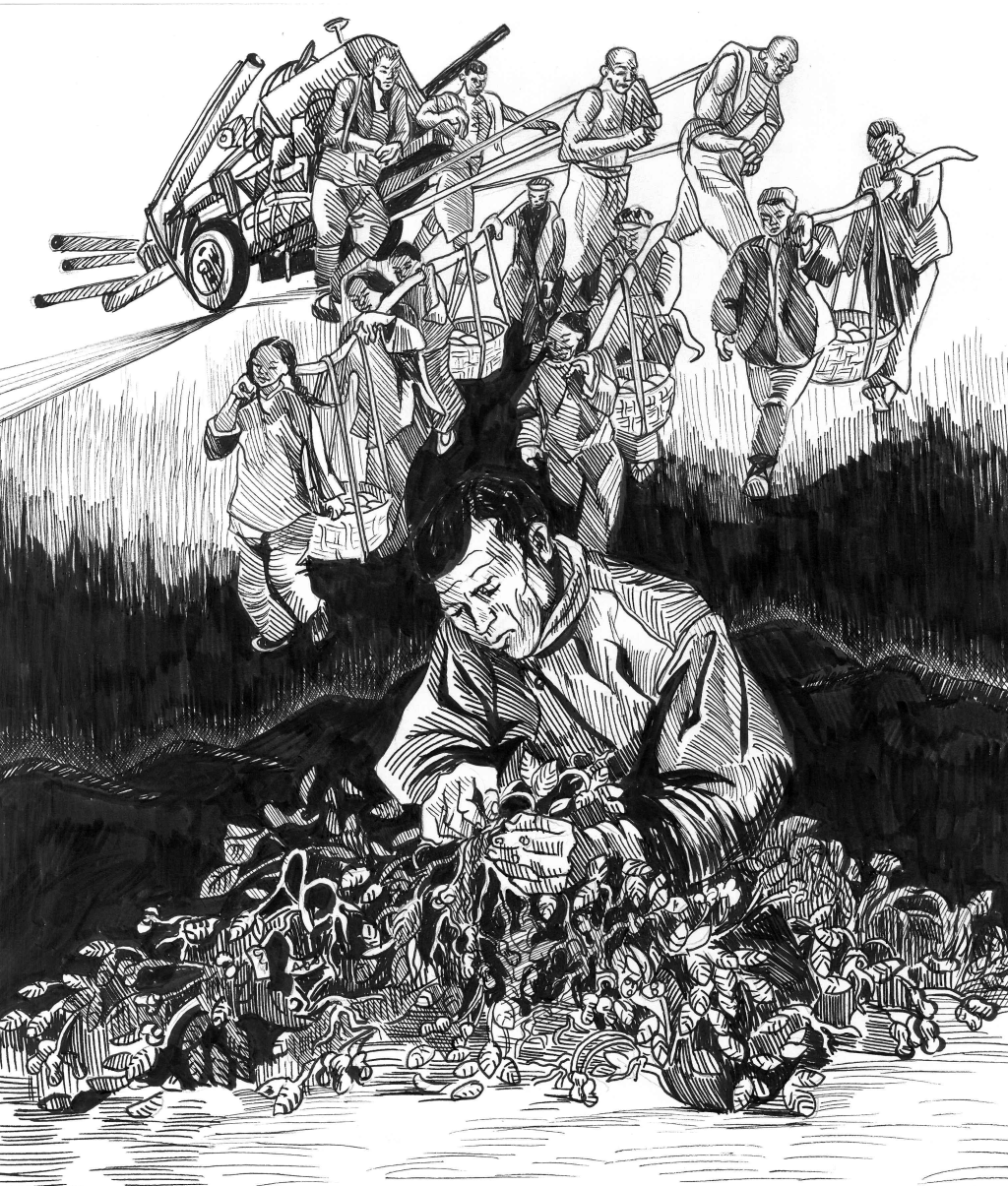
Following the Soviet model into the contradictions of socialism
By 1953, the tasks of New Democracy had, in the main, been completed. Foreign imperialism was decisively kicked out of China, and the People’s Republic went a step further and delivered a decisive blow to US imperialist aggression in Korea. China’s feudal landlords had been completely defeated and ceased to exist as a material and political class, with land reform delivering their holdings to the masses of poor and landless peasants. A new state power had been constructed that cemented the revolutionary alliance between the proletariat and peasantry, created the conditions for the long-term transformation of other classes, and delivered democratic reforms to China’s population, such as legal equality between women and men. It was time to take the revolution further and transition from New Democracy to full-blown socialism and, step-by-step, state ownership of the means of production.
But what means of production were there for the state to own? Coming out of centuries of feudalism and a century of foreign domination, China was deprived of mechanized agricultural tools, functional transportation that effectively tied the country together, and modern industrial means of production. What little heavy industry, such as steel production, that existed was concentrated in a few coastal cities and in Manchuria, where it had been developed under Imperial Japan’s occupation. In both cases, industrialization had served foreign imperialism far more than it did China’s people, with port cities providing imperialist powers the means to extract wealth from the country. After the 1949 liberation, China was free from foreign domination and moving quickly to rid itself of feudalism, but the overwhelming majority of its population remained in a state of material deprivation, without adequate food to eat, let alone access to electricity and the benefits of modern technology and industrial production.
Consequently, developing China’s productive forces and its heavy industry was a priority for the new socialist state. Without industrialization, China would be unable to overcome the material deprivation and raise the standards of living of its population, unable to get beyond rural production relations based on individual peasant proprietorship and production and the class differences that grew from it, and at a great disadvantage in the face of imperialist aggression by armies equipped with industrially produced weaponry. Having come to power through a largely rural, peasant-based revolution, the Chinese Communist Party was adept at leading land reform, governing rural areas, and politically mobilizing the peasants. But it was quite inexperienced at leading industrial development, central economic planning, and the various classes necessary for operating modernized means of production. In the face of this inexperience and the enormity of the challenge of industrializing China, the CCP looked to the world’s first socialist state, the Soviet Union, as a model and for practical guidance.
Socialist China was, at its inception, among a growing number of socialist states that had emerged through and in the aftermath of World War II, who constituted its political allies and reservoir of economic support. The Soviet Union, established three decades prior, naturally constituted the leading state among them, having illuminated a path to the consolidation of proletarian power and socialist industrialization coming out of a Russian empire in which feudalism prevailed, albeit with substantial industrialization and modernization in a few cities. So when the CCP started, in late 1952, drawing up its First Five Year Plan to guide China’s economic development, it copied much from the Soviet model, for better and worse. Furthermore, socialist China relied substantially, if not slavishly, on the Soviet Union’s commitment to assist its development of industrial enterprises, including via the deployment of thousands of Soviet technical personnel to help set up and run modernized factories.
China’s economic focus, in the mid-1950s, was on developing heavy industry, which received 88.8% of state investment in industry. The industrial output goals of the First Five Year Plan of a 14.7% annual increase were exceeded at every turn, achieving a 16–18% yearly increase from 1952–57, with steel, coal, and electric power production seeing massive gains and planes, tractors, and trucks made domestically. Industrial production extended beyond coastal cities and Manchuria to China’s interior, with two-thirds of the Plan’s intended new industrial enterprises slated for construction there. China’s industrial cities grew in number and population, but without the explosion of unwieldy rural to urban migration and slums that occurred in so many other newly independent countries in the post-WWII decades. In its primary goal of developing and spreading heavy industry, socialist China’s First Five Year Plan was a great success.1
Yet it came at significant costs, economically and, more importantly, politically. Agricultural production increased only 3.7% annually, with little mechanized tools reaching their way to the peasantry working the land. Under First Five Year Plan thinking, the collectivization of agriculture—the elimination of private ownership of the means of production in the countryside, including land, and the proletarianization of the peasantry into a collective labor force—was put off for the future, with mechanization of agriculture via the development of heavy industry perceived as its necessary prerequisite. The gap between cities and countryside if anything widened in the mid-1950s, with the latter left behind the former in access to the conveniences of modern technology, as well as healthcare and education. Light industry—which produced mainly consumer goods and required less massive production machinery—likewise failed to keep pace with gains in heavy industry, and stratification among the proletariat between those who acquired the skills to work with modern technology and those who who did not began to create a new, privileged section of the working class.2
Politically, the industrialization drive of the First Five Year Plan put emphasis on technocratic efficiency and created a growing class division in socialist China by buttressing the power and privileges of administrators, managers, and experts, all of whom were necessary for developing heavy industry, with its need for technicians, planners, and centralization. How those necessities were handled, however, and whether they strengthened socialist or capitalist relations of production was a political question depending on what line and policies were pursued. The Soviet approach, for the most part copied in socialist China’s mid-1950s industrialization, tended to strengthen bourgeois rather than proletarian ideology and methods. Furthermore, putting decision-making and authority in the hands of experts and administrators risked reproducing, in a new form, old Imperial China’s use of bureaucratic officials as a privileged elite standing above the masses and demanding their obedience.
Under the First Five Year Plan, CCP officials became economic planners, administrators, and enforcers via the creation of the State Planning Commission and other state bodies set up during the mid-1950s, such as the State Council and the Ministry of State Control, the latter initiated to stop corruption and other problems. The CCP could make and carry out effective economic plans that served China and its people and avoided the anarchy of production inherent in capitalism through these state bodies. But the cadre assigned to them became office workers, increasingly divorced from the masses and from the production they were overseeing. Administration and the bureaucracy that went with it were unavoidable to some degree, of course, though the degree to which they grew in the mid-1950s transformed the vanguard party in a bourgeois direction, with many Party members settling into white-collar work and the privileges of city life.
At the factory level, one-man management was often employed, on the Soviet model, to ensure the efficient operation of complex industrial enterprises. The masses’ role in such factories was reduced to laborers on the means of production, albeit ones ensured stable employment and an “iron rice bowl” providing them with the necessities of life, rather than as collective masters of the production process. To boost production, managers turned to material incentives rather than revolutionary politics to motivate workers, and pay differentials among the working class increased, with an emerging section of more privileged, skilled workers.
To carry out industrialization, the socialist state recruited large numbers of intellectuals, largely from the pre-existing national bourgeoisie and petty-bourgeoisie, to serve as managers, engineers, technicians, and experts in the production process. They were given high salaries and the privileges of urbanization, and many were recruited into the Communist Party itself. Between these technical experts and the Party cadre in administrative positions, a new class was emerging on the basis of urbanization and industrialization that stood over and above the masses of peasants and proletarians in their role within the division of labor of society and with the material privileges that went with that role. That class began to reproduce itself via socialist China’s education system, which made impressive gains in enrollment in the 1950s—the number of university students went from 117,000 in 1949 to 441,000 in 1955.3 Those gains, however, were disproportionately located in the cities and benefited the children of the previously existing urban privileged classes and of the Party officials who had moved into the cities after the Revolution’s victory.
One of the most difficult contradictions of the socialist transition to communism is overcoming the centuries-old division between mental and manual labor. Socialism needs experts to keep its economy and society functioning, those experts will at first mostly come from the petty-bourgeoisie built up in the previous society, and the generation of new experts from the masses can wind up creating a new petty-bourgeois strata. Furthermore, to avoid a “brain drain” and have the engineers, doctors, scientists, etc. they need, socialist countries have had to pay experts more than the masses, in effect bribing them to put their skills in service of socialism rather than emigrating to a capitalist country, where they could be paid more, or refusing to work. China’s First Five Year Plan did not adequately work against widening the division between mental and manual labor and entrenching a new privileged elite due to the need for experts.
While bribing pre-existing petty-bourgeois mental workers with higher salaries was understandable to some extent, entrenching the new elite within the Party lowered the vanguard’s standards far below the revolutionary commitment that defined it during the revolutionary war that brought it to power and fostered bourgeois thinking in its ranks, especially in the cities. This entrenchment of a new elite within the CCP took place through recruitment of unremolded petty-bourgeois experts into the Party, bureaucratization of existing Party members, and the growth of rank and pay differentials. According to historian Maurice Meisner, by 1955, “cadres were divided into 26 distinct ranks with corresponding salaries ranging from 30 to 560 yuan ($12–$224) per month; and in the cities, at least, rank assignments largely were determined by the importance of the cadre in the industrialization process.”4 All this represents a big step backward from the serve-the-people spirit that made the CCP one with the masses in the 1930s and 40s, and put technocratic administration and economic efficiency rather than revolutionary politics in command of significant sections of the Party apparatus and of the industrialization drive overall.
Taking corrective measures
The implementation of the First Five Year Plan was not an unmitigated embrace of bureaucracy alienated from the masses inspired by the Soviet model. Some CCP leaders, especially Mao, were aware early on of its negative aspects and took corrective measures. At the very beginnings of the Plan’s implementation, on January 5, 1953, the Party’s Central Committee issued a directive, drafted by Mao, titled “Combat Bureaucracy, Commandism, and Violations of the Law and Discipline.” That directive drew attention to the problem of cadre becoming divorced from the masses, ignoring their problems, and suppressing their criticisms. It summed up that the early-1950s “Three-Antis” campaign against corruption, waste, and bureaucracy had largely succeeded against the first two maladies but had not yet defeated the last.
Then in August of 1953, Mao gave a speech titled “Combat Bourgeois Ideas in the Party” at a national conference on financial and economic work. Mao’s speech is well worth studying, as it points out how policies pursued by CCP leaders and those involved in economic administration can strengthen socialism or capitalism depending on the the political line in command. Bo Yibo, a leading CCP economic planner, comes in for criticism because his taxation policy strengthened privately owned capitalist enterprises.5 Beyond specific policies, Mao’s speech draws attention to questions of method and attitude, such as whether Party members embrace collective leadership as a means to strengthen the Party’s work through critical scrutiny of its practice or whether they prefer to escape supervision and accountability.
Mao’s interventions in 1953 were indicative of how rectification campaigns within the CCP became a string of related events during the socialist transition period. As one ended, another began; as one bad tendency was mostly corrected, another asserted itself and needed to be struggled against. The vanguard party was not a pure entity, and each new phase of socialist construction opened up new contradictions within its ranks and/or re-opened old ones. Mao’s leadership proved exemplary at recognizing these contradictions, analyzing how they were manifesting within the Party, and launching internal struggles to bring forward the positive side of the contradiction and defeat the negative, largely through political education and ideological transformation rather than purges. But purges did become necessary when erroneous approaches by some Party leaders and members consolidated into bourgeois outlooks and threatened the socialist transition to communism. In 1953, Gao Gang’s desire to go full-steam ahead in emulating the Soviet model during the First Five Year Plan posed such a threat.
Gao Gang had solid credentials as a CCP leader during the period of revolutionary warfare. He became the Party leader in charge of industrialized Manchuria, and developed close ties with Soviet leadership (Manchuria shared a border with the Soviet Union, and Soviet troops played a key role in ending the Japanese occupation of Manchuria, and then occupied it themselves). When the State Planning Commission was formed in 1952, Gao was its chairman. From his positions of economic and state power, Gao took the adoption of the Soviet model the furthest, putting one-man management, bureaucratic administration, and technocratic privilege in command in Manchuria. In 1953, he was knocked down from his leadership positions and ultimately expelled from the Party at the end of the year; Gao subsequently committed suicide.
The official narrative concerning Gao’s downfall, not made public until 1955, was that he had made Manchuria his “independent kingdom” and was plotting a wider power ploy against the CCP’s leadership of socialist China. Rao Shushi, the Party leader in charge of the Shanghai region who was also part of the State Planning Commission and in charge of the Party’s Organization Department, was said to be in cahoots with Gao. The “Gao-Rao Anti-Party Conspiracy,” as it came to be called, demonstrated the contention within the CCP over implementation of the First Five Year Plan and apprehension, by Mao and others, about going too far in following the Soviet model. Whatever the truth of Gao and Rao’s conspiratorial efforts to usurp greater power for themselves, their political line stood in opposition to the socialist development of China. It is unfortunate that the struggle against their political line was presented mainly in conspiratorial terms—an unfortunate adoption of the Soviet model when it came to dealing with inner-Party struggle, ironically in a struggle against following the Soviet model of economic development. CCP leadership likely felt constrained in their ability to openly criticize the Soviet economic model for reasons of diplomacy (the Soviet Union was their closest ally) and because they had yet to develop a coherent alternative model.
The purge of Gao, Rao, and their closest allies in leadership positions was followed up with the “Campaign to Wipe Out Hidden Counterrevolutionaries,” launched at a 1955 National Party Conference and continued into 1956. This campaign was mainly directed against Party members serving in the government bureaucracy, with 150,000 such people investigated, not only for any possible connections with the Gao-Rao Anti-Party Conspiracy, but also for masking bourgeois outlooks behind stated fidelity to the ideology and politics of the CCP. Some of those investigated were sent to labor camps for a brief period of ideological remolding, but unlike what was practiced in the Soviet Union, there was not a rash of executions accompanying this purge. More than anything else, the Campaign to Wipe Out Hidden Counterrevolutionaries served to put the state bureaucracy that had grown dramatically in the preceding years in check, and reassert Communist Party ideological and political leadership over what had become too much of a technocratic administration.6
Another hidden counterrevolutionary exposed and brought down in the mid-1950s was the literary critic Hu Feng, who had weaseled his way into a position in the leadership of the Chinese Writers’ Union. While claiming to generally support the CCP’s objectives of building socialism, Hu’s criticisms of the Party painted the new society it was creating in a mainly negative light, as if pre-Revolution China was a more desirable place to live. Perhaps it was for privileged intellectuals like Hu, but not for the masses, and the monumental achievements of socialist China’s first years needed to be defended against their cynical petty-bourgeois detractors. So beginning in Summer 1954, Hu was publicly taken to task by Party leaders, including cultural authority Zhou Yang and Premier Zhou Enlai, as a reactionary seeking a return to the old China. Hu was imprisoned as a counterrevolutionary in Summer 1955.
Hu cloaked his criticisms of the new China in a bourgeois-democratic insistence on freedom to express dissenting viewpoints. One of the contradictions of the socialist transition to communism is the importance of allowing and encouraging freedom among the masses to air different viewpoints and debate those viewpoints out to arrive at truth while exercising dictatorship over the reactionary classes, along with their ideological representatives. Especially when those ideological representatives seek to create reactionary public opinion against the socialist state and mobilize their petty-bourgeois compatriots against it, it can become necessary to curtail or suppress their political activities.
In socialist China’s early years, some petty-bourgeois intellectuals embraced the new society, others went along with it supportively or cynically, and still others longed for a return to the old society and the privileges they had within it. The latter often cloaked their reactionary desires by attaining positions within the ideological and cultural apparatuses of the socialist state and then spread ideological poison from within them under the guise of bourgeois-democratic freedom of opinion. Hu Feng was a primary example of this phenomenon in mid-1950s socialist China. To its credit, in the CPP’s campaign against what they dubbed the Hu Feng counterrevolutionary clique, they published Hu’s writings, including secret letters he sent to his ideological compatriots which unmasked his reactionary views, along with their own criticisms of Hu’s ideology and politics in a book titled Material on the Counterrevolutionary Hu Feng Clique. Rather than simply labeling Hu the leader of a conspiracy, editorials published in socialist China’s main newspaper, People’s Daily (Renmin Ribao), took the time to explain what made his views counterrevolutionary so that the masses could judge for themselves.
Central state planning and socialist economics
Between Gao-Rao and Hu Feng, mid-1950s socialist China demonstrated how bourgeois elements, in the Party and among the intellectuals, were mounting opposition to the forward momentum of the socialist transition to communism. Whether in the form of wholesale emulation of the Soviet model and its negative bureaucratic consequences or by using bourgeois-democratic freedom to create public opinion against the gains of socialism, this opposition was met with suppression by the socialist state and wider ideological struggle in the Party and in society. That ideological struggle would need to be deepened to deal with the underlying contradictions—between mental and manual labor, between the Party and the masses, between the productive forces and the relations of production, and between different classes, new and old—that would continue to assert themselves as socialism advanced.
Nevertheless, under the First Five Year Plan, even with all its weaknesses, an important foundation was built from which to move through these underlying contradictions. As outlined above, China’s heavy industry was rapidly developed and geographically spread. Mechanisms for planning and coordinating the socialist economy were created, such as the State Planning Commission. And while the state apparatuses in charge of the economy were staffed by many Party cadre who were all too quick to embrace bureaucratic privileges and become divorced from the masses, they also included dedicated, genuine communists steering them in the right direction. Chief among the latter was Zhou Enlai, Mao’s more diplomatic right-hand man, who served as socialist China’s top state official as the Premier at the head of its State Council.
The new industrial enterprises built up under the First Five Year Plan were state-owned, meaning that heavy industry did not belong to any individual, but to the whole people. Decisions about which enterprises to invest in were not made based on the profit motive, but on what industries China needed for its all-around economic development. The products of those state-owned enterprises in heavy industry provided the materials, such as steel, cement, and coal, and machinery for construction, energy, and further production.
At the beginning of the First Five Year Plan, some industrial enterprises were still privately owned, by capitalists that the CCP had categorized as belonging to the “national bourgeoisie.” Those enterprises stood in contrast to ones that had been owned by foreign imperialist powers or their comprador collaborators, which were seized by the socialist state without compensation. The national bourgeoisie was considered a class that stood in contradiction with imperialism and could be enlisted in China’s socialist development, so long as they did not oppose the general objectives of the socialist state. Over time, however, their ownership of the means of production needed to be phased out in order for socialism to prevail. The CCP sought to achieve this objective non-antagonistically by, in effect, buying out their businesses.
In the mid-1950s, private enterprises owned by members of the national bourgeoisie were converted to joint private-state ownership, with their former owners retaining a non-controlling stake in them and receiving dividends on the profits their productive activity generated. Those former owners often remained at their factories as managers and administrators, having accumulated the skills to run them when they were their private property—skills which the socialist state still needed. Eventually, those former owners lost their stake in these enterprises and their dividends were cut off, but that did not occur until a later phase. While the national bourgeoisie went along with being phased out of existence as a class, and some betrayed their class interests and embraced this process for ideological reasons, state power in the hands of the proletariat meant they were powerless to resist if they had wanted to hold onto their private ownership of industrial enterprises. Moreover, the repression meted out to reactionary classes upon the Revolution’s victory made clear what would happen if they did resist—persuasion rested on the proven coercive powers of proletarian dictatorship.
In addition to enterprises owned by the national bourgeoisie, private ownership persisted in handicraft industry, individual peasant proprietorship of land and farming tools, and trade transactions in urban and rural markets. Those who privately owned means of production and trade, even on a small scale, sold their products as commodities (things produced with the intention of selling them on the market). To prevent commodity production and exchange from expanding capitalist relations, socialist China thoroughly regulated it via the state-run economy, especially when it came to commodities that were crucial necessities for the masses and/or for the overall functioning of society. In Fall 1953, China implemented the Unified Purchase System, with which the state had a monopoly on the purchase and sale of grain and other crucial agricultural products. This ensured no market speculation on what the masses needed to sustain themselves and on the agricultural inputs industrial production depended on. Furthermore, it eliminated a source of class power for rich peasants, who had more grain to sell, and traders. By acting as the medium through which grain was bought from peasants and sold to those who needed it, the state ensured the producers would be paid and the consumers could access their products for a low and stable price—the economics of the worker-peasant alliance at that stage.7
Socialist economic planning largely eliminated the anarchy of the commodity market, wherein prices fluctuated, production priorities shifted based on what products would turn the greatest profit, and the needs of the masses had no bearing on the prices of essential goods. In socialist China, under state ownership, regulation, and central planning, prices for consumer products were stable and set at prices that made necessities cheap and luxury products expensive, ensuring the masses had what they needed while the upper classes had to pay extra if they wanted to enjoy a privileged lifestyle. Essential goods, such as basic foods, were sold without making any profit, subsidized as needed by the state. Slightly less essential products, such as medicines, were generally priced at the cost of production, making no profit in their sale, or with a small profit margin. Luxury items that were considered nonessential for daily life, such as watches, were sold at their historical price, making them comparatively expensive, and as their cost of production decreased, the higher profit margins on their sale became capital for the socialist economy’s further development.8
Through state ownership, industrial development, central planning, and firm regulation, China’s First Five Year Plan succeeded in laying the foundations and establishing the basic functioning of a socialist economy from 1953–57. Socialist economics, however, is a moving process, and the dynamic factor within it is the relations of production, encompassing not just the literal ownership of the means of production but also the division of labor within the production process. In the mid-1950s, beyond the grasp of the steady hand of central planning, further dynamic transformation of China’s relations of production came not in heavy industry, the focus of the First Five Year Plan, but in agriculture, from the peasant masses, via a socialist upsurge in the countryside.
Suggested further reading:
Paoyu Ching, From Victory to Defeat: China’s Socialist Road and Capitalist Reversal (Eurotrash Foreign Languages Press, 2019).
Mao Zedong, Combat Bureaucracy, Commandism, and Violations of the Law and Discipline (1953); Combat Bourgeois Ideas in the Party (1953); Speeches at the National Conference of the Chinese Communist Party (1955); In Refutation of “Uniformity of Public Opinion” (1955); Preface and Editor’s Notes to Material on the Counterrevolutionary Hu Feng Clique (1955).
Socialist upsurge in the countryside
Land reform dramatically transformed the Chinese countryside by ending the tyranny of landlords and putting the land into the hands of the people who cultivated it. Peasants finally owned the means of their subsistence and took enormous pride in their land, forming deep emotional connections to their family plot. They tended to it with such zeal that during the dynamic period of land reform in progress, from 1949 to 1952, grain and cotton production spiked.9
However, by the completion of land reform in 1953, agricultural production had stagnated. Even with the contradiction between landlords and peasants resolved, China faced an existential problem in the agricultural sector: having to feed 22% of the world’s population with about 7% of the world’s arable land.10 Much of that land was uncultivated due to centuries of landlord neglect, wars, and natural disasters. Famines have featured prominently and horrifically throughout China’s history. In order to raise the standard of living for the whole population and fuel the industrialization necessary to revolutionize China’s productive forces, agricultural production had to increase on a major scale.
The CCP never assumed that land reform on its own would result in better agricultural yields or collective social relations, and, sure enough, as soon as land reform was completed, a new contradiction opened up as old forms of class exploitation found new expression. The poorest peasant families owned their own land but struggled to cultivate small, low-quality soil with few tools or draft animals, and their lives were easily threatened by a poor harvest or losing a working family member to death or illness. So they would be forced to borrow money from wealthier families, at usurious rates, eventually sell the land that had been so recently hard-won, and hire themselves out as landless farmhands.11 There was an exodus of peasant migrants to the cities seeking work in heavy industry, which was not yet ready to absorb a larger labor force, adding to the problem of unemployment in the cities, fracturing peasant families, and further undermining agricultural production.12 The nuclear family still formed the molecular structure of the rural workforce, and feudal relations, particularly patriarchal family structures, remained insidious and were not overcome by land reform alone.
In order to move beyond a rural economy of individual peasant proprietors working their family plots, land reform was always intended to lead to collectivization, where peasants would pool their land, resources, tools, skills, and labor, and eventually to the abolition of private property entirely. CCP economic planners assumed that many peasants, deprived of their own land for so long, would be possessive of their new rights and resist collectivization, and the Party very much wanted to avoid the Soviet experience of forcing collectivization from above, even if the poorer peasants were supportive. The plan was for collectivization to proceed very slowly, in three stages, with every step taken completely voluntarily by the peasants. First, groups of households would be organized into mutual aid teams, where they would work cooperatively but still retain individual ownership of their lands and whatever crops were harvested. Second, those mutual aid teams were to be combined into lower cooperatives, where members would still own land individually but divide their crops between them according to the amount of labor and land contributed. Third, the lower cooperatives would be combined into advanced or socialist cooperatives, where all means of production, including the land, would be owned collectively, ending private property, and all crops and proceeds divided according to the needs,not just the contributions, of every member.13
But this was the peasantry who had formed the backbone of the revolution, and many were already ready to take the socialist road. Peasants in parts of the countryside that had been liberated base areas before the 1949 seizure of nationwide power already had substantial political education and had been won over to the communist cause by the patient political work and example of the Red Army. Many peasants in those areas had joined the Red Army or had formed peasant associations prior to 1949, embracing collectivity and selflessness in service of revolution. Peasants throughout China had participated in the land reform movement, and had stood up to their oppressors and taken back the land that was rightfully theirs. Having seen how much change was possible through the Revolution that had already upended centuries of feudal and imperialist oppression, facing the obstacles and hunger that came with struggling to cultivate their land individually, and with a personal stake in their revolution, their new society, the poorest peasants were ready to collectivize. In 1953–54, agricultural cooperatives began to be formed in places where rural CCP cadre and peasants had a higher level of political consciousness and recognized the need to work collectively to solve problems of production.14
By 1954, floods and droughts had made the already precarious agricultural production situation even worse with two years of poor harvests, and through 1955, the Party’s Central Committee was consumed with the question of if, and how, to speed up collectivization in order to meet production goals. When the Central Committee agreed to accelerate collectivization, the decision was met with political opposition in the Party based on the difficulties that existing cooperatives were facing, from better-off middle peasants refusing to join cooperatives, to rich peasants starting to control new cooperatives for their own benefit. In March, the State Council halted further expansion of cooperatives, and in May, the Central Committee resumed expansion but at a much slower pace.15
Advocacy for a slower pace was based on the assumption that cooperatives would remain at the “lower” stage for a long time, having to wait for the mechanization of agriculture before they could move to a higher stage. Waiting for mechanization before advancing collectivization put the development of the productive forces (mechanization), via heavy industry, principal over the revolutionization of production relations (collectivization). It was the conventional wisdom on socialist construction imported from the Soviet Union, which all too many CCP leaders were beholden to, and it was upended by intervention from Mao and initiative from the masses.
Lighting the socialist spark ablaze
Mao strenuously disagreed with conservative assessments of the readiness of the peasantry for collectivization and the gradualness of the existing plan for it, but he was overruled by the majority of the Central Committee. On July 31, 1955, he went around the Central Committee by addressing his argument for accelerating agricultural collectivization to a meeting of provincial, municipal, and autonomous region Party secretaries, declaring:
An upsurge in the new, socialist mass movement is imminent throughout the countryside. But some of our comrades, tottering along like a woman with bound feet, are complaining all the time, “You’re going too fast, much too fast.”… The high tide of social transformation in the countryside, the high tide of co-operation, has already swept a number of places and will soon sweep the whole country. It is a vast socialist revolutionary movement involving a rural population of more than 500 million, and it has tremendous, worldwide, significance. We should give this movement active, enthusiastic and systematic leadership; we should not drag it back by whatever means.16
In this speech, Mao gave a presentation on the facts and figures of current cooperatives, using specific quantitative data to demonstrate how fast they were growing, and accused the CCP of holding back this “socialist spark” in the rural areas. He gave examples of ways certain cooperatives were struggling out differences between poor and middle peasants, and how wealthier peasants were being swept along with the cooperative movement. This was not necessarily because they wanted to join cooperatives or because they were being forced to (Mao continued to stress that joining a cooperative must be completely voluntary for every peasant), but because of the irresistible strength of the collectivization movement.
Mao laid out a plan for how the Party and leading cadre should go about escalating the collectivization timeline. Above all, he insisted that this “high tide of socialist transformation” was inevitable, and that by 1958, the end of the First Five Year Plan, the majority of China’s rural population would be part of agricultural collectives rather than remaining individual farmers. Mao’s ideas about how the peasants could begin to change the relations of production through collectivization before building up the productive forces flew in the face of orthodox socialist economics.
With Mao having circumvented top Party leadership and presenting his vision to the Party at large, opposition by some CCP leaders to accelerated collectivization could not hold back the “high tide” he described, and in October his plans were given formal approval. By the end of 1955, 63% of peasant households had joined cooperatives. By May 1956, not only were over 90% of households part of agricultural collectives, but many lower cooperatives had advanced into fully socialist cooperatives, the last stage of collectivization that CCP planners had initially thought would be decades in the future.17 Mao had been right when he said in his July 1955 speech that “even middle peasants are still not well off,” and that the peasantry’s low quality of life was driving them to take this radical leap. The poor and middle peasants who made up the majority of the Chinese population were willing to give up private ownership of their land in favor of the chance to improve their lives and avoid the perpetuation of class divisions by coming together into collective forms of owning and working the land.
Socialist transformation as a struggle, in the Party and among the masses
The formation of agricultural cooperatives from 1953–56 was by no means smooth sailing. Rural CCP cadre had to win over the peasantry to collectivization by persuasion, and then had to reorient peasants used to production by individual families to work collectively. Along the way, they had to figure how to contend with calculations of “what’s in it for me?” ideologically and practically, such as how work points (points for labor carried out, which determined income) were allocated to cooperative members, who was assigned to what job, and which production tasks to focus on. Collectivization was a matter of trial and error, with lots of adjustments to everything from work point systems and how manure was collected to how to care for and best use oxen. Inevitably, plenty of mistakes were made before figuring out the best methods.18
CCP leaders and members committed to collectivization did not try to pretend the process was perfect. In fact, they wrote and published reports on the process of forming cooperatives that gave honest, critical assessments of mistakes made and solutions arrived at, showing how when one contradiction of collectivization was resolved, another opened up in an ongoing process of struggle for socialist transformation. Many of these reports were published, in 1955–56, in a massive three-volume collection titled Socialist Upsurge in China’s Countryside so that the rural CCP cadre taking the lead in forming cooperatives could learn from efforts to do so all over China.19
Those rural cadre, who came from the peasantry and still had strong roots there, threw themselves into the task of organizing millions of courageous and enthusiastic, but largely uneducated, illiterate, and under-resourced peasants, often in very remote and hard-to-access areas, into efficient collective enterprises. They knew the people and knew how to mobilize them politically, but lacked the managerial expertise necessary for leading and coordinating the advanced (or socialist) cooperatives, which were larger than the lower cooperatives had been. Experts sent down from urban areas had these managerial skills, but did not know the people or necessarily appreciate their strengths. So the first few years of collectivization were, inevitably, disorganized, and that had a negative effect on production.20 As 1957 drew to a close, it became clear that although collectivization had not brought the economic chaos or violence that many top CCP leaders had anticipated, it also had not delivered the dramatic increase in productive output that Mao and those aligned with him had hoped it would.
Nevertheless, the challenges and setbacks inherent in setting up advanced cooperatives could not dim the optimism of the peasants or of Mao in the wake of this high tide of socialist transformation. If anything, the increasingly urgent need to meet production goals only intensified the national commitment to collectivization. Meanwhile, collectivization was already beginning to improve the conditions of the peasants’ lives, even if their incomes did not increase. The backbreaking work of farming China’s varied terrain with only simple tools and oxen was made easier and more productive by combining the available, if rudimentary, productive forces and putting labor together to improve the land and coordinate various production activities. These accomplishments suggested, to the rural masses, that even more dramatic changes were possible by taking collectivization to a higher level.
As the First Five Year Plan drew to a close, CCP leadership tried to reckon with how to speed up urban industrialization and increase agricultural production in symbiosis, without harming either goal. The same Party leaders who had opposed accelerated collectivization were still afraid that a more radical timetable for economic growth would end in chaos. Meanwhile, Mao, emboldened by the socialist upsurge in the countryside, prepared to propose even more daring plans for accelerated agricultural collectivization that would come to be known as the Great Leap Forward. Between 1955 and the start of the Great Leap Forward in 1958, Mao advanced a deeper critique of conventional wisdom concerning socialist construction, theorizing how to further revolutionize the productive and social relations in the direction of communism.
Suggested Further Reading
Mao Zedong, On the Cooperative Transformation of Agriculture (July 31, 1955).
Vivienne Shue, Peasant China in Transition: The Dynamics of Development Towards Socialism, 1949–1956 (University of California Press, 1980).
Socialist Upsurge in China’s Countryside (Foreign Languages Press, 1957).
Reconceptualizing socialism
The socialist upsurge in the countryside was a challenge to the prevailing conventional wisdom that socialist construction, especially the collectivization of agriculture, depended principally on the development of the productive forces. The leap forward in establishing agricultural cooperatives in China’s countryside in 1955–56 demonstrated that the relations of production could jump ahead of the productive forces by way of the conscious initiative and ideological commitment of the peasant masses, even if they did not have tractors and other mechanized tools. It upended the orderly process of economic development one-sidedly favoring heavy industry under the First Five Year Plan and challenged the Soviet model of socialism it was based on. In light of this practical experience, Mao was beginning to theorize a different path than the one charted by the Soviet Union under Stalin’s leadership.
Yet the emerging new conception and practice of socialism developing in China faced challenges from within and without. Some leaders in the Chinese Communist Party were never enthusiastic about the socialist upsurge in the countryside, and what was labeled “rightist conservatism” held back advances in production outputs in agriculture and industry by doubting the potential power of the masses’ subjective agency. In the first first half of 1956, mid-level Party leaders afraid of being tainted by the label of “rightist conservatism” focused on getting quick results in higher production outputs, neglecting safety and quality in industry and making bad plans in agriculture, such as producing lots of ploughs that did not work in southern China. Those mistakes, together with the growing pains of agricultural collectivization, were seized on by some in the CCP to push back against Mao’s revolutionary approach to advancing socialism in the countryside, and adverse weather in 1956 that hurt agricultural yields bolstered their arguments. By Summer 1956, the orderly approach of the First Five Year Plan was making a comeback in agriculture and industry.21
Outside China, a new leadership in the Soviet Union, headed by Nikita Khrushchev, had seized the reins of the Communist Party and state apparatus in the years following Stalin’s death on March 5, 1953. At the Communist Party of the Soviet Union’s Twentieth Congress in February 1956, Khrushchev dropped an ideological and political bomb on not just the Soviet leadership but the entire international communist movement. He denounced Stalin in a closing speech to the Congress and painted his former comrade as a tyrant exercising a personal dictatorship over the Soviet Union with no shortage of brutal repression. Khrushchev’s speech pointed to real errors made by Stalin while absolving himself and the current Soviet leadership of responsibility for those errors, setting the Soviet Union up for a reversal of socialism and the restoration of capitalism under the guise of moving beyond Stalin’s tyranny. For the Chinese Communist Party, Khrushchev’s denunciation of Stalin presented, on the one hand, an opportunity to criticize the problems in the Soviet model of socialism more freely but, on the other hand, an obligation to uphold socialism, the dictatorship of the proletariat, and the achievements made under Stalin’s leadership against their detractors within the international communist movement.
Stalin’s best defender and best critic
The CCP’s initial public response to Khrushchev’s denunciation of Stalin came in the form of an editorial titled “On the Historical Experience of the Dictatorship of the Proletariat” published in People’s Daily (Renmin Ribao), China’s national newspaper under Party leadership, on April 5, 1956. Given the bad advice that Stalin, the Soviet Union, and the Comintern had given to the CCP from the mid-1920s through the mid-1940s, you might expect the Chinese comrades to take the opportunity to skewer Stalin and the Soviets for their mistakes. Stalin and Soviet leadership had counseled the CCP to subordinate themselves to the Guomindang or to attempt to mechanically copy the Russian Revolution and launch urban insurrections, and both of these approaches had proved disastrous. Even after the CCP had proven itself during the War of Resistance Against Japan, Stalin remained skeptical of its ability to defeat the Guomindang, seize nationwide power, and build socialism. Furthermore, the Soviet Union was far less generous with aid and assistance to the newly founded People’s Republic of China than it could have been—and should have been by the principle of proletarian internationalism.
The CCP, however, was not concerned with settling scores, but with upholding revolutionary principles while subjecting the Soviet experience and Stalin’s leadership to necessary critique. “On the Historical Experience of the Dictatorship of the Proletariat” did criticize Stalin for offering “certain wrong advice on the international communist movement,” using examples from the CCP’s experience and highlighting the rift between the Soviet Union and socialist Yugoslavia. Rather than label Stalin a tyrannical dictator, as Khrushchev had, the CCP’s editorial identified repressive measures in the Soviet Union as a question of political line, criticizing Stalin for broadening “the scope of the suppression of counterrevolution” far beyond what was correct and necessary. It remained dialectical, rather than personal, in its judgment of the exercise of proletarian dictatorship under Stalin’s leadership:
To defeat powerful enemies, the dictatorship of the proletariat requires a high degree of centralization of power. This highly centralized power must be combined with a high level of democracy. Where there is an undue emphasis on centralization, many mistakes are bound to occur.
“On the Historical Experience…” also opened up an important critique of the way the Soviet Union had built heavy industry on the backs of the peasantry, exploiting their labor to feed the cities and provide capital for industry. It stated that Stalin “failed to pay proper attention to the further development of agriculture and the material welfare of the peasantry.” This critique would be further deepened over the coming months and years as socialist China moved further away from one-sided emphasis on heavy industry in a few cities. Mao’s emphasis was on bringing forward the revolutionary initiative of the peasantry as a dynamic force in socialist construction, not one that had to await, and passively support with their labor, the development of the productive forces in the cities for their salvation.
Most importantly, the CCP identified the roots of Stalin’s errors not in personal megalomania, but in incorrect methods of leadership. The “cult of the individual” constructed around Stalin was criticized less as a personal problem and more as an issue of elevating individual leadership above the collective of the Party and the masses and refusing to learn from the masses. The CCP viewed this issue as not just a problem on Stalin’s part, but as a wider problem of bureaucratism that can set in when a communist party goes from an insurgent force to a governing force, and its leading cadre can wind up “alienating themselves from the masses and collective leadership.” This criticism of the Soviet Union under Stalin’s leadership was also a warning to the CCP itself, and, unlike how Khrushchev’s speech absolved himself of guilt, “On the Historical Experience…” turned its critique to problems within the CCP. In skewering “doctrinairism” as the intellectual method of the “mentally lazy,” the CCP’s editorial made a profound analysis of the dangers of communist ideology being treated dogmatically after it becomes the ruling ideology in socialist society:
…because Marxism, since the victory of the revolution, has been generally recognized as the guiding ideology in the whole country, it often happens that not a few of our propagandists rely only on administrative power and the prestige of the Party to instill into the minds of the masses Marxism-Leninism in the form of dogma, instead of working hard, marshaling a wealth of data, employing Marxist-Leninist methods of analysis, and using the people’s own language to explain convincingly the integration of the universal truths of Marxism-Leninism with the actual situation in China. We have, over the years, made some advances in research in philosophy, economics, history, and literary criticism, but, on the whole, many unhealthy elements still exist. More than a few of our research workers still retain their doctrinaire habit, put their minds in a noose, lack the ability to think independently, lack the creative spirit, and in certain respects are influenced by the cult of Stalin. In this connection it must be pointed out that Stalin’s works should, as before, still be seriously studied and that we should accept, as an important historical legacy, all that is of value in them, especially those many works in which he defended Leninism and correctly summarized the experience of building up the Soviet Union. Not to do so would be a mistake. But there are two ways of studying them—the Marxist way and the doctrinaire way. Some people treat Stalin’s writings in a doctrinaire manner, with the result that they cannot analyze and see what is correct and what is not—and even what is correct they treat as a panacea and apply indiscriminately; inevitably they make mistakes.
In critiquing Stalin, the Soviet Union, and problems in the leadership of socialist China, the CCP’s editorial emphasized the fact that contradictions persist during the socialist transition to communism, painting that transition as a process where “one contradiction will lead to another; and when old contradictions are solved, new ones will arise.” This dialectical understanding stands in contrast to Stalin’s mechanical materialist treatment of socialism as a more or less static system, wherein once ownership of the means of production has been settled, the principal task becomes to further develop the productive forces rather than to further revolutionize the relations of production.
With “On the Historical Experience of the Dictatorship of the Proletariat,” the CCP articulated a guideline to evaluating Stalin and socialism more generally based on communist principles and a willingness to openly critique socialism’s shortcomings and mistakes without throwing out its great achievements or condemning the leaders who erred in the context of building socialism. By contrast, communist parties in command of socialist states in much of Eastern Europe, with the exception of Albania, and in the Soviet Union itself took Khrushchev’s condemnation of Stalin as an opportunity to begin discarding communist principles, carry Stalin’s mistakes further in order to degrade the socialist character of their societies, and embrace bourgeois ideology and politics, especially in the form of renouncing class struggle and the dictatorship of the proletariat. In communist parlance, this betrayal of communist principles while keeping the outer trappings of socialism and monikers of communism is called revisionism (revising the revolutionary heart out of communism).
Revisionism among communist parties in the latter half of the 1950s came in different forms. Its most blatant one took shape in Yugoslavia, whose “socialist” state was led by Tito and the Yugoslav League of Communists. Unlike other Eastern European countries that emerged from World War II as socialist states, Yugoslavia had pursued an independent path from the Soviet Union, and a political rift between the two countries developed in the late 1940s. Tito and his Yugoslav compatriots were all too eager to take Khrushchev’s condemnation of Stalin even further, and in doing so presented Western capitalist bourgeois-democracy as more or less superior to socialism and proletarian dictatorship, even warming up to US imperialism diplomatically and economically. In Poland and Hungary, where socialist states were established after World War II without adequate social transformation that involved the masses, struggles broke out within communist party leadership over proletarian dictatorship vs. bourgeois-democracy, and students and intellectuals openly challenged communist party leadership and socialist government. In Hungary, this took the form of open revolt in October 1956, which was put down by the Soviet Union’s military intervention the following month.
The CCP’s response to revisionism within communist parties and socialist governments and disunity within and between socialist societies was twofold: it critiqued the former in increasingly strident polemics while seeking to shore up political unity among the latter. The CCP continued to uphold the Soviet Union as the world’s first socialist state and the most powerful country within the socialist camp, even as ideological and political differences between it and the CPSU mounted. As practical support, China dispatched its premier, Zhou Enlai, to Eastern Europe in January 1957 to use his great diplomatic skills to patch up relations between Eastern European socialist countries and the Soviet Union.
In the context of 1950s geopolitics and the threat posed by US imperialism, fighting for the unity of the socialist camp was the correct overall strategic approach, although it meant objectively strengthening the legitimacy of Soviet leadership and glossing over, at least diplomatically, the moves it was making in an increasingly counterrevolutionary direction. On principle, it was right to try and win over communist parties that were becoming revisionist through persuasion, appealing to the comrades within them who still had revolutionary convictions rather than condemning them to the enemy camp immediately. Moreover, tactically speaking, socialist China would have been quickly isolated internationally if it had not taken the approach of seeking unity with other socialist states and communist parties while engaging in debate with them over questions of principle.
When it came to critiquing revisionism, the second salvo from the CCP in the international debate over communist principles was the editorial “More on the Historical Experience of the Dictatorship of the Proletariat,” published in People’s Daily on December 29, 1956. Where the April editorial emphasized the problem of dogmatism and doctrinairism, the December editorial put revisionism, in the form of renouncing proletarian dictatorship and embracing bourgeois-democracy, on equal par:
In the present anti-doctrinaire tide, there are people both in our country and abroad who, on the pretext of opposing the mechanical copying of Soviet experience, try to deny the international significance of the fundamental experience of the Soviet Union and, on the plea of creatively developing Marxism-Leninism, try to deny the significance of the universal truth of Marxism-Leninism.
“More on…” took Tito to task for painting the Soviet experience as principally negative and throwing out communist principles along with the legacy of Stalin. It drew attention to the international context—US imperialism seizing on disunity in the socialist camp—to insist on drawing a clear line of demarcation between the enemy and comrades who had made mistakes, even serious mistakes, but were part of the international communist movement. In an exemplary exercise in materialist dialectics, the CCP’s December 1956 editorial ardently defended Stalin’s leadership and the Soviet Union’s achievements while deepening a critique of Stalin’s leadership and Soviet Union’s shortcomings. It added national-chauvinism to its critique, pointing out how Stalin had failed to treat comrades outside the Soviet Union as equals, presuming that the most powerful socialist state in the world must be more right than communists elsewhere and dispensing bad advice to those comrades based on mechanically applying the Soviet experience to their conditions.
As the CCP’s critique deepened and expanded, it continued to draw attention to questions of methods of leadership. The December editorial explained that Stalin “began to put blind faith in personal wisdom and authority; he would not investigate and study complicated conditions seriously or listen carefully to the opinions of his comrades and the voice of the masses.” It identified, as the root causes of problems in the Soviet Union in the 1930s and 40s, Stalin’s departure from relying on the masses and failure to develop the means for involving the masses in really running society and linking leadership with the masses of people. Furthermore, the CCP refused the arrogance that can come with historical hindsight, with its December editorial articulating an insistence on embracing the pedagogical value of our predecessors’ mistakes:
For those who know how best to learn from others, this whole body of experience, both of success and failure, is an invaluable asset, because it can help them avoid roundabout ways in their progress and reduce their losses. On the other hand, indiscriminate and mechanical copying of experience that has been successful in the Soviet Union, let alone that which was unsuccessful there, may lead to failures in another country.
Within its critique of Stalin and his increasingly revisionist detractors, the CCP was constructing a far more dialectical understanding of socialism—one where subjective agency, just as much if not more than the question of what system was put in place, determined the direction of society:
Systems are of decisive importance, but systems themselves are not all-powerful. No system, however excellent, is in itself a guarantee against serious mistakes in our work. Once we have the right system, the main question is whether we can make the right use of it; whether we have the right policies, and right methods and style of work. Without all this, even under a good system it is still possible for people to commit serious mistakes and to use a good state apparatus to do evil things.
The dialectical approach to socialism and proletarian dictatorship articulated in “More on the Historical Experience of the Dictatorship of the Proletariat” was being developed further in theoretical work by Mao and became the subject of struggle within the leadership of the CCP in 1956–57. Internationally, the struggle against revisionism heated up as condemnation of Stalin paved the way for socialist states to betray socialism and embark on capitalist restoration and for communist parties not in positions of state power to renounce the need for revolution. The CCP continued what it started with its April and December 1956 editorials in polemical exchanges with communist parties and leaders around the world who were turning revisionist. In doing so, socialist China provided ideological and political leadership to the international communist movement, helping veteran comrades and a new generation of revolutionaries around the world delineate revolution and socialism from reformism and betrayal.
Taking the principled path came with material consequences for socialist China, however. In response to the CCP’s polemics, the Soviet Union pulled its advisors, technicians, and technology out of China in 1960, an act of sabotage that hurt China’s economy at a difficult moment, but one the People’s Republic rebounded from by further developing its own self-reliance. After seven years of debate that turned increasingly polemical and failed attempts at fighting for unity, in 1963 the CCP condemned the Soviet Union’s leadership as having betrayed socialism, and socialist China found itself isolated from the supposed socialist camp. Along the way, Mao, his revolutionary comrades in the CCP, and the masses of people in China developed a radically different model for the socialist transition to communism that neither negated the Soviet Union’s achievements under Stalin’s leadership nor stayed stuck within its serious shortcomings in methods of leadership and practical policies.
Seeds planted, but blossoming mostly deferred until next season
Prior to the 1956 critique of Stalin and the Soviet model, Mao’s radically different approach to socialist agriculture, which sprouted in the 1955 socialist upsurge in the countryside, was synthesized into a twelve-year plan. In opposition to the Soviet experience and socialist China’s own First Five Year Plan, Mao’s twelve-year plan outlined how to raise agricultural production yields through collectivization and the conscious initiative of the peasantry—taking revolutionization of the production relations as the leading factor rather than waiting for industrialization to bestow mechanization on the countryside from the cities. While agreed to by the CCP’s Central Committee in January 1956, the twelve-year plan for developing fully socialist agriculture was essentially put on hold, as CCP economic planners went on with the First Five Year Plan approach.22
Those who wanted to stick with the Soviet model justified pouring cold water on the peasant masses by pointing to instances where collectivization of agriculture and the drive to meet higher production targets had fallen short. Eliminating private plots and sideline production and focusing on grain sometimes backfired when grain yields were lower than expected and peasants could not fall back on diversified cultivation of various crops to make up for the loss, or to provide the overall economy with a range of agricultural products. Peasants worked hard to achieve high yields, but if those yields did not materialize, they did not see an increase in their income.
A bigger problem, however, was the mid-level Party leaders who advocated exceedingly high production goals, beyond what Mao had called for in his twelve-year plan, for the careerist, “save your ass” purpose of proving they were with the plan and not stuck in rightist conservatism. Those mid-level Party leaders not only hurt the livelihood of the peasants under their leadership and the socialist economy’s interconnected functioning, but also gave ammunition to higher-level Party officials who wanted to tank Mao’s plan and overall approach. From Summer 1956 through 1957, CCP leaders opposed to the Maoist approach had the upper hand in blocking the further revolutionization of the relations of production in the countryside, tagging any attempts at that revolutionization, along with overly ambitious production targets by mid-level Party leaders, as impetuosity and adventurism. It would take another mass upsurge, the Great Leap Forward launched in 1958, to get their conservatism out of the way and ultimately go beyond even Mao’s twelve-year plan.23
While the debate in CCP leadership over agriculture was raging—or, rather, being won practically by Mao’s opponents through underhanded methods while remaining unsettled at the level of political line—Mao began to reconceive socialist construction beyond the realm of agriculture in ways that further challenged the Soviet model. On April 25, 1956, Mao gave a speech to an enlarged meeting of the CCP’s Politburo titled “On the Ten Major Relationships.”24 Mao’s speech is a pathbreaking reconception of socialist economics and governance, based on a masterful application of materialist dialectics and a summation of problems stemming from the Soviet model of socialist construction. To contemporary readers, Mao’s pithiness and clarity of explanation may make his brilliance come off as obvious, but his insights were all but obvious at the time and proved contentious and difficult to put into practice. As such, we highly recommend studying “On the Ten Major Relationships” and thinking through the complexities it is dealing with.
One of those complexities that was center stage in socialist China at the time was the relationship between heavy industry, light industry, and agriculture. Mao’s innovation was to insist that the three form a dialectical unity, and even as heavy industry was necessary to emphasize, failing to also develop light industry and agriculture in correspondence with heavy industry—an error made in the Soviet Union and other socialist countries—would ultimately undermine heavy industry. Another Soviet problem Mao’s “Ten Major Relationships” sought to correct was overemphasis on the needs and prerogatives of the socialist state at the expense of collective production units and the individuals who labor in them—a problem that would result in a growing contradiction between the state, on the one hand, and smaller collectives and individuals, on the other.
In opposition to one-sided top-down centralization of the socialist state, Mao insisted that
it is far better to have the initiative come from both the central and the local authorities than from one source alone. We must not follow the example of the Soviet Union in concentrating everything in the hands of the central authorities, shackling the local authorities and denying them the right to independent action.
Mao’s “Ten Major Relationships” keenly finds ways of bringing forward all positive factors, recognizing different sides of the contradictions of socialist society and seeking resolutions that synthesize contributions from different aspects of those contradictions. With regard to non-communist political forces, Mao argued for “long-term coexistence and mutual supervision” within the overall framework of proletarian dictatorship and the Communist Party’s leadership. Note that mutual supervision means that Communist Party leadership has something to learn from, and can be held accountable by, non-communist political forces.
“Ten Major Relationships” addresses other shortcomings of the Soviet Union, largely by way of critical analysis of and policy proposals for socialist China. In combating Han chauvinism,25 Mao noted that an overall correct policy towards national minorities was established in socialist China’s early years, just as the Soviet Union had done, but that policy should be reviewed frequently with a critical eye toward any instances of Han chauvinism. That type of review had not been conducted in the Soviet Union, where Russian chauvinism took increasing hold in the run-up to World War II. “Ten Major Relationships” also has a frank discussion of the suppression of counterrevolutionaries, which does not renounce past waves of executions or rule out the prospect of future ones, but argues that it is generally better to subject counterrevolutionaries to labor camps or supervision by the masses. With a dash of Chinese peasant humor, Mao called attention to the fact that a mistake in executing someone cannot be undone, and also insisted that the masses’ demands and the effect of executions on society more generally be driving factors in decisions of what to do with counterrevolutionaries. In a related critique of purges under Stalin’s leadership, Mao insisted that people in socialist society who make mistakes should be given a chance to transform, via a policy of “learning from past mistakes to avoid future ones and curing the sickness to save the patient.”
More than its particular policy suggestions, Mao’s “Ten Major Relationships” laid down a visionary orientation for how to move through the contradictions of socialist society in ways that brought the masses of people into the process of not only advancing production but also revolutionizing society in all its dimensions. Yet many leaders within the CCP either did not understand the profound rupture Mao was making with conventional wisdom and the Soviet model of socialist economics and governance, or were so stuck in it, that they (silently) opposed the theses in “Ten Major Relationships.” So they essentially went on with the conception contained within the First Five Year Plan, perhaps patting themselves on the back for not repeating the worst errors of the Soviet Union.
The Chinese Communist Party held its Eighth Party Congress in September 1956—its first Party Congress after coming to power. Given the emerging critique of the Soviet model, the advances in socialist agriculture, and Mao’s pathbreaking reconceptualization of the socialist transition period, the Eighth Party Congress should have been the occasion to debate out different conceptions of socialism, unite around Mao’s, and synthesize a new path for socialist China. Instead, it was a consolidation of existing, conservative thinking. Mao’s radical theoretical breakthroughs had little bearing on the political lines adopted by the Congress, and in late 1956, the CCP’s economic planners set about crafting a Second Five Year Plan that was a continuation of the first one. Some of the problems of socialism that Mao identified, such as growing bureaucratism, were acknowledged at the Eighth Party Congress, but not with any collective determination to address them. Mao’s growing emphasis on the primacy of the struggle to change the relations of production with the subjective agency of the masses was, formally speaking, rejected in the Party Constitution adopted by the Eighth Congress, which identified the principal contradiction in China as that between its advanced social system and its backwards productive forces.26
Mao was somewhat sidelined, organizationally and ideologically, at the Eighth Party Congress. In the name of not repeating the “cult of the individual” that developed under Stalin’s leadership in the Soviet Union, the Party Constitution adopted by the Congress dropped the notion that the CCP was guided by the Thought of Mao Zedong, which had been inscribed in the previous Party Constitution. Liu Shaoqi and Deng Xiaoping gave the main political reports to the Congress; the former remained second in command to Mao in the CCP and took on the role of state chairman, and the latter became the CCP’s General Secretary, giving him organizational power over the Party’s functioning. Mao effectively stepped back from operational leadership of the Party, letting others take the day-to-day reins while he continued to give overall leadership and develop the visionary theory that was (supposed) to guide the CCP. Liu and Deng both had solid revolutionary credentials, having played leading roles in the revolutionary war that led to liberation, and had demonstrated firm dedication to the Party and socialist state since 1949. But dedication, even genuine selfless dedication, must always be to one political line or another, and the coming years were to show increasing divergences in political line in top CCP leadership between Mao and his comrades, on the one hand, and Liu, Deng, and their comrades, on the other—a subject we will explore below.27
Between the “Ten Major Relationships” speech and the rejection of its principles by way of omission at the Eighth Party Congress, Mao made a practical effort to put some of those principles into practice and transform the political and intellectual atmosphere of socialist China. Speaking to a Supreme State Conference on May 2, 1956, Mao brought back a slogan from the previous year: “let a hundred flowers blossom, let a hundred schools of thought contend.” The slogan was meant to concentrate and encourage the principle of “long-term coexistence and mutual supervision” articulated in the “Ten Major Relationships” speech. In Mao’s conception, a loosening of the Party’s reins on intellectual life would allow for greater artistic and intellectual ferment; a hundred flowers blossoming signified greater diversity in cultural work and aesthetics, while a hundred schools of thought contending meant scientific debate that was not too constrained by political considerations.28
Prior to Mao’s May 2 speech, the CCP had begun advocating better treatment of intellectuals, including their working conditions, but conceptually because it needed them for purposes of socialist economic construction. The “hundred flowers” approach treated the intellectuals’ potential contributions to socialist society as not just a utilitarian economic matter, but a strategic and epistemic one. Mao welcomed the dissenting views of artists and intellectuals and the atmosphere of debate and critical thinking created by a hundred flowers blossoming and a hundred schools of thought contending as a necessary and positive method for uncovering the Party and socialist society’s shortcomings. He challenged Party members to overcome their “sectarianism” towards non-Party intellectuals and not be afraid of their criticisms. Furthermore, Mao viewed such criticisms as a means to rectify the Party itself, to correct any errors and shortcomings it made in its institutionalized leadership position within socialist society.
Implementation of Mao’s strategic and epistemic approach to intellectuals and intellectual life, however, proved difficult in 1956. Lu Dingyi, head of the Party’s Propaganda Department, gave a compelling speech announcing the new approach to a Beijing meeting of scientists, writers, and artists on May 26. While largely articulating Mao’s line in that speech, including with no small amount of invective for Party members being sectarian towards non-Party intellectuals, it is questionable how much Lu followed through on that line given that Party propaganda, including the People’s Daily, often articulated an opposing line (see below). Much of CCP leadership seemed at best unenthusiastic and at worst hostile to unleashing criticism and debate from non-Party intellectuals. And the 1955 repression of prominent anti-communist intellectual Hu Feng and the concurrent “Campaign to Wipe Out Hidden Counterrevolutionaries” understandably made many non-Party intellectuals hesitant to articulate more strident criticisms of the CCP’s leadership of socialist China.
Despite those brakes on blossoming and contending, among urban intellectuals and in China’s universities, publications, and culture, there was an atmosphere of more debate, dissent, and intellectual open-mindedness in Summer 1956. The Writers’ Union held forums to discuss both literary aesthetics and broader political questions. The growing problem of bureaucracy and commandist attitudes by Party officials came in for considerable criticism. Blossoming and contending created room to explore various ideas, including the merits of birth control for women’s equality. Some of the dissenting opinions expressed in Summer 1956 later became policy, such as the widespread availability of birth control in 1960s China. However, the flowers that blossomed that Summer were never given sufficient fertilizer. While the CCP’s Eighth Congress in September paid lip service to the hundred flowers concept, most CCP leaders did little to cultivate dissenting viewpoints from non-Party intellectuals. The Hungarian revolt against socialist state power that began the next month provided justification for Party publications to warn of the dangers of giving petty-bourgeois intellectuals too much freedom.29
The stubborn opposition by many in the CCP, including at its leading levels, to having the Party’s leadership questioned or criticized, and more generally to departing from the Soviet model, was proof that rectification was needed. Where many CCP leaders saw mass discontent in Eastern European socialist countries and revolt in Hungary, as well as scattered strikes in China in 1956, as reasons to assert greater bureaucratic control over socialist China, Mao was drawing the opposite conclusions. In his theoretical work, Mao began to emphasize the contradictions between leaders and led within socialist society, and advocate for a rectification campaign to reconnect the Party with the masses and make criticism from outside the Party a crucial, dynamic force in that rectification.
Flowers briefly blossom, two schools of thought contend in the Party, and poisonous weeds proliferate
A Fall backlash against Mao’s advocacy of blossoming and contending, debate and dissent, by many CCP leaders gave way to a formal stalemate the following Winter. Mao was increasingly arguing for a major rectification movement in the Party against the evils of bureaucratism, sectarianism, and subjectivism. The order in which Mao presented these three evils at this time was significant, as it put primacy on the problem of Party officials becoming administrative overlords divorced from the masses, and secondarily on the negative attitude of many in the CCP towards non-Party political forces and intellectuals who were part of socialist society. Subjectivism, wherein plans and political lines are divorced from objective reality, was the problem that Mao’s opponents in Party leadership preferred to emphasize, as they could use it to rebuke so-called impetuosity and adventurism in pushing the socialist transformation of agriculture too far. Furthermore, to the extent CCP leaders such as Liu Shaoqi saw the need for rectification, it was to instill greater discipline and dedication to carrying out Party directives rather than to ideologically transform Party members and their outlook towards the masses.30
In Winter 1956–57, Party leadership seems to have formally agreed to a rectification campaign but failed to collectively unite on a plan and timeline for making it happen. Disunity on the aims and methods of rectification prevailed. Meanwhile, Mao was developing a deeper theoretical understanding of the contradictions of the socialist transition period, a task that became increasingly urgent given clear evidence of mass discontent in socialist countries, especially in Poland and Hungary, but also in the Soviet Union and even in China. In 1956, there were scattered strikes and disturbances among industrial workers, students, and peasants in different parts of China. Though relatively minor events and often focused, on the surface, on economic issues, these disturbances did reveal contradictions between the people, on the one hand, and the Party and the socialist state, on the other.31
Mao’s theoretical breakthroughs on the contradictions of socialism found their most concentrated articulation in “On the Correct Handling of Contradictions Among the People,” given as a speech to a Supreme State Council conference on February 27, 1957 to an audience that included non-Party members. This speech was published, in People’s Daily, on June 19, 1957, with some editorial changes based on the unfolding of events since its first delivery as well as refinements Mao felt were necessary. We will be quoting from the published version and explain the twists and turns of the struggles over the issues it raises below. “On the Correct Handling of Contradictions Among the People” joins “Ten Major Relationships” as one of the greatest expositions of the contradictions of socialism, and should be studied, along with Mao’s other speeches from around this time period, by anyone looking to understand how to keep socialism headed in the direction of communism rather than becoming an oppressive society.
“Correct Handling…” treats socialism not as a static system, but as one driven forward by its internal contradictions: “The ceaseless emergence and ceaseless resolution of contradictions constitute the dialectical law of the development of things.” At this time, Mao considered socialism’s contradictions to be mainly non-antagonistic in nature, and as such called for methods of struggle based on persuasion and mutual transformation through a process of unity – struggle – unity among the people broadly. But he warned that if not handled correctly, those non-antagonistic contradictions among different classes and sections of people in socialist society could become antagonistic. For example, socialist China had a lenient policy towards the national bourgeoisie—small-time capitalists who had been hemmed in by foreign imperialism before liberation. But Mao pointed out that
the contradiction between the working class and the national bourgeoisie will change into a contradiction between ourselves and the enemy if we do not handle it properly and do not follow the policy of uniting with, criticizing, and educating the national bourgeoisie, or if the national bourgeoisie does not accept this policy of ours.
While the national bourgeoisie clearly had to remold itself to remain on the right side of socialist construction, Mao argued against thinking that class origins and position means ideological purity, and advocated that everyone needed to transform themselves in the process of moving to communism, if in different ways for different classes:
In the building of a socialist society, everybody needs remolding—the exploiters and also the working class. Who says it isn’t necessary for the working class? Of course, the remolding of the exploiters is essentially different from that of the working people, and the two must not be confused.
On a deeper level, Mao’s treatment of classes and class struggle in “Correct Handling…” suggests that under socialism, subjective actions on the part of different classes, and by the vanguard party leading socialist society, play an important, perhaps primary, role in determining their character—whether they are (or become) revolutionary, progressive, or reactionary. In other words, the nature of different classes and political forces is not determined solely or statically by their place within the system of production relations, but by how they function within that system, what actions they take in a moving process of transforming the production relations, without any predetermined outcome. As Mao put it,
At the present stage, the period of building socialism, the classes, strata, and social groups which favor, support, and work for the cause of socialist construction all come within the category of the people, while the social forces and groups which resist the socialist revolution and are hostile to or sabotage socialist construction are all enemies of the people.
Mao warned of problems within the Party in handling the contradictions of socialist society. He pointed to the fact that the CCP had spent decades in revolutionary war, focused on an entirely antagonistic contradiction between the people and the enemy classes (feudal landlords, bureaucrat capitalists, and foreign imperialists), and now had to focus on qualitatively different contradictions. The CCP was now the leading force in governing society, and had to work through complex contradictions among the people and apply the method of unity – criticism – unity not just within the contained structures of democratic centralism that governed the Party’s functioning, but throughout society. While, in contrast to communist parties leading Eastern European socialist states, the CCP had gained greater experience in governing through the decades of protracted people’s war prior to winning nationwide power, a change in orientation was still necessary if the Party was to avoid turning contradictions between itself and the people in antagonistic directions. Two ways that could happen were through the Party becoming a new privileged elite and by seeking to impose its views rather than win the masses over to them.
On the former, Mao starkly pointed out that a “dangerous tendency has shown itself of late among many of our personnel—an unwillingness to share weal and woe with the masses, a concern for personal fame and gain. This is very bad.” While other CCP leaders identified the cause of disturbances by workers, students, and peasants in 1956 as discontent with their economic conditions, Mao saw that “a more important cause was bureaucracy on the part of leadership.” His attitude towards these disturbances was that “In a large country such as ours, there is nothing to get alarmed about if small numbers of people create disturbances; on the contrary, such disturbances will help us get rid of bureaucracy.”
On the latter, Mao insisted that “Ideological struggle differs from other forms of struggle, since the only method used is painstaking reasoning, and not crude coercion.” Undoubtedly with the experience of the Soviet Union under Stalin’s leadership in mind, Mao stated that “It is not only futile but very harmful to use crude methods in dealing with ideological questions among the people.” Beyond insisting on correct methods in the realm of ideological struggle, Mao’s “On the Correct Handling of Contradictions Among the People” argued for a deeper corrective to the way that socialist states, up to that point, had treated artistic and intellectual life:
Different forms and styles in art should develop freely and different schools of thought in science should contend freely. We think that it is harmful to the growth of art and science if administrative measures are used to impose one particular style of art or school of thought and to ban another. Questions of right and wrong in the arts and sciences should be settled through free discussion in artistic and scientific circles and through practical work in these fields. They should not be settled in an over-simple manner. A period of trial is often needed to determine whether something is right or wrong. Throughout history, at the outset new and correct things often failed to win recognition from the majority of people and had to develop by twists and turns through struggle. Often, correct and good things were first regarded not as fragrant flowers but as poisonous weeds. Copernicus’ theory of the solar system and Darwin’s theory of evolution were once dismissed as erroneous and had to win out over bitter opposition. Chinese history offers many similar examples. In a socialist society, the conditions for the growth of the new are radically different from and far superior to those in the old society. Nevertheless, it often happens that new, rising forces are held back and sound ideas stifled. Besides, even in the absence of their deliberate suppression, the growth of new things may be hindered simply through lack of discernment. It is therefore necessary to be careful about questions of right and wrong in the arts and sciences, to encourage free discussion and avoid hasty conclusions.
Mao was truly throwing down the gauntlet with this orientation, calling on the Party to relinquish the notion that it had a monopoly on truth, to welcome an atmosphere of debate and dissent, and to revive the approach concentrated in the slogan “let a hundred flowers blossom, let a hundred schools of thought contend.” Like the mass line method of leadership Mao formulated during the course of revolutionary war, the hundred flowers line on arriving at truth was an epistemic breakthrough for the international communist movement that put the vanguard party in a process and position of leadership with the masses rather than over and above them. Mao admonished CCP members to get with this revolutionary line and get beyond their sectarianism towards intellectuals:
Many of our comrades are not good at uniting with intellectuals. They are stiff in their attitude towards them, lack respect for their work, and interfere in certain scientific and cultural matters where interference is unwarranted. We must do away with all such shortcomings.
For Mao, sectarianism towards intellectuals was both an epistemic and an ideological problem, wherein communists in positions of power resist having their views and positions challenged and fear the messiness of struggle in the ideological realm that comes with it. Mao’s orientation was that communists “should not be afraid of criticism from any quarter. Quite the contrary, they need to temper and develop themselves and win new positions in the teeth of criticism and in the storm and stress of struggle.”
Petty-bourgeois historians often interpret Mao’s “On the Correct Handling of Contradictions Among the People” and the hundred flowers line as indicative of a period and process of “liberalization” in the aftermath of criticism of Stalin’s leadership of the Soviet Union. However, Mao’s reconception of socialist society and the relations between its leadership (the vanguard party) and the people is not grounded in bourgeois-democracy, but in materialist dialectics. It is a recognition of how truth emerges, how new contradictions developed from within socialist society, and how those contradictions have to be handled in order to deepen the unity of the people with the vanguard in a definite direction, towards communism. Within Mao’s advocacy of the hundred flowers line, he rebuked criticisms of the exercise of proletarian dictatorship over class enemies and the forward motion of socialist transformation. On the former, he upheld the widespread suppression of overthrown exploiters in the early 1950s while recognizing that the new conditions of the mid-1950s called for a different approach:
Because of the failure to understand that our present policy fits the present situation and our past policy fitted the past situation, some people want to make use of the present policy to reverse past decisions and to negate the tremendous success we achieved in eliminating counterrevolutionaries. This is completely wrong, and the masses will not permit it.
On the latter, Mao was ardent that any problems in China’s recent advances in agricultural collectivization were overall secondary, and those who expected socialist construction to be a smooth ride were undialectical in their thinking:
It is also clear that it takes hard struggle to build cooperatives. New things always have to experience difficulties and setbacks as they grow. It is sheer fantasy to imagine that the cause of socialism is all plain sailing and easy success, with no difficulties and setbacks, or without the exertion of tremendous efforts.
It is worth noting the unity between Mao’s epistemic line and understanding of socialist construction. In arriving at truth and in building socialism, new things struggle against old, entrenched ways of thinking and doing. Those new things, whether ideas or agricultural collectivization, do not advance except by way of contention within a nonlinear process full of forward motion, stumbles, hitting against obstacles, and confronting new contradictions. On a deeper level, Mao’s “On the Correct Handling of Contradictions Among the People” articulates an attitude and orientation towards contradictions not as problems to suppress, but as the engines of ongoing transformation. From that standpoint, while the dissenting views of intellectuals and disturbances by discontent masses could go in directions that challenged socialist construction, they could also draw attention to mistakes by the vanguard and shortcomings in socialist society, and be used to remedy them. As Mao put it shortly after delivering his “Correct Handling…” speech, “thoroughgoing materialists are fearless,”32 and, we may add, they need a dialectical rather than a mechanical materialism to understand how to move through the contradictions of socialist society.
The profound theoretical breakthroughs and refined articulation of the hundred flowers epistemic line concentrated in Mao’s “On the Correct Handling of Contradictions Among the People” speech, which circulated among non-Party intellectuals in tape-recorded form and through subsequent talks by Mao, started to stir a new intellectual life in socialist China in Spring 1957. Intellectuals began to offer critiques of bureaucratism and engage in a more open atmosphere of debate and dissent. However, the backlash of the previous Fall from CCP officials against the hundred flowers line made those intellectuals cautious to voice too much dissent, and those officials did nothing to encourage them to. Indeed, just like Mao’s Summer 1955 call for socialist transformation of the countryside in opposition to the orderly progress of the First Five Year Plan, the “Correct Handling…” speech and the policies it pushed involved going around rather than through Party leadership.
The upper echelons of the CCP were decidedly split over implementing the hundred flowers line. Premier Zhou Enlai, Mao’s more diplomatic and administrative alter ego, was an ardent advocate of the kind of long-term coexistence and mutual supervision between the CCP and progressive intellectuals and democratic parties in socialist China that Mao advocated. Zhou had successfully brought personnel from among those intellectuals and democratic parties into government ministries and developed friendly working relations with them. Kang Sheng, a stalwart, trusted comrade of Mao’s who was no stranger to purges and the suppression of counterrevolutionaries—that was his responsibility during the CCP’s 1942–44 rectification campaign—joined Zhou in recognizing Mao’s theoretical breakthrough and, later that Spring, advocated that the CCP’s Higher Party School suspend its normal course of study to focus on discussing “On the Correct Handling of Contradictions Among the People.”33
Kang’s suggestion was blocked with the support of Liu Shaoqi, who, in Spring 1957, did seemingly nothing to embrace Mao’s call for rectification in the Party and debate and dissent in socialist China’s intellectual life. Liu was joined in pouring cold water on the hundred flowers line by Peng Zhen, the Party Secretary and mayor in charge of Beijing, who had a reputation for treating non-Party intellectuals with disdain, other than the few he could count on to loyally parrot his political line, such as the writer Wu Han. Peng ran the Beijing Party organization with tight discipline, a discipline he used to prevent much discussion of Mao’s radical ideas and critique of bureaucratism. Judging by its actions, the CCP’s Propaganda Department appears to have ignored or opposed the content of Mao’s “On the Correct Handling of Contradictions Among the People.” Editorials in the People’s Daily did little to discuss or advocate the hundred flowers line until mid-April, and only then after intervention from Mao himself. Indeed, the People’s Daily had previously published an editorial by PLA leaders attacking the idea of a hundred flowers blossoming in the arts and stridently advocating socialist realism as the only aesthetic worthy of guiding artistic expression in socialist China. Given the People’s Daily‘s editorial practices in Spring 1957, it seems highly unlikely that the head of the CCP’s Propaganda Department, Lu Dingyi, was on board with the hundred flowers line.34
Why was there such sharp disagreement in Spring 1957 among socialist China’s top leaders? (1) They drew vastly different conclusions from recent events in the socialist camp, with some doubling down on following the Soviet model of socialism and others deepening their critique of that model. (2) To the extent people like Liu Shaoqi acknowledged problems in the Party, they feared unleashing the masses and the disruption that could cause to the smooth functioning of socialist construction and the unquestioned authority of the Party. (3) Especially in the cities, Party officials were becoming a new class of administrators and experts, encrusted in the state bureaucracy, and people like Peng Zhen and Liu Shaoqi began to function as the political leaders and protectors of that class, defending its class interests from any diminishment of its privilege and any challenge or even criticism from the masses. Non-Party intellectuals, who mostly came from the pre-1949 privileged elite, in contrast to the Party officials who replaced that privileged elite as the governing force in China, were in effect the class competitors of Liu and Peng’s class brethren, so criticism from them was perceived as a threat to class interests of Party officials.
Therefore, as Mao began to conceptually unite the hundred flowers line with Party rectification, leaders such as Liu and Peng had increasing difficulty getting on board. In communist parties, rectification campaigns are typically internal matters, carried out by way of criticism and struggle within the democratic centralist structures of the vanguard. In the context of the revolutionary struggle to seize power, this is necessary because opening up the vanguard’s problems to the outside would give the enemy and its repressive state apparatus intimate knowledge of the revolutionary forces’ weaknesses that could be used to crush them. However, Mao’s “Correct Handling…” speech made clear that the game changed after the seizure of power, and the vanguard was in a different position—one of authority and power—in relation to the enemy and the people within socialist territory. It logically followed that a Party rectification campaign should be conducted differently, less internally and secretively, and using the advantage of having state power in the hands of the masses to unleash the masses to participate in rectifying the Party by criticizing its errors, especially tendencies toward bureaucratism. Therefore, Mao joined the call to “let a hundred flowers blossom, let a hundred schools of thought contend” with the call for a rectification campaign inside the Party, embracing the criticisms of intellectuals as a way to push Party members to transform.
Joining Party rectification with criticism of the Party by China’s intellectuals was a step Liu, Peng, and their ilk were not willing to take. Nevertheless, in April 1957, Mao prevailed within the CCP’s top leadership to launch a Party rectification campaign of a new type, one that combined internal struggle with external criticism. Undoubtedly, Mao’s prestige within the CCP, the loyalty to his revolutionary leadership among Party members and leaders, and Liu and Peng’s hesitation to openly challenge him allowed for the formal start of, if not ideological commitment to, the rectification campaign and rejuvenated hundred flowers movement. On May 1, 1957, the People’s Daily published a directive announcing the start of the rectification campaign. That directive clearly ranked the problems in the Party in need of rectification as bureaucratism, sectarianism, and subjectivism. An April 13 People’s Daily editorial had prepared the ground by pointing out that the “contradictions between the masses of the people and their leaders in our country at present are mainly due to the work style of bureaucratism…on the part of our leaders.” The May 1 directive made clear that, even as it was stark in its assessment of bureaucratism, the methods of struggle should be like a gentle breeze, a mild rain, rather than the sharp struggle sessions used against the overthrown exploiters in the early 1950s.35
In May 1957, the CCP remained split over how and whether to carry out rectification. Indicating where the Propaganda Department’s leadership stood, the People’s Daily made “create public opinion against rectification and the hundred flowers line” its central task that May and the following Summer. It published editorials downplaying contradictions between the Party and the masses, ignoring the content of Mao’s “Correct Handling…” speech, and pointing out how too much focus on rectification would harm the orderly business of running socialist society, as Party members would be spending hours in meetings focused on ideological struggle rather than administration. Liu and Peng at best paid lip service to the rectification movement, distorting its aims by de-emphasizing bureaucratism and using the “gentle breeze, light rain” concept to blunt ideological struggle. They had considerable power over the Party’s organizational apparatus, around the country and in Beijing, which they used to put the brakes on any thoroughgoing rectification. The Party Secretaries in charge of China’s provinces were decidedly split on rectification, with some leading the charge and chairing meetings devoted to its aims and others slow-rolling its implementation. The call for Party leaders to take part in labor as a way to challenge bureaucratism was taken up at best unevenly, with Peng Zhen holding out as long as he could until doing a ceremonial, publicized day of manual work on May 10. An exception to the cold water poured on rectification by many CCP leaders took place in the State Council headed by Zhou Enlai. China’s premier consistently promoted the politics of Mao’s “Correct Handling…” speech, and the State Council’s directives that June put the tasks of rectification central to advancing socialist construction, placing revolutionary politics in command of economic considerations.36
While a revisionist wind was blowing against Mao’s revolutionary line within the Party in May, the gentle breeze of criticism from intellectuals that had gotten started in March grew into a storm of strident dissent in May. The Party Central Committee’s United Front Department held forums beginning May 8 at which non-Party political leaders and intellectuals could air their criticisms in the presence of CCP officials. Their criticisms of bureaucratism developed into challenges to the socialist system in total and the Party’s institutionalized leadership role within it. The flowers of dissent pollinated on college campuses, and students joined established professional intellectuals in calling for the forms of bourgeois-democracy to replace the structures of socialist governance. Beginning May 19 with student protests at Beijing University, intellectuals-in-training proved more unruly than their elder class compatriots. They put up posters on democracy walls, published literature, defended the counterrevolutionary Hu Feng, and challenged the CCP’s political leadership on all fronts. They found an articulate leader in Lin Xilang, a student at a cadre training school (Chinese People’s University) whose proximity to the CCP made her able to articulate a specific critique of how Party officials were becoming a new bureaucratic class. Student protests grew increasingly disruptive, culminating in riots in Hanyang on June 12 and 13.37
May blossoming of dissent in an anti-communist direction unfortunately proved the fears of CCP leaders like Liu and Peng that allowing free rein to intellectuals to criticize the Party and socialism would generate poisonous bourgeois ideological weeds and disrupt socialist construction by severing intellectuals’ allegiance from the state. Undoubtedly, those CCP leaders’ stubborn opposition to the hundred flowers line and arrogance towards non-Party intellectuals encouraged the growth of dissent grounded in bourgeois ideology, as non-Party intellectuals and discontent students received bureaucratic opposition rather than revolutionary leadership from many in the CCP when they dared to speak up. Another reason for the bourgeois ideological direction of dissent in May was that the hundred flowers movement was largely confined to petty-bourgeois intellectuals and students, who were prone to raise criticisms of socialist society from a privileged position that did not recognize the gains socialism had made for the masses of peasants and proletarians and the difficulties involved in socialist construction. Asserting their class interests took the form of advocating for the structures of bourgeois-democracy, through which they could better advance their class positions and privileged careers than under the supervision of proletarian authority. However, the biggest problem with the May 1957 hundred flowers movement was not the class limitations of its participants, but the bureaucratism within the CCP that prevented a revolutionary leadership from working through and transforming those class limitations. The hundred flowers epistemic line theorized by Mao remains a correct orientation that has yet to be properly put into practice—an unresolved contradiction between theory and practice to be more correctly handled in future socialist societies.
Uprooting poisonous weeds…in the Party or among the petty-bourgeoisie?
For about a month, increasingly vitriolic criticism of the Party’s leadership and the socialist system and growing advocacy for bourgeois-democratic politics were allowed free rein, with little counter-criticism in response from the CCP. This state of affairs was in part an implementation of Mao’s hundred flowers epistemic line, and likely in part a tactic employed by Mao’s opponents in CCP leadership to justify a subsequent crackdown on dissent and argue that Mao was wrong all along. This situation of unchecked anti-Party criticism proved temporary. The anti-rightist38 campaign against bourgeois ideological and political attacks on the Party and socialism began with an editorial published in the People’s Daily on June 8, which effectively announced the end of letting a hundred flowers blossom and a hundred schools of thought contend. Petty-bourgeois intellectuals lost the freedom of criticism that had been extended to them and were subjected to sharp criticism by the Party. Unlike in the Soviet Union under Stalin’s leadership, however, socialist China’s 1957–58 anti-rightist campaign was a largely ideological one, without much in the way of executions or imprisonments. Mao’s critique of the Soviet model had at least won enough ground within the CCP to avoid its worst excesses, though many of China’s intellectuals and artists were mistreated, removed from their professional positions, and/or could not freely carry out their intellectual and artistic work in the late 1950s.39
How the anti-rightist campaign was taken up differed considerably within the Party, though all CCP leaders, including Mao, agreed on the need to check the assertion of bourgeois ideology and politics by dissident intellectuals and rebellious students. In the version of “On the Correct Handling of Contradictions Among the People” that was published in the People’s Daily on June 19, Mao added six criteria for how to distinguish criticisms—whether they were fragrant flowers or poisonous weeds. Most important among those six criteria were whether criticisms strengthened the leading role of the Party and the socialist direction of society. Mao insisted on labeling the Party’s petty-bourgeois critics as “bourgeois rightists” rather than as reactionaries, the latter being a term that would justify harsher repression. At Party conferences over the Summer, Mao continued to uphold the theory behind the hundred flowers line and insist on the need to build a culture of debate and criticism, even as he condemned the bourgeois direction in which that criticism went the previous May. He wrote an editorial that was published, unsigned, on July 1 in the People’s Daily upholding the blossoming and contending policy, and made a point of addressing a meeting of non-Party intellectuals and members of the national bourgeoisie in Shanghai on July 7. Kang Sheng and Zhou Enlai joined Mao in upholding the hundred flowers line and the importance of Party rectification, with Zhou opening the National People’s Congress in late June with a speech trumpeting rectification efforts and criticizing bourgeois rightists without condemning them as reactionaries.40
Most other top Party leaders took the opposite course. The speeches from CCP officials that came after Zhou’s at the National People’s Congress were by and large focused on condemning bourgeois rightists, with little concern for combating bureaucratism in the Party. The People’s Daily‘s editorials that Summer by and large ignored Mao’s line and gleefully egged on the suppression of bourgeois rightists, except when it came to their criticisms of Mao, which they published that July. Peng Zhen was all too eager to turn the Party apparatus against non-Party intellectuals deemed bourgeois rightists, whom he condemned by suggesting they were on the level of Chiang Kaishek and the reactionaries overthrown in 1949. Zhou Yang, the Party’s literary authority, used the anti-rightist campaign to establish dictatorial control over the Writers’ Union against his perceived enemies, such as Ding Ling, a writer and CCP member with solid revolutionary credentials who lost her Party membership and position in the Writers’ Union and was sent to labor in Manchuria. The split in top CCP leadership in Summer 1957 was exceedingly obvious, and the People’s Daily made no attempt to hide it, even as the Party was formally united in the need to carry out the anti-rightist campaign.41
Mao’s solution to this increasingly antagonistic contradiction in the CCP, especially its leading levels, was to combine the campaign against bourgeois rightists among intellectuals and students outside the Party with the ongoing rectification campaign inside the Party. He drew increasing attention to the dangers of revisionism in addition to dogmatism, and identified bureaucratism within the Party as the CCP’s own sin of bourgeois rightism. While the the anti-rightist campaign’s initial ideological targets were urban-based petty-bourgeois intellectuals, Mao got approval from the Central Committee in late July to extend its scope to the countryside. There, a socialist education campaign, announced in the People’s Daily on August 10, criticized bourgeois individualism among middle peasants and departmentalism among rural CCP cadre, both of which led to hoarding grain, concealing output from the state, and selling agricultural products on the market to gain a profit rather than serve socialist construction. That month, the State Council under Zhou Enlai’s leadership began clamping down on the private market to refortify the socialist state’s role in regulating and curbing commodity exchange. The rural socialist education campaign aimed to rectify Party cadre and bring the peasantry further into the fold of socialist construction, and succeeded in pushing back against steps backward in agricultural collectivization that had followed the 1955 socialist upsurge in the countryside. Perhaps more importantly, it paved the way for a Great Leap Forward in socialist agriculture beginning in 1958.42
The launch of a rural socialist education campaign was followed by a renewed and more consequential Party rectification effort agreed to by the Central Committee in September 1957, which essentially took the logic of purging bourgeois rightists and applied it to the Party apparatus, especially where it had become a bureaucracy over and above the masses. As historian Maurice Meisner describes, “urban administrative offices were emptied as state and Party officials and cadre were ‘sent down’ to engage in physical labor, mostly in the countryside. By the time the purge had run its course in 1958, over a million Party members had been expelled, put on probation, or officially reprimanded.”43 It is likely that CCP leaders, such as Liu and Peng, who were opposed to Mao’s conception of rectification as a movement against bureaucratism found themselves stuck having to go along with it after having so zealously embraced the anti-rightist campaign against non-Party intellectuals the previous Summer.
The rural socialist education campaign and the rectification movement aimed at bureaucratism among urban cadre returned the initiative within the CCP to Mao’s line and Mao’s comrades. It set the stage for upending the economic plans, conservative politics, and orderly operations of Party leaders like Liu Shaoqi and Peng Zhen from 1958–60, especially in the countryside. Mao continued to advocate, polemically, for the hundred flowers epistemic line within the Party—for example, in his March 1958 “Talks at the Chengdu Conference.”44 But Mao’s attempt to enact the policy of “let a hundred flowers blossom, let a hundred schools of thought contend” did not prevail as a long-term, institutionalized policy due to stubborn opposition from within the CCP and real bourgeois rightism among non-Party intellectuals. It seems fair to sum up from this fact that the 1957 rectification campaign within the Party never went deep enough ideologically, even if it ultimately gained ground organizationally. And the cleavages in CCP leadership developing around two different ideological outlooks and political lines remained unresolved, though unity was restored on the surface and formally in Fall 1957. Above all, the events of 1957, including and especially the negative trends, proved the theses articulated in Mao’s theoretical work of 1956–57: contradictions persist in socialist society; contradictions between leaders and led, the socialist state and the masses, can become antagonistic; and the correct methods of struggle would have to be found for working through those contradictions in the direction of communism.
Suggested further reading:
Mao Zedong, On the Ten Major Relationships (April 25, 1956); On the Correct Handling of Contradictions Among the People (February 27, 1956 [published June 19, 1956]); Talks at the Chengdu Conference (March 1958).
People’s Daily Editorial Department, On the Historical Experience of the Dictatorship of the Proletariat (April 5, 1956); More on the Historical Experience of the Dictatorship of the Proletariat (December 29, 1956).
The Great Leap Forward
The struggles within the leadership of the Chinese Communist Party in 1957—over the hundred flowers epistemic line, the target of the anti-rightist campaign, the aims and objectives of Party rectification, and Mao’s reconception of socialism—revealed two diametrically opposed lines on socialist construction and the role of the masses. One thing Party leadership agreed on, however, was that China’s productive capacity still needed to be exponentially increased, and quickly. The socialist upsurge in the countryside that had started in 1955 transformed the lives of hundreds of millions of peasants, but had not yet translated to dramatic growth in agricultural yields, let alone the leap in industrial production necessary to modernize China’s economy and raise the masses’ quality of life. Industrialization under the First Five Year Plan had made strides, but still left China far behind the Soviet Union, let alone the imperialist powers. A Second Five Year Plan had been drawn up that was more or less a continuation of the First, following the Soviet model rather than Mao’s reconception of socialism. It was soon upended by the initiative of the rural masses combined with an alternative approach, pushed by Mao, that promised rapid development of agricultural and industrial production by relying on mass initiative from below.
In Winter 1957–58, peasants all over China, already organized into small-scale agricultural cooperatives, took up a campaign to develop irrigation and the means to store water, such as building dams and reservoirs. Doing so was crucial to making China’s farming more productive and guarding against the often disastrous effects of heavy rains and droughts on agriculture by building an infrastructure capable of collecting and storing water and then deploying it as needed through social planning. With little mechanized tools at their disposal, peasants accomplished these monumental production tasks by binding their labor together, combining agricultural cooperatives into production brigades that made good use of labor power in the off season, when peasants were not planting or harvesting crops. These feats of collective labor were motivated not by immediate material reward, but by thinking ahead to the future and taking on a selfless spirit—in short, by the communist world outlook. They involved tremendous coordination to bring peasants together in socialized production; for example, in Henan Province, 27 cooperatives combined 9,369 households into a new type of organization, later called the commune, to make great leaps forward in water conservancy projects. While there was considerable unevenness throughout rural China in the effects of collective infrastructure building in Winter 1957–58, the campaign succeeded beyond anyone’s expectations, or certainly beyond those of the architects of the Second Five Year Plan. In response to these successes, some CCP leaders began to speak of and advocate for a “great leap forward” (a phrase coined by Zhou Enlai) in socialist construction and economic development.45
Meanwhile, Mao was formulating an approach to socialist construction guided by methods of leadership that unleashed the conscious initiative of the masses rather than relying mainly on technical expertise, central planning, or top-down administration. This approach, which drew on the best practices Mao observed around China, was synthesized into “Sixty Points on Work Methods” and published on February 2, 1958. The “Sixty Points” covered everything from detailed guidelines on how to logistically plan and carry out accelerated collectivization, to analysis of China’s economic strengths and weaknesses, to slogans illustrating the philosophy of what came to be called the Great Leap Forward, as in Point 13:
Our slogan: Bitter struggle for three years. Our method: Arouse the masses in an entirely uninhibited manner―and everything must be tried out first.
The “Sixty Points” emphasized throughout that the radical production targets it proposed (like overtaking Britain in steel production in just fifteen years) could only be achieved through relying on the masses—not only on their labor power, but also on their dedication and innovation. Mao challenged Party cadre all over the country to bolster their faith in the masses, integrate with them and learn from them, and then lead from the bottom of the hierarchical pyramid, with the intention of flipping that pyramid on its head. The Maoist principle of “red and expert,” which insisted that technical expertise be combined with and led by revolutionary politics, found its early articulation in the “Sixty Points.”
Many CCP cadre took up the methods of leadership advocated in “Sixty Points” with revolutionary devotion, joining with the masses’ enthusiasm for socialist construction in the countryside to make miracles in production happen. Others, including Party leaders such as Liu Shaoqi and Deng Xiaoping, likely got on board with Mao’s push to boost production through collectivization and mass initiative for economist reasons. They viewed socialism as a matter of developing the productive forces and boosting production yields to create material abundance, and as long as agricultural collectivization and bold plans for rapid economic development showed proven potential to accomplish those goals, they could be won over to the Maoist approach. Consequently, the May 1958 CCP Central Committee meeting approved the Great Leap Forward then underway, jettisoning the more conservative Second Five Year Plan.
The Great Leap Forward (GLF) started as a bottom-up movement of peasants collectively building infrastructure for water conservancy and use in the countryside in Winter 1957–58. By way of Mao’s insistence on the dynamic role of subjective agency in socialist construction, bottom-up initiative was fused with Party leadership into a mass movement to boost grain and steel production in the late 1950s by leaps and bounds. Gains in grain production were crucial to overcoming material deprivation and feeding China’s massive population, including the growing portion of that population devoted to industrial production rather than agriculture. Steel is a key ingredient in industrialization, and socialist China needed it in vast quantities to create the the means of production, infrastructure, and mechanized farming tools to become a powerful, modernized country capable of defending itself with advanced (steel-laden) weaponry. These two key links of socialist construction, grain and steel production, became the focus of massive collective efforts by China’s population and Party leadership from 1958–60. Those efforts relied on radical transformations in the relations of production to boost production outputs rather than the conventional wisdom of relying on attaining capital and technology to acquire advanced means of production.
Unlike Five Year Plans, the GLF was not a scripted, stage-managed effort. It unleashed bold initiative and social experimentation on a massive scale, with the Party figuring out how to guide that initiative and reproduce the best results of that experimentation through many twists and turns, successes and failures. Socialist China was trying something new and unprecedented, decisively breaking with the Soviet model and entering into the unknown.
Creating communes and unleashing China’s labor power
Without much in the way of mechanized agriculture and lacking a large industrial base, the key to making a great leap forward in grain and steel production lay in unleashing the labor power of China’s vast population in the countryside. Doing so required collectivization of that population and its labor power on an organizational scale large enough to carry out industrial-sized production efforts. The socialist upsurge of 1955 had gotten the ball rolling on collectivizing agriculture throughout China, and the people had seen what was possible if they pooled their resources and labor. The Winter 1957–58 water infrastructure projects, the politics of the “Sixty Points,” and the Party’s unity around the Great Leap Forward approach to economic development further ignited the socialist spark in the countryside. In the Spring and Summer of 1958, rural CCP cadre united with peasant masses to take collectivization of the countryside to a higher level. They combined agricultural cooperatives into communes, bringing together tens of thousands of peasants into an organizational form that brought the land and productive forces under collective ownership and combined peasant labor into a mighty collective force.
The newly created journal Red Flag (Hongqi), edited by Chen Boda, who had worked directly under Mao as his secretary, became the literary center of the GLF, extolling the bold initiative of the masses and pushing the movement forward in radical, and sometimes reckless, directions. In its July 1958 issue, Red Flag heralded the formation of people’s communes, which received the official approval of the CCP’s top leadership later that Summer. Regardless of Party approval, by August 1958, the vast majority of China’s peasantry had entered into the commune system. In light of the strides being made by collective agriculture, CCP economic planners forecasted an even better harvest in 1958 than the bumper harvest of 1957, and the changing social relations in the newly-formed communes were already improving the quality of life of the people.46
As the creation of a mass movement in a large country with different subjective and objective conditions from one place to another, the rural communes varied in size, organization, and quality, and to the extent a unified model of commune organization emerged, it did so through trial and error in the course of the GLF. The standard structure had three tiers: the commune, the production brigades, and the production teams. The latter were the size of the initial agricultural cooperatives set up in the mid-1950s, several of which were brought together to form a production brigade. Communes combined multiple production brigades and administered several villages and thousands of households, but members of a production team would generally be from the same village and work closely together.47
Each commune was a largely self-sufficient entity, organizing and administering not only production but also education and healthcare, social welfare and self-defense (communes developed their own militias), and communal finances, including collecting taxes for the state. During the high tide of the GLF, the products of each harvest, principally grain, were divided among all commune members based on their needs―their age and the physical demands of their labor. Any remaining income was divided among production team members according to their contributions, measured by the work point system, which took into account time spent working, any special skills or physical strain contributed, and an individual’s overall attitude and willingness to cooperate. The way work points were allocated to each member was debated and decided democratically by each work team. Tools and livestock, in addition to land, became the collective property of the commune rather than means of production to be used for individual advancement.48
Meeting the production goals of the GLF with little in the way of mechanized agriculture and still-underdeveloped industry relied on the under-utilized labor power of China’s enormous population to create capital, rather than relying on advanced technology to be developed first. In other words, collective manual labor was put toward achieving a greater harvest, with crops to be sold to pay for investment in heavy industry. When peasants were not harvesting crops, their collective manual labor was recruited to develop agricultural infrastructure, building on the irrigation projects, dams, reservoirs, and wells that had been constructed in Winter 1957–58. Light industry (producing household goods and other things people need for daily life) was set up in the form of rural workshops, industrializing the countryside while also bridging the gap between urban and rural life.
Key to the GLF was the optimization of China’s enormous population, which would also solve the question of how to provide for hundreds of millions of people, turning a perceived burden into a source of strength. This optimization began with increasing the number of active working days. Traditionally, peasants did not work year-round, but only during planting and harvest seasons. Communization and the formation of production brigades mobilized peasants to work on improvement projects during the traditional off-season―and there was plenty of improvement work to do in order to use every inch of land that could potentially grow crops. Large numbers of peasants working together got started terracing hilly land, making their own fertilizer, rehabilitating neglected land, and building irrigation systems to water previously unusable cropland.49
Through putting themselves to the task of transforming the physical landscape, the peasants’ active work days per year were extended over the course of the GLF. The peasants’ overall acceptance of such an extraordinarily demanding schedule was explained in practical terms by Charles Bettleheim, a French communist intellectual who visited China in 1959:
The considerable increase in the individual output of work has been psychologically possible only because the prevailing social conditions were such that the Chinese peasants were sure to benefit fully, either immediately or later on, by the increase in production due to their strenuous labor. In other words, the Chinese peasants feel sure that the increase in production will neither give rise to higher land rents (as there are no landlords left), nor to a price fall for their products (the State buys at fixed prices all the production they want to sell), nor to higher taxes.50
The other crucial way China’s labor power was unleashed by the GLF was by freeing half its population―the women―from household chores to join communal work (more on this in a moment). Unleashing China’s labor power did not just mean harder work and longer hours; it meant drawing every person into public life and full participation in the making of a new society.
The energy of the rural communes reverberated out into the cities, and urban communes were set up to replicate the new forms of production and social relations developed in the countryside. Urban communes faced their own unique challenges, from challenging petty-bourgeois ideology among city dwellers, to the greater social isolation of city living and dependence on the countryside for basic foods.51 Nevertheless, they planted the ideological seeds of communal living among the urban population, and industrial workers sought to organize their factories in ways that were managed more collectively and without the motivation of individual material incentives.52 In cities and the countryside, communes drew most of China’s population inexorably into the movement to accelerate production and, simultaneously, create a whole new way of living and working.
Communes as building blocks for communism
The communes came to be seen as the essential unit, in the countryside, of China’s new society, harbingers of a fully communist society. As such, every aspect of social life was administered by the communes. This meant that there was finally an organizational apparatus to set up healthcare systems in the most remote parts of China. The communes also arranged a new adult education system that was based on workers’ ability to study and learn simultaneously. A variety of programs were set up allowing people who worked long hours to study in their free time or to divide their working day between labor and learning, with evening schools, continuing education classes to take in any spare time, and “half-work-half-study” programs, where students were sent down to the countryside to work alongside the peasants while continuing their studies.53
The philosophy guiding the new education system was summed up with the slogan “both red and expert.” For technical expertise to serve the people, petty-bourgeois intellectuals would need to transform into committed communists, training a new generation of experts who learned their trades within a red social structure and according to communist philosophy. Later, “red and expert” was used to refer to the way that the masses were to be trained in both communist ideology and also the technical expertise necessary to master all the ambitious projects entailed in the GLF. The goal was to end China’s dependence on the educated minority and Soviet technical expertise, overcome the division between mental and manual labor, and prevent a new intellectual bourgeoisie arising from inequalities in access to education.
The liberation of Chinese women continued during the GLF as women joined the public workforce in massive numbers, many for the first time. Peasant women already did a large share of agricultural work, but they also had the grueling and isolating daily reproductive tasks of cooking, cleaning, and childcare. It is worth reminding ourselves how time consuming and labor-intensive all this reproductive labor was for women in rural 1950s China, with no running water, electricity, or grocery stores. It was backbreaking work that was not compensated or, better yet, collectivized.
Therefore, a crucial feature of the communes was the collectivization of reproductive labor in order to free women for public work and life. Communal kitchens and cafeterias were established and childcare collectives were set up, both run by older peasant women. These forms not only freed many women up to work, but also thoroughly shook up the remnants of the old feudal social order. Women earned work points in their own names, not their family name, challenging the husband-headed hierarchy of the nuclear family. Older women were put in positions of authority where their life experience was appreciated; people not only worked closely with non-family members but also got to know them by eating alongside them in the communal cafeterias; and children were socialized from infancy in a collective setting.54 Growing up, living, and laboring in communal settings with real equality between women and men instilled, in the generation coming of age during the GLF, the communist world outlook against petty-bourgeois individualism and traditional patriarchy.
Another important feature of the communes was their marked militarization. Many of the large-scale projects of the GLF, which significantly transformed China’s physical landscape, depended on military-style discipline and organization to effectively mobilize production brigades. Another reason for militarization was the threat of war over Taiwan, with the US making clear in September 1959 that it was willing to take military action against an attempt by China to reunify Taiwan with the mainland, and the Soviet Union making clear it would not come to China’s defense in such a situation.55 Consequently, each commune organized its own militia, with young members trained by comrades who had seen real combat in the Revolution, against the Japanese invasion and occupation, and in the War to Resist US Aggression and Aid Korea. After centuries of the peasantry being disarmed and having to use rudimentary weapons to rise up and resist their oppression, the Chinese people were now more heavily armed than at any other prior point in history.56 Production teams often marched to their assignments to military music blasting from loudspeakers, and worked with their rifles stacked at the edge of the field. A big reason for the early efficiency of the production brigades working on large-scale irrigation projects was that they were organized with, quite literally, military precision. Workers were trained to see the obstacles they faced as battles to be won, as part of a larger war—an ongoing revolution—and to confront those battles with the same kind of urgency that they had felt during the revolutionary war that liberated them from feudalism.57
The relationship between the Party and the masses during the GLF period was characterized by the CCP as that of fish and water, where the Party (the fish) depends upon the water (the masses), a metaphor that emphasized how essential the support of the masses was for anything the Party might attempt.58 Observing the relationship between the Party and the masses during the GLF firsthand, Bettleheim described how the CCP assessed the struggles of socialist construction, made decisions about how to move it forward, and carried out those decisions with the masses:
I had the profound impression that the Chinese Communist Party really constitutes, if the image may be used, the nervous and cerebral system of today’s China. It is through it that the millions of bits of elementary information “rise” which, at every moment, make the estimation possible of alternative courses; it is within the Party that conclusions and a line of development emerge; it is also through the medium of the Party that the conclusions and ensuing directives make their way in a clear and precise manner to the masses, who alone can transform a correct theoretical vision into effective practice.59
The fish-in-water relationship had a hard-won history, with its roots in guerrilla warfare and the Red Army’s political work in the villages during the Revolution, and the fact that so many rank-and-file Party members were recruited from poor peasant families. During the GLF, Party leaders regularly visited and worked alongside the peasants in each village under their supervision; following the Red Army’s code of conduct during wartime, they ate the same simple food as the masses and paid for everything they consumed. Village leaders did the same hard manual labor as everyone else in addition to performing their managerial and political responsibilities.60
No government since the advent of the state, even those that claim to be pinnacles of democracy, can claim the same level of connection with, and supervision by, the masses, nor has any class-divided society sought to integrate mental and manual workers together like socialist China did. During the GLF, government officials, students and professors, and renowned intellectuals were sent down to the countryside to work alongside peasants and demonstrate that old class privileges would not be respected in the new society. Artists and intellectuals were sent down to the countryside to transform themselves through integration into peasant life and to involve the peasant masses in art and cultural life, soliciting peasant-written poems and folk songs.61 The sight of famous artists performing for workers on the edges of irrigation ditches and fields demonstrated to the peasants how important and respected their labor was. At its best, the relationship of the Party to the masses during the GLF showed itself when peasants knew their lives and work were central to the plans and policies of their government, that their leaders actually knew about their conditions, and that their agency was the engine upon which the future turned.
Passionate experimentation
The GLF was marked by true mass participation; ordinary people were encouraged to take up the revolutionary politics guiding the movement and to boldly experiment. Mobo Gao sums up the spirit of the masses during the GLF:
Experiments of all kinds emerged at that time with political passion. This passion was reinforced by the previous successes of the CCP leadership, a passion built on a belief that with the correct leadership of the CCP the Chinese masses could achieve anything: the only limit was one’s imagination. This passion in believing in revolutionary change and in China’s new destiny was almost religious.62
Communal kitchens and cafeterias were initially an experiment by a few communes in response to the need to liberate women workers from household chores and feed a large and busy workforce efficiently. They gained traction and, with support from the CCP, became a nationwide phenomenon, exemplifying the application of the mass line: a good idea from the bottom gets codified and spread throughout the country.63 In the new educational systems that combined work and study, people were trained in the application of communist philosophy to their practical tasks. A peanut farmer named Yao Shichang wrote about how he and his production brigade boosted their peanut production after applying their studies of philosophy to their work:
I selected two clusters of peanut plants for field observation, and stayed in the field for three nights during the blossoming stage. I found that peanuts blossom just before dawn. From the fourth night I went to the field before dawn each day, and labeled each flower with the date it blossomed. I continued doing this for more than twenty days, including one rainy night when I went only after struggling with the thought that one night’s absence wouldn’t matter much. Then I remembered Chairman Mao’s teaching that the Marxist philosophy of dialectical materialism has two outstanding characteristics. One is its class nature: it is in the service of the proletariat. The other is its practicality. How could I learn the laws governing the growth of peanuts if I did not apply Chairman Mao’s philosophic ideas, first of all, to think always of serving the proletariat. I got a good soaking that night and was chilled through, but I had followed Chairman Mao’s teaching and overcome a difficulty.64
Light industries like electrical plants, textile workshops, and crop processing factories relied on very basic materials and a lot of innovation, diversifying production in the countryside and improving the material conditions of the peasantry.65 Commune-run industries also enabled peasants to learn technical skills, proletarianizing them and giving the young people a purposeful outlet that did not drive them away to the cities, as ambitious young people growing up in impoverished places tend to do under capitalism in the phenomenon known as “brain drain.”
The boldest experimentation was in steel production, in the communes and as a countrywide effort. Beginning in Summer 1958 and reaching fever pitch the following Fall, China’s entire population was mobilized in a mass movement to make a great leap forward in the country’s steel output. Steel furnaces of varying qualities and scales were set up from cities to countryside, with peasants and office workers taking time away from their usual occupations to smelt steel. People, including children, scoured everywhere to find materials that could be used to produce steel, in the process appropriating usable household and productive items along with scrap metal. Trees were cut down and small mines were set up, sometimes too haphazardly to be productive but causing ecological damage. Resources, especially the coal needed to fire furnaces, were diverted to serve steel production, transported to big factories and backyard furnaces alike. In the process, China’s railway system’s principal use became sending coal and iron ore to wherever it could be used to make steel, and the decentralization of steel production made coordinating the transportation of raw materials and finished products difficult, disrupting the nation’s supply chain and distribution of grain.66
Sometimes called the “backyard steel” campaign, the drive to boost steel production in 1958 drew forward enthusiastic participation from the Chinese people to meet audacious output goals. While those goals were never met, steel output did increase from 5.35 million tons in 1957 to 18 million tons in 1960, with coal output increasing from 130 million tons to 390 million tons in the same period.67 Beyond that impressive output increase, a substantial amount of steel produced in 1958 was of too low quality to be used. Decentralizing steel production and relying on bottom-up initiative had mixed results, as can be expected of any grand social experiment. The biggest problem with the great leap forward in steel production in 1958, however, was that it diverted peasant labor away from the Fall harvest.
Too big, too fast
China’s peasants threw themselves into realizing the grand vision of fast, large-scale economic development with such enthusiasm and spirit for experimentation that they had often far surpassed Party directives, with CCP leaders trying to catch up with the dizzying speed of mass initiative. When it became clear that many crops were not being harvested due to rural communes’ focus on smelting steel, the Party organized “shock brigades” to the fields in Fall 1958 to rescue the grain before it was too late. Nevertheless, some crops were lost to the focus on steel that year, and peasants who had devoted their energy to steel production were physically depleted by then having to divert what energy they had left to the Fall harvest. Food shortages ensued, with exhausted peasants unable to replenish their bodies after a year of enthusiastic collective labor. A transportation system clogged with coal, iron, and steel shipments failed to get enough grain to the cities or industrial goods to the countryside.68
Shortfalls in grain production, chaos in distribution, and exhaustion from overwork posed problems for China’s economy as a whole and pointed to problems in how many communes were run. Some of the communes were simply too large; their size had initially been capped at 6,000 households, but that turned out to be too many people to communicate with and organize efficiently. Especially in communes without competent leadership and administration, the large size of the commune and the shortfalls in distribution begot chaos.69 Some peasants had been skeptical of the creation of communes to begin with, and those in more well-off cooperatives sometimes harbored resentment for having to surrender their resources and amalgamate into the communes. Especially in southern China, where land reform and collectivization did not have the level of mass participation as in the north, some peasants had slaughtered their livestock rather than turn them over to their commune. Then, as peasants suffered food shortages in Winter 1958–59, rural cadre and rural masses concealed grain from commune leadership and state officials to hold onto meager food resources for themselves.
CCP leadership struggled over how to deal with the problems of the newly-formed communes amid a nationwide grain shortage threatening China’s urban population. A campaign against “departmentalism” ensued that accused rural cadre of putting the interests of their production brigades and teams over socialist construction and the nation as a whole by concealing grain and purposely reporting low production figures. As anti-departmentalism reached fever pitch in February 1959, rural cadre concealing grain to feed the people in their locales were accused of right opportunism by going against the GLF drive to make big advances in socialist construction. Increasingly aware of the problems that had emerged in the steel campaign and in the communes, and deeply concerned about the masses’ need for food after expending so much effort in collective labor, Mao resolutely opposed the campaign against “departmentalism” and upheld grain concealment, siding with rural cadre against high officials. He went so far as to state “On behalf of the one million brigade-head-level cadre and the 500 million peasants, I say: firmly implement right opportunism, thoroughly and to the end.”70 Besides being utterly hilarious, Mao’s admonition is indicative of the fact that, especially in a situation where bold subjective action creates new conditions through struggle, a correct policy can only be determined by an appraisal of the specific conjuncture.
While humorously advocating right opportunism to defend the rural masses’ right to the grain they produced, Mao had to fight off real right opportunism among CCP leaders who were shook by the shortcomings in the GLF’s production goals and the problems of commune administration and organization. Those leaders, such as Deng Xiaoping, had heralded the communes with an economist logic, claiming they would generate material abundance in a few short years and make the masses rich with all the grain they could eat and all the consumer goods they desired.71 They never firmly believed in the radical transformation of production and social relations that guided the GLF, only uniting with those transformation for the utilitarian reason that they promised to boost production outputs.
Consequently, CCP meetings from late 1958 through Summer 1959 were full of struggle over what to do with the communes. Many Party leaders advocated returning to compensation based purely on work points (an individual’s labor contribution) rather than need (what an individual requires to thrive). They also supported individual ownership of smaller-scale means of production, like previously privately owned tools and livestock, and more time spent on family-owned plots of land for individual subsistence. With the support of Liu Shaoqi, gutting the gains of the communes became Party policy. Greater administrative power was placed in the hands of the production brigade, weakening the rural commune as a form of political and economic organization.72 The rural cadre and production team leaders who had pushed the GLF forward and shared in the hardships of the peasants they worked alongside of came in for criticism for being too radical and “utopian.” Their authority was undercut by the reintroduction of top-down state leadership over rural villages.73 While Mao had criticized propaganda, including in Red Flag under Chen Boda’s editorship, that claimed the communes portended a coming fast transition to communism, he firmly upheld the communes as a radical transformation that advanced the socialist transition to communism.74 He faced an uphill battle to defend the gains of the GLF against their detractors in the top leadership of the CCP, with a showdown on the horizon at Lushan in August 1959.
Peng plots, peasants are overworked, Soviets sabotage, typhoons torment, and disaster ensues
In Spring 1959, Peng Dehuai, a veteran revolutionary and then the Minister of Defense, visited the Soviet Union as part of a military delegation, and complained to Khrushchev, the leader of the Soviet Union, that he vehemently opposed the policies of the GLF and Mao’s leadership in general. As Peng already knew, the Soviet Union was unhappy with the GLF, both because of Mao’s overt criticisms of, and overall departure from, the Soviet model, and because that departure was tied to diminished Soviet influence in China, particularly military influence. When Peng returned to China in June, he continued his political attack on the GLF, culminating in an open letter addressed to Mao, and in accusing Mao and his supporters of isolation from the masses and “petty-bourgeois fanaticism.”75
At the same time, Khrushchev announced that the Soviet Union would end military aid to China and publicly denounced the GLF-created commune system. Although many CCP leaders agreed with Peng’s criticisms, they were at a tactical disadvantage when it came to voicing that agreement. The timing of the blow from Khrushchev made it appear that Peng had colluded with a foreign government against his own country, an unacceptable betrayal to a people who had struggled so hard to be free of foreign domination and achieve self-reliance. It was with tensions high that in August, CCP leaders met in Lushan, a resort in Jiangxi Province, to discuss the future of the GLF.
At this meeting of the Central Committee, which has come to be known as the Lushan Plenum, Mao defended his actions and the policies of the GLF by calling for a resurrection of the communes, explaining why he still saw the ideological basis for the communes in the enthusiasm of the masses for communism, and criticizing Peng and any other detractors as “wavering in a time of crisis.” Most startlingly to the assembled leadership, he explicitly threatened that if Peng’s criticisms were upheld and the GLF and the communes left behind, he would go to the peasantry to lead a revolt against the government and start his own army (though he also said he thought the People’s Liberation Army would likely follow him). This was not a threat to be taken lightly; there was great reverence for Mao among the masses and in the PLA. To avoid a violent upheaval, at the conclusion of the Lushan Plenum, a resolution was adopted denouncing Peng and dismissing him from office as Minister of Defense. Another resolution committed to the revival of the GLF while also acknowledging the problems of the movement thus far. It reinstated the communal kitchens and other communal social structures, but defined the production brigades, not the communes, as the essential unit of organization and production.
Regardless of what resolutions were passed at Lushan, Mao’s opponents within CCP leadership and their followers among local Party officials continued to undermine the radical transformations in production and social relations of the GLF. By the end of 1959, the social structures of the communes had been significantly weakened, with peasants spending more time on their private plots and the communal kitchens and recreational facilities hollowed out, in accordance with the retreat insisted on by a majority of Party leadership at the beginning of the year. Despite the fact that the measures prescribed in this retreat were taken to stabilize the economy, food shortages and problems with transportation persisted, with industrial projects in the cities hamstrung due to lack of raw materials. CCP leaders opposed to or skeptical of the GLF had thrown cold water on the socialist initiative of the peasantry, demoralizing them and driving them back to individual subsistence, while still failing to address their practical needs.
To make up for production and management shortfalls, peasants were asked to work more and more hours per day from 1959–60, after their voluntary efforts in 1958 to build irrigation systems and produce steel. The increase of the traditional peasant’s active work days per year was not accompanied by a necessary increase in caloric intake and balanced nutrition. Traditionally, China’s impoverished peasantry had survived by only eating bountiful, high-calorie, high-nutrient foods during the busy seasons of planting and harvest, and even these foods were rationed for people doing the most intense manual labor. In the off-season, they would typically eat two simple meals a day, usually just porridge or sweet potatoes, wake up late, and go to bed early, all to save energy and meager food supplies for the next harvesting season.
During the GLF, every day became a “busy season” day, and people working on the irrigation and construction projects―very physically demanding jobs―suffered in particular when the old system of budgeting food during the off-season was kept in place. Overall food shortages and distribution issues compounded the problem, and the communal kitchens could not stretch their supplies to adequately feed everyone. People working in the fields sometimes resorted to eating green (unready for harvest) crops just to keep going. When they became exhausted, rather than bring down the morale of the work team by quitting, they would “pretend” to work, i.e., mime the motions of working without actually exerting themselves.76
Compounding the peasants’ exhaustion were increasingly unrealistic production goals set by Party leaders who were caught up in the fevered political atmosphere of the GLF, had not broken with a careerist mentality, and sought to be praised from above as better and more ambitious than other cadre.77 Mao had warned as early as 1958 that inflated industrial targets would necessitate unrealistic agricultural targets and that the peasantry would end up suffering when pushed past their human limits, but all too many of his “comrades” ignored these warnings.78 Many Party officials and commune leaders ended up falsifying their reports to central leadership and administration, exaggerating their commune’s output to make themselves look good and avoid criticism from above.
Wildly inaccurate reports, boasting about purported production outcomes far higher than the actual yields, made it even more difficult to organize the economy efficiently, since Party economic planners were under the impression that they had much greater resources to work with than they actually did. Those central economic planners, such as Bo Yibo and Chen Yun, had been skeptical of or opposed to the GLF to begin with, committed as they were to the Five Year Plan approach, and often failed to move decisively to solve problems that came up in the course of lots of decentralized initiative. Making matters worse, ecstatic reports of exaggerated production were published in the People’s Daily, spreading the careerist culture of lying to make oneself and one’s commune look good. Many peasants, who could not figure out why their tremendous efforts were not producing the results they were reading about in other places, were understandably frustrated and demoralized.79
The masses were still struggling for their subsistence, with the same problems that had arisen at the end of 1958 finding new expression in disorganized and demoralized rural social relations. In other words, people were still struggling to get their needs met, but without the strong collectivity that had kept them going through the high tide of 1958. Attempts to revive the industrial communes in the cities, which had been paused in early 1959, were more practical than ideological efforts; people pooled their dwindling resources and set up small workshops to provide for their basic needs since industrial production and food delivery from the countryside had stalled.80
As 1960 wore on, worse catastrophe struck in the form of several natural disasters, on a devastating scale. Typhoons struck in South China and Liaoning Province, causing major flooding; meanwhile, droughts in other parts of the country reduced the flow of the Yellow River (the second-longest river in China, known for the rich farmland surrounding it) by two-thirds. The overall environmental destabilization gave rise to a surge of insect pests that devastated the croplands, and after the peasantry had worked so hard to rehabilitate China’s arable land, the crisis temporarily destroyed 60% of cultivated fields.
Then, in the summer of 1960, mounting hostility between China and the Soviet Union culminated in Khrushchev recalling all Soviet scientists and technical experts who were working in China to assist with the industrialization aspect of socialist construction, and ordered them to take all their blueprints with them. Mikhail Klochko, a Soviet chemist who was one of the scientists recalled, described the toll this betrayal took on the Chinese people:
The abruptness of the withdrawal meant that construction stopped at the sites of scores of new plants and factories while work at many existing ones was thrown into confusion. Spare parts were no longer available for plants built according to Russian design and mines and electric power stations developed with Russian help were closed down. Planning on new undertakings was abandoned because the Russians simultaneously canceled contracts for the delivery of plans and equipment. A planned power and irrigation project from the Yellow River, which frequently overflows its banks, was one of those which had to be abandoned.81
At the same time, Khrushchev also demanded immediate repayment of all China’s debt, which was considerable. The Soviet Union had made large military loans to finance the War to Resist US Aggression and Aid Korea, on the understanding that they were fraternal socialist allies and that there would be no hard deadline for repayment.82
Through withdrawing technical support and turning financial assistance into a backbreaking debt burden, at a moment when the Chinese people were most vulnerable due to natural disasters, the Soviet Union managed to squeeze China’s peasantry in just the way they had exploited their own, the way Mao had sought to avoid by abandoning the Soviet model of economic development. China’s primary source of capital and way of paying the debt―which they had to do quickly or become economically dependent on, and politically subservient to, the Soviet Union―was through agricultural products. So the peasants, already exhausted, hungry, and battered by natural calamity, had to turn over their best livestock and highest-quality crops to the state to fund debt payment.83
The “bitter years,” as 1960–1962 came to be known, saw widespread famine and malnutrition. It was a time when everyone was hungry and thin; the masses, especially the peasants, had their rations reduced to mostly grain with very little protein or fat to supplement.84 The government had stores of relief supplies for famine-stricken areas, but they were often never delivered because local officials concealed the severity of the conditions in their communes so that they would not suffer the political consequences, which could include being accused of being “rightists” or punished for mismanagement.85 Though there is no exact account of how many people starved to death, and the projected estimates that do exist are certainly greatly exaggerated by anti-communists,86 there is no question that the Chinese masses suffered greatly and that millions of people lost their lives, especially older people whose bodies had already been weakened by growing up in feudal and war-torn China. Notably, in the long, brutal history of famines in China, the famine triggered by multiple causes at the end of the GLF was the very last one.87
The Chinese masses―hungry, frustrated, and betrayed by the only major world power that had been a firm ally to them―retained their passion for self-reliance. Come hell or (literally) high water, they refused to be economically or militarily subjugated to the Soviet Union after all they had done to win their freedom from imperialist domination and build a new society. Premier Zhou Enlai explained at the time, in an interview with the journalist Anna Louise Strong, that it was a matter of everyone bracing themselves for a few hard years together in order for China to keep its independence for future generations.88 In those hard years, Zhou worked tirelessly to procure grain from abroad and solve distribution and transportation problems in order to alleviate the famine as quickly as possible. The Chinese people continued to work hard and make significant sacrifices in order to pull through the storm, and after a few years, the economy had stabilized. However, the GLF was officially at an end, with Liu Shaoqi and Deng Xiaoping moving to take control of the Party apparatus and reverse the radical transformations in production and social relations of the preceding years.
Lessons from the Great Leap Forward
Mao did not shy away from admitting his mistakes in the course of the GLF. During the Lushan Plenum and the meetings leading up to it, he publicly criticized himself for the problems caused by the backyard steel campaign and for pushing communization to grow too rapidly, saying, “The chaos caused was on a grand scale and I take responsibility.”89 At the same time, he insisted on the correctness of upholding communization and following those peasants that were intent on taking the socialist road. During the GLF years, while Mao chastised Party leaders for being too cautious or holding back the masses, he also cautioned against overly hasty timelines, overlarge communes, and unrealistic production goals.90 Though it was not public knowledge at the time, after it became clear there were food shortages among the masses, Mao gave up eating meat and refused extra rations for himself and his family, as did other CCP leaders.91 This spirit of humility and self-criticism, in combination with bold action and faith in the masses, came from the socialist energy of the peasants themselves. Mao’s insistence on taking the socialist road had material roots in the communes that forged ahead in the face of serious setbacks.
The anti-communist narrative on the GLF, spread by faulty and unimpressive scholarship such as Jasper Becker’s book Hungry Ghosts: Mao’s Secret Famine and filtered down to popular consciousness by sheepish repetition, pins the blame almost exclusively on Mao for the famine, hardship, and economic shortfalls of the early 1960s. Anti-communist ideologues even go so far as to ridiculously suggest that Mao purposely starved peasants to bolster his own power, painting a picture of a tyrannical communist dictator at odds with the reality of Mao’s deep concern for the masses and constant learning from them. Beyond slandering Mao, the anti-communist narrative suffers from reducing a messy historical episode—messy because it involved decentralized mass initiative, contending lines within the Party, Soviet sabotage and natural disasters, and other unscripted events—down to the machinations of a single leader. Anti-communist ideologues seek to erase the subjective agency of the masses, the masses’ active involvement in the revolutionization of their society, with the masses only entering anti-communist narratives when they are dying, and only then when their deaths can be blamed on socialism rather than capitalism.92
An accurate appraisal of the GLF must take into account the twists and turns of the struggle to revolutionize China’s production and social relations, the unforeseen events that affected that struggle, the range of objective conditions across China’s countryside, and the subjective agency of everyone involved. There was no monolithic “they,” either in the form of the Party or the masses, carrying out the Great Leap Forward. There was revolutionary leadership, coming from Mao and the CCP cadre, especially in the rural areas, taking up the GLF’s vision and seeking to make it a reality, and there was genuine mass enthusiasm. There was also opposition, within the Party and among the masses.
In northern China, the CCP had decades of experience rooting itself in the peasantry during the revolutionary war and patiently winning peasants over to carry out land reform and then collectivization—peasants who had a reservoir of experience in class struggle and training in communist ideology and politics. The masses there tended to take up the call to build communes with greater enthusiasm, and could draw on their rich experience in and ideological devotion to revolution to run the communes effectively. In southern China, by contrast, where the revolution came later and land reform and collectivization were not the products of decades of patient work, communes were a harder sell to the masses, and often lacked the level of commitment or the collective capability needed to run them effectively.
Many of the rural cadre charged with leading the formation of communes from the bottom up had great revolutionary devotion to the peasant masses and to socialist construction. Some proved to be effective administrators of the new form of socialist governance in the countryside, while others could not translate their revolutionary zeal into efficient organizational skills and navigating the contradictions that inevitably came up in the course of forming the communes. Where revolutionary enthusiasm was not matched with effective plans, organization, and leadership, shortfalls in production and chaos in administration ensued, and all too often were not remedied for fear of feeding into right opportunist opposition to the GLF. That right opportunism was a real and powerful phenomenon in the CCP, and manifested in two forms of sabotage. Some CCP cadre dragged their feet or did a bad job with implementing GLF policies, while others purposely pursued recklessly grandiose production goals bound to produce failure in order to discredit the GLF. Sorting out whether production failures and problems in commune administration were the cause of genuine but adventurist cadre or right opportunist ones proved difficult when both failed to produce accurate summations. The fact that the CCP’s central economic planners were never on board, ideologically and politically, with the GLF made remedying the problem of false reports and inflated production yields difficult if not impossible.
A truly sobering lesson from the GLF is the importance of honest summation. Dishonest or just plain inaccurate reporting was a big reason for the failures of the GLF, from the early days of inflated production reports to the human suffering that resulted from the actual, lower than reported, agricultural yields that could not feed overworked peasants what they needed. This dishonesty was a product of, at best, wanting to look like a good communist rather than being willing to humble oneself to the masses, and, at worst, careerist ambitions, with which some Party officials wrote reports that covered up the suffering of the masses in hopes of retaining their positions or advancing to higher ones. Either way, that dishonesty stood in contrast to the Maoist insistence on being open and aboveboard and placing the well-being of the people above fear of personal consequences.
The challenges and hardships of the GLF could not erase the incredible effectiveness of collectivization, and the organizational structure for communes that was synthesized from the experiments of the GLF would shape rural China’s social structure and production relations for years to come.93 Put another way, the GLF was exactly what had been predicted in the “Sixty Articles on Work Methods”: three years of bitter struggle, in service of China’s long-term future. The irrigation projects and land improvements, though hard-won, did succeed in improving China’s agricultural production in the long run, the communes brought education and medical care to a peasantry denied them for centuries, and the GLF prepared the masses for greater struggles over the direction of society in the years to come. No retreat or revisionist program could ever again imprison women in the household after they had embraced public life through communal work. The young people who came of age in communal settings, working and studying to build towards communism, received an ideological training that would prove crucial in later battles against Party leaders whose policies threatened to take China down the capitalist road. And through the GLF, the masses were learning how to apply communist philosophy to the construction of their new society in order to be the architects, not the passive recipients, of their future.
Suggested Further Reading
Charles Bettelheim, “China’s Economic Growth,” Monthly Review 10, no. 11 (March 1959).
Dao Yuan Chou, Silage Choppers and Snake Spirits: The Lives and Struggles of Two Americans in Modern China (Eurotrash Foreign Languages Press, 2019), chapter 28.94
Dongpin Han, “Farmers, Mao, & Discontent in China,” Monthly Review 61, no. 7 (December 2009).
Sixty Points on Work Methods: A Draft Resolution from the Chinese Communist Party Central Office (February 2, 1958).
Mobo Gao, Constructing China: Clashing Views of the People’s Republic (Pluto Press, 2018), chapter 8.
The great leap backward
The Great Leap Forward was the first attempt to put Mao’s reconception of socialism into practice on a mass scale. Whereas the Hundred Flowers movement and the anti-rightist campaign that followed it were largely struggles in the realm of ideas—with important material ramifications—the GLF aimed at nothing short of the revolutionization of production and social relations for the broad masses, with life and labor radically transformed in agriculture, industry, education, and culture. It should come as no surprise that this first attempt to practice a reconceptualized socialism had its share of mistakes and shortcomings, just as the world’s first attempt at building socialism, the creation of the Soviet Union, involved plenty of errors. With the GLF, mistakes and shortcomings were compounded by the wave of natural disasters that crippled crop production and the Soviet Union’s betrayal that sabotaged industrial production. The outcome of the GLF was a setback for the forward advance of the socialist transition to communism, even as the experience of the GLF provided valuable lessons and laid the basis for further continuing that transition.
Each advance in the theory and practice of the socialist transition to communism will run into problems for which it has yet to find solutions and require refinement to consolidate its gains. Socialism’s detractors will use that fact to argue for rolling back or reversing the socialist transition to communism. In the post-GLF years, leading figures within the Chinese Communist Party took advantage of the GLF’s shortcomings and mistakes, and the famine and economic instability facing China, to impose an increasingly bourgeois bureaucracy and state power over the masses and the relations of production.
As payment for the mistakes of the GLF, Mao was, in effect, sidelined from practical leadership of the CCP in the early 1960s. He remained Chairman of the Party, but his revolutionary line did not define its strategy and practice. Liu Shaoqi, from his positions as second in command of the Party and as the People’s Republic’s Chairman presiding over the state apparatus, and Deng Xiaoping, from his role as General Secretary of the Party with his tentacles on the entire CCP’s organizational functioning, took the reins. They were joined in shaping the direction of China by comrades associated with the First Five Year Plan, such as Bo Yibo, and Party leaders who had shown little enthusiasm for the GLF, such as Beijing’s mayor Peng Zhen. Under Liu and Deng’s leadership in the early 1960s, the Party and state apparatus successfully overcame the economic chaos that plagued China at the end of the GLF, restoring industrial and agricultural production as well as the orderly distribution of necessities for the masses and inputs for production. But how they did so involved regressing to, and taking further, the policies associated with the First Five Year Plan and strengthening a Party and state bureaucracy increasingly divorced from the masses.
While paying homage to Mao with incantations of his words, Liu and Deng went in the opposite direction of his goals and methods. Rather than relying on the conscious initiative of the masses, they strengthened the organizational centralism of the Party and state and sought to solve problems and implement policy via top-down methods and orderly discipline. Under the Central Committee, regional Party bureaus, established in 1960, enforced decrees from above via the channels of democratic centralism to the provincial and county level Party Committees. Instead of launching ideological struggle and rectification campaigns, Control Commissions were constituted to combat corruption and other problems and impose centralized discipline. Party schools trained cadre as well-organized, obedient functionaries rather than dynamic revolutionary thinkers and leaders. Urban administrative leadership dominated over rural revolutionary initiative, with teams of Party cadre from the cities sent to the countryside to reverse the policies of the GLF and blame rural cadre for its mistakes.95
The top-down, administrative approach to Party leadership was fortified by an influx, in the early 1960s, of petty-bourgeois technical personnel and experts into the Party, who had skills needed for running the economy but little, if any, commitment to revolutionary politics. Indeed, in the first half of the 1960s, joining the vanguard party became a career path for administrators, intellectuals, and bureaucratic functionaries rather than a commitment to serve the people and advance the revolution. That new wave of recruits into the CCP found ideological compatriots among the many cadre who had been criticized or sidelined during the 1957 anti-rightist campaign and the GLF, now rehabilitated into positions of leadership.96
The next generation of Party officials, state functionaries, and technocratic experts promised to be worse. The radical changes to the education system made during the GLF were reversed to the detriment of the rural masses, but to the benefit of expanding the ranks of the urban technocratic elite via “key schools” and universities in the cities. Students there were, for the most part, the children of the pre-1949 bourgeoisie and petty-bourgeoisie or of the post-1949 Party officials governing socialist China from its cities. These princelings aspired to privileged positions as experts and administrators.97
The centralized Party apparatus and state administration and the growing bureaucracy built up by them proved highly effective at implementing policy—bourgeois policy that rolled back the gains of 1955–60 made by the combination of mass initiative and revolutionary leadership. While the communes established during the GLF remained in place as organizational forms, if divided into smaller units consisting of fewer people, they were in effect bourgeoisified. Salaried officials responsible to centralized authority rather than the rural masses were installed as administrators in charge of the individual communes. Official policy encouraged the development of “sideline production” on private plots by peasant families and the selling of agricultural products on the marketplace, fostering and rewarding entrepreneurial rather than revolutionary spirit. Collective labor and ownership in agriculture did continue, but at a smaller scale (prioritizing the production team rather than the brigade or commune), with diminished emphasis, and without the ability and encouragement to create collective improvements in agricultural production and rural life. Competing for work points, on which wages were based, rather than socialist cooperation became the daily life of peasants, and the more backward among them collaborated with corrupt Party officials to cheat the system and enrich themselves.98
The radical experiments in rural and decentralized industrialization were brought to an end, with no attempt to sift through and assess the many different enterprises that had emerged through bottom-up initiative and strengthen those that showed real promise. Industrial production was subjected to greater centralized administration via top-down planning and managerial authority, with the latter allowed greater independence to pursue profit maximization. Workers in factories were disciplined rather than politically mobilized, and, just like peasants in the countryside, were motivated from above with material incentives rather than socialist objectives. The first half of the 1960s saw growing class stratification, with privileged classes of technical personnel, skilled workers, and entrepreneurial rich peasants put above the masses of peasants and proletarians via widening wage differentials, and the inequalities between city and countryside only grew stronger.99
Under Liu and Deng’s leadership, stabilizing the economy in the early 1960s came at the expense of a great leap backward in the production and social relations, culture, and ideas governing socialist China. Indeed, the restored and renewed power of administrators and experts, the top-down administrative leadership of the Party and its emphasis on organizational discipline over revolutionary dynamism, and the divorce of the state bureaucracy from the masses threatened to transform the very character of society. The political line in functional command of the CCP and the policies of the state in the early 1960s were putting China on the capitalist road, and the Party leaders pursuing that line (Liu Shaoqi, Deng Xiaoping) were fast becoming capitalist roaders.
Liu, Deng, and their ideological compatriots in the CCP had shown great dedication during the revolutionary struggle to overthrow imperialism and feudalism, but their commitment after 1949 was not to the further revolutionization of society in the direction of communism. Instead, they sought to build a modernized, powerful China through the economic efficiency provided by central planning, stable administration, technical expertise, and managerial authority. The role of the masses would be—and was being—relegated to laborers obediently following order installed from above…until revolutionary intervention from Mao and the masses upended the entire orderly process.
1Maurice Meisner, Mao’s China and After: A History of the People’s Republic, third edition (The Free Press, 1999), 112–13.
2Ibid., 114; EL Wheelwright and Bruce McFarlane, The Chinese Road to Socialism: Economics of the Cultural Revolution (Monthly Review, 1971), 40.
3Meisner, Mao’s China and After, 125.
4Ibid., 119.
5Apparently Bo Yibo never learned from these criticisms, as he became a leading figure in China’s capitalist restoration in the 1980s and 90s.
6Meisner, Mao’s China and After, 122–23.
7Paoyu Ching, Revolution and Counterrevolution: China’s Continuing Class Struggle Since Liberation (Eurotrash Foreign Languages Press, 2021), 42.
8Charles Bettelheim, Cultural Revolution and Industrial Organization in China: Changes in Management and the Division of Labor (Monthly Review Press, 1974), 64–66; Paoyu Ching, From Victory to Defeat: China’s Socialist Road and Capitalist Reversal (Eurotrash Foreign Languages Press, 2019), 21.
9Ching, From Victory to Defeat, 36.
10Mobo Gao, Constructing China: Clashing views of the People’s Republic (Pluto Press, 2018), 161.
11Ching, From Victory to Defeat, 33.
12Meisner, Mao’s China and After, 130.
13Ibid., 131.
14Vivienne Shue, Peasant China in Transition: The Dynamics of Development Toward Socialist, 1949–1956 (University of California Press, 1980), 277–78, 285; Socialist Upsurge in China’s Countryside (Foreign Languages Press, 1957).
15Meisner, Mao’s China and After, 135.
16On the Cooperative Transformation of Agriculture (July 31, 1955).
17Meisner, Mao’s China and After,143; Shue, Peasant China in Transition, 284–86.
18See Shue, Peasant China in Transition, chapter 7 for an overview of these growing pains of collectivization, and Socialist Upsurge in China’s Countryside for first-hand accounts.
19An English translation of some of these reports was published in 1957 in a single volume with the same title.
20Meisner, Mao’s China and After, 148.
21Roderick MacFarquhar, The Origins of the Cultural Revolution, Volume 1: Contradictions Among the People, 1956–1957 (Columbia University Press, 1974), chapter 7.
22Meisner, Mao’s China and After, 162.
23MacFarquhar, Contradictions Among the People, 87–88, 126–29.
24Politburo is short for political bureau, and is the political leadership body within the central committee of a communist party. The only higher body than it within a communist party is the standing committee, which is the central committee’s top collective leadership group. An enlarged meeting of the politburo is one where several comrades who are not members of the politburo are invited to sit in.
Mao’s “On the Ten Major Relationships” is sometimes translated as “The Ten Great Relationships.” We are using the official version of this speech published in Volume 5 of Mao’s Selected Works, while recognizing that official publications of speeches contain changes that were made after the speech was given for various reasons, including contemporary political considerations.
25Han Chinese are the overwhelming majority of China’s population (94% in 1956), but there are many other, minority, nationalities in China who occupied over half of its territory. Han chauvinism is what we in the US would call racism, and the CCP long insisted that its Han members not look down on minority nationalities and developed policies for equality between different nationalities within the socialist state.
26Meisner, Mao’s China and After, 161, 169–70.
27MacFarquhar, Contradictions Among the People, chapter 8.
28Historical background information on the events of the 1956 attempt at letting a hundred flowers blossom can be found in MacFarquhar, Contradictions Among the People, chapters 4 and 6; and Meisner, Mao’s China and After, 158–68.
29Meisner, Mao’s China and After, 168.
30MacFarquhar, Contradictions Among the People, chapter 9.
31Ibid., 112–13.
32From Mao’s “Speech at the Chinese Communist Party’s National Conference on Propaganda Work,” delivered March 12, 1957, and well worth studying, as it continues the themes of “Correct Handling…”
33MacFarquhar, Contradictions Among the People, 241.
34Ibid., chapters 14 and 15.
35MacFarquhar, Contradictions Among the People, 200–202, 207–212; Meisner, Mao’s China and After, 174.
36MacFarquhar, Contradictions Among the People, 212–17, chapter 16.
37MacFarquhar, Contradictions Among the People, 218–25, 230–31; Meisner, Mao’s China and After, 174–80.
38“Rightist” is a term long used, in different contexts, to refer to conservative or reactionary political forces.
39Meisner, Mao’s China and After, 180–82.
40MacFarquhar, Contradictions Among the People, 265, chapter 18.
41MacFarquhar, Contradictions Among the People, chapter 18; Meisner, Mao’s China and After, 182–83.
42MacFarquhar, Contradictions Among the People, chapter 19; Meisner, Mao’s China and After, 187–88.
43Meisner, Mao’s China and After, 188.
44An English translation of these talks was published in Stuart Schram, editor, Chairman Mao Talks to the People: Talks and Letters, 1956–1971 (Pantheon Books, 1974).
45Roderick MacFarquhar, The Origins of the Cultural Revolution, Volume 2: The Great Leap Forward, 1958–1960 (Columbia University Press, 1983), 34, 77.
46Ching, From Victory to Defeat, 36; MacFarquhar, The Great Leap Forward, 78–82; Meisner, Mao’s China and After, 220.
47Meisner, Mao’s China and After, 222. The terminology for different organizational forms that were part of the communes was not settled or uniform at their inception; we are using the terminology that became standard to make things easier for our narrative.
48Ching, From Victory to Defeat,37.
49Charles Bettelheim, “China’s Economic Growth,” Monthly Review 10, no. 11 (March 1959), 439–40.
50Ibid., 442.
51Meisner, Mao’s China and After, 234.
52Ching, From Victory to Defeat, 41.
53Meisner, Mao’s China and After, 225.
54Ching, From Victory to Defeat, 57.
55MacFarquhar, The Great Leap Forward, 92–100.
56Dongpin Han, “Farmers, Mao, and Discontent in China,” Monthly Review 61, no. 7 (December 2009).
57Meisner, Mao’s China and After, 226.
58Han, “Farmers, Mao, and Discontent in China.”
59Bettleheim,“China’s Economic Growth,” 452.
60Han, “Farmers, Mao, and Discontent in China.”
61MacFarquhar, The Great Leap Forward, 42.
62Gao, Constructing China, 165.
63Ibid., 164.
64Yao Shichang, “Raising Peanut Yields,” in Serving the People with Dialectics: Essays on the Study of Philosophy by Workers and Peasants (Foreign Languages Press, 1972), 3.
65Meisner, Mao’s China and After, 224.
66MacFarquhar, The Great Leap Forward, 113–16.
67Ibid., 327.
68Ibid., 88–90, 119–20.
69Gao, Constructing China, 164.
70MacFarquhar, The Great Leap Forward, 153.
71Ibid., 84–85. Apparently Deng’s vision of communism had much in common with Dave Chappelle’s parody of MTV’s Cribs, right down to the sweatshop in the basement if we include Deng’s 1980s “reforms.”
72Meisner, Mao’s China and After, 229.
73Han, “Farmers, Mao, and Discontent in China.”
74MacFarquhar, The Great Leap Forward, 130.
75Our account of the Lushan Plenum and its aftermath draws on Meisner, Mao’s China and After, 230–34; and MacFarquhar, The Great Leap Forward. MacFarquhar’s chapter goes to absurd lengths to paint Peng Dehuai as a noble victim deeply concerned about the suffering of peasants in the communes, quoting conversations Peng purportedly had in the countryside in 1959. Those quoted conversations come largely from late-1970s, post-counterrevolutionary coup sources. Apparently none of the many academic experts MacFarquhar thanks for reading his work in the Preface to his book, nor the expert peer reviewers Columbia University Press who presumably got to read his work, found anything faulty with using clearly biased sources to give accurate depictions of conversations that occurred two decades before those sources were written. So much for the supposed high intellectual standards of academic work in the Western world, at least when it comes to constructing anti-communist narratives.
76Han, “Farmers, Mao, & Discontent in China.”
77Dao Yuan Chou, Silage Choppers and Snake Spirits: The Lives and Struggles of Two Americans in Modern China (Eurotrash Foreign Languages Press, 2019), 200.
78Gao, Constructing China, 169.
79Chou, Silage Choppers and Snake Spirits, 200.
80Meisner, Mao’s China and After, 232–33.
81As quoted in Meisner, Mao’s China and After, 236.
82Ching, From Victory to Defeat, 63.
83Chou, Silage Choppers and Snake Spirits, 209–10.
84Han, “Farmers, Mao, & Discontent in China.”
85Meisner, Mao’s China and After, 238.
86Gao, Constructing China, 173.
87Ibid., 161.
88Chou, Silage Choppers and Snake Spirits, 277.
89Meisner, Mao’s China and After, 231.
90Gao, Constructing China, 167.
91Han, “Farmers, Mao, & Discontent in China.”
92For real: we suggest reading some anti-communist historical summations with attention to their method of reasoning, (mis)use of empirical evidence, ecstatic and falsified portraits of rightists such as Peng Dehuai, and attitude towards the masses—or, more accurately, the absence of the masses from those summations except when the masses are suffering under socialism.
93Gao, Constructing China, 165.
94Unfortunately, this otherwise good book ends with Joan Hinton’s parroting of the capitalist roader line on Jiang Qing (see part 4 of our narrative for an explanation of this reactionary line).
95Meisner, Mao’s China and After, 250–51.
96Ibid., 251–52.
97Ching, From Victory to Defeat, 44; Meisner, Mao’s China and After, 269–70; Wheelwright and McFarlane, The Chinese Road to Socialism, 67–68.
98Ching, Revolution and Counterrevolution, 126–27; Meisner, Mao’s China and After, 262–64.
99Meisner, Mao’s China and After, 264–67; Wheelwright and McFarlane, The Chinese Road to Socialism, 68–73.
 Going Against the Tide: A journal charting a path for communist revolution in the US