
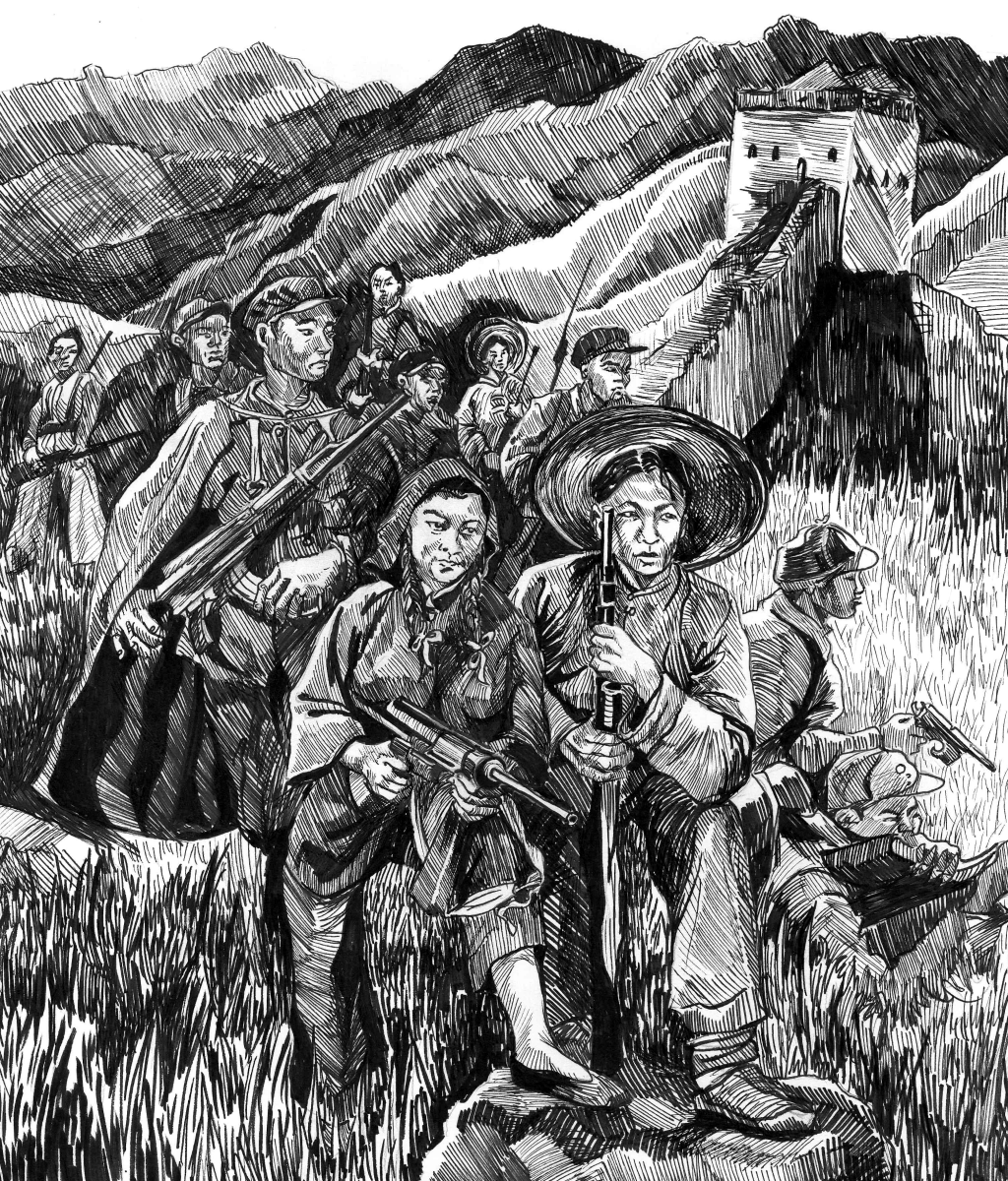
Overthrowing the old order
For a couple thousand years, feudalism shackled the masses of people in China under the exploitation of landlords, with an imperial state at the center of power. The imperial state enforced landlord authority, using reactionary ideologies such as Confucianism to inculcate obedience among the masses and recruiting bureaucratic officials to carry out its decrees, from collecting taxes to fund opulence for the ruling class to overseeing murderous repression against those who dared resist. The masses of peasants had to work the land and give the products of their labor to landlords, tax collectors, and usurers. Resting on the exploitation of the peasantry and a strong central state, for centuries Imperial China was more powerful than European feudal rulers. But it was not without internal conflicts, and imperial state power changed hands from one dynasty to another, one emperor to another, over the course of time and was sometimes weakened or transformed by conflict within the ruling classes.
The greatest internal conflict in feudal China, however, was between the bitterly exploited peasantry and the emperors, landlords, and bureaucratic officials who ruled over them. Peasant rebellions at times grew so powerful that they threatened the power of the imperial state. In the nineteenth century, peasant rebellion and competition among elites began to weaken the imperial state from within. European powers, transitioning from feudalism to capitalism, drawing on several centuries of success at colonialism, and newly bolstered by industrialization, began to batter down the protectionist policies of Imperial China, which proved unable to ward off British gunboats and unequal trade.
A “century of humiliation” ensued, where the shackles of feudalism were joined with foreign domination by European, American, and Japanese imperialist powers. British opium and American missionaries invaded Chinese ports. The latter added Christianity to the reactionary ideologies weighing down the masses and preaching submission to authority. Opium was dumped on China’s port cities by British traders looking to profit off of crippling addiction, and Britain fought two “Opium Wars” against China in the mid-nineteenth century to force the imperial state to open its country to the drug trade. Foreign capitalists began setting up shop on China’s coasts, exploiting Chinese laborers and taking the profits home with them.
The weakened imperial state granted “concessions” to foreign imperialist powers, with coastal cities becoming “treaty ports” opened to unequal trade and further exploitation. Beginning in the nineteenth century, feudal China was subjected to semicolonialism, where foreign powers did not subjugate the country as a whole to administrative control, but did dominate its coastal cities and impose conditions of unequal trade. China’s central imperial state power only got weaker in the process, and with its collapse, warlords carved up the country, making it easier for foreign imperialism to dominate. Feudal landlords remained as the oppressors of China’s vast peasantry in the countryside, while a new class of compradors, or bureaucrat capitalists, emerged that functioned as middlemen facilitating foreign imperialist exploitation of China’s laborers and resources and unequal trade, enriching themselves in the process.
Whereas foreign imperialism dominated the coastal cities, prior to the 1949 Revolution, of China’s roughly 500 million people, the vast majority lived in the countryside, toiling on land they did not own. A small landlord minority controlled a disproportionate share of arable land, while most peasants were crushed by taxes, usurious loans, and state-sanctioned violence. The average life expectancy hovered around 35 years, and in many rural regions it sank into the low twenties. Patriarchy was a cornerstone of feudalism, with women subjected to arranged marriage, concubinage, and the crippling practice of foot-binding, where a baby girl’s feet were tightly wrapped until they lost circulation and the tissues died, resulting in women with small, crushed feet who were unable to flee their oppressors. For adult women, divorce was virtually impossible, and patriarchal violence ruled the household as surely as landlords ruled the land. Disease and famine swept the countryside, while in the cities millions wasted away in opium dens and colonial slums. For the overwhelming majority of Chinese people, existence was marked by abject poverty, starvation, and degradation—conditions that cried out for revolution.
Forming a Party and figuring out how to make revolution
In the late 1910s, a new generation of radical intellectuals in China spearheaded the New Culture Movement, which criticized the country’s feudal culture and sought to construct a modernized, liberated culture in its place. In addition to their rejection of tradition in favor of iconoclasm, they drew on the politics of the nationalist movement led by Sun Yatsen (known in mainland China by his birth name, Sun Zhongshan), which saw national unification and an end to foreign domination as crucial to China’s modernization. In the wake of World War I, growing youth rebellion and anti-imperialist sentiment exploded in the May Fourth Movement. On May 4, 1919, students led militant protests in response to China’s humiliation under the Treaty of Versailles, which handed German concessions in China over to Japan.1 What began as student protests quickly grew into a nationwide upsurge that denounced imperialism, called for cultural renewal, and demanded revolutionary change.
Some of the radical youth and intellectuals who took part in the New Culture and May Fourth Movements began to look to the 1917 Russian Revolution and the newly founded Soviet Union, the world’s first socialist state, as a model for China’s liberation. They formed Marxist study circles, and in 1921 came together to found the Chinese Communist Party (CCP). Numbering in the dozens, they set about connecting communist politics with China’s emerging proletarian class centered in coastal cities, mines, and railway construction, following the Russian Revolution’s example of seeing the proletariat as the class that could lead the revolution.
China’s proletariat was a small portion of the country’s population, but it was erupting in struggle in the 1920s, against its exploitation by foreign and Chinese capitalists and against imperialist domination in general. However, the early CCP’s focus on the proletariat at the expense of the peasantry became codified into a dogmatic approach divorced from the concrete conditions of China, where feudalism prevailed. CCP leadership uncritically followed the directives of the Communist International (Comintern), an international organization of communist parties from around the world that was headquartered in the Soviet Union. The CCP did benefit in some ways from its involvement in the Comintern, receiving resources from the Soviet Union, training, and international legitimacy. But Comintern directives were all too often based on the experience of the communist movement in developed capitalist countries in Europe, where the peasantry was going out of existence as a class, and the industrial proletariat was a numerically large class.
In addition to failing to recognize the revolutionary potential of China’s peasantry, Comintern orthodoxy dictated a stage-ist approach to revolution in feudal countries dominated by imperialism. In such countries, Comintern leadership insisted that the revolution would have to pass through a bourgeois-democratic stage that overthrew foreign domination and feudalism and allowed for capitalism to develop under the leadership of a national bourgeoisie that, unlike the comprador bourgeoisie, did not serve foreign imperialism. According to that orthodoxy, only after that bourgeois-democratic stage of the revolution was completed could a communist party and the proletariat as a class assume leadership and move to the socialist transition to communism.
Applying Comintern directives and strategic thinking, in the mid-1920s, the CCP entered into a united front with the nationalist Guomindang (GMD), led by Sun Yatsen, in order to fight warlordism and imperialist domination. What came to be called the First United Front, brokered with support from the Comintern, was not only a tactical alliance but also reflected genuine shared goals: national unification, resistance to imperialist domination, and the drive to modernize China. The GMD, under the leadership of Chiang Kaishek (Jiang Jieshi in Pinyin transliteration) after Sun’s 1925 death, developed a powerful army, with help and military training from the Soviet Union. From its stronghold in southern China, the GMD’s Nationalist Army launched the “Northern Expedition” with the aim of defeating warlords and unifying China under republican rather than feudal rule.
The CCP subordinated its efforts to the goal of national unification under GMD leadership, while expanding their reach among workers and peasants to considerable success. From 1925–27, a powerful revolutionary movement swept China, with peasant uprisings and strikes by proletarians who worked in urban factories, mines, and railway construction. The CCP grew to tens of thousands of members and led large, militant unions and peasant associations, drawing the most exploited and oppressed into the movement for national unification, to the consternation of GMD leaders and the capitalists and landlords who supported them.
In April 1927, after rebellious proletarians in Shanghai had welcomed the Nationalist Army into their city, the local bourgeoisie gave Chiang Kaishek the go-ahead to betray them. Chiang turned the GMD’s guns on Communists and proletarian masses, and the First United Front collapsed in bloodshed. Massacres of Communists and militant workers swept Shanghai, Wuhan, and other cities, and hundreds of thousands were killed in what became known as the “White Terror” of 1927–30. The CCP’s organization in the cities was shattered, and the Party was disconnected from the urban proletarians among whom they had built support. Many of those proletarians became the victims of GMD repression. Surviving CCP members had to go underground to flee GMD repression, and most had no choice but to flee to the countryside.
The counterrevolutionary terror of 1927–30 forced many CCP members to confront the disastrous pitfalls of subordinating their Party to the GMD, awaiting a bourgeois-democratic revolution before a socialist one, and trying to follow the model provided by the communist movement in Europe of focusing on the proletariat in the cities. As their experience began to make clear, the most explosive class antagonisms in China lay in the countryside, where the landlord class dominated hundreds of millions of poor and landless peasants. China’s history was marked by violent peasant uprisings, such as the second-century Yellow Turban Rebellion during the Han dynasty, the fourteenth-century Red Turban Rebellion during the Yuan dynasty, and more recently the mid-nineteenth-century Taiping Rebellion and the 1899–1901 Boxer Rebellion. Each eruption ended in defeat, but together they testified to the centuries-long struggle of the peasantry against feudal exploitation. These uprisings foreshadowed the reality that the countryside could become the main theater of revolutionary war.
By the late 1920s, Mao Zedong, a participant in the New Culture Movement and a founding member of the CCP, came to insist that revolution could not be won in the cities alone. He pushed the Party toward a strategy for seizing power rooted in the peasantry, the deepest reservoir of revolutionary potential in feudal China. Before the counterrevolutionary terror began in April 1927, Mao had traveled to Hunan Province, where a peasant uprising was challenging the power of landlords and unleashing the masses, organized into peasant associations, to radically reshape class and social relations in the countryside. Mao’s investigation resulted in his March 1927 essay Report on an Investigation of the Peasant Movement in Hunan, a document that heralded the revolutionary potential of China’s peasantry and challenged those in the CCP who were afraid of that potential. His report showed that peasants were already “rising like a mighty storm,” overthrowing landlords, abolishing usurious rents, and dismantling feudal customs that had ruled village life for centuries. Mao insisted that without destroying the landlord class through revolutionary violence, no genuine liberation was possible.
Building red political power in the countryside
In October 1927, Mao arrived in Jinggangshan, in southeast China, with a ragtag group of communist troops that had escaped GMD repression. Another group of defeated but armed revolutionaries, led by Zhu De, soon joined them, and they began recruiting from rebel peasant bands in this impoverished area. Over the next several years, Mao and his comrades developed the strategy and tactics for establishing revolutionary base areas in rural China, including waging guerrilla warfare against the armed strength of feudal warlords and the GMD and organizing the peasantry to rule the countryside. The CCP developed a political process among the peasantry involving social investigation, mass meetings, and struggle sessions to bring the rural masses forward to cast off feudal relations and begin to run society themselves in their interests.
Struggle sessions were public meetings in which peasants confronted landlords, clan leaders, or corrupt officials over their abuses. By voicing grievances and directly challenging local oppressors, peasants became active participants in shaping a new order. What made these and other forms of peasant empowerment possible was the growing strength of the emerging Red Army, commanded by Zhu De, which backed up peasant rebellion with armed might.
By 1931, Mao’s strategic innovation in centering communist revolution in China among the peasantry in the countryside had led to a wide swath of southern Jiangxi Province becoming liberated territory, under the authority of the CCP and the rural masses the Party had organized as a revolutionary force. They declared that liberated territory, with three million residents, a Soviet Republic in November 1931, taking inspiration from the socialist Soviet Union for its moniker. Other, smaller rural soviets emerged, where landlord power was overthrown, their land was redistributed to the peasants who worked it, and those peasants were organized into peasant associations that governed liberated territory and radically reshaped social relations.
The overthrown landlord class did not go quietly, and was backed up by the GMD’s counterrevolutionary troops in carrying out assassinations, village burnings, and torture to punish the masses for standing up. Key to the CCP’s ability to defend the rural soviets was the growth of the Red Army to 300,000 soldiers, mastering the art of guerrilla warfare, and gaining the ability to defend revolutionary base areas against attempts at encirclement and suppression by GMD troops. For nearly three years after its founding in November 1931, the Jiangxi Soviet held out against counterrevolutionary terror, but eventually the size and superior weaponry of the GMD troops amassed against it proved too much to overcome.
In October 1934, facing annihilation, the Communists who had governed in Jiangxi made the hard decision to abandon their base area, and the masses they left behind were subjected to brutal repression and the reestablishment of landlord authority. The Communists who left Jiangxi embarked on the Long March, a massive strategic retreat that became one of the most extraordinary feats in revolutionary history. Nearly 100,000 set out across 6,000 miles of mountains, swamps, and enemy territory. Only a fraction survived, but along the way they fought dozens of battles, evaded countless traps, and forged bonds with peasants in every region they passed through.
One of the most dramatic episodes of the Long March occurred at Luding Bridge in May 1935. Pursued by GMD forces and on the brink of destruction, a Red Army battalion was ordered to storm the suspension bridge under heavy machine-gun fire. The bridge’s chains had been stripped of planks, forcing the soldiers to crawl forward hand over hand while comrades laid new boards behind them. Against all odds, they seized the bridge, opening the path for the rest of the army to cross.
The Long March was born out of crisis, but it revealed the Communists’ greatest strength: the conquering spirit of collective sacrifice and revolutionary purpose. Soldiers carried the wounded on stretchers for hundreds of miles, shared the last handfuls of grain, and endured frostbite, starvation, and endless pursuit without breaking. What looked like a catastrophic defeat became the crucible in which the Chinese Communist Party was remade. By the time the Red Army reached Yan’an in Fall 1935, it had not only regrouped and consolidated under Mao’s political leadership but also spread its message to new regions and drawn the most committed fighters closer to its cause. Yan’an, isolated in the hills of northern Shaanxi Province, became the heart of the revolution, a laboratory of mass participation, cultural renewal, and revolutionary education that pointed towards a future China.
Synthesizing revolutionary strategy and tactics and transforming the Party in the Yan’an years
Setting up its headquarters in the caves of remote Yan’an in Fall 1935 gave CCP leadership some breathing room after years of battles with the enemy and counterrevolutionary repression. They used this breathing room to sum up the lessons of the Party’s experience since its founding in 1921 and synthesize strategy and tactics and methods of leadership for advancing the revolutionary struggle, while immersing themselves more deeply among the rural masses.
Uniting on a strategy for revolution in China was not without struggle in the Party, however. Mao’s emerging strategic conception that centered the revolutionary potential of the peasantry and sought to build red political power in the countryside before attempting to seize the cities remained in contention with Comintern orthodoxy. And Comintern orthodoxy not only had the weight of the Soviet Union, the first socialist state, behind it, but also had advocates within top CCP leadership, such as Wang Ming and others who had been trained politically in the Soviet Union and had previously dominated top CCP leadership. During the Yan’an years, on the basis of the proven achievements of Mao’s leadership and the evident failures of following Comintern directives and Wang’s leadership into a disastrous focus on urban insurrection, the CCP united around a peasant-based, rural-focused conception of revolution. Beyond recognizing the key social force and social and military geography of revolutionary warfare, Mao’s leadership offered lessons in philosophy, the role of art and culture, and the art of leadership itself.
During the Yan’an years, Mao gave a number of talks and wrote pivotal essays that trained Party cadre in how to think and act as farsighted revolutionaries who could connect with and lead the masses of exploited and oppressed people. In addition to manuals on guerrilla warfare were two pathbreaking talks on materialist dialectics—On Practice and On Contradiction—that connected overarching philosophical questions to the Party’s practical work and pushed CCP members to rupture with rigid ways of thinking. As radicalized intellectuals and artists flocked to Yan’an to join the revolution, Mao urged them to integrate with the masses of peasants and create art that drew on their lives and connected with their aspirations, as concentrated in his Talks at the Yan’an Forum on Literature and Art. And of perhaps greatest practical importance, Mao elaborated the mass line method of leadership, with which the Party, through social investigation and integration with the people, took the ideas and aspirations of the masses and synthesized them into revolutionary political line, which was taken back to the masses in the form of concrete policies and programs.
At Yan’an, the CCP transformed itself into a vanguard capable of winning over the broad masses all over China to risk their lives for revolution. For example, the Party rectified previous mistakes during the Jiangxi Soviet in alienating wealthier peasants by pushing land reform too far, and adopted a variety of policies for combating feudal exploitation suited to the particular circumstances and aimed at uniting all who could be united against the main class enemy in the countryside (the landlord class). Beyond fixing specific policy errors, Mao synthesized a strategic approach to uniting all the classes oppressed by imperialism and feudalism in China under communist leadership, in opposition to the Comintern stage-ist approach and subordination to the national bourgeoisie, that he called New Democratic Revolution. (See below for a more thorough explanation of this concept.)
To make the CCP capable of carrying out Mao’s strategic vision and insistence on fusing with the rural masses, a rectification movement from 1942–44 used the practice of criticism and self-criticism to get Party members to acknowledge mistakes and analyze the reasons behind them. Tendencies towards elitism that disconnected the Party from the masses and dogmatism that treated communist theory rigidly and failed to apply it to the real world came in for sharp struggle. CCP members who proved incapable of revolutionary transformation were purged, and the Party’s security apparatus oversaw expulsions and, in some cases, executions of infiltrators, enemy agents, and those judged beyond reform. Rectification made the CCP better able to serve the people and put the interests of the revolution and the masses above concerns for self or any careerism, in stark contrast to the corruption and individualism that ruled in the GMD.
The process of uniting the Party around Mao’s strategy and methods of leadership put the CCP in a better position to bring forward the masses of peasants as a revolutionary force, in Yan’an and anywhere Communists could spread their work. The CCP’s leadership empowered the masses to fight against landlords, develop education and rudimentary healthcare in villages that had long languished in illiteracy and disease, and struggle against patriarchy within the household so that women could take part in the revolution, all backed up by the armed power of the Red Army. Fortuitously, the rectification and revolutionization of the CCP in the Yan’an years overlapped with the War of Resistance Against Japan (1937–1945), during which the Party was able to put its devotion, discipline, and unity around a correct strategy into practice far beyond Yan’an and its environs.
The War of Resistance Against Japan
In 1937, Imperial Japan launched a full-scale invasion of China. The CCP and the GMD entered into a Second United Front to resist the imperialist assault. On paper they were allies, but in practice the GMD hoarded arms, avoided major battles, and preserved its strength for the coming resumption of civil war with the Communists. The Communists, by contrast, threw themselves into the resistance against Japan, organizing guerrilla warfare, mobilizing the peasantry, and spreading political authority across the countryside. Unlike in the First United Front, in the Second one the CCP refused to subordinate its efforts to the GMD, maintaining its own independence and initiative in the War of Resistance Against Japan and knowing that when that war was over, it would have to fight another war against the GMD.
In the course of fighting the Japanese occupation, the Red Army did not attempt to seize big cities, where Japanese forces were concentrated, head-on. Instead, it surrounded the cities from the countryside, establishing base areas, striking the enemy where it was weak, and using each liberated zone as a seedbed of new power. The Red Army’s ability to strike blows against Japanese occupation rested on the Maoist principle of relying of the masses, with villagers housing and hiding Communist troops, providing them with food and supplies, and becoming a network of communication and logistical support for the Red Army. Communist military action was intertwined with political work, and the Red Army sought to attend to all the problems the masses faced, from feudal exploitation to patriarchy, while raising the level of political consciousness of the masses and empowering them to take history into their hands.
In and beyond the growing revolutionary base areas, the CCP gained broader legitimacy and popularity throughout China as the proven defenders of their nation against foreign invasion and occupation. By the time Japan surrendered in 1945, the CCP controlled vast stretches of northern China and tens of millions of people lived under its authority. Red political power grew from the barrel of a gun, with zones of guerrilla warfare laying the basis for embryonic institutions of a new society: people’s governments, militias, land reform committees, schools, and cultural organizations. As those embryonic institutions grew in strength and size, they created a new form of authority that rivaled and ultimately surpassed the old regime. In the course of the War of Resistance Against Japan, the CCP proved in practice that it alone had the strategy, organization, and mass support necessary to both defeat imperialism and lay the foundations of a new society.
Civil war and seizing nationwide power
After Japan’s surrender and the end of World War II, civil war between the GMD and the Communists resumed in 1946, but in a political situation far more favorable to the CCP than twenty years prior. The GMD, propped up by the United States, had a large army and lots of weapons, but was hated by the people for its corruption and repression. Its base of support lay mainly with landlords, bureaucratic officials in government, comprador capitalists tied to imperialist exploitation, and sections of the urban elite. The CCP, by contrast, had governed liberated areas with increasing legitimacy and skill, drawing the backing of the poor peasants, much of the rural petty-bourgeoisie, and a growing section of the proletariat. It had also refined a winning strategy—protracted people’s war—over years of fighting against Japanese invasion and occupation. Against the advice of Stalin and the Soviet Union, who urged compromise with Chiang Kaishek’s GMD, Mao saw the opportunity to push the revolution forward.
The Red Army that had vastly expanded in size while fighting Japan was reorganized and renamed the People’s Liberation Army (PLA) in 1946, and once fighting with the GMD resumed, it went on the strategic offensive. Each battle won against the GMD was an opportunity to seize the enemy’s weapons and strengthen its fighting ability. The People’s Liberation Army advanced steadily, surrounding the cities from the countryside. Major cities like Harbin, Shenyang, and eventually Beijing and Shanghai fell. In each case, the communists prioritized discipline, protection of civilians, and the swift restoration of social services. The contrast with the GMD’s retreat, littered with looting and massacres and leaving economic collapse in its wake, further proved the CCP as liberators to the masses.
On October 1, 1949, Mao Zedong stood at Tiananmen Square in Beijing and declared the founding of the People’s Republic of China. The revolution had won.
Mao’s strategic innovations: a brief summary
The 1949 victory of the Chinese Revolution would not have been possible without a correct military and political strategy and correct methods of leadership. The CCP led the Revolution, but it did so by drawing the masses of people in China forward, in an alliance of all classes oppressed by feudalism and imperialism, to militarily defeat the old order and begin constructing the new. Conceptually, the keys to victory were the mass line, protracted people’s war, and New Democratic Revolution.
The mass line method of leadership
Mao insisted that revolutionaries must “go among the masses,” not as bureaucrats collecting reports, but as comrades integrated with the lives of workers and peasants. In Hunan in 1927, he immersed himself in village life, recording the rage of peasants against landlords and the creative ways they resisted oppression. From this investigation came his conceptual breakthrough: in a feudal country like China, the peasantry held enormous revolutionary potential when organized under proletarian ideological and political leadership.
Mao synthesized his process of social investigation among the masses and concentrating what he learned into revolutionary strategy and policies as a method of leadership he called the mass line. Methodologically speaking, the mass line rests on epistemic collectivity—the idea that truth emerges from the collective experience and struggle of the people, not from the individual genius of isolated leaders.2 Mao wrote in On Practice (1937):
Discover the truth through practice, and again through practice verify and develop the truth. Start from perceptual knowledge and actively develop it into rational knowledge; then start from rational knowledge and actively guide revolutionary practice to change both the subjective and the objective world.
With the mass line method of leadership, Party cadre gathered the scattered insights of the masses, synthesized them through communist analysis, and returned them to the masses in the form of clear revolutionary policies. When these policies were tested again among the people, they came back sharpened. The masses recognized their own ideas and aspirations elevated into conscious strategy, and this gave the CCP’s political program immense power. Land reform, literacy drives, and armed struggle were not imposed from above; they were the people’s own demands, concentrated and led forward by the vanguard party.
The mass line was also a method through which the Party could resist the drift toward revisionism. Revisionism meant the abandonment or dilution of revolutionary principles, such as substituting reformism, class collaboration, or bureaucratic commandism in place of proletarian leadership and mass struggle. When leadership became detached from the masses it claimed to represent, bureaucracy and dogmatism flourished. The mass line countered this by keeping the Party’s knowledge rooted in the masses’ experiences, lives, and aspirations, responsive to changing conditions, and accountable to the people. Applied in practice, it repeatedly unleashed the conscious initiative of the masses as co-creators of the revolutionary process, whether in overthrowing landlords, resisting Japanese invasion, or advancing the socialist transition to communism.
Protracted people’s war
Militarily, the Chinese Revolution advanced through a protracted strategy of surrounding the cities from the countryside. In the countryside, the central state was weak, landlords preyed on the peasants, and hundreds of millions lived under feudal oppression. There, the CCP could carve out red political power in liberated, revolutionary base areas where the old order was overthrown. In those base areas, a new society began to take shape via land reform, literacy campaigns, challenging patriarchy, and changing the social relations and culture. The masses were empowered to govern that new society via new organs of political power, with militias defending their revolutionary authority.
Mao emphasized that people, not weapons, are decisive in war. Guerrilla warfare could succeed because it relied on the support of the oppressed majority, not easy access to advanced weaponry. As Mao wrote in 1937, “The guerrilla must move among the people as a fish swims in the sea.” Without mass support, guerrillas die in isolation; with it, small units can evade, harass, and attack better-equipped and larger armies. Indeed, Chiang Kaishek himself became the Red Army’s quartermaster, since Communist forces captured huge amounts of weapons and supplies from the GMD through raids and ambushes. As Mao summed up in his 1930 essay A Single Spark Can Start a Prairie Fire,
When the enemy advances, we retreat.
When the enemy halts, we harass.
When the enemy tires, we attack.
When the enemy retreats, we pursue.
Mastering the tactics of guerrilla warfare prepared the CCP for moving through a larger strategy for seizing nationwide power. That strategy, protracted people’s war, unfolded in three main stages. In the strategic defensive, small guerrilla units carried out flexible operations, avoided major confrontations, and survived by drawing strength from the masses. In the stage of strategic equilibrium, the CCP expanded its base areas, spread liberated zones, and tied down enemy forces in a war of attrition. Finally, in the strategic offensive, the Red Army shifted from mobile warfare to positional warfare, with large, regular formations capable of holding territory, waging pitched battles, and eventually storming the cities. Out of this process the Red Army was renamed the People’s Liberation Army, the regular armed force of a new state.
Mao and the CCP proved that protracted people’s war was more than a Chinese path—it became a strategy that could be adopted and adapted for oppressed nations confronting imperialism and feudal conditions. From Vietnam and the Philippines to Peru and Nepal, revolutionaries drew on this roadmap of starting with guerrilla warfare in the countryside, relying on the masses of peasants, and going from guerrilla zones to base areas to vying for nationwide political power.
New Democratic Revolution
New Democracy was developed as the political strategy for uprooting feudalism and imperialism while preparing the ground for socialism. It was conceived as a step within a forward-moving process of revolution in countries oppressed by foreign domination and still bound by feudal relations, eschewing the stage-ist approach of insisting on bourgeois-democratic revolution led by the national bourgeoisie. New Democracy was a recognition that the proletariat was too small to make revolution alone in feudal countries dominated by imperialism, but the tasks of national liberation and land reform could not be entrusted to the bourgeoisie. Proletarian leadership was what made New Democracy “new,” as unlike democratic revolutions led by the bourgeoisie, such as those at the end of the eighteenth century in France or the United States, China’s New Democratic Revolution led to socialism rather than bourgeois dictatorship over the masses.
Mao’s breakthrough was to articulate a revolutionary alliance of classes—the proletariat, the peasantry, the petty-bourgeoisie, and the national bourgeoisie—united under the ideological and political leadership of the proletariat and its vanguard party. In theory, the proletariat stood at the core; in practice, the Party itself often embodied that role, drawing its ranks largely from the peasantry but seeking to lead with a proletarian outlook. That outlook was crucial, as the peasantry’s class interests pushed it toward land redistribution and relief from feudal oppression, but encouraged small property ownership rather than collectivization. The proletariat, by contrast, had no private stake in property and therefore had a material class interest in abolishing small property ownership in addition to all forms of exploitation. Consequently, the Party insisted that only proletarian leadership could ensure that the revolution advanced towards socialism.
The peasantry provided the main force for armed struggle and land reform; the petty-bourgeoisie brought expertise and administrative capacity; and sections of the national bourgeoisie could be temporarily won to the anti-imperialist struggle. This alliance was not a dilution of socialism but a strategy for making it possible, ensuring that the revolution advanced beyond national independence and democratic reform.
In practice, New Democracy meant that the seizure of power did not immediately abolish all private property or capitalist relations. Instead, it prioritized smashing the landlord class, driving out imperialist influence, and creating a state where the masses held power based on a strategic alliance with the proletariat and the peasantry and involving other classes. By addressing the most immediate contradictions, imperialist domination and feudal exploitation, it created the conditions in which socialist transformation could unfold.
Mao explained that China’s revolution must unfold in two distinct but connected stages: first, the New Democratic stage, and later, the socialist stage. The former was a bourgeois-democratic revolution of a new type, one that aligned with the global socialist movement rather than the world capitalist system. Mao wrote in On New Democracy (1940):
Although the Chinese revolution in this first stage (with its many sub-stages) is a new type of bourgeois-democratic revolution and is not yet itself a proletarian-socialist revolution in its social character, it has long become a part of the proletarian-socialist world revolution and is now even a very important part and a great ally of this world revolution. The first step or stage in our revolution is definitely not, and cannot be, the establishment of a capitalist society under the dictatorship of the Chinese bourgeoisie, but will result in the establishment of a new-democratic society under the joint dictatorship of all the revolutionary classes of China headed by the Chinese proletariat. The revolution will then be carried forward to the second stage, in which a socialist society will be established in China.
The New Democratic state would nationalize key sectors of the economy, regulate private capital, abolish landlordism, and distribute land to peasants. It would also promote democratic reforms such as expanding literacy, gender equality, and cultural renewal. Yet the aim was always to build the political, economic, and ideological infrastructure necessary for socialism.
New Democracy also had an international dimension. Conceptually, it emerged in the wake of the 1917 Russian Revolution that established the world’s first socialist state, in a world where capitalism-imperialism had become a fully global system of domination. Mao emphasized that revolutionary movements in colonies and semicolonies could no longer be confined within the limits of bourgeois nationalism but, under proletarian leadership, had the potential to become part of the world socialist revolution. China’s revolution was therefore linked to a global front against imperialism, and its success depended in part on concrete political and material support from abroad—above all from the Soviet Union, but also from the struggles of oppressed peoples worldwide.
While the New Democratic stage was essential, Mao was explicit that it was not the endpoint. The revolution could not stop at political independence or land reform. The dictatorship of the revolutionary classes had to transition, through continued class struggle, into the dictatorship of the proletariat. This transition would not occur automatically, and any failure to move forward risked a rollback into capitalist restoration. Therefore, the Communist Party had to lead not only the seizure of power but the transformation of all social relations. In short, New Democracy was both a rupture and a bridge. It ruptured with the old order of landlords, warlords, and compradors, and it built a bridge to the socialist future.
The victory of the Chinese Revolution is only the first step in a long march of ten thousand li
The Chinese Revolution triumphed because the Chinese Communist Party gave millions of people disciplined leadership, a revolutionary political line, and an army forged in their struggle. Through the mass line, base areas, and protracted people’s war, the CCP transformed peasant fury and proletarian leadership into a strategy that could seize power. The PLA was the instrument of that strategy; Mao’s leadership unified it into a single revolutionary will.
The October 1949 victory opened a new stage. State power had been won, but the old society still persisted in customs, privileged classes, institutions, and habits. Consolidating the dictatorship of the proletariatmeant carrying class struggle into daily life—through land reform, new laws, cultural revolution, and transformations in production—so that the new state rested on new social relations.
The first years of the People’s Republic of China tested whether victory in war could be transformed into socialist construction. With revolutionary resolve and mass participation, the CCP launched coordinated mass campaigns and radical social changes with the Agrarian Reform Law (1950), the Suppression of Counterrevolutionaries (1951–52), War to Resist US Aggression and Aid Korea (1950–53), the 1950 Marriage Law, the eradication of opium addiction and reactionary secret societies, and the Three-and Five-Anti campaigns against corruption (1951–52). These were not isolated policies but interlinked struggles that advanced revolutionary transformation in every village, factory, city, and household.
Suggested further reading:
Jack Belden, China Shakes the World (Monthly Review Press, 1949).
Bill Hinton, Fanshen: A Documentary of Revolution in a Chinese Village (Monthly Review Press, 1966).
Mao Zedong, Report on an Investigation of the Peasant Movement in Hunan (1927); A Single Spark Can Start a Prairie Fire (1930); On Guerrilla Warfare (1937); On Practice (1937) On Contradiction (1937); Some Questions Concerning Methods and Leadership (1943); On New Democracy (1946); The Foolish Old Man Who Removed the Mountains (1945).
Edgar Snow, Red Star Over China (Random House, 1937).
Wang Hui, China’s Twentieth Century: Revolution, Retreat, and the Road to Equality (Verso, 2016), chapters 1–2.
Consolidating the revolutionary victory and building socialism
The founding of the People’s Republic of China on October 1, 1949 was not the end of revolution but the beginning of socialist construction. The People’s Liberation Army had defeated the Guomindang’s armies and driven imperialist powers out of China, but feudal and semicolonial relations remained deeply entrenched. Landlords still controlled villages in spirit, if not on paper. Opium dens and reactionary secret societies continued to operate. Patriarchal traditions, feudal habits, and bureaucratic thinking and functioning lingered inside the very institutions the revolution was trying to build. To consolidate the dictatorship of the proletariat, the Chinese Communist Party would have to lead a series of coordinated mass campaigns to remake the very fabric of social life.
The early years of the People’s Republic were marked by revolutionary audacity. The CCP was not afraid to take the offensive. It moved to destroy the remnants of enemy classes, forge a new economic and political order, and mobilize the people to participate in their own emancipation. This period set the tone for what socialist transformation would require moving forward: mass mobilization and the sharpening of political and ideological struggle within the new socialist society.
Forging a new state, led by the vanguard party
The revolution dismantled the state apparatus of the old society, but it did not dissolve the state itself. On the contrary, a new state had to be constructed, one capable of defending the gains of the revolution and carrying out the massive project of socialist construction. This state would not arise spontaneously from the revolutionary process, nor could it be borrowed from the bureaucratic traditions of Imperial China or the GMD. It had to be built under the leadership of a revolutionary vanguard party.
The CCP embedded itself in every organ of the new state. At every level—national, provincial, county, and township—Party committees set policy direction, supervised implementation, and struggled to put communist ideology in command of state power. The People’s Liberation Army remained firmly under CCP command and, under its leadership, became a school of socialism, a site of political education, and a model of collective discipline and life, in addition to constituting the armed defense of socialist China.
The new state was built under the leadership of the CCP, which itself was organized according to the principle of democratic centralism: debate over political line and policies within the Party and firm unity in carrying out policies after they were decided. While Chinese people who were not members of the CCP were not bound by democratic centralism, the Party extended its methods of consultation, synthesis, and collective discipline into the institutions of government and social life. Within the Party, cadre were trained to listen to the masses, draw lessons from their experiences, and act decisively in carrying out all tasks of socialist construction. They were also expected to fight relentlessly for the Party’s political line and ensure it guided every action, and resist localism, careerism, and bureaucratism.
Governance in the new state did not rely solely on authority from above, however. The CCP worked to build mass organizations that linked the people, the vanguard party, and the organs of state power. Trade unions, peasant associations, youth leagues, and women’s federations were not neutral civil society bodies; they were vehicles of socialist construction, charged with implementing the vanguard party’s line while also channeling the demands and initiative of the masses into the policies of the new state.
The vanguard role of the CCP did not rest on careerist bourgeois electoral politics or technocratic expertise. Its authority came from its record of revolutionary struggle, its deep ties with the masses, and its ability to lead the socialist transition to communism. From the outset, Mao emphasized that the vanguard had to remain bound to the masses and lead class struggle, not harden into an administrative elite. That principle, forged in the revolution’s early years, increasingly became a source of fierce contention, with that contention erupting in 1966 into an all-out battle inside the Party and across society known as the Great Proletarian Cultural Revolution.
Crushing the remnants of the old order
The GMD had fled to Taiwan, but its political apparatus and class allies remained embedded throughout China’s cities and countryside. To deal with the remaining class enemies, the CCP launched the Campaign to Suppress Counterrevolutionaries in 1950. Its purpose was not to offer reconciliation to those who had actively resisted the revolution, but instead to destroy their capacity to regroup, sabotage, or ideologically corrupt the revolution from within.
The campaign focused first on known GMD agents, collaborators, and saboteurs. But it also targeted landlords who retained wealth and influence, members of reactionary religious sects, former secret police officers, and others who had exploited the war years to enrich themselves. Trials were often public, with accused counterrevolutionaries brought before mass assemblies and subjected to exposure, confession, and judgment by their former victims. In many cases, the death penalty was applied. According to official estimates, over 700,000 people were executed between 1950 and 1952 as part of the campaign, with millions more arrested or placed under surveillance.
To put that number in perspective, China had a population of about 540 million in 1950, whereas the United States, in 2025, has a population around 340 million. If a proletarian revolution were to come to victory in the contemporary US, consider how many millions of its population are class enemies, whether members of the bourgeois class or its loyal servants in the repressive state apparatus, or organized reactionaries. While all class enemies do not need to be executed after a revolution, and not all of them were in China after the 1949 Revolution, it is hard to imagine that the masses of exploited and oppressed people would tolerate anything short of disciplining and punishing those who had exploited and oppressed them for so long and could pose a counterrevolutionary danger to a new socialist state.
Beyond disciplining and punishing counterrevolutionaries, the CCP moved quickly to establish new norms of authority and power. Local security forces were purged of former GMD officers, and civil servants were retrained or dismissed. Village governance, long dominated by landlords, was reorganized under the direct guidance of Party branches. Class enemies were broken politically and stripped of the authority they had used to oppress the people.
Eradicating opium, smashing a colonial poison
One of the most celebrated early achievements of the socialist China’s early years was the dismantling of the opium economy. For over a century, addiction had been a weapon of imperialist control, a source of profit for landlords, compradors, and foreign imperialists, and a plague on the masses. By 1949, over twenty million Chinese were estimated to be addicted to opium. The trade had been propped up by foreign powers—Britain waged war against China twice in the mid-nineteenth century to force the country to accept opium imports, while Japan later expanded cultivation and distribution of opium in occupied territories.3 Local elites and officials enriched themselves as addiction spread.
Revolutionary state power struck hard against the opium scourge. Within three years, the production, sale, and use of opium were virtually eliminated. The CCP closed off opium imports, destroyed fields, arrested traffickers, and closed dens. In contrast to the bourgeoisie’s version of the “war on drugs”—which has always meant a war on the masses—the CCP’s campaign did not target the masses with repression. Thousands of clinics were opened to provide free detoxification and rehabilitation. Addicts were integrated into labor collectives, where they could rebuild their bodies, regain dignity, and reorient their lives through productive activity and political struggle.4
What made the campaign decisive was its political character. Eradicating opium addiction was never treated as a matter of morality or medical policy alone; it was understood as a class contradiction. Those who profited from opium stood exposed as enemies of the people. Those who suffered from it were organized to confront their oppressors—dealers, landlords, and corrupt officials alike. The eradication of opium was thus more than a public health victory. It was an act of revolutionary sovereignty, a direct break with the century of foreign domination and the ruling class’s complicity that had poisoned China.
Women’s liberation as a revolutionary campaign
The 1950 Marriage Law marked a seismic shift in the social foundation of Chinese society. It abolished arranged marriages, concubinage, polygamy, bride prices, and the legal subordination of women to their husbands and fathers. For the first time in Chinese history, women were guaranteed the right to divorce, own property, and participate in public life as equals. Unlike previous attempts, by the nationalist movement under Sun Yatsen’s leadership, at abolishing legalized, feudal oppression of women, these reforms could be enforced by the consolidation of a new state power.
The real struggle began in implementation. In rural areas, male Party cadre often resisted the new Marriage Law or failed to enforce it. Many came from poor peasant backgrounds and had internalized patriarchal attitudes. Clan structures in the countryside acted as bastions of the old order. Elders who had lost land through reform clung to their control over daughters and daughters-in-law.
The CCP responded by organizing mass campaigns led by women themselves. Central to this effort was the All-China Women’s Federation (ACWF), established in March 1949 as a national mass organization with branches at every level, from provinces to villages. It spearheaded campaigns around the Marriage Law, literacy, health, and production, while also equipping women to take on leadership roles within the Party and society. Advances in women’s liberation were made on the basis of unleashing mass struggle, bringing women forward as leaders, and struggling with people who clung to backward ideas.
The struggle for women’s liberation in daily life was not easy, as patriarchal family structures had oppressed women for centuries, including within the household itself. Women were sometimes murdered for demanding divorce or refusing arranged marriages. Some Party cadre, clinging to feudal traditions, had to be disciplined or removed for obstructing implementation of the Marriage Law. The CCP treated these contradictions as struggles to be won because it understood that women’s emancipation struck at the heart of feudal property and family relations, making it vital to the revolutionization of society.
Land to the tiller: class struggle in the countryside
Of all the mass campaigns in socialist China’s early years, land reform was the most far-reaching in its direct impact on the people. It transformed the lives of hundreds of millions of peasants and reshaped the entire rural economy. More than a simple policy of redistribution, land to the tiller was a campaign of revolutionary class struggle, smashing the landlord class, reorganizing rural power, and awakening the political consciousness of the poor and landless.
The process of land reform began with social investigation. Party Work Teams—groups of cadre dispatched by the CCP to organize villages and carry out social investigation—entered villages to conduct class analysis. Who owned how much land? Who rented? Who lent money at interest? Who served as headman under the GMD? These were the kinds of questions Party Work Teams used to draw political lines and expose class antagonisms.
Based on this investigation, the population of each village was classified into five groups: landlords, rich peasants, middle peasants, poor peasants, and landless laborers. Then came mobilization. Meetings were held to publicize the results of the social investigation and class analysis. Peasants were encouraged to speak bitternenss: identify exploiters, expose their crimes against the people, and challenge the authority of local elites. The poor and landless were formed into struggle teams, which organized demonstrations, carried out confrontations, and ultimately seized land.
Many landlords were subjected to public denunciation, beatings, or execution. Others were allowed to live but stripped of their land and wealth. The land seized was distributed primarily to the poor and landless, with middle peasants often left untouched and allowed to retain their holdings. This policy aimed to unite the bulk of the peasantry while isolating the exploiting minority.
By 1952, over 300 million peasants had received land, and the landlord class had been effectively abolished as a political and economic force. The countryside was radically transformed. The reform also laid the basis for future collectivization by breaking the social dominance of rich peasants and building the confidence and organization of the poor. For hundreds of millions who for generations had toiled on land they did not own, paying rent and interest to landlords and moneylenders, the ability to till their own plot was a revolutionary change in daily life.
Land reform was not without contradictions. In some regions, local cadre protected landlords or failed to mobilize the masses, and in others, excessive violence occurred without clear political aims. The CCP issued corrective guidelines to bring the reform back on track and prevent further mistakes. But overall, the campaign succeeded in revolutionizing rural social relations and consolidating the CCP’s leadership among the peasantry.
Internationalism and the War to Resist US Aggression and Aid Korea
In June 1950, less than a year after the founding of the People’s Republic of China, the Korean War broke out. The Democratic People’s Republic of Korea (DPRK)5 established in northern Korea had emerged from the Korean people’s long struggle against Japanese colonialism and for national liberation. When civil war came, US forces, operating under the United Nations flag, invaded Korea with the aim of crushing the DPRK and extending US imperialist domination up the entire Korean peninsula. US General Douglas MacArthur boasted that US troops would march to the Yalu River, the very border of China. The US assumed China, exhausted after decades of war, would not dare to intervene.
The US imperialists miscalculated. In October 1950, under the banner of the War to Resist US Aggression and Aid Korea, the CCP sent the Chinese People’s Volunteers across the Yalu. Mao had long insisted that imperialism, however fearsome it appeared, could be broken by the organized strength of the masses. As he told American journalist Anna Louise Strong in 1946, “Imperialism and all reactionaries are paper tigers. In appearance, the reactionaries are terrifying, but in reality they are not so powerful.”
The Chinese People’s Volunteers fought some of the fiercest battles of the twentieth century. They faced a far better-equipped US military but drew on the PLA’s years of experience in revolutionary warfare, which taught them strategic flexibility, relying on the masses, and the ability to live and fight in the harshest conditions. Chinese troops adapted creatively to new challenges, tunneling underground to evade US air power, using night marches to neutralize American superiority in firepower, and turning mobility and discipline into decisive strengths. In a series of grueling campaigns, they pushed US and allied forces back from the Chinese border and forced them into a bloody stalemate.
The sacrifices were immense. Hundreds of thousands of Chinese soldiers died, and resources urgently needed for socialist construction in China were redirected to the front. But the victory was unforgettable. A country that had long been carved up and humiliated by foreign powers now stood shoulder to shoulder with Korea and fought the most powerful military in the world to a standstill.
The new socialist state’s efforts in Korea were proletarian internationalism in action. Despite famine, destruction, and the immense tasks of land reform and state-building, the CCP placed revolutionary internationalism, expressed through concrete support for Korea, above narrow national interest. The Chinese People’s Volunteers and the people behind them provided troops, supplies, and political resolve to defend a fellow revolution. For the Chinese masses, the war proved that their own revolution was part of a broader international struggle against imperialism. The victory became a source of deep pride, binding the Chinese Revolution to the global tide of anticolonial and socialist movements.
Struggle against the emerging new bourgeoisie: the Three-Antis and Five-Antis Campaigns
By 1951, the old ruling classes in China had been mostly destroyed, but a new exploiting class was beginning to take shape. Some CCP cadre used their positions for personal enrichment, turning their backs on the masses and betraying the revolutionary principles they had fought for. Some urban officials who had suddenly gained authority over budgets, housing, and contracts slipped into graft. Some businessmen, tolerated under the strategy of New Democratic Revolution that included the national bourgeoisie as allies, continued to exploit workers and began to manipulate state contracts for their benefit. Corruption, waste, and bureaucratism threatened to erode the gains of revolution and alienate the masses from the new socialist state.
In response, the CCP launched a new set of class struggle campaigns: the Three-Antis (against corruption, waste, and bureaucracy) in 1951, followed by the Five-Antis (against bribery, tax evasion, theft of state property, cheating on government contracts, and stealing state secrets) in early 1952. The targets of these campaigns were not limited to low-level officials or fringe capitalists. They reached deep into state institutions, business sectors, and even the Party itself. For example, Liu Qingshan and Zhang Zishan—senior Party officials in Hebei Province and veterans of the revolutionary struggle—were publicly tried and found guilty of corruption, embezzlement of state funds, and abuse of power for personal gains. Their executions in 1952 demonstrated that the CCP would not tolerate graft, even in its own ranks, and would move decisively to stamp out corruption within the new socialist state.
Rooting out corrupt officials and practices was not just the work of professional state security and investigation forces, but rested on mass supervision. Work units were mobilized to report offenses, and mass meetings exposed abuses. Millions were investigated, and while a number of accused were imprisoned or even executed, the larger goal was rectification. Offenders were made to confess, undergo re-education, and commit to ideological transformation. In the cities, entire bourgeois families were confronted publicly; in state offices, cadre were compelled to write self-criticisms.
These campaigns were about more than anti-corruption in the narrow sense. They were a recognition that class struggle persisted under socialism, and that new bourgeois elements could emerge from within socialist society. The longstanding power of bureaucratic officials in Imperial China could be reproduced in a new form within the socialist state if elitism, careerism, and corruption among state officials was not struggled against. Mao warned repeatedly that without vigilance, socialism could rot from the inside. The Three- and Five-Antis were early attempts to set a precedent that power, privilege, and enrichment at the expense of the people would be relentlessly attacked.
What state power in the hands of the masses makes possible
In the span of only a few years, the Chinese Revolution transformed the lives of hundreds of millions. Landlords who had ruled the countryside for centuries were swept away; peasants who had known only servitude stood on their own land as free producers. The masses of women, long chained by patriarchal law and feudal custom, began taking part in running society. Literacy campaigns opened the world of knowledge to those who had been denied it. Foreign imperialism, which had subjected China to a century of semicolonial domination, was kicked out of China and fought to a stalemate on Korea’s battlefields. Corruption and privilege inside the new state were met not with tolerance but with mass campaigns to expose and eradicate them.
For the masses, these were not abstract reforms. They were a lived emancipation. The ability to till your own land, to divorce an abusive husband, to attend school for the first time, to see exploiters denounced and punished—these were victories that reshaped daily existence and gave dignity to the promise of revolution.
What made all this possible was not benevolent rulers, nor technocratic planning, nor gradual reform. It was proletarian state power: the dictatorship of the proletariat. The CCP, as the vanguard party, concentrated the initiative of millions into a disciplined force that could smash the old society and begin constructing the new. Mass organizations linked people to the central state power; campaigns fused political education with mass struggle; and mistakes were corrected through rectification, not ignored.
This is the great, forgotten lesson of the early years of socialist China. Today, many who long for a better world believe that state power can achieve little more than tinkering around the edges of exploitation and oppression, and some go further, doubting that revolution is possible or that proletarian state power is even desirable. The experience of the Chinese Revolution proves otherwise. When the proletariat, led by its vanguard party, seizes power, mobilizes the masses, and consciously wages class struggle, it can transform society in ways once thought impossible.
Socialist China’s beginnings were years of enormous hope, of victories wrested from centuries of exploitation and oppression. They showed that the poor and oppressed, when organized and armed with revolutionary leadership, could not only win power but wield it in the interests of the people. Later chapters of the revolution would confront new contradictions and go through fierce struggles. But in these first years, the achievements stand as a monumental demonstration of what proletarian state power can accomplish.
Suggested further reading:
Bill Hinton, Fanshen: A Documentary of Revolution in a Chinese Village (Monthly Review Press, 1966).
Maurice Meisner, Mao’s China and After: A History of the People’s Republic, third edition (The Free Press, 1999), chapters 5–7.
Wang Hui, China’s Twentieth Century: Revolution, Retreat, and the Road to Equality (Verso, 2016), chapter 3.
1The Treaty of Versailles transferred Germany’s colonial concessions in Shandong Province to Japan rather than restoring them to China. Chinese officials had entered the war on the Allied side expecting to regain sovereignty over those concessions in Shandong, but instead discovered that the Allied powers had secretly bargained them away. This betrayal of national sovereignty ignited the May Fourth protests.
2By epistemic collectivity, we mean treating knowledge not as the property or product of an individual thinker or leader, but as generated through the collective practices, struggles, and experiences of the people. In the context of the mass line, it means that revolutionary truth was arrived at, refined, and advanced through the interaction between the vanguard party and the masses—an ongoing cycle of learning and transformation. Mao’s essay On Practice codified this approach, making it a cornerstone of communist epistemology.
3The First (1839–42) and Second (1856–60) Opium Wars were fought when Britain, later joined by France, forced China to accept the opium trade as legal. The Qing dynasty’s attempts to suppress opium were met with gunboat bombardments, humiliating defeats, unequal treaties, and the seizure of ports and territory. These wars opened the so-called “Century of Humiliation,” during which foreign powers used military aggression, commerce, and missionaries to dominate China. What the Qing state could not achieve under imperialist pressure in more than a century—ending the opium scourge—the Chinese Communist Party accomplished in only a few years, demonstrating the new state’s revolutionary capacity and sovereignty.
4C. Clark Kissinger, “A Question of Power: How Revolutionary China Got Rid of Drugs,” Revolutionary Worker no. 734 (December 5, 1993). Kissinger’s article was first published in 1988.
5Popularly known as North Korea today, it unfortunately became a dynastic kingdom in all but name rather than a genuine democratic people’s republic or socialist state in the decades that followed its establishment through national liberation struggle.
 Going Against the Tide: A journal charting a path for communist revolution in the US