
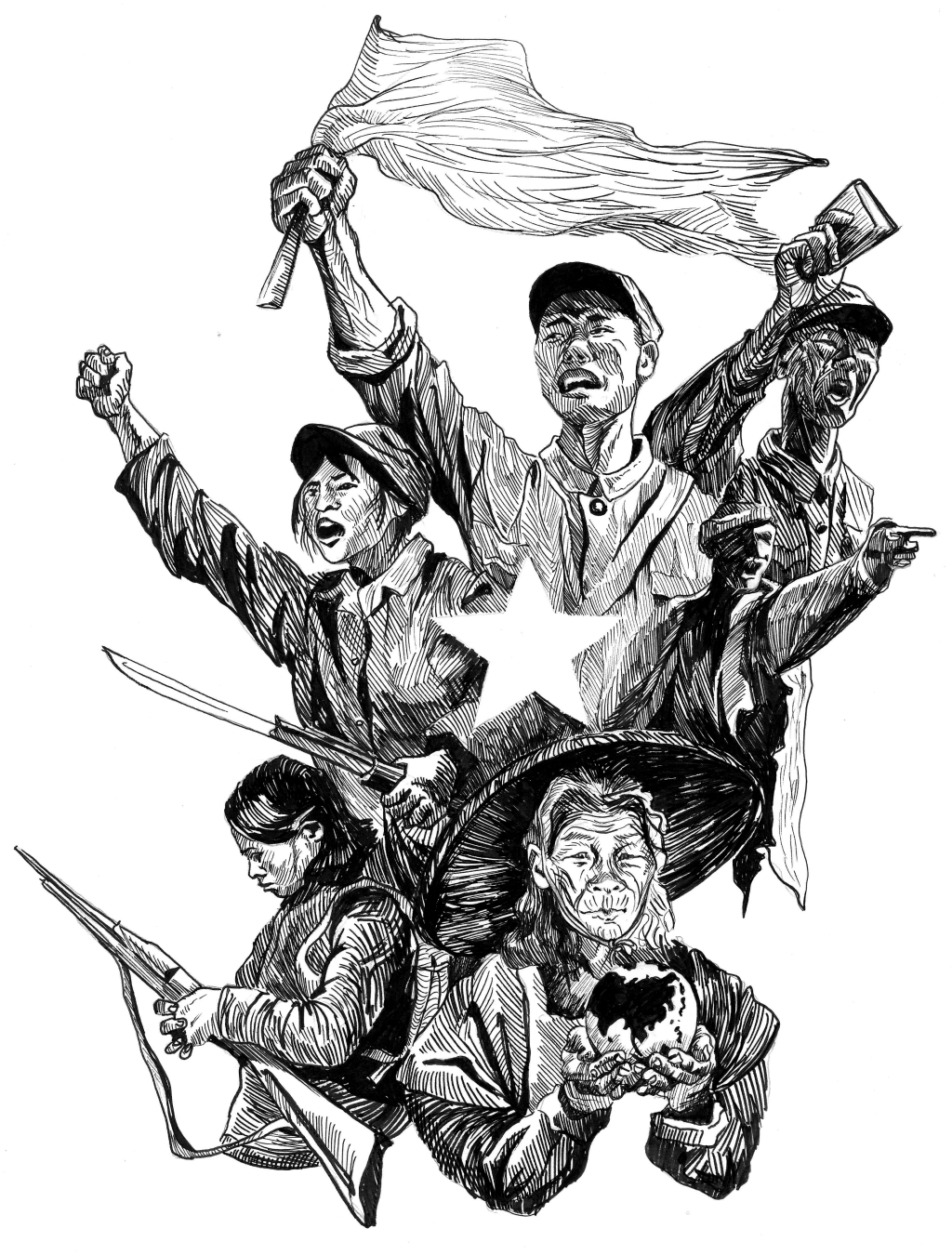
With a new generation of communist cadre stepping forward in the US, sinking roots among the proletariat, and connecting revolutionary politics with the masses, the history of socialist countries of the twentieth century—what we can learn from their achievements, how we can avoid their mistakes—has become an increasingly urgent question. As we work towards revolution, the overthrow of the existing order, it is only natural that we think more and more about the society that we will build on the ashes of this one, and how our goal of a communist world informs everything we do today. Socialist China, from the victorious revolution in 1949 to the counterrevolutionary coup in 1976, stands out as our greatest historical resource. Its history is a shining example of what socialism can achieve for the masses, a window into the difficult challenges of the socialist transition to communism, and a guide to meeting those challenges by bringing forward the masses as the makers of history.
This volume is intended as an introduction to socialist China’s history and to the contradictions of the socialist transition to communism more generally. It is above all a political summation, focused on how the revolutionaries in the Communist Party of China and the masses of people in China sought to overcome all the exploitative and oppressive social divisions of the old society while confronting the new challenges opened up by the struggle to revolutionize socialist society in the direction of communism. With that focus in mind and given the vast subject matter that is socialist China’s history, we had to make conscious decisions about what not to write about. Our approach is to highlight the key political struggles in China from 1949 to 1976, pick some historical episodes for more detailed treatment given the important lessons we can draw from them, and leave out many names and events and much historical information in the process.
There is a rich literature in English on the socialist years in China, and this volume is not intended to replace that literature. There are many first-hand accounts that paint a vivid picture of life in socialist China, and there are various summations of specific facets of that life, as well as the broader picture. We encourage readers of this volume to pursue further study of socialist China by digging into that literature, and we have given a few recommended readings at the end of chapters in this volume, as well as a larger bibliography to explore. Our summation draws on this bibliography, as well as on what we have learned from the communist tradition, including from comrades who visited China during the Great Proletarian Cultural Revolution and from the work of historical summation by the Revolutionary Internationalist Movement (RIM).
Readers familiar with the RIM’s work may note ways we have sought to paint a more complicated picture of China’s socialist years, benefiting from the work of professional historians with varying degrees of sympathy with socialism and from reevaluations of the Mao years by Chinese intellectuals who grew up in those years and uphold their basic character. In particular, we emphasize how struggles over the direction of socialist society drew in sections of the people for and against the further revolutionization of society, with various class interests and allegiances at play. Furthermore, we present the struggle against capitalist restoration and to make further advances towards communism as a more ongoing process stretching back to socialist China’s early years, with various phases and punctuation points in that struggle and different methods used to wage that struggle in different time periods. The Great Proletarian Cultural Revolution (GPCR) was a culmination of those previous struggles. It was both a brilliant, revolutionary approach to the class struggle under socialism and an act of desperation when previous approaches had failed to curtail the growing strength of capitalist roaders in the Communist Party and the heavy weight of intertia of bourgeois ideology and commodity relations in society.
The international bourgeoisie and its ideologues and literary warriors have provided a vastly different summation of socialist China than the one presented here. Their summation has been propagated in trashy bestsellers with little historical credibility and by college professors enlisted by the bourgeoisie in the Cold War and then in the capitalist triumphalism of the 1990s. Refuting the bourgeoisie’s voluminous anti-communist slander of socialist China is a task in its own right. Our summation is not written as an argument against bourgeois summations of socialist China. Instead, it is written from the partisan perspective of asking how we get to communism through the socialist transtion period and what lessons we can learn from the Chinese experience to do so. For readers seeking more refutation of the bourgeois summation of socialist China than we can offer given our focus, we suggest checking out work focused on such refutation, such as the writing of Mobo Gao, who takes on anti-communism with both intellectual rigor and biting humor.
The visionary leadership of Mao Zedong, the Chairman of the Communist Party of China preceding and during its socialist years, looms large in our summation of socialist China. Our understanding of the contradictions of the socialist transition period and the means to move through them largely comes from studying Mao’s leadership, as concentrated in his published speeches and essays. We strongly suggest reading the fifth volume of Mao’s Selected Works, published by China’s Foreign Languages Press in 1977, and the collection Chairman Mao Talks to the People, edited by Stuart Schram and published by Pantheon Books in 1974, as companions to this volume.
Hopefully, our summation of socialist China will open up more questions than it answers, as any intellectual work guided by materialist dialectics ought to do. To answer those questions (and to pose more questions), the collective that authored this summation—the Socialist Transition Period Study Group—aims to produce further writing on the history of socialism in the twentieth century and the theoretical questions bound up with that history. Some specific features of socialism in China may get further, more in-depth treatment in future articles and pamphlets—the pamphlet on women’s liberation in China in this volume is an example of that line of work. Overarching questions and challenges of the socialist transition period, such as overcoming national oppression within the framework of the multinational socialist state, socialist economics, the foreign policy of socialist states in a world dominated by capitalist-imperialist powers, and the role of the vanguard party in the socialist transition period, will also likely get focused attention in future writing. And the first attempt at building socialism, the Soviet Union from 1917 to 1956, also calls for a summation along the lines of this volume. For those and any other future writings produced by the Socialist Transition Period Study Group, keep reading the journal Going Against the Tide, which published this volume, and follow its website, goingagainstthetide.org.
 Going Against the Tide: A journal charting a path for communist revolution in the US