
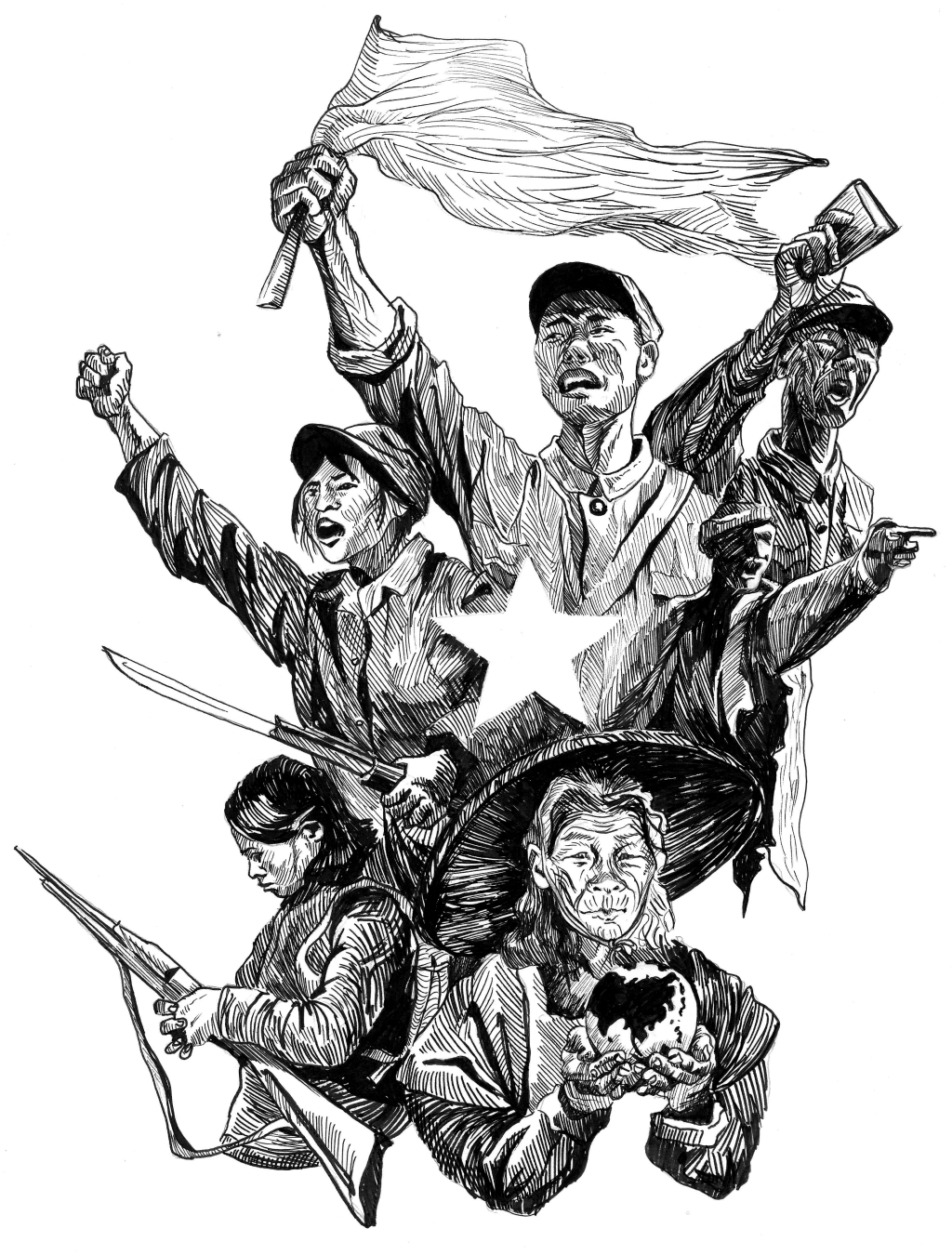
Mao Zedong had a predilection for using stories from China’s history and literary tradition as metaphors for contemporary struggles and events. Given that the English-language audience of this book is mostly unfamiliar with that history and literary tradition, we have largely left those metaphors out of our narrative, losing some of the richness of Mao’s leadership and the gravitas of the revolutionary struggle over twentieth-century China’s destiny in the process. However, one of Mao’s metaphors merits attention here, as the shock and dismay that comes with reading about the overthrow of socialism and China’s subsequent capitalist restoration settles in.
In the wake of the Great Leap Forward and amid a growing split between socialist China and the Soviet Union, Mao collaborated with the poet He Qifang on a book titled Stories About Not Being Afraid of Ghosts. Drawn from the centuries-long Chinese literary and story-telling tradition, the tales chosen for this collection were ones that emphasized fearlessness in fighting ghosts. The introduction to the book made clear Mao’s metaphorical intention: we must be fearless in the face of the ghosts that haunt us in the present day—imperialism and revisionist betrayal of the socialist transition to communism.1 Such fearlessness was especially important in the aftermath of the Great Leap Forward, when natural disasters, Soviet betrayal, capitalist roader sabotage, and real mistakes by genuine communists brought significant suffering to the Chinese people, which threatened to shatter confidence in socialist construction and bolster fear in the face of imperialist aggression and revisionism taking power in several formerly socialist countries.
Over the last five decades, a new ghost has haunted the masses of exploited and oppressed people around the world: the specter that says that if you dare to make revolution, if you sacrifice everything in the struggle to overthrow capitalism, and you win, it will only work out badly for you anyway. The international bourgeoisie launched an anti-communist ideological offensive in the wake of capitalist restoration in China and the Soviet Union, producing a vast literature of ghost stories depicting socialism as a horror show that only produced suffering by trying to transform “human nature.” Some of these ghost stories deploy faulty but well-funded research by academics to pick apart socialist history for its real and imagined shortcomings, while others are the work of hacks and stand on little empirical ground. Either way, they are told from the triumphalist position of late-twentieth-century bourgeois victory against socialism and revolutionary struggles, and they have been propagated far and wide to control the historical narrative about socialism. In the face of this ideological onslaught, it is easy to conclude that revolution is impossible, that we cannot prevail over the forces of exploitation, that the masses are too mired in the muck of cutthroat competition to change themselves and change the world, and that heroic revolutionary leaders that emerge from the masses will only betray the masses in the end.
But we do not need to fear the ghost of socialism’s defeat. First off, because it was a defeat, not a failure, and the monumental achievements of socialist China prove that even more such achievements are possible in the future, while the future of capitalism can only bring more exploitation and oppression. And second, because the experience of socialist China, if we study it, shows us how to avoid defeat in the future. For China’s socialist years and Mao’s leadership made clear that socialism is a transition period, full of class struggle and with no predetermined outcome, that can bring humanity to communism if we, collectively, understand the contradictions involved and chart our way through them. No, we do not get to rest after the revolution, but we do get the chance to get beyond all class divisions, all exploitation and oppression, all the bourgeois ideas and culture that hold us back, so long as we struggle for it.
For the restless ones, the stories about not being afraid of ghosts in the preceding pages are not just history; they are also the future. They are a roadmap and a compass to charting the struggles ahead, after we have vanquished the ghost of capitalism’s present. The future is bright, the road is tortuous, and on the basis of socialist China’s example, we can walk that road again, next time to the end.
1Roderick MacFarquhar, The Origins of the Cultural Revolution, Vol. 3: The Coming of the Cataclysm, 1961–1966 (Oxford University Press and Columbia University Press, 1997), 21–22.
 Going Against the Tide: A journal charting a path for communist revolution in the US