
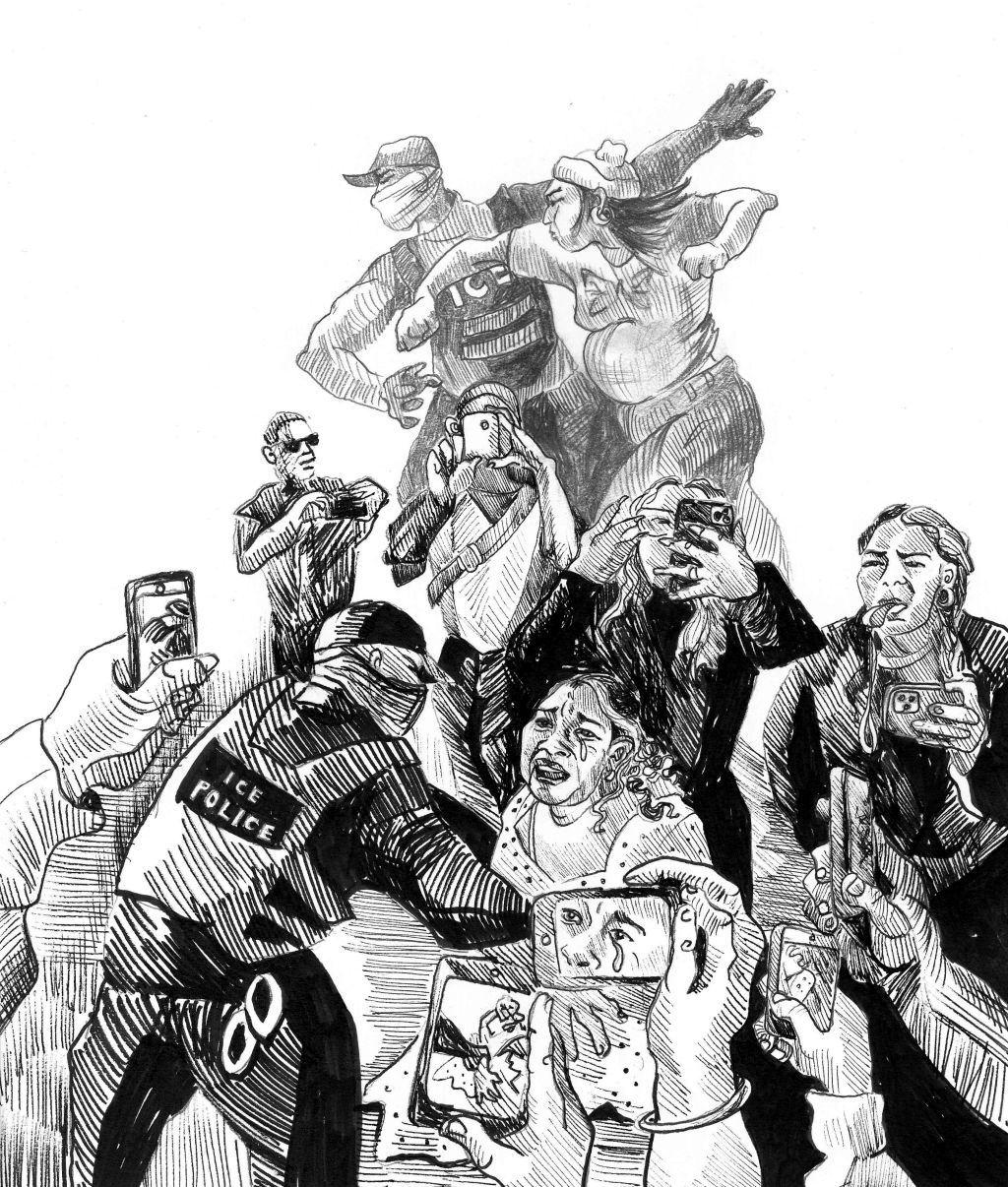
Pat Grant1, January 2026
download a leaflet to promote this article
Since the start of Trump’s second presidential term, the immigrant proletariat has been at the center of a firestorm of state repression, fueled by rabid anti-immigrant vitriol from Trump’s sycophants and their revanchist mass base, that is increasingly spilling over to affect other sections of the proletariat as well as anyone who makes a genuine effort to put it out. Across the country, federal agents are kidnapping not just immigrants, but anyone they think looks like an immigrant, from US-born Latinos to Native Americans. In the name of immigration enforcement, federal troops have descended on several major cities, where they have terrorized Latino and Black neighborhoods, even killing a US-born Black man in his home in cold blood, and blown off judicial orders with their use of chemical weapons and other forms of brutality to repress protests.
Although the onslaught against immigrants and their allies is extreme, the liberal reaction that mostly consists of hysteria and hand-wringing about impending fascism misses the point: the oppression of immigrants has existed almost as long as the US has, and will continue to exist as long as the US does. Most of the tactics being used by the federal government today aren’t actually new at all, and sensationalism about impending fascism obscures the fact that the exploitation, oppression, and brutalization of immigrants is a structural component of capitalism-imperialism that can’t be voted or legislated away. To understand where these tactics come from, we trace the history of immigration policy and enforcement over the past 200 years, and the effects those policies have had on the immigrants who have to live through them, especially the immigrant proletariat. We also analyze the balance of forces that has produced the particular situation immigrants are in today. And maybe most importantly, although we don’t have all the answers, we consider Lenin’s timeless question: what is to be done? As always, communists will have to carry out work among the immigrant proletariat, sum up the lessons from it, and make advances in order to begin to answer that question. We hope this editorial will help point us in the right direction.
A brief history of immigration enforcement in the US
Post-Civil War era (late 1800s)
The Chinese Exclusion Act of 1882 was the first US law excluding a specific national group from immigrating to the United States. It prohibited all immigration from China to the US for 10 years, except for diplomats, and barred all Chinese immigrants living in the US from being eligible for US citizenship. This act came in the wake of two major developments in US history. The first was that US territorial expansion had essentially finished, except for the subsequent colonization of islands such as Hawaii, Puerto Rico, and Guam, with the purchase of Alaska in 1867. For the first 100 years of its existence, the US was undergoing rapid geographic expansion, and had a constant need for new settlers to arrive from other countries in order to drive out and supplant the indigenous populations from each new territorial acquisition. For this reason, restrictive immigration policy had never been on the table before, but by the later 1800s, the territorial expansion had mostly come to an end and the need for a constant influx of immigrants was less pressing.
The second was the end of the Civil War in 1865, which formally abolished slavery in the entire US. The abolition of slavery created a massive vacuum in the economy which needed to be filled with cheap labor. Sharecropping was one source of cheap labor that emerged in the wake of the Civil War, especially to replace slave labor on plantations, but due to its reliance on trapping sharecroppers in limited geographic areas, it couldn’t meet all of the economy’s needs, not just for agriculture, but for increased production and economic expansion in the wake of the war. Immigrants from oppressed countries stepped in to fill that void, and during this period, Chinese immigrants came to play a pivotal role in building railroads and other infrastructure on the west coast of the US.
The number of Chinese immigrants living in the US rose from approximately 25,000 in 1852 to 105,465 in 1880. With a stable niche in the economy, Chinese immigrants began to integrate economically and find some prosperity, not just as laborers, but also as entrepreneurs. Their economic success could not be tolerated by the US bourgeoisie because it was a threat to the availability of cheap immigrant labor. Also, white supremacist ideology was on the rise throughout the US during the Reconstruction period (1865–1877) and its aftermath, punctuated by routine acts of white supremacist terrorism concentrated in the US South. The interests of the bourgeoisie to maintain their supply of cheap labor and the interests of white Americans to reestablish their racial status dovetailed in the need to put Chinese immigrants in their place, so to speak. The 1882 Chinese Exclusion Act marked the beginning of a new era in the situation of immigrants in the US, which is characterized above all else by ongoing social and economic dispossession.
Interwar period (1920s–1940s)
The Chinese Exclusion Act was followed by a series of minor exclusionary laws that accumulated over the following decades, mostly targeting disabled people, poor people, communists, anarchists, and other undesirables for exclusion. The next major development in US immigration policy didn’t occur until the 1920s with the passage of the National Origins Act in 1924. The 1920s saw a wave of reaction opposing the progressive atmosphere of the moment, which especially took the form of the national resurgence of the Ku Klux Klan and the emergence of the anti-immigrant Nativist movement. Throughout the late 1910s and early 1920s, the Nativists began to gain a foothold in national politics, filling in a range of government positions including in the legislature.
The National Origins Act was a major legislative victory for the Nativists that established a literacy test, a health exam, and an entrance fee for new immigrants, as well as new national quotas where “96% of all quota slots were reserved for European immigrants.”2 It also eliminated the statute of limitations on deportation for unlawful entry, suddenly making tens of thousands of immigrants who were already in the US subject to deportation. However, the National Origins Act created an exemption to the quota system for all countries from the western hemisphere due to pressure from agribusiness capitalists and other employers across the southwestern US. These capitalists relied on cheap labor from the approximately 100,000 Mexicans who crossed the border each year.3 In order to win over the Nativists who were opposed to permitting Mexicans to continue to enter, they argued that “Mexican immigrants were ‘swallows’: like migrating birds, they would never permanently settle within the United States” and that, because the vast majority entered illegally, they were “deportable.”4
The National Exclusion Act negotiated, but wasn’t able to resolve, a growing tension within the bourgeoisie between white supremacist ideology that advocated the exclusion of immigrants on the one hand, and labor needs that favored the inclusion of immigrants on the other. The resolution of that contradiction came four years later, with the Undesirable Aliens Act of 1929. The 1929 Act reoriented the focus of immigration policy from putting limits on authorized immigration, as previous legislation had done, to punishing unauthorized immigration. It sidestepped a previous Supreme Court hearing5 that decriminalized unlawful residence by criminalizing unlawful entry.
With the passage of the Undesirable Aliens Act, thousands of immigrants already residing in the United States, mostly Mexicans, who had entered the country outside of legal immigration channels became “illegal” overnight and were suddenly subject to detention and deportation. Following the passing of this law, the federal prison population exploded, and the federal prison system, which in 1929 only had the capacity to hold 13,000 people, quickly became overcrowded.6 The contradiction within the bourgeoisie was resolved: Nativists got their detentions and deportations, and agribusiness and other capitalists got their immigrant labor. The shift to focus on enforcement rather than blanket exclusion also created a degree of flexibility in immigration enforcement that was used to discipline immigrant populations. Unemployed and poor Mexicans in LA, for example, were targeted for enforcement through public order charges, and “evidence suggests that labor control was the main reason.”7
In the 1930s, the extreme policies toward immigrants began to come under the scrutiny of social welfare advocates and legal reformers who argued that “deportation policy was applied in arbitrary and unnecessarily harsh ways” and “frequently operated in the breach of established traditions of Anglo American jurisprudence” as a part of a broader progressive backlash against the Nativist movement.8 However, these changing tides, and the limited progressive reforms to the immigration system that resulted, mostly focused on and served to benefit European and Canadian immigrants. The Mexican and Asian immigrants who had already been subjected to the worst of the immigration system were largely left out of the reforms. For example, a 1935 agreement between the Department of State and Immigration and Naturalization Services that provided a pathway to legalization for unauthorized immigrants was restricted to European immigrants only by 1938.9 Meanwhile, Mexicans and Asians continued to be subject to targeted deportations and racial profiling.
The key contradiction at work during the 1920s and 30s was between revanchist ideology on the one hand, which promoted the exclusion of immigrants, and economic rationality on the other, which called for immigrants to be admitted to the US in order to fill the need for cheap labor. By the end of the 1930s, these two competing forces in society had negotiated an uneasy truce agreement that would allow immigrants from oppressed countries to enter the US, but under conditions of social disenfranchisement and ongoing dispossession. The contradiction was stabilized for the time being, although the tension between these two forces was not resolved, and the position of immigrants in US society remained a contentious issue.
It wasn’t long before this issue exploded again, with the institution of the Bracero Program in 1942 on the one hand, and the mass internment of Japanese Americans beginning in spring 1942 on the other. The Bracero Program was a diplomatic agreement between the US and Mexico that created work permits for Mexican men to legally work short-term labor contracts in the US. It was supported by the agribusiness sector that needed to make up for agriculture labor shortages during WWII, which resulted from many young, American men being drafted to fight the war overseas.10 The Bracero Program walked back the mass illegalization of Mexican immigrants that had been established in 1925 with the National Origins Act by giving Mexican immigrants the opportunity to legalize their status, provided they were coming to the US to work.
After the WWII bombing of Pearl Harbor by Imperial Japan, some 120,000 Japanese Americans were forcibly removed from their homes in California, Oregon, and Washington State and relocated to internment camps. These camps were seen by the War Relocation Authority as “‘Americanizing projects’ that would speed the assimilation of Japanese Americans.”11 This drastic attempt to force Japanese Americans to assimilate into white American culture was actually on the more moderate end of anti-Japanese sentiment during WWII—bills were being introduced in Congress at this time that advocated for revoking the citizenship of Japanese Americans en masse and for the mass deportation of all Japanese Americans to Japan. Meanwhile, during the internment of Japanese Americans, the houses, businesses, and farms that they had left unoccupied on the west coast were being stolen and destroyed. When Japan surrendered to the US in August 1945, Japanese internment was formally ended, but many Japanese Americans had no home to return to, their houses, businesses, and farms having been stolen or destroyed during their internment, and several thousand Japanese Americans had voluntarily renounced their US citizenship during their internment in response to the treatment they were subjected to at the hands of the US government. Those who had renounced their citizenship were deported to Japan after the end of the war, despite the fact that many had been born in the US.
Japanese internment during WWII is not just another one of the many bloody stains on US history: it teaches us an important lesson. With every wave of anti-immigrant reaction throughout the country’s existence, many progressives have been quick to cry that measures taken against immigrants are extreme, unprecedented, or unconstitutional, appealing to bourgeois-democracy for a resolution. That position relies on selective amnesia, ignoring the times in US history when such drastic actions were taken against immigrants, and where the perpetrators were never brought to justice. US immigration policy over the past two centuries has established that immigrants do not have bourgeois-democratic rights in the US,12 which is why telling immigrants today who are facing increasingly frequent and brutal ICE raids to “Know Your Rights” sounds as idiotic to them as it does to us.
The end of the Cold War and globalization (1980s–1990s)
In the decades after WWII, restrictions on immigration from Europe continued to loosen, while the situation of Mexican and Asian immigrants remained largely the same. The Bracero Program was ended in 1964 when the postwar boom in the US-born population and the mechanization of agriculture made agribusiness less reliant on temporary/seasonal Mexican labor.13 And in 1965, the Immigration and Nationality Act was passed, which formally overturned the national quota system established by the National Origins Act of 1925 and established a limit on immigration from the Western Hemisphere for the first time. This Act did change the demographics of immigrants to the US significantly, with increased numbers of Asian, African, and Caribbean immigrants compared to their European counterparts. The total number of immigrants to the US also increased significantly following the passage of the Act: total immigration to the US doubled between 1965 and 1970, and doubled again between 1970 and 1990.14
In the mid-1970s, following the withdrawal of the US military from Vietnam, a wave of immigration from Southeast Asia and accompanying revanchist anti-immigrant grumblings from the US-born population brought the question of refugees to the forefront. The Refugee Act of 1980 established two tracks for refugees to enter the US: (1) the president, after consulting with Congress, can authorize certain groups of refugees to be admitted, or (2) refugees who are not included by executive action can apply for asylum at ports of entry. These two options are not equal, however, and the second track is much more conservative in terms of the number of people approved for admission. Between 1980–2000, tens or even hundreds of thousands of refugees were admitted by executive decree, whereas the number of refugees admitted each year via asylum applications remained under 15,000 for at least the first 20 years of the arrangement.15 Asylum seekers from countries not on the executive decree were likely to be labeled economic refugees rather than political refugees, which lowered their chances of being approved for asylum and often resulted in discrimination and mistreatment at the hands of the INS.
The strategic admission of refugees by executive decree was a political maneuver that allowed the US government to use refugee populations as their pawns in the game of geopolitics. Specifically, “[w]ithout much Congressional opposition, presidents have continued to favor refugees from [so-called] Communist countries while consistently ignoring pleas of those from US allies.”16 For example, in 1980, the Carter administration designated 169,000 openings for refugees from Southeast Asia, 33,000 for the Soviet Union, 19,500 for Cuba, and just 1,000 openings for the entire rest of Latin America. In 1992, after the fall of the Soviet Union, the George H.W. Bush administration increased the total number of openings for refugees to 142,000 in order to accommodate 61,000 openings for refugees from the former Soviet Union. These numbers are no coincidence, are not proportional to the demographics of refugees arriving to the United States, and are not a reflection the actual conditions refugees faced in their country of origin. This was a late-Cold War maneuver by the US government to use refugees against their countries of origin and to reward US allies, many of which were outright fascist regimes, by keeping their oppressed populations trapped within their borders. It also served to reinforce anti-communist propaganda within the US, and the US government propped up anti-communist testimonials from Southeast Asian, Soviet, and Cuban refugees, while keeping the suffering of oppressed people from capitalist, US-aligned countries out of sight of the US populace.
By the mid-1980s, the US economy was declining, and frustration was growing among the US populace about the number of undocumented workers in the US. This shift in attitude toward immigrants resulted in the passage of the Immigration Reform and Control Act (IRCA) of 1986. Passed in the same year that Mexico entered into the General Agreement on Tariffs and Trade, a global free trade agreement that dramatically increased trade and economic integration between the US and Mexico, the IRCA’s nominal purpose was to reduce the number of undocumented immigrants in the US by (1) offering limited amnesty and paths to legalization for some undocumented immigrants and (2) instituting sanctions for employers that hire employees who are not authorized to work in the US. As Bill Ong Hing points out,
Casual observers of immigration policy in the 1980s might cite the IRCA’s legalization provisions as an example of a congressional swing toward a pro-immigration policy. That observation, however, would be wrong. The amnesty provisions just barely eked through the House of Representatives, while the employer sanctions provisions received overwhelming legislative support.17
The main legal avenue for executing the employer sanctions was the creation of the I-9 form, which placed the responsibility for enforcing work authorization on individual employers. This made hiring undocumented workers riskier for employers, and employers who were willing to take that risk offloaded it onto their employees in turn by lowering their wages. Employers took advantage of the fact that undocumented immigrants no longer had equal employment opportunities compared to documented immigrants and citizens, exploiting their desperation to coerce them into accepting insufficient wages. Employers also offloaded the risk of hiring undocumented immigrants by using intermediary labor subcontracting companies rather than hiring directly. As a result of these changes becoming standardized, “the hiring process was completely restructured in sectors of the economy where immigrants worked. As indirect hiring became established after 1986… it was imposed on all workers regardless of legal status or citizenship…. Thus, a perverse consequence of IRCA’s employer sanctions was to lower the wages not only of undocumented immigrants, but of legal immigrants and US citizens.”18
The intensifying restrictions on immigrant labor in the US were in sharp contradiction with the trajectory toward integration between the economies of the US and Mexico. In other words, as the flow of capital and goods between the two countries grew following trade agreements, the natural movement of human beings following the flow of capital was increasingly suppressed. The result, as the contradiction sharpened, was the growing precarity and exploitation of the undocumented workforce. This was the class power of the bourgeoisie at work. They puppeteered the contradictory economic and social policies at play such that their interests were enshrined in policy against the interests of every other class in US society: they secured both the free movement of capital that would enable them to maximize their profits and the geographic and social constraints on immigrant proletarians that would enable them to maximize their control over the labor force.
The adoption of NAFTA in 1993 only deepened this contradiction, and a series of immigration policies were passed in the immediate aftermath of NAFTA that doubled down on the restrictions on immigration. Operation Blockade in 1993 and Operation Gatekeeper in 1994 dramatically increased policing at the US-Mexico border, following a new immigration control strategy of “prevention through deterrence” that was pretty much exactly as draconian as it sounds. Rather than having the actual effect of numerically limiting immigration to the US, the new strategy just rearranged patterns of border crossing geographically, driving immigrants from safer, more established paths across the border into more difficult and dangerous routes. Before 1993, the two main points of crossing the US-Mexico border were at Juarez-El Paso and Tijuana-San Diego. The new policies focused border policing around those two crossing points, which forced immigrants to find alternative routes, and as a result, the rate of death during border crossings increased dramatically after 1993.19 The new policies also resulted in Mexican immigrants settling in more dispersed regions in the US: whereas before 1993 most immigrants settled close to the border, the heavier policing of the border region pushed immigrants further into the interior of the country. And because the risk of immigrating to the US had increased so dramatically, immigrants were much more likely to stay in the US once they had made the journey, rather than migrating more freely across the border. Taken all together, these policies resulted in “more US residents in unauthorized status than at any other point in American history, yielding a large and growing population of vulnerable and eminently exploitable people.”20
In 1996, Congress dealt another blow to immigrants in the US with the passage of the Illegal Immigration Reform and Immigrant Responsibility Act (IIRIRA). IIRIRA ushered in a new era of close collaboration between local law enforcement and federal immigration enforcement via the 287(g) program, through which participating police departments shared all arrest information with the INS so that they could begin deportation proceedings immediately following the arrest of an undocumented immigrant, with the immigrant being detained by local law enforcement on behalf of the INS. It changed the definition of what constitutes an “aggravated felony,” broadening out the (deportable) offense to include a wide range of nonviolent crimes, including prostitution and repeated unauthorized border crossing. It also “curtailed immigrants’ rights of due process on the basis that immigration control is a civil, or administrative, legal power not subject to robust challenge in the courts.”21 Furthermore, “despite executive orders and memoranda directing authorities to focus only on serious felony offenders, both the 287(g) and Secure Communities programs have not focused narrowly on individuals arrested and convicted on serious criminal grounds.”22
IIRIRA was passed at the height of the Clintonian Democrats’ power as part of their broader “tough on crime” political program that used the criminalization of oppressed people to put the blame for poverty and other forms of oppression onto individuals and their life choices,23 rather than on a system whose basic functioning will always require the existence of an underclass of oppressed people. In the case of IIRIRA, the enmeshment of law enforcement and immigration enforcement, and the targeting of undocumented immigrants with both, functioned as a form of social control: “undocumented communities [were] driven underground, out of fear that being public [would] increase the chances of being deported.”24 The Clintonian immigration program was never a strategy for removing criminals or preventing immigrants from entering the country, but a thinly-veiled strategy for allowing immigrants to enter and remain trapped in the US on conditions of extreme precarity so that their labor can be exploited by the US bourgeoisie and so that the land and resources in their countries of origin can be plundered by the international bourgeoisie. In this way, both sides of the contradiction between the free flow of capital across borders on one hand and the restriction of the movement of people across borders are working in service of the bourgeoisie while the international proletariat is the candle being burned at both ends (in their countries of origin and in the countries they immigrate to). As Douglas Massey so insightfully pointed out,
Despite its extravagance, the expensive post-IRCA enforcement regime has had no detectable effect either in deterring undocumented migrants or in raising the probability of their apprehension. It has been effective, however, in causing hundreds of needless deaths each year. It has also lowered wages for workers—both native and foreign, legal and illegal—and has exacerbated income inequality in the United States.25
9/11 and George W Bush (2001–2008)
On September 11th, 2001, Al Qaeda soldiers hijacked several passenger planes, crashing them into the World Trade Center and attempting to reach the Pentagon, and resulting in thousands of casualties. After decades of US imperial domination over the Middle East which killed, starved, and displaced millions of Arabs, the chickens of US imperialism came home to roost, and the same far-right extremist militia that the US had created and armed in order to maintain US control and combat Soviet influence in the Middle East turned around and attacked the US. Less than a month later, on October 7th, President George W. Bush declared war on Afghanistan, and in March 2003 he started a war on Iraq. Millions of people across the region were starved, brutalized, and murdered from 2001 and on. The last of the troops from the “War on Terror” operation that began in 2001 were withdrawn almost two decades later in 2021, once it was clear that the US had failed to establish complete domination, and that the war was economic failure, never mind a disastrous tragedy.
In the face of an existential threat to US imperialism’s dominance, all too many people across the country readily sided with the government and their “War on Terror” rather than understand the continued terrorism the US inflicted on immigrants in the US and on the masses abroad. There was a massive mobilization by the federal government after 9/11 in response to the threat posed to US global hegemony, with the US government uniting on a program to not only wage war on the entire region as punishment for Al Qaeda’s attack, but also to bring that war home and inflict state and vigilante violence on Middle Eastern, South Asian, and Muslim immigrants living in the US. Five days before 9/11, Bush had met with the Mexico’s President Vicente Fox to work out a border agreement that would facilitate the seasonal temporary work that many Mexican nationals had done in the US for decades, and to naturalize a larger number of Mexican immigrants. But when public opinion on immigration policy changed overnight following 9/11, Bush abandoned that agreement and went all-in on the repression of immigrants, especially, but not exclusively, those from Muslim-majority countries.
The USA PATRIOT Act was a watershed law passed during this period that granted the executive branch the authority to deport individuals without due process, regardless of their legal status. Section 215 of the USA PATRIOT Act massively expanded the federal government’s capacity to spy on the US populace in the name of fighting terrorism, resulting in over a decade of mass surveillance that never once led to the prevention of a terrorist attack. Under Section 411 of this act, the definition of “terrorist activity” was expanded to become so vague that the government could arbitrarily take legal measures against non-citizens for a wide range of First Amendment-protected activities, including associating with political organizations that practice civil disobedience.
The creation of the Department of Homeland Security (DHS) in 2002 was a decisive change in the exercise of state power that has made the process of regulating immigration in this country far more efficient for the bourgeoisie, and incredibly cruel for immigrant masses. In the largest government reorganization since the Defense Department was created after World War II, DHS was established with the stated goals of preventing terrorist attacks and controlling US borders. Today, DHS is a well-oiled machine with 24 sub-agencies, including USCIS (US Citizenship and Immigration Services), Immigration and Customs Enforcement (ICE), Customs and Border Protection (CBP), the Transportation Safety Administration (TSA), the Federal Emergency Management Agency (FEMA), and the Coast Guard.
In the immediate aftermath of 9/11, counterterrorism and immigration enforcement became more intertwined than they had ever been before, and thousands of unsuspecting immigrants from Muslim countries were suddenly caught in the crosshairs. In January 2002, the Department of Justice instructed federal agents to detain and interrogate thousands of Muslim immigrants, a mass terror event carried out by law enforcement that purportedly aimed to uncover any ties those immigrants might have had to terrorism.26 In September 2002, the National Security Entry-Exit Registration System (NSEERS), a registry list of immigrants from Muslim countries used to surveil Muslim immigrants for over a decade, was established. And in March 2003, DHS detained asylum seekers from 33 Muslim-majority countries under their short-lived Operation Liberty Shield. Less than a week after 9/11, the INS had increased the amount of time an immigrant can be held without being charged with any crime, which, over the following years, resulted in innocent immigrants being detained for weeks or months at a time without being charged. These people were detained in secret, their hearings were held in secret, and at no point were they given access to a lawyer.27
The absolute depravity of rounding up thousands of random immigrants simply because they are from Muslim countries, holding them in secret detention centers, and interrogating and torturing them can’t be overstated. And the Muslim immigrants who were lucky enough not to be detained were added to government registries, surveilled at every turn, and painted as terrorists and criminals, which led to social ostracization, discriminatory targeting from local law enforcement, and even vigilante violence. Hate crimes against Muslims, Arabs, and other targeted groups such as Sikhs (racists are fucking idiots) shot up in the thousands, including arson attacks, gasoline bombs thrown at businesses, and property damage and vandalism of homes and places of worship. The first racist killing after 9/11 happened on September 15th, 2001, only four days after the attacks, when white supremacist Frank Rouque shot and killed Balbir Singh Sodhi, a Sikh immigrant from India.
By late 2004, the Bush administration was back to pushing immigration reform that would facilitate Mexican nationals coming to the US to work, at the same time as a Homeland Security Bill with restrictive immigration provisions was being debated in Congress. Bush proposed several comprehensive immigration reform bills during his second presidential term, which combined increased border security, the creation of a legal avenue for temporary workers to enter the US, and heightened consequences for illegal entry. These proposals were an attempt to balance the rational need for immigrant labor, at a time when the US economy was growing and the construction industry in particular was booming, on the one hand, with the majority of the country’s association of undocumented immigrants with terrorism and resulting desire to see a militarized and “secure” border, on the other. In a 2007 State of the Union policy brief, the Bush administration wrote that “the President supports a rational middle ground between a program of mass deportation and a program of automatic amnesty. It is neither wise nor realistic to round up and deport millions of illegal immigrants in the United States.”28
But despite the US government’s friendly negotiations with the Mexican government, while the Bush administration was supposedly busy protecting national security against the red herring threat of Muslim terrorists, right-wing vigilante militias were stalking the US-Mexico border, hunting down immigrants, kidnapping them, and delivering them into the waiting hands of the Border Patrol. For decades, anti-immigrant vigilante groups like the Minutemen and the Three Percenters were not just permitted by local politicians and law enforcement, but frequently encouraged. This encouragement came from Republican members of Congress from states as far away from the border as New Jersey introducing legislation in 2006 that would prevent the Department of Homeland Security from undermining these vigilante groups’ activities.29 Vigilantes at the US-Mexico border worked hand in hand with the Border Patrol and local law enforcement, and were encouraged by the violent revanchism of local government officials like Maricopa, Arizona’s Sheriff Joe Arpaio. Arpaio became infamous around the country for his diabolical treatment of immigrants and incarcerated people in his county, and a symbol of the state of Arizona’s war on immigrants that gained a new level of notoriety nationally notoriety with the passage of SB1070 in 2010.
In 2005, the House of Representatives passed the Border Protection, Anti-Terrorism, and Illegal Immigration Control Act, also known as the Sensebrenner Bill, which contained a number of batshit provisions including mandating a 10-year minimum sentence for immigration fraud, requiring that all undocumented immigrants detained by local authorities be taken into federal custody, and making unlawful presence (as opposed to unlawful entry) a felony crime. Perhaps the most cruel and inflammatory provision of the bill criminalized providing aid to undocumented immigrants “knowing or in reckless disregard of the fact that such a person is an alien who lacks lawful authority to come to or enter the United States.”30
Although it never passed the Senate, this bill sparked outrage among immigrants and was the catalyst for weeks of mass protests around the country that began in March 2006 and brought millions of people into the streets. On May 1, 2006, millions of immigrants went on a successful one-day strike that was known as “A Day Without Immigrants.” From our perspective, the significance of these mass protests was that they were the product of a groundswell of action by immigrant proletarians rather than being initiated or controlled by the organized Left, Democrat politicians, or nonprofit advocacy groups (although those opportunists certainly tried to get in on the protests). For example, in North Carolina, the immigrants who worked in construction and on the tobacco fields were mobilized into the streets via Mexican-immigrant-oriented radio stations that added assertive calls to protest between the ranchera and banda songs they played. In the spring 2006 protests, the masses of immigrant proletarians made clear that the US economy depends on their labor and successfully pushed back against reactionary legislation that would have amped up anti-immigrant state repression.
The Obama administration (2009–2016)
During the Obama administration, we see a deepening divide between “deserving” and “undeserving” immigrants and a return to Clintonian techniques of criminalization. Obama maintained his progressive image, and thereby the support of his voter base, through (1) a very limited number of policies like Deferred Action for Childhood Arrivals (DACA) that genuinely did make life better for “deserving” immigrants, and (2) cozying up to what we call the Immigrant Rights Class Struggle Containment Apparatus, which consists of immigrant rights nonprofits and lobbyists. At the same time, his administration avoided drawing too much ire from the anti-immigrant bloc by passing policies that instituted harsh and inhumane punishments for the majority of undocumented immigrants who were deemed “undeserving.”
DACA was passed in 2012, after having sat on the table since the 2006 mass protest movement, led largely by undocumented proletarians, especially families, whose rallying cry was “¡Aquí estamos y no nos vamos!”31 DACA did not offer a path to citizenship, but it did provide work authorization and temporary protection from deportation to eligible immigrants. Eligibility is based on the year a person arrived to the US and their age (specifically, they had to have arrived to the US before age 16), being enrolled in school or being an honorably discharged veteran, and having a clean criminal record. DACA was seen by most progressives as uncontroversial and humanitarian: undocumented immigrants who came here as children brought by their parents, through no agency of their own, should not be punished for a crime (crossing the border illegally) that they didn’t commit.
The unspoken implication there is that people who did make the choice themselves to enter the country illegally do deserve to be punished, and that if they don’t want to be subjected to precarity, poverty, undignified working conditions, predatory economic relationships, and even deportation, they shouldn’t have come here in the first place. This would seem like a cynical reading of the widespread support for DACA if it weren’t for the many policies passed under the Obama administration that implemented that exact logic (more on that soon). The US government was cherrypicking from the immigrant population, offering amnesty to some groups while criminalizing the majority.32 This was a beautifully faithful application of the postmodernist DEI33 logic that paved the way for Obama’s election in the first place: if the president was Black, what did it matter that the country’s prisons were still full of Black men? If 5% of the best, brightest, youngest, and most respectable undocumented immigrants got work authorization and temporary protection from deportation, what did it matter that the 95% of undocumented people who were deemed undesirable were being deported at record numbers?
Alongside passing DACA, the Obama administration kept up the appearance of being pro-immigrant by giving “unprecedented access” to individuals and organizations from the Immigrant Rights Class Struggle Containment Apparatus.34 This “unprecedented access” meant that select groups and individuals were invited to meet regularly with White House staff, which provided them not just an audience from the executive branch, but also an opportunity to play ball in the big leagues with other massive nonprofits, garner attention from journalists, and acquire funding from major donors. The Obama administration knew that they were providing these groups with a seat at the table that they might not otherwise have, and they shamelessly leveraged their ability to revoke that access in order to control these groups and silence criticism of the administration’s immigration policies.35 Meanwhile, the Obama administration didn’t even follow the recommendations of these organizations, despite the frequent meetings and lip service: ultimately, they opted for the strategy of “win[ning] the support of Republican colleagues and the public by getting tough on immigrants.”36
Thanks to Obama’s pragmatism and the Immigrant Rights Class Struggle Containment Apparatus’s eager betrayal of the population they claimed to speak for, the “unprecedented access” was ultimately meaningless in terms of giving immigrant-rights organizations and individuals the ability to impact the Obama administration’s actual policy. However, it was successful in bringing those organizations under the control of the system and making their ability to access funding and media attention conditional on their support for Obama’s anti-immigrant policies. Specifically, “[a] hard critique of the White House could result in ejection from the table, which would imperil access to other sources of capital. Well-connected organizations therefore had little incentive to target the Obama administration with criticism and strong incentive to direct their ire at congressional Republicans.”37 As Malcolm X said of Lyndon Johnson and the Civil Rights Movement in 1964,
And the first thing the cracker does when he comes into power, he takes all the Negro leaders and invites them for coffee to show that he’s alright. And those Uncle Toms can’t pass up the coffee. They come away from the coffee table telling you and me that this man is alright…. Oh, I say you been misled. You been had. You been took.38
Leaving Barack Obama’s actual phenotype aside, he undeniably employed one of the oldest strategies in the cracker’s book to bring a potentially destabilizing, bottom-up movement for democratic rights squarely within the bounds of the white supremacist social order, just like his forefather Lyndon Johnson did in 1964. And for their part, the organizations he invited to the coffee table, with almost no exceptions, proved that they were chomping at the bit for a chance to sell out the fight for democratic rights for immigrants in exchange for that cup of coffee with Obama.
The organizations in the orbit of the Obama administration, such as the Center for Community Change, the National Immigration Forum, the National Council of La Raza, the Center for American Progress, and United We Dream,39 staffed by petty-bourgeois employees disconnected from the masses and led by upper-petty-bourgeois and even genuinely bourgeois Executive Directors who made six- and seven-figure salaries, were eager to sacrifice meaningful policy change in order to funnel more grant money into their bank accounts. There was a sinister reciprocity between the Obama administration and the Immigrant Rights Class Struggle Containment Apparatus where both used their proximity to the other and some progressive virtue signaling to mask their heartless pursuit of self-interest. While the Immigrant Rights Class Struggle Containment Apparatus was busy licking Obama’s asshole, the undocumented immigrants they had abandoned were caught in between the economic crash of 2008 (it should go without saying that there was no relief offered to undocumented proletarians) and the Obama administration’s increasingly aggressive deportation strategies.
While Obama used the carrot to reward the Immigrant Rights Class Struggle Containment Apparatus for good behavior, he was using the stick to chase off undocumented immigrants from both the border and the interior of the country. He “abandoned some Bush-era strategies, such as worksite enforcement operations, but allowed others to scale up. [For example, by] 2013, Secure Communities was operational in all jails and prisons in the United States.”40 Secure Communities was a Bush-era program modeled after Clinton’s 287(g) that facilitated cooperation between local law enforcement and immigration enforcement. Basically, when local police departments made arrests, they would register the identity of the arrestee in a database that was shared with DHS. The local law enforcement agency would be notified that the person was undocumented, and DHS would be notified that an undocumented person had been arrested and, because of policies targeting “criminal” immigrants, that person was therefore subject to deportation. This allowed ICE to arrive and arrest the person on the spot, even if the person had not actually been convicted of a crime. Apprehensions of undocumented immigrants at the border went down under Obama, and the rate of people apprehended at the border being returned to their country of origin decreased under Obama from an almost 100% rate of return to approximately 20%.41 Although informal returns at the border decreased, however, formal removals of immigrants from the interior of the country spiked under Obama, earning him the nickname of “Deporter-In-Chief.”
As Muzaffar Chishti et al explain, “[o]ver the course of the Obama administration there was a pronounced shift in focus to the removal of recent border crossers and criminals rather than ordinary status violators apprehended in the US interior. The underlying reasoning was to deter illegal border crossing and remove unauthorized immigrants before they become integrated into US communities.” That said, the policies and directives issued by the Obama administration to DHS seem to have little effect on the actual behavior of DHS agents. For example, ICE’s Criminal Alien Program (CAP), which was created to find and deport immigrants with criminal records, encountered 2.6 million immigrants from 2010 to 2013, but only 3% of the immigrants found through CAP had been convicted of a violent or “serious” crime. Then, of the immigrants who were actually deported through CAP, 27.5% had no criminal conviction at all, and 55.4% were convicted of nonviolent offenses considered “non-serious” by CAP’s own standards.42
Although Obama’s purported focus on prioritizing removals of immigrants with criminal backgrounds didn’t actually impact how immigration enforcement was carried out, it did mislead the American public into believing that if an immigrant was being deported, they were probably a criminal. The discursive association, popularized by Clinton and doubled down on by Obama, between undocumented immigrants and criminality served the Democratic administration well. They could deport as many people as they wanted without having to worry about moral outrage or humanitarian concerns, because on paper they were only going after the people who “deserved” it.
There was also a cold economic rationality to Obama’s policy of promoting removals from the interior over border enforcement: due to the economic crash in 2008, which resulted in the US economy tanking, fewer immigrants were crossing the border, as there were fewer jobs available in the US. At the same time, also because of the 2008 crash, the construction industry specifically had been devastated. The many undocumented immigrants living in the US who were accustomed to working as day laborers in the construction industry had suddenly become a surplus population, which could spell instability for US society if they became rebellious. This was the sinister economic incentive for Obama to deport massive numbers of undocumented people living in the US, under the guise of “targeting criminals.” Obviously, most of the section of undocumented immigrants who were DACA eligible (overwhelmingly young, educated, and upwardly mobile) were never going to work as day laborers in the construction industry, so they could be conditionally incorporated into the US economy through the semi-regularization of their status.
The Obama administration’s linking of undocumented proletarians with criminality came to a head in 2014 with its “Aggressive Deterrence Strategy” against a wave of tens of thousands of Central American immigrants who arrived in spring and summer of that year, which Obama characterized as a “humanitarian crisis.” The “Aggressive Deterrence Strategy” involved a number of components which were ostensibly designed to deter Central Americans from immigrating to the US:
- A media campaign launched in multiple Central American countries that highlighted the risks of illegal immigration and the consequences immigrants would face in the US.
- Dramatically increasing the number of Central American women and children who were detained (rather than being released on bond) while waiting for asylum.
- Expediting removal proceedings for Central American women and children who were found after having entered illegally, which meant that they could be removed before they even submitted an asylum application or before a decision was made on their application.
- Dramatically increased workplace and neighborhood ICE raids targeting Central Americans in summer 2016.43
Despite calling the wave of Central American asylum seekers a “humanitarian crisis,” the real humanitarian crisis was created by the Obama administration’s reaction. The “tough on crime” approach was projected by the administration as being primarily a method of deterring undocumented immigration, but that claim was never backed up by data. In fact, research found that Central Americans “were more likely to have intentions to migrate if they had been victims of one or more crimes in the previous year” and “a substantial majority of [Central Americans] were also well aware of the dangers involved in migration to the United States…. This widespread awareness… however, did not have any significant effect on whether or not they intended to migrate.”44 In other words, the vast majority of Central Americans were not deterred by the Obama administration’s scare tactics because they didn’t have another option but to take the risk.
Why would the Obama administration adopt an “Aggressive Deterrence Strategy” that was not backed by data and was therefore doomed to fail in achieving its stated goals?
What the “Aggressive Deterrence Strategy” and other Obama-era tactics of immigration enforcement did succeed in doing was placing the blame for the US’s treatment of immigrants onto individual immigrants who “decided” to come to the US illegally, work illegally, or commit a crime while here, because the administration could claim that they were aware of the risks and the consequences they might face, and chose to do it anyway. This sleight of hand served to deflect blame away from the system that carried out such abject brutality so that the oppression of immigrants could continue to be carried out, uninterrupted by such pesky distractions as basic humanitarian principles. Because of the association forged under Obama between undocumented immigration and criminality, individual immigrants didn’t even have to demonstrably have a criminal record to be slotted into the category of “undeserving.” They just need to be associated with criminality in the minds of the US populace in order to be considered automatically deserving of mistreatment and oppression. This association had much more to do with economic class and country of origin than it did with an actual individual’s criminal history.
Through shifting the blame for their own oppression onto individual immigrants who were painted as “undeserving,” while at the same time holding up a small number of immigrants as “deserving,” Obama’s administration was able to divide the immigrant proletariat against itself, forcing immigrants to strive for “deserving” status and disavow any fellow immigrants who could be seen as “undeserving” for one reason or another. Working in lockstep with the Immigrant Rights Class Struggle Containment Apparatus, who was fighting for their seat at the Deporter-In-Chief’s coffee table while claiming to represent the interests of undocumented immigrants, the Democratic administration successfully deployed the carrot and the stick to contain the immigrant proletariat. When Obama said “Yes We Can!” in his 2008 electoral campaign, even the most cynical among us couldn’t have predicted that one of the things the US would do with Obama in office was deporting 3.1 million people in just eight years.
Trump’s first term (2017–2020)
The first Trump administration was the crest of a wave of revanchist sentiment that had been building throughout the country for decades. Much ink has been spilled about Trump’s attacks on immigrants during his first term,45 but in fact, his administration was characterized overall by an emphasis on discourse over praxis when it came to immigration enforcement. Although the lives of the immigrant proletariat were certainly not peachy from 2017–2020, Trump actually deported far less people each year during his first term than Obama had. While the Obama administration had built a well-oiled deportation machine, relying discursively on “enforcement priorities” (whether those priorities were actually prioritized is another question) in order to manufacture consent for streamlined, mass deportations, the Trump administration’s chaotic, “build-the-wall!” strategy was far more border theatre than border enforcement.
Rather than using his executive powers to ramp up removals of immigrants from the country, Trump used those executive powers to protect his revanchist base from legal consequences when, as individuals, they took oppressing immigrants or other groups into their own hands. On rare occasions this came through the form of direct executive action, such as his pardon of former Arizona Sheriff Joe Arpaio in 2017. For the most part, though, he achieved this by creating a political climate where revanchist acts of violence would go unpunished through apparently secondary actions such as appointing conservative judges, influencing media outlets, and stoking mass sentiment in favor of revanchist vigilantes through his speeches and social media accounts. One classic example of his discursive influence was his claim that Mexican (and other) immigrants are rapists, one of the main ideological points of his presidential campaign. He didn’t have to actually pass any laws, convict any Mexican immigrants of rape, or deport that many Mexicans in order to successfully mobilize his revanchist mass base and put immigrants on the defensive (“we’re not rapists!”) rather than the offensive (“we deserve basic human rights!”). Without having to deploy executive power much, Trump tapped into a reactionary mass base that got on with his hysterical anti-immigrant discourse like a house on fire. This mass base did a lot of the work of actually carrying out the oppression of immigrants for him, which was fortunate for him because the chaotic revolving-door administration of Trump’s first term likely wouldn’t have been able to accomplish much through pure executive action anyway.
One key exception to this overall trend of elevating discourse over praxis was Trump’s so-called Muslim ban, a series of executive orders that banned all travel to the US from Iran, Iraq, Libya, Somalia, Sudan, Syria, and Yemen (eventually North Korea and Venezuela were added as well) and suspended the US Refugee Admissions Program. By the first full day the ban was in effect, several hundred people from banned countries were detained in airports in the US, and hundreds more people were being turned away from US-bound flights in foreign countries, including students, refugees, and legal permanent residents of the US. Over 50,000 visas were revoked for people both inside and outside the US from the banned countries. International and even national travel plans for those from the affected countries, for all Muslims, and for other immigrant groups were thrown into chaos as uncertainty about the future of the Muslim ban and any other potential executive orders made many people fearful of going anywhere near an airport. In the weeks before the Muslim ban, the US was accepting approximately 1,800 refugees per week from the seven banned countries, but while the executive order was in effect, the US accepted only two total refugees from those seven countries.
This all occurred through Trump’s wielding of executive power, despite the implementation of the Muslim ban being delayed several times by lawsuits that were all ultimately thrown out by the Supreme Court. Neither the lawsuits nor the spontaneous protests that sprung up46 were willing to confront the state directly, but settled with registering dissent, so the ban stayed in effect until it was overturned by Biden.
Another noteworthy policy change under Trump’s first administration was the policy of separating immigrant children from their parents inside detention centers. Although this was more continuous with Obama-era procedures rather than a distinct break from them, the naked and celebrated cruelty of the policy was certainly different from the Obama administration’s rationalized cruelty that was disguised with moral rhetoric. In order to legitimize his discourse in the eyes of the revanchist bloc, Trump had to deploy his executive power in service of actually doing really fucked up things to immigrants at least a couple times, and family separation was certainly one of those times.
In response to the family separations and increased media coverage of conditions in ICE detention centers, the Immigrant Rights Class Struggle Containment Apparatus led groups of well-meaning, mostly petty-bourgeois activists and concerned citizens in accompanying undocumented immigrants to their court dates. They had gotten the idea—and it wasn’t an entirely bad one—from progressive Church groups, who had been doing court accompaniments for years based on statistics that showed immigrants saw better outcomes at their court dates if they were accompanied, especially if they were accompanied by an English speaker. Although religious folks certainly pushed the envelope more than their more cynical nonprofit counterparts, overall, court accompaniments never went much beyond the court date to actually getting to know the person in question, building them up as a leader in a broader struggle for immigrants, disrupting court proceedings, or disobeying court orders. In other words, the court accompaniments, particularly those led by the Immigrant Rights Class Struggle Containment Apparatus, stayed within the confines of a blatantly unjust system rather than challenging the foundations of that system.
Another phenomenon that emerged during the first Trump administration were rapid response ICE watch patrols, which had existed previously in limited ways, but rose to popularity amid the public outcry against Trump’s flashy and cruel immigration enforcement directives. The premise was that well-meaning individuals would receive training on how to interrupt ICE raids, and then be organized into patrols in immigrant neighborhoods to monitor ICE activity in those neighborhoods and, sometimes, make efforts to interrupt ICE operations when encountered. The best of the ICE watch efforts actually organized the residents of the immigrant proletarian neighborhoods where ICE activity was concentrated, which was really only possible to scale in places like Los Angeles where there were large concentrations of first- or second-generation immigrant proletarians living among recently arrived immigrants, with the former, as citizens, having more confidence in purposefully intervening in ICE operations. In most other places, the people organized into rapid response networks weren’t from, or didn’t have strong ties to, the neighborhoods they were patrolling, which severely limited their ability to actually encounter ICE activity in the first place (one or two patrols a week isn’t gonna catch shit), not to mention their ability to develop a muscle for intervening.
However, even the best of the rapid response efforts were premised on waiting for ICE to attack, and then scrambling to mount a spontaneous defense, with a schematic insistence that if we could just get enough of these patrols to respond to ICE’s attacks, that would somehow make ICE stop attacking in the first place. Bringing immigrant proletarians together to fight to take away ICE’s ability to attack their neighborhoods at all was never on the table. Bizarrely, the court accompaniments and rapid response didn’t really stop after the end of the first Trump administration, despite their proven inefficacy in confronting the problem of immigration enforcement and state power.
When the COVID-19 pandemic hit at the end of Trump’s first term, undocumented immigrants were among the hardest hit by both the disease and the economic crisis that resulted, in addition to Black proletarians. Because undocumented immigrants were disproportionately working frontline jobs, they were exposed to COVID-19 at higher rates. Undocumented immigrants are far more likely to work jobs that do not provide benefits such as sick time, which also increased their risk of contracting COVID-19 and impaired their ability to recover from the illness. Additionally, undocumented immigrants are more likely to live in more crowded households and in intergenerational households, which also increased risk of transmission, especially to vulnerable groups such as those who were elderly or pregnant. Higher death rates for those who got sick also resulted partly because many undocumented people are afraid to seek healthcare. In California, during the pandemic, there was a 55% increase in the death rate among undocumented immigrants, compared to a 22% increase for documented immigrants and a 12% increase for US-born citizens. The death rate increased 91% for undocumented, Latino, essential workers during the pandemic.47
Beyond facing a higher risk of sickness and death from COVID-19, many undocumented immigrants were excluded from the federal relief programs that the Trump administration provided, such as the increased unemployment benefits and the stimulus checks. While being excluded from relief programs, and after already being disproportionately below the poverty line even before the pandemic, undocumented immigrants also faced unemployment at disproportionate rates. This was due to a combination of the general precarity of their employment with the fact that most of the industries affected by COVID-19, such as hospitality, agriculture and food production, and construction, had high concentrations of undocumented workers. In the first six months of the pandemic, the immigrant unemployment rate rose from 4.1% to 15.3% compared to 4.0% to 12.4% for the general population (and keep in mind that the unemployment rate only counts those who have declared unemployment—for undocumented immigrants, the real number was likely much higher).48
So the situation of immigrants, especially undocumented immigrants, during the pandemic was dire. Surely, other forces in society would have seen that and stepped in to fight alongside immigrants against what they were facing? Well, kind of. It was at this point that the Mutual Aid Industrial Complex was built from the bottom up, neighborhood by neighborhood, led politically by Tweets and Instagram infographics, in response to the immense survival needs of immigrants and other proletarians and oppressed people during the pandemic. Its formation was also enabled by the fact that large sections of the upper proletariat and petty-bourgeoisie found themselves either unemployed but making more money than they ever had at work thanks to Trump’s relief programs, or working from home. These people suddenly found themselves with extra cash and more time on their hands than they knew what to do with, so they decided to step up and help their neighbors who were struggling to meet their basic needs.
There’s nothing wrong with that—morally, it’s the right thing to do. The problem emerged when mutual aid became positioned as the solution to the problems poor and oppressed people were facing, rather than just something basic and totally apolitical that everyone should be doing for their neighbors. Sections of the petty-bourgeoisie realized that they could feel good about themselves when they contributed to neighborhood charity efforts, and that if they pretended that what they were doing was somehow political, they didn’t have to take up any real political work that would challenge them to change their life or actually confront something (anything). Thus, the Mutual Aid Industrial Complex was solidified and, like court accompaniments and ICE watch patrols, it stuck around way past its expiration date and has become the ceiling of what activist common sense considers possible for immigrants.
By the end of Trump’s first term, the country had exploded into mass uprisings against police brutality and the oppression of Black people, and the immigration discourse had taken a backseat, temporarily. Despite his inflammatory rhetoric, Trump hadn’t actually succeeded in deporting more people than Obama, likely because of his entire administration’s lack of commitment to actually implementing their rabid anti-immigrant discourse, and the general incompetence of his revolving-door first term administration.
The Biden administration (2021–2024)
Despite Trump’s generous stimulus packages, the US economy tanked in late 2020. Demand for Amazon deliveries and delivery services like Doordash exploded during the height of the pandemic, creating an opening in the labor market that unemployed proletarians rushed to fill. When businesses began to reopen and the petty-bourgeoisie began returning to in-person work, that bubble burst, leaving behind a new surplus population. Meanwhile, during 2020 and early 2021, the upper-petty-bourgeoisie was flooding out of US cities to pursue a “digital nomad” lifestyle, leaving the service industries of those cities with a reduced consumer market for reopening. Many small businesses never recovered from the pandemic, unemployment rates soared in major cities, and there was a massive wealth transfer from the proletariat, who as a whole have still not recovered from the economic impact of the pandemic, to the bourgeoisie.
Starting in 2022, unprecedented numbers of refugees began arriving at the US-Mexico border owing to a number of factors. For one, a new, safer land migration route for immigrants from African countries opened up in 2022, which resulted in a wave of immigration from economically strangled, Al Qaeda-occupied West African countries such as Senegal, Gambia, Mali, and Burkina Faso. Over the several years leading up to 2022, the US-South America drug trade had shifted from Colombia to Ecuador, which resulted in skyrocketing gang violence, state-sponsored terror, and economic instability in Ecuador that pushed many immigrants to flee north. And with US sanctions and IMF loans strangling Venezuela and Haiti, the increasingly abysmal quality of life in those countries forced many of their residents to take their chances crossing the border and seeking asylum in the US.
As the waves of immigrants arriving at the US-Mexico border grew to new heights, Texas Governor Greg Abbott concocted a scheme to land a blow against the northern, liberal-Democrat-run “sanctuary cities.”49 From 2022 to 2024, Texas rounded up recently arrived immigrants and loaded them onto buses bound for “sanctuary cities” like Denver, Chicago, Philadelphia, and New York by the tens of thousands. Immigrants were dropped off in these cities at random locations and random times with nothing but the clothes on their back and one bag to hold all their belongings, after having been commanded by CBP to remove their jackets and even their shoelaces before their relocation. The cities that received these busloads scrambled to respond to the sudden arrival of thousands of homeless immigrants with a combination of opening emergency shelters, on the one hand, and police brutality, including sweeps of encampments of immigrants who had nowhere else to go, on the other. The emergency shelters were often inadequate for human residence, and immigrants were left sleeping on cots on the floor and cooking their meals outdoors because the shelter food was inedible. What’s worse, many of these cities have closed much, if not all, of that emergency housing over the past year, leaving immigrants to fend for themselves.
Another consequence of these Democrat-run cities’ scramble to house and feed recently arrived immigrants was that their US-born proletarian residents, who had been subjected to austerity from city governments and eroding welfare programs for decades, saw their city governments mobilize resources to house and feed (however poorly) thousands of people, while US-born proletarians continued to go hungry and sleep on the street. A flood of far-right propaganda in the news and on social media targeted Black proletarians specifically, stoking resentment over the perceived “privileges” that immigrants were receiving compared to US-born Black people. Hoods around the country were buzzing with rumors that immigrants who had arrived on buses were all getting green cards, $50,000, and a free e-bike.50 With the sudden arrival of so many immigrants, a few of whom were gang members,51 being dumped into shelters in the hood, tensions between Latino immigrant gangs and Black American gangs in these cities were heightened, sometimes resulting in deadly clashes over turf. All too many US-born proletarians were so focused on parroting far-right arguments of why these immigrants shouldn’t be housed and fed, rather than uniting with them to fight for housing and food for all, that they didn’t realize the bourgeoisie was digging the grave of the welfare state in front of their very eyes.
While all this was happening, Biden was busy fighting for his life trying to string together a coherent sentence. Although he didn’t have the intellectual faculties to combat the far-right rhetoric around the waves of immigrants arriving to the country during his presidency, he certainly managed to grease the wheels of the deportation machine, deporting as many people as Trump had during his first term. He ultimately returned over 4.4 million immigrants (this includes deportations, expulsions, and other actions taken to block immigration), more than any president since George W. Bush.52 Unfortunately, his PR team was so bad that he didn’t even get credit for his deportation numbers among the right-wingers. His administration’s total incompetence in handling this immigration crisis, alongside widespread suspicions that he had had a series of strokes while in office, unsurprisingly prevented him from being elected to a second term.
With thousands of destitute immigrants arriving to the “sanctuary cities,” the Mutual Aid Industrial Complex, which had just cut its teeth during the pandemic, stepped in to habituate immigrants to their new position in society as homeless and illegal, with uncertain futures. Using morally charged rhetoric, including often calling themselves “revolutionary,” the Mutual Aid Industrial Complex churned through an endless cycle of fundraising, serving food, collecting donations of items such as clothes, and distributing those items.
When the emergency shelters for immigrants began to close, and immigrants were once again on the street, the Mutual Aid Industrial Complex found that its best charity efforts were inadequate to supplant the government, as much as it claimed that that was what it was doing. Meanwhile, their months of charity without building any meaningful organization or self-sufficiency among the people they served cultivated passivity and hopelessness in those people. These victims of the Mutual Aid Industrial Complex received the message that trying to confront or change the system was impossible, and the best they could do was keep their heads down, take whatever handouts they could get, and try to survive within the system.
The reality of immigration enforcement today
State power
By Trump’s reelection in 2024, the unprecedented quantity of immigrants arriving from places like Venezuela, Ecuador, and West Africa, combined with the Republican policy of busing recently arrived immigrants to so-called “sanctuary cities” like New York and Chicago, had brought the question of immigration back to the forefront of US politics. In addition to the revanchist bloc, Trump’s traditional voter base, Trump’s 2024 election campaign had successfully appealed to sections of the Black and Latino proletariat and broad-lower-middle classes, uniting them under a broader revanchist program that could best be summarized as “fuck the refugees, fuck the welfare queens, we don’t owe anything to anyone.” When he took office, he was ready to deliver on his campaign promises. And although several groups of people had come into Trump’s viewfinder, such as “antifa” and trans people, his administration quickly settled on making immigrants the primary focus of its attacks.
Within the Trump administration, there are two basic camps that have joined forces to their mutual benefit: right-wing grifters and white supremacist ideologues. While the ideologues are openly motivated by their desire to enshrine white supremacy in US policy and openly gratified by the sadistic brutality they are able to enact on immigrants and their allies through their command of the repressive state apparatus, for the grifters, terrorizing immigrants is less a primary goal than a talking point they can use to achieve their real goals. The Trump administration grifters want money and raw power for themselves, as individuals and as a group, and they simply cash in on widespread revanchist sentiments to attain it. In fact, the main obstacle in their path isn’t immigrants at all, but the liberal bourgeois political establishment, whose insistence on bourgeois-democratic norms is a ball and chain on the grifters’ ability to do whatever the fuck they want.
Immigrants have become a pawn in the struggle for power between the grifter wannabe bourgeoisie and the liberal bourgeoisie, with Trump and his fellow grifters deploying attacks on immigrants opportunistically in order to beat the liberal bourgeois political establishment into submission. Look no further than Gregory Bovino, Border Patrol “commander-at-large,” and his jetsetting: when local Democrat politicians have gotten out of line, Bovino has reliably pulled up to their cities to unleash chaos. Every city he’s visited or threatened to visit so far during his tenure in the Trump administration—Los Angeles, Chicago, Charlotte, Boston, and most recently, Minneapolis—are so-called “sanctuary cities” led by Democrat politicians who have expressed dislike for the Trump administration’s immigration policies. Like Texas governor Greg Abbot did in 2022, Bovino and his boys are trying to teach “sanctuary cities” and the liberal politicians that run them a lesson.
The failure of the Biden administration, and the liberal bourgeois establishment overall, to make any meaningful policy interventions around the unprecedented numbers of Venezuelan refugees arriving at the US-Mexico border meant that the second Trump administration had inherited a new, growing, and unstable surplus population that was already becoming a destabilizing force in “sanctuary cities.” For example, in New York, many newly-arrived, homeless Venezuelans found themselves in sometimes violent confrontations with the preexisting homeless population, racist vigilantes, and/or the NYPD. So some of Trump’s attacks on immigrants, such as, for example, discursively characterizing Venezuelans as criminals coupled with terminating Temporary Protected Status (TPS)53 for Venezuelans, could almost be characterized as economic rationality, as they were sometimes attempting to resolve, from the right, real economic contradictions.
However, any semblance of economic rationality was thrown to the wind by the time the Trump administration set its sights on Los Angeles, whose numerically and economically stable, majority-Mexican immigrant population certainly wasn’t causing any economic problems. In doing so, the administration crossed the line into an outright offensive against the liberal bourgeois establishment. When it comes to immigration policy, traditional economic rationality, the longtime strategy of the liberal bourgeois establishment, has been overtaken by unbridled revanchism, a particular contradiction that is reminiscent of the early 1900s, as the Trump administration and its adherents attempt to assert their authority over the liberal bourgeois political establishment.
Right-wing grifters like Kristi Noem and Gregory Bovino have flocked to the limelight that comes with proximity to Trump like moths to a flame, putting on a dazzling performance of fascism for the cameras of far-right influencers. They perform for the cameras while the white supremacist ideologues, people like Steven Miller and Tom Homan, are crunching numbers behind the scenes, committed to actually implementing the inflammatory, revanchist discourse spouted by Trump and the grifters.
Gregory Bovino, who occupies the murky position of Border Patrol “commander-at-large,” which is outside the formal command structure of the Border Patrol, falls in the grifter camp. His skill set mostly consists of political theatre and displays of irreverence and raw brutality. His nearly 30-year career working for Border Patrol was spent in mid-level management positions until his promotion to a senior management position in 2019—a position he almost lost in 2023 when several racist social media posts of his came under investigation. When Trump was elected, Bovino saw an opportunity to grift. Starting even before Trump’s inauguration in January 2025, and continuing up until the present, Bovino courted Trump’s favor through a series of calculated raids and social media posturing, like when he and his agents showed up in gear at a rally held by California’s Democrat governor Gavin Newsom, an outspoken opponent of Trump’s immigration policies, in August 2025.
He seamlessly combines flashy media spectacles, like the time he swam across a river along a notoriously deadly immigration route with a gaggle of journalists in tow, with enforcement directives to Border Patrol agents that promote unfettered violence and cruelty against immigrants, anyone who kind of looks like them (including Native Americans), and anyone who stands with them. His agents have smashed car windows and busted down doors when immigrants have refused to open them. And as he leads the charge in the repression of anti-ICE protests, his agents have reached a new level of brutality, murdering and maiming people like Renee Good, Kaden Rummler, and Britain Rodriguez who dared to take a stand against the Border Patrol’s kidnapping and inhumane treatment of immigrants.54 Bovino has described his strategy as “turn and burn” as he tours Democrat-led cities around the US, flooding them with federal agents and unleashing a torrent of repression everywhere he goes.
Kristi Noem is another grifter type: her tenure as the Secretary of the Department of Homeland Security is characterized more by political theatre than political effectiveness. She plays GI Jane for the media, like when she donned tactical gear to live tweet an ICE raid in New York City, when she toured a tent camp in Guantánamo Bay followed by a flock of cameras, or when she went all the way to the infamous Salvadoran mega-prison, CECOT, to film a herself proclaiming, in front of half-naked prisoners, that “if you come to this country [the US] illegally, this is one of the consequences you could face.”55 She has taken the theatrics so far that even former Fox News host and current right-wing podcaster Megyn Kelly said that Noem should “stop trying to glamorize the mission and put yourself in the middle of it, as you cosplay ICE agent, which you’re not.”56
The counterpart to Noem’s competence when it comes to extravagant performances and courtship of right-wing media is a noticeable incompetence when it comes to the actual immigration policy and enforcement. For example, at a Congressional hearing in late May, 2025, Noem butchered the definition of habeas corpus, a cornerstone of US law with particular implications for immigrant detentions that provides all people incarcerated in the US with the right to petition for their own release and challenge their own detention in court. What did Noem think it was? She thought it was the president’s constitutional right to deport people—whatever that means.57 Especially for the first several months of her tenure, she struggled to lead her department to meet the deportation quotas set by the Trump administration. When DHS did successfully ramp up deportations in late May, 2025, the directives seemed to largely be set not by Noem herself, but by those among the Trump administration with more political efficacy, such as Steven Miller, who co-authored the directive doubling daily quotas for DHS agents.
However, even if she doesn’t really know or care how US immigration law works, Noem’s political theatre is in itself a form of immigration enforcement when her statements in front of cameras are backed by state power, whether or not she’s the one actually deploying it. One example of this is the multi-million-dollar, international ad campaign that featured her standing in front of tacky, PowerPoint looking green screen backgrounds imploring immigrants to self-deport (“leave now”) or to not come in the first place (“don’t even think about it”) alongside dramatic footage of ICE raids (which she narrates over: “you will be caught, fined, detained, and forcibly removed.”) The self-deportation app she advertises in these videos, CBPHome, does exist in the world and has been downloaded and used by 25,000 immigrants for self-deportation, according to DHS data.58 Her propaganda is shaping the political landscape and influencing people’s behavior, and it’s able to do that because even if there’s a fair amount of smoke and mirrors involved in the production, she does ultimately have the power to do what she says she’s going to do.
The media spectacles wouldn’t get very far, however, if it wasn’t for the people behind the scenes who are diligent in making sure that the white supremacist agenda that Noem, Bovino, and their fellow grifters feed on is being applied to policy and executed systematically. One such string-puller is Tom Homan, the director of USCIS and the so-called “border czar,” who largely stays out of the media spotlight, at least in comparison to the likes of ICE Barbie Kristi Noem, and whose career is marked by quantitative results rather than outstanding performances for the media circus. For example, he was appointed head of ICE’s deportation branch by Obama in 2013, which was the year that ICE deported more people than any other year in all of US history (over 432,000).59 Although deportation numbers in 2014, with the deportation branch still being overseen by him, followed close behind (close to 405,000), his deportation record from 2013 has yet to be beat.60 As ICE director during the first Trump administration, he was the architect of that administration’s infamously cruel family separation policy, a “zero-tolerance” program that he had been advocating for since the Obama years. Throughout his time in office, going back to at least 2014, Homan has had public relationships with verified white supremacists such as Proud Boy Terry Newsome, apparently meeting with them regularly to discuss policy.61
Another lower-profile actor who is more dedicated to implementing his white supremacist agenda than garnering media attention is White House chief of staff and homeland security adviser Steven Miller. Through a combination of his formal position as White House chief of staff, his tireless dedication to converting Trump’s discourses into concrete policies, and his initiative and forcefulness in doing so, he has reached a level of influence within the second Trump administration that has earned him the nickname “prime minister” and left him with practically unlimited power to carry out his agenda. He’s used that power to dismantle as many avenues for legal immigration as he can, which dovetails beautifully with Bovino and his boys’ all-out offensive against illegal immigration. Since the beginning of the second Trump administration, Miller has tripled daily arrest quotas for DHS, increased green card denial rates and processing times, reduced refugee admissions from 125,000 to 7,500, and attacked Temporary Protected Status, including eliminating it entirely for people from 8 countries, leaving hundreds of thousands of people suddenly subject to deportation. Under his direction, DHS is arresting people way faster than they’re able to deport them, and Miller has been building out a network of black site warehouses to hold detained immigrants in while they await deportation.62
For years, Miller’s program vis a vis immigration has been one of unmasked white supremacy. The sinister logical conclusion of his frequent characterizations of immigrants as invading hordes of dark masses, posing an existential threat to the bright lights of democracy and Western civilization, is that those masses need to be kept out or, in the case of those that are already here, removed in order to neutralize the threat they pose. In his own words, “if you import the Third World, you become the Third world.”63 However, his deep white supremacist convictions alone wouldn’t have gotten him very far if it wasn’t for his relentless and exacting dedication to producing results. The New Republic writes that “Miller’s obsession with sheer numbers—the amounts of various categories of immigrants who are either in the United States or trying to get here—borders on pathological.”64
White supremacist ideologues like Miller and Homan benefit from their alliance with the far-right grifters. Not only are the ideologues given pretty much free range to implement whatever sadistic fantasies they might have of subjecting immigrants and other oppressed people to, but the grifters essentially roll out the red carpet for them to do so by producing a constant deluge of propaganda that manufactures mass buy-in for their program. Meanwhile, the grifters’ desire (or lack thereof) to back up the vitriol they spew against immigrants with tangible policy changes is secondary to their desire to gain fame, fortune, and political power by playing to the most base reactionary sentiments among the US populace. But luckily for the grifters, they can point to the results that the white supremacist ideologues have produced to bolster their grift, and they never have to figure out how to achieve those results themselves.
Meanwhile, although Democrat politicians technically have responded to the attacks on bourgeois-democratic rights and institutional functioning, that response has barely gone beyond crocodile tears and hand-wringing about fascism, and never beyond staging performative protest arrests, such as the one last year by then NYC Comptroller Brad Lander. Even if they did make a genuine effort to deploy the power their government positions grant them to take a stand against Trump’s program, they probably wouldn’t get very far, and they might find themselves with a federal occupation on their hands, or even a mutiny by the forces they command. Well, the liberal bourgeois establishment might dream of returning to the business-as-usual state oppression of immigrants that they like to carry out when they control the state, but we don’t. If the history outlined in this editorial reveals anything, it’s that there has never been a time in US history (at least not since 1898, when US territorial expansion was basically completed) that the “business as usual” of the bourgeois state has been good for immigrants. With the oppression of immigrants being as American as cherry pie, nothing short of the revolutionary seizure of state power, followed by the establishment of a multinational socialist state, can begin to dismantle it.
The Left
While the government continues to strengthen its reactionary repressive machine against immigrants, what organized forces in society are resisting? (Or, better put, “resisting”?)
First, we have the rapid response networks and the Mutual Aid Industrial Complex. These consist mainly of members of the postmodernist petty-bourgeoisie, a small number of principled anarchists, and a lot of clout chasers and fakes.65 The tactics of the rapid response networks are pretty much limited to filming ICE operations and posting them on social media, and blowing whistles when they see ICE. Even though some groups or people have intervened or at least tried to intervene in ICE operations, it’s not what these groups prioritize strategically or even typically do on a day-to-day basis. After years, these Leftists are still literally watching ICE. They mostly just make Instagram posts and Signal groupchats where they say shit like “UNMARKED ICE VAN AT [INTERSECTION] 3:32 PM SHARE WIDELY,” while claiming that this is one of the most important strategies for fighting ICE brutality and deportations.
The Mutual Aid Industrial Complex is pretty much still just serving food, sometimes alongside providing condescending and under-researched legal advice to immigrants. At worst, they even try to rope immigrants into even more condescending, half-baked, and outright dangerous schemes like small-group squatting in abandoned buildings in major US cities that have armies of local police and federal agents on standby to prevent exactly that. The people who started doing mutual aid out of a genuine desire to help people and make the shit immigrants are subjected to stop have, for the most part, realized that mutual aid isn’t going anywhere and abandoned it. The people left staffing the Mutual Aid Industrial Complex now are cynical clout chasers who like the ego boost of being popular and feeling like they’re doing something important, well-intentioned but totally green activists looking to “do something” for the first time (and I hope they find their way out before they live long enough to see themselves become the villain), or the brain-dead majority in the middle who just don’t think critically about what they’re spending their time and money on. Regardless of where they fall on the spectrum, the bottom line is that none of these activists are willing to face the discomfort of humbling themselves to ask the people they’re serving food to what they imagine for society and what they’re willing to do to get there. As a result, the message that rapid response networks and the Mutual Aid Industrial Complex send to immigrants is that they should keep their head down, take whatever handouts they can get, and hope that ICE never comes for them, because if they do, no one will do anything to actually stop them.66
There’s also the Immigrant Rights Class Struggle Containment Apparatus, which consists of mostly useless job positions at nonprofits with a side of sometimes lobbying for progressive local legislation changes. Under the second Trump administration, these nonprofits are receiving more funding and becoming activated because they give the appearance of fighting the oppression of immigrants, when in reality all they’re doing is competing for grant money. Many of the people in these positions probably enter them with good intentions and eventually become demoralized or leave altogether after seeing the backwardness of these organizations. The worst of the nonprofit bunch are those in leadership and those who have been committed to the organizations for years, in the process completely disregarding the people they are supposedly helping. Some of them will rake in six figures and push for reformist measures, regardless of the fact that immigrants continue to suffer even after their precious reforms are passed.
The class sisters and brothers of the Immigrant Rights Class Struggle Containment Apparatus are the group we call the (Other) Service Industry: social workers, immigration lawyers, and others who provide actually helpful services to immigrants. Although their services are necessary and make a real difference in the lives of immigrants, they tend to stay confined to working within a system they know is unjust, rather than taking the harder but necessary step of breaking out of it. We need the (Other) Service Industry professionals to take a stand and fight tooth and nails for immigrants, rather than continuing to operate within acceptable channels.
Although the Immigrant Rights Class Struggle Containment Apparatus and especially the (Other) Service Industry sometimes provide helpful services to immigrants, they are guilty of grifting off of the suffering of immigrants, taking advantage of the Trump administration’s attacks on immigrants to manufacture fear and hysteria for the sake of their grant applications. As a result of their dishonesty and exaggeration, they spread fear and demoralization among immigrants and among society more broadly. And the (Other) Service Industry ensures that only its professionals hold the power to gatekeep resources, and that immigrants stay in the powerless position of clients. At the end of the day, these organizations are accountable to the class that funds them (the bourgeoisie) and the class that staffs them (the postmodernist petty-bourgeoisie), not the immigrant proletariat they claim to represent. That said, there are people in these positions that not only provide life-saving services to immigrants, but that want to go beyond helping immigrants navigate a system stacked against them, and we should push these people to take a stand with immigrants that goes beyond the confines of the “acceptable channels.”
It’s worth mentioning the Controlled Opposition camp, such as 50501 (the organization behind No King’s Day), FRSO, PSL, and DSA. Because they’re so well-funded, these organizations are the first thing that anyone who feels genuine outrage over the attacks on immigrants and decides they want to go to a protest will likely find. That genuine outrage is then diverted into marches that lead people nowhere, with no intention to take things further, which leaves anyone who was hoping to actually change things feeling demoralized and defeated. Worst of all, anyone who shows up expecting an actual protest rather than a parade and tries to take things up a notch in defense of immigrants is neutralized with swift reactionary violence from these forces67—that’s the “controlled” aspect of “Controlled Opposition.”
Lastly, there’s the Democrat politicians getting performatively arrested and filing performative lawsuits against Trump. Although many Democrats are frantically grifting, competing with each other to pull off the most extreme performative resistance stunt and therefore ensure their reelection, none of them are actually willing to leverage the power that their political office grants them to stop the deportations. Frankly, even if they tried to use state power to curtail the Bovino boys’ rampages, their police departments, state troopers, and the National Guard troops under their control would probably mutiny against them. Still, the pathetic impotence of Democrat politicians doesn’t make their little publicity stunts any less infuriating in the face of the mass brutality and deportations being carried out by the government that they are also a part of.
All of the organized forces outlined above have clear strategic and ideological differences, but what they have in common is that none of them actually represent the interests they claim to represent: those of undocumented immigrants. This fact is expressed by how, despite all their professed strategic differences, they are overall united on an idiotic insistence that the best strategy for fighting ICE raids, deportations, and brutality from federal agents is for immigrants to “Know Your Rights.” Although it has been true for most of US history, it has become especially clear since the start of Trump’s second term that an immigrant “knowing their rights” will not deter ICE or any law enforcement from repressing and kidnapping them regardless of their legal status or due process. “Know Your Rights” reveals the class interests behind all of these organized forces: they’re founded on an anti-masses assumption that immigrants don’t understand what’s happening or how to fight for themselves and their people, only petty-bourgeois activists, politicians, and/or nonprofit employees do. Immigrants, especially proletarian and undocumented immigrants, already understand that any formal “rights” they might have don’t actually protect them from anything, especially not from ICE. The Left organizations pushing that shit would have already realized how corny they sound if they actually paid any attention to what immigrants’ lives are like or what they think about their own oppression.
The idea that educating individual immigrants on their so-called “rights” or organizing rapid response networks run by Leftists, Pac-Man style,68 without leadership or a unified strategy, will somehow accumulate and add up to anything is pure delusion. And those who know that these things won’t actually go anywhere but insist that it’s the best we can do are worse than delusional—they’re counterrevolutionaries, and enemies of the immigrant proletariat. Immigrants are up against an onslaught from the repressive state apparatus wielded by a section of the bourgeoisie that gets off on raw power and unbridled violence. That repressive state apparatus can’t be chipped away at neighborhood by neighborhood, and it can’t be warded off with a little red card that says “You have the right to remain silent.” It needs to be weakened by militant mass struggles that put demands on the state and win concessions, and it ultimately needs to be confronted and overthrown by proletarian revolution under the leadership of a communist vanguard party. Any organizations or individuals that claim to represent the interests of immigrants but fall short of that are grifters and frauds.
Most importantly… the masses
Now more than ever, as the federal government’s onslaught on immigrants becomes more depraved with each passing day, the oppression immigrants face in the US is the expression of a sharp contradiction between the repressive state apparatus and the immigrant proletariat. The changes to immigration enforcement under Trump’s second administration have been added on top of the usual horrors that immigrants have faced for years at the hands of the federal government. The horrors that predated Trump’s second term included unimaginable brutality at the border, such as the Border Patrol agents on horseback shown whipping Haitian immigrants in (2021) in photographs that looked like they were taken in 1798, or Border Patrol agents dumping out gallons of water left by people of conscience in the border zone so that immigrants wouldn’t die of dehydration while crossing the desert. There were also the infamous conditions of detention centers, where immigrants are left sleeping on the floor, without soap or blankets, with one toilet for every 30 people, that lead to dozens of deaths every year of people who were healthy before being detained.
Since January of 2025, the horrors that immigrants are subjected to at the hands of the federal government have only multiplied and intensified. There’s the new-and-improved travel ban on countries whose governments and social fabrics have been obliterated by US imperialism, such as Libya, Syria, and Venezuela, as well as an ICE directive sent out in late May 2025 that instructed ICE agents to grab whoever they can get their hands on every time they step into the streets to serve an individual warrant. There are Trump’s changes to the deportation machine, such as the streamlining of third-party deportations, the detention of immigrants at routine court appearances, and the de-classing of previously stable immigration statuses.69
The federal government has also been deploying its army of incels, rapists, and wifebeaters, led by Gregory Bovino, to cities around the country under the pretense of enforcing immigration law, which has spread beyond the immigrant proletariat to affect the masses more broadly, as evidenced by DHS rounding up the residents of an entire apartment building in Chicago’s South Shore,70 or the murder of Renee Nicole Good by ICE agents when she tried to prevent them from detaining Somali immigrants in Minneapolis. Meanwhile, the broad masses who have taken a stand against this brutal deployment of state power against immigrants have been abandoned by the liberal bourgeoisie and petty-bourgeoisie. For all their grandstanding, liberal politicians have not made any real moves to stand in the way of the state that they form a part of but claim to oppose, and few progressive lawyers have stepped up to defend protesters.
The brutality that the bourgeois state has been able to inflict on immigrants, and the way that that brutality has impeded the productivity of the immigrant workforce, shows that state repression is the principal antagonistic contradiction facing immigrants. In the present moment, revanchist white supremacy is driving that state repression more than is the bourgeoisie’s longstanding need to keep immigrant proletarians easily exploitable through undocumented status and the threat of deportation. Compared to the antagonism they feel with the state, many immigrants don’t feel a strong antagonism toward their bosses at work, and when they do, it’s not primarily because they feel they should be making more money or have more benefits, but because their bosses are petty tyrants.
Speaking in generalizations, the immigrant workforce does take pride in their work and have consciousness of their productive power, so disrespect from a petty tyrant boss who couldn’t last a day in the job of the person they’re treating as lesser will undoubtedly piss that person off. However, many immigrant proletarians are overall happy to have the financial stability their job affords them, having come from much worse situations of poverty and violence in their home countries. Comparing the antagonism that immigrants may or may not feel toward their bosses to the abject terror and real hate that a mention of ICE can elicit, it’s clear that communists need to focus our attention on the violence immigrants are subjected to by the bourgeois state. Although we shouldn’t lose sight of the exploitation immigrants are subjected to by their employers as a contradiction worth intervening in, we shouldn’t treat it as the principal antagonistic contradiction facing immigrants.
In addition to state repression and, secondarily, workplace exploitation, it’s necessary to understand the divisions among the immigrant proletariat, and between immigrants and other sections of the proletariat, in order to understand the conditions of the lives of the immigrant masses. Divisions among immigrants in part result naturally from language barriers and cultural differences, but they have been stoked by the federal government and right-wing media’s criminalization of immigrants. For example, Muslim African immigrants might see Catholic Latin American immigrants as more criminal because they drink and have premarital sex, while Latin American immigrants might see African immigrants as criminal because they’re Black. And within ethnic groups, there is often antagonism between immigrants who have resorted to petty crime, who use drugs, or who have fallen into homelessness, on the one hand, and immigrants who have a stable job and living situation (however impoverished) on the other. There are also divisions between immigrants who came legally vs. illegally, and who have papers vs. who don’t. All of these fault lines are expressed with the sentiment, “I’m not like those other immigrants” or “they’re not like me.”
There’s also a division between US-born proletarians and immigrant proletarians. A classic example of this is white American proletarians, singing the song of the revanchist petty-bourgeoisie, who blame immigrants for their own poverty, unemployment, and downward mobility. There’s also a significant section Black American proletarians who blame immigrants for the welfare austerity that Black Americans are being subjected to, as though immigrants receiving some form of aid from the government is the reason that government aid is being denied to Black Americans. Years of revanchist propaganda against immigrants, combined with the very real phenomenon of the well drying up for proletarians across the board in recent decades, has some of the US-born proletariat convinced that it is in competition with the immigrant proletariat for the few drops of water left in the well. The proletariat is divided against itself and pointing their fingers at immigrants; meanwhile the well is dry because Nestle diverted the river that fed it, like they did in Flint, Michigan in 2014.
Due to the intensity of state repression and their isolation from other potentially sympathetic forces in society, like the US-born proletariat and the liberal petty-bourgeoisie, the tide isn’t currently flowing in the direction of resistance led by the immigrant proletariat. Not only are undocumented immigrants afraid to even go to the grocery store, they’ve seen that when immigrants and their supporters do step out and stand up to state repression, the rest of society turns its back and allows them to bear the full force of the retaliatory repression that the bourgeois state inevitably unleashes on them. Given this situation, it’s no wonder that immigrants aren’t flooding the streets, despite the outrage and heartbreak they may feel. As communists, in light of this materialist analysis of the current conditions of the immigrant masses, we must seek out creative ways to bring forward the immigrant proletariat in class struggle. We shouldn’t necessarily expect masses of undocumented immigrants to be on the frontlines of direct confrontations with the bourgeois state; instead, mass organizations of undocumented immigrants can give political leadership, strategic direction, and breadth to those frontline struggles.
Given the task at hand, it’s worth spilling some ink to analyze what obstacles are currently holding the immigrant proletariat back from stepping into their role as a revolutionary people. The objective divisions among immigrants mentioned above and the ways that immigrants have adopted those divisions into their worldview and identity is one clear obstacle to the immigrant proletariat uniting and working together toward revolutionary aims. There’s also the fact that because of linguistic barriers and long work hours with no paid time off, many immigrants haven’t actually had the chance to get to know the society they’re living in very well. This can mean that some immigrants don’t understand very well how US society or the US government functions, so they might misdiagnose the problem they’re up against. This can also mean that some immigrants operate from the same class outlook they had in their home country: if they were a small business owner in their home country, for example, and a laborer in the US, they are more likely to retain a petty-bourgeois class outlook if they aren’t exposed more broadly to a collective experience of what it means to be proletarian in the US beyond the narrow conditions of their workplaces. Relatedly, many immigrants feel that they don’t have the right (or the responsibility) to take politics in the US into their own hands, as they see themselves as outsiders residing in a country that isn’t theirs.
Another contributor to a petty-bourgeois class outlook among proletarian immigrants is the fact that most immigrants have undergone some sort of upward mobility, even if they’re still living in poverty in the US. Many immigrants come from destitute economic circumstances, in addition to being exposed to wartime levels of violence on the daily, in their home country that make living below the poverty line in the US with a low-wage job, an overcrowded home, and gutted public infrastructure feel like winning the lottery. We need to consider this fact when stepping to immigrants, because what they’ve been conditioned to accept influences what they’re willing to fight for. If communists are approaching immigrants with an economistic program that limits itself to higher wages or better public services, it’s going to come across as out of touch to the masses of immigrants with a global perspective on poverty who feel like they’ve already got it pretty good, economically speaking.
More than anything else, what’s holding the immigrant proletariat as a whole back from taking up the task of overthrowing the bourgeoisie is extreme fear and uncertainty around being detained by ICE and deported, highlighted by the fact that many immigrants don’t even want to go to the grocery store. Once they come to the US, undocumented immigrants live their entire lives in the shadow of the deportation machine, and that means total precarity: the future is always uncertain, and everything they have could be taken away at any moment. This helplessness is fed by many immigrants’ subjective sense (and it’s based in reality) that all of society is against them, or at best unwilling to stand with them, from the bourgeoisie and its state all the way down to their US-born coworkers and neighbors.
Decades of not being able to trust the present or plan for the future, of being helpless to prevent being attacked by the deportation machine, or to protect themselves when they are attacked, has a profound psychological affect. Nihilism is the result, and over decades, many people become so beaten down by nihilism, fear, and trauma that they lose all hope that they could possibly take on the system and win. Many immigrants, especially those who came to the US at a young age and have spent their entire lives undocumented, unable to have hope for a future they can’t control or predict, don’t even want to engage with the prospect of waging collective struggle against the deportation machine because hope has proven itself to be too painful. Immigrant youth might blow off the possibility of revolution and instead turn to drugs or petty crime to cope with this trauma, while older immigrants often express their sense of helplessness in religious terms (“it was God’s will for me to come here, and if I’m deported, that will be God’s will, too”) or secular terms (“I just have to go through the system and hope for the best—even if they end up deporting me, I have no other choice”) or both.
That said, just because someone is saying that going through the system is the only option, it doesn’t mean they actually believe in the system. Generally speaking, most immigrants have very little faith in the system—at least, until it works for them. While some immigrants who have managed to acquire green cards, become naturalized, or ascend to the petty-bourgeoisie might express the backward sentiment that “the system worked for me, so other people should do what I did, instead of breaking the law,” it’s rare to hear that from undocumented immigrants. Those immigrants who feel defeated by the system and have become disillusioned with any possible alternatives shouldn’t be dismissed as backward for simply trying to survive within a system that is hell-bent on putting them through an emotional and economic meat grinder. Our task is to understand how this profound nihilism is a result of immigrants’ concrete experiences in the world, and rather than arrogantly proclaim that it’s wrong, to lead struggles against the deportation machine so well that even the most hopeless among the immigrant proletariat feel that it’s worth trying, despite the massive risks involved.
As much as the nihilism that many immigrants feel and the repression that immigrants face are obstacles to building communist organization among the immigrant proletariat, there are also several factors that can work in our favor. One key factor is that overall, immigrants are conscious of their power as a class. It’s common to hear immigrant proletarians say things like, “we run this city, and without us, everything would stop.” Immigrants know that collectively, they are the backbone of some of the most essential industries in our society, from construction, to delivery, to agriculture and food production, to healthcare. Our task as communists is to encourage that sense of pride and class power, and to stretch it beyond the horizon of economism and labor strikes to the prospect of staging political interventions and actually running society altogether. After all, if the immigrant proletariat already knows collectively how to run these key economic sectors, what do we need the bourgeoisie for?
Another factor that communists should pay attention to is immigrants’ desire to speak their language and express their cultures. Some immigrants have a strong sense of cultural pride and refuse to become “Americanized,” defending their cultural values and practices against the pressure to conform to the dominant culture. Many others feel that they should be learning English and assimilating to American culture and are unable to actually achieve that, but even if they feel like they should be assimilating, they still have a heart for their language and cultural practices, and feel comfortable and affirmed when they are able to express their culture freely. The suppression of someone’s cultural practices can be a devastating psychological blow that ripples out into generations of trauma, while being able and encouraged to participate in cultural practices goes a long way in building up someone’s self-confidence. Even something so simple as being able to eat food from their home country is an essential aspect of immigrants’ well-being, whether they subjectively feel a sense of pride about that food or not. While resisting state repression and the Bovino boys’ terror is the principal struggle today, we should keep in mind that political struggles over language and cultural rights, against the suppression of immigrants’ languages and cultures, can and have played important roles in society and in developing the class confidence of the immigrant proletariat. That said, as a part of organizing the immigrant proletariat under a communist program, we need to promote cultural and linguistic expression as something that immigrants subjectively feel that is important (while of course struggling over the backward aspects of any particular culture).
We need to insist that all immigrants have the right to speak their own language and engage in their cultural practices, and that they be able to do so freely, without facing shame or suppression. When organizing with immigrants, we should put this forward as something worth fighting for, and we should be trying to draw out a subjective sense of cultural pride from the people we meet because that cultural pride can be the basis for immigrants seeing the need to take political action, as opposed to feeling like they’re not entitled to a voice in US society. In other words, we need to cultivate a sense in people that in order for immigrants to be free from the cultural and political violence they face, the very foundations of US society need to change, and that immigrants themselves are a key part of leading that change. The immigrants who have consciously refused to assimilate to American culture can be leaders in this.
Setting aside immigrants’ subjective experiences and sense of collective identity, there is also a key objective factor that communists can use to bring forward the revolutionary initiative of the immigrant proletariat. The fact is, as afraid as immigrants are that stepping out and taking a stand could result in them or their family members being detained or deported by ICE, that could happen to them at any moment even if they do nothing. Immigrants already know that they have no rights in this country, especially if they’re undocumented, and that they’re never really safe from ICE. That reality is especially stark in a moment like this, when news footage of immigrants who don’t even have deportation orders being grabbed off the street, out of their homes, or out of courtrooms is being delivered to our phones in a never-ending stream. Rather than allowing that reality to make immigrants afraid, divided, and defeated, our task is to prove to people that it’s all the more reason to take a stand against their oppression. After all, you can spend your whole life hiding and still be deported, so why not stand up and fight?
To take that point even further, fighting back against repression is often actually safer than hiding from it. For example, once an immigrant is grabbed by ICE off the street, they lose all control over what happens to them. If they’re lucky, they might be released, or if they’re unlucky, they’ll be deported or, worst of all, they’ll die in an ICE detention center. However, if they were already a part of fighting back against the deportation machine, they would have options, like connections to lawyers who actually want to fight the system, not just work within it, or a network of people ready to mobilize a mass campaign demanding their release, or enough of a profile as a known activist that their detention can be challenged legally as an attack on First Amendment-protected political activity. Immigrants have nothing to lose by fighting back, and everything to gain, and it is our responsibility to prove to immigrants around the country that if we dare to struggle, we dare to win.
This isn’t a foreign concept to immigrants by any means, as we can see from the recent spontaneous uprisings in immigrant neighborhoods around the country that forced ICE to retreat, like the Somalis in Minneapolis, the Haitians in Brooklyn, and the Mexicans in Camarillo, CA, as well as mass protests in Los Angeles and Chicago. Immigrants have shown incredible courage in these spontaneous uprisings because they recognize that if they don’t fight back, then they’re guaranteed to lose. This is another reason why we have no respect for Leftist ICE watch patrols that claim to defend immigrant neighborhoods from ICE activity. Immigrant proletarians are already defending their neighborhoods from ICE better than any Leftists ever could, not by filming on their phones and blowing their whistles, but by coming out in massive numbers, fearlessly getting in the way, and forcing ICE out. We definitely don’t need activists taking something immigrant proletarians are already spontaneously doing, trying to do it for them, and doing it worse. Not only is it patronizing and frankly insulting to the masses, it’s just not enough to stop the deportation machine. Our task is to give that spontaneous resistance structure, class-consciousness, and strategic leadership, and to channel it into sustained resistance against the federal government’s campaign of terror against immigrants, and the fact that the resistance exists at all is proof that it can spread.
Looking forward: “The road ahead is tortuous, the future is bright.”
Throughout this editorial, we’ve painted a pretty dire picture of the position of immigrants in the US since the winds changed against immigration in the late 1800s. The key antagonists throughout this narrative have been (1) the bourgeoisie, who wields state power to its advantage to control immigrants, to subject them to grueling oppression and exploitation in the US, and to pillage their countries of origin, and (2) the Left, especially the Immigrant Rights Class Struggle Containment Apparatus and the Mutual Aid Industrial Complex, who not only capitulate to state power again and again, abandoning immigrants to the whims of the bourgeoisie, but who even leverage their access to the state, media, and other resources to manipulate immigrants into capitulating, too, when they might otherwise be inclined to rebel.
With bourgeois state power as the primary force carrying out the oppression of immigrants, it’s our responsibility as revolutionaries to mobilize masses of people in class struggle to confront state power directly. This is something no other force in society is willing to do, but something that desperately needs to be done in the face of brutal ICE raids, inhumane conditions in detention centers, streamlined deportations of refugees, vigilante violence, and the environment of fear and desperation encircling and suffocating the immigrant proletariat.
Direct confrontations with state power invite an extreme level of repression, as the protesters in LA who were charged with bullshit felonies over the summer (and who are still rotting in jail to this day) for protesting against ICE can attest.71 Furthermore, resistance movements are crushed when they are unable to meet the repression they face with even stronger resistance. Within the current balance of forces, where even so-called progressive organizations and individuals are propagating capitulationism among the immigrant proletariat and its potential allies, the few who have taken a militant stand against the deportation machine have been politically isolated, and left to bear the full force of state repression alone. It’s telling, for example, that few of the protesters charged in LA over the summer have even been able to secure lawyers, that even fewer are actually fighting the charges that were brought against them, and that none of them are receiving support to do so from the Left. There is a dire need for progressive lawyers, journalists, clergy, and others with any degree of leverage within official political channels to take a stand in defense of those courageous few who were willing to risk everything for the possibility of actually stopping the brutalization and mass deportation of immigrants.
Even more important is the dire need for broad masses of people to join those who have dared to throw sand in the gears of the deportation machine. Before they can even reach the deportation machine, however, they will first need to take a stand against the Immigrant Rights Class Struggle Containment Apparatus and the Mutual Aid Industrial Complex, who would sooner see undocumented people isolated from a crowd and thrown into the waiting hands of police than see those people defended by a crowd that is united in disobeying the police.
Over the summer, the immigrant proletariat and their families filled the streets of the country to mark their dissent against the escalations in immigration enforcement. Many of those people had no illusions about capitulating to police directives, knowing that the police in front of them were executing the same state power that ICE was when it brutalized and deported their friends, family, and neighbors. However, the protesters with such proletarian street smarts and rebel spirits were held back and in many cases even physically attacked by representatives of the Immigrant Rights Class Struggle Containment Apparatus and the Mutual Aid Industrial Complex. These wolves in sheep’s clothing sabotaged the frontlines leadership of the most clearsighted and militant protesters, mostly first- or second-gen immigrant teenagers, in order to prevent the mass protests from actually threatening the state, and in order to protect the favor they’ve built with local governments and with donors. They claim to want to fight the oppression of immigrants but are unwilling to confront the repressive state apparatus that is executing that oppression because they’re more scared of becoming targets themselves than they are outraged and moved by what is happening to immigrants.
For years, they have been trying to convince the immigrant proletariat that the best they can do is accept charity and “know their rights,” and to convince everyone else in society that the best they can do to stop deportations is act as passive witnesses to unfettered state violence, filming ICE while they attack immigrant communities. What the Left doesn’t even put on the table is the necessity of taking agency over the political situation by attempting to take away ICE’s ability to attack immigrant communities in the first place. If we hope to ever force concessions from the bourgeois state around immigration enforcement, we simply can’t allow these people to continue to hold the masses back. They need to be exposed as enemies of the immigrant proletariat and delegitimized in the eyes of the general population wherever they operate, and their ability to dictate what is considered “acceptable” (AKA ineffective) resistance needs to be undercut.
The only way to cleanse this harmful influence from the immigrant proletariat is to build communist organization and leadership within the immigrant proletariat that can isolate and remove these organizations from the equation, like antibodies removing a debilitating virus from a human body in order to restore its health. All revolutionaries, whether they’re coming from within the immigrant proletariat or not, who want to end the brutal oppression of immigrants in this country need to root themselves among the immigrant proletariat, share their lives, understand their fears, learn what they’re up against, take a collective stand against the oppression they’re facing, and, in doing so, build mass organizations among the immigrant proletariat that can act as vehicles for waging increasingly sharp collective struggles. The communist movement in the US is small, and hasn’t done much work among the immigrant proletariat in recent years, but it is our responsibility to change that. We need to sink roots among the immigrant proletariat, which today is largely isolated, divided, and afraid, and convert it into a fighting force that can make revolution together with the rest of the multinational proletariat, under the leadership of a communist vanguard.
This process begins with social investigation, developing an encyclopedic knowledge of the conditions of immigrants’ lives and what they’re up against, including how the deportation machine functions from the inside. In doing so, we need to develop cutting exposure that can project immigrants’ stories to a wider audience and we need to begin forming deeper ties with immigrant proletarians. Through the process of investigation, we should be identifying class enemies, whether they be individual ICE agents or judges who are known to be particularly brutal, (Other) Service Industry nonprofits that are screwing immigrants by providing shitty services, or the politicians who enable ICE to carry out their brutality and protect them from accountability. Once we’ve identified these class enemies, we need to write demands and make plans with the masses to wage campaigns against them, the whole time building up the political leadership of the immigrant proletariat and steeling immigrants in these political battles against their enemies. Building up the political leadership of the immigrant proletariat then enables us to bring others under that leadership, from well-meaning immigration lawyers to rebellious youth looking to turn up the heat at a protest.
We also need to sharpen our legal understanding of the deportation machine and build shared knowledge with and among immigrants around the rapidly changing immigration laws so that we can cut through the misinformation and confusion. We need to begin mounting legal defenses when immigrants are taken by ICE, taking advantage of whatever crumb of due process we have left to turn the system against itself, while pairing any moves we’re able to make within the legal system with mass mobilizations outside of it. Those are a few suggestions we have for where to get started, but revolutionaries will ultimately have to figure out themselves how to navigate the tortuous road ahead, through the process of integrating with the immigrant proletariat and waging collective struggle alongside it.
Before we end this editorial, in the spirit of fighting against the nihilism and hopelessness that many immigrants feel when faced with the state terror that is the deportation machine, we want to leave our readers with a glimpse of the bright future that only a communist revolution can achieve. What are we fighting for?
We’re fighting for a world where immigrant proletarians will live free from the threat of state violence and deportation because the US government will have been destroyed and replaced by a multinational socialist state. The immigrant proletariat will be able to come out of the shadows and contribute to running the new socialist society, and the boot of US imperialism will be lifted once and for all from their home countries. We’re fighting for a world where people don’t have to leave their homes for a better life in the first place. And if some immigrants want to return to their home countries, like many immigrants in the US currently wish they could, their fluency in the language(s) and culture(s) of their home countries would be put to good use by them acting as revolutionary ambassadors to their home countries and sinking roots among the proletariat and building a communist vanguard party there.
After the bourgeoisie and its allies have all either fled or been killed during the revolutionary seizure of power, Charlie Kirk’s worst nightmare will finally be realized, and white people will be a minority in the multinational socialist state. In that future, immigrant parents won’t have to be afraid that they’ll never see their children again every time they leave the house because ICE will have been eradicated, and every ICE agent and official will have received their just punishment, with that punishment decided and enacted by the immigrants they terrorized under capitalism. This might sound like a pipe dream, but history has proven that all of it is possible and more after the seizure of state power, with masses of immigrant proletarians taking up responsibility for carrying out these transformations under the leadership of a communist party. These kind of things happened in the early decades of the Soviet Union’s existence, they happened in socialist China from 1949–1976, and they can happen in what’s today the US, too, but only if communists struggling alongside the masses of people at the bottom of society make them happen.
1Many thanks to the individuals and the collectivity that were part of the process that produced this editorial.
2Kelly Lytle Hernández, City of Inmates: Conquest, Rebellion, and the Rise of Human Caging in Los Angeles, 1771–1965 (University of North Carolina Press, 2017), 133.
3Ibid., 134.
4Ibid., 136.
5Turner v. Williams, 194 U.S. 279 (1904).
6Hernández, City of Inmates, 139.
7Ibid., 148.
8Mae M. Ngai, “The Strange Career of the Illegal Alien: Immigration Restriction and Deportation Policy in the United States, 1921–1965,” Law and History Review. 21, no. 1 (2003): 90–91.
9Ibid., 101.
10“A Latinx Resource Guide: Civil Rights Cases and Events in the United States,” Library of Congress, https://guides.loc.gov/latinx-civil-rights/bracero-program.
11Mae M. Ngai, “The World War II Internment of Japanese Americans and the Citizenship Renunciation Cases,” in Impossible Subjects: Illegal Aliens and the Making of Modern America (Princeton University Press, 2004), 177.
12Sure, some wealthy immigrants have successfully bought their way into having rights, but the past few months have shown that immigrants as a group, or people who are assumed to be immigrants or associated with immigrants, have none.
13“A Latinx Resource Guide: Civil Rights Cases and Events in the United States,” Library of Congress, https://guides.loc.gov/latinx-civil-rights/bracero-program.
14Diane C Vecchio, “US Immigration Laws and Policies, 1970–1980,” Immigrants in American History, Arrival, Adaptation, and Integration 4 (2013).
15Bill Ong Hing, “No Place For Angels: A Reaction to Johnson,” University of Illinois Law Review 559 (2000), 596.
16Ibid., 595–96.
17Ibid., 600.
18Douglas S. Massey, “Understanding America’s Immigration ‘Crisis,’” Proceedings of the American Philosophical Society 151, no. 3 (2007), 321.
19Ibid., 317.
20Ibid., 319.
21Leisy Abrego, Mat Coleman, Daniel E. Martinez, Cecilia Menjívar, and Jeremy Slack, “Making Immigrants into Criminals: Legal Processes of Criminalization in the Post-IIRIRA Era,” Journal on Migration and Human Security 5, no. 3 (2017), 697.
22Ibid., 703.
23See also: Bill Clinton’s 1994 Violent Crime Control and Law Enforcement Act; Hillary Clinton calling Black teenagers “superpredators” in 1996.
24Ibid., 704.
25Massey, “Understanding America’s Immigration ‘Crisis,’” 322.
26Regardless of any claims about fighting terrorism, we as communists know that it was politically advantageous for the federal government to identify an internal enemy to scapegoat for 9/11 so that they could mobilize the outrage of the entire US populace toward terrorizing that group, thus avoiding any further threat to their rule.
27Michelle Mittelstadt, Burke Speaker, Doris Meissner, and Muzaffar Chishti, “Through the Prism of National Security: Major Immigration Policy and Program Changes in the Decade since 9/11,” Migration Policy Institute (2011).
28State of the Union Policy Initiatives, President Bush’s Plan For Comprehensive Immigration Reform (2007).
29Vanda Fellab-Brown and Elisa Norio, “What border vigilantes taught US right-wing armed groups,” Brookings, March 12, 2021, https://www.brookings.edu/articles/what-border-vigilantes-taught-us-right-wing-armed-groups.
30The Border Protection, Anti-terrorism, and Illegal Immigration Control Act, H.R. 4437 (2005).
31“We’re here, and we’re not going anywhere!” There’s a second line, too, that roughly translates to “and if they deport us, we’ll just come back!”
32Of the 12 million undocumented immigrants in the US in 2012, only 900,000 (under 8%) were eligible for DACA.
33For an explanation of how we see DEI and the postmodernist ideology that underpins it, see our post-2024 election editorial “The reactionary repudiation of a restorationist program and the ongoing tantrums of two reactionary petty-bourgeoisies,” published in GATT #3 and available online at goingagainstthetide.org.
34Walter J. Nicholls, The Immigrant Rights Movement (Stanford University Press, 2019), 178.
35Ibid., 188–89.
36Ibid., 178.
37Ibid., 193.
38Malcolm X, “The Ballot or The Bullet” (1964, emphasis ours).
39Nicholls, The Immigrant Rights Movement, 181.
40Muzaffar Chishti, Sarah Pierce, and Jessica Bolter, “The Obama Record on Deportations: Deporter in Chief or Not?” Migration Policy Institute, January 26, 2017, https://www.migrationpolicy.org/article/obama-record-deportations-deporter-chief-or-not.
41Ibid.
42Leisy Abrego, Mat Coleman, Daniel E. Martinez, Cecilia Menjívar, and Jeremy Slack, “Making Immigrants into Criminals: Legal Processes of Criminalization in the Post-IIRIRA Era,” Journal on Migration and Human Security 5, no. 3 (2017), 697.
43“Detained, Deceived, and Deported: Experiences of Recently Deported Central American Families,” American Immigration Council, May 18, 2016, https://www.americanimmigrationcouncil.org/report/deported-central-american-families.
44Ibid.
45Because so much has already been written about Trump’s anti-immigrant policies and rhetoric from 2016–2020, we’re not attempting comprehensive coverage here. Rather, we want to provide an overview of Trump’s first term that can set the stage for a more in-depth analysis of the situation of immigrants today. If you want to know more about the first Trump administration’s treatment of immigrants, we recommend a Google search, as there’s lots of policy reports and opinion pieces available online.
46Although people did respond to the ban with a sense of urgency by showing up to airports to protest, those protests were quickly brought back into the fold of official channels when liberal politicians like Elizabeth Warren jumped to the front. Throughout the first Trump administration, every protest movement until summer 2020 quickly either became subsumed into the Democratic Party machine or gave up entirely.
47Lisa Schnirring, “Study details higher COVID death risks in undocumented people,” University of Minnesota Center for Infectious Disease Research and Policy, July 28, 2025, https://www.cidrap.unm.edu/covid-19/study-details-higher-covid-death-risks-undocumented-people.
48Sascha Krannich and Douglas S. Massey, “The effect of the COVID-19 pandemic on immigration and immigrant wellbeing in the United States,” Social Science & Medicine – Population Health 27 (2024).
49We put “sanctuary cities” in quotes because anyone who’s ever been to one, or met an immigrant anywhere in the US, knows that there are no sanctuaries for immigrants in this country, and anyone who claims there are is probably trying to either get grant money or get reelected.
50This probably sounds insane to anyone who didn’t live through it, but we swear, the propaganda actually did have people believing this.
51We can reject the right-wing propaganda that all Latino immigrants are gang members with MS-13 tattoos while also acknowledging the objective fact that some of these immigrants were gang members. It happens, gangs exist. Still doesn’t mean they deserve to be rounded up like animals into megaprisons.
52Muzaffar Chishti and Kathleen Bush Joseph, “Comparing the Biden and Trump Deportation Records,” Migration Policy Institute, June 27, 2024, https://migrationpolicy.org/article/biden-deportation-record.
53TPS is a special immigration status granted to people from countries experiencing ecological or political disasters that are so extreme that they cannot be safely returned to that country. It must be renewed each year, and does not offer a pathway to legal permanent residence or citizenship, just a temporary protection from deportation. So basically, it already sucked ass to begin with, and now they’re taking even that away from people.
54Ruben Vives, “Second man shares horrific story of being blinded by officers at anti-ICE rally in Santa Ana,” Los Angeles Times, January 16, 2026, https://www.latimes.com/california/story/2026-01-16/second-man-says-homeland-security-blinded-him-at-anti-ice-rally.
55The ad, first released in July 2025, is available on YouTube: https://www.youtube.com/watch?v=DpyHrFoF7Os.
56This clip is also available on YouTube: https://www.youtube.com/shorts/NpK488G_U_A.
57Lauren Gambino, “Kristi Noem: the made-for-TV official executing Trump’s mass deportations,” The Guardian, June 7, 2025, https://www.theguardian.com/us-news/2025/jun/07/kristi-noem-trump-secretary-homeland-security.
58Melissa Sanchez and Mariam Elba, “‘I Don’t Want to Be Here Anymore’: They Tried to Self-Deport, Then Got Stranded in Trump’s America,” ProPublica, October 10, 2025, https://www.propublica.org/article/trump-self-deportation-cbp-home-app.
59Maria Ramirez Uribe, “Who is Tom Homan, Donald Trump’s ‘border czar’? And what has he said about mass deportations?,” Poynter, November 14, 2024, https://www.poynter.org/fact-checking/2024/trump-border-czar-tom-homan-deportations. (Although immigration statistics can be confusing because of the many types of repatriation that DHS carries out, “deportation” refers specifically to forced removals.)
60“Immigration Enforcement and Legal Processes Monthly Tables,” Office of Homeland Security Statistics, November 2024, https://ohss.dhs.gov/topics/immigration/immigration-enforcement/monthly-tables.
61Jeff Tischauser, “Head of Trump’s Immigration Plans Met Proud Boys Associate About Deportations,” Southern Poverty Law Center, February 7, 2025, https://www.splcenter.org/resources/hatewatch/head-trump-immigration-plans-met-proud-boys-associate-deportations.
62Greg Sargent, “Inside Stephen Miller’s Dark Plot to Build a MAGA Terror State,” The New Republic, December 15, 2025, https://www.newrepublic.com/article/204191/stephen-miller-maga-terror-state-dark-plot.
63Ibid.
64Ibid.
65See our post-2024 election editorial “The reactionary repudiation of a restorationist program and the ongoing tantrums of two reactionary petty-bourgeoisies,” published in GATT #3 and available online at goingagainstthetide.org.
66For more on what’s wrong with Leftist mutual aid efforts, see Kenny Lake’s “Malcolm X Didn’t Dish Out Free Bean Pies” (2021), available online at goingagainstthetide.org.
67We’re referring to the protest “safety marshals” in tacky hi-vis vests that these organizations deploy at protests. They are notorious for collaborating with the police—and more recently, with the federal agents who are increasingly playing a repressive role at protests—to repress the militant element at their protests, going so far as to physically assault protesters and throw them to the police. It’s telling that if you see a “safety marshal” at the scene of a confrontation between protesters and police, they always stand with their backs to the police. These people leave no room for doubt about which side they’re on.
68See “Revolution Has Vanished” (2022) by Kenny Lake for a detailed explanation of what we mean by Pac-Man politics and why they will never lead to revolution, available online at goingagainstthetide.org.
69For a more detailed explanation of these changes, see the social investigation report titled “Migrant Misery in the Metropole,” published in GATT #6 and available online at goingagainstthetide.org.
70In the early morning hours of September 30, 2025, DHS agents stormed an apartment building and rounded up dozens of people indiscriminately. One resident said ICE took everyone in the building, including her, and asked questions later: “they just treated us like we were nothing.” Black Americans were held in one van and immigrants in another, and residents were told that if they had a warrant out for them, even if it wasn’t related to immigration, they would not be released. In the raid, ICE agents caused such damage to the building that it became a “fire trap,” according to a housing court judge, and a month after the raid residents were told that they had two weeks to permanently relocate.
71The Cop City protesters, one of whom was killed by police in 2023 while dozens more were charged with domestic terrorism and racketeering for blocking the construction of a militarized police training facility in Atlanta, are another example of the extremes that the bourgeois state is willing to go to when a small group of activists stand up to state power—and just imagine how much further it would have gone if that resistance had involved broad masses of people.
 Going Against the Tide: A journal charting a path for communist revolution in the US