
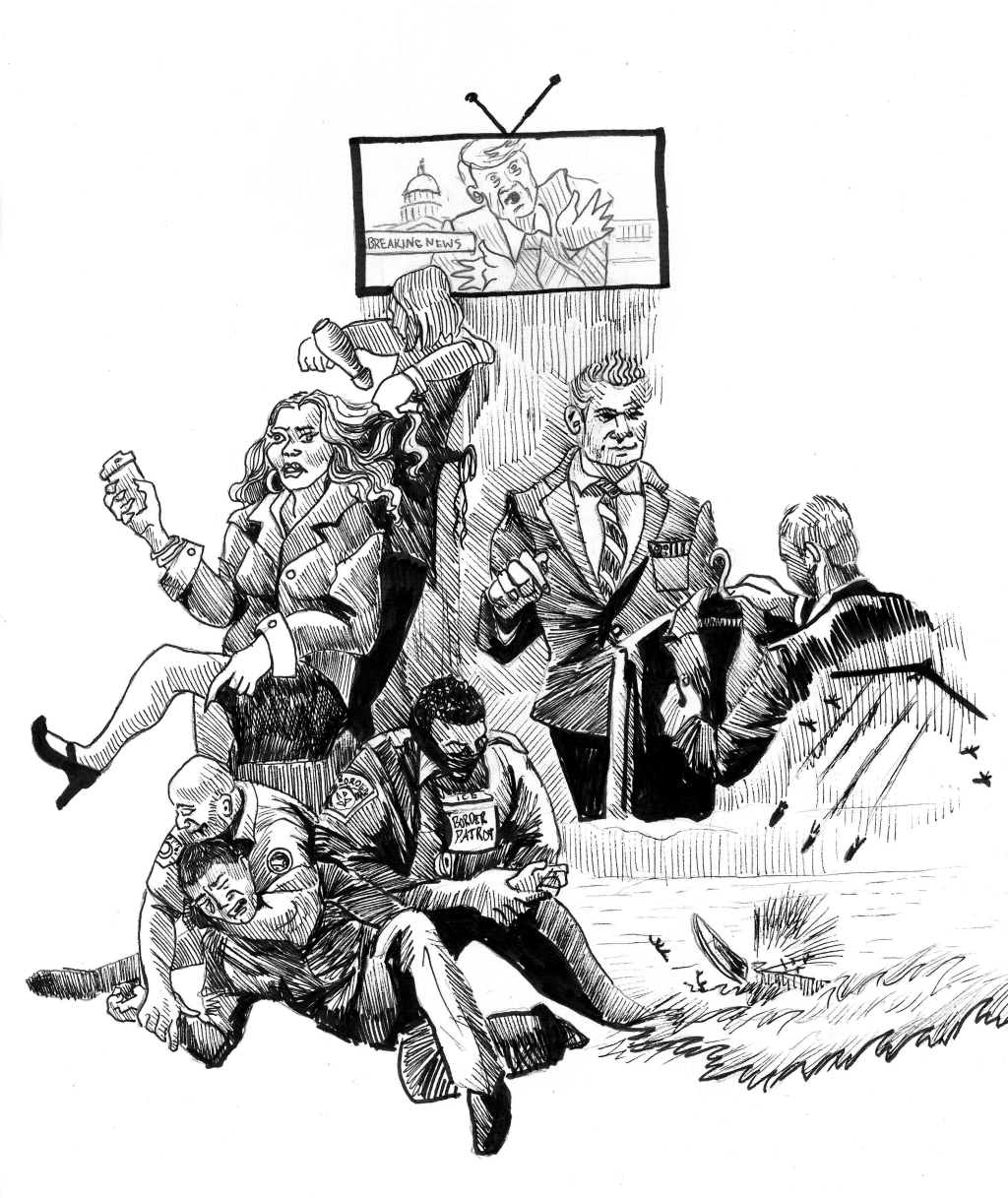
GATT editorial, January 2026
In its first year at the helm of state power, the second Trump administration has moved rapidly and decisively to reshape US politics, policy, and bourgeois class power by following through on the reactionary revanchist fantasies that got their star elected to the presidency a second time. The Trump administration has targeted its perceived enemies with defunding, witch hunts, discursive demonization, legal maneuvers, draconian repression, and a diversity of other tactics, steamrolling ahead with little meaningful opposition from the losing side of the 2024 election. The Bovino boys—ICE and Border Patrol agents, including many new recruits, eager to violently kidnap immigrants and brutalize anyone who gets in their way—have besieged several Democrat-run cities and, across the US, stalked their targets for detention and deportation. Funding for social welfare, and even the very agencies responsible for administering it, has been gutted, leaving tens of millions of people without food in the case of cuts to SNAP. Federal bureaucracies the Trump administration deemed part of an administrative state at odds with its mission have likewise been gutted. Colleges and universities face a renewed clampdown on dissent against US imperialism, especially its key role in the Gaza genocide, and strong-arm tactics to bend their politics, culture, and demographics to the executive branch’s will. The health and very existence of trans people are being subjected to legal and extra-legal moves with deadly implications.
We could go on describing the ways that the steamroller is crushing its targets, and each depraved attack on the masses by the current manifestation of bourgeois state power in command deserves and demands ruthless exposure and incisive analysis. However, our purpose in this editorial is to ask why and how this is happening. In contrast to the first Trump administration, which was beset by a revolving door of personnel, fraught with chaos in policy and organizational ability, blocked by institutional and administrative checks, and far more effective discursively than practically, the second Trump administration entered executive power ready to execute its agenda. It is stacked with loyalists eager to prove their worth (sycophants such as JD Vance, Pam Bondi, and Kristi Noem), driven in part by fascist ideologues (with Stephen Miller at the top of the list) given a largely free hand to pursue their depravity, and buttressed by capable, longtime political operators (Susie Wiles, for example) able to finesse the gears of state power and smooth out the implementation of policy. Trump and his closest confidants learned their lessons from their initial experience in government, and now know how to get their way.
But what is the “their way” they are determined to get? Is it the triumph of a reactionary set of policies that have been fought for and refined over decades, articulated in a document produced by right-wing think tanks called Project 2025? Is it a move toward fascism, with a suspension of bourgeois-democratic norms and the terroristic use of the repressive state apparatuses on far wider sections of society, and in far more open ways, than is normally the case in the US? Is it the narcissistic drive and dictator aspirations of Trump himself?
Those questions all point to parts of the answer, but other than the last one, they miss the more profane than profound ingredient that is, arguably, principal: the grifter style in American politics. From the proverbial snake-oil salesman to the millionaire podcaster conspiracy theorist, grifters have been a strong presence throughout US history. Westward expansion in the nineteenth century and the fortunes, small and large, that arose from Indigenous genocide, the plunder of the Earth’s riches, and rapid capitalist development gave grifters plenty of economic activity and wealth to sucker their targets out of. As the US rose to the position of top imperialist power in the world in the twentieth century, the financial (and, if we are being honest, literal) fattening of the US population with the spoils of imperialism created an even stronger material and ideological basis for grifting. A large segment of the population emerged whose paychecks were large enough to give some of their earnings to grifters, and who were stupified enough by American imperial culture for grifters to fool them out of their money.
When US capitalism-imperialism was in its ascendancy, grift was a key part of city political machines, often with kickbacks and corruption along white ethnic lines. But as running an empire abroad increasingly necessitated stability and institutional order at home, government corruption was curtailed and sometimes cracked down on harshly, even as it never disappeared entirely. The US bourgeoisie came to depend on and expect a government that served its collective class interests, not the narrow interests of a particular section of the bourgeoisie, a specific white ethnic group, or an individual politician and their friends. Elected officials and career government employees were allowed to advance their careers and standing by following the rules of the institutional order, and thrown out if they bent those rules to serve their own individual interests. The state power that cohered on the basis of this arrangement has proven robust and long-lasting, in contrast to countries where personal power ploys and tolerated corruption lead to states that fall along with their leaders.
A major shock to this arrangement was the revelations of President Nixon’s corrupt practices with the Watergate scandal—corrupt practices that served Nixon personally rather than bourgeois class power collectively. Nixon was impeached, and the US bourgeoisie spent the rest of the 1970s restoring institutional stability and public confidence in government. Yet the seeds for the grifter style in American politics had been sown before Nixon’s fall. Those seeds sprouted by feeding on what historian Richard Hofstadter labeled the paranoid style in American politics, with which sections of the US population were fed political hysteria to unite them against real or imagined enemies. The second Trump administration is the marriage of the grifter and paranoid style in American politics, with the former feeding off the latter and codifying its paranoia into state policy. While the paranoid style takes many forms and embraces different political persuasions, reactionary and revanchist outlooks have long proven more prone to paranoia, and, over the last several decades, have proven to be the outlooks most able to be monetized off of by grifters. If Trump can be crowned a king of anything, it is of grift, as he has demonstrated a unique ability to tap into and profit off of revanchist paranoia, fend off capture for corruption, and repeatedly fail upwards. What paved the way for his mastery of the grifter style?
The development of a style
The victories of the Civil Rights Movement in the early 1960s provoked a revanchist backlash from reactionary white sections of the population, who (irrationally but ardently) feared losing their power and privilege over Black and other oppressed people. The 1964 presidential campaign of Barry Goldwater sought to mobilize that reactionary sentiment. Though it failed to unseat Lyndon Johnson, Goldwater’s campaign moved the Republican Party in a decisively right-wing direction and, perhaps more importantly, birthed an important stylistic innovation in US politics. The Goldwater campaign harnessed lots of small donors, and grifter political operative Richard Viguerie obtained the list of these donors and started a business of soliciting them for donations to various campaigns and causes, using alarmist right-wing rhetoric, and taking a cut for himself. Viguerie went on to amassing lists of other likewise potential donors, soliciting donations from growing lists of like-minded reactionaries, and selling those lists to others. This became a lucrative business practice, and one that depended on amping up the donors’ paranoia about any real or perceived progressive changes in US politics.1 The grifter style promoted and profited from the paranoid style.
Mobilizing resentment among reactionary white voters against oppressed people and progressive politics became the modus operandus of the Republican Party from Goldwater’s campaign on, with a narrative of an America falling from grace (its glory days in the 1950s) due to rebellious Black people, women, and LGBT people asserting their rights, spoiled college students protesting the Vietnam war, immigrants eroding the white majority, the decline of Christian values, etc.. Whereas Presidents Ford and Carter represented attempts at appeasement between conflicting segments of the US population in the mid-to-late 1970s, some political operatives who viewed Nixon’s ouster as outrageous constituted themselves as the New Right and sought to amp up reactionary resentment. They did so by waging what Joe Conason calls “the permanent negative campaign,”2 using populist rhetoric while positioning themselves as lobbyists wielding donations, big and small, to impose their desired policies through the elected officials whose campaign coffers were filled with those donations. Among the New Right were Paul Manafort and Roger Stone, both of whom have done Donald Trump’s dirty work and enriched themselves through their shady political operations. Over the course of his career, Stone became “one of the highest-paid political consultants in the country, often sporting suits worth thousands of dollars and flashy jewelry.”3
The New Right and its efforts to mobilize revanchist resentment scored a victory with the election of Ronald Reagan to the presidency in 1980, in a campaign that promised to roll back the progressive gains of the 1960s. There were certainly true believers within the Reagan administration, though there was also rampant corruption, profiteering, and grift. This state of affairs was no surprise considering that the Reagan campaign was a product of the practice of duping donors out of money for reactionary political campaigns that paid the political operatives behind them well, in addition to the Reagan administration’s willingness to give the bourgeoisie whatever tax breaks, deregulation, and government contracts its members wanted.
Parallel with the political practice of duping donors out of money by mobilizing their reactionary fears was a similar modus operandus by Christian fundamentalist preachers. The evangelicals who voted overwhelmingly for Reagan also gave lots of money to the reactionary religious leaders who mobilized them as a voting bloc, not just through church donations but also as consumers of an emerging Christian fundamentalist media empire. The televangelists of the 1980s and 90s, such as Jerry Falwell, may or may not have been true believers in the reactionary poison they preached on broadcast, mail-order videos, and other media. They were rarely loyal practitioners of their professed worldview, with so many of them caught having extramarital affairs. They were, however, all grifters, amassing fortunes as Christian media moguls. Playing on the paranoia of conservative Christians who believed, or could easily be convinced, that the world was going to hell if the progressive changes of the 1960s were not rolled back proved immensely profitable. Even when their grifts were exposed, such as with the Falwell family’s scandal-ridden Liberty University, their religious credentials often kept them in the good graces of their (reactionary) godly followers, or enabled them to make comebacks with new profitable ventures.4
While preachers and political operatives increasingly practiced grift, profiting by mobilizing the reactionary paranoia and donations of their congregations and constituents, Republican elected officials remained somewhat above the fray of the grifter style throughout the 1980s and 90s and into the 2000s. They certainly pushed US politics in a reactionary direction and rewarded the sections of the bourgeoisie they served with policies that increased their profits, and the Bush administration exemplified the rolling door between the executive branch and business boards of directors (especially with regard to oil and energy companies) that has been a longstanding cornerstone of bourgeois class power in the US. But Republicans in Congress and in presidential power remained largely beholden to the bourgeois-democratic institutionalized stability that had served bourgeois power well throughout the twentieth century, even as they tested its limits at times.
That began to change when the Republican Party chose Sarah Palin as its candidate for Vice President in the 2008 election. Palin was beyond the pale of what was normally expected of candidates for high office, displaying an ignorance of and hostility towards political norms and historical fact, which played well with the revanchist petty-bourgeoisie that cohered as an ideological bloc after Obama won the 2008 election. While Palin did not ascend the government ladder, she did become an exceedingly successful political grifter, enriching herself through speaking engagements, her own Political Action Committee, and tapping into the rage of the Tea Party movement. As Conason sums up, Palin’s financial success after electoral defeat signaled “the commoditization of fame and the monetization of ideology.”5 The revanchist petty-bourgeoisie that constituted the social base of the Tea Party entered into a feedback loop with political figures—elected and otherwise—who amplified its reactionary fears and collected its money, whether through donations, media content, or other means.6
Where Palin failed to translate the grifter style in American politics into electoral power, Trump took the political establishment by storm in 2016, scoring an unexpected win first in the primary and then in the general election. His opponents thought his uncouth, grifter style would turn voters away from him, missing the fact that Trump had decades of experience as a successful grifter in business and mass culture. He was no stranger to shady business dealings and hiring the lawyers, such as Roy Cohn, that could orchestrate such dealings and protect their protagonist from prosecution.7 Trump’s real estate ventures may have largely failed, but they did teach him the art of getting away with failure. They also taught him how to shift to the next grift with no shortage of bravado, to reinvent himself by playing on public idiocy and get-rich fantasies. Trump’s 1987 book The Art of the Deal reinvented its supposed author as a savvy businessman who knows how to succeed, beginning a cult of personality subsequently cultivated through his hit reality TV show The Apprentice. The image of success was largely fictitious, as demonstrated by Trump’s real estate failures and bankruptcy, but in the me-first idolization of luxury that defines American culture, the image succeeded, popularly and financially. As Conason sums up, Trump’s “post-bankruptcy line of business involved licensing the use of his name on luxury buildings as a symbol of success and opulence.”8
One Trump business venture, Trump University, purported to train its students in its namesake’s entrepreneurial acumen, but proved to be a grift, with its former students launching a lawsuit after they realized they had been swindled. Despite his opponents in the Republican primary hammering him on the Trump University scandal at a February 2016 debate, Trump trounced these very opponents two weeks later on Super Tuesday.9 Whereas exposing a grifter trying to enter the political arena may have had the desired effect in decades past, by 2016, large sections of the population, from religious conservatives to Leftist protesters to anyone with Tom-Haverford-style delusions about becoming a mogul (and there are a lot of such people in the US), had come to embrace grifters and even worship at their feet, literally or figuratively (more on this problem below).
In these circumstances, Trump was ideally positioned to use his business experience—where he succeeded on the basis of branding and bullshit—and his longstanding finger on the pulse of reactionary revanchism (he had called on the Central Park Five to be executed; they were later exonerated) and distance from the failures of Republican politics (he did call the Iraq War a mistake) to successfully bring the grifter style into the apex of the electoral arena. Endorsements from his religious counterparts in the grifter style, such as Jerry Falwell Jr. and Paula White, added evangelicals and other fundamentalist Christians to his voting bloc, whose potential qualms with his sins were vanquished with his promises to deliver on their reactionary desires and the style with which he made such promises. As Conason puts it, Trump’s “unbridled pursuit of wealth, his showmanship, his disdain for government, and his propensity to make extravagant promises with no means or intention of fulfilling them all echoed the lifestyle of a top-tier prosperity preacher.”10
The grifter style comes to dominate American politics while failing to hold on to the executive branch
In the 2010s through the early 2020s, Trump was merely the most successful grifter, the one who gained the most political power and ability to monetize that political power, in a sea full of grifters. Or two seas, as the grifter style flourished not just among the right-wing crowd, but also among sections of the population out in the streets protesting police brutality and the oppression of Black people, the injustices perpetrated by the first Trump administration, and (later) the US-Israel genocidal war on Gaza. As we have analyzed,11 grifterism on the Left was the product of a new class, the postmodernist petty-bourgeoisie, constituting itself as an ideological bloc and fighting to advance its class interests via securing lucrative careers and monetizing its social justice credentials. Leftist and postmodernist grifters reached their apex of success in 2020–21, profiting off of the Summer 2020 rebellions and mass protests against police brutality and the oppression of Black people.
In comparison to Trump and right-wing grifters, Leftist and postmodernist grifters have faced far less public exposure, investigations, or lawsuits. While Trump’s book Art of the Deal is undoubtedly full of shit, is it any less full of shit than Robin DiAngelo’s White Fragility or Ibram X Kendi’s How To Be an Antiracist (bestsellers in 2020–21), Angela Davis’s abolitionist literature, or, for that matter, most postmodernist scholarship produced after the 1980s? Trump University and other right-wing shady businesses have been hit with lawsuits and dragged on liberal media, but the Black Lives Matter organization got away with swindling people out of hundreds of millions of dollars (if we include its leaders’ private income from speaking gigs and other efforts to monetize on their fame). That swindle provoked a mild-mannered exposé in New York magazine in January 2022, “The murky finances of Black Lives Matter,” and little other public rebuke. No donors have demanded their money back or filed lawsuits, and the Justice Department has yet to launch an investigation into BLM’s corruption, even under the second Trump administration. Unlike the not insignificant number of right-wing believers duped by Trump and his ilk who have spoken out against the grifts they fell for, virtually no one duped by Patrisse Cullors, Ibram X Kendi, Robin DiAngelo, Tamika Mallory, or Keeanga-Yamahtta Taylor has expressed their shame publicly or demanded repercussions for those that swindled them. Abolitionist politics continue to garner a cult-like following despite the fact that they are so obviously empty, with their only practical use being to funnel money into nonprofit organizations so that the grifters who run them can raise their salaries.
The grifter style’s success rests on getting people to suspend critical thinking and keep believing in what the grifter style is selling them even when it becomes so obviously bullshit and the grifters themselves are clearly so morally compromised. For example, in 2024, genocide apologism became common among today’s most alarmist anti-fascists in the liberal petty-bourgeoisie, who, when confronted with the Biden administration’s active sabotage of a ceasefire in Gaza and fascist repression against pro-Palestine protesters, offered excuse after excuse for Democrat genocidaires and quickly tried to turn the conversation to how much worse a second Trump administration would be on foreign policy. Democratic Party leadership has arguably been running a far greater blackmail scheme than Trump has ever pulled off, blackmailing millions of people who hate their policies to vote for their chosen candidates simply because they are not Trump or Trumpists.
Grifterism on the Left may not have sucked in many proletarians, the ones who are bearing the brunt of the social injustices Leftist grifters claim to be concerned about, as proletarians tend to have strong bullshit detectors. But absent a revolutionary movement with which the proletariat can assert its class interests, the grifter style on the Left went largely unchecked over the last decade, even if it does not have quite the same clout or success today as it did in 2020–21.
Trump’s first administration brought the grifter style into the White House, with cabinet officials spending lots of public funds on travel and luxury, in gaudy ways that broke with the norms and decorum of previous administrations.12 However, there were substantial checks on the grifter style going too far on an institutional level, with plenty of old-style personnel constituting a counterweight to the grifters, and Trump avoiding the most blatant uses of presidential power to enrich his family’s business ventures. Those guardrails have come off during his second administration, a subject we will return to below. But by the end of his first administration, Trump found himself increasingly isolated, having to depend on has-beens (Rudy Giuliani) and kooks (Jeffrey Clark) in failed attempts to get his way, culminating with the desperate effort to overturn the 2020 election results.
Nevertheless, the grifter style was consolidated in right-wing politics during the first Trump administration. Rising stars in congressional, state, and local elections owed their success to their ability to mobilize revanchist paranoia by making the most unhinged reactionary statements and basking in the fame it gave them—fame that could quickly be monetized. Those who came off as fake and forced in their adoption of the grifter style, such as Florida’s Ron DeSantis, failed to advance to the next level. As Jacob Silverman puts it, “If you’re going to be a bitter right-wing demagogue, you have to say it with your chest.”13
Trump administration officials who lost their executive branch jobs attempted to use their credentials and connections to profit by monetizing revanchist sentiment. For example, fascist ideologue and operative Steve Bannon was part of a crowd-funded campaign called “We Build the Wall” that built a tiny stretch of border wall while the campaign’s directors pocketed hundreds of thousands of dollars for themselves, laundering the money through their right-wing political platforms. Bannon was indicted in August 2020 for this grift, but pre-emptively pardoned by Trump and then staged a comeback as a reactionary media figure well-connected to political players in Washington DC. Trump’s own post-2020 election political and business ventures (or, better put, political/business ventures), from TRUTH Social to the Save America PAC, cashed in on his presidency for himself, his family, and his friends by channeling revanchist sentiment into consumerism, media consumption, and political donations. (The tons of money raised by Save America has never been accounted for and seems to have been used mainly to pay Trump and his fellow grifters’ legal fees and enrich Trump loyalists rather than serve its political mission.)14
Beyond administration personnel, the grifter style proliferated by way of right-wing podcasters and media personalities, fascist kitch consumerism, and nonprofit organizations that raked in millions in donations. The podcaster has become the DIY grift par excellence for the present-day, allowing for those adept at speaking to and amping up revanchist paranoia to build their own mini-media empires, which exist in a larger eco-system where right-wing grifters can go from government official to well-paid FOX News commentator and vice versa. On the nonprofit end, Turning Point USA enabled its founder, Charlie Kirk, to rise into the ranks of the lower bourgeoisie by way of articulately if detestably setting Christian fundamentalist ideology against Gen Z progressive values. Turning Point USA raised around a quarter-billion dollars in its first seven years, making Kirk a millionaire living in a mansion before his well-deserved assassination.15
The larger point here is not to minimize the political poison peddled by reactionary grifters like Bannon or Kirk, which has real material effects in the world and helps to cohere a revanchist social base. However, we have to recognize that climbing the class ladder is just as much a part of these people’s motivations as is enacting the reactionary politics they articulate, which they may or may not entirely believe in. Above all, it is mastery of the grifter style that allows right-wing ideologues and political operators to succeed in today’s America, Their taste of success over the last decade has encouraged the rise of a grifter wannabe bourgeoisie that understands that political power in service of revanchist policies is their best ticket to wealth, which can then become the capital needed to put them in the ranks of the bourgeoisie proper. Ascending to that position requires knocking down—at least in the domain of public opinion and political power, if not capital accumulation—the liberal bourgeoisie and its political representatives that stand in the way of the revanchist policies that right-wing grifters use to climb the class ladder. However, since the grifter wannabe bourgeoisie needs to challenge established bourgeois-democratic norms and institutions to succeed, and does not possess the capital itself to fund its operations, it requires the support of a section of monopoly capital and an expansion of the means to grift off of the paranoid style.
The most reactionary section of monopoly capital today puts their money and media behind the grifter style
Trump faced two dramatic losses of political power in January 2021: having to leave the White House and getting banned from Twitter. As a loss of political power, the latter was arguably a very close second to the former.
If we understand Trump’s motivations as more profane than profound, more financial than fascist, then his expert use of Twitter to whip up revanchist resentment (among his followers) and enrage his opponents—both of which generate lots of attention, which is really the point—is perhaps his greatest asset. Denying him his platform of choice—which he frequently used to dictate policy during his first administration, often to the surprise of many administration personnel—was a bigger cramp on his grifter style than was losing the 2020 election, as he could at least grift off of an election loss by saying it was stolen (he literally raised lots of money that way for his Save America PAC). Being banned from Twitter not only diminished Trump’s ability to determine the discourse, but also threatened his potential to stage a comeback. Furthermore, how was he to easily monetize on his following without hundreds of millions of Twitter followers?
The decision to ban Trump from Twitter and other social media platforms was indicative of where most of the tech capital bourgeoisie stood politically in 2020–21. For decades, tech capitalists had generally leaned liberal, supporting Democrats with donations from their base of operations in Silicon Valley, in the Democrats’ golden state of California. On a personal level, most of them embraced liberal social values, such as tolerance for LGBT people and concern for ecological devastation. Tech capital pioneers Steve Jobs and Bill Gates liked to imagine the role of their industry in utopian, altruistic terms, imagining the technology they were producing (via sweatshops in Asia) as paving the way to a future of equal access to information and technologically-driven solutions to human suffering.
Tech capitalists’ liberal leanings, however, did not stop their leading luminaries from attending a meeting at Trump Tower with the then president-elect on December 14, 2016, brokered by their reactionary renegade Peter Thiel (more on him below).16 A brief if uneasy bromance between tech CEOs and the first Trump administration ensued, but became a rocky relationship due to the latter’s unpredictable behavior, which violated what the monopoly capitalist class expects the federal government to provide: smooth sailing for profit-making. In 2020–21, tech capital by and large got on board with the postmodernist and Leftist side of the grifter style, donning “Black Lives Matter” and other woke slogans on their platforms, doing diversity trainings in their companies (that paid Robin DiAngelo well), and making donations to grifters (for example, former Twitter CEO Jack Dorsey showered Ibram X Kendi with $10 million). More existentially, tech capitalists, along with the overwhelming majority of the US bourgeoisie, worried that Trump’s erratic policy moves and self-serving actions, and the chaos that defined his first administration, would, if allowed to continue, only lead to further instability for their capital accumulation. So they by and large backed Biden, a decades-long steady steward of bourgeois class interests, for president.
Beneath the surface of woke posturing and conjunctural concern for the stable conditions of capital accumulation, however, tech capital was becoming increasingly structurally positioned to morph into the most reactionary section of monopoly capital. We use that last phrase a bit jokingly given its misuse in the late 1930s by communist parties during the Comintern’s United Front Against Fascism period.17 Those Comintern parties identified a reactionary section of monopoly capital aligned with fascism and a progressive, antifascist section, and sided with the latter against the former, sacrificing communist principles and revolutionary objectives in the process. Joking aside, especially at moments of transition in the global capitalist system, some segments of monopoly capital and the bourgeois individuals that command that capital do come to play an outsized role in pushing state power and society in more reactionary directions. Beginning around 2022, tech capital and tech capitalists decisively moved into that role.
What led to that move was both structural (decades in the making) and conjunctural (a reading of how their class interests would best be served in the present moment). On the structural end are several factors, beginning with increasing links to government defense and intelligence contracts. As state security and the wars of the last two decades have increasingly demonstrated (think of Israel’s high-tech guided murderous and genocidal actions in Gaza, Lebanon, and elsewhere or Ukraine’s resistance to Russian invasion), and as US imperial rivalry with China suggests, the ability to quickly adapt new technology for military and intelligence use is crucial for imperial hegemony. Both bourgeois governments and tech capitalists recognize this fact and have increasingly formed a symbiotic relationship around it. The Bush administration relied on telecom and tech companies to facilitate and engineer its massive expansion of surveillance, and then granted those companies immunity for their roles in helping with warrantless wiretapping. The Obama administration created a revolving door between tech capitalists and security state positions, with Google’s Eric Schmidt finessing and cashing in on the arrangement. As Jacob Silverman describes, “Schmidt represented a Silicon Valley variant of an increasingly prominent type: the politically connected defense contractor, comfortable with the broad exercise of US power, seeking to form deeper relationships between tech startups and the security state.”18
In other words, for tech capital, US imperialist domination of the globe, and the murderous and genocidal actions that domination depends on, is a deeply profitable endeavor, and one that guarantees lucrative and steady government contracts less beholden to the ups and downs of the market. Furthermore, maintaining US military and intelligence agencies’ edge over potential rivals and opponents of US imperial hegemony is necessary for US-based tech capital to remain in its position of global preeminence. Consequently, tech capitalists have increasingly eschewed their purported discomfort with state surveillance, even turning their surveillance capabilities against their own employees, especially to purge their ranks of opposition to the US-Israel genocidal war on Gaza, throwing performative wokeness to the wind in the process.19 The most reactionary expression of this trend is the company Palantir, which “catalyzed a consequential shift in Silicon Valley culture and investment: working on behalf of an intelligence agency or an illiberal foreign ally like Israel was no longer something forbidden or done quietly.”20 What Palantir did out loud welcomed well-established tech companies and new startups to embrace what was already well underway.
Where the tech capital/defense and intelligence government contract nexus differs from the post-WWII military-industrial complex is in its degree of material production. The latter built weaponry and employed large numbers of skilled factory workers. The former builds some things (drones and microchips, for example), but focuses much more on software than hardware, such as boosting surveillance capabilities via programming that can spy on and target populations and individuals in the US military’s crosshairs.
Even more removed from production is tech capital’s most well-known creations: social media companies. Their means of profit-making are highly parasitic, relying on algorithm-targeted advertising by other, usually more productive, companies (essentially taking a cut of those companies’ profits) and by mining and selling user data. Their claim to produce a public good is that social media platforms provide users with a means of free expression and social connection, democratizing the world through connectivity. Unfortunately, many people on the right side of protests against injustice believed and promoted this claim in the 2010s, buying and feeding into tech capital propaganda that credited social media platforms with strengthening or even creating protest movements such as the Arab Spring and Occupy Wall Street.
In reality, whatever tactical benefits social media platforms maybe (emphasis on maybe) have provided for rapid mass mobilizations, their ideological, political, social, and cultural role has been overwhelmingly reactionary. These platforms have proliferated a culture of self-obsession, self-commodification (especially in regard to young women’s bodies and sexualities), self-isolation, and social alienation. They have vastly diminished information literacy and basic critical thinking skills by shortening people’s attention spans and forcing content to fit within forms that render well-reasoned argumentation over ideas next to impossible. And, of course, social media platforms can be engineered to bolster some political views and ways of thinking over others, as we shall return to below. Ideologically, social media facilitates commodity relations par excellence, with the illusion that users are free to shape their world outlook by picking from a plethora of content, rather than algorithmically steered towards dominant outlooks in a process they are oblivious to. In short, social media platforms have created the most brainwashed populations ever in human existence—ones who proactively participate in producing their own brainwashing.21
While we could go on to enumerate the reactionary effects of social media companies on people’s thinking and culture, for the purposes of this editorial, two conclusions about tech capital’s monstrous creations stand out. (1) By making social media platforms a successful mode of capital accumulation, tech capital moved in an extremely parasitic direction, distant from material production or providing anything that could be deemed a public good. Furthermore, the platforms themselves became a means to facilitate participatory parasitism via a new, completely vapid and parasitic profession: the influencer. (2) Social media platforms constituted the crucial technological innovation for the rise and dominance of the grifter style in American politics. They were the perfect means for grifters to foment and monetize on the paranoid style, with reactionary revanchist resentment ultimately proving the best paranoia to profit from. It is hard to imagine the rise of Trump and his ilk without the rise of social media.
Like social media, other highly lucrative tech capital innovations profit through highly parasitic mechanisms, exemplified by the new gig work economy. As Silverman sums up, “gig work, built on the backs of precarious laborers summoned by app, introduced new conveniences for the consumer class”22 while viciously exploiting those who provided the conveniences and undermining the small businesses engaged in actual production. Amazon provided the model for creating a tech platform that profited from production and sale by others, and used the vast capital it accumulated through parasitic means to build a global empire of production and distribution that combined old-style vertical integration with new-style outsourced horizontal commercialism. More recently successful brands, such as Uber and Lyft or DoorDash, went from startups to monopolies by staying out of production or even much in the way of formal employment, in a method of capital accumulation that could be called exploitation by way of app.
The boom in tech capital profits over the last two decades was enabled in part by the era of so-called zero interest-rate policy (ZIRP), where, in response to the 2008 financial crisis and lasting into the Biden administration (with ups and downs along the way), interest rates were set so low by the federal government that tech startups could secure the investments that enabled them to join the ranks of monopoly capital firms. Facilitating and profiting massively from this process were tech-capitalists-turned-venture-capitalists. Essentially, these are individuals who created, or got in on the ground floor of, a successful tech firm startup, accumulated lots of wealth from that startup’s success, often by selling their startup to a larger capitalist, and then turned their wealth into venture capital by investing in new startups and profiting from their success. These tech/venture capitalists fancy their billionaire status as the product of the supposed innovative genius behind their initial startup success and then their genius in spotting and investing in other geniuses, breeding a highly narcissistic class outlook. While many of them put on woke rhetoric and diversity initiatives in 2020–21, they are overwhelmingly white men.23
Unlike previous rounds of monopoly capital accumulation in the US, especially in the post-WWII period, the last several decades of tech/venture capital accumulation has produced little to nothing that could be considered a public good. Post-WWII industrial capital accumulation funded and facilitated massive infrastructure building and employed a vast, well-paid working class. By contrast, public infrastructure has been crumbling in the US since the 1970s, and tech capital’s data centers suck power from the public grid, raise energy bills for the population, and add pollution to the environment. Manufacturing jobs created by tech capital are largely low-wage positions in Asia, with app-work in the US sinking growing sections of the population into poverty and precarity, without the steady paycheck and benefits of mid-century factory employment. Even the relatively small number of highly-paid petty-bourgeois professionals working as programmers and experts for tech companies are now starting to be replaced with Artificial Intelligence, and they have been disciplined and punished by their employers for attempts to speak out against their companies’ support for the genocide in Gaza and other atrocities. Even when it comes to donating a small portion of their profits to charity, tech/venture capitalists are faring far worse than prior generations of monopoly capitalists, or even pioneers in their industry such as Steve Jobs and Bill Gates. Previous incarnations of the monopoly capitalist class, such as the Carnegies and the Rockefellers, “built libraries, museums, and universities,” whereas today’s tech/venture capitalists “build political and media operations designed to propagate their influence.”24
Propagating their influence, on public opinion in general and on the exercise of state power in particular, has become increasingly important to secure the monopoly position of tech capital against challenges to its means of exploitation. Social media companies have lobbied, waged public relations campaigns, and fought back against attempts at government regulation over their harmful effects on public health and well-being and over geopolitical concerns, and largely successfully. For example, Jeffrey Yass, the richest man in Pennsylvania and a massive Republican donor with a large financial stake in TikTok, managed to get the second Trump administration to walk back moves to ban the app in the US in the name of rivalry with China—a ban that would have hurt Yass’s profits.25 Tech companies involved in material production and transportation, most notably Amazon and Tesla, have fought ardently against unionization efforts among their workers. And the capitalists at the helm of gig-work apps have worked to sabotage any attempt to force them to treat the app-workers they exploit as formal employees entitled to benefits and a minimum wage. An example of such class warfare was the 2020 passage, by way of a tech-capital-funded PR campaign, of California’s Prop 22, which classified exploited-by-app rideshare and delivery drivers as independent contractors, in opposition to attempts by state legislators to grant them employee status and the collective rights that go with that status. Tech capital’s parasitic position depends on a regime of precarious, outsourced employment in which the exploited lack collective organization, enforced legally and repressively by state power.
While tech capitalists have always been quick to assert their right to exploit and profit within their lanes of economic activity, they have also, increasingly, made broader claims to a godlike position to determine the political, economic, social, and cultural direction of society. Steve Jobs and Bill Gates had their utopian liberal version of these broader claims, which dominated the class outlook of tech capitalists until relatively recently. However, a reactionary version of the godlike position and right of tech capital to reshape the world coexisted with the liberal Jobs/Gates version at least since the 1990s. Tech/venture capitalists Peter Thiel and David Sacks began promoting reactionary revanchism as students at Stanford University, and then cultivated a growing if minority section of tech capitalists with vitriolic hatred for the liberal bourgeois order under the Democratic Party. They donated heavily to Republican candidates and funded the dissemination of their views while making close connections within the inner circles of reactionaries in government, jumping on board the Trump train when it demonstrated the possibility of realizing their reactionary vision.
Around 2022, venture/tech capitalists began turning their backs on the Democratic Party and joining Thiel and Sacks in demanding that state power stop attempting to regulate their ability to make profit and stop providing social welfare for or paying lip service to the concerns of the exploited and oppressed in society. Their principal point of unity was over economic policy. The zero interest-rate policy that had facilitated their fortunes came to an end under the Biden administration, tanking the burgeoning cryptocurrency industry that relied on asset bubbles created by investment in fictitious money. The venture capitalists who relied on low interest rates to throw money at tech startups found their method of capital accumulation operating at diminished capacity. “In 2021, US venture capitalists announced about $345 billion in investments; the number dropped to $242 billion in 2022 and $170.6 billion in 2023.” Federal Trade Commission Chair Lina Khan became a thorn in the consolidation of tech/venture monopoly capital to higher levels when she struck down major venture capitalist business deals, earning the ire of their class. The Biden administration’s comparatively more union-friendly governance likewise worried the tech/venture capital bourgeoisie, who had grown accustomed, under previous administrations, to suppressing unionization efforts or even formal employment contracts for those they exploited. Investments in Artificial Intelligence (AI) totaling hundreds of billions of dollars, accompanied by no shortage of dystopian, Skynet-esque dreams by the tech bourgeoisie, provoked the next tech bubble by 2024 after the cryptocurrency one had burst. But the the Biden administration had not lavished AI companies with the government contracts they needed to sustain the bubble, which became a graver concern when AI products failed to do all that well on the market. Moreover, and moving into the second Trump administration, China began to demonstrate the potential to beat US AI companies at their game by developing the capacity to produce microchips and with the release of DeepSeek.26
Where concerns for the conditions of capital accumulation moved the monopoly tech/venture capitalist class as a whole against the Biden administration and looking for a presidential candidate who would better secure their class interests, a conscious reactionary political turn over the direction of US society pushed that class toward supporting Trump’s 2024 candidacy. Tech/venture capitalists began advocating a revanchist class war against the dispossessed and precarious sections of the proletariat they had played an outsized role in augmenting. Growing homeless populations and the (real or imagined) deteriorating quality of life in cities became the principal targets of this class war, with the tech bourgeoisie’s historic haven of San Francisco as its scapegoat. Some tech/venture capitalists publicly and performatively fled the Bay Area for Austin or Miami, where, especially in the latter, they could avoid paying income, capital gains, wealth, and real estate taxes, with Denver as a third destination of choice (apparently proximity to hipster culture in Denver or Austin was worth paying more taxes than they would have in Miami for some). But these members of the bourgeoisie were not content with self-banishment from San Francisco. They poured money into anti-homeless ballot initiatives and local candidates, using lobbyists and nonprofits to advance their anti-masses agenda in San Francisco and Austin (the Lonsdale-funded Save Austin Now bill, for example). They joined with a larger wave of anti-homeless legislation and repression that received Supreme Court backing, carried out enthusiastically by liberal Democrats such as California’s Governor Gavin Newsom, who personally took part in dismantling homeless encampments and trashing homeless people’s belongings, and San Francisco’s Mayor London Breed. The latter was nevertheless not reactionary enough in her assault on homeless people for the tech/venture capital crowd, who backed Levi Strauss heir (you can’t make this shit up!) Daniel Lucrie’s successful 2024 campaign to unseat her.27
Tech/venture capital’s class war against the homeless and precarious sections of the proletariat became part of a more encompassing reactionary politics under the signboard of opposing “wokeness.” Trans rights, immigrants, COVID restrictions, assertions of Black humanity, critique of US imperialist foreign policy, basic dignity for oppressed people, and other perceived maladies took the blame for the tech/venture capitalists’ perception of an America in decline, echoing the rhetoric that brought Trump to power in 2016. Tech capitalists also had growing ire for government bureaucracies they perceived as threats to (via regulation) and drains on (via the taxes that funded them) their capital accumulation. The professional experts that staffed these bureaucracies, as well as the ones that staffed companies, nonprofits, and public institutions performing public goods (such as healthcare and education), became another class to get out of the way of tech capital accumulation.
The success of tech capital’s parasitism and the narcissism of tech capitalists imagining themselves to be innovative geniuses became justifications for tech capital’s rapacious entrance into various spheres of productive and economic activity, especially ones purporting to provide a public good, and displacing the experts at their helm. Deriding existing expertise in these spheres “provided broad rhetorical and ideological cover for tech moguls to refashion any industry in their image, from taxis to healthcare to real estate to the entire federal government. This worldview upheld the pretense that creative destruction and technological innovation were synonymous with progress.”28 Beginning around 2022, the increasingly arrogant imperatives of tech/venture capitalists began to coalesce into a political program, albeit with varying degrees of unity among individual members their class, and a search for the presidential candidate to carry it out.
The initial search for the right candidate came up short, with Ron DeSantis’s campaign announcement on Twitter turning into an embarrassment due to technical problems (the tech bourgeoisie’s technology isn’t all it’s cracked up to be) and DeSantis’s overly forced effort to play the part of revanchist politician. One of the tech bourgeoisie’s own, Vivek Ramaswamy, entered the race, but more to build his brand than with the expectation of winning the Republican nomination (an aspect of the grifter style in American politics). Despite these duds, tech/venture capital’s search for its candidate animated the primary by way of Elon Musk, who had an about-face on ecological concerns and any liberal political views he once held and took the torch from Thiel to advance tech capital’s reactionary political program. Buying Twitter, rebranding it as X, and re-engineering it into a platform to promote revanchist politics in the grifter style was a brilliant move by Musk to shape the outcome of the 2024 election, even if it was not a smart business decision (apparently the tech bourgeoisie are not the entrepreneurial geniuses they imagine themselves to be). Musk might be one of the most unlikable human beings on the planet, going back well before his reactionary turn around 2022, but he “had spent years building up a cult of personality that projected an image of himself as a swaggering entrepreneur.”29 He knew how to play the part of reactionary cheerleader well and had the money and following to do so.
Settling on Trump as their candidate of choice was in part a fait accompli presented to the tech/venture bourgeoisie when Trump’s mastery of the grifter style, and his welcome back to Twitter (now X), enabled him to trounce other Republican hopefuls whose revanchist rhetoric just could not captivate reactionary paranoia like his could. Reading the tea leaves of class power, Trump gave the tech/venture capital bourgeoisie what they desired in policy promises and access to his administration upon victory. He publicly embraced Musk and his $288 million in campaign contributions and guaranteed him a position slashing the government agencies and employees that the tech/venture capital bourgeoisie viewed as impediments to their profit-making. Musk and his class compatriots would not have to worry about the government investigations and regulations on their businesses that were piling up under the Biden administration, and looked forward to lucrative government contracts, especially in the realms of AI, microchip manufacturing, and tech-defense. Tech capital’s bastard stepchild, the fledgling cryptocurrency industry, wounded by the arrest and conviction of its grifter wunderkind Samuel Bankman-Fried, was promised a comeback free from obtrusive government investigations and regulations when Trump spoke at the annual Bitcoin conference in July 2024. Crowning tech/venture capital’s embrace of Trump was his pick for Vice President, JD Vance, who had been brought into the venture capitalist world by Peter Thiel and had changed his ideology and politics to fit with Thiel’s (whether for the payoff or out of genuine belief is a question mark, as Vance’s own grifter style is to articulate whatever politics advance his career). With one of their own slated for the number two spot in a second Trump administration, the tech/venture capital crowd could rest assured that their class interests would be staunchly advanced.30
All electoral campaigns in the US operate on the premise that wealthy donors give to candidates they expect to facilitate smooth conditions for their future capital accumulation. Trump’s 2024 campaign and the support it received from tech/venture capital, in donations and also in making social media platforms become arms of the campaign, went beyond the norms of this premise to a blatant embrace of the grifter style. Top donors were essentially promised they would get what they want and have personal access to the administration and the ability to dictate policy in their lane of economic activity. Musk running DOGE with Ramaswamy as its number two and running over federal agencies was just the overarching, most blatant expression of that arrangement, which also included making David Sacks the second Trump administration’s point-person to facilitate the success of AI and cryptocurrency companies and using Andreesen Horowitz firm personnel to staff the administration.31 Another player in the grifter game was the Middle East oil-rentier bourgeoisie, especially its Saudi contingent, which invested its surplus capital in US tech companies and Trump family ventures and whose Prince Mohammed bin Salman received a royal welcome at the White House and forgiveness for any sins of respectable bourgeois governance (such as murdering journalist Jamal Khashoggi) in return.32
Certainly economically but also to some degree ideologically and politically, to the extent there is a coherent program being pursued by the second Trump administration, it is at minimum deeply responsive to the interests of the most reactionary section of monopoly capital today, if not informed or even dictated by the tech/venture capital bourgeoisie. Even that class’s more politically liberal members, such as Mark Zuckerberg and Jeff Bezos, welcomed the second Trump administration and showered its inauguration with donations and their presence.
Given its extremely parasitic modes of capital accumulation, nexus with imperialist war-making and surveillance-state capabilities, role in reshaping the social fabric in a reactionary direction, and facilitation of revanchist politics in state power, the tech/venture capital bourgeoisie stands as a primary class enemy of the international proletariat, and one eager to dispose of proletarians it cannot usefully exploit. Consequently, we suggest that our readers study the rise and modus operandus of this class, via books such as Jacob Silverman’s Gilded Rage: Elon Musk and the Radicalization of Silicon Valley, Margaret O’Hara’s The Code: Silicon Valley and the Remaking of America, and Gil Duran’s forthcoming The Nerd Reich: Silicon Valley and the War on Democracy. Beyond getting to know our enemies better, such study should lead to strategizing ways to make the tech/venture capital bourgeoisie targets of class struggle by exposing their rapacious exploitation and reactionary designs to the masses and mobilizing the masses against their business operations and against them as individuals.
In understanding this class enemy, we have to put it in a larger matrix of reactionary politics within the US, a facilitator and profiteer off of the grifter style but not its trend-setter. The tech/venture capital bourgeoisie is just too out of touch with people who are not billionaires and their friends and too unlikable as individuals to captivate a mass political following for their class (exhibit A: JD Vance). To get around that problem, they turned to a rising grifter wannabe bourgeoisie to seize state power and authentically speak to revanchist sentiment.
The wannabe grifter bourgeoisie seizes state power
Trump had long been an outsider to “respectable” bourgeois circles, too brash, uncouth, and gaudy to fit in among people who had no anxieties about their place as top exploiters in the global order and no need to publicly flaunt their positions.33 Psychologically, rejection from mainstream bourgeois circles fueled a revanchist desire to outdo and exercise power over those circles, which Trump pulled off via using the grifter style to ascend to the presidency. Whereas his revanchist desires against the liberal bourgeoisie in particular and aim at upsetting the functioning of bourgeois power in general were substantially thwarted during his first administration, his second administration has been stacked with officials who share Trump’s specific revanchist desires and seek to emulate his grifter style and use of political power for upward class mobility. Enter the grifter wannabe bourgeoisie.
Prior to the 2024 elections, those who joined the second Trump administration spent their time auditioning, Apprentice-style, their ability to use revanchist rhetoric to bolster their fame and/or finances and put down their opponents. For example, Kash Patel worked the right-wing podcast circuit, Pete Hegseth was as a reactionary commentator for FOX News, and Elise Stefanik led Congressional hearings in which she belligerently attacked university presidents for not cracking down harshly enough on pro-Palestine, anti-genocide student protesters (Stefanik passed her initial audition but did not make the final cut). In short, they proved their ability to use the paranoid style in service of the grifter style. Ability to govern in the traditional way and professional credentials were inconsequential to their job prospects in a second Trump administration, which could count on some Project 2025-types and senators willing to go along with the program to the extent it needs their professionalized capabilities.
Once in the administration, members of the grifter wannabe bourgeoisie have made it their right to raid state coffers to live lavish, whether Kash Patel visiting his B-list country singer girlfriend in FBI-provided private jets and using an FBI swat team as her security detail or Kristi Noem similarly spending DHS funds to fly around and play the part of fascist Barbie (after previously using her South Dakota governorship to deck her governor’s mansion in gaudy luxury). Top Trump administration officials get to live bourgeois lifestyles by virtue of political appointment, and their aim is to further profit on their proximity to political power in the future, whether by becoming media personalities (on FOX News or podcasts) or through business ventures. Their sycophantism to Trump is The Apprentice come to the White House, where its power broker elevates up the class ladder those that prove their worth.
The grifter practices and the gaudy image of trashy luxury—from Hegseth’s corny-looking game show host suits to Noem’s hideous makeup34—have earned the ire of the liberal bourgeoisie and petty-bourgeoisie, who are outraged that these people have become the face of US imperialism. The liberal bourgeoisie’s outrage is that these people do not know their place. That is why it is absolutely essential for the grifter wannabe bourgeoisie to adopt a brazenly combative style, to hit back hard against any criticism of their use of power, to double down on their nonsensical narratives, and to put their critics, especially those in bourgeois class and political circles, down when they dare challenge them. Every distortion of reality and absurd defense of Trump administration policies by White House press secretary Karoline Leavitt is a defense of the grifter wanna bourgeoisie’s class aspirations, which, to be realized, require utter arrogance to make up for their unearned (by traditional bourgeois standards) positions and steamrolling over all in their way.
The fascistic policies that the grifter wannabe bourgeoisie pushes and the revanchist rhetoric they take to ridiculous extremes are, substantially, a performance, a bid to cash in on the paranoid style by proving they can put its poisonous implications into practice. There are true believers in those fascistic policies among them, perhaps most of all Stephen Miller, who, since high school, has pursued an American final solution to ensure an overwhelming white majority. It is Miller who has been pushing the immigration enforcement apparatus to apprehend as many non-white immigrants as possible and break legal barriers to do so, such as normalizing racial profiling. However, most Trump administration officials, whatever they personally believe, are doing fascism for the ‘gram.
The duality of performative and real fascistic measures comes into sharp focus when we look at the leading edge of revanchism as policy: the brutal, terroristic crackdown on immigrants by the Bovino boys. Border Patrol agent Gregory Bovino was selected by the Trump administration to be the public figure at the helm of this crackdown precisely because he had gotten into a public spat with the Biden administration over his attempts to go beyond the limits that administration put on repressive state power against immigrants and, more importantly, because he had curated a public image of himself doing just that. From late 2024 to early 2025, Bovino made sure to publicly antagonize Trump’s opponents, behavior that moved him up the ranks to the position of “commander-at-large.” It is not a Nazi high command selecting the best SS officers for rank promotion, but auditions to be on The Apprentice series two: electric boogaloo, the state power edition.
Since Bovino’s elevation to belligerent wannabe tough guy leading fascistic assaults on immigrants in Democrat-run cities, he has made sure to make media appearances cosplaying as an SS officer and throwing tear gas canisters at protesters in defiance of court orders (hitting back at liberal bourgeois authority on behalf of the entire grifter wannabe bourgeoisie). More effort seems to be put into making videos for social media of high-profile immigration raids—for example, the one that showed federal agents in HD descending from helicopter onto a Chicago apartment building where some Venezuelan immigrants resided and kicking in doors, trashing apartments, and kidnapping people—than planning the raids themselves. Underscoring that point is the fact that right-wing social media influencers are routinely embedded in the Bovino boys’ operations, building their brand in the grifter style while celebrating the kidnapping of immigrants and the brutalizing of protesters online.
That is not to say that the Bovino boys’ reign of terror is just for show—it is also real terror brutalizing real people, particularly the immigrant proletariat and, increasingly, protesters who get in the way of the Bovino boys, even in mild, perfectly legal, liberal petty-bourgeois ways. As ICE agent Jonathan Ross’s murder of Renee Good demonstrates, unlike members of other law enforcement agencies, the Bovino boys extend state-sanctioned murder to middle-aged, white, petty-bourgeois women (beyond the fairly widespread practice of such women who happen to be married to cops being murdered by their husbands). The display of terror is very much the point. And that display is also a recruitment drive to find the men looking for a well-paying job where they get to beat up, kidnap, torture, and even murder people, whether because they are committed to a revanchist outlook or just want to pursue their bully fantasies against whoever they can after being rejected by or flaming out from the police or the military.
Like the grifter wannabe bourgeoisie in the presidential administration, new recruits to ICE get to fail upwards and make far more money than they could in any other career path. The appropriate historical analogy for mid-2020s America is less to Nazi Germany and more to the Sforzas’ seizure of power in fifteenth-century Milan (even there the analogy is strained by the Sforzas’ professional military capabilities, though not by their embrace of conspicuous luxury as proof of upward class mobility). The Bovino boys stalking the streets of Democrat-run cities in immigration enforcement surges lack the professional ability and collective discipline that defined fascist state power in Nazi Germany, and they would probably be incapable of conducting an efficient genocide. But they are good at cosplaying as fascist storm troopers and using official encouragement and little checks on their actions to violently deliver on the revanchism against immigrants that won Trump the White House in 2024.
Immigrants are the immediate targets of deployments of the Bovino boys to Democrat-run cities, and for fascist ideologues like Miller, these deployments serve the strategic objective of ethnic cleansing, making America more white by way of mass deportation. However, another crucial strategic objective that serves the class interests of the grifter wannabe bourgeoisie is the challenge to liberal bourgeois governance by way of the Bovino Boys running roughshod over the authority of Democrat mayors and governors. As those mayors and governors have failed to assert their authority in any practical way, and as any attempts to deploy local and state law enforcement agencies against the Bovino boys would almost certainly be met with refusal by the footsoldiers of those agencies, the grifter wannabe bourgeoisie’s strategy of knocking down liberal bourgeois governance has proven effective. California’s Governor Newsom and Minneapolis’s Mayor Frey can talk all the shit they want, but the second Trump administration keeps upping the ante (threatening criminal investigations against Frey and Governor Walz, for example) and largely getting their way, with judges’ orders against particular actions by the Bovino boys either ignored or coming too late to matter. Moreover, it must be said that the Biden administration could have easily prevented all this terror from happening if they had aggressively prosecuted and punished Trump and his co-conspirators for their comical attempts to overturn the 2020 election results—something Attorney General Merrick Garland in particular refused to pursue with any teeth.35
To reiterate, the deployment of state power against the liberal bourgeoisie and its political representatives is absolutely necessary for the grifter wannabe bourgeoisie to pursue its narrow class interests by knocking down and replacing their rivals. The weaponization of the Justice Department by the second Trump administration may raise the alarm of “authoritarianism” to the liberal petty-bourgeoisie, but that weaponization, along with the choice of Democrat-run cities as targets of the Bovino boys, has much more to do with supplanting the authority of the liberal bourgeoisie. Moreover, ordering the Justice Department to go after anyone who got in his way, economically, politically, or personally, is simply Trump treating the DoJ like the shady lawyers he has used to protect his shady business practices and go after his business rivals. It is the grifter style in prosecution more than the Nazi style in persecution, though of course the two are not mutually exclusive.36 As communists, our role is to welcome the destruction of liberal bourgeois authority while firmly opposing the grifter wannabe bourgeoisie’s use of state power for their own repressive purposes.
Thus far, the tech/venture monopoly capitalist clique has stayed on board with the grifter wannabe bourgeoisie’s seizure and use of state power, some enthusiastically (Musk, even after losing his position at the helm of DOGE and being publicly humiliated in the unceremonious end of his bromance with Trump), some quietly (Zuckerberg, who has bought up land in Hawaii where he can ride things out if shit gets too chaotic37). In return for their support, tech/venture capitalists have received everything they wanted economically from the second Trump administration, from government contracts and support for AI companies and a comeback for the cryptocurrency industry, to an end to federal oversight, investigations, and regulations that got in the way of their capital accumulation, with Trump continuing to hound the Federal Reserve to lower interest rates.38 However, while holding on to their primary billionaire bourgeois backers, the grifter wannabe bourgeoisie has lost the electoral coalition that gave it state power, and the brazenly grifter use of state power for class ascendance has eroded the methodically built strength of the US federal government as an instrument of bourgeois dictatorship.
Strategically favorable factors for proletarian revolution
As we analyzed over a year ago in our post-election editorial, the revanchist petty-bourgeoisie, the force behind the Tea Party, was the class whose reactionary energy drove Trump’s comeback from the ground up. Its political representatives, such as Marjorie Taylor Greene (MTG) and Lauren Boebert, won seats in Congress in 2020 and carried Trump’s torch in the halls of political power for the next several years. But the second Trump administration’s policies have largely failed to advance the class interests of the revanchist petty-bourgeoisie: tariffs have hurt their businesses and bank accounts, their health care premiums are now skyrocketing, and some of their small business ventures are suffering from deportations (while hating immigrants, many among the revanchist petty-bourgeoisie employ their labor in their construction, roofing, and other contracting small businesses). The best the second Trump administration can do for them right now is double down on revanchism as social policy while failing them economically.
The revanchist petty-bourgeoisie is not giving up on revanchism and becoming a class ally of the proletariat, but a rift is emerging between it and the second Trump administration, as exemplified by MTG’s ugly fallout with Trump (over the Epstein files and refusing to get on board with some Trump policies) and subsequent resignation from Congress. If (or as) the revanchist petty-bourgeoisie becomes Trump’s jilted former lover, we should take tactical advantage of the breakup without seeking anything even close to a committed relationship with the revanchist petty-bourgeoisie. One thing we will unite with the revanchist petty-bourgeoisie on is the demand for the full, uncensored release of the Epstein files.
Another class betrayed by the second Trump administration is what we referred to, in our post-election editorial, as the broad lower middle—members of the upper proletariat and lower petty-bourgeoisie working in semi-professional, clerical, and service occupations. That class hoped for an improvement in their economic conditions and was maybe sucked into some revanchism, or at least was willing to look the other way in the face of revanchist rhetoric, but has been jilted at the altar of taxbreaks for billionaires, tariffs hurting their purchasing power, cuts in social welfare spending, and the expiration of Obamacare. Since, as a class, they were not fervent revanchists in 2024, the broad lower middle is largely opposed to the Bovino boys’ terror against immigrants, especially since it affects their class directly, as many of them are immigrants or come from immigrant families.
Add to those shifting class alignments the fact that the liberal petty-bourgeoisie is up in arms (or, more accurately, up in whistles and goofy colonial garb at No Kings protests), and the Trump administration is increasingly isolated. In the November 2025 elections, Democrats captured the governorships of Virginia and New Jersey by wide margins after polls had suggested close races. Those wins were part of a general trend in which Democrats fared well against Republicans a year after their embarrassing electoral performance in 2024, indicating growing popular indignation and feelings of betrayal with the second Trump administration. The administration can still count on a social base numbering in the tens of millions, brainwashed by way of tech/venture capital’s social media creations, who will support their policies and actions, no matter how griftery and fascistic they get. But loss of broader support is a blow to a wannabe bourgeoisie whose grifter style depends on inflated prestige and popularity.
The repressive state apparatuses are easy for the grifter wannabe bourgeoisie to staff with enthusiastic, if often inept, footsoldiers. By contrast, the ideological state apparatuses depend on broader, willing participation by competent professionals, including from the liberal petty-bourgeoisie, who are often perturbed by Trump’s attempts to use those apparatuses for self-aggrandizement. For example, rebranding the Kennedy Center with Trump’s name resulted in a mass exodus of artists, curators, and an entire opera company from its programming; the best concert the Center can now hope for would likely involve a world-historic duet between Kid Rock and Anna Netrebko, a meeting of American white trash and European high art.39 Jokes aside, if not for the ineptitude and inability of the liberal bourgeoisie’s political representatives in the Democratic Party to mount a meaningful political counterattack, the grifter wannabe bourgeoisie’s growing isolation may have spelled its loss of state power by now.
The contradiction between the growing isolation of the grifter wannabe bourgeoisie and the pathetic position and impotence of its political rivals, the liberal bourgeoisie, is one that is potentially favorable for a revolutionary proletariat to make advances in building a united front of class forces under its leadership. However, we must be clear that the liberal petty-bourgeoisie is not up for grabs by the proletariat, given its desperate clinging to the delusional hope that all will be right in the world when the Democrats finally seize the initiative and score electoral victories. In the meantime, bold revolutionary initiative may find broader petty-bourgeois support than it does normally.
Perhaps the most favorable factor in the long-term to come out of the second Trump administration is the gutting of the federal government’s repressive state apparatuses of career professionals and the diminished investigative, intelligence-gathering, and prosecutorial capabilities that come with it. Beneath the bravado of the Bovino boys, Kristi Noem, Kash Patel, and Pam Bondi is the reality that competent FBI agents and federal prosecutors with firm, decades-long dedication to preserving bourgeois class power have been resigning or getting fired in droves, beginning with a revanchist campaign at the beginning of 2025 against any of them that participated in investigations into Trump’s attempt to overturn the 2020 election. What the grifter wannabe bourgeoisie brings to the Departments of Homeland Security and Justice in cruelty and corruption, they lose in ability to target genuine revolutionary threats to bourgeois class power. While pursuing their obsession with finding Soros funding behind anti-ICE protests, they are likely diverting resources and personnel away from the FBI’s longstanding mission of investigating and neutralizing real efforts by revolutionaries to organize the proletariat to fight for its class interests. Moreover, the witch hunts launched by the Justice Department into perceived enemies in government have failed miserably, along with many prosecutions of protesters against the Bovino boys’ terror, based as they were on blatantly unconstitutional arrests and hindered by the Bovino boys’ failure to gather evidence.40
We have not addressed foreign policy in this editorial, but in that realm the contradiction between bravado, backed up by the most powerful military in the world, and growing isolation has the potential to go one way or another. The second Trump administration has scored some successes for the imperialist interests of the US bourgeoisie, such as brokering a ceasefire that allows Israel to continue carrying out its genocide on Gaza and capturing Venezuela’s President Maduro. Longstanding US allies spent 2025 largely acceding to Trump’s demands and playing on his narcissism. However, the result of successes and appeasement seems to be a move by Trump towards a more personal revanchism and adventurism, using tariffs to hit back against those who slight him, writing an angry letter to the president of Norway after not receiving the Nobel Peace Prize,41 and threatening a military takeover of Greenland. Any missteps in foreign policy, especially ones that result in diminishment of US imperial hegemony and/or strengthen the Chinese bourgeoisie’s hand, as well as substantial economic chaos, could isolate the Trump administration not just from popular support but also from bourgeois backing.
The wannabe grifter bourgeoisie at the helm of the second Trump administration has thus far operated on the principle that with state power, all their revanchist delusions are possible. The unified support of tech/venture monopoly capitalists for enacting those delusions has functioned as a bourgeois protection racket in a symbiotic relationship between established and ascendant class enemies of the international proletariat. But those revanchist delusions can come into contradiction with realities either outside of the grifter wannabe bourgeoisie’s control or of their own making, from erosion of popular support, to policy failures, political blunders, and their ineptitude in running the state, to the resistance of the masses. The latter reality is the variable that communists can most greatly impact, and this editorial is above all about recognizing our enemies’ weaknesses so we can better take advantage of their missteps.
Furthermore, the big bourgeois backers of the second Trump administration, the tech/venture monopoly capitalists, are widely detestable as individuals (even by many in the revanchist petty-bourgeoisie) and are responsible for ruining the lives—and social fabric—of much of the American population (and, it goes without saying, the masses around the world). The more they are made targets of class struggle, the more the second Trump administration and the grifter wannabe bourgeoisie driving it will become isolated and at risk of losing their grip on state power. For that to happen, communists will have to expose individual members of the tech/venture capital monopoly bourgeoisie as class enemies to the masses and convince the masses to move from anger at the petty tyrants that they confront as oppressors in daily life to mounting coordinated campaigns against the ones who rule over their lives from a distance, behind computer screens, while secluding themselves in mansions.
Political economist Giovanni Arrighi identified, in global cycles of capital accumulation, a move from production to finance that ended with the loss of hegemony and class power for the specific imperialist bourgeoisie in command. US imperialism’s cycle of capital accumulation made the move from production to focusing on finance capital several decades ago, and today seems to be turning to tech-driven parasitism and grift. We have always refused assessments of capitalism that argue for an inevitable coming collapse or decline that will spell the doom of today’s global hegemons, the US bourgeoisie. However, we certainly welcome, strategically, the sharpening contradictions caused by the grifter wannabe bourgeoisie coming to the helm of state power, but only from the standpoint of making subjective interventions on those contradictions, using them to swing the masses into a revolutionary movement aimed at making US imperialism fall.
1Joe Conason, The Longest Con: How Grifters, Swindlers, and Frauds Hijacked American Conservatism (St. Martin’s Press, 2024), chapter 4.
2Ibid., 79. Chapters 5 and 6 of Conason’s book provide explanation of the New Right’s tactics and personnel and their rise into the Reagan administration.
3Carol Leonnig and Aaron Davis, Injustice: How Politics and Fear Vanquished America’s Justice Department (Penguin Press, 2025), 56.
4Conason, The Longest Con, chapters 7 and 11.
5Ibid., chapter 9 (quote on p. 148).
6For an explanation of how the revanchist petty-bourgeoisie came into existence as an ideological bloc and its effects on US politics, see our post-2024 election editorial “The reactionary repudiation of a restorationist program and the ongoing tantrums of two reactionary petty-bourgeoisies,” published in GATT #3 and available online at goingagainstthetide.org.
7On Cohn’s history as a shady lawyer who worked for Senator McCarthy and then for the mafia, landlords, and politicians in New York, pushing the envelope in getting away with grift and corruption along the way, see Conason, The Longest Con, chapter 1.
8Ibid., 205.
9Ibid., chapters 12 and 13.
10Ibid., 192.
11See “The reactionary repudiation of a restorationist program and the ongoing tantrums of two reactionary petty-bourgeoisies,” published in GATT #3, as well as the kites editorial committee’s “Abolish grifterism” (2021), both available at goingagainstthetide.org.
12Conason, The Longest Con, 226–30.
13Jacob Silverman, Gilded Rage: Elon Musk and the Radicalization of Silicon Valley (Bloomsbury Continuum, 2025), 75–76.
14Conason, The Longest Con, chapters 14 and 15.
15Ibid., chapter 14.
16Silverman, Gilded Rage, chapter 1.
17The Comintern was an international organization of communist parties headquartered in the then-socialist Soviet Union.
18Silverman, Gilded Rage, chapter 3 (quote on p. 12).
19Ibid., 16. See also chapter 16.
20Ibid., 12.
21Before she became a PSL hack, Jodi Dean wrote a pretty good book on this subject, Democracy and Other Neoliberal Fantasies: Communicative Capitalism and Left Politics (Duke University Press, 2009).
22Silverman, Gilded Rage, 162.
23See chapter 14 of Silverman’s Gilded Rage for a deeper dive into ZIRP and the tech/venture capitalist mentality.
24Silverman, Gilded Rage, xxi.
25Ibid., 177–78.
26Ibid., chapter 15 (quote on p. 168).
27Ibid., chapters 8 and 9, 134, 262–63.
28Ibid., 37.
29Ibid., 249.
30Ibid., chapters 17 and 18, 250, chapter 21.
31Ibid., 272.
32Ibid., chapter 6.
33On the culture that Trump came up in, see Jonathan Mahler, The Gods of New York: Egoists, Idealists, Opportunists, and the Birth of the Modern City, 1986–1990 (Random House, 2025).
34Perhaps if Hegseth wasn’t such a racist, Steve Harvey could take him to his tailor and show him how to dress like a game show host who has style, and perhaps if anti-trans bigotry wasn’t part and parcel of the Trump administration, a doll could show Noem how to do her makeup right.
35For a comprehensive account of the Biden administration’s failure to do so, see Leonnig and Davis, Injustice, part 2.
36On the second Trump administration’s use of the Justice Department, see Leonnig and Davis, Injustice, part 3.
37Zuckerberg’s purchase of land in Hawaii is part of a larger trend among tech/venture monopoly capitalists, who have bought up islands, acquired land in remote places, and built bunkers—escape from the chaos they have created is part of their dystopian vision.
38On the enriching of AI companies in 2025, see Natalia Rocha, “The new billionaires of the AI boom,” New York Times (December 29, 2025).
39That shall be Going Against the Tide‘s one and only sop to the liberal petty-bourgeoisie’s lunatic fears that Trump is buddying up with and being used by Vladimir Putin.
40We suggest, to our readers, ongoing study of the emerging weaknesses of the US bourgeoisie’s repressive state apparatuses so that we can take advantage of those weaknesses. A good starting point for such study is Carol Leonnig and Aaron Davis’s book Injustice: How Politics and Fear Vanquished America’s Justice Department (Penguin Press, 2025).
41Trump’s demand for the Nobel Peace Prize is arguably his most rational lunacy, given that Obama won the award while ordering drone strike assassinations every Tuesday—this is perhaps the only incidence of reverse racism in US history.
 Going Against the Tide: A journal charting a path for communist revolution in the US