
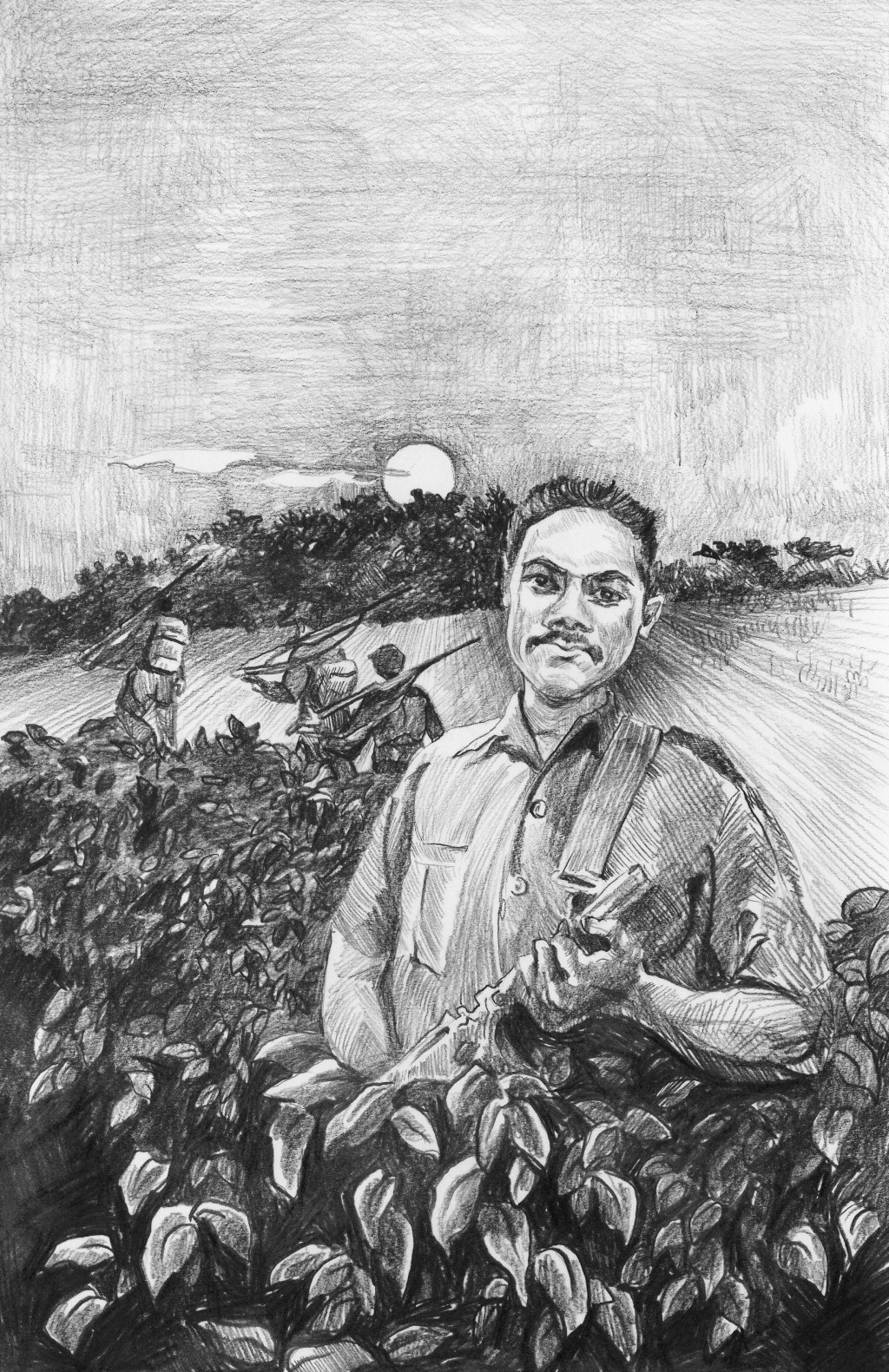
Hinton Alvarez, 19 June 2025
On May 21, 2025, the General Secretary of the Communist Party of India (Maoist), Namballa Kesava Rao, was gunned down by an elite unit of the Indian military. Rao, known as Comrade Basavaraj, was among the 27 revolutionaries who lost their lives that day, a concentration point in the genocidal onslaught waged by the Modi government. Whenever a leading revolutionary dies, especially at the hands of the enemy, it is important to honor their contributions and reflect on the circumstances of their death. Basavaraj was a top leader and a veteran cadre of one of the most important revolutionary movements in the world today, so his assassination by the Indian government is an egregious crime against the people.
The Indian government under Narendra Modi is claiming the cowardly killing of Basavaraj as a victory in its quest to completely eliminate revolutionaries in India. Despite the loss of Basavaraj, the legions of Hindutva fascist followers, and the elite troops armed with US, Russian, and Israeli weapons, the flame of the Indian revolution has not been extinguished. It is the responsibility of communists around the world to remember the martyrdom of Basavaraj and other comrades by following their lead and dedicating our lives to the cause of revolution in our own countries.
The genocidal Operation Kager
The Maoist movement in India traces its roots to the 1967 “Clap of Spring Thunder”: the Naxalbari uprising. The revolutionary movement has gone through various phases since that uprising, gaining strength when several Maoist organizations came together to form the CPI (Maoist) in 2004. With an existing social base, increased numerical strength, and political clarity, the CPI (Maoist) was able to quickly expand its reach, especially in the forest regions where India’s Adivasi indigenous people live. The revolutionaries led the Adivasi in powerful waves of revolutionary war and class struggle against the Indian government’s forestry department and foreign mining interests trying to sink their teeth into the land. At the height of the CPI (Maoist)’s influence in the late 2000s, the revolutionaries were active throughout a “red corridor” stretching through seven of India’s 28 states.
The existence of a revolutionary People’s Liberation Guerrilla Army (PLGA) defending some of the most exploited and oppressed masses of India and challenging the legitimacy of the Indian bourgeoisie’s rule provoked a counterrevolutionary response. Rather than engage in peace talks, the Indian bourgeoisie chose to wage a series of relentless wars against the masses. The Indian government borrowed tactics from US imperialism’s dirty wars in Latin America and created the Salwa Judum, a reactionary paramilitary group of Adivasis who opposed (or were paid off to oppose) the people’s war. The Salwa Judum was essentially a death squad, backed by the Indian government, that went on a rampage of kidnapping, murder, torture, rape, and its favorite tactic: burning villages accused of Maoist sympathy. They joined the Indian government’s counterinsurgency effort, called Operation Green Hunt, in the southern part of Chhattisgarh state.1 At its peak, Operation Green Hunt involved 100,000 Indian troops stationed in the Adivasi regions.
Green Hunt and each successive counterinsurgency operation followed a similar playbook: a state or national-level government leader would declare that they were finally going to bring an end to the communist insurgency with an influx of troops and the latest surveillance technology. The result was a rabid campaign against the Adivasi and other masses: sexual assault with impunity, mass displacement, the destruction of ecosystems through the creation of new roads and paramilitary camps, and, increasingly, aerial bombardment from drones and helicopters.2 All of the operations employed a central tactic: the fake encounter. These encounters are extrajudicial killings staged to look like military engagements. Hundreds of these encounters have taken place in the last decade, killing men, women, and children, members of the PLGA, and leaders in Adivasi social movements alike.
In January 2024, the Indian government launched the latest and most genocidal war against its own people: Operation Kager (“Final Mission”). The very first day of Kager saw security forces opening fire on a group of Adivasis, killing a six-month-old girl. In the first year of Kager, tens of thousands of security personnel were deployed, alongside dozens of drones and helicopters, and over 300 fake encounters were staged.3 Facing this genocidal onslaught, the revolutionaries, at the beginning of April 2025, reached out to the national government and the state government in Chhattisgarh, offering a ceasefire and attempting to initiate peace talks. The Indian government responded by deploying a reported 10,000 troops to encircle the forest where they believed the CPI (Maoist) leadership to be.
If the Indian bourgeoisie and the foreign powers it collaborates with had any interest in simply ending the Maoist revolution, they could have engaged the revolutionaries in their offer for peace talks and a ceasefire. They could have halted the construction of paramilitary camps, the displacement of indigenous people, and the destruction of their ecosystems. They could have stopped and punished the rapists they employ or ceased their policy of staged encounters. However, the goal of the counterinsurgency, the goal of Operation Kager, has never been merely ending the revolution. The counterinsurgency also aims for the eradication of the Adivasi people, whose very existence stands in the way of plundering the land and its resources, and who have been waging determined struggles to defend them.
The forests inhabited by the Adivasi are home to some of the largest deposits of bauxite and iron ore in the world. More than anything else, the promise of displacing the indigenous people and granting foreign and Indian corporations access to these massive deposits and other natural resources is driving the genocidal campaign. As far back as 2009, Arundhati Roy described the rush of the Indian government to sign Memorandums of Understanding (MOUs) granting corporations rights to this land, stating with only a hint of hyperbole, “There’s an MOU on every mountain, on every forest, and river in this area.”4
The death of Comrade Basavaraj
In a statement following the killing of Basavaraj, the CPI (Maoist) provided a detailed and frank explanation of events.5 They described how this was the third attempt this year to kill him, how the onslaught of Operation Kager and previous assassination attempts weakened the PLGA unit assigned to protect Basavaraj, and how some defections from the revolutionary ranks led the Indian military to his location. The revolutionary people’s war in India faces difficult challenges right now, with the full force of the Indian repressive state apparatus aimed against it in the most intensive anti-communist encirclement and suppression campaign of this century.
Understandably, onlookers sympathetic to the revolutionary struggle are trying to assess the state of the revolutionary forces and the difficult strategic questions of how to wage people’s war in a contemporary India very different from 1930s and 40s China. While we await deeper analysis, most especially from the revolutionaries directly engaged in these questions, it’s important to support and take inspiration from the comrades in India remaining firm in their revolutionary convictions, standing with the masses in the face of a genocidal onslaught by a well-armed bourgeois government. Whatever mistakes they may have made in the course of doing so certainly need to be summed up and criticized, but from the perspective of firmly upholding the audacity to persist in waging revolutionary people’s war.
Those of us outside India who support the revolutionary struggle and consider ourselves proletarian internationalists have important questions to ask of ourselves: Why has so little international awareness been raised about the ongoing revolution in India? Where are the internationalist campaigns to expose the reactionary Indian government and to struggle against the flow of weapons from countries like the US that are used to kill our comrades in India? Why have there been so few visible manifestations of opposition around the world to the Indian government’s genocidal Operation Kager? As a beginning—and only a beginning—answer to those questions, readers of Going Against the Tide are encouraged to go to the masses and distribute copies of the journal’s pamphlet Naxalbari means revolution: India’s ongoing people’s war, available for download at goingagainstthetide.org, as a way to create public opinion in support of the revolutionary struggle in India.
At the time of his death, Basavaraj was 72 and still leading the revolutionary movement from the heart of the guerrilla zone, with a bounty on his head. His comrades remember that he joined the revolutionary movement while he was an engineering student and became a member of the Communist Party of India (Marxist-Leninist) (People’s War) in 1980. He was an early leader in the revolutionaries’ efforts to make the Dandakaranya forest region a key base of the Indian revolution and played a crucial role in the merger of different revolutionary organizations that led to the establishment of the CPI (Maoist) in 2004. As a key commander of the PLGA, he was the architect of several high-profile attacks on the enemy and is remembered as a keen military strategist.
In a 2022 interview, Basavaraj responded to a question about defeatist attitudes:
When we fight with a strong enemy, we have ups and downs, advances and retreats. We take up the challenges, spread to all areas and sectors of the country, enhance the mass base, and shall fight courageously and with daring. We shall achieve success. People are invincible. They are the decisive factor. If we organize the oppressed people, the majority shall definitely bring down the few exploiters. We are absolutely confident in the historic truth that there is defeat-success-defeat and ultimately success. Capitalist imperialism is not permanent on this earth.6
“People are invincible” captures the spirit of the Indian revolution and the essence of a comrade who dedicated 45 years of his life to that revolution and to proletarian internationalism. It’s up to all of us to honor his life, his sacrifice, and his commitment by stepping up to take our place in the world proletarian revolution.
1Detailed accounts of the many violations committed in the name of “eradicating Naxalism” can be found in the report by the New Delhi based Forum Against Corporatization and Militarization, Violation of Civil and Political Rights of Indigenous Peoples in India: Submission to the UN Human Rights Committee for India’s Review of ICCPR Commitments, available at facamindia.wordpress.com.
2A 2023 report, by the Coordination of Democratic Rights Organisations, When Sky Spits Fire, documenting these bombings is available at indiamattersuk.com.
3“Telangana People’s Organisations Demand End to Operation Kagaar in Chhattisgarh,” The Siasat Daily, siasat.com. January 29, 2025.
4Arundhati Roy, interview on Democracy Now!, September 28, 2009.
5CPI (Maoist) General Secretary Comrade Nambala Keshav Rao alias Basavaraj Amar Rahe! Homage to the immortal martyrs of Gundekot! Condemn the May 21, Mad Gundekot massacre! Statement by Vikalp, Official Spokesperson, Dandakaranya Special Zonal Committee, Communist Party of India (Maoist), available at bannedthought.net.
6Comrade Basavaraj, Three Interviews. Available at bannedthought.net.
 Going Against the Tide: A journal charting a path for communist revolution in the US