
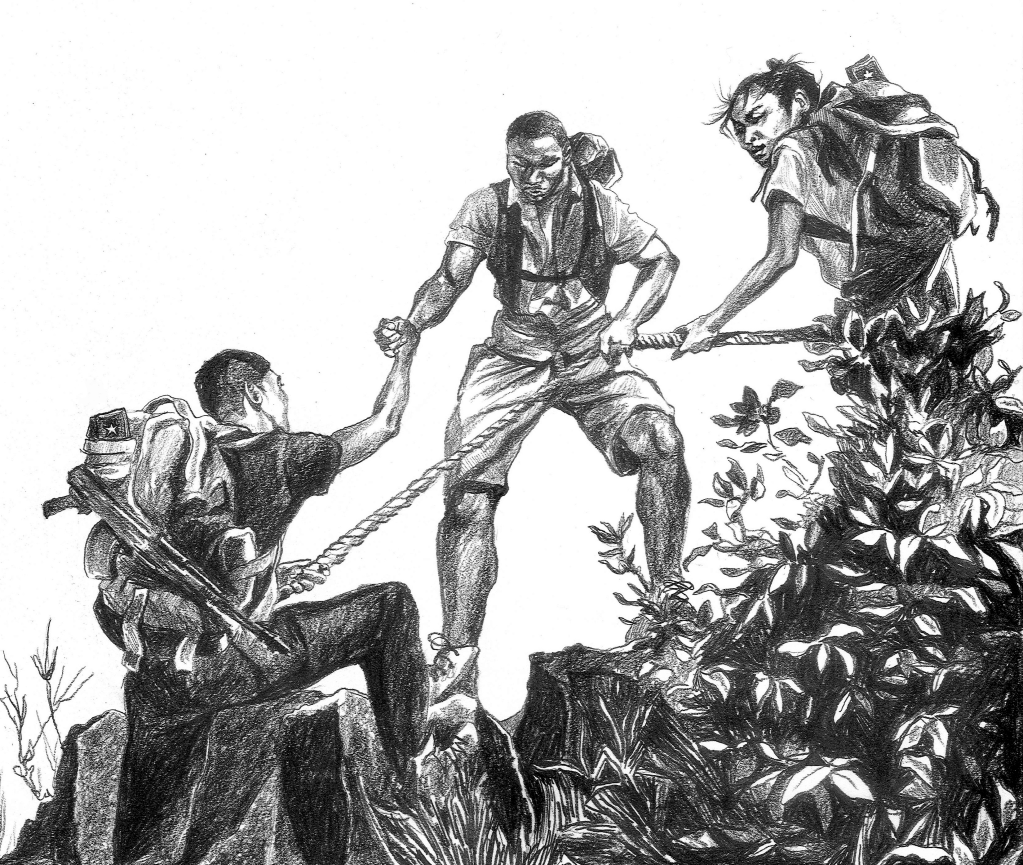
A training manual by the Organization of Communist Revolutionaries, May 2025
We write this manual after the OCR has recruited a number of young cadre who are stepping up to lead, train, and recruit the next wave of cadre, and as the question of organizational expansion—in places where we have units and in places where we do not—is on the agenda. A few, more security-sensitive, aspects of recruitment and building Party organization have been deliberately omitted from this manual, and OCR members should consult with their leadership to get filled in on those details. Beyond those omissions, we hope this manual can be a fairly straightforward, practical guide to how to lead through collectivity, recruit cadre, and build local Party branches, though we warn against taking this manual too schematically. As with all tasks, everything addressed in this manual needs to be thought of as a process, guided by our strategic objectives and understood dialectically as a matter of working our way through contradictions. Special thanks to the comrades at the leadership training session on which this manual was based.
Forming like Voltron: leading through collectivity
A weakness in our work has been leading through strong collectivities. Why? (1) We live in an extremely and disgustingly individualist society—the most individualist culture in human history—and that seeps into us. Even as we are fighting for a communist world and seek to operate in the collective ways of the future, we cannot escape the gravitational pull of the present.
(2) We are trained in petty-bourgeois work habits from school, jobs, and the broader culture, even if we come from proletarian class backgrounds. Those work habits include the bureaucratic functioning of office jobs, completing tasks as alienated individuals walled off from the larger, socialized production processes we are part of, and, when we do work directly with others, issuing orders to others and/or avoiding the scrutiny of others.
(3) We are trained to judge our work and ourselves through the prism of petty-bourgeois perfectionism. In school, we are taught perfectionist approaches to getting tasks done, and that perfectionism sticks with us the rest of our lives if we do not consciously struggle against it. There is a world of difference between striving to fulfill our responsibilities to the masses in the best ways possible, trying to make the best possible contributions we can to advance the revolution, and the individual-centered approach of petty-bourgeois perfectionism. The latter centers individual accomplishment and, in a unity of opposites, holds us back from making contributions by worrying our contributions won’t be “good enough” because they are imperfect.
(4) Zoomer culture and the technologies at the heart of it cut against collectivity. Being glued to our phones and communicating through groupchats diminishes the kind of discussion, including face-to-face interaction, necessary for forging strong collectivities. It also breeds self-cultivation and conflict avoidance. As is well known, social communication skills have gotten worse in our culture over the last couple decades.
(5) Finally, and a more unavoidable contradiction, is the necessity to get tasks done. As we have said elsewhere, getting shit done is a communist principle, and as Mao said, so many urgent tasks cry out to be done, and always urgently. We do not have the luxury of waiting to get tasks done in just the right ways, through just the right collective decision-making and action. Necessity often impinges on best methods.
Why should we resist these objective pulls towards individual rather than collective ways of getting tasks done, just like we do in other instances where the spontaneity of living in bourgeois society pulls us away from thinking and acting like communists? For starters, how we operate today needs to model, and be a bridge towards, the communist future we are fighting for. Moreover, there is a synergy, a whole that is greater than the sum of its parts, that comes through strong collectivities. This isn’t just true of communist organization, but applies in all realms of human activity—think of the best sports teams, your favorite bands, or great writer/director/actor teams. The output that comes from this synergy cannot be recreated by a different set of individuals who do not have the same bond that was forged through collective work over a period of time. There’s a spiritual dimension to this—a collective energy you feel, including physically, when you are in sync with a collectivity that you can count on and that makes your ideas and actions better than they would be without it. The more materialist dimension is the way that the combined strengths of different individuals cancels out weaknesses and allows individuals to draw from the strengths of others, something like a real life version of the television series Sense8. Finally, there’s a matter of training. If the individual best at a given task always does that task themselves, it never trains others in that task. By carrying out tasks through collectivities, we train ourselves up, and even the strongest members of the collectivity learn new ways of approaching the same tasks.
So how do we break bad habits and lead collectively? We have to have a recognition of the contradiction between the necessity to get tasks done and the best, collective methods for getting those tasks done, and bend the stick more towards the best methods than we have been. Relatedly, we need to recognize when something has to be done the best way possible vs. when we can let go of the reins, let someone else run point, let them make mistakes and learn from those mistakes, but also learn from how they might do better than we would.
In all our political work, there needs to be much less reliance on groupchats and text messages to make decisions and plans, and more face-to-face meetings and phone calls. In whatever collectivities we are part of, we need to be talking to each other more. Even a simple check-in phone call before carrying out a task together to ensure everything is set is better than sorting details out through text message. However, lots of meetings and phone calls cannot become new clogs in our collectivity. More the point is to have well-planned, regular meetings, with enough time to discuss the things that need to be decided on, make definite assignments of tasks, and then have brief check-ins (usually by phone) to follow up on and follow through with what was decided and address any problems that have come up along the way.
A strong collectivity needs strong leadership. When there is too much “equality” among individuals within a collectivity, everyone tends to wait for one another to figure things out, make a plan, and designate tasks, and little ends up getting done. If there is not a formal or default leadership of a collectivity, someone needs to step up and take the reins. Regardless, collectivities require someone, or someones, to recognize what problems need to be solved, steer collective discussions towards achieving definite objectives, figure out what tasks need to get done, and then delegate the ways to carry out those tasks, including but not limited to individual assignments.
Getting good at synthesis is central to leading through collectivity. Besides too much “equality,” another problem that makes collectivities unproductive and unwieldy is when the individual members of a collectivity cannot come to the table with summation. We’ve all been in meetings where people give summations that are play-by-play reports or focus on secondary details—methods of summation grounded in empiricism that result in a stream of information rather than a grasp of the key contradictions. We need to train people in the art of synthesis, in being able to foreground the principal aspects to report, the pertinent information, the anecdotes that explain the whole, and the key problems that have to be solved. Whoever is leading the collectivity needs to be good at directing comrades to give summations that focus the collectivity’s attention on the contradictions and most important information, and then synthesize the key lessons from those summations. In meetings, the leadership can intervene towards that end by asking questions and directing the flow of information. That will then feed into collective discussion of how to solve problems and advance our work, and recognition and delegation of tasks. Flowing through all this is a focus on contradictions rather than things.
The leadership of a collectivity needs to be attentive to involving everyone to the maximum degree possible. Developing the ability to come up with questions that draw people into the process of problem-solving is one important aspect of doing this. Another is to present ideas and proposals in ways that are open-ended, such as presenting the strengths and weaknesses of two different options under consideration, rather than presenting every idea in ways that are fully formed, with no room for development (and no internal contradictions). During collective discussions, it is important to notice when individuals are not speaking up because they feel they do not know enough to contribute, and to find ways to solicit their ideas and boost their confidence. Likewise, the leadership of collectivities should be aware of how individuals often gravitate to some tasks rather than others, and, relatedly, to logistical problems rather than political problems, and be sure not to let predispositions, especially those based on oppressive gender divisions, determine the collectivity’s functioning. Communist-led collectivities, on all levels, should be working to break down the division between thinkers and doers, a manifestation of the centuries-old division between mental and manual labor that class society has codified.
Meetings of any collectivity should ideally be split between discussion of political line that is more abstract in nature, i.e., not narrowly focused on the nitty-gritty details of practice, and more practical problem solving, decision making, and delegation of tasks. The leadership of a collectivity should get good at recognizing the bigger ideological and political questions and challenges that are coming up through the collectivity’s practical work, and start meetings with a prop and discussion that addresses those questions and challenges from the high plane of line. However, we cannot neglect all the details that need to be addressed—we should address them efficiently and decisively to make room for deeper discussion. Lots of “deep” discussion that results in no decisions or delegation of tasks is no good either, so we need the right synthesis of abstraction and practicality, with political line taking organizational shape.
An important secondary aspect of forging strong collectivities is the side conversations and social activities that should blossom around collectivities. Taking walks together, sitting down for a pot of tea or coffee, cooking a meal and eating together—these are all important ways we make time for discussing secondary matters not addressed in meetings that nonetheless have important implications for the principal tasks. They’re also crucial to getting to know the individuals in your collectivity better, checking up on how everyone is doing politically and emotionally, and providing a secondary form of democratic consultation, learning how each member of the collectivity thinks about the decisions made and the direction we’re moving. Leadership should periodically have side conversations with all members of the collectivity they are responsible for.
Moving forward, we should make sure that when someone gets involved in our political work, they are quickly put into a definite, organized collectivity under our leadership. This makes them feel part of something, spiritually and politically, and gives them a sense of obligation to our work. It will also help us get to know them better and on a deeper level than if they just float in and out of our work. Making everyone part of a collectivity is easy to do when we are small, when it is just a matter of adding them into whatever small collectivity exists. It takes more social engineering and organizational strategy as we grow, so as we do, we should be sure to make sensible plans for dividing the people under our leadership into specific, smaller collectivities with particular responsibilities. Periodically, all collectivities under our leadership need attention from higher leadership, usually in the form of prop sessions addressing the key challenges or main political questions and meetings focused on deeper, longer-term summation and strategic planning.
As people get more deeply involved in our work, their collectivities need to be raised to a higher level by taking on greater responsibility, or they as an individual need to be moved into a collectivity with greater leadership responsibility. Optimally, that means recruitment into the OCR, where they can be part of the higher collectivity of an OCR unit. But even before that stage, and even after it, we need collective functioning to be a moving process of greater responsibility.
One of the most pressing contradictions right now in OCR units and other collectivities under our leadership is having too many different responsibilities on their shoulders. This is a difficult problem to solve given our revolutionary ambitions, but we need to move towards having units—whole collectivities rather than individuals—that are more singularly focused on specific lines of political work. We also need to get good at handling different tasks and being part of multiple collectivities, able to shift our focus as necessary. The reality is that individuals recruited into the OCR at this stage in the game are needed to step into leadership bodies and sometimes lead multiple collectivities. This will mean being less in the trenches, and more stepped back with a bird’s eye view, leading those who are in the trenches. Admittedly, the best (and funnest) collectivities to be a part of are the ones that are in the trenches together, so enjoy these while you are part of them and learn everything you can from their collective functioning so you can imbue the best aspects of that functioning in others as you take on higher leadership responsibilities.
Recruiting cadre
Now that the OCR has firmly established itself as a revolutionary organization leading several spheres of political work among the masses and with a correct ideological and political line articulated and developed in thousands of pages of writing, recruitment of cadre is the key link in moving to the next phase of establishing a vanguard party. The contradiction to resolve is that between quality and quantity. We have an advanced political line and strategic thinking owing to our roots in and connections to the communist tradition as well as our initiative in addressing theoretical problems and new challenges left unanswered by that tradition. But we only have a small number of cadre, as we did not develop through a split from an existing organization, and the generation that came into political life since 2011 has largely been ruined of revolutionary potential by postmodernism and the Left. So our principal task in the coming years is to turn quality into quantity, to make our line a significant material force by bringing forward a critical mass of cadre carrying out our line and expanding the scope of our work. Our initial experience shows that when young aspiring revolutionaries take up and get trained in our line, they can connect revolutionary politics with the masses, bring forward others like themselves, and organize waves of class struggle, even if thus far this is all on a small scale. Red salute to those initial cadre; now let’s figure out how scale things up.
Where do we find potential recruits? The people involved in existing lines of political work and organizational forms under our leadership are the most likely candidates for recruitment into the OCR, and we should be following Lenin’s guidance and turning those lines of political work and organizational forms into transmission belts into the Party. To make them such transmission belts, we need to give proper emphasis to ideological and political training among the people involved in them, challenge those people to step up their level of responsibility, and take opportunities to push them to rupture with petty-bourgeois ideology and lifestyles. Most of the people we are talking about here will be relatively young, so this avenue for recruitment is about turning revolutionary youth into lifelong communist cadre—the principal way that most vanguards are built.
As we turn more and more revolutionary youth into communist cadre, we need to devote specific attention to recruiting advanced proletarians who we meet through our specific mass organizing efforts and our broader agitation among the masses. With the latter, intensive contact follow-up is a must to bring the advanced we meet through our broad agitation into discussion circles and other organizational forms, and then bring them towards recruitment. In our mass organizing efforts, we need to devote more attention to propaganda work and one-on-one discussions of our full revolutionary politics, wielding the appropriate communist literature; take the advanced through our basic course; and recruit those who are won over to communist ideology. Recruiting large numbers of proletarians will require collective attention to the specific ways proletarians are prevented from exercising their agency to make revolution, from repression to poverty to chaotic life conditions to decreasing rates of functional literacy in American society, and we will need to find collective ways to address these challenges.
Beyond revolutionary youth and advanced proletarians, we should seize any opportunities for recruiting individuals from other classes and life circumstances who want to commit to serving the people. To do so, we should not limit the scope of recruitment to the existing political work and organizational forms under our leadership. Lenin said that “communism springs from all pores of society,” not “communism springs only from the particular organizing efforts we are engaged in.” People come to question and oppose the existing social order through all sorts of avenues which we currently have little or nothing to do with directly, from art, theater, music, literature, various political movements (not just the ones we happen to be involved in), religion and spirituality, etc. At minimum, we as communists should be genuinely interested in this process and the people who emerge from it. Our all-around political work, and projecting it via revolutionary agitprop work in particular, should generate attractive pull more broadly throughout society and bring potential recruits into contact with us. And we should seize on any opportunities that open up to stretch a line into any of the myriad ways that people question and challenge the existing order. By recruiting cadre from political, social, and cultural arenas that we are not currently involved in, we can expand the scope of our work to encompass those arenas.
How do we get an individual ready to be recruited? How does someone prove they are capable of being a communist cadre? The process should take at least six months and involve:
- Political work among the masses under our leadership. This needs to go beyond “mass work tourism” and be substantive, ongoing mass work, wherein the potential recruit proves they have real heart for and dedication to the masses and solid commitment to advancing our work among the masses. This is best achieved through assigning the potential recruit to a sphere of political work that involves broad and deep political engagement with the proletariat with definite objectives.
- Integration with the masses, getting to know their lives and fusing with them. This can be done in relation to the political work described above, but can also be done, or supplemented, with cultural and social integration (getting a proletarian job with lots of co-worker interaction, joining a sports league, attending a house of worship, etc.). For people from petty-bourgeois backgrounds, cultural and social integration with the masses is an important, if secondary, way of ideologically remolding themselves.
- Training in our ideology and politics. Besides happening in relation to involvement in our political work, this takes place by going through our basic course and studying and discussing our literature. Collective forms for this training, such as discussion groups, allow us to more efficiently bring forward groups of potential recruits rather than individuals one at a time and test how people defend and debate our politics with others. Potential recruits need to be convinced of the correctness of our ideological and political line, and should have solid unity with our Manifesto before recruitment begins. They should also be intellectually engaged with our politics and philosophy and the broader world around them, whether or not they read at a high level.
- Stepping up their level of responsibility. When someone takes initiative to advance our political work, that is one sign that they would make a good cadre. Beyond their initiative and enthusiasm, we should consciously lead them to step up their level of responsibility by giving them appropriate challenges and assigning them specific tasks, testing out their potential as a cadre in the process.
- Getting to know the potential recruit well. Before we “pop the question” about joining the OCR, we should get to know an individual’s political history and have a full picture of who they are. We do not need to know every personal detail, but we need to know enough about their family life, cultural and religious background, employment and education history and any career aspirations, struggles they have been through, mental and physical health issues, etc. to know them as a full human being. This is because (1) we are responsible to every person we recruit, and we need to know how we they can thrive in the context of our democratic centralist organizational structure; (2) personal life questions are bound up with the ideological questions that need to be addressed in recruitment; (3) we need to know they are who they say they are for security reasons; and (4) getting to know people as three-dimensional human beings and being genuinely interested in getting to know people is just part of who we are as communists.
The process towards recruitment should be one of growing partisanship and, yes, loyalty, to the OCR, a deepening love for the masses, and an increasingly firm dedication of one’s life to revolution. The above bullet points can function as a recruitment “checklist” of sorts, but we should also feel that they’re ready to join, and that they need the higher collectivity of being part of the OCR to further their development and make their fullest contributions. Beyond meeting the “checklist,” we should be identifying the contradictions within potential recruits and seizing on the positive aspects to overcome the negative. The principal contradictions are always ideological, centered around the question “what is your life going to be about—yourself or the masses and revolution?” Usually that question, or any other key ideological question, gets expressed indirectly, so we need to be good, and even a little Freudian, at bringing what’s beneath the surface to the level of consciousness so we can struggle it out.
There may also be political questions holding back a potential recruit, such as specific disagreements about our line on the socialist transition period or the national question, especially in the case of people with experience in the Left and/or who learned postmodernism in college. However, even with these political questions, there is usually a deeper ideological question at the core that needs to be brought to the surface. We need to struggle over the political question to get to the deeper ideological question, for example, struggling over our line on the national question to purge remaining allegiance to postmodernist identity politics, or struggling over the dictatorship of the proletariat to purge remaining petty-bourgeois fear of the masses ruling society. We also need to be good at drawing out differences, as often times people will agree with our line on the surface but have doubts or differences beneath the surface. Moreover, we want recruits who are not content with pat answers or simplistic solutions, so we need to get potential recruits digging into the challenges of making revolution, not just taking our word for it.
When you feel it is time to start a recruitment process, we should make sure necessary security checks on the potential recruit have been done and discuss the potential recruit with your unit. If the unit gives collective approval, you should make a plan to “pop the question” (yes, we deliberately use a phrase associated with marriage proposals to emphasize how joining a communist organization is a life commitment). You should review our Manifesto and Membership Constitution with the potential recruit to assess any remaining differences with or doubts or questions about our line they might have. Before popping the question, be sure to get a commitment from the potential recruit to keep your conversation in confidence (not telling anyone else about it, even the people personally closest to them) and be sure your conversation cannot be listened to by anyone else. In discussing potential recruitment, you should emphasize that joining the OCR means committing your life to revolution and functioning under democratic centralism, and paint a living picture of what the latter means, including ways their life would change. You should also explain that joining the OCR does not require a sophisticated understanding of every political question, but a basic, firm understanding of our line and an ability to apply it, and confidence that they can follow the OCR’s line on questions they haven’t yet developed a sophisticated understanding of. In other words, they need a faith in the vanguard based on solid unity with it and a commitment to keep learning.
If the potential recruit wants to move forward with a recruitment process, then you should make plans for them to write an application on a device that does not go on the internet. The application should explain why they want to join the OCR, why they think they are ready to make this commitment, and what brought them to this point (their political biography), and raise any questions they want to discuss in the recruitment process. Between their application and our own summations of their development, we should have a good idea of the ideological questions that need to be addressed in the recruitment process, as well as any remaining political education that needs to be done with them before they join the OCR.
If the unit presiding over the recruitment, and any higher leadership body needed, approves moving forward with the application, then a two-person recruitment delegation needs be assigned, and they need to make a plan for what recruitment sessions need to be conducted and any challenges to further step up responsibility that need to be given to the potential recruit. Recruitment sessions should be focused on ideological questions, especially concerning where further ruptures with petty-bourgeois ideology are needed, and secondarily on any political questions or lingering disunity with our line. These sessions should be transformative, not just passive political education, and be well-prepared, with one member of the recruitment delegation opening with a prop on the question the particular session is addressing. Readings should be assigned to prepare for each session to deepen the recruit’s ideological and political level and help focus the discussion. Recruitment processes should consist of about four sessions, depending on what questions need to be addressed, and there should be a timeline given for the recruitment process at the beginning of it, generally lasting no more than 3–4 months. At the end of the process, the recruitment delegation should be able to give a clear report on where the potential recruit is at ideologically and politically and a firm opinion on whether they should be brought into the OCR, which the unit responsible and any higher leadership necessary can assess and come to a collective decision on.
When we bring new recruits into the OCR, besides training them in security protocols and internal functioning, their first unit meeting should include a warm welcome and a little celebration, as making the commitment to be a communist cadre is the best thing you can do with your life and every cadre is precious to the masses. All members of the OCR should be taking great initiative to recruit cadre so that we can move towards forming the vanguard party capable of leading the overthrow of the most powerful and most evil empire in human history. There is a race against time element to recruitment, as our enemies have clocked us as something to take seriously, we have experienced the beginnings of state repression, and we should be expecting higher levels of it coming our way. We need to recruit in order to defend ourselves from these coming attacks, and yes, to replace comrades who get locked up or killed. More positively, we have seen the revolutionary potential of the masses through the political work we have fought hard to establish, but only on a small scale thus far. Imagine the far greater potential that could be unlocked if we multiplied the number of OCR cadre, and get on a mission to recruit, recruit, and recruit some more.
Building local Party branches
As we recruit cadre, we will need to organize those cadre not just into units but into local Party branches. Taking that leap forward requires a head for two things: personnel and strategy. Mao gave us a nice, simple definition of communist leadership as working out ideas and using cadre well, and that’s what we’re talking about here. The particular art of building local Party branches is the synthesis of strategy and personnel: how to take the existing people we have and deploy them to make the most advances possible, and how to bring forward more people to realize our strategic vision.
In building local Party branches, we need a strategic vision that (1) draws lessons from our work around the country and from revolutionary history and applies our national plans to specific, local conditions, and (2) is also based on the specific local conditions where the branch is being built and the particular cadre in that branch. That’s another way of saying that we need to be good at implementing what central leadership and the best of the communist tradition has constructed for us, but without forcing the foot to fit the shoe.
Our leadership capabilities are developed not principally from our direct experience, as important as that is, but from applying what we have learned through indirect experience. This is part of why the OCR has put great emphasis on studying revolutionary history, not just communist theory. It is by studying lots of different examples of revolutionary practice throughout history, here and around the world, that we develop a flexible set of strategies and tactics. We have to then adapt that set of strategies and tactics to particular circumstances, picking up the best tools for the given challenge. (And we should be wary of the fact that wrong lines are often justified by taking what was correct in one set of circumstances and insisting on applying that to a different set of circumstances.) The larger point here is that communist leaders are people who have absorbed and internalized lessons from multiple sources and know which of those lessons to apply in the specific circumstances. In other words, originality is far less important than creative application.
With that in mind, we also need to build local Party branches in relation to the specific local conditions and opportunities, both objective and subjective ones, not by mechanically applying central plans or imagining we can simply replicate what worked elsewhere. Some questions we should consider about the specific place where we are building a local Party branch:
- What is the class makeup and social demographics of the area? What is the social geography, i.e., what classes and kinds of people live where and in what conditions?
- What are the key industries (sorry, that sounds a bit Trotskyite), what are the biggest employers?
- What are the cultural and intellectual particularities, including the languages spoken, and the influential institutions?
- What are the dominant political forces and points of contention, among the local bourgeoisie and among the people broadly?
Based on the answers to these questions, we should be able to figure out the class antagonisms around which we can organize class struggle, the more favorable neighborhoods to carry out political work, and the specific opportunities in terms of political, social, and cultural forces and conflicts. But we need not write a rote, mechanical analysis of local conditions that tries to be comprehensive and winds up being static and statistical. Instead, we should be focused on identifying and understanding the defining features of a given area, for example, the contours of deindustrialization and dispossession in Midwestern cities and if new industries (such as healthcare or tech) that have come in. Having a sense of the essential features and class contradictions of a given area should inform how we deploy our forces as we recruit more cadre.
Thus far, we have built our presence in a given area by starting an activist organization; using it to establish footholds and mobilize class struggle among specific sections of the proletariat and, secondarily, to do some broader agitation when possible; attracting some revolutionary-minded young people to our work and developing deep ties with some masses; and then recruiting cadre into the OCR from among the people we have brought under our leadership. This is a generally correct basic schema, though other approaches might make sense in some circumstances. The bulk of our recruits in the next several years will likely come through applying this basic schema, but once we have recruited a few cadre, we need to expand the scope of our work and fill in some missing ingredients in order to build a local Party branch.
Propaganda work, both among the advanced around us and broadly among the masses, becomes essential if we are to advance the class-consciousness of the masses and bring the advanced into recruitment processes, and also to attract different types of advanced, not just those who are immediately drawn to mass struggle. Cadre will need to be consciously assigned to put more focus on propaganda work at the expense of other tasks, including sometimes by making it the principal task of one member of a given unit. Organized ties become necessary to build support for our overall work and broaden its reach, and cadre need to be assigned to developing organized ties. To become a recognizable and formidable revolutionary force in a given area, we need a combination of steady work where we entrench ourselves among sections of the proletariat, especially but not only through focused mass organizing efforts, and bold political interventions responding to the sudden emergence of social conflicts, crises, and mass struggle. Consequently, a definite division of labor is required with some cadre treated as stationary forces and others as mobile forces. Finally, a local Party branch needs to enter into the broader cultural, social, and intellectual life in its area, which will require both broadening the reach of our all-around revolutionary work and developing cadre with expertise in particular arenas.
Going from the basic schema for establishing our presence to broadening the scope of our work suggests the following model of organizational development for building a local Party branch:
- Initial units focused on leading our activist and mass organizations, mass organizing efforts and political interventions, all while training our initial cadre as skilled agitators, propagandists, and organizers.
- Then a unit focused on developing organized ties, which can broaden our reach, carry out support tasks, and take some contact follow-up work off the shoulders of our overburdened frontline cadre.
- To feed into the work of developing organized ties and to broaden our presence among the masses, a unit should be established to take responsibility for revolutionary agitprop work in different potential forms, thereby gathering contacts among the masses who are attracted to revolutionary politics and doing the initial follow-up work with them.
- This basic division of labor should be the basis for multiplying units. For example, units leading our activist organizations and mass organizing efforts should grow in members and then divide into two units or redeploy some cadre to other lines of work, and the advanced proletarians brought forward through their work should be recruited and constituted into units in proletarian neighborhoods. If the unit focused on developing organized ties recruits three workers in the healthcare industry, those three comrades could become a unit carrying out revolutionary work among healthcare workers.
- Flowing from and in addition to that last point, as a local Party branch grows, it should constitute specialized units based on the cadre recruited and the specific conditions in the area.
In addition to the above model for the organizational development of local Party branches, we should also play the hand we’re dealt when it comes to what cadre we have. For example, if we have a group of revolutionary musicians under our leadership, establish a musical agitprop group. If we recruit some budding journalists, start a local revolutionary media outlet. The OCR purposely does a lot of scaffolding, especially via the literature produced under its leadership, to facilitate different potential forms that revolutionary work can take and cultivate the development of cadre with different skill sets and focuses. The point here is that while being a member of the OCR means being willing to fulfill any task needed by the revolution, cadre are not literally interchangeable, and where it makes sense to, our strategic plans and development of units should be based on the particular strengths of the cadre we recruit.
After about three units have been established, forming the basis of a small local Party branch, a local leading committee (LLC) should be constituted with the most advanced cadre in the area. At first, the LLC will likely consist of all the unit chairs in a branch, but as a branch grows, not all unit chairs will be part of the LLC—the point is not equal representation of units but strategic leadership and ensuring a correct line is in command. More than an organizational matter, the LLC is the internal leadership and center of strategic planning necessary for a local Party branch to function, expand, and advance our work in a given area. The LLC needs to pay attention to training cadre, helping comrades through contradictions, leading line struggle when it breaks out internally, and charting the path through challenges and opportunities. This means the LLC has to be a bit above the fray, a bit freed up from the daily grind, in order to see the overall picture. That overall picture includes both the subjective conditions—our cadre and the people and organizations under our leadership—and the objective situation locally, including the structural conditions and bourgeois political machinations. The LLC needs to have the political and organizational ability to concentrate our forces (local cadre in particular) to make breakthroughs, including by swinging the maximum force possible to intervene when important opportunities for revolutionary advance emerge.
To lead a local Party branch, representatives from the LLC should periodically meet with units and individual cadre; conduct prop sessions to address key challenges; develop strategic plans for specific spheres of work with definite objectives and timelines and deploy units and cadre accordingly; check on the work of each unit via summation at periodic intervals; and do comprehensive summations at periodic intervals and and make new strategic plans. The LLC should avoid micro-managing and instead rely on the initiative and follow-through of our cadre, but it should step in to solve problems where problems arise, and forcefully so when political work or cadre go off track. Ideal methods of leadership require a systematic and scientific approach to assessing our work, which becomes increasingly necessary the more units and cadre there are. The LLC needs to be able to see which spheres of work are advancing and which ones are floundering, sum up why that is the case, reassign cadre and even halt political work that is going nowhere, and concentrate forces where breakthroughs are possible.
Building and leading a local Party branch has its own particular challenges, requiring greater attention to internal dynamics, a more bird’s eye strategic view, and the ability to lead different spheres of political work simultaneously. The experience of stepping into leadership roles in other ways should help prepare our cadre for this task, but it will nonetheless necessitate a qualitative shift in how we lead and how we approach our all-around political and organizational work. To build the vanguard party so sorely missing in this country, the best of our cadre will have to step up to build and lead local Party branches, and thereby develop crucial political and organizational blocks of the vanguard party brick by brick, area by area. To put it in simple, schematic terms: correct line + Party center + local Party branches = vanguard party. One down, two to go.
 Going Against the Tide: A journal charting a path for communist revolution in the US