
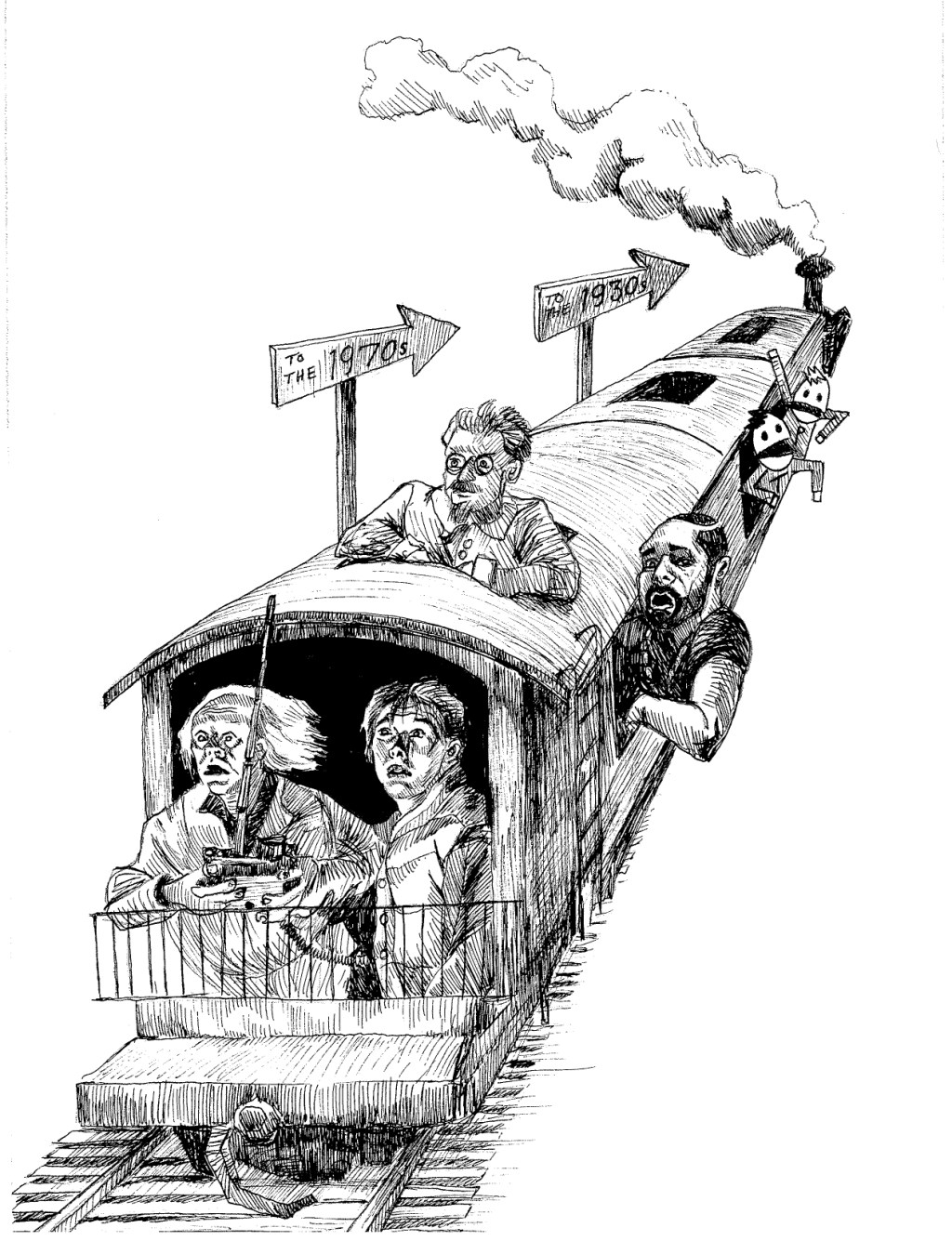
On the (Nostalgic) Communist Party of Canada’s rapid descent into a self-made swamp of economism, sycophantism, Trotskyism, and opportunism
Organization of Communist Revolutionaries (US), Department of Diss Tracks
May 2025
A year ago, the rapper J. Cole put out an album pathetically titled Might Delete Later, on which he arrogantly dissed rappers with far better skills on the mic than himself, such as Kendrick Lamar, in what was likely a misguided attempt to claim a place at the top of the rap game. Cole is often considered a “conscious MC,” but in truth he’s something more like a wannabe self-help guru with a decent flow but no real fire against the system, or his rivals in the rap game, apparently. The Canadian rapper Drake, by contrast, is more like a copy of a copy—the Nickelback of rap, another vapid cultural production from Canada—using ghostwriters and trading on his Degrassi television fame to imitate the flows of rappers much more innovative and skilled than him. He’s amassed a lot of fame and wealth that way, but made the mistake of responding to Might Delete Later with diss tracks that took aim not just at J. Cole but also at Kendrick Lamar.
Lamar answered Drake with “Not Like Us,” a diss track to end diss tracks, a display of Lamar’s rival-slaying skills on the mic, and a rightfully boastful demonstration of his roots in Compton, not after-school specials. We certainly have our political criticisms of Lamar, who, like J. Cole, fixates on personal change and bourgeois notions of empowerment rather than taking aim at the system—he’s an Obama-era rapper not just in chronology but also in ideology. However, we have no aesthetic criticisms of “Not Like Us,” 2024’s rightful heir to the diss track tradition that previously brought us Tupac’s “Hit ‘Em Up,” Ice Cube’s “No Vaseline,” and KRS-ONE’s “The Bridge Is Over,” among other classics.
Unfortunately for the (New) Communist Party of Canada, their recently published “(N)CPC-CC Reply to the OCR’s ‘Red Salute’” lacks the substance and swagger of those battle rap classics. Politically, it somehow manages to combine the pathetic posturing heard on J. Cole’s Might Delete Later with the unearned arrogance of Drake’s “Family Matters” in a sad attempt to attack the Organization of Communist Revolutionaries and the politics of the journal kites. Perhaps they decided to publish it in the first issue of their utterly uninteresting journal Railroad because their so-called Party has gone nowhere since its founding, and all they can do to draw attention to themselves is to attack us, a real communist organization making real moves with a real commitment to revolution and the masses.
“(N)CPC-CC Reply to the OCR’s ‘Red Salute’” is such utter garbage that it doesn’t really deserve a response from us. Anyone familiar with our politics, anyone who has read kites, should have no difficulty discerning the distortions and outright lies about our politics that the (New) Communist Party of Canada (hereafter (N)CPC) spins. However, to avoid any possibility of confusion, especially among international readers less familiar with the OCR, we’ll waste the time refuting enough of the nonsense in “(N)CPC-CC Reply to the OCR’s ‘Red Salute’” to show the opportunism behind it. Before we go there, we’ll clarify to kites readers why the journal they cherished came to an end—how the opportunism of the (N)CPC made continuing it with its revolutionary integrity intact an impossibility.
To make the obnoxious task of swatting down petulant, pathetic opportunism serve a higher purpose, we’ll try and draw out the lessons that would-be communists can learn from the (N)CPC’s rapid descent into opportunism and irrelevance. In the imperialist countries, all too many “parties” and organizations have been started in the last decade with lots of revolutionary rhetorical bravado that either quickly collapsed or turned into nothing more than vehicles for bolstering the false sense of self-importance of their members. Since we’re familiar with the (N)CPC’s variation on that theme, perhaps dissecting its descent can help aspiring revolutionaries elsewhere avoid a similar fate.
“Blame Canada! Blame Canada!”: How the (N)CPC dragged kites to the ground
Goddamn I’m glad y’all set it off
Used to be hard, now you just wet and soft…
…Lookin’ like straight bozos
I saw it comin’, that’s why I went solo
and kept on stompin’
-Ice Cube, “No Vaseline”
The journal kites was started in Winter 2019–20 after discussions between the Organization of Communist Revolutionaries (OCR) in the US and Revolutionary Initiative (RI) in Canada that united around the need for and conception of a communist journal in North America. In the US, kites played a crucial role delineating communist principles from the Left and postmodernism, attracted a few young aspiring revolutionaries who have gone on to become communist cadre, and charted a strategic path for those cadre to take up. In Canada, it seems to have accomplished very little.
In any event, kites distinguished itself by addressing the strategic challenges of making revolution, especially in imperialist countries, rather than offering dogmatic regurgitations of Maoist verbiage. It filled important theoretical and analytical gaps left by the 1960s and 70s generation of Maoists, in particular by analyzing who the social base for revolution is in imperialist countries and how they can be brought forward as a revolutionary force. The series The Specter That Still Haunts by Kenny Lake, published in kites #1–4, was central in that respect, and central to the reputation of kites.1 But other articles, including from comrades in Canada, such as “Chronicles of the struggling and dispossessed,” also contributed to filling that gap. Additional content in kites caught the attention of young people looking to figure out revolutionary politics after the 2020 rebellions, especially “Malcolm X didn’t dish out free bean pies,” the most popular article on the kites website.2
While the majority of the content in kites was written by comrades in the US, kites was very much a joint project, with comrades in Canada making important if less voluminous contributions to its content and taking the lead on production and on interviews with comrades outside North America. One difficulty kites faced early on was that Revolutionary Initiative collapsed as an organizational form soon after the journal’s founding. This was a setback for the development of revolutionary forces in Canada and put a new level of stress on the Canadian side of the kites editorial committee—which stuck with kites and continued to make important contributions to it even after losing their organization.
In 2021, some comrades in Canada with previous experience in the PCR-RCP (Revolutionary Communist Party of Canada), who at that time had no involvement with kites, started making initial moves to regroup the remnants of Canada’s Maoists and get on track to building a new vanguard party. When the Canadian side of the kites editorial committee shared this news with us, we were on the one hand skeptical of the dogmatism of the PCR-RCP, which we could see being reproduced in the initial moves towards forming a new vanguard party, and on the other hand enthusiastic that there were comrades in Canada moving with seriousness and determination. We did the principled thing and shared our concerns about dogmatism with the Canadian side of the kites editorial committee while embracing the seriousness about building a vanguard. We welcomed the contributions that came from comrades in Canada to kites #5/6 and #7, especially “Chronicles of the struggling and dispossessed,” the best piece of social investigation published in the journal and one that advanced the class analysis that had been developed in kites #1–4.
Up through the publication of kites #7, there was no indication of any serious differences between the OCR and the comrades in Canada working to build a new vanguard party. The kites editorial committee was able to quickly unite around editorials and obituaries up until early 2023, when “Some orientation to our readers on the continued struggle against police killings” was published on the kites website in response to the latest wave of police brutality and murder and mass protests in the US. There were certainly differences between the Canadian and US side of the kites editorial committee along the way, especially in relation to the aftermath of the 2020 rebellions, resulting in “Defund, abolish…but what about overthrow?” being awkwardly signed “kites editorial committee, US section.” And most content signed by the kites editorial committee was written by comrades in the US. But overall unity prevailed, and comrades in Canada greeted the OCR’s summation of the communist movement in the US, published as kites #8, with enthusiasm and voiced no disagreement with its firm rejection of economism, to us anyway.
In late 2022, what was to become the (N)CPC was more formally brought on board kites. Trust and political unity were always more important to us than formality, and in the discussions and communication that led to the (N)CPC becoming a party to kites, while it was clear there were some political differences, the comrades in Canada did not raise any fundamental disagreements with the content of kites #1–8.
The (N)CPC’s name never appeared in a print issue of kites, as its existence was not then public, and Revolutionary Initiative’s name continued to be branded on kites after RI no longer existed. We uphold the spirit of RI—young comrades grabbing hold of Marxism-Leninism-Maoism, rejecting more established dogmatic and revisionist organizations, going to the masses, and organizing class struggle, even as it had the kind of political weaknesses you would expect from a young revolutionary organization formed in the 2000s, and we are happy to have RI associated with kites. But we must self-criticize that it was a practice of political truth to act as though it continued to exist and to fail to produce even a basic statement acknowledging its dissolution. We certainly prodded the Canadian side of the kites editorial committee about this problem, but did not insist on a better resolution, an instance of liberalism on our part. Unfortunately, given the (N)CPC’s descent into economism, opportunism, and arrogance, it is doubtful that an accurate and politically useful summation of Revolutionary Initiative will ever be produced. The plan for issue 9 of kites was to be something like the Canadian equivalent of issue 8, with summations of RI and the PCR-RCP. Fortunately, kites ended before soiling itself with whatever wack summations the (N)CPC would have written, and the (N)CPC has yet to produce such summations.
As far as kites is concerned, the (N)CPC came late to the game, formally becoming a party to the journal well after kites‘s politics and reputation had been firmly established. Soon after the (N)CPC formally became a party to kites, it became increasingly clear to us that they had substantial differences with the OCR and with the established politics of kites on a number of questions, including their conception of Maoism, their class analysis, and their strategic thinking. We raised our perception of differences to our main point of contact with the (N)CPC over the course of late 2022–2023, who either did not respond to our concerns, brushed them off, or told us we were perceiving differences that were not really there. Then, in Summer 2023, we received a draft of the (N)CPC’s Program, and the stark differences between it and the politics that defined kites were glaringly obvious.
At that point, we perceived the (N)CPC as genuine comrades who want revolution but had adopted a lot of economism and an eclectic conception of socialism at odds with Mao’s theory and practice. We wrote a thorough critique of the draft of their Program and forwarded it through private channels, hoping they would recognize their errors in line. We did start to wonder why they had been denying there were serious differences between us over the last year and why they had formally become a party to kites without being open and aboveboard about their strong disagreements with its politics.
As the (N)CPC’s Program went from draft to final version in Fall 2023, while some small, secondary weaknesses in formulations were remedied, the eclectic conception of socialism remained and the economism got worse, with the (N)CPC uniting around the principle of “workers’ centrality” in its class analysis and strategic conception of revolution. Meanwhile, the (N)CPC failed to respond to our critique of their Program in draft form, even as they had expressed enthusiasm to us for taking the time to write it and agreed to publish a (more muted) version of it for public consumption (what became our “Red salute on the formation of the (New) Communist Party of Canada and the publication of its Program”). Since we had not heard from them about these issues, we sent a more pointed letter to our main point of contact in late November 2023 expressing our concerns for the future of kites, given their strong disagreements with its politics, and reporting on the universally negative responses to the draft of their Program from our younger cadre. We had always made clear to our now no longer comrades in Canada that we did not conceive of kites as an open forum for different viewpoints, but as a journal developing and arguing for a revolutionary line.
We never received a reply from the (N)CPC to our concerns about the future of kites or the negative reaction of our members to their Program. At this point, we should have “stopped the presses” and insisted on discussion of our differences and the future of kites rather than moving ahead with the publication of the (N)CPC’s Program on the kites website. There was a streak of liberalism and eclectics, a fear of ending a comradely relationship and the journal that had been the main vehicle for articulating our politics, within the leadership of the OCR, which led to errors in other spheres of work in addition to our relationship with the (N)CPC and our collaboration with them on kites. This problem of liberalism and eclectics has since been struggled out, though we appeal to OCR members and supporters to continue to supervise leadership and criticize any tendencies towards liberalism and eclectics, especially in the face of attacks from opportunists on our organization.
It is a great stain on the reputation, revolutionary integrity, and legacy of kites that the (N)CPC’s Program, full of economism and a decidedly non-Maoist conception of socialism, was published on the kites website. The OCR’s “Red salute…” cleaned up the stain to some degree by critiquing the (N)CPC Program’s incorrect political lines, but it did not recognize those political lines as part of an opportunist package. To some degree, we were deceived by the (N)CPC, whose leadership pretended to like kites but in reality hated its politics. We must take responsibility for being deceived, but we still do not know for certain what the (N)CPC’s intentions were or when those intentions might have changed. At best, it seems they had a Leftist and eclectic approach to organizations and publications as vehicles for whatever political line you want them to have rather than being shaped by a process of unity–struggle–unity to arrive at a revolutionary line. At worst, they opportunistically intended to use kites to insert their politics into it and use its reputation to promote themselves, without acknowledging their differences with it. Or perhaps they wanted to take it over or wreck it. In any event, it seems that there were underhanded, deceitful, duplicitous, and malicious intentions behind the (N)CPC’s involvement in kites.
Soon after the publication of the (N)CPC’s Program and our “Red salute,” the (N)CPC’s opportunism became clear to us when they sent us, through private channels in March 2024, a “Reply” to our “Red salute” and tried to insist it be quickly published on the kites website. “(N)CPC-CC Reply to the OCR’s ‘Red Salute,’” published in Railroad #1, is an updated, slightly edited version of this document. It took us a few weeks to collectively study and discuss their “Reply,” and after deliberation, we responded by calling attention to its hostile tone towards us and distortions of our politics, suggested they reread our Manifesto, and raised our concern that publishing this “Reply” would be a bad look for kites. In this and subsequent notes through private channels, we made clear that while we would uphold their democratic right, as a party to kites, to publish their “Reply” on the kites website, we would have to insist on our democratic right to quickly publish our response to it on the kites website given their blatant distortions of our politics. The (N)CPC never agreed to uphold our democratic right to publish a response, and instead offered a resolution aimed at them getting the “last word” and preventing us from calling them on their bullshit, while continuing to publish issues of kites.
In our private exchange with the (N)CPC in Spring 2024, we further clarified our criticisms of both the distortions and the dogmatism in their “Reply” and warned them that publishing it would prove to be a major embarrassment for the (N)CPC and for kites. They never really responded to the substance of our criticisms—sometimes we wondered if their Central Committee was actually reading our notes. Given the impasse, we proposed that kites be brought to an end, with an agreement that no new content be posted on its website aside from an announcement of its dissolution and announcements of new journals from the Canadian and US sides of kites, and that no more reprints be done of kites print issues (but that the respective sides of the journal could republish their content in new forms of their choosing). In the interest of transparency, we have included our notes in the Spring 2024 private exchange with the (N)CPC as an appendix at the end of the online version of this document (available at goingagainstthetide.org).
In this Spring 2024 private exchange, the (N)CPC seemed intent on keeping kites going for a few more issues, despite their hatred for its politics made clear by their “Reply.” The only explanation we can come up with for this nonsensical intention is opportunism: the (N)CPC wanted to use the reputation of kites—a reputation largely based on content from comrades in the US, with a political line that the (N)CPC fervently disagrees with—to promote their own politics, decidedly different from and antagonistically opposed to the politics of kites. Confirmation of their opportunism and downright pettiness came when the (N)CPC vetoed publication, on the kites website, of the OCR’s “Make way for the defiant ones” statement on the Spring 2024 student encampment protests against the US-Israel genocidal war on Gaza—a statement entirely in line with the politics of kites and making an important political intervention, which the (N)CPC decided to block. The (N)CPC gave us the false (and disgustingly petty) justification that they wouldn’t let us publish “Make way for the defiant ones” because we wouldn’t let them publish their “Reply”—even though we had agreed to publish their “Reply” on condition that we get to publish a response to it.
Clearly, the (N)CPC’s Central Committee was not following communist principles—opportunism was in command of the (N)CPC soon after its founding, if not all the way leading up to its founding. Revolutionaries in the US could not be without a publication giving them theoretical, analytical, and strategic guidance, and kites could no longer be that publication. Therefore, the journal Going Against the Tide was quickly established, with a website going up in late May 2024 and its first print issue out that August. Given that the (N)CPC had not yet, in early May 2024, agreed to end kites, quickly initiating Going Against the Tide was a correct tactical maneuver to present the (N)CPC with a fait accompli and provide the communist movement in the US with a vehicle for publishing its views after the (N)CPC refused to allow it to do so via kites. Over the last year, Going Against the Tide has published four print issues of content that have improved on what kites started and eliminated any of the eclectics that was a secondary presence in some kites content.3 It has also taken ownership over the US content of kites, publishing four reprints over the last year and maintaining an online library of kites content.
Meanwhile, the (N)CPC took until December 2024 to publish an announcement of its journal Railroad, and then until March 2025 to publish its first issue. The announcement of Railroad on the kites website is another stain on the reputation and revolutionary integrity of kites—it’s a rather boring, meandering, pathetic attempt to justify a shitty title for a “communist” journal guided by 100% economist politics. The tagline “the revolution is back on track” is dripping with the kind of unearned arrogance by North American Leftists that kites repeatedly criticized. The content of Railroad #1 is nothing but same-old Trotskyism, warmed over with some Maoist language, written in a dogmatic style that is sure to bore away anyone with revolution in their heart.
The OCR’s Spring 2024 proposal to end kites was the best of bad options available. Negatively, it means that the (N)CPC’s Program and its announcement of Railroad soil the kites website, stains on an otherwise revolutionary publication. Positively, the (N)CPC’s economist and now full-blown Trotskyite and opportunist line never saw publication in print issues of kites. And kites ended without a public blow-up that would have come off to many as the petty squabbles all too typical of the online Left, and the US side of the kites editorial committee has not been locked out of its website (at least as of the time we’re writing this—we’ll see if that stays the case, and if it doesn’t, that’ll be further proof of the (N)CPC’s opportunism). The OCR has remained committed to the agreement we made with (N)CPC to end kites—that no new content be published on its website besides the aforementioned three announcements, on the dissolution of kites and the initiation of Going Against the Tide and Railroad—and we have every intention of continuing to do so, despite our embarrassment at the (N)CPC’s presence on the kites website. We hope that the (N)CPC will continue to honor this agreement, but we don’t trust opportunists and encourage kites readers to turn to the library section of Going Against the Tide for kites content, as we can guarantee it will not be altered there.
Our self-criticism is that we should have ended kites sooner. A streak of liberalism and eclectics in the OCR’s leadership led to failing to see the (N)CPC’s moves in an increasingly opportunist direction for what they were, despite the warning signs being there. Fear of losing comrades in Canada and a publication we spent years building got in the way of firmly struggling against wrong lines, insisting on the Maoist approach of unity–struggle–unity, and recognizing when things were going beyond wrong lines and into opportunism.
On the (N)CPC’s part, they have yet to offer any self-criticism for their opportunist conduct in relation to kites, nor bothered to explain why they hate the politics of kites so much but made themselves a party to the journal. The (N)CPC has every right to disagree with the OCR and with the politics of kites, of course. Even as we think their disagreements are entirely wrong, we are deeming them opportunists not because of their disagreements, but because they pretended not to have disagreements in order to insert their politics into kites without discussion, without the Maoist practice of being open and aboveboard. We suspect that it was their intention to change the political character of kites in this opportunist manner for some time and misuse the journal to promote themselves and their politics, though of course intentions can never be proven, and we do not know the inner workings of the (N)CPC Central Committee, just its outer idiocy. We are disturbed that they made connections with communists (and fellow opportunists) in Europe and elsewhere by playing up their affiliation with kites while they completely disagreed with its politics, and we hope that this document can clarify any confusion that genuine communists around the world may have as a result of the (N)CPC’s opportunist conduct. (In January 2024, we sent a lengthy letter to the (N)CPC Central Committee on the state of the international communist movement and critical of some of their proposals for interviews with “communists” outside North America to be published in kites, and never received a response from them. The political line of this letter defines the OCR’s recently published “Pageantry or plotting world proletarian revolution? On the state of the international communist movement today.”)
For our part, the OCR 100% upholds the politics and the attitude that defined the journal kites. That doesn’t mean we agree with every single thing in every article written, or that we haven’t further developed our politics and moved beyond some political weakness in kites. But on the whole, kites was a badass attempt to carve out a revolutionary position in the face of widespread opportunism, dogmatism, and postmodernism and an organized Left acting against revolution and the masses. The journal Going Against the Tide, the recruitment of cadre into the OCR, and the OCR’s advances in building a small but solid revolutionary movement in the US rest on the achievements of kites. Too bad we can’t say the same for Railroad and the (N)CPC.
The (N)CPC’s Might Delete Later should have been deleted
Wait, you just dissed me? I’m perplexed
Insult me in a line, compliment me on the next…
-Eminem, “Killshot”
Who shot me? But you punks didn’t finish
Now ya ’bout to feel the wrath of a menace
-Tupac, “Hit ‘Em Up”
Despite our warnings about what an embarrassment it would be, the (N)CPC couldn’t resist the urge to publish their “(N)CPC-CC Reply to the OCR’s ‘Red Salute’” (an edited version of what they wanted to publish on the kites website over a year ago, which we’ll hereafter refer to as “Reply”) in the first issue of their idiotically titled journal Railroad. This “Reply” miserably fails to answer the criticisms we made of the (N)CPC’s Program, instead making pathetic attempts at “gotchas,” largely by way of insinuations and rhetorical questions, against the political line and strategy of the OCR…only not our actual political line, but a straw man constructed by way of distortions and outright lies. Unfortunately for the (N)CPC, our politics are clearly articulated in thousands of pages of writing (see kites #1–8), and none of the insinuations and false claims they make about those politics withstand critical scrutiny, or even basic common sense.
The methods of argumentation in the (N)CPC’s “Reply,” dripping in paternalism, condescension, and arrogance, belong on Leftist Twitter or in a postmodernist grad school seminar, where it’s common practice to invent positions your opponents don’t have in order to tear them down and prop yourself up. Making matters worse, the (N)CPC’s “Reply” is nearly 17,000 words of utterly boring writing, taking forever to get to the point about anything because it has no point. We half wonder if the meandering style of writing is a conscious part of the (N)CPC’s opportunist methods, hoping the reader (if anyone other than whatever morons are still members of the (N)CPC can stomach reading this nonsense) will get too bored and lost in the verbal gymnastics to notice the lack of substance of the “Reply” and its lies about the OCR’s politics. But it’s probably just bad writing.
In its “Some remarks on the ‘Red salute’–’Reply’ Exchange,” the (N)CPC tries to paint this back and forth as “a struggle for the correct strategic line” among communists, rather than some Canadian opportunists trying to diss the OCR and tarnish the revolutionary politics of kites. They even have the audacity to write: “What comrades of the OCR perhaps did not expect was that the (N)CPC might actually have a fulsome response to the criticisms issued to it.” No, we didn’t expect the (N)CPC to have such a full of shit response, and that’s our bad for not clocking their opportunism sooner. While we think there is nothing productive to learn from the (N)CPC’s “Reply,” we’ll waste some of our time exposing its opportunism for the benefit of international readers who are not familiar with the OCR’s politics, and to defend the reputation of kites, especially since the (N)CPC seems intent on staking a claim to kites that it does not deserve by muddying the waters about the journal’s politics.
We’re not going to bother to respond to all the false claims in the (N)CPC’s “Reply,” as that would take too long and be a waste of ink. Most of these claims are made by way of attempted “gotchas,” along the lines of “what about these workers you didn’t mention in your Manifesto?”, or, for example, idiotically asking us to name a wage-rate threshold above which someone is no longer proletarian. If these were genuine questions, why didn’t they just ask them to us directly rather than writing some pathetic, performative attempt to appear smarter than us that only made them look stupid?
Parsing through the meandering writing, the basic arguments made in the (N)CPC’s “Reply” seem to be that (1) the OCR believes the “lower and deeper” proletariat can make revolution alone, (2) the “labor aristocracy” is really only a small number of opportunists in the labor movement, and (3) the OCR’s conception of the dictatorship of the proletariat is too dictatorial. To make the first argument, the (N)CPC relies on stating the obvious, insinuation, and idiotic rhetorical questions. Here’s a few instances of those from their “Reply”:
…we are led to the conclusion that communist revolutionaries cannot merely look to the lowest and most oppressed alone for the success of the proletarian revolution…
But unless we’re expecting that the lower and deeper sections of the proletariat to [sic] go-it-alone (which you may not be explicitly saying, but it seems implied) then we urgently need a theory and a method to crack the puzzle that is the revolutionary organization of the rest of the working class and the popular masses…
But we have yet to see the larger class analysis from you comrades that merits arguing that you can make revolution with the lower and deeper alone, which you’re not saying directly but you are saying it indirectly by forfeiting leadership in the struggles of the rest of the working class…
Our question for OCR is one of a strategic character: Do you not recognize the need for the industrial proletariat and the working class more broadly in making socialist revolution, even if this isn’t your principal work at this moment in time?
Unfortunately for the (N)CPC, our Manifesto is clear on whether or not the “lower and deeper” proletariat can make revolution alone:
The proletariat in the US is far too isolated and not numerically large enough to make revolution on its own, and other class forces bring various strengths and resources into the revolutionary struggle.
Communist revolution in the US, as in all countries, must be made by a united front under the leadership of the proletariat.
Since the (N)CPC’s “Reply” relies on rhetorical questions, permit us to ask two in response to their lies and then a real question: Is the entire membership of the (N)CPC’s Central Committee functionally illiterate? Did they get a bad French translation of our Manifesto off of Google Translate? Or is the truth that they have read our Manifesto, at least one of them has read it many times over, but they deliberately decided to imply, with rhetorical question after rhetorical question, that we think the “lower and deeper” sections of the proletariat can make revolution on its own despite our Manifesto saying the exact opposite? Since writing our Manifesto, we have elaborated on the (potential) role of different classes in the revolutionary struggle and given our strategic thinking on how to work on those different classes in many pieces of writing, and we will continue that elaboration, without offering any magic formulas or get-rich-quick schemes.4 We’ll do so based on our ongoing interactions with the masses, our work to bring them forward as a class-conscious revolutionary force, and our study of how class antagonisms are unfolding in society—not by responding to idiotic and irrelevant questions from the (N)CPC.
Alongside the nonsensical implication that we believe we can make revolution with only the “lower and deeper” proletariat, the (N)CPC’s “Reply” also tries to imply that we think revolution will come about as an outgrowth of spontaneous rebellions by the “lower and deeper” proletariat. Too bad for them that none of our writing treats revolution as a spontaneous act. As our Membership Constitution states,
Revolutions do not happen, they are made, and communists, above all else, are makers of revolution. Revolutions are not a magical coming together of the objective situation, with people as pawns of the productive forces in contradiction with the relations of production. Revolutions are made when people, and especially the advanced class in any given society, step onto the political stage, take initiative, and make them happen in the midst of and by creating opportunities.
Furthermore, kites published a number of editorials about the 2020 rebellions and subsequent spontaneous waves of protest, written by comrades following the OCR’s political line, and none of it imagines the seizure of state power by the proletariat would magically come out of such rebellions. We do, however, believe those kinds of rebellions to be of far greater significance to proletarian revolution, far more strategically favorable, than the labor strikes and unionization drives that the (N)CPC is so smitten with. A hallmark of revisionism in the imperialist countries for the last several decades is to downgrade the importance of proletarian rebellion below labor strikes, as revisionists fear rebellion by the masses but love the bureaucracy and safety of most labor struggles in contemporary imperialist countries.
Main argument #2 in the (N)CPC’s “Reply” concerns who constitutes the labor aristocracy in imperialist countries and what portion of the population belongs to that class. It’s odd that in a supposed reply to our “Red salute,” which never uses the term “labor aristocracy,” the (N)CPC devotes so much attention to it. We’ve used that term, along with the related term “bourgeoisified workers,” here and there, perhaps a bit imprecisely at times. But for us what has been far more important than these terms is understanding the overall parasitism that defines imperialist countries With that parasitism, the ranks of the petty-bourgeoisie are swelled and sections of the working class, beginning during the period of high colonialism and increasing dramatically after World War II, were afforded higher wages and access to social services and stable infrastructure, paid for by imperialist plunder and exploitation of the oppressed countries, giving them a material stake in imperialism. We’ve come to call those sections of the working class the well-paid working class, in part to avoid idiotic debates among Leftists about the labor aristocracy replete with grotesque misuse of Lenin quotes. (Again, the (N)CPC has failed to keep up with our ongoing analysis, falling far below Lenin’s standard for principled debate and polemic.)
The (N)CPC’s arguments about the labor aristocracy are entirely part of those idiotic debates among Leftists, and much of what they write about this in their “Reply” to our “Red salute” are arguments not against our politics, but against sections of online Leftists and a specific dogma about home ownership of the PCR-RCP (which they replace with a different, equally dumb, dogma). The aim of their argument is to overthrow the communist principle, first argued for by Lenin and picked up on and developed by the Revolutionary Internationalist Movement, that the split in the working class between an upper, privileged section and a “lower and deeper” exploited section is a product of the divide between imperialist and oppressed countries, and has great strategic implications for proletarian revolution. Following Trotskyite precedent, the (N)CPC cherry picks some Lenin quotes to overthrow Lenin, finding passages where Lenin argues against ultra-leftist dogmatism within the communist movement and imagining that because Lenin considered the labor aristocracy to be only a small portion of the population during his time, it must also be only a small portion of the population today.
Cherry picking quotes from sacred texts written long ago and divorcing them from their historical context is the universal intellectual method of religious fundamentalists everywhere, and has unfortunately been adopted by all too many “Maoists” who treat communist ideology like fundamentalist religion. The (N)CPC’s argument that because Lenin, a hundred years ago, said that the labor aristocracy is but a small portion of society it must also be today is one of the most idiotic misuses of Lenin we’ve ever heard, as if little has changed in the class structure of imperialist countries over the last century.5
The (N)CPC’s “Reply” makes a few performative acknowledgments of the parasitism of imperialism, but these are the Trotskyite equivalent of the postmodernist petty-bourgeoisie making land acknowledgments to Indigenous people. The (N)CPC insists that this parasitism has little effect on the class structure and class interests of people in imperialist countries. Instead, they claim that the principal problem communists in imperialist confront is the leaders of the labor movement—the real labor aristocracy—who have misled the workers away from their true class interests, an argument Trotskyites have been making for decades. Their strategy then becomes to replace those misleaders in the labor movement with themselves, and they have miserably failed in their attempts to do so over the last year, pathetically adopting the tried and failed Trotskyite tactic of latching onto any strike or labor struggle they can as desperate cheerleaders imagining someday they’ll get their chance to play the game.
To discredit the OCR, the (N)CPC’s “Reply” uses insinuations and rhetorical questions to make it sound like our analysis of the parasitism of imperialism leads us to entirely write off sections of the working class receiving higher wages than the “lower and deeper” proletariat. As people who deal with contradiction, we see no problem prioritizing who we think constitutes the bedrock social base for revolution, whose class interests most align with the exploited and oppressed around the world, while also recognizing the need for broad work among different sections of the people and making strategic decisions about how to deploy our (quite limited) cadre accordingly in relation to how contradictions are unfolding in society. The (N)CPC’s “Reply” attempts to conflate our strategic focus with “Third Worldism,” an online Leftist trend in the imperialist countries that we do not take seriously—never have, never will. Third Worldists have no strategic approach, as they use the fact of imperialist parasitism to justify giving up on revolution and never following the Maoist imperative to go to the masses. Kenny Lake’s The Specter That Still Haunts said as much as needed to be said about Third Worldism by showing the economist foundations of Zak Cope’s more sophisticated theoretical exposition of Third Worldist politics—economist foundations which the (N)CPC shares, even as they take them in a different direction. The OCR’s attitude towards the Third Worldists using Maoism to justify never going to the masses, such as the nerds and weirdos (and not in a good way) in the opportunist organization the Maoist Internationalist Movement in the US, can be explained in two words: fuck off.
Back to reality, not internet idiocy, the fact of the matter is that revolution in imperialist countries will not be an outgrowth of the labor struggles of the well-paid working class, and the labor movement and established labor unions in imperialist countries were largely incorporated into bourgeois governance in the decades after World War II. Our line on communist involvement in unions and labor struggles remains: either do it the Senderista way or don’t do it at all. The (N)CPC’s “workers’ centrality” principle is nothing but thinly-veiled social-chauvinism—a denial of Lenin’s insistence that the seal of parasitism is stamped on all of imperialist society—and goes a long way towards explaining why the (N)CPC has miserably failed to make any meaningful intervention in the mass movement against the US-Israel genocidal war on Gaza. Once you adopt the principle that the class interests and labor struggles of the industrial working class in contemporary imperialist countries are paramount to revolutionary strategy, you quickly stop standing with the masses in the oppressed countries in any way other than rhetoric, and you stop working towards proletarian revolution.
Main argument #3 in the (N)CPC’s “Reply” is an attempt to counter our criticisms of their Party Program’s eclectic, non-Maoist conception of the dictatorship of the proletariat and and the socialist transition period—what could perhaps be described as “socialism with libertarian characteristics.” There’s worthwhile questions about proletarian dictatorship and the socialist transition to communism that need further elaboration from the OCR’s perspective, and the journal Going Against the Tide is likely to publish such elaboration over the next year. For now, our Manifesto and the Declaration of the Revolutionary Internationalist Movement provide the best synthesis available on this matter. The (N)CPC’s “Reply” poses no such worthwhile questions while failing to answer our criticisms of their Program, so we’ll include our criticisms (from “Red salute”) below, as they have not previously seen print.
We will, however, address one point on socialism from the (N)CPC’s “Reply,” mainly to show how dogmatically out of touch with reality they are. The (N)CPC writes that “you comrades insist that the vanguard role of the party should be ‘institutionalized’” under socialism. We do, but we’re also just pointing out the historical fact that the communist party’s leadership was institutionalized throughout society under socialism in both the Soviet Union and China. In all major institutions, from economic planning to the military, in government on all levels, and throughout workplaces, cultural institutions, and the education system, the communist party’s leadership was institutionalized, with communist cadre assigned to key posts and the vanguard deeply involved in all key decisions. In the most important levers of state power, such as the military and central economic planning, the communist party had a monopoly on institutional control. None of that was in opposition to the masses’ involvement in running society, and was in fact necessary to enabling them to run society. The (N)CPC’s attempt to use quotes from the constitutions of the Soviet Union and the People’s Republic of China to discredit our views is simply at odds with the historical facts, and only betrays their bourgeois-democratic conception of socialism, in opposition to the RIMist conception. Why can’t they just be honest and say they reject the RIM’s summation of the historical experience of the dictatorship of the proletariat and the principles that flow from that summation?
So with that in mind, here’s what we wrote in “Red salute” to point out the problems in the (N)CPC Program’s conception of socialism:
As RIMists, we believe that the Great Proletarian Cultural Revolution (GPCR) in China was the highest pinnacle of achievement for the proletariat as a class and for the international communist movement. Summing up the experience of proletarian dictatorship in the Soviet Union and China, Mao recognized that the key struggle in socialist society, after proletarian power was consolidated, was to further revolutionize society in the direction of communism in opposition to the attempts of a newly generated bourgeoisie to take society back down the capitalist road. Through this struggle, the material conditions that make capitalist restoration possible can be eliminated step by step. In the course of the GPCR, concrete methods were developed to advance this struggle and move through the contradictions of socialist society, such as overcoming the division between mental and manual labor, revolutionizing the vanguard party while strengthening its institutionalized leadership role, and moving beyond “bourgeois right.” Given these achievements, the GPCR is something of a crystal ball through which to see what the future socialist society will look like. The historical experience of the GPCR, Mao’s theories that guided it, and summation of the GPCR by the RIM is what our organization has used to conceptualize what the socialist transition to communism will look like in our country (see our Manifesto).
The (N)CPC Program’s conception of socialism mentions some of the principles that flow from the GPCR, but its conception of socialism seems to be an eclectic mix rather than a set of policies firmly rooted in the most advanced experience of the proletariat in power. Many of the immediate measures for socialism in Canada presented in the (N)CPC Program, such as equality between nations, renouncing Canada’s imperialist role, and guaranteeing basic rights to work, housing, education, and healthcare are not only correct but an important indication of what proletarian state power makes possible right after the revolution. A few of these measures, however, seem to be drawn more from the Paris Commune than Maoist China, such as the “possibility to revoke all State officials at any time,” a possibility that capitalist roaders could surely take advantage of.
Beyond immediate measures, the (N)CPC Program presents socialism more as the extension of democracy than the elimination of class divisions. For example, the Program states that
Under socialism, democracy will be installed in workplaces. Manual workers will be invited to speak and think, intellectual workers will be invited to get on solid ground. Simultaneously, anarchy in production will be abolished. Individual factories, mines, hospitals, etc. will not be left to themselves, but will have to work within the frameworks of central plans decided upon democratically by the higher organs of working-class power following the recommendations of scientists and experts. Democratization of the economy will be the order of the day.
What is being described in the first two sentences of the above excerpt is not, in fact, democracy in the workplace, but overcoming the division between mental and manual labor, including the very real material basis for that division. In the second half of the above quote, in addition to the notable absence of the leading role of the vanguard party and the nebulous reference to “the higher organs of working class power,” there is an all-too-democratic treatment of scientists and experts that suggests a lack of understanding of the continued ideological and material strength of the bourgeoisie even under the dictatorship of the proletariat. As Lenin described this reality in Proletarian Revolution and the Renegade Kautsky, “For a long time after the revolution the exploiters inevitably continue to retain a number of great practical advantages: … they still have various connections, habits of organization, and management; knowledge of all the ‘secrets’ (customs, methods, means, and possibilities) of management; superior education; close connections with the higher technical personnel (who live and think like the bourgeoisie)…” (our added emphasis). Without the leadership of the vanguard party and the supervision of the masses (i.e., the dictatorship of the proletariat), the recommendations of the scientists and experts you intend to follow will be bourgeois recommendations. That is why, in Maoist China, they insisted on the principle of red and expert and developed forms such as three-in-one committees to enact that principle.
We worry that some policies for socialism in the (N)CPC Program could wind up extending and strengthening, rather than restricting and eliminating, bourgeois right. For example, your Program advocates the “abolition of consumption and income taxes for common workers.” Taken together with the characterization of socialism as “where working people reap the fruits of their labour,” this sounds a bit like the old Lassallean concept of the right to the full proceeds of labor, which Marx and Engels took to task. We wonder how the state would function and social provisions be provided without taxing common workers. As we understand it, the socialist transition period is not the abolition of appropriation, but the abolition of private appropriation. In fact, the socialist transition period will involve an increase in social appropriation until social appropriation becomes absolute, and thus ceases to exist, under communism.
In regards to ownership under socialism, the (N)CPC program states that
the revolution will begin a vast process of socialization of the means of production (i.e., nationalization under democratic control). The economy will be taken from the hands of private individuals, firms and corporations and be given to the democratic institutions of the people.
In both the Soviet Union and Maoist China, social ownership of the means of production took the form of state ownership. We note that your Program substitutes ambiguous conceptions of democratization of the economy for the specific form of state ownership; the concrete means of involving the masses in determining the direction of the economy practiced during the historical experiences of proletarian dictatorship, especially during the GPCR; and the crucial importance of the institutionalized leadership role of the communist vanguard party in economic planning. Indeed, throughout the sections of your Program on socialism, there is a consistent downplaying or omission of the role of state ownership and the vanguard party, and an underestimation of the difficulties of exercising dictatorship over the overthrown bourgeoisie and newly generated bourgeois elements.
We draw attention to these questions of dictatorship and democracy for philosophical and practical reasons. On the former, we note that democracy, in conception and practice, has always been bound up with individual property rights. No democracy in human history ever worked to overcome class divisions at their root, though bourgeois-democracy, Queen Elizabeth and King Charles notwithstanding, did put an end to formal class privileges. On the latter, we call attention to the path taken by communists who upheld the more “democratic” measures of the Paris Commune over the more “dictatorial” measures of the Soviet Union and socialist China. Within the RIM, those who took this path, such as K Venu of the Central Reorganizing Committee, Communist Party of India (Marxist-Leninist) and Prachanda and Bhattarai of the Communist Party of Nepal (Maoist), led their organizations down the road of bourgeois-democracy, revisionism, and capitulation. The great advances of the revolutionary people’s war in Nepal that brought the masses to the precipice of state power were sacrificed on the alter of democracy.6
Finally, we believe our differences with the (N)CPC Program’s conception of socialism are tied to the fact that the final aim of communism gets little mention within it, coming more as an afterthought tacked on at the end. A great strength of your Program is in how it sets the (N)CPC’s sights on the revolutionary war for the seizure of state power and insists on viewing the Party’s present work from that perspective. We believe that the socialist transition should be treated in a similar fashion, with our sights on communism. Doing so will force us to confront, in a more materialist and dialectical way, how to move through the contradictions of socialist society to a communist world and train the masses in understanding those contradictions.
The (N)CPC’s short march to Trotskyism
It’s your moment, this is it
As big as you’re gonna get, so enjoy it
Had to give you a career to destroy it
-Eminem, “Killshot”
Our “Red salute” was too kind to the (N)CPC’s Program, though we still think there’s positive aspects to that Program in terms of its statement of revolutionary objectives, analysis of Canadian history and the national question, and analysis of Canada’s place within the Anglo-American Imperialist Alliance (a term we’ve adopted, with due credit to its creators). But as far as class analysis of Canadian society, strategic approach, and conception of socialism, there is little, if anything, of value in the (N)CPC Program. Other serious shortcomings in it include the failure to give even a basic revolutionary analysis and programmatic statement on the oppression of women, instead adopting an economist approach.7 In response to our criticism of how this deficiency in addressing the oppression of women is in stark contrast to the Maoist tradition, the (N)CPC’s “Reply” states that “the need for a greater elaboration on the women’s question was indeed raised at our Congress, but it was collectively decided that to make an impromptu debate of it when our membership was not adequately prepared to do so would not have been fruitful. In other words, comrades, our revolutionary Party is a work in progress and this is a subject for debate and struggle in the coming period.” It’s been over a year…still nothing, huh?
Where the (N)CPC’s Program has a few positive aspects, its writing since then offers nothing of value for making revolution in Canada or for rebuilding the international communist movement, as indicated by the contents of the first issue of its journal, Railroad. Before we even get to the contents, however, we have to poke fun at the goofy-ass image of guys in hard hats (real workers!) adorning its cover—an image fit for an AFL-CIO or trade school brochure, not a communist journal. And the journal’s moniker Railroad just smacks of Trotskyite obsession with “key industries” and “productive workers,” politically stuck in the 1930s and lacking any revolutionary style or creative energy. Railroad #1 devotes 4,000 words trying to justify an embarrassing journal title in an opening editorial arrogantly titled “The Proletarian Revolution Is Back on Track,” which uses a dorky conductor metaphor and rivals the (N)CPC’s “Reply” in meandering, boring writing full of a false sense of self-importance but devoid of any compelling substance.
The train wreck that is Railroad #1 only gets worse from there. “Field notes on the developing situation in Canada…” reads like what would happen if Trotskyites wrote Wikipedia entries on cities in Canada, with its boundless enthusiasm for any labor strike anywhere but no WITBDist strategic sense of how to divert them towards revolutionary objectives. It projects the standard faith of mechanical materialist “Marxism” in the sharpening of objective contradictions, from inter-imperialist rivalry to class conflict, as a cover for the (N)CPC’s failure to take advantage of those sharpening objective contradictions to advance the subjective forces for revolution.
What spells the total descent of the (N)CPC into Trotskyism is the article “Long March Through the Unions: Forging a revolutionary working class on shop floors and the streets.” It locates revolutionary possibility in the power of industrial workers to shut down production and imagines the thoroughly bureaucratized unions of the imperialist countries to be great sites for revolutionary work. Despite a few phrases of revolutionary posturing, it’s a manual for labor organizing that doesn’t go beyond the narrow horizons of trade union politics, and rather conservative labor organizing at that, so obsessed with union legality that we came to appreciate anarcho-syndicalism a lot more by reading it.
The main reference points in the “Long March Through the Unions” are not Sendero Luminoso or the Communist Party of the Philippines’ more recent examples of red unions and militant labor struggles serving revolutionary objectives, but North American labor organizers. Despite the (N)CPC’s love for lecturing us with Lenin quotes, notably absent as a reference point—and not just citation-wise, but in strategic outlook—is Lenin’s What Is To Be Done?, the rightfully canonic work in the communist tradition that draws a firm distinction between trade union and communist politics (needless to say, the (N)CPC is on the wrong side of that distinction). By contrast, William Z Foster, the militant labor organizer who went on to become a leader of the CPUSA, is held in high esteem in the (N)CPC’s “Long March Through the Unions.” As the OCR’s summation of the CPUSA made clear, Foster was fully implicated in the factionalist intrigue and careerist ambitions that defined the CPUSA’s leadership, and he never ideologically remolded himself as a communist, beholden to an economist outlook confined to the narrow horizons of labor struggles and failing to provide strategic leadership towards revolutionary objectives.
The (N)CPC’s love affair with Foster’s writing betrays the fact that it views the time when communist parties in imperialist countries had their greatest strength within labor unions of the industrial working class as the glory days they’d like to return to. In reality, that time period (the late 1930s and, especially in Europe, the years following World War II) was precisely when those communist parties took a nose dive into reformism and revisionism. Those communist parties traded revolutionary objectives for positions in the union bureaucracy, betraying the masses of oppressed and exploited around the world for some of the spoils of imperialism. While the (N)CPC is unlikely to gain much in the way of union bureaucrat positions for its cadre, it has already traded in revolutionary objectives for hopes of such positions. “Long March Through the Unions” reads like boilerplate Trotskyism through and through, warmed over with some Maoist language. Railroad has taken the Trotskyite track and set proletarian revolution in Canada back.
What’s especially sad about the (N)CPC’s short march to Trotskyism is that the very politics and strategy they’re committed to have been summed up with great clarity by the Revolutionary Internationalist Movement as the mistake that led most Maoists in the imperialist countries in the 1970s off the revolutionary road. As the RIM Declaration put it,
In most imperialist countries during this period [the 1970s], a significant section of new-born revolutionary forces took wrong turns into policies of adventurism or left sectarianism. But especially as time wore on, the new Marxist-Leninist-Maoist parties and organizations generally adopted a line of making the center of their work concentrating on the day-to-day struggles of the workers and battling with the revisionists and bourgeois trade union officials for the leadership of these struggles. This worship of the “average worker” and the preoccupation with the economic struggle led to little in terms of actually winning workers to a revolutionary position and to the Marxist-Leninist-Maoist parties but did unfortunately have a corrosive effect on the Marxist-Leninist-Maoist parties themselves and on their members. The economist line dominating the Marxist-Leninist-Maoist movement in these countries stood in sharp contrast to the very revolutionary principles on which it was founded. The young militants who made up the bulk of these parties joined them because they wanted to contribute to the worldwide revolutionary process, because they wanted to struggle for communism. The desire to spread the revolutionary movement of the 1960s to the proletariat and to merge with the workers, inspired to no small degree by the experience of the revolutionary youth in the Cultural Revolution, was a powerful and correct revolutionary sentiment which, however, became stifled and distorted under the influence of economism. As the worldwide revolutionary upsurge receded, the Marxist-Leninist-Maoist parties and organizations tended to move further and further to the right in an effort to obtain a mass following on a non-revolutionary basis. The members of these organizations saw less and less connection with the preparation for revolution and the tasks they were actually pursuing. The results of this were distortion, demoralisation and the strengthening of opportunism.
As Lenin put it in What Is To Be Done? about the economists of his day, “Mutato nomine de te fabula narratur” (change the name and the tale is about you).
1970s nostalgia, adopting Marxism-Leninism-Maoism-Wop Thought, and asskissing the CPP
You called Future when you didn’t see the club
Lil Baby helped you get your lingo up
21 gave you false street cred
Thug made you feel like you a slime in your head
Quavo said you could be from Northside
2 Chainz say you good but he lied
-Kendrick Lamar, “Not Like Us”
For the (N)CPC, the late-1970s era of Maoists in imperialist countries “going to the workers,” getting industrial production jobs, and doing economist political work is the glory days they wish to repeat, not the economist turn that led Maoists into the gutter. They are especially in awe of a couple 1970s Canadian Maoist organizations, largely for their numerical presence within the industrial working class in Quebec. Here’s how the (N)CPC characterizes the demise of these organizations in their “Reply”:
In our country, this great and tragic reversal in the ICM took the form of the liquidation of two significant communist vanguard parties and organizations that survived and existed up until the early 1980s, namely the Workers Communist Party (WCP) and In Struggle!, which were rival Marxist-Leninist formations that had somewhere between many hundreds to well over a thousand members each.
It’s really a tragedy that some section of the Second Party-Building Movement in Canada couldn’t hold itself together to sync up with developments in the coming years that would lead to the consolidation of the Revolutionary Internationalist Movement (RIM), which could have perhaps propped up and re-inspired a new generation of communists in Canada to pick up the torch of proletarian revolution much sooner.
What’s ignored in the (N)CPC’s lament for the demise of the Workers Communist Party and In Struggle! is the rotten political line of those organizations that led to their liquidation. Both organizations were thoroughly steeped in economism and failed to take a firm revolutionary stand upholding Mao and the Great Proletarian Cultural Revolution against the 1976 counterrevolutionary coup and the capitalist roaders who seized power and ended socialism in China. They would have never made it into the Revolutionary Internationalist Movement with those politics, and it’s insulting to the RIM’s legacy for the (N)CPC to even suggest they may have. The (N)CPC overlooks the economism and lack of clarity on the counterrevolution in China of the “the Second Party-Building Movement in Canada” because for them, how many cadre you have working factory jobs is the decisive factor.
The deeper problem in the (N)CPC’s assessment of its 1970s predecessors, and a problem that defines the contemporary Left in imperialist countries, is the way that it’s part of searching for a magic formula, a get-rich-quick scheme to get lots of numbers (of cadre, of workers under your leadership, of unions under your control, etc.). Rather than dealing with the difficult challenges of revolution and thinking dialectically about the contradictions, the (N)CPC and Leftists as a whole adopt wishful thinking—schemes that promise to garner a mass following without really winning the masses to revolutionary politics. This wishful thinking takes the forms of nostalgia (usually for the 1970s or 1930s) and sycophantism for foreign revolutionaries.
The (N)CPC arrived at the wishful thinking of its “workers’ centrality” principle by way of nostalgia for 1970s Canadian Maoist organizations and awe for the politics of the (New) Italian Communist Party (in its Italian initials, (n)PCI), what we insultingly call Marxism-Leninism-Maoism-Wop Thought.8 The (n)PCI boasts of its militant involvement in labor struggles among the industrial working class in Italy, and while we cannot directly assess its practice, we’re skeptical of its bravado. For the (N)CPC, this bravado leaves them in awe of the (n)PCI, whom they elevate to a position of authority within the international communist movement, as evident from the following two passages from the (N)CPC’s “Reply”:
The Italian Maoist comrades of the (n)PCI and the CARC have made it a point of debate for the whole ICM that we understand well and comprehensively the nature of the economic crises playing out.
If it’s our position that the imperialist bourgeoisie maintains and is constantly adjusting its regime of preventive counter-revolution, and that labour peace is a pillar of that regime, then we would do well as our Italian comrades do to recognize that this pillar is the least stable one of all, and has for decades now been disintegrating.
The problem with the first passage is that the (n)PCI has not, in fact, “made it a point of debate for the whole ICM.” They have declared that it should be, but no one but the (N)CPC seems to be discussing their analysis of the economic crises playing out. The second passage is a tautological argument—labor peace is the least stable pillar of the regime of preventive counterrevolution, because the Italian comrades say it is, so we must focus our strategy on this pillar, because the Italian comrades said so.
kites conducted interviews with members of the (n)PCI and CARC and published them in issues 4 and 5/6, and we’ve found some aspects of the (n)PCI’s “Four main issues” document to be stimulating. We’ve made use of their “regime of preventive counterrevolution” formulation, though without adopting their exact meaning of the concept, and responded to other aspects of the “Four main issues” document in a few articles. However, as we’ve become more familiar with (n)PCI’s politics, we’ve become increasingly disturbed by its revisionist bent, as evident especially in its claim to uphold the Maoist conception of socialism while insisting that contemporary China and Russia, decades after counterrevolutionaries seized power and both now with a thriving billionaire class, are still sort of socialist in some vestigial way. (Their line on this is so nonsensical that it’s hard to pin down with exactitude, but that seems to be the gist of it.) If rejecting Mao’s theory of capitalist restoration doesn’t go far enough, the (n)PCI recently sent, to its email list, a statement from the contemporary Communist Party of China with positive appraisal, as well as a statement from the recently formed American Communist Party, an organization that fuses online Leftist politics, fascist politics, American patriotism, and stanning for contemporary Russia and China (we couldn’t make this shit up). We delve into these details as a self-criticism for not doing our due diligence before the interviews with members of the (n)PCI and CARC were published in kites and we engaged with the (n)PCI’s theoretical work in our own writing. The (N)CPC, by contrast, shows its true colors by treating the (n)PCI, an organization that’s clearly in the revisionist camp by now if not previously, as some great authority in the international communist movement, modeling their name and some of their analysis after them.
While stanning for revisionists is obviously reprehensible, sycophantism in general is evidence of desperation, of trying to bolster one’s revolutionary credentials by way of association with foreign revolutionaries rather than through revolutionary practice and coherent articulation of a revolutionary line. That brings us to one more piece of writing from the (N)CPC that merits mocking, its “Solidarity message to the Communist Party of the Philippines on the occasion of its 56th anniversary.” 50th anniversary—sure, a solidarity message is warranted. 55th anniversary—maybe. But 56th? C’mon, you losers are desperate for accolades that the Communist Party of the Philippines hasn’t given you and hoping that stanning the organization leading the largest revolutionary struggle in the world today will bolster your revolutionary credentials. The “Solidarity message” itself is nothing but boilerplate revolutionary rhetoric. While we think the Communist Party of the Philippines is a genuine revolutionary vanguard, we believe its eclectic and opportunist line on internationalism and international relations needs criticism, especially since those negative qualities can only hold back the development of communist vanguard parties around the world.9
Sycophantism and nostalgia, even for genuine communist organizations and real revolutions, is a recipe for dogmatism. If we’re going to bring up a new generation of revolutionary successors with the strategic sophistication to rise to the challenges of today, we need to learn from our predecessors and contemporary comrades. But the kind of learning we need involves critical scrutiny and dialectical thinking, not imagining we can repeat the past or adopt foreign models. If you’re motivated by love for the masses and the conviction that our responsibility is to overthrow capitalism-imperialism, then you’re obligated to dig deeper, to restlessly search not for pat answers or schematic promises, but for how to move through all the contradictions involved in making revolution. If you’re looking to bolster your sense of self-importance, then easy answers, old and new dogmas, and empty revolutionary rhetoric will suffice.
The legacy of kites
Psst…I see dead people.
-Kendrick Lamar, “Not Like Us”
In all likelihood, the (N)CPC will either soon collapse on its opportunist foundations or patter on as an irrelevant organization of Trotskyites proud of wearing hard hats at their day jobs and boastful of whatever positions they acquire as low-level union bureaucrats, talking to their co-workers constantly about “the bosses” but rarely, if ever, about revolution. They may keep talking more shit about the OCR, perhaps responding to this diss track with another nonsensical polemic and/or with a false narrative about what happened to kites. We’ll likely ignore any future shit talking from the (N)CPC, as responding to their idiocy is beneath us and we’ve got better things to do. To international readers less familiar with the OCR’s politics: know that whatever the (N)CPC says about us is almost certainly full of shit—a self-serving opportunist attempt to make themselves look good by lying about us—and if you’re confused, just read our documents and use your critical thinking skills and common sense to see how the (N)CPC’s (mis)characterizations of our politics don’t match up with what we write or do.
While the (N)CPC is nothing more than a mosquito to be swatted, the one thing that matters to us in all this is the reputation and legacy of kites—a revolutionary journal that provided the foundation for the contemporary communist movement in the US and planted a red flag in opposition to opportunism of all stripes. Our real problem with the (N)CPC—the only reason we took time to respond to their bullshit—is that they tried to insert, through opportunist methods, their Trotskyite politics into kites and continue to stake a claim to its legacy. As is clear from the entirety of the content of kites #1–8, as well as from the fucking name kites (which, it’s worth noting, came from the Canadian side of the kites editorial committee), we would never have started a journal with an organization that had the politics of the (N)CPC’s Program, and we ended kites soon after the (N)CPC’s Program was made public. To reiterate our self-criticism: we should have clocked the (N)CPC’s opportunism sooner than we did and ended the journal kites before the (N)CPC Program was put on the journal’s website—the OCR’s biggest error to date.
If the (N)CPC wants to stake a claim to the legacy and revolutionary reputation of kites, then they should explain, publicly, what they uphold about the journal’s politics. And if there’s kites content that was authored in Canada that’s worthwhile to read (and we think there are at least a couple articles in that category), then the (N)CPC should take a cue from Going Against the Tide and have Railroad publish a reprint of Canadian content from kites, letting readers judge for themselves who made kites a revolutionary journal and who didn’t. Such a reprint would only fill one volume anyway. Otherwise, the (N)CPC should admit that they hate the politics of kites, they only became a party to the journal for the opportunist reason of using its revolutionary reputation to platform themselves and their Trotskyism, and they are completely incapable of writing anything that comes close to the quality of its content (in case that’s not already obvious from reading Railroad #1).
As for the (N)CPC itself, by diverting a number of comrades who genuinely wanted revolution into a Trotskyite organization, they have set the communist movement in Canada back, possibly by a generation. If there’s anyone left in the (N)CPC who still genuinely wants revolution, then their obligation is to get off the short march to Trotskyism, “bombard the headquarters” (repudiate the opportunism of the (N)CPC’s Central Committee), and get to work forging a revolutionary line to guide the next wave of communists in Canada.
Let this also be a message, not just to the (N)CPC, but to all the opportunists out there: if you try and fuck with the OCR, you can expect to suffer the consequences. At this point in time, those consequences will likely be limited to political embarrassment, but they may take other forms in the future. To the extent we have let opportunists trying to fuck with us slide by unscathed, we offer our apologies to the international proletariat, as it is our duty to the masses to expose and defeat opportunism whenever it tries to fuck with the revolutionary movement.
Appendix: Notes from OCR leadership to the (N)CPC Central Committee sent via private channels, April–June 2024
The following notes are the OCR’s side of the private exchange with the (N)CPC that led to the dissolution of kites journal. These notes were sent to the OCR’s main point of contact with the (N)CPC, but after that, we do not know who in the (N)CPC read them. We’re publishing these notes in the interest of transparency, so that anyone trying to understand how and why kites ended can better assess the actions of the OCR and the (N)CPC. We have used [brackets] to indicate where we have redacted anything in order to omit identifying info, sensitive specifics, or communication details, filling in those brackets with an appropriate, more vague description. We left off the exact dates of each note for security reasons. We welcome if the (N)CPC follows suit and publishes its side of this exchange, with the appropriate redactions, but we must warn the (N)CPC that we will call bullshit if they publish something we never received and claim it was part of the exchange.
While we think it is appropriate to publish our notes to the (N)CPC in these circumstances, the OCR would never publish private communications or internal documents from the (N)CPC. Doing so would be cop behavior, the kind of thing that the FBI’s COINTELPRO did in the late 1960s. As a matter of principle and security, after we severed comradely relations with the (N)CPC, we deleted any internal or private documents they had shared with us, only saving the private exchange that led to the dissolution of kites journal.
Note 1
We’re writing to raise a few concerns regarding publishing your intended public reply to our “Red Salute” on the kites website after having spent some time reading your reply and discussing it. It took us a couple weeks because we wanted to sit with it for a minute, and because it’s longer than we expected and came in the middle of some important events on our end. We understand that we asked for a quick turnaround on our “Red Salute,” but we figured y’all had already read the private version months ago, and then people under our leadership and in our orbit were asking a lot of questions about your program and we wanted to make sure those questions were led in a good direction, towards good will for your organization.
We see a pretty stark difference in intent, substance, and tone between our “Red Salute” and your reply. Our “Red Salute” was intended as a warm welcome to the NCPC, a promotion of its revolutionary politics, a way to foster good will towards your organization on this side of the border, and as a way to clarify to our members and supporters and the core readership of kites what our main disagreements with it are. The tone of our “Red Salute” is enthusiastic, diplomatic, and comradely even when it gets critical.
Your intended public reply comes off to us as something quite different. It seems to be an attempt at a “takedown” of our line, especially on how we see the proletariat and on our strategic thinking for revolution in our country. The position in your reply seems to be that our organization is on the wrong path, and we need to adopt your class analysis and the workers’ centrality principle to get on the right path. Is that an accurate characterization of your reply? Several of us have read it and discussed it, and we have a hard to perceiving it as anything other than that. As for tone, after the diplomatic opening, your reply comes off to us as condescending and belittling, with no small degree of nitpicking and petty carping. Is that perception inaccurate?
Beyond intent and tone, we believe your reply substantially distorts our positions, especially as they are presented in our Manifesto. For example, we don’t know where you’re getting the ideas about limiting our work to only a small section of the proletariat from, as there’s nothing in our writing that indicates that perspective. We’re wondering if you’d like to reread our Manifesto and consider adjusting some of your reply’s characterization of our strategic thinking before publishing.
We’re also wondering what you think the effect of your reply will be. Will it help build your organization and our organization? Will it help to elaborate and explain the line of your program? Or will it be perceived as something more akin to the debate between 1970s ML groups that your reply rightfully criticizes? If the latter, we worry it could turn off a lot of readers of kites (not just from your reply, but from the journal in general).
We’d encourage your CC to take a few calm breaths (sorry for the hippy shit) and think about these issues. If you decide you want to publish your reply more or less as is, then we’d have to insist on our right to quickly publish a reply on the kites website (as in about a week later). That insistence is based on the fact that we feel your reply substantially distorts our positions as they are stated in our Manifesto and other writings that have been published in kites, and because our members and supporters and the core readership of kites would be confused and perhaps angry about your reply, and we have to answer to them. We would avoid our reply to your reply to our Red Salute being long (we’d hope we can do it in 5,000 words), though we would need to explain how we think your reply distorts our line, and we would also need to criticize aspects of your reply that we feel are below the standard kites has set in regard to dogmatism and intellectual engagement.
As the above phrase “reply to your reply to our Red Salute” suggests, that then moves this in the direction of the bad 1970s debate your reply rightfully criticizes. We don’t think this exchange will help either of our organizations develop our lines, nor do we think it would help recruit anyone. It might turn people off from both our organizations. We mean this in a genuine comradely way, but have you considered the negative effects your reply could have, especially given we would have to push back on the distortions of our line in it? We worry that it could wind up being an embarrassment for your organization shortly after the publication of its Program. And we worry about its effect on partisanship towards kites, especially at a time when readership of the print edition (a more serious and important readership than whatever online traction the journal gets) has taken a good step forward.
Before your organization decides to publish this reply and before our organization then has to publish our reply to your reply, we should raise an alternative possibility that we do not desire. If our organizations are at the point where the differences between us are too strong to productively collaborate on a journal, would it be better to bring the journal to an end on an amicable note? In other words, would it be better for the kites EC to put out a short statement saying something to the effect of “this journal has served its purpose, there’s now serious communist organizations in both Canada and the US that are developing in their own ways, and they’re each going to start their own journals”? And then post announcements of those journals whenever they come out, but add no new content to the kites website? Or, alternatively, we could make a plan for whatever remaining content we want to be published as issues of kites and then end publication of the journal, but without getting to the point of a potentially embarrassing and counterproductive public back and forth between our organizations? Whatever the particulars, the point would be to give the journal a proper end that promotes the future publications and directions of both our organizations without pitting them against each other, and then our organizations can continue to collaborate but not at the level of putting out a journal together.
Again, we’d rather continue with a joint journal because the collaboration has been productive and valuable, and it’s also spread the labor between both sides when we’ve all got too many tasks on our plates. But if it’s gotten to the point where our differences are too great to do so, then we think it’d be better to have an amicable divorce without yelling in front of the kids, and then be able to productively co-parent but while living in different houses. We only raise this because it seems like your evaluation of our politics is quite negative, to the point of thinking that we are fundamentally on the wrong path. That has not been our evaluation of your organization, even with our disagreements.
Also, just to reaffirm something that goes without saying for us, whatever our disagreements and wherever our relationship ends up, we’ll remain committed to never revealing any internal matters or privileged information.
Note 2
We’ll write this in a fairly blunt way to try and get to the heart of the issues and to not waste time.
On timelines: We explained the reasons it took us a few weeks to reply to your note in our previous note (it’s a 15,000 word document making a lot of claims about our positions that aren’t true, we all had to read it and figure out what was up and how we should response, and we got it while we were all busy with specific campaigns that we couldn’t ditch). But let’s talk more longterm timelines. We’ve been raising to [our main point of contact with the (N)CPC], mainly in private correspondence, for nearly two years that we were seeing growing political differences (with [our main point of contact with the (N)CPC] and with your organization as it was in formation) and that this would have ramifications for the journal. The general reply we got from [our main point of contact with the (N)CPC] for about a year was that we were seeing differences that weren’t really there, or making too big a deal about it. We were aware that your comrades in one city had some differences with Specter (and flowing from that, other documents of ours) on questions of class analysis, but we were unaware that [our main point of contact with the (N)CPC] and others had those same differences with us. Then the draft of your program made clear there were quite substantial differences, which we quickly explained in our feedback on your program (in August). We (our organization and yours) had come to agreement in the Fall (with seeming enthusiasm on your end) that we would publish a response to your program (based on our private reply) not long after your program was published on the kites website. A few months passed with no finalized version of your program. So in late 2023 we wrote to [our main point of contact with the (N)CPC]:
We’ve been waiting to see the finalized program to raise this, but since it’s been almost three months: we have a concern about what the line up there on the proletariat will mean for the journal. A significant part of the journal’s political identity has been its view of the proletariat, developed in pieces from both sides of the border (Specter, Theses, Chronicles of the Struggling and Dispossessed, The Drug War, etc.). It’s a view that’s rejected workerism and economism and given a lot of emphasis to dispossession, and that’s obviously in contrast to the line adopted in the program. It would be confusing to our readers if two different views on this question were peacefully co-existing in the journal, and to the core audience of our journal, it would feel like an about-face (the youngens we’ve recruited or brought under our leadership would find it troubling, and we’d have to answer their criticisms).
How do you see this difference affecting the future direction and political identity of the journal? Understand that on our end, we were kind of broad-sided by what we see as a change in your line on the question of who the proletariat is (and by your here I mean you individually). We’ve gotten a lot of enthusiasm from you over the years on our work on this question, and your writing, in our perception, was in basic agreement with ours on this question. In hindsight, we probably should have had more formal “line” discussion of our key writings with you to understand what your unity was with them more clearly. But in any event, it seems fair to say that we justifiably thought we had general unity with you about who the proletariat is, and then we suddenly found you uniting with a substantially different line on this question in a way that felt like an about-face, especially since you’ve been arguing over the last year that we were seeing political differences that weren’t there. So I’d like to hear your thoughts on this, since, whatever the journal started as, at this point it’s forged a distinct political identity, which its analysis of the proletariat is a core part of.
[Our main point of contact with the (N)CPC] did not respond to this passage, so we re-sent it to [them] in February. In late January, we raised issues of differences [concerning evaluations of communist parties and organizations around the world], and used that to raise important questions about the future direction of the journal. All along the way, we’ve been clear that we don’t conceive (and have never treated) the journal as a forum for different views, but as a way to develop a correct revolutionary line. We were never absolutist about that and were always open to some degree of differing views in the journal. But along the way, the journal has developed a distinct political identity—based mostly but not solely on content from us—that has earned it its readership and reputation (the latter a very negative reputation among the Left, which we’re quite proud of).
For that reason, and because people we’ve recruited and people under our leadership are (being) trained in the line of kites #1–8, we felt the need to quickly post our Red Salute to clarify why the (N)CPC Program was in significant contradiction with the politics of kites. The “quickly” part had a lot to do with the fact that people outside our organization but partisan to the journal were raising criticism and even a little anger at the politics of the (N)CPC program (a couple of our comrades got “what is this and why is it on the kites website?” phone calls from people outside our organization). We wanted to steer those people—who aren’t yet under our democratic centralism—away from developing a negative attitude towards the (N)CPC, or, worse yet, airing it publicly (none of them did to our knowledge). We sent a note to [our main point of contact with the (N)CPC] explaining this in late February, and we’re including the entirety of that note at the end of this document as an appendix.
We never got any substantive reply to our question of “how will these differences in line affect the journal?” that we’ve been raising for quite some time until your Reply (which we’ll refer to as Reply from here forward) to our Red Salute. We write all this to say that we’ve been doing our part to raise and struggle over these differences and explore how they would affect the journal, and we’ve been clear in stating our thinking on this. We didn’t get much response from y’all. And now we’re here. If there’s ways we could have handled the last two years better, we’re all ears, but that’s the timeline we’re looking at here.
On your Reply: We think the method of argumentation in your Reply (including the latest version) is opportunist. By that we don’t mean that you as individuals or your organization has crossed the threshold into opportunism, but that your CC collectively wrote a document that invents a strawman—positions it claims we have that there is no evidence for in our hundreds of pages of writings—and then engages in attempts at “gotchas” and “what abouts” to refute that position. This method of argumentation is what you find on Leftist Twitter or among postmodernist grad students. If people distort our positions on Leftist Twitter, we don’t give a fuck. If the (N)CPC distorted our positions on its own website or publication, we’d be disturbed by it, but we’re not sure how or whether we would respond. But if the (N)CPC insists on publishing distortions of our politics on the kites website—and we’re begrudgingly upholding your democratic right to do so as a party to the journal—then we have to insist on our democratic right to clarify what our positions actually are and sharply criticize the (N)CPC CC for its method of argumentation (we won’t use the word “opportunist” in our public response so long as things don’t go beyond methods of argumentation, but we’ll be unsparing in our criticism). And that’s that, we see no other way to deal with someone, anyone, using the kites platform to distort our positions—which are all clearly stated in kites.
We’re not going to help you edit an opportunist argument against our politics. Your [mid-April] note states that in your Reply, “the Manifesto is only ever referred to in order to illustrate points that are made within the Salute piece, and it is strictly this piece which is the target of our response.” We have to call bullshit on that. Your Reply makes references to our Mani and Specter, and invents all kinds of positions we don’t have that are not in our Salute. Just as one example, a significant portion of your Reply is about the labor aristocracy (your position on it and what you concoct as our position). Our Red Salute never mentions—not even once—the term labor aristocracy. We’ve used that term a few places, but it’s never had much importance to us. So why does your Reply spend so much time on a position we don’t have about the labor aristocracy? This is also a good example of the dogmatism in your Reply we find far below the standards of kites. Where your Reply lectures us with Lenin quotes, it just comes off to us like someone arguing “if you read the Bible in the original Hebrew, it really says this.” And yes, we would have to publicly criticize the dogmatism in your Reply if it was published on the kites website.
Further issues related to our Red Salute: Your [mid-April] note states that our Red Salute “openly undermines key concepts of our line and program.” Yes, but doesn’t the overwhelming majority of the content of kites #1–8 do that as well (including some content from your side of the border)? Haven’t we actively argued against the workers centrality principle from the very first issue of kites on, i.e., starting several years before there was an (N)CPC with a workers centrality principle? Doesn’t the very title of the journal (which came from RI comrades, not us) undermine the workers centrality principle? Isn’t issue 8 full of refutations of the workers centrality principle (which, for some odd reason, did not bother your organization)? And haven’t those politics defined kites? And doesn’t it logically follow that there needed to be some clarification from us in kites on that question since you decided to publish your program on the kites website? We’re genuinely confused how you’re using kites #1–8 in your organization when the majority of its content undermines key concepts of your line and program.
Your [mid-April] note criticizes our Red Salute for feeding attacks on your Program on Leftist Twitter. We don’t pay that much attention to Leftist Twitter, but as we understand it, those attacks came in the couple weeks after your Program was published on the kites website—before our Red Salute was published. There’s probably been a few attacks since then, though the Leftist Twitter attention span is short. But we don’t see how there’s a causal relationship between our Red Salute and attacks on your Program on Leftist Twitter, and your [mid-April] note provides no evidence for there being one. To our knowledge, none of those attacks used our Red Salute—all the people making those attacks likely hate us more than they hate you. Our Red Salute made a point of saying that we think those sort of people are total garbage. Part of why we did so, and part of why we wrote our Red Salute (a very secondary reason) was that we anticipated that Leftists would use the wrong lines in your Program as a basis to attack your Program, and we didn’t want to give any more ground to those Leftists than your Program already did. But the heart of the matter here is: If a communist party can’t write three strong sentences explaining the contemporary oppression of women in its program, then what do you expect?
Perhaps more important here is the fact that your [mid-April] note seems to take Leftist Twitter far too seriously. In it, you refer to these Leftist Twitter fools as “those segments of the broader movement which you have so far been rightfully critical of.” To be clear, we’re not part of some broader movement that includes them. We’re not part of the Left. We have nothing but antagonism for those Leftist Twitter fools, and we don’t want them anywhere near our Organization. If the “so far” in the previously quoted sentence from your [mid-April] note is implying we might cozy up to them in the future, we can assure you as an absolute truth that that is never going to happen, and we’d rather face torture in a CIA blacksite than be friends or comrades with such people, as the latter would be a far worse form of torture to us. Because the internet exists and the Left has grown a lot in the last decade, we’ve had to polemicize against Leftist politics in order to clear a path to build a revolutionary movement. We’re dead serious about everything we’ve written about Sendero’s approach to the Left. We’re not trying to recruit people who are Leftists, with the only possible exceptions being people who are very self-consciously trying very hard to stop being Leftists. (In answer to your question about what to tell labor militants in our country about us, it’s simple: if they want revolution, they should stop being Leftists and join with us.) Where we’ve involved Leftists in our political work, it’s generally done more harm than good.
For anyone in your orbit getting influenced by Leftists politics, including Leftist attacks on your Program, the content we’ve put out in kites (including the Red Salute) is the best form of internationalist assistance we can offer.
Where to from here?
As we stated, your Reply blatantly distorts our positions and comes with a lot of dogmatism, so if it’s published on the kites website, we would have to publish a refutation of it on the kites website soon after it. We have not written that refutation, and we don’t plan on it unless we need to. Frankly, reading your 15,000 word Reply and then figuring out how to respond has not been a good use of our time. We don’t put this in the category of productive exchanges over differences that can model something good for the rest of the ICM. As stated in our previous note, we don’t want to go down this road, as we think it would damage the reputation of kites and damage the reputation of your organization (and we do not wish to do either).
We can understand your need to reply to the criticisms of your line in our Red Salute. But we don’t think your Reply accomplishes that, as it is focused on attacking our politics. Wouldn’t a defense of your line do things like explain how teachers and nurses in Canada are proletarians, or the relation between the spoils of imperialism and the 60% of the Canadian population this is proletarian? [This question was raised based on the (N)CPC’s “Reply” as it had been sent to us in Spring 2024, not the published version in Railroad #1.] Explain how and why the (N)CPC’s political efforts among the workers are going to win them over to revolutionary politics and prepare them for a revolutionary civil war? That’s just a few examples, but your Reply fails to do anything like that. Instead, it’s focused on attacking our politics. If the (N)CPC wrote a genuine defense of its line that wasn’t an attack on ours, that would be a different story.
We think publishing your Reply on the kites website, whatever our respective desires, would be the beginning of the end of kites. We don’t see how we could productively collaborate on a journal after that exchange, we think the exchange would turn off a lot of readers, and we have no desire to engage in a continual back and forth like that. This would be a bad end to the journal.
Your [mid-April] note indicates a desire to continue publishing kites. Based on this exchange, we don’t see sufficient unity between our organizations to continue collaborating on a journal together. We think the workers centrality principle is wrong, and we’re basing that assessment on the whole history of the 70s Maoist movement in the imperialist countries, especially as summed up by the RIM (see the penultimate section of the RIM Declaration, titled “The Imperialist Countries”). We’ve been developing a whole different class analysis, which your organization thinks is wrong. And then there’s a whole slew of related issues we have strong disagreements on, including the socialist transition to communism (that’s a big one). Practical example of the inability to collaborate on a journal together: “Between Gilead and OnlyFans” is an important piece for us that was the product of collective discussion, with [the Canadian side of the kites editorial committee] playing a very important role in it. Could we write such a piece today? Does your CC agree with “Between Gilead and OnlyFans”?
We don’t think these disagreements needs to mean antagonism between our organizations, but we don’t see how collaborating on a journal will be possible with them. Can you explain why you think it will be possible? On a practical level, we don’t see how we could come to agreement on EC-signed editorials, which have been important for the journal. Sidenote: on the Palestine statement, if we remember correctly, the sentence in question,
In the coming months, a crucial task of communists is to challenge the legitimacy of these institutions and bourgeois rule more generally, and to work towards a mass defection of allegiance away from bourgeois institutions,
is the most important political point in the whole statement for us and has defined our work on this question. Recent events in our country show just how correct and important that sentence is. We have no idea how your organization has been trying to move in relation to the anti-war movement, so it’s hard to know how we could have come up with a joint statement. EC-signed statements, have, for the most part, been quick responses to major events in the world or obituaries for communist leaders, so part of the issue here is there’s not a lot of time to struggle out differences before the statements lose their window of opportunity in the world.
Given all that, it seems the only reason to keep kites going is that it has established a readership and reputation. We’re frankly confused, given how divergent the politics of kites #1–8 are from the (N)CPC’s line, why the (N)CPC wants to be so closely associated with kites. The only reasons we can come up with are pragmatic ones—it’s an established vehicle. But as we have been saying, it’s not an empty vessel.
So what we’re proposing (this will be more or less a repeat of what was in our previous note) is that we wind kites down in a way that’s an amicable divorce and where both parties get to benefit from the reputation and reach that kites has established (and while we have provided the majority of content for kites, we fully recognize that important articles have come from your side of the border, and that one of your comrades has put in lots of time and energy to conceiving and producing kites, so we want to give y’all that credit). What that could look like:
- Whenever we decide to end kites—and we think that should be sooner rather than later, but we can talk exact timelines—the EC puts out a short statement to the effect that this journal has served its purpose, the OCR and NCPC are growing and are developing their own journals, which will be announced soon on the kites website. We can find a nice way to state that there are substantial line differences btw the two organizations, and if people want to understand those differences, they can read the NCPC Program and the OCR Mani.
- After that EC statement, the only new posts to go up on the kites website are announcements of the two new journals, leaving the journal homepage with three posts at the top—the “kites is over” EC statement and the posts promoting both organizations’ future publications (and then thumbnails for the covers of each print issue below that, with a thumbnail for “online-only” content and the April Fools Day issue as needed).
- As for issue 9: we’re fine with y’all going ahead with the “CanCon” issue as planned if that’s how y’all want to handle it, with the only condition that it not take any jabs at us (i.e., take out the “they don’t have a program yet” bullshit in the RI summation) so that we don’t feel any obligation to respond. There’s no need for our Red Salute to be included in the print issue – that can just stay up online. Another option would be for y’all to make what would have been issue 9 the first issue of your new journal – it would be a strong first issue. We think that’s a better option, both to establish your journal and to not muddy up the waters as far as the politics of kites goes (on the latter, there’d be a fairly consistent politics to kites #1–8 and then a very different politics to kites #9).
- We’re not inclined to put out an issue 10, but we’re open to a suggestion. We’re concerned that new content from your side of the border might pose problems as far as the politics that have defined kites goes. Since issue 9 is all CanCon, it’s a little easier for us just to say “yea, that’s their views, you should read and evaluate them”. It’s tougher when it’s a mixed content issue.
Putting out a new journal on our side of the border would be a considerable organizational strain for us, so we’re not happy about this necessity, but we’ll bite the bullet in favor of amicably ending kites with its reputation intact and with the website promoting the two new journals. After we settle what to do with the kites, then we can figure out how our two organizations can relate to each other. And we can sort out finances concerning kites.
We have to reject your proposal that “Following the publication of our reply, we would all contribute to a connected series of three short (as short as possible) concluding statements from the (N)CPC, OCR and the EC), which would be reviewed by all concerned parties and unified around as a package.” It would leave an unprincipled attack on our organization’s politics unanswered and lets the (N)CPC CC dodge accountability for blatantly distorting our politics.
One thing that overall bugs us about your approach to this whole thing is there’s this strange co-existence between an “it’s all good, we can just keep this journal going” alongside a petty, condescending Reply that distorts our politics in order to polemicize against a strawman. That’s an untenable position to us, and we genuinely don’t understand why y’all want to hold two goods in stock.
Finally, this all raises concerns to us about the level of confidence we can have in your CC. Our last note suggested y’all read our Mani and re-evaluate your Reply: assess whether it accurately depicts our politics. We did this out of some hope—some confidence even—that your CC could do just that. We don’t see how anyone could, in good faith, read our Mani and argue that we have the positions that your Reply claims or implies we have. For the NCPC CC members who aren’t familiar with our Mani and writings, we have to ask: why did you feel confident writing your Reply without getting familiar with our politics? And why did you decide to publish your Program on the kites website without being familiar with the content of kites? For the NCPC CC members who have read our documents, we have to ask: how on earth do you think your Reply accurately represents our politics? The conclusion here is that if your CC is going to so blatantly misrepresent our politics, we can no longer have the level of trust we had in you, and we can’t put out a journal together without trusting that our politics, even if you strongly disagree with them, will be fairly represented by you. Furthermore, now we’re worried about the fact that [the (N)CPC used its affiliation with kites journal to represent itself internationally despite being either unfamiliar with its content or having strong disagreements with it]. We would certainly like to rebuild our trust in the NCPC CC after we settle this, but right now that trust has been diminished.
Appendix: Note sent to [our main point of contact with the (N)CPC] dated [mid-]February 2024
Hey comrade-
Just wanted to give you a quick report on reactions to the NCPC program in our neck of the woods, and in turn explain our push to publish our response quickly. Internally, we circulated the NCPC program final version and our response, with a brief cover note, to all our comrades shortly after we received the program from you (i.e., about a month before it was published). This allowed us to have some internal discussion of it before or shortly after it went up online, and for our comrades to study it so they could discuss it with people outside our ranks after it went public. To give two telling anecdotes of that internal process:
- One comrade who, every time I see them asks “what’s up with issue 9?” out of enthusiasm and has had a lot of love and appreciation for articles from the Canadian side of the border, was at first excited to get to read the NCPC program, then a bit disappointed in its content, then glad that the journal content has been as strong as it has been.
- Another comrade, during a unit meeting discussing the NCPC program, made a point of quoting, out loud, the last paragraph of “Chronicles of the Struggling and Dispossessed” and then contrasting that with the NCPC program’s analysis of the proletariat in Canada.
Through our internal process, we were able to struggle for the view put forward in our response: that the program represents a great and inspiring step forward showing real determination to make revolution, that its line is in the main revolutionary, that its analysis of imperialism and the national question is an important creative development answering important questions, and that it secondarily has serious weaknesses in the realm of class analysis and conception of socialism. We generally united our comrades to this assessment, although not without serious concerns on their part about what the weaknesses we see in the NCPC program could mean (negatively) for the NCPC’s future development. I’d have to say that our comrades will argue for our leadership’s assessment half out of genuine agreement but half out of democratic centralist obligation. The comrades we’ve recruited have a leg up on maturity and sophistication above people under our leadership who we have not yet recruited, and that makes them better able to understand what goes into developing a vanguard party. Issue 8 was helpful in that respect.
But when it comes to those under our leadership who have been studying the journal but whom we have not yet recruited, there was a lot more upset about the NCPC program and difficulty seeing what we see as its principally positive features. That upset manifested in a kind of “wtf?” about the NCPC’s line of workers’ centrality and its conception of socialism. A couple comrades from proletarian class backgrounds raised the question of whether the NCPC program was written in a way that could resonate with the masses (I think this missed the purpose of the program in uniting existing networks of comrades, but it’s a point worth thinking about). Our Organization’s members fielded anxious questions from a few people in this category of under our leadership, studied the journal, but haven’t been recruited yet, and from the reports I’ve gotten it was difficult to win them to enthusiasm for the creation of the NCPC.
Given both the internal process and the external reaction, we grew increasingly concerned about not putting out our response quickly and giving some leadership to people’s criticisms of the NCPC program that recognized its principal aspect while criticizing its secondary aspects (what our public response does). We were especially concerned about journal readership and people following our line who we do not have direct or regular access to. Our beginning geographic expansion has raised concerns about people under our leadership where we don’t have cadre (or are just recruiting a cadre) going off the rails, and we’ve had some minor problems of this [in specific examples]. We didn’t have confidence in those geographically distant people being able to correctly assess the NCPC program’s positive side and argue for that with others, so we felt the need to quickly make our response public to give them leadership and set our line out clearly. Beyond those people who are actively working under our leadership, we know that there’s some partisan readers of the journal who have not gotten in touch with us, who may be surprised by the differences between the line of the NCPC program and previous content in the journal, and looking for explanation. We certainly don’t want them left with Leftist Twitter for explanation. (And so far, to my knowledge no one under our leadership or even anyone partisan to the journal but not under our direct leadership has mouthed off online with their criticisms of the NCPC program, which is a testament to the kind of principles we’ve been advocating in the journal..and its core readership’s lack of interest in online Leftism.)
To be clear, the people I’m talking about—our Organization’s members, people directly under our leadership, and people who have been studying the journal carefully—are small in number. However, as we have been emphasizing within our Organization, those small numbers are the numbers that matter the most, as they can play the dynamic role in bringing forward much larger numbers by putting a revolutionary line into practice. They are also the people that the leadership of our Organization is most directly responsible to, and they are the people actively looking to the journal for leadership.
Anticipating this contradiction, I wrote to you in a note [in late 2023]:
We’ve been waiting to see the finalized program to raise this, but since it’s been almost three months: we have a concern about what the line up there on the proletariat will mean for the journal. A significant part of the journal’s political identity has been its view of the proletariat, developed in pieces from both sides of the border (Specter, Theses, Chronicles of the Struggling and Dispossessed, The Drug War, etc.). It’s a view that’s rejected workerism and economism and given a lot of emphasis to dispossession, and that’s obviously in contrast to the line adopted in the program. It would be confusing to our readers if two different views on this question were peacefully co-existing in the journal, and to the core audience of our journal, it would feel like an about-face (the youngens we’ve recruited or brought under our leadership would find it troubling, and we’d have to answer their criticisms).
How do you see this difference affecting the future direction and political identity of the journal? Understand that on our end, we were kind of broad-sided by what we see as a change in your line on the question of who the proletariat is (and by your here I mean you individually). We’ve gotten a lot of enthusiasm from you over the years on our work on this question, and your writing, in our perception, was in basic agreement with ours on this question. In hindsight, we probably should have had more formal “line” discussion of our key writings with you to understand what your unity was with them more clearly. But in any event, it seems fair to say that we justifiably thought we had general unity with you about who the proletariat is, and then we suddenly found you uniting with a substantially different line on this question in a way that felt like an about-face, especially since you’ve been arguing over the last year that we were seeing political differences that weren’t there. So I’d like to hear your thoughts on this, since, whatever the journal started as, at this point it’s forged a distinct political identity, which its analysis of the proletariat is a core part of.
This contradiction is now on our doorstep on this side of the border. I’m not presenting this as an antagonistic contradiction, but as a real one that we will have to navigate in the journal from here forward. On this side of the border, we’ve been training up a (small) number of comrades in the politics that have been put forward in the journal. Those politics have truly been transformative, and the dedication of those comrades to go up against posmo and the Left, go to the masses, and build the subjective forces for revolution is real, inspiring, and achieving initial results. They have a lot of enthusiasm for what the journal has put out up to this point exactly for that reason, and we’ll have to answer to them with whatever content the journal puts out moving forward.
Note 3
We’re writing because we would like to bump up the timeline for bringing kites to an end, with an amicable divorce. We’ve included a draft of a simple announcement at the end of this note for your review. The reason we feel the need to end this thing quickly is simple. Since its second issue, one important feature of kites has been its ability to respond quickly to major events of strategic and/or political importance with a revolutionary line, and that feature is mainly effective on its website rather than in print. The student revolt that has rocked our country (and maybe yours too; we’ve just been trying to keep up with the rapid pace of events here) in the last couple weeks is such an event, and we felt it important that the journal address it. Given the current lack of unity between our two organizations and the need to respond quickly, we felt this was best done through an OCR statement (“Make Way for the Defiant Ones”). And then y’all blocked the publication of that statement on the kites website. Are we living in the same world? One where the best thing to happen on college campuses in the US in over fifty years is playing out right before our eyes, and has the potential to weaken the legitimacy of bourgeois rule? And don’t we need to do our best to inject revolutionary politics into this moment?
[Based on communication concerning publishing this OCR statement], your reasoning for blocking publication of “Make Way for the Defiant Ones” on the kites website was not any strong political disagreement with the statement or concern that it would do damage to kites or your organization, but something along the lines of “you won’t let us publish our Reply to your Red Salute so we won’t let you publish your statement on the student revolt.” First off, that just sounds petty as fuck, especially since the Reply/Red Salute and the student revolt statement have nothing to do with each other. Second, it’s factually untrue. We’ve said that we think publishing your Reply is a bad idea because it will be an embarrassment for your organization and kites, but we uphold your democratic right to publish it so long as you uphold our democratic right to publish a response to it soon after. Third, why does the (N)CPC not want there to be a statement on the student revolt on the kites website? Who is that benefiting? Fourth, why are people who were not involved in kites until recently now dictating what can and cannot be published on its website? [The Canadian side of the kites editorial committee] and us built kites. We’re still confused about why people who have such strong disagreements with the politics of its first eight issues want to now determine (all?) its future content.
Given all that, we can only conclude that blocking the publication of “Make Way for the Defiant Ones” on kites was an opportunist move on the part of the (N)CPC CC. We call on your CC to reverse its decision and make a self-criticism. We hope that this is only an isolated incident, an opportunist decision made in the heat of the moment, and your CC can get back to acting like communists concerned with making revolution rather than being petty.
In any event, given this impasse and the need for both of our organizations to have a platform we can freely publish our views on, including hot on the heels of major events, we think it’s time to end kites right away and for both of our organizations to establish their own journals. Another reason to move quickly on this is that we had to publish our “Make Way for the Defiant Ones” statement on the OCR website to make it available to people under our leadership. It’s the only platform available to us right now, and it’s not a platform we’ve tried to build or promote, so it doesn’t help spread the statement more broadly. People are going to start asking us why it’s not on the kites website, and that’s going to start to get awkward.
So we reiterate our proposal here: the only new content to appear on the kites website from here forward should be a statement declaring its end and then announcements of the new publications associated with each organization, as soon as those announcements are ready to be made. And then we can sort out finances in relation to kites. Here’s a proposed “kites is over” statement:
kites is over…but its mission will continue in other forms
kites began in 2020 through the collaboration of Revolutionary Initiative in Canada and the Organization of Communist Revolutionaries (OCR) in the US. Since then, we’ve published eight issues that have been crucial to training up a new generation of communist cadre, addressing the strategic challenges of making revolution, and planting a red flag in opposition to postmodernism, the Left, and opportunism of all stripes. The organizations behind kites have also changed in that time period, with Revolutionary Initiative no longer in existence but with comrades from it joining with others in forming the (New) Communist Party of Canada ((N)CPC). With those developments, there is now a need for separate journals that address the particular challenges of making revolution in Canada and the US, two countries with many similarities but also many differences. Furthermore, while both the (N)CPC and the OCR are united in the goal of communist revolution, there are substantial differences between them in how they see achieving that goal. Interested readers can study the (N)CPC’s Program and the OCR’s Manifesto to understand those differences.
Readers of kites can expect the content it is known for to continue in two new journals, one from the US and one from Canada. We will be posting announcements of those two new journals on kites-journal.org as soon as they are up and running. Readers can expect many of the articles on kites-journal.org that have not yet been published in print to be made available in those new journals. But other than the announcements of the two new journals, no new content will be posted on kites-journal.org.
Amil K
Kenny Lake
kites editorial committee
We figure signing it this way gives a nice continuity from beginning to end, but it could just be signed by the EC with no names. We’re aiming for brevity and matter of fact-ness here. Of course, if y’all have a better way for representing developments on your side of the border, please send along a rewrite, and feel free to make other suggested rewordings. But let’s keep it brief (under 300 words) and matter of fact, and direct readers to our new journals.
Note 4
We appreciate that you agreed to end kites without publicly pulling any opportunist moves. However, since our last note from almost two months ago, we have not received any explanation or self-criticism from you, just the communication from [omitted communication detail] agreeing to end kites and follow-up dealing with technical matters. We don’t like to leave relations like this open-ended or ambiguous, so we’re taking the initiative to close this off and resolve outstanding issues. We’re also entering a busy summer where we might not be able to respond to stuff through this channel, at least not with adequate collectivity or in a timely way, so we wanted to get this done now. Therefore, we’re writing to formally end what for all intents and purposes was a fraternal relation between the OCR and the NCPC.
[We’ve redacted a passage concerning internal documents and communications and kites journal financial matters.]
As far as formally ending our (in effect fraternal) relationship goes, to be blunt, we don’t trust y’all anymore. Your actions over the last several months around kites just come off as fucked up to us, and we’re left wondering about your intentions. We’ve approached the NCPC with seriousness and respect, and sent along our honest thoughts on its line, positive and negative, and especially pointed out how our differences would affect the future direction of kites. We’ve been entirely principled and aboveboard. If there’s any mistake we made, it was liberalism—not bringing our differences to the surface more sharply and not insisting we deal with them more definitively where kites was concerned.
By contrast, your organization never responded to any of our concerns or substantive engagement with your documents. The NCPC joined on to kites without making clear your substantial disagreement with its politics, and used the kites platform to publish its program and promote itself without any attempt to discuss its differences with us, and by extension, the politics of kites. Notably, none of the contributions to kites from your side of the border prior to your program advocated the workers centrality line—quite the opposite. The politics of the NCPC program were a radical departure from the politics of kites, yet your organization failed to address that contradiction with us. Then you sent us a lengthy attack on the politics of kites—written as an attack on positions you attribute to our organization that we don’t have—and insisted on publishing it on the kites website, and refused to agree to allow us a right to respond.
That was some truly fucked up opportunist shit. You decided to write a takedown of our politics, but have yet to write a takedown of JMP? Really? The total disengagement from discussing our differences and then sudden insistence on publishing an attack on us in kites makes us wonder about your intentions. Was the NCPC’s plan to get involved in kites in order to attack us, impose its line on kites, or wreck kites? Without any explanation from you, we’re left to guess, but it feels an awful lot like some ill-intent on your part was involved. In contrast, we’ve been entirely consistent in our positions and approach, explained where we thought we had differences, and asked for your responses to issues pertaining to the future of kites and never got any.
All that leads us to conclude that we cannot work with the NCPC as comrades in future absent explanation and self-criticism from you. Based on your moves around kites, we worry your organization is headed down an opportunist path. Our door is open if y’all decide to change course, but we’re not interested in engaging with people we can’t trust. So moving forward:
- [Bullet points concerning future communication have been redacted.]
- We’ll stick to the agreement we made to end kites. We’re not interested in polemicizing against your organization and we figure the differences will speak for themselves. If y’all polemicize against us, we might respond, but we’ll cross that bridge only if we need to.
- In public and in whatever organizational relationships we build with others, we’ll stick to what we’ve put out publicly (in the “kites is over” post). But if y’all present a false narrative about how kites ended, we won’t hesitate to call bullshit.
One final request: we’d appreciate any clarity you can give us on representing kites [internationally]. We’re quite disturbed by the fact that your CC wrote a polemic against much of the content of kites but [used affiliation with kites to represent itself internationally]. Surely you can understand how it would be confusing to people [internationally] to hear you articulate your positions and then read the opposite positions in kites. This will have ramifications for us in the future, so knowing whether you presented the NCPC’s positions as the politics of kites, voiced your disagreements with us while presenting yourselves as affiliates of kites, etc., would be helpful. We’re not holding our breath for this clarification, but it would be the comradely thing to do.
1For the record, it was the Canadian side of the kites editorial committee that pushed for the entire Specter series to be published in kites, even though it had already been published on Revolutionary Initiative’s website.
2Within the OCR, we’ve come to joke that it’s unfortunate that this is the most popular kites article, as it’s purposely a bit nicer and more inviting to Leftists than other articles, such as “Revolution has vanished.”
3See, for example, the opening editorial to kites #1.
4We strongly suggest reading the Going Against the Tide post-2024 election editorial “The reactionary repudiation of a restorationist program and the ongoing tantrums of two reactionary petty-bourgeoisies” for the most up-to-date class analysis of US society. The (N)CPC doesn’t seem to be able to keep up with our work of class analysis, as they miserably fail to engage with any of it besides our Manifesto and Kenny Lake’s The Specter That Still Haunts, and even those they engage with narrowly and dishonestly. Why are these fools laying claim to kites and acting like they haven’t read much of it?
5It’s telling that the (N)CPC’s “Reply” titles one of its subheadings “How does Lenin see the ‘split in socialism’?” (our emphasis). The verb you’re looking for is did, as Lenin has been dead for a century, and he doesn’t see anything anymore…unless, of course, you believe in ghosts, which the (N)CPC seems to judging by the way they can authoritatively tell us what Lenin thinks about contemporary reality.
6Democracy vs. proletarian dictatorship was a particularly contentious question within and between RIM parties and organizations in South Asia, and the documents from this debate are worth studying. We suggest spending some time reading A World To Win #17 (1992) and, by way of negative example, the Communist Party of Nepal (Maoist)’s The Worker #9 (2004). Notably, comrade Kiran, who went against the bourgeois-democratic tide in the Communist Party of Nepal (Maoist), snapped a firm rebuke of what he thought was an attempt to promote the democratic measures of the Paris Commune above proletarian dictatorship in the Soviet Union and China in kites‘s interview with him. (The question had an entirely different intention than the one Kiran perceived, but it was poorly worded and did not take into account the debate among South Asian Maoists on the Paris Commune—our mistake.)
7“It would be much easier to curtail domestic abuse directed against women if there was a universal right to housing that could enable them to leave a dangerous partner at any time without risking homelessness, poverty, or having to rely on charities.” Obviously, but a universal right to housing does not address the deeply ingrained patriarchal ideology and behavior that perpetuates domestic violence against women.
8The OCR has decided that in the contemporary US context, derogatory slurs against Italians and other “white ethnics” are okay given their prevalence in the police force, the worst of the well-paid working class, Jersey Shore (the television show and the place), and Staten Island (with apologies to the Wu-Tang Clan).
9See the OCR’s “Pageantry or plotting world proletarian revolution? On the state of the international communist movement today,” published in Going Against the Tide #4 (2025).
 Going Against the Tide: A journal charting a path for communist revolution in the US