
GATT pamphlet series, published for May Day 2025
Click here to download a PDF for distribution.
Let us declare that the state of war does exist and shall exist so long as the Indian toiling masses and the natural resources are being exploited by a handful of parasites. They may be purely British capitalist or mixed British and Indian or even purely Indian… All these things make no difference.
– Bhagat Singh, Indian revolutionary, executed in 1931 at age 23
Malcolm X once said that “You can’t understand what is going on in Mississippi if you don’t understand what is going on in the Congo.” There are lessons to be learned everywhere that people are fighting back against their oppressors, especially when they are taking up arms and fighting for a new society. If we want to make revolution in the US, we can learn a lot from people trying to make revolution in other countries. For more than fifty years, people in India have been waging armed revolutionary struggle. This pamphlet gives a brief introduction to their history and struggle.
India became formally independent from British colonialism in 1947, but little changed for the masses of people. Twenty years later, the average life expectancy was only 45 years. Indians died from starvation caused by famines and food shortages. Many of those who suffered from a lack of food were the tribal people and other peasants who worked the agricultural lands. These peasants toiled on land they did not own and only received a pittance of the value they created for the big landlords.
After independence, India was developing as a capitalist country, with its economy and politics subservient to foreign interests and domination. Instead of a rational, planned economy, run by the masses of people and serving their interests, India was (and still is) subject to the anarchy of capitalist production. Goods and agricultural products were produced for export on an ever-changing world market, and sometimes went to waste when they could not earn a profit. Instead of providing people’s basic needs, like food and shelter, the economy is oriented to enriching the small group of people on top, the Indian bourgeoisie, and the foreign imperialists they serve. India after independence had a strict oppressive hierarchy of castes, and the lower caste and Indigenous people who did the bulk of agricultural labor were bitterly oppressed and exploited. Twenty years after formal independence, the Indian masses, especially the peasants, needed revolution.
The situation in post-independence India was in stark contrast to neighboring China, which embarked on the socialist transition to communism after its victorious 1949 revolution. Until socialism was overthrown in 1976, China served as a model for visionary and viable socialist planning, making the masses of workers and peasants the masters of society rather than keeping exploiting classes in command. Revolutionary China pursued policies that sought to overcome centuries of feudal exploitation and the famines that accompanied it, get beyond the oppression of women and national minorities, and eliminate class divisions. Most radically, China under Mao’s leadership launched the Great Proletarian Cultural Revolution in 1966, inviting the masses of people to “bombard the headquarters”—overthrow people in positions of power who wanted to take the country on the capitalist road.
1967: Spring Thunder!
Marxism consists of thousands of truths; it is impossible for one person to know them all. But they can be summed up in one statement: It’s right to rebel against reactionaries!
– Mao Zedong
The Chinese Revolution was a source of tremendous inspiration to the small group of Indian revolutionaries who gathered in the late 1960s to light the spark of revolution. That small group, led by a man named Charu Mazumdar, rejected the misleaders in India who called themselves communists but were content to find places within the old rotten system. Those phony “communists” had actually become revisionists: people who claim Marxism but had revised the revolutionary heart out of Marxism. Mazumdar and his small group of comrades had been studying Mao’s leadership and the Chinese Revolution, and had integrated with the bitterly oppressed and exploited masses in a part of India called West Bengal. From their study of the Chinese Revolution and their experience with the masses of people, they knew that the peasants were ready to take up arms against their oppressors.
In March of 1967, the masses in the Naxalbari region of West Bengal proved them right. Armed at first with only spears and bows, the peasants rose up. They occupied the land they had been working. They seized the food that had been stolen from them. Then they raided the police station to secure weapons. For several months they defended themselves and waged guerrilla war against the police who were working with landlords and the bourgeoisie. The revolutionary Chinese newspaper People’s Daily greeted the rebellion: “A pearl of spring thunder has crashed over the land of India.”
The heroic peasant uprising in Naxalbari inspired thousands of others to fight. New peasant struggles erupted, joined by youth and students, and a new revolutionary vanguard was formed in 1969: the Communist Party of India (Marxist-Leninist). The new generation of revolutionaries faced the immense challenge of forging the revolutionary path forward under conditions of extreme repression. While the Naxalbari rebellion was only able to hold out for several months before being defeated, the new formed CPI(ML) was able to initiate armed struggle in other parts of India, including in the large city of Calcutta.
The Indian government responded to this outpouring of revolutionary energy with a campaign of vicious repression. Rather than working to improve the conditions of the people, the government hunted down the leaders of the rebellion, including Charu Mazumdar, who in 1972 was the most wanted man in India. When he was captured by the authorities of “the world’s largest democracy,” Mazumdar was denied access to medical care and tortured to death. His death, the extreme political repression, and some of the revolutionaries’ own mistakes all led to serious setbacks for the revolutionary movement in India. But the uprising in Naxalbari continues to inspire people around the world. In fact, to this day, people in India who fight for revolution are still called Naxals or Naxalites. It would be a grave mistake to say that the people shouldn’t have risen up because of the setbacks; the heroic sacrifices made in Naxalbari and by Charu Mazumdar and his comrades illuminated revolutionary possibilities for millions of people in India and around the world.
Towards a new phase of Spring thunder
Naxalbari did not die and will never die.
– Charu Mazumdar
After Mazumdar was tortured to death and amid intense repression, the revolutionary movement had to figure out the road forward. They had to debate and struggle over what mistakes had been made and how best to rectify those mistakes. These debates sometimes took the form of two-line struggle, the term that communists use to denote a struggle over the direction of the revolution itself among its participants. As a result of these debates, the Naxalite movement splintered into different communist organizations from the mid-1970s to the mid-2000s, some regional and others trying to develop a central, all-India leadership but unable to unite all of India’s genuine communists.
Beyond the genuine communists charting a new phase of Spring thunder, some people with roots in the Naxalite movement gave up on revolution altogether, either outright renouncing communist principles or claiming the mantle of Naxalbari while putting off armed struggle to some later, imaginary date. Still others were confused and demoralized by setbacks in the revolutionary struggles of the 1970s, in India and internationally.
Those determined to continue the revolutionary struggle worked to sum up the errors of the first phase of Spring thunder. They assessed that the CPI(ML) had made three main errors: (1) There had been an overemphasis on copying the strategy and tactics of the Chinese Revolution rather than learning from it and creatively applying its lessons to the concrete conditions of India. Mazumdar himself had proclaimed, referring to Mao, that “China’s chairman is our chairman,” a quasi-religious view that downplayed the need to develop a creative revolutionary leadership in India. (2) In the armed struggle, Mazumdar overemphasized the role of assassination, calling it the supreme tactic of the annihilation of class enemies. While this led to richly deserved justice against oppressors in many cases, it also looked to some people among the masses as random violence rather than targeted revolutionary justice, such as when traffic police in Calcutta were assassinated. (3) In a righteous rebuke to the revisionist phony communists who had given up on revolution, the early Naxalites neglected struggle and organization other the armed struggle and the communist vanguard. They did not do enough to forge mass organizations and forms of open, legal political work that could support the armed struggle and the communist vanguard, isolating themselves and leaving themselves more vulnerable to repression as a result.
Over several decades of struggle, summation, and ongoing revolutionary practice, a revived communist movement began to take shape in India. This current movement can trace its history back to the Naxalbari uprising, but has grown its geographic reach throughout India. One of the most important organizations leading this revival was called the Communist Party of India (Marxist-Leninist) (People’s War) (for short, CPI (ML-PW)), who in 1980 made the decision to launch armed struggle with guerrilla zones in a part of India known as Andhra Pradesh. Alongside a few other organizations who were integrating with the masses and leading them in revolutionary armed struggle, this decision demarcated the political forces who were serious about making revolution from those who just wanted to endlessly talk about it.
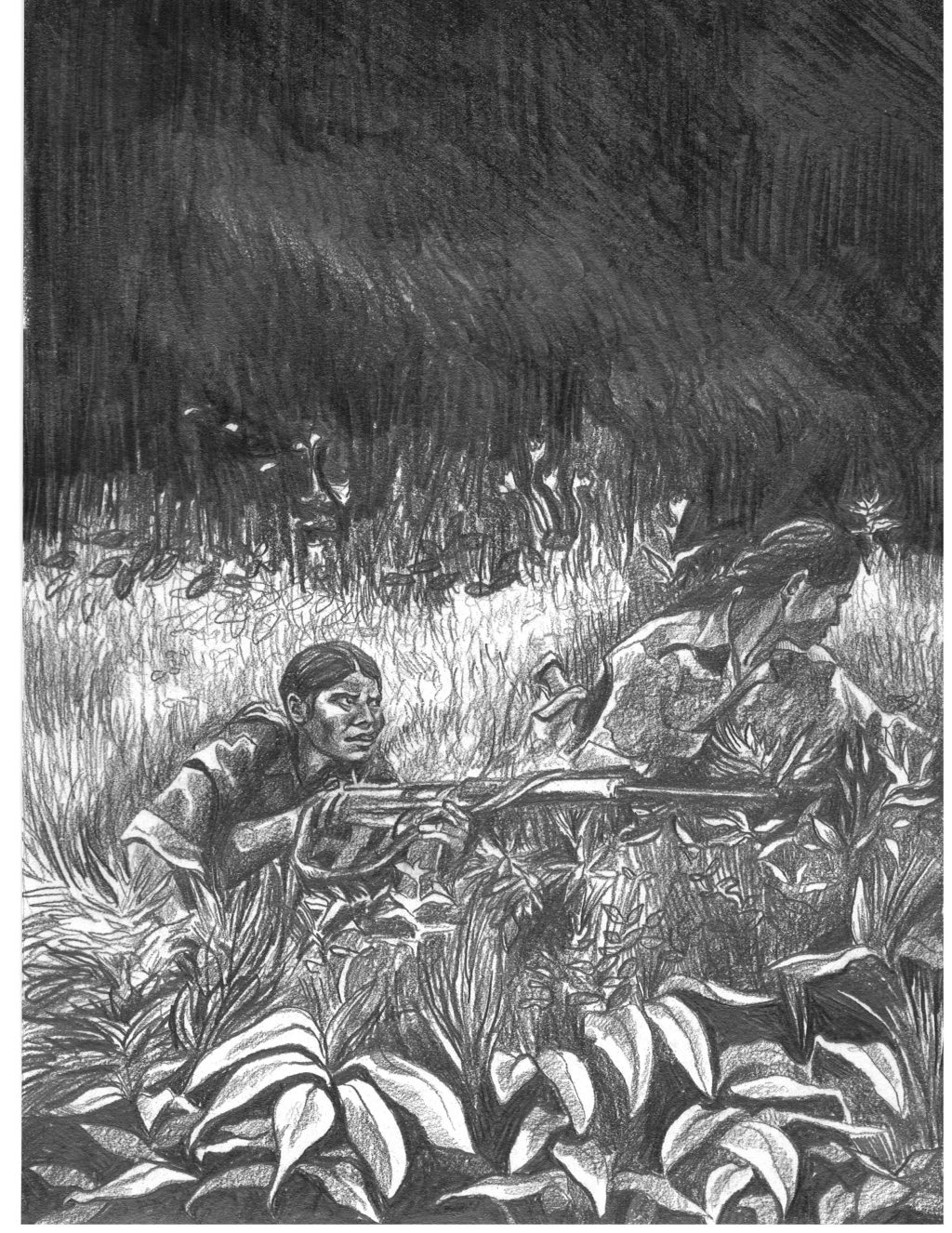
As Indian revolutionaries developed guerrilla warfare in the 1980s, they found the Dandakaranya forest region, populated by the Adivasi indigenous people, to be a good place to escape from government forces and develop a mass base of support. The Adivasis, numbering over 100 million, live on the periphery of Indian society, suffer high rates of disease and malnutrition, and are neglected and bitterly exploited by the Indian bourgeoisie. Like the peasants of Naxalbari, the Adivasis of Dandakaranya are a prime social base for revolution. Through years of waging class struggle and integrating with the Adivasi masses, the CPI(ML-PW) was able to build a base of support in the Dandakaranya region. The Indian Forest Department (which owned much of the land and regularly beat people and raped women) was beaten back, new forms of local people’s government under communist leadership were established, and women were brought into the revolutionary struggle.
In 2004, the CPI(ML-PW) merged with another organization waging armed struggle, the Maoist Communist Centre of India, to form a new revolutionary vanguard, the Communist Party of India (Maoist). This merger went a long way towards solving the problem of many separate communist organizations in India unable to unite to take on the enemy together, especially after several small Naxalite groups merged into the CPI(Maoist). When the CPI(Maoist) was founded, it assembled an armed gathering of thousands of guerrilla fighters, outside the eyes of the Indian government, to celebrate the new organization and make its plans for the future.
Today: Dandakaranya and the red corridor
If you’re an Adivasi living in a forest village and 800 Central Reserve Police come and surround your village and start burning it, what are you supposed to do? Are you supposed to go on hunger strike? Can the hungry go on a hunger strike? Non-violence is a piece of theater. You need an audience. What can you do when you have no audience? People have the right to resist annihilation.
– Arundhati Roy
As the communists were building strength, the capitalist-imperialist system had other plans for Dandakaranya. Mining companies began to target the Bauxite deposits under the hills and mountains in Dandakaranya. Bauxite, a key ingredient in aluminum, is extracted and refined through the construction of massive mines and dams. These are environmentally destructive projects that threaten to displace millions of people from their homes to enrich a small number of Indian capitalists and foreign corporations. The imposition of foreign-backed mining and dam projects into the forest means that the revolutionary people’s war isn’t just being waged against local oppressors, but against the central Indian government and the global workings of the capitalist-imperialist system itself.
The Indian state has deployed wave upon wave of counterrevolutionary violence against the CPI(Maoist) and its armed forces, the People’s Liberation Guerrilla Army (PLGA). The government united with the elite section of Adivasi society to build a counterrevolutionary terrorist force to target the people accused of supporting the revolution. They burned hundreds of villages and displaced hundreds of thousands of people. The revolutionaries were able to respond boldly, mobilizing the righteous anger of the masses. In one particularly brilliant 2007 action, the communists were able to attack 80 police officers who were camped out at a girls’ hostel and using the girls as human shields. By cordoning off the area where the girls lived, the PLGA was able to kill 55 police officers and leave the girls unharmed.
In 2009, Indian Prime Minister Manmohn Singh called the communist revolution “the greatest internal security threat to our nation.” From their base in Dandakaranya, the CPI(Maoist) had influence across large parts of central and east India—a red corridor of revolutionary activity. Since that time, waves of violent government repression against the revolution have sprung up under new names, such as Operation Green Hunt and Operation Kagar. India is now governed by the extremely reactionary politics of Narendra Modi. The Modi government has given the military and the paramilitary forces license to militarize the Dandakaranya region, clearing out the traditional inhabitants of the forest, whose very existence stands in the way of the Indian bourgeoisie handing over the wealth of the country to corporations.
These counterrevolutionary operations make no distinctions between civilians and combatants. Revolutionaries are targeted in fake “encounters,” in which government and reactionary forces kidnap and assassinate revolutionaries and then stage the scene to make it look like a military battle took place. Whole villages are burned, women are assaulted and raped, children are killed, and the government has even begun using aerial bombardment against its own citizens. It’s a great achievement that the revolutionary movement has survived in the face of this counterrevolutionary onslaught, and a testament to the faith the masses have in the CPI(Maoist) and the people’s army it leads, because no revolution can survive without the support of the people.
In the face of truly horrific destruction by the Indian government, the revolution has achieved great things. Cultural troupes travel from village to village, inspiring the masses with theatrical and musical performances with a revolutionary message. Women participate in the revolution, including in the PLGA and the leadership of the CPI(Maoist), and communist-led women’s organizations have spread among the Adivasis, fighting against forms of patriarchal oppression in Adivasi society and leading women to physically confront the police who routinely rape Adivasi women. Where they have influence, the communists have opened schools, provided medical care, and worked to repair ecological damage. Most importantly, they have established new forms of revolutionary political power and people’s government, where the masses can begin the process of administering society, building the seeds of the new society inside the shell of the old.
Because they dare to make revolution, the communists in India are hunted down by high-tech surveillance and modern-day death squads. While they have faced setbacks due to intense repression, the revolutionary people’s war persists, with the goal of seizing nationwide power and radically transforming the whole country as part of the world revolution.
One of the leaders of the CPI(Maoist) was a woman named Anuradha Ghandy. Anu, as her friends called her, went to college and could have lived a comfortable middle-class life. Instead, she undertook the great personal sacrifice of joining the revolution. She integrated with the Adivasi masses, and was famous for giving lectures and classes on revolutionary politics to women fighters and the masses. While living in the jungles and forests, subsisting on whatever food they could find or were given by the masses, Anu sharpened the political outlook of the CPI(Maoist), writing on caste and women’s oppression, and helping bring new women into the leadership of the vanguard party. Because of the hard life of a revolutionary, Anu developed health problems and died of malaria at age 54. The life of Anuradha Ghandy is one example of the millions of people who have been transformed by decades of revolutionary struggle in India, from peasants and Adivasis taking up the gun against their oppressors to urban intellectuals going to the forest to join them.
The revolutionary spirit of Naxalbari and Dandakaranya is urgently needed in the US. Revolution in a country like the US feels, at times, like an impossible task. Revolution must have felt the same way to starving peasants in Naxalbari who stood up to the landlords and the police in 1967. It must feel that way at times to the revolutionaries who confront the mining corporations and the drones and death squads that serve them in Dandakaranya. Yet the Naxalites in India have been brave and made revolution possible through hard struggle. People in the US who want revolution, who want to overthrow this rotten system, need that same courage and determination to go up against what seem like insurmountable odds, until we change those odds through hard struggle. While the revolutionary movement in the US is far behind the comrades in India, fortunately, the Organization of Communist Revolutionaries (OCR) in the US is leading the way in laying out a strategy and training people to become revolutionaries in the belly of the beast. From Naxalbari to Dandakaranya to the exploited and oppressed in the US, let’s spread the revolutionary spark of Spring thunder!
 Going Against the Tide: A journal charting a path for communist revolution in the US