
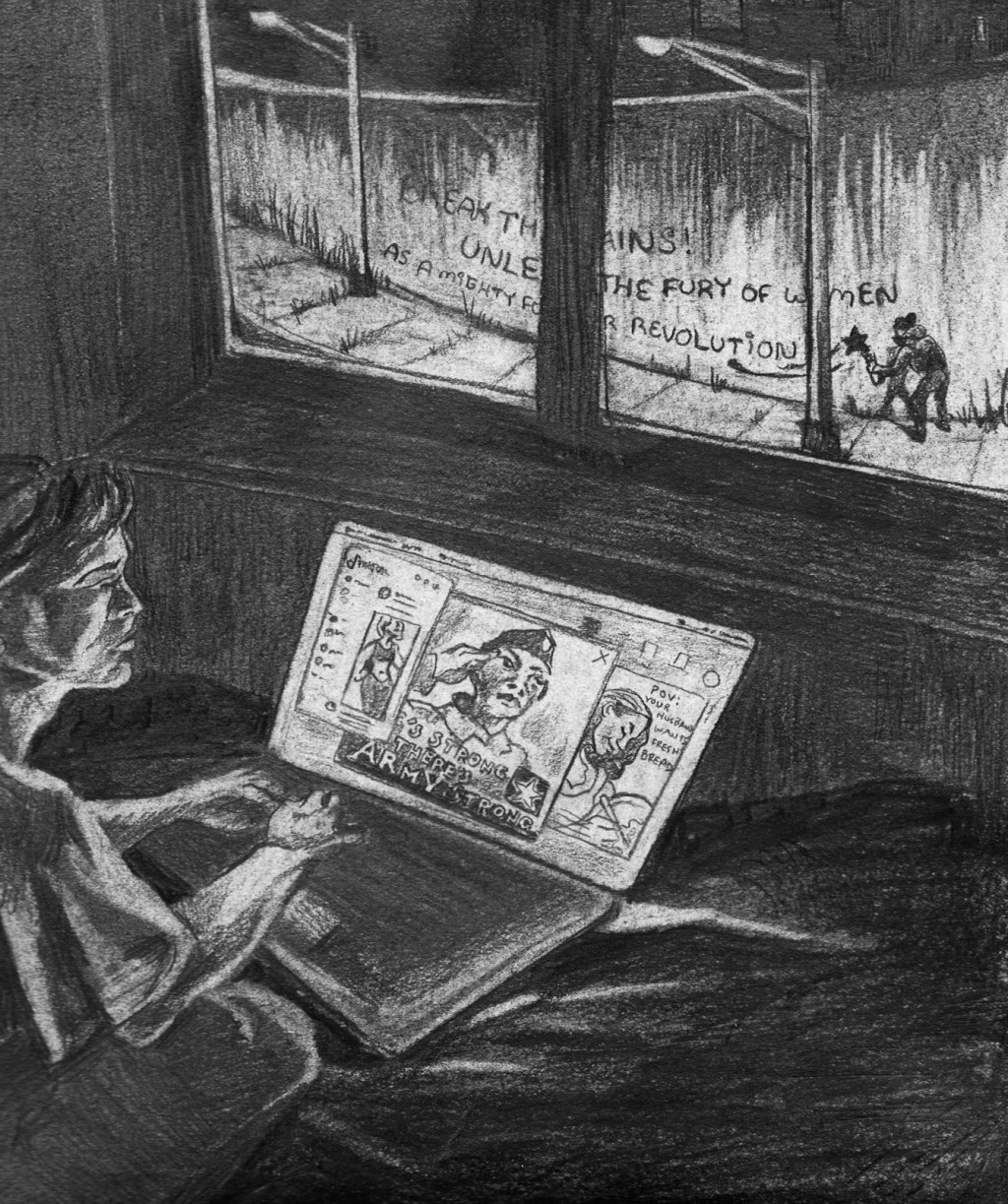
GATT pamphlet series, published March 2025
Click here to download a PDF for distribution.
Under capitalism-imperialism, women are subjected to patriarchy, degradation, and violence, from harassment in their workplace to domestic abuse at the hands of a romantic partner or other family members. In all corners of society (on the street, at work, at home, or at school), women face sexual assault, rape, and even murder, regardless of their socioeconomic background. Globally, nearly 1 in 3 women have experienced physical and/or sexual violence at least once in their lifetime. While the feminist movements of the 1960s and 1970s were able to win some victories for women’s equality, such as the legal right to abortion and the ability for women to join careers previously only reserved for men, women are are still oppressed as women and far from being viewed and treated as equal members of society. These legal victories can improve the lives of some women, but they can and have been reversed, and they cannot, in and of themselves, root out centuries of patriarchal thinking.
The reversal of Roe v Wade by the Supreme Court in 2022 and the subsequent restriction to access to abortions and contraceptives in many states is one example of the reassertion of patriarchal authority over women’s bodies. In the absence of a revolutionary movement, longstanding forms of women’s oppression such as prostitution, pornography, and the objectification of women in Hollywood and advertisements go unchallenged. These forms of women’s oppression have been exacerbated by the rise of digital technology and social media, while new forms have also sprung up in recent decades due to the creations of the tech bourgeoisie.
The bourgeoisie is the class that owns everything people need in order to survive. They gain their wealth through the exploitation of the propertyless classes and rule society through their control of all major social and political institutions. The tech bourgeoisie runs the global technology industry, and therefore has considerable influence over the masses through the internet and social media platforms. The bourgeoisie uses this influence to ideologically disarm the masses and hold them back from fighting their oppression. Through their concerted effort, bourgeois ideas about women’s empowerment have become increasingly more prevalent, obfuscating the reality that women continue to be an oppressed group and that their liberation can only be won through communist revolution.
OnlyFans, only a new way of exploitation
Millions of proletarian (propertyless), immigrant, and trans women have no option but to resort to prostitution to meet their subsistence. Locked out of formal ways to make income, they risk their lives on the street in a world that views them as disposable. In fact, prostitutes are 60–100 times more likely to be killed than non-prostitutes. Instead of being up in arms about these realities, some so-called radicals who claim to champion women’s liberation have decided to promote the slogan “sex work is work” (with sex work encompassing prostitution, pornography, stripping, and other in-person and digital forms). At best, they claim to want to destigmatize sex workers, and, at worst, they celebrate one of the most pervasive forms of women’s oppression. The peddlers of this slogan, who are either naive or ideological partners of the bourgeoisie, often go so far as claiming that sex work is liberating and empowering for women who do it, upholding the experience of the small percentage of (petty-bourgeois) women who do sex work with relatively free from coercion. This obfuscates the experience of women and girls who are trafficked in the sex trade or are otherwise under direct coercion, or who sell sexual access to their bodies out of desperation to meet their subsistence needs (indirect coercion), in circumstances which put them at risk of violence or death.
In recent years, the tech bourgeoisie has promoted new ways of doing sex work that claim to give women self-control of commodifying their sexuality. OnlyFans is a pay-per-view internet subscription service that hosts content creators and is especially popular for users selling and buying pornography. The platform rose in popularity in 2020 due to the job loss and financial struggles caused by the COVID-19 pandemic. This new technology makes it easier than ever to commodify self-sexualization and normalizes exploitation of women under the guise of self-employment and entrepreneurship.
The idea that the best way a woman can make money is by selling her image or body, and that any woman can achieve financial freedom if she’s willing to do so, is consistently reinforced online. Instagram has long proliferated the use of women’s sexuality and bodies to sell products as social media influencers. The most successful of these influencers will show off luxury possessions and vacations, glamorizing their petty-bourgeois lifestyle and making women and girls aspire to influencer careers. This encourages women and girls to expose their bodies online for popularity and business opportunities, and also preys on the insecurities of women to sell beauty, fashion, and “health” products.
The proliferation of using women’s bodies to sell products online has paved the way for the normalization of women as the product themselves. Because OnlyFans (OF) requires its creators to advertise on mainstream social media platforms to gain subscribers to their OF page,OFcareers are heavily promoted on Instagram and TikTok. This promotion includes glorifying the luxurious lifestyles they’re afforded through their self-exploitation, and in some cases the exploitation of their peers in the sex trade.
Celebrities have also greatly contributed to the popularity of OF, but despite the glamorization and glorification mentioned above, the over-saturation of the platform means there isn’t equal opportunity to make income for all creators. Actress and model Bella Thorne broke records on the platform when she made one million dollars in her first 24 hours on OF. Sopranos star Drea de Matteo credited OF with saving her home after joining the platform made her enough money to pay off her mortgage in just five minutes. Women like Thorne and de Matteo are able to make millions from OF because of their status, while the majority of women need other sources of income, including in-person sex work, in addition to OF just to make ends meet.
Still, the fantasy of financial freedom and liberation persists, and it is the tech bourgeoisie benefiting the most from those buying into this fantasy. OF’s owner, Leonid Radvinsky, made over a billion dollars in his first three years owning the platform—no matter how much this or that OF creator makes, the one profiting the most is the sleazebag bourgeoisie at the top. The celebration of OF as a way for women to gain their autonomy, sexual expression, financial freedom, and even their liberation (what the fuck?) clouds the dark reality that the original forms of women’s exploitation still exist. Old school pimps utilize OF to their advantage, and some women are forced to make content on the platform by pimps or abusive partners. Selling adult content on a platform like OF is promoted as a better and safer alternative to working for a traditional pornography company or other types of in-person sex work, with the touted benefit of being your own boss, though many OF creators still need to work the streets to sustain themselves. Women do not need better, more efficient ways to be exploited and their greatest aspiration shouldn’t be to own their own chains, but rather to break free from them, and get beyond commodity relations entirely.
So you wanna be a girlboss?
If you’ve ever been online or watched TV, you’ve definitely heard the term “girlboss.” Women in high ranking positions in the bourgeoisie, such as CEOs and politicians, are celebrated and propped up as role models and representations of women achieving equality. From the bourgeois perspective of women’s empowerment, being a CEO or businesswoman is the greatest aspiration a woman can achieve, as this means she’s succeeded in becoming a capitalist. Impoverished girls and young women are indoctrinated through these role models, the internet, and the media to strive toward an entrepreneurial future. This ideology convinces people the only way to get out of poverty and have a good life is by becoming an exploiter, inevitably exploiting other women in the process. Today there are more women in positions of power or at the helm of major companies than ever before, and this hasn’t fundamentally improved the lives of the majority of women. Buying into capitalist ideology means women in this position must strive for profit no matter how it might affect other people, including other women they may have shared conditions with.
Among the most egregious examples of a girlboss is Bryce Adams. One of OF’s top earners, Adams runs an adult content company that employs two dozen young women who work on her multi-million dollar compound making explicit content and chatting with OF clients to maximize profits from the platform. The company brings in ten million dollars annually, with Bryce making about $30k a day. This goes beyond any individual women’s decision to sell her own body, with people like Bryce exploiting other women for her own profit. This includes taking advantage of women as young as 18 years old who become interested in digital sex work to pay for college or other personal aspirations. In this case, Adams takes on the role of a pimp under the guise of female entrepreneurship. Only a few women are able to achieve this capitalist goal, and while it may bring them individual success by bourgeois standards, it does not free them from having to compete within the system of commodity relations where there is still inequality between men and women. Instead, the success of these women is used to further indoctrinate the masses that this is the way out.
The music industry’s promotion of sexual self-exploitation as empowerment
Music, like all pop culture, has significant influence on the masses. This can be positive, with music often highlighting political struggles. For example, hip-hop has long articulated the experiences, struggles, and aspirations of Black and Latino youth in the hood and protested the mass incarceration and violence they face at the hands of the bourgeois state. It’s no surprise that these aren’t the stories being amplified by the music industry, which instead promotes the male artists who have the most explicit, degrading lyrics about women, glorify the mistreatment of women, and objectify them in their music videos. This, among other cultural trends, contributes to the idea that men must dominate women and use them as sexual pawns in order to be considered successful and masculine, especially to other men.
The oversaturation of male rappers with misogynistic views about women understandably moved female rappers to challenge the way they were viewed in hip-hop, wanting to flip the script on the sexualization of women by men. Increasingly, many female rappers, such as Nicki Minaj, Cardi B, and Megan Thee Stallion, have put their sexuality at the core of their music and brand, and for this reason they have been touted as champions of women’s empowerment. Female rappers having graphic lyrics about themselves and dancing provocatively is promoted by the music industry as a subversion of the degradation women face from men. The desire for commercial success drives female artists, who are heavily scrutinized for their physical appearance, to take on a more sexualized persona because the music industry rewards those who conform to this image in a highly competitive industry. This applies to female artists in all genres, but Black female rappers especially, as men make up the majority of rap’s target audience and music executives profit from the sale of men’s sexual fantasies. The sexualization of Black female rappers is but the latest manifestation of the longstanding sexualization of Black women in the US in all facets of their life, including in popular culture.
The most popularized media depicts women from the male gaze and showcases them within only the boxes that are deemed acceptable in patriarchal society. Mainstream media typically involves caricatures of women that lack nuance, often depicting women as either repressed, submissive housewives or sexually empowered bombshells, with the latter character enjoying much more independence. Both of these shallow representations of women not only exist to serve men, but contribute to the false idea that sexual empowerment equals liberation, and this idea has been heavily promoted through female rappers today, often making up the main lyrics and visuals of their work.
Female rap that uses women’s sexuality as the main weapon to free women from men’s oppression has negative social consequences for the women who consume these songs and music videos. Young girls and women are taught to hyper-fixate on their physical appearance and strive for whatever is considered sexiest at the time, even turning to plastic surgery, and that their worth is based on their ability to appeal to men. It also further reinforces the idea that women are objects to be sold, in this case by the record label moguls, and that women can and should become successful by exploiting themselves and their image. The lyrics and themes that often represent a powerful woman as someone who gets one over on men and other women do nothing to improve social relations between men and women, and encourage women to compete with one another. Female MCs from the 1980s to the early 2000s, like Queen Latifah, Missy Elliot, and Lauryn Hill, rapped about issues such as violence against women, the objectification of Black women’s sexuality, and other daily challenges of women’s lives from harassment on the street to the difficulties of motherhood. We need more music that humanizes rather than objectifies women and collectively empowers us to fight for our liberation.
A revolutionary model of women’s empowerment
The bourgeois ideas about women’s empowerment that are most popular today, from self-sexualization to girlboss feminism, have not brought women any closer to being liberated from their oppression. These ideas, which are rooted in individualism, might help some women get ahead in society, but do not challenge the conditions women as a whole face everyday. While it is true that historically, women’s sexuality has been wrongfully repressed and demonized, the models of sexual empowerment propagated by the bourgeoisie haven’t actually freed women from social oppression by men, or freed them from the bourgeois ideals about what femininity and womanhood should look like. This model of women’s sexual empowerment serves to normalize one of the longest standing forms of women’s oppression, the selling of women’s bodies for male gratification. Whether you’re owning your own chains or the chains of others, these forms of women’s empowerment force women to remain within commodity relations, and therefore playing the same game that keeps women oppressed.
Playing the bourgeoisie’s game clouds the fact that the bourgeoisie as a class is the primary enemy that is standing in the way of true women’s liberation. Women’s liberation can only be achieved collectively, through the overthrow of the bourgeoisie and a revolution that not only ends class divisions, but transforms the hearts and minds of people so that through struggle they can shed the baggage of the old society together. Women can, and should, set their aspirations far higher than that of individual success and dedicate themselves to world revolution. If women stand together with the women and all the exploited and oppressed people of the world, we can pave the way for a new future where women can finally lead fulfilling lives and achieve their aspirations without exploitation, coercion, and violence—a communist future where women, men, and all of humanity live together as equals.
 Going Against the Tide: A journal charting a path for communist revolution in the US