
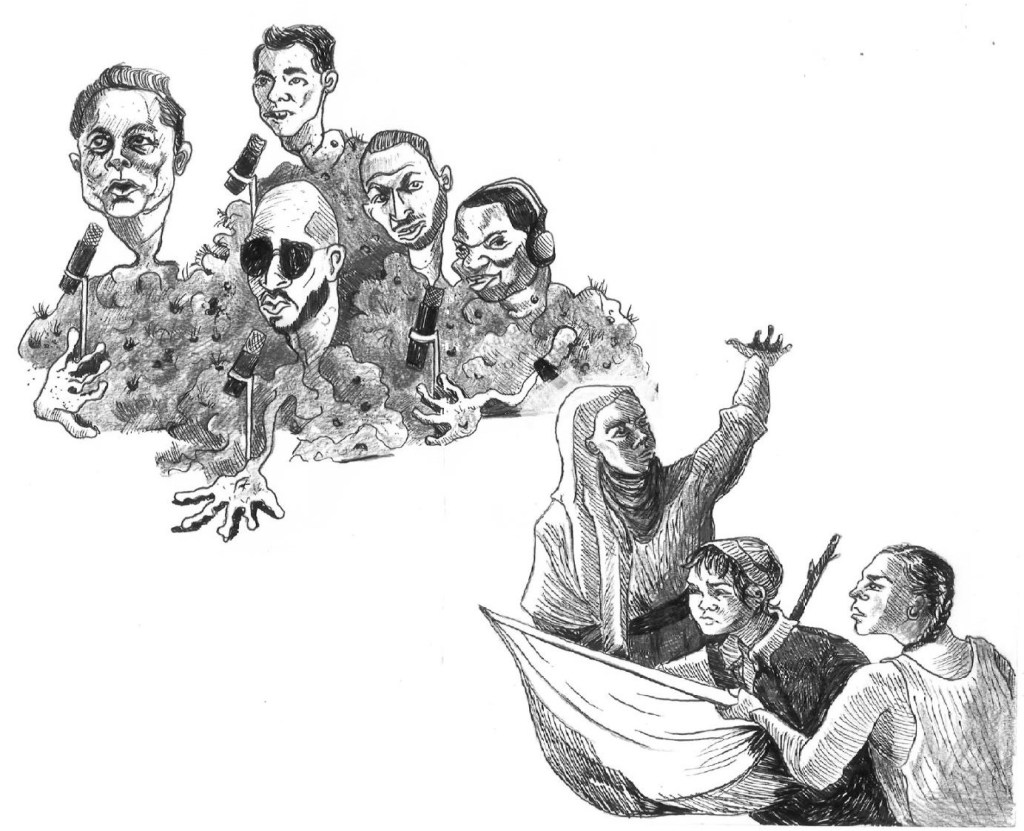
GATT pamphlet series, published March 2025.
Click here to download a PDF for distribution
It’s 2025. A cabal of rapists has set up shop in the White House. For months, trans teenagers on hormones have had their life-saving medications taken away from them. Now, Trump is trying to do this to trans teenagers across the country. In Texas and other red states, tens of thousands of women have been forced to give birth against their will due to anti-abortion laws. Women suffer an epidemic of domestic violence, behind closed doors, feeling completely alone. Women’s bodies are sold for sex on a massive scale, from street prostitutes, to pornstars for OnlyFans and PornHub, to trafficked “masseusses,” to maids harassed for sex. In all spheres of society, from college campuses to public transportation to nightlife, young women live in constant fear of being sexually harassed, raped, and even murdered. In the hood and on the rez, every week a new poster goes up, blaring out in black, white, and red bold text the same message: another young, poor, Black, Brown, Indigenous woman, missing… The faces of millions of women and LGBTQ people start to blend together into a single mass: over half the population is subjected to the daily horrors of a world of systemic sexism, patriarchy, homophobia, and transphobia.
And yet this oppression is still assumed, celebrated, and even actively promoted in the halls of political power and on the media. Popular culture is permeated with images that treat women as sex objects and celebrate rape, sexual harassment, and domestic violence. Men and boys openly chant “No means yes.” Manosphere influencers like the arch-misogynist Andrew Tate spew vile sexist propaganda, openly spread anti-woman and anti-LGBT hate, and promote a masculine ideal of rich men who exploit, cheat, and rape.
Andrew Tate is in many ways a concentration of all the worst aspects of the patriarchy into a single man. His influence cannot be overstated: Tate, a kickboxer-turned-pimp-turned-influencer, headed a massive network of misogynists promoting his content with tens of billions of views on TikTok and other platforms and a cult following among young men and boys. His unapologetic, outrageously masculine aesthetic dazzled their eyes: his muscly physique, scenes of wealth and glamor, chomping cigars, wielding machetes, driving fancy cars, and spinning nunchucks. His words cut to the innermost insecurities of his fans: you are weak, you are a “Beta,” a “soy boy,” a “cuck,” and unless you change, you will never find wealth or love. He offered a clear enemy: feminists, gay people, nonbinary people, and trans people, but most of all, “bitches”: ordinary women who refuse to act like a slave to men and boys. And he offered a solution: with hard work, discipline, and a small fee of $50 a month, men and boys could join his online platform Hustlers University (later “the Real World”), learn to get in on his grift, and make money pumping out Andrew Tate content online, spreading his message of anti-woman hate and male insecurity to the world.
But Tate’s day job was as a pimp, sex trafficker, and professional rapist and fraudster. Tate and his brother trafficked women to Romania, a country with especially loose laws on consent and the sex trade, and made them “slaves” for their OnlyFans business, raping them and incarcerating them with armed guards and CCTVs. This was a step too far and an embarrassment for the Romanian authorities, who finally stepped in and arrested the Tate brothers, putting them on and off house arrest for years. Tate’s crusade for his own freedom to rape and exploit young women is not over: on January 14, 2025, he was released from house arrest and allowed to roam around Romania while his case proceeds. The US government has been attempting to sway Romania into giving Tate, an American citizen, the freedom to travel to other countries. Even the arch-rapist of the world is getting away with his crimes with nothing but a slap on the wrist.
Tate is a perfect example of revanchist masculinity: men wanting to violently and directly take back their patriarchal right to treat women as domestic and sexual slaves and punish those who step out of line. And despite Tate’s legal struggles, the broader movement of revanchist masculinity has gained great political influence, with manosphere podcasters like Joe Rogan and Tim Pool garnering a cult-like following among masses of young men and boys from different classes and nationalities, but especially among white men of the downwardly mobile petty-bourgeoisie (popularly known as the “middle class”) and well-paid sections of the working class. To understand this movement, we need to go back in history to the time that many of these revanchists want to bring us back to, the 1950s, and work our way back from there.
“When men were men”: The golden age of capitalist patriarchy
In the 1950s, the United States was in the “Golden Age of Capitalism.” After conquering half the world for US imperialism in World War II, the US bourgeoisie created relative social stability in the homeland by sharing some of the spoils of imperialism more broadly throughout the population. Millions of workers—mostly white men—had well-paying union jobs. They could afford to buy a new car to get to work from his single family home in the suburbs for their nuclear family: a man, his wife, and his 3.44 children (3.44 was the fertility rate in 1955, according to the Bureau of Labor Statistics). While the husband was bringing home the bacon from his job, his wife was at home doing her unpaid job: birthing and raising her children, preparing food, cleaning, shopping for the family, and cooking. And when her husband got back from work, her work day was not yet done: she still had to serve food, wash dishes, play with the children, put them to bed, and have sex with her husband.
Millions of men and women lived in their separate spheres. The world of productive labor, making and building things for use and consumption, was mostly the domain of men. The world of reproductive labor, involving tasks such as raising children, “housework” such as cooking, cleaning, and laundry, basic education, and caretaking, was mostly the domain of women, whether paid as wage work or, more often, completely unpaid. The LGBTQ people who didn’t fit into these rigid binary gender roles were ruthlessly persecuted and forced to live “in the closet,” hiding who they were from society. This order was maintained by laws that banned abortions, companies that limited women from many jobs, cops that trashed gay bars and raided drag ballrooms, and a broader culture that treated women as second class citizens and LGBTQ people as dangerous lunatics.
Women did not all want to slave away at home as housewives. Many preferred to work outside the house and be independent. But most women could not enter the workforce because they were chained to their homes. Many a man would not be seen letting “his woman” run off and make money in the outside world. Most bosses would not hire young women at all for anything outside the narrow confines of “women’s work,” such as being a secretary. Women were very openly discriminated against in hiring and in pay, and and rampant sexual harassment pushed women out of jobs.
Out of the kitchen, into the street
But changes were afoot: women were entering political life in greater numbers in the 1960s, fighting for their rights to equal protection under the law and agitating against the humdrum existence of housewifery. Feminists organized “consciousness-raising” groups to talk about their oppression and how to fight back. Women fought for a place at the cutting edge of social change in revolutionary organizations like the Black Panther Party, the Young Lords Party, and Students for a Democratic Society. They played a key role in successful struggles to demand the government meet the survival needs of the proletariat through welfare and social programs. For example, the first government program of free breakfast for children was started explicitly as a counter to the Black Panthers’ own highly successful free breakfast for children program that was feeding kids and winning hearts and minds for the Panthers. This breakfast program was largely administered and staffed by Black proletarian women.
Facing mounting pressure, the government outlawed sex discrimination in the Civil Rights Act of 1964. With the birth control pill proliferating and giving women unprecedented control over their own bodies, the movement to legalize abortion gained steam until Roe v. Wade finally legalized most abortion across the country in 1973.
Women can do anything a man can do
In the 1970s, the United States ruling class was rocked by a deep crisis brought about by a decline in the profitability of industrial manufacturing firms at home, the overextension of the American empire abroad, and the revolutionary upsurge of the 1960s. These developments had made young proletarian men an unruly population, difficult for the ruling class to exploit. For profits to keep expanding, someone would have to pay.
The bourgeoisie sharpened their knives. For the past fifty years, the US bourgeoisie has punished the proletariat with mass layoffs of workers in the factories, the slow dismantling of the welfare state, and the incarceration of masses of men in prisons. If American men wouldn’t take the new dead-end jobs that were the only thing on offer, then proletarian women (along with immigrants) would have to fill the gap. In many ways, this was an obvious choice: proletarian women were less organized into labor unions than men, and were doubly oppressed by labor exploitation and patriarchy. After thousands of years of being told to keep their head down and take abuse, and after decades of being sidelined from resistance movements, proletarian women had the potential to be a much more docile and readily exploitable workforce than proletarian men. And with automation changing the nature of manual labor, the physical differences between men and women didn’t matter so much anymore. As Mao Zedong said, “Times have changed. Men and women are the same. Whatever men can do, women can do, too.” Bringing more women into the workforce also had the effect of flooding the labor market, enabling the bourgeoisie to lower wages and thus increase profits for themselves.
These developments laid the groundwork for women to enter the workforce on a greater scale than ever before, with the most gains in the 1970s and 80s, and the proportion of women in the workforce peaking at the turn of the century (according to Bureau of Labor Statistics). Bowing to political pressure and economic necessity, the US government invested in the socialization of reproductive labor. Prior to recent decades, children were mostly conceived, carried, birthed, raised, fed, and educated at home, within the confines of the patriarchal nuclear family and under the supervision of the “man of the house.” Increasingly, however, children are parented by society at large through the state and private businesses as much as they are by their parents. Daycares and schools expanded. Kids spend more hours in a day and more years in their life at school than ever before. Employers increasingly provided maternity leave and medical insurance. Welfare programs covered basic nutrition for families, often with work requirements. These changes made families far less reliant on women’s unpaid labor for the basic physical requirements of reproducing society via their role as mothers and wives in the nuclear family. Consequently, many women were freed up to work outside the home and make profits for the bourgeoisie.
So, where would the newly freed up women workers go? Starting in the 1970s, with manufacturing increasingly offshored to oppressed countries around the world, the service industries became a growing part of the US home economy. Restaurants, hotels, and hospitals became mass employers of mostly women. They were performing the same servile labor but outside of the home. With women no longer chained to the household, men could no longer rely on them to always serve them food and drink, clean the house, and have sex with them for free. These acts of reproductive labor were commodified too: for more and more men, if you want food service, cleaning, or sex, you have to pay for it.
The loosening of traditional gender roles also created an opening for LGBTQ people to assert their rights and take the political stage. Social movements like the fight to protect LGBTQ people from the HIV/AIDS epidemic in the 1980s and 90s and the struggle for gay marriage gained major victories, with HIV now a treatable illness, gay marriage legalized across the country, and wider acceptance of gay people’s right to exist.
Loosening traditional gender roles also paved the way for the mass entry of women into professional and managerial positions within the petty-bourgeoisie (and not just as secretaries, teachers, and nurses), and even within the bourgeoisie as CEOs and owners of major companies. Women had 23.9% of bachelor’s degrees in 1950, 49% in 1980, and now actually outnumber men in the universities (according to the National Center for Education Statistics’ Digest of Education Statistics). Feminists such as Gloria Steinem became household names, and female politicians like Madeleine Albright, Hillary Clinton, and Condoleezza Rice gained unprecedented power and prestige. More and more industries started gradually letting women into fields previously reserved for men.
The backlash
But for millions of men of the middle classes, this new economic and social order taking shape was a bitter pill to swallow. No longer could men rely on stable employment, upward mobility, and a high standard of living. No longer could men rely on women working, without pay, day in and day out to service their needs. These conditions of life were previously considered the natural birthright of American men. Now they were a privilege reserved for the few who made it into upper positions in the class structure.
The revanchist backlash started early. In the 1970s and 80s, evangelical Christians like televangelist Jerry Falwell entered into an alliance with the Republican Party, and undertook mass propaganda campaigns to push their reactionary anti-woman and anti-gay ideas firmly into the political mainstream. And they found an audience in men who were afraid of the social changes that were affecting their class status and their access to the unpaid reproductive labor of women.
This audience has only grown with the decline of the middle classes, deindustrialization, the 2008 recession, and COVID. Today, millions of young men in the United States are restless. They are unemployed, underemployed, overworked and exploited, or not making as much money and achieving the same status as their fathers did. They live a cramped existence in their parents’ home or in a bachelor pad where they struggle to pay rent. They are lonely: they don’t have girlfriends, and they don’t have sex. The most oppressed among them are hounded by the police and treated like criminals. Many find solace in drugs, alcohol, video games, and social media.
For these boys and young men, this state of affairs amounts to a promise by society broken into pieces. From a very young age, boys are told about the American Dream: if you work hard, you’ll have a job, a house, a girlfriend, and a car, you’ll be able to vote for whoever you want, and everybody will respect you. You’ll have wealth, freedom, love, and happiness. But every year they grow up, they start to see more and more cracks in this facade…
Who do they blame? A chorus of voices sing the same tune: it’s not the fault of the ruling class—the capitalists, landlords, and politicians who actually control this syem. It’s the fault of women, LGBTQ people, and weak effeminate men. Online revanchist ideologues peddle a vision of strong, rich, masculine men, who make money, get what they want, and put women in their place by violent force.
These “alpha males,” they claim, are the natural rulers of society, but have been pushed aside by the decadence of modern society, with feminists and effeminate men taking their place. They use a host of conspiracy theories to peddle their ideological poison, from the idea that soy contains estrogen that makes men more feminine to the idea that fluoride or vaccines or seed oils or office jobs or any number of things is responsible for “men no longer being men.”
But most of all, they rail against women: they view women as naturally weaker, less intelligent, more “emotional,” and less capable of reasoning or leadership than men. This, they explain, is why women have had a secondary place in society for so long, and why it is only right that women be treated as second class citizens and be economically and sexually exploited by men. One of the most vile expressions of this mentality comes from Andrew Tate, who insists that we “stop pretending normal male behavior is rape.”
Any examples of women being treated like human beings are seen as evidence that women are actually dominating or oppressing men. Women who so much as speak up against, say, the objectification of female characters in video games, are mercilessly persecuted online and offline, facing death threats, stalking, and, ironically, cancellation by these “men’s rights activists.” That’s exactly what happened in the famous Gamergate harassment campaign that targeted feminist video game critic Anita Sarkeesian and other online feminists.
Revanchist masculinity has spread online like wildfire over the last decade, from the darkest corners of the internet such as 4chan to popular posts on mainstream social media sites like Twitter and TikTok. Some who are radicalized online to hate women and LGBTQ people turn their bigotry into violence, with many a mass shooter motivated in large part by revanchist masculinity. Beyond the internet, revanchist masculinity has taken real-life dimensions in organized fascist groups such as the Proud Boys, whose members mobilize to harass LGBTQ events and look for street brawls wherever they can find them, with the police largely allowing their violence to go on unimpeded. And revanchist masculinity is by no means a fringe trend, with many officials in the Trump administration and in state and local politics fully on board with this ideological poison and giving it official legitimacy.
The new patriarchal order was summed up by Trump’s famous line: “When you’re a star, they let you do it… Grab ’em by the pussy.” Rich men can trade their wealth and social prestige for women’s time, reproductive labor, and love, and they can get away with rape and harassment. This is why the misogyny and the get-rich-quick schemes of these revanchist grifters go hand in hand: to became a “real man” for these reactionaries means to be a rich man, with the financial power to get away with rape.
Unite to defeat revanchist masculinity!
For the vast majority of men, the promise of wealth, power, and easy access to women’s bodies and labor is an illusion of a bygone era. The get-rich-quick schemes and grifts victimize the young men who fall for them. The insane relationship advice peddled by pickup artists are a total flop: women absolutely do not want TikTok-addled wannabe pimps and cryptobros who think they have a right to their body because some idiot on the internet said so. Chasing these phantoms only makes men poorer, lonelier, and angrier, and thus pushes them even deeper into the rabbithole. When Tate and Rogan’s red pills lose their appeal, some turn to the black pill, declaring themselves incels (involuntary celibates) and blaming women for denying them sexual access to their bodies.
And for women and LGBTQ people, revanchist masculinity is a threat to the rights they still have and an enemy that must be defeated. The religious right has already clawed back the right to an abortion across half the country, and made it harder to access elsewhere as well. Revanchists are successfully waging a mass ideological campaign against the very existence of trans people. Once they convince the country that it’s just fine to forcibly medically detransition trans prisoners and trans kids, it will be that much easier to take away the right for women to choose whether to give birth across the country. When women and LGBTQ people fight for their rights, revanchists routinely show up to harass and terrorize them.
The broad masses of people, especially women and LGBTQ people but most straight men as well, have a shared interest in defeating revanchist masculinity and fighting for a world where people are not divided by rigid gender roles, a world where women, men, and LGBTQ people live and work side by side as equals, where people can freely choose to engage in fulfilling, 100% consensual emotional and sexual relationships with other people without the pressures of patriarchal values, and where the reproduction of society is a collective task undertaken by all who can contribute, not just women, where people get what they need and produce what they can—in a word, communism.
To fully realize a society without the patriarchy, we’ll need to turn this whole system upside down. But we can start by organizing the masses of women and LGBTQ people in the here and now to oppose the oppression they face. From the frat rows of universities where rape culture runs rampant to the urban ghettos where posters of missing and murdered women abound, to the neighborhoods where women suffer domestic violence in silence, to the corners where pimps sell prostitutes’ bodies, to the foster care homes where LGBTQ youth abandoned by their parents suffer virtual incarceration, to the prisons where trans women are being forced to detransition, to the states where tens of thousands of women are being forced to give birth against their will—all across the country, millions of women and LGBTQ people can be mobilized to stand up as equals to straight men, take power from their oppressors, and establish the kind of proletarian authority that can actually prevent and stop instances of gender oppression. Men who want to abuse, harass, rape, and take rights away from women and LGBTQ people must be made to fear the wrath of organized, agitated, revolutionary women and queers and all those who stand with them. Andrew Tate said of his arrest that “you cannot kill an idea.” There’s only one way to find out.
 Going Against the Tide: A journal charting a path for communist revolution in the US