
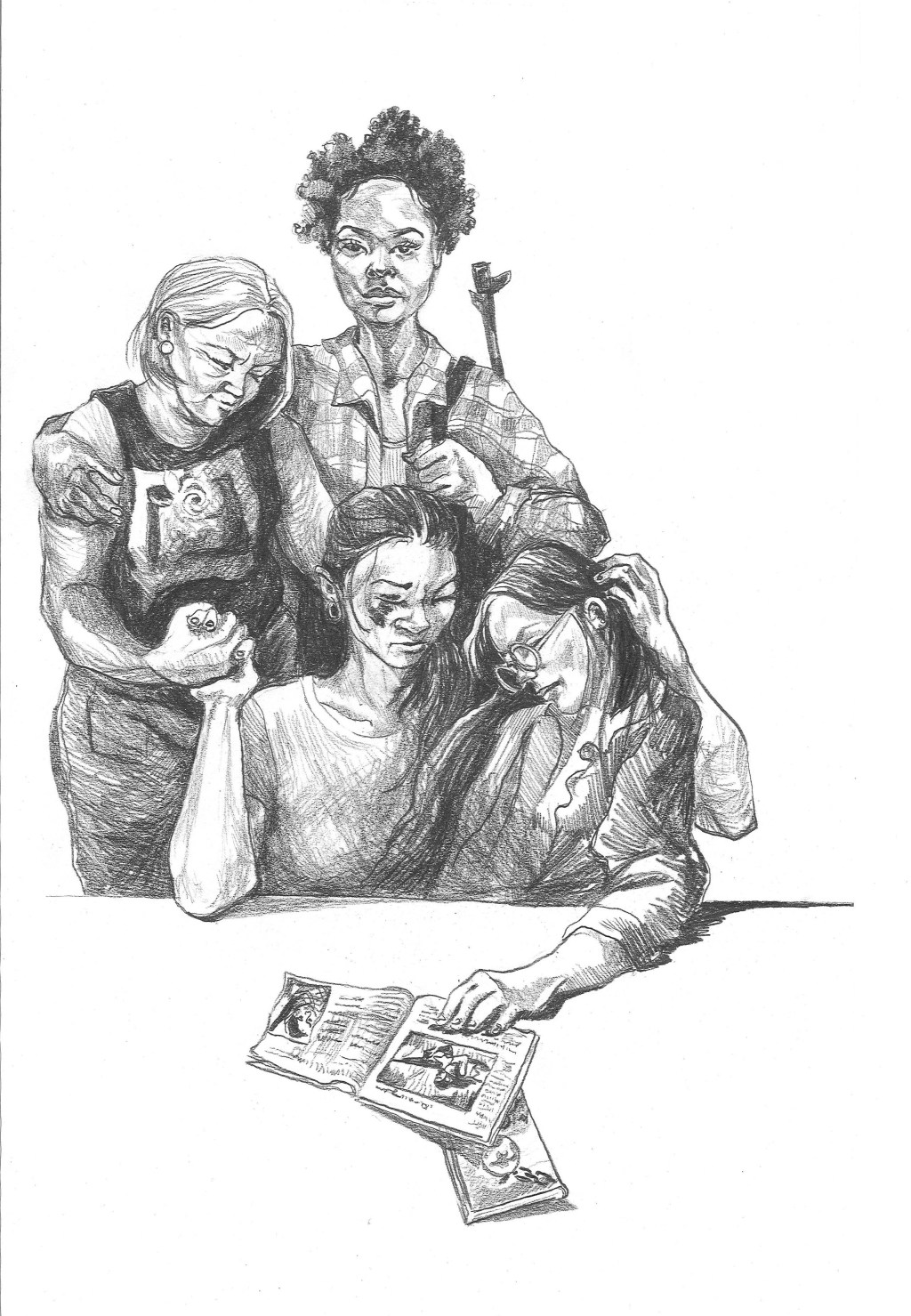
GATT pamphlet series, published March 2025
Click here to download a PDF for distribution.
The first quarter of the 21st century is over, and unlike in centuries past, violence against women is no longer a taboo subject. Since 1920, wife-beating has been formally illegal in every state. A whole network of social services and nonprofits exists to serve victims of rape and domestic violence, and in the 1990s, the Violence Against Women Act created a legal and funding framework meant to aggressively prosecute abusers in the courts and by law enforcement. Domestic violence is a hot topic on social media, and it drives the plot of blockbuster movies. Yet as of 2023, women in the US are more likely to die before the age of 35 than at any other time in the last 50 years; homicide alone accounts for part of this surge in early death, but the other contributing factors, suicide, overdose, and pregnancy related death, are also often connected to abusive relationships. Women are far more likely to be murdered by our husbands or boyfriends than anyone else, and if you’re a woman in the US reading this, there’s a 25% chance you know firsthand what that fear feels like: 1 out of 4 of us are victimized by severe physical violence (being hit, kicked, choked, or threatened with a knife or gun) from a partner at some point in our lives, and many more have been emotionally and psychologically terrorized.
Our mothers’ and grandmothers’ generations fought hard to change their daughters’ lives. So why are so many of us still living in fear? The feminist movement, which gained new strength through the radical upsurge of the 1960s, put domestic violence on the mainstream agenda, and included the rebellion of women across every social class. It was a powerful social movement, but not a revolution that could begin to uproot the oppression women by overthrowing class society once and for all.
The oppression of women across every aspect of life under capitalism-imperialism1 is enforced by violence against women, mostly in our personal relationships as a way to undermine and control us at the most intimate level. Domestic violence exists among every class and every nationality, and it’s a problem that can only be ultimately solved through making revolution. If you’ve been terrorized in your own home, in your most intimate relationship, know that what you’ve been through isn’t an isolated thing. It’s not because of you or even your partner’s unique personal failings, and it shouldn’t be only up to you to fix it. Capitalism, the system we’re all living under, needs violence against women to exist. It’s by overthrowing capitalism that we can end domestic violence for future generations.
What’s at the root of patriarchal violence?
Patriarchy, the oppression of women by men, was the original exploitative social relationship that set in motion the division of human societies into classes. As class divisions became more entrenched, and the division of labor in human societies became more deeply exploitative, different modes of production emerged, such as feudalism or capitalism, with their own forms of exploitation. Through every class division and mode of exploitation that humanity has created, the oppression of women has been at its core. The subjugation of women means that even the most dispossessed man can feel like he has someone to own and oppress. And violence, or the threat of violence, in the home enforces social oppression and keeps women from fully participating in society, economically undermined, and taught through generations of nonstop conditioning to crave our own oppression, to see being “chosen” and kept as male property as the highest achievement of, and justification for, our lives.
What does domestic violence look like today?
The most commonly referenced statistic is jarring: 1 out of every 4 women in the US has been severely physically abused by her partner, but some researchers say that number is actually much higher.2 About 4 women are killed by their partner every day, and 25% of all female homicide victims are murdered by their husband or ex-husband. Meanwhile, although public health agencies have only recently started to collect data on this, a woman’s risk of being murdered increases by 20% if she gets pregnant and in the year after she gives birth, making homicide one of the leading causes of death for pregnant and postpartum women. Young Black and Indigenous mothers suffer the highest rate of lethal violence, more than any other demographic group. In fact, murder is the third leading cause of death for Indigenous women overall. Extractive industries like oil and mining bring new waves of violence, including sexual assault and kidnapping, to Indigenous women, with perpetrators often never prosecuted because of “jurisdictional issues” between tribal and federal agencies. About a third of all children in the US are exposed to violence in their families each year.
These numbers can’t really paint the full picture of how fully steeped in violence so many women and children’s lives are, but they give an idea of the extent to which violence against women is the water we swim in. During the COVID-19 pandemic lockdowns, with households hyper-isolated and abusers given the power to wield complete control, calls to domestic violence hotlines and related calls to 911 went up by 20% in most major cities, and an overall spike in domestic violence in 2020 has not gone back down. In the 1980s, 40% of police officers self-reported that they physically abused their spouse. That study has not been repeated, but for decades, women who go to the police for help often describe the cops as dismissive, sympathizing more with the abuser than the victim, and suggesting that the violence was mutual.
When women kill their partner in self-defense, they are more likely to be convicted of homicide than men who use a self-defense justification, despite the fact that 80% of women incarcerated for killing their partner suffered extreme physical violence from that partner in the year leading up to the killing. Proof of abuse can be used in court as motive for murder rather than a defense, and self-defense laws, especially “stand your ground” laws which are based on the idea of a homeowner defending themselves from an intruder (in a single, spur-of-the-moment instance rather than violence unfolding over time), assume that even if a couple own or rent their home equally, it is by default the man’s home and he has the right to drive the woman out of it. Sometimes these cases make national headlines, like in 2012 when Marissa Alexander fired a warning shot into her ceiling as her ex-husband attempted to break into her home, and was sentenced to 20 years in prison for assault with a deadly weapon. Similar cases are common even though they rarely make national headlines. In 2018, Chrystul Kizer, a Black teenager from Milwaukee, killed a white man who was already under FBI investigation for making child pornography of Chrystul and many other Black children. She was held in county jail for years and in 2024 sentenced to 11 years for homicide. Her case has since mostly disappeared from the news.
In the long term, domestic violence and sexual abuse are some of the most common forms of trauma. The stress causes higher rates of chronic illness, including brain damage from strangling and trauma to the head (which occurs in abused women at even higher rates than football players or boxers) and lifelong mental health issues. At the same time, survivors of abuse may be less likely to seek medical care, either because it’s invasive and triggering or because it might reveal ongoing abuse. When children witness domestic violence growing up, they become much more likely to both suffer from, and commit, domestic and sexual abuse as adults.
“Why doesn’t she just leave?”
Many people ask why victims of domestic violence don’t just leave their abuser. It’s not the right question to ask, mostly because it’s usually asked in bad faith or in an attempt to turn the blame for abuse back on the victim. But the idea that victims of domestic violence are to blame for their own abuse is so prevalent that many women do blame themselves. So why don’t victims of domestic violence just leave?
Women who eventually leave an abusive partner have attempted to leave, on average, seven times, and most women who are murdered by their partners are killed after they leave. Threats of murder, of murdering the kids, or of social and financial ruin if the victim leaves, are a common part of the overall psychological terrorism. Isolation from friends and family is also a common part of abuse and it makes leaving that much harder, without support. Sometimes victims know that their partner will try to turn the tables on them and accuse them of being mutually violent, and they’re afraid they could actually lose their children to an abusive parent.
Although women in the US. may rely less on men economically than in the past, even women with jobs often aren’t able to support their families on their own income alone, and financial abuse like controlling a joint bank account or taking your earnings by force will also leave you facing homelessness. This means that proletarian women3 are more vulnerable, both to abusive partners and because they may have to rely on a punitive and judgmental social services system in order to leave. And many women in abusive relationships are dealing with traumatic brain injuries from being repeatedly hit in the head or strangled, so brain damage, and all that comes with it like fatigue, memory loss, and chronic pain, prevents a lot of victims from making a plan to leave and carrying it out. Even without actual brain damage, making that kind of high-risk plan under terrifying conditions is overwhelming. Women with serious disabilities sometimes depend on an abusive partner as a caregiver, and disabled women have some of the highest rates of physical abuse and sexual assault of every group.
Even considering all the practical barriers to leaving an abusive relationship (and it’s hard to have patience for anyone who can’t get themselves to empathize with the way the reasons mentioned above can snowball off each other), the social and psychological barriers to leaving might be even greater, if harder to quantify. So many women are pressured to stay with their partner no matter what by their families and communities, especially if they share children with him. Some religious communities (notably Christian fundamentalist ones) play a heavy role in enforcing the idea that a woman is subordinate to her father or husband, and it’s hard to break free from that kind of upbringing even if you leave the church as an adult.
For many of us who were abused as children and/or witnessed domestic violence growing up, being hit or threatened by your partner can seem normal. It just doesn’t seem like something that should drive you to leave the person you love. Long-term abuse features a cycle with periods of harmony and affection, building into tension and punctuated by violence, followed by apologies and the harmonious phase again. This psychologically conditions victims to associate the parts of life that feel the best with the parts of life that feel the worst, so the abuse itself makes the abuser seem irresistible. Culture reinforces the romanticization of violence in a relationship, with music and movies that portray abuse as a form of passion. Victim-blaming attitudes have many women feeling too ashamed to ask for help. And if you love your partner, even if you know you have to leave him for your own safety, you might be reluctant to go to the police. There is basically no path toward rehabilitation for offenders in the US justice system; prison is likely to make abusers more violent.
How is violence against women in the US addressed today?
The position of women in the US has gone through significant changes, as a result of both the struggles of women for equality and widespread economic and social changes. In 1945, rape within a marriage was outlawed; in 1974, the first shelter for victims of domestic violence opened; in 1989, October as National Domestic Violence Awareness Month was officially observed by the federal government; and in 1994, Congress passed the Violence Against Women Act (VAWA), creating a legal framework for prosecuting perpetrators of sexual assault and domestic violence.
VAWA, which is primarily a funding bill funneling money to law enforcement, was initiated as part of the infamous 1994 crime bill; then-senator Joe Biden asked an aide to “find something on women for the crime bill.” In other words, VAWA channeled the righteous outrage expressed in the women’s movement of the late 20th century into shoring up support for the police and the criminal justice system. VAWA is the legal expression of the current perception of domestic violence: that justice for victims is in the hands of the police and the courts, that it’s a criminal problem, that it can be solved by mass incarceration.
Reforms, like VAWA, and the growth of nonprofit and social service agencies serve to blunt some of the worst of the problem. They also serve to alienate proletarian women, who are more hesitant to involve the police in our lives, and who deal directly with the patronizing and demeaning attitudes of social workers and shelter workers. The social services that exist are shamefully inadequate when compared to the actual size of the problem: there are never enough beds in domestic violence shelters to meet the need, with social workers having to decide between victims, and applying their own opinions as to who is more desperate or more worthy.
VAWA must be reauthorized by Congress every few years, which makes it a perfect tool for politicians trying to mobilize women voters for elections. Generally speaking, the ruling class is happy to use the issue of violence against women to manipulate the masses; this is even more evident in the propaganda drumming up support for imperialist wars. Politicians use racist tropes of men in oppressed and war-torn places around the world as being somehow uniquely oppressive to woman, using instances of oppression that are unfamiliar to US women (like acid attacks and female circumcision) to insinuate that those men are more barbaric. Those racist tropes are then used to argue that the US military needs to intervene to “save” these women through occupying and butchering their countries, even as rates of sexual violence within the US military continue to make headlines, and sexual violence committed by US military personnel against civilians around the world remains a feature of US imperialism.
Debates and public concern over high rates of domestic and sexual violence in the US usually pit proletarian women and men against each other, painting men who give in to a lifetime of patriarchal conditioning as individually evil, and fueling the learned misogyny of otherwise powerless men while telling women that the only way out of our oppression is girlboss feminism, to try and gain enough personal power to oppress other people in turn. For the researchers, journalists, healthcare workers, and social workers, who have the best vantage point to understand the broad scope of how violence against women plays out on a society-wide level, the most they can suggest is “policy changes,” or “education on healthy relationships.” In other words, toothless reforms that do not speak to the reality of women in abusive relationships or seek to involve the masses of women in our own liberation.
The political right wing tends to deny that violence against women as patriarchal oppression exists at all, glorify it (see: Andrew Tate’s popularity), or blame it on the people who have the least resources and are most vulnerable to the criminal justice system. Popular culture, especially Hollywood, functions as both normalization of abuse and as an outlet for the righteous outrage of generations of women. “Enough” (2002), a vigilante fantasy film, provides catharsis with its depiction of a battered woman getting justice for herself and her children with superhero-style skills, by herself alone. By contrast, the more recent “This Ends With Us” (2024) depicts domestic violence as passionate and glamorous, even as it trades on updated perceptions of violence against women and piously markets itself as an awareness-raising piece. The cop propaganda TV show “Law and Order: Special Victims Unit,” which focuses on sex crimes and is one of the longest running and most popular shows in television history, profits off the masses’ hunger for real justice, and perhaps equally off the sexualization of violence, by peddling a fantasy where the police actually aggressively go after rapists and abusers (there are no real-life cops like Olivia Benson).
At best, if we’re lucky and come from loving and tightly knit families, proletarian women can sometimes rely on our original family unit for support or to rescue us from an abusive situation. Falling back on family still replicates reliance on the patriarchal unit; it doesn’t change things for other women, and it doesn’t give us justice or power.
So where do we go for justice?
Coni Ledesma, the Filipina revolutionary leader, summed up the way forward by saying, “It is only in participating in the revolution that women can work for their liberation.” In this worldwide capitalist system of oppression, women can’t put our liberation in the hands of the police, the state, our individual support networks, or ourselves alone, no matter how strong or resourceful we are. Generations of women after us, not just in the US but all over the world, will continue to live in fear if we only manage to win better conditions in our own lives or in some small communities. We have to “mobilize women in their numbers,” as Ledesma said, to overthrow the social and economic system that makes the oppression of women possible, and the patriarchal violence that makes that social and economic system possible in turn.
Mao Zedong said that wherever there is oppression, there is resistance. The women of the Gulabi Gang in India, a vigilante group founded in the 1980s, were briefly famous for getting together to beat rapists and wife-beaters with wooden bats, a site that would be welcomed in today’s society. They also used measured violence to enforce broader political activism, working first as conflict mediators and advocates, and as buffers between victims and abusive police, before resorting to beatings. They made it a priority to defend Dalit women, from the lowest, “untouchable” section of the Hindu caste system. Most importantly, any woman who called upon the gang to deliver justice to her abuser would be expected to participate in his sentence and to become a member of the gang: to participate in her own, and other women’s, liberation.
But ending patriarchal violence requires more than a social movement, even a militant one. We aren’t just trying to change things on local levels, we intend to take power on a scale that can decisively transform the world. Fortunately, we can look to history around the world for examples of how revolutionaries seized state power and wielded it to get beyond capitalism and patriarchy. Before the 1949 communist revolution in China, feudal society rested on the oppression of women. Forced marriage or concubinage (sexual slavery) was the reality for many rural peasant women; women could be sold by their fathers or husbands as property, and some upper-class women had their feet bound tightly as infants to permanently cripple them and make them helpless. As industrialization began to take hold in the cities, newly proletarianized women, who had come to the cities to fill the need for cheap labor in the factories, told shocked American journalists that even though their working conditions were inhumane, they preferred the backbreaking labor of the factories to the oppression they would face at home. It’s a statement that should resonate even with women in the US, 75 years later.
During the Chinese revolution, as the communist Red Army—which had both men and women in its ranks, and which, for the first time in Chinese history, forbid the abuse of women by soldiers on pain of death—fought their way through China, they formed Women’s Associations in villages throughout China, where communist revolutionaries helped local women to organize against their oppression. Peasants were empowered to bring their grievances to “Speaking Bitterness” meetings, where they could talk freely about their lives and confront their oppressors face to face, and where petty tyrants who had exploited the people for decades finally faced judgment. Women in abusive marriages were able to confront their husbands, and the in-laws who enabled them, backed by militant women who were able to enforce physical, revolutionary justice. Peasant women were sometimes recruited into the Red Army or into other roles in the revolution through this experience.
After the nationwide seizure of power in 1949, Chinese women blazed new trails in participating in every aspect of society. There were red detachments of women taking part in agriculture, production, government, education, and the army. Local women’s committees were organized, under the leadership of the Communist Party, to respond to cases of abuse, and backed up by the power of the state in the hands of the proletariat. Centuries of patriarchal and feudal oppression were beginning to be changed so dramatically that even critics of the revolution in the imperialist countries couldn’t deny the historic transformations. Unfortunately, counterrevolutionaries took power in China in 1976 and put the country onto the capitalist road, and now Chinese women face new forms of patriarchal oppression.
A revolutionary response to patriarchal violence
Violence against women poses one of the most entrenched challenges to the revolutionary struggle because it’s so deeply ingrained in human psychology and culture, not because of some innate human nature, but through centuries of social conditioning in patriarchy. Coni Ledesma points out that it’s an example of the type of contradiction among the masses that revolutionaries have to struggle through, with the people, on the road to changing society. This opens up new possibilities for rehabilitation for proletarian men who have given in to a lifetime of conditioning and hurt the people closest to them, a redemption so rare in our current system that it seems impossible (and is impossible, left in the hands of the bourgeois state). It also presents an opportunity for women to get together and exact revolutionary justice with revolutionary violence, with discipline, ultimately through taking power in our hands, not as vigilantes or as individuals, but as the makers of history.
Becoming the makers of history means becoming revolutionaries. It means people of all genders stepping up to the challenge of fighting to tear down this system, and build a new one, through the tortuous work of struggling with other people, and waging relentless struggle against the ruling class, until we wage a revolutionary war to bring down capitalism once and for all and take state power for the proletariat. With state power in the hands of the proletariat, we can start to uproot patriarchal oppression, wielding state power to put a stop to domestic violence.
As Mao Zedong, the leader of the Chinese revolution, famously said, women hold up half the sky. There will be no proletarian revolution without full participation from women, and and to participate fully, patriarchal violence must be met with revolutionary violence. The revolutionary future is one in which violence against women is not tolerated by the victim, the legal system, or society at large. The people we bring forward today to create that future can and must combat domestic violence in the present wherever it rears its head, taking cues from the Chinese revolution and from women who rise up against their oppression, with our sights set on a world in which patriarchy and violence against women is completely stamped out.
1Capitalism-imperialism, or just “capitalism,” is the economic and social system we live in, where the drive to make a profit, for the ruling class, drowns out all real human needs. It depends on the brutal exploitation of most of humanity, who are forced to sell our labor (since we own nothing else) to survive, and stretches across the world, subordinating people in colonized and oppressed countries to the demands of the imperialist ones.
2Data collected from multiple different studies and agencies agrees that 85% of domestic violence victims are women. In recent years, apologists for patriarchal violence have argued that men and women commit violence against each other at roughly equal rates, and of course it’s true that women can also be abusive, and also that domestic violence happens in LGBT couples as well. Those numbers are dwarfed by the amount of violence inflicted on women by male partners. Statistics that suggest that relationship violence is equal flattens all types of violence into the same package, and depends on survey studies in which women are more likely than men to admit that they have at some point slapped or pushed their partner. That type of behavior from women in relationships can certainly be dysfunctional and abusive, but it is not the same thing as the social relationship of patriarchy that permeates society and oppresses all women, including through domestic violence. Public health researchers take those studies into account but also include information from hospitals and the courts about instances of severe physical harm and stalking, which the majority of people would never self-report.
3The “proletariat” is the class that owns no substantial property and has to sell its labor to survive. This includes the “reserve army of labor”: those of us who can’t find, or are prevented from getting, stable or legal work, and are cast off into deeper poverty.
Selected Sources:
Belden, Jack. China Shakes the World (1949).
Chodosh, Sara. “The Killings of Young Mothers.” The New York Times (December 2024).
Desai, Shweta. “Gulabi Gang: India’s Women Warriors.” Al Jazeera (March 2014).
Fridell, Lorie. “Domestic Violence Within Law Enforcement Families.” University of South Florida, (May 2009).
Gao, Helen. “How Did Women Fare in China’s Communist Revolution?” The New York Times (September 2017).
Goodmark, Leigh. “Assessing the Impact of the Violence Against Women Act.” Annual Reviews (January 2022).
Goodmark, Leigh. “Who Watches the Watcher? Domestic Violence and Law Enforcement.” April 2023.
Kleger, Jeffrey. “Domestic Violence Is a Pandemic Within the COVID-19 Pandemic.” TIME Magazine (February 2021).
Kopf, Marina, and Kate Snow. “Brain Injuries Often go Unrecognized Among Domestic Violence Victims.” NBC News (December 2024).
Ledesma, Coni. “An Interview with Coni Ledesma of the National Democratic Front of the Phillipines” kites #7 (2022).
National Domestic Violence Hotline. “Domestic Violence Statisics” (2023).
Petrosky, Emily, et. al. “Racial and Ethnic Differences in Homicides of Adult Women and the Role of Intimate Partner Violence.” Center for Disease Control and Prevention (July 2017).
Smith, Erica. “Female Murder Victims and Victim-Offender Relationship, 2021.” Bureau of Justice Statistics (December 2022).
Snyder, Rachel Louise. “Who Gets to Kill in Self Defense?” The New York Times (September 2024).
Srygley, Sara. “Today, Young Women in the United States Are More Likely to Die Than at Any Point Since the 1960s. Why?” Population Reference Bureau (November 2023).
Wisniewska, Milena. “Domestic Violence Statistics 2024” (January 2025).
 Going Against the Tide: A journal charting a path for communist revolution in the US