
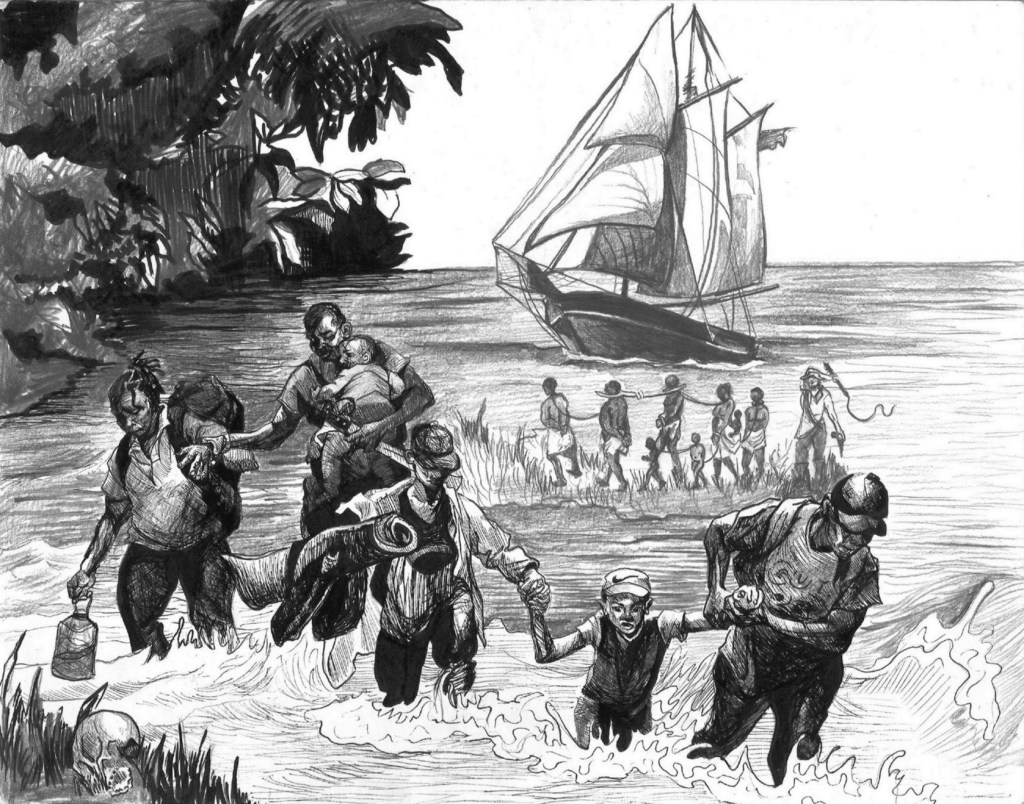
GATT pamphlet series, published October 2024
Click here to download a PDF for distribution.
Over the last decade, millions of people, particularly from Central America, South America, the Caribbean, and West Africa have come to the United States. Politicians like Donald Trump and Greg Abbot, along with the news media, have spent years talking about this “migrant crisis.” They tell us that “illegal immigrants” crossing the border are getting handouts, while also being responsible for all kinds of social problems ranging from crime to displacement and unemployment. We’re here to set the record straight about the migrants because the rulers of this country are lying to you. As Malcolm X said, “If you’re not careful, the newspapers will have you hating the people who are being oppressed, and loving the people who are doing the oppressing.”
What’s going on?
The number of people crossing the border into the US is the highest it’s been in two decades. In December 2023, the US Border Patrol recorded nearly 250,000 encounters with migrants at the US-Mexico border, the highest monthly total on record. “Encounters” is just Border Patrol lingo for the times they run into people crossing the border, but it’s always a lower amount than the actual number of people physically entering the country. Almost half are traveling in families. People are coming from Mexico, El Salvador, Guatemala, Honduras, Haiti, and elsewhere. More recently, Venezuelans and Ecuadorians have made up a bigger share. What brings them here?
Millions of people are fleeing conditions of poverty and violence in their home countries. Inflation has caused the cost of goods to skyrocket in countries like Venezuela, which is subjected to economic sanctions imposed by the US. Other countries, some previously ravaged by civil war like El Salvador, suffer from widespread gang violence and little opportunity for people to make a living in the formal economy. This is all because, through various means, US imperialism has shaped the conditions of life for hundreds of millions of people in Latin America.
Since the 19th century, the US has treated Latin America like its own backyard to use as its sees fit, exploiting resources and the labor of the people for the benefit of US corporations. While Spain was losing control of its colonies through a succession of wars for independence in the early 1800s, the US adopted the Monroe Doctrine as its official foreign policy—opposing European colonialism in the Western Hemisphere to consolidate US power and influence. With access to Latin American markets, the US could plunder, exploit, and control these resource-rich nations south of its border to industrialize and ascend into the top ranks of the global imperialist powers (like France, Germany, and Britain), which it superseded to reach top dog in the food chain after World War II. Since then, not a single country in Latin America and the Caribbean has ever had the chance to determine its own affairs without the US stepping in with brutal economic sanctions, bloody coups, and death squads, from Cuba, Nicaragua, Chile, Haiti, to Bolivia. In some countries, the US has installed military dictatorships to do its bidding. The result is millions of people trying to escape conditions imposed on them by a foreign power, namely US imperialism. And while we’re focusing here on Latin America, similar things could be said about US imperialism’s role in Africa, Southeast Asia, and elsewhere, which has also resulted in migration from those places.
To understand more recent immigration history, we can start in the 1990s. After NAFTA (the North American Free Trade Agreement) took effect in 1994, capital was “free” to flow into Mexico from the US. Tariffs, taxes, and other barriers to trade and investment were eliminated. Privatization and the injection of American finance capital drove up the price of goods and restructured the Mexican economy. Many American manufacturing industries moved to Mexico seeking to exploit cheaper labor, which was in high supply as people all over the country were being dispossessed and uprooted from their ways of life. For example, farmers growing corn were put out of work trying to compete with cheap American corn flooding the market. The International Monetary Fund (IMF) and the World Bank rolled out Structural Adjustment Programs (SAPs), which used the growing debt owed by poor countries to foreign banks to blackmail them with into restructuring their economies according to the needs of finance capital. Countries that have implemented SAPs devote greater labor and resources towards producing commodities for the world market to pay off debt rather than taking care of the needs of their populations. Imperialist countries like the US then have the audacity to call this economic model “development.”
Extractive industries like mining, oil, and gas are examples of “development” dependent on foreign capital that has devastating effects on the people living in these indebted countries. Commanded by stockbrokers on Wall Street, these industries rob and contaminate land and water, displacing more and more people every year. In more recent years, due especially to competition with China and Russia as rival imperialist powers, the US has ramped up the economic pressure on countries in Latin America and the Caribbean to extract more resources, taking advantage of new openings in their economies caused by social and political instability.
As peasants could no longer make money off their crops and as formal employment became more difficult to find, the drug trade became an important employer (just like it did in the US). Drugs produced in Latin America are transported up north to US markets and pass many hands before being sold on the streets here. For decades, the US has responded to this with the drug war, a cycle of violence between gangs and law enforcement and against the people, that has led to people migrating from targeted countries to escape. We see, for example, an uptick of Ecuadorian migrants as drug production and transport has shifted from Colombia and Peru to Ecuador. Far from putting an end to the drug trade and the brutal exploitation of people required to produce and transport drugs, the drug war has effectively spread this brutality to other places and caused even more people to flee their countries.
Anytime the global system of capitalism-imperialism is reconfigured so that the bourgeoisie can keep making profits, such as with the SAPs or the expansion of the drug trade, those reconfigurations cause great dislocations of people from their lands and livelihoods. The result is migrations of people, whether voluntary or coerced, as we’ve seen in prior centuries with colonization, the slave trade, and the Great Migration. With the transatlantic slave trade, people were kidnapped and shipped overseas to work on plantations growing cash crops sold on the world market to generate the profits and raw material necessary for industrialization. In 19th-century Europe, peasants were stripped of their lands and forced to move to cities to seek pitiful wages in the factories created by industrialization. And in the century after emancipation from slavery, millions of Black people fled from sharecropping and the Jim Crow South in what historians call the Great Migration, only to wind up in ghettos enduring decades of white supremacist oppression in new forms like police brutality and mass incarceration.
So what does this look like for today’s migrants? There are countless stories of the hard trek north, where migrants face multiple perilous crossings like the Darien Gap, the Rio Grande, and the US-Mexico desert. Smugglers and gangs take advantage of migrants, coercing and extorting people for passage across different borders. Women and girls prepare for the journey by taking contraceptives with them due to the high rates of sexual assault along the way. Migrants go through hell to get here, but even when they make it to the US, a run-in with Border Patrol can lead to detention in inhumane conditions, family separation, and even deportation back to the nightmares they’ve escaped.
But for the hundreds of thousands of migrants who’ve made it through, they’ve been shipped to different cities all over the country, and those cities haven’t been handling it well. On arrival, migrants have been put into all kinds of accomodations, from refugee camps made up of tents in parks, to homeless shelters and even some hotels. Many have also ended up living on the streets. Without permanent addresses and the legal right to work, migrants struggle to get jobs, hustling an income delivering food, selling snacks on the street, or worse. Without formal employment, they struggle to pay for a place to live and can’t escape whatever temporary accommodation they’re given.
City governments are saying that migrants put a “strain” on resources like shelters that would typically be reserved for the homeless. The reality is these public services were already strained. There are huge sections of people in this country struggling to get by who depend on public assistance. But from the top down, virtually all these pubic services have been defunded or handed over to the nonprofit sector. So despite the little assistance we see here and there, what US-born proletarians share with their immigrant brothers and sisters is that they are left to fend for themselves—uprooted from their ways of life, forced into whatever arrangement they can live in, and competing for the few decent jobs that are available. Divided up and left to fend for ourselves, social war is stoked among the masses so people fight each other instead of the real enemy.
What do we mean by “social war”?
Social war is part of the divide and conquer strategy of the ruling class; it’s the battle for who gets access to welfare, what school your kids get to go to, who gets help from nonprofits, who gets jobs and who gets to work the streets. The driving force behind this social war is the needs of the bourgeoisie, meaning whatever will benefit their profit-making and capital accumulation. The ruling class wants different sections of people fighting over the crumbs they’re thrown for two reasons: (1) It prevents proletarians from becoming conscious of who our real enemy is and how we can unite to overthrow them. (2) It breeds reactionary, bourgeois ideology in the minds of the masses and gets some proletarians following the political leadership of fascistic elements. In short, social war is how the bourgeoisie is playing you.
In proletarian neighborhoods in the US, you hear a lot of people talk about the amount of welfare and accomodations for new migrants while people already living in the US are left to fend for themselves against poverty, displacement, homelessness, and other forms of dispossession. For example, New York City started giving $350/week debit cards to some migrant families while slashing budgets for libraries and after-school programs to “alleviate the burden” of the large numbers newly-arrived migrants (nearly 200,000 within a single year from 2023 to 2024, many bussed in from Texas in a political ploy by Governor Abbot). New policies kick the homeless out of shelters to house migrants. We’ve also seen how the ruling class is perfectly happy to exploit the labor of immigrant proletarians while keeping many Black proletarians locked out of formal employment. These examples point to how the battle lines of the social war among the masses are drawn. The ruling class creates these battle lines, deepening them through coordinated political messaging that shifts the blame for social problems onto different groups of people oppressed by the system, like migrants, the homeless, and trans people, so that the real people responsible for these problems—the bourgeoisie—can continue getting away with it.
What kinds of twisted ideas has this social war generated? While white supremacy is a driving force behind backwards ideas about migrants, white people are not the only ones with anti-migrant sentiments. Notably, some Black proletarians, experiencing poverty, mass incarceration, the war on drugs, and alarming rates of police brutality, have embraced reactionary revanchism, whether in part or in full. Reactionary revanchism, in this context, means the desire to overcome your losses in the social war for survival by blaming, and taking revenge against, those you perceive as getting a leg up in that social war. It’s a petty, me-first ideology that takes real grievances and blames the wrong people for them, seeking to drag down other oppressed people instead of dragging down the system behind all oppression. Seeing newly-arrivaled migrants receive some social assistance while Black people haven’t made it out of centuries of oppression, many rightfully wonder, “when’s our turn?” This, coupled with the non-stop reactionary news and social media buzz, turns people who are already on the bottom of society against their false foe: immigrant proletarians, their class brothers and sisters.
Immigrant proletarians, whose life conditions we’ve detailed above, arrive here looking for a better life. People are looking for the so-called American Dream, and the fact that people fleeing violence and poverty spend months risking their lives coming here means that for many, a little upward mobility is possible for the first time in their lives. There’s no opportunity for upward mobility where they’re from, so even hustling candy on the subway while carrying their kids around can be a step up. And coming from countries exploited and devastated by US imperialism, living in the heart of global empire is a step up in the world. This adds an uncomfortable truth to the revanchism some proletarians feel: the reality is that for migrants, coming here is a way of improving one’s situation, while proletarians here have only faced worsening life conditions. However, few of the migrants arriving are ever going to attain the picturesque American Dream, and most end up living in poverty and ghettos, being forced to work the worst jobs, and having to worry about deportation.
Long live proletarian internationalism!
Who are our friends, and who are our enemies? The people of the world exploited and oppressed by capitalism-imperialism are our friends, whereas the people reponsible for their oppression are our enemies. But our enemies have deliberately blurred these lines. Both the nauseating decay of humanity under this system and the effectiveness of enemy propaganda have blurred the battle lines of class war and given way to social war among the masses. Our task is to draw these lines ourselves, to fight the divide and conquer strategy of the ruling class with proletarian internationalism.
Proletarian internationalism means that those facing the worst of this system all belong to the same class— the proletariat—regardless of where they’re from or what country they’re living in. It isn’t just about getting along with people from different backgrounds, although we should all strive to get to know our class brothers and sisters of different nationalities, their histories, and their cultures. Proletarian internationalism is the strategic recognition that the class capable of overthrowing capitalism-imperialism and ending all exploitation and oppression spans the globe and is fundamentally bound together by socialized production on a world scale.
From exploited coffee bean growers in Ghana to minimum-wage service industry workers serving coffee in the US, from auto factory workers in Mexico to truck drivers and transport workers around the world, from cobalt miners in the Congo to the factory workers making iPhones in China, the international proletariat collectively produces all that we use in our daily lives and makes society run. What the proletariat lacks is ownership over the factories and fields where it works, the machinery and resources it works with, the transportation systems and infrastucture that we all rely on. Right now, the bourgeoisie owns all that, and the social war among the masses has us fighting for scraps instead of collectively taking what the bourgeoisie is depriving us of. It’s time to resolve the proletarian identity crisis that the social war among the masses has created so we can bring together the multinational proletariat in the US, and the international proletariat around the world, for revolution.
Stop blaming the migrants. Start blaming the bourgeoisie.
 Going Against the Tide: A journal charting a path for communist revolution in the US