
GATT pamphlet series, published October 2024
Click here to download a PDF for distribution.
At a time when people who are poor and oppressed are encouraged to blame each other for our problems, it’s important to understand that we live in a class society – capitalism-imperialism – and to define what “classes” are. The bourgeoisie is the class that owns everything that people need to survive, and rules society through their control of all the major social and political institutions. Their existence depends on being able to exploit the propertyless classes to maximize their profits, and their ability to do so is protected by the police and military. The proletariat is the class that owns only personal possessions, not property, and must sell our labor in order to survive. This includes a reserve army of labor: those of us who can’t find stable or legal work and are cast off into deeper poverty. The reserve army of labor is created, controlled, and repressed by criminalization and incarceration.
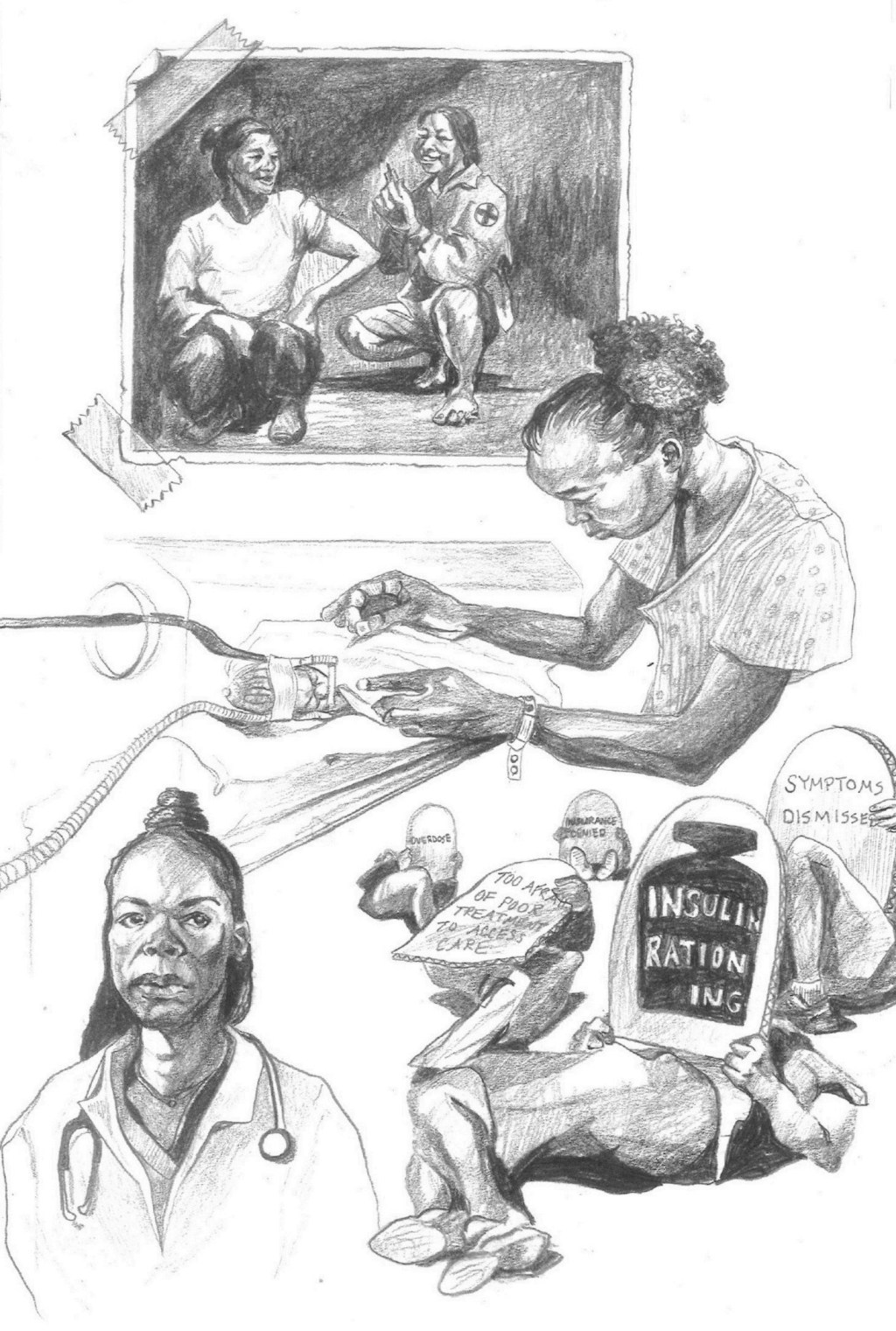
It’s no secret that the healthcare system in the United States, like every other industry, is driven by capitalism’s bottomless hunger for profit, not by any quest for the well-being of the people. In fact, it’s in the desperate search for medical care that many of us come up against oppression in its starkest forms. Look back at the days when Victorian-era doctors experimented on slaves, then to as recently as 2016 as many medical students learn in their textbooks that Black people have “higher pain tolerance.” Listen to how chronic illness caused by generations of poverty and trauma is blamed on “lifestyle choices” and used to excuse the denial of basic medical care on the reservation, in the ghetto, and in forgotten rural towns. Families drown in medical debt so their children and grandparents can receive substandard care. Exploitation through “medicine” is baked into the infrastructure of American healthcare.
In the past few decades, efforts of people from both within and outside of the political system have demanded legal reforms of the health insurance industry, or sometimes greater accountability for pharmaceutical companies. The toothlessness of these reforms, and the fact that the healthcare system remains ineffective at best and brutal at worst, demonstrates that the masses cannot be “healed” by a kinder, gentler form of capitalism; to the bourgeoisie, our bodies and lives are just one more opportunity to mine for profit.
Your money, or your life
Many people living in the US simply cannot afford basic healthcare. For example, when the average deductible for a single person with private health insurance costs about $2,000, one-third of single people with that plan can’t pay their initial bill before insurance coverage kicks in, and when that deductible rises to $6,000 as it does in many plans, over half can’t pay. So despite major reforms to the healthcare insurance industry (the Affordable Care Act or “Obamacare”), even those of us fortunate enough to have health insurance are often deep in medical debt. For those of us without health insurance, consider that the average out-of-pocket cost for an ambulance ride is $1,000. Who among us hasn’t pitched in to someone’s social media-fueled appeal to “crowdfund” medicine or surgery they need to survive?
Pharmaceutical price gouging made headlines when venture capitalist Martin Shkrelli bought the antibiotic Daraprim, which is often used to treat opportunistic infections found in people with HIV/AIDS, and hiked its price from $13 to $750 per pill, but that was only a more open expression of how the anarchy of the market affects the cost of healthcare on a daily basis. The best example of this may be insulin, which millions of diabetics rely on to survive. Before 1923, diabetes was a death sentence, and the chemists who developed insulin declined to patent their invention to make sure everyone who needed insulin would have access to it. Nevertheless, subsequent generations of pharmaceutical companies have bought and sold insulin like any other commodity until its price is out of reach for the average patient: in 2021, the average cost of a single vial (most diabetics need two or three vials per month) was $98.70. In fact, the need for insulin has driven its cost: within capitalism, the demand for insulin as a commodity increases its price, so the capitalists who own it depend on the suffering of diabetics for their profits.
Medical apartheid
During slavery, a surgeon now known as “the father of modern gynecology” operated on enslaved women without anesthesia in order to test experimental techniques. The birth control pill was first tested on Puerto Rican women, who were told they were taking vitamins; the pill initially caused side effects like blood clotting and many women died. The Indian Health Service made it standard practice in the 1960s and 70s to forcibly sterilize Indigenous women, and Fannie Lou Hamer coined the term “Mississippi appendectomy” in 1961 to illustrate how common it was to sterilize Black women without their consent during unrelated medical procedures. Perhaps the most famous example of medical exploitation in the US is the notorious Tuskegee Experiment, when Black men were injected with syphilis and used as living laboratory experiments, but Black and Indigenous people have been used this way over and over throughout history and up to the present. Generations of medical students have been taught that Black people have a higher pain tolerance: as recently as 2016, the University of Virginia found that half of their medical students believed this. They have been taught through centuries of racist pseudoscience to think that oppressed people are physically different from, or inferior to, white people, on a biological level.
So, oppressed people get substandard care and have worse health outcomes across the board. The best predictor of health outcomes isn’t your lifestyle, it’s your zip code. For example, in Streeterville, a rich area near Chicago’s downtown, the average life expectancy is 90. In Englewood, a mostly Black and proletarian neighborhood on Chicago’s South Side, it’s 60. As history moves on, medical exploitation simply takes different forms. Enormous research hospitals provide healthcare to the masses not because they are charitable, but because they stand to gain more from the use and abuse of people too desperate and sick to demand better care.
Reproductive INjustice
The United States has the highest maternal and infant mortality rates of any wealthy capitalist country, with about twice the per capita pregnancy-related deaths as Canada and the United Kingdom, and four times that of Scandinavian countries like Sweden. As of 2020, infant mortality stood at 5.4 deaths per 1000 births, compared to 1.6 deaths in Norway. Even as the US spends more money on healthcare than any other country, and even as pregnancy outcomes have actually improved over the years for white women of all income levels, these figures persist because Black mothers and their babies are in danger in the hands of the healthcare industry. Even wealthy Black women experience similar outcomes as poor Black women (think of tennis star Serena Williams nearly dying of a postpartum pulmonary embolism, her symptoms dismissed by her doctors). As mentioned above, forced sterilization of Black youth (often of young men as well as women) was standard practice until very recently; we have heard of women who were sterilized against their will in prison hospitals in just the last few decades. In state and county jails, incarcerated women must give birth in shackles. In 2020, a nurse at an immigrant detention prison in Georgia revealed that immigrant women were being sterilized against their will: forced to sign authorizations for tubal ligation or hysterectomies in the middle of childbirth, in a language they could not read.
The struggle for abortion rights has long been an indicator of the overall struggle of women to participate in society, with the healthcare industry as one battlefield. The American Medical Association (AMA) began the initial anti-abortion crusade in the mid-19th century in order to take obstetrical and gynecological care out of the hands of midwives and consolidate it among (white, male, bourgeois) medical doctors. The AMA combined forces with the eugenics movement, calling for higher birthrates among white women, and access to birth control and abortion have been weaponized against oppressed women in different ways ever since. For decades, but especially now with the overturning of the Roe v. Wade Supreme Court decision that decriminalized abortion in 1973, when women seek abortions they are shamed, victimized, and used as political pawns at the highest level of electoral politics. At the same time we have little to no support in becoming parents from the healthcare and social services apparatus run by the government. When Black, Indigenous, Latina, poor, and immigrant women become mothers, they are often scrutinized by a predatory social services system that criminalizes their every move and splits their families apart.
The demand for safe, legal, and accessible abortion as part of healthcare can and must be made alongside the demand for social support for mothers and children. Attacks on abortion and abortion rights by Christian fundamentalists and right-wing politicians are attempts to keep women under the control of men. The demand for safe, legal, and accessible abortion and birth control is both a demand for women to control their own bodies and futures, and a demand for women to participate in society as full human beings, not incubators.
Empire of addiction
After decades of speculation and whistleblowers being publicly dismissed by the mainstream media and lawmakers as conspiracy theorists, it’s now well known that the CIA purposely funneled crack cocaine into Black neighborhoods in order to cause social breakdown, then launched the so-called “war on drugs” to control a generation of oppressed youth through criminalization. Following the passage of stiffer penalties for crack cocaine and other drugs, the Black incarceration rate in the U.S exploded from about 600 per 100,000 people in 1970 to 1,808 in 2000, with 1 in 5 prisoners listed with a drug offense as their most serious crime.
This technique of creating a problem and profiting (both economically and socially) from the solution is one the bourgeoisie uses again and again, and it’s especially prevalent within the healthcare industry. When US imperialist aggression in Afghanistan flooded the global market with opium poppies (the US military encouraged Afghan farmers to grow them, according to a former FBI contractor turned whistleblower), the pharmaceutical industry started pushing prescription narcotics to profit from it, and created a new wave of opioid addiction and an entire new industry of drug hustling, “pain management” clinics, rehab and recovery services, and methadone programs. Drug overdose deaths have quintupled since 1999, with 106,699 overdose deaths in 2021, 75% due to opioids. Pharma billionaires like the Sackler family have become even richer off this empire of death and addiction, off the devastation of entire neighborhoods and small towns, and, let’s not forget, off the murder and displacement of millions of our Afghan sisters and brothers.
The cult of “wellness”
The healthcare industry sells the idea that we as individuals are solely responsible for our health outcomes: that if we eat right and exercise we will be healthy, and that if we get sick, it’s likely our own fault. You might live with some combination of genetic disease caused by generations of poor medical care, stress, and trauma. Maybe you have a low-wage job that wears on your body while leaving you too exhausted to cook a healthy meal even if you have access to affordable groceries. Statistically, you likely have an untreated chronic illness that gets worse with every year. Meanwhile, the stress of everyday life causes ongoing inflammation and drives you to self-medicate with alcohol, drugs, and destructive relationships. You may put a lot of time and effort into making nutritious meals for your family, and even make the time for exercise, meditation, or other self-care, but individual effort can’t undo the toll that capitalism has taken on your body. And thus the healthcare industry expands while displacing the blame for all this sickness and misery onto you.
Many of us are driven to seek solutions from outside the healthcare industry, and in response the pharmaceutical industry has fought to block the expansion of “holistic” or “alternative” medicine with lawsuits and publicity campaigns. Some natural and holistic healthcare approaches, like acupuncture or some herbal disciplines, offer actual benefit, while many are just grift. Attempting to leave the mainstream healthcare industry for “alternative medicine” leaves us still trapped within commodity relations, struggling to discern medicine from scams and conspiracy theories because good personal and social health still isn’t the objective in many of these schemes. Even the most reputable methods and practitioners have to be driven by the profit motive, and therefore offer no way out.
Pandemics: some of us are disposable
When the COVID-19 pandemic hit the United States, every inequity and inadequacy of the healthcare industry was laid bare. The word “pandemic” implies a society-wide impact, but Covid has been no equalizer. Since 2020, over 1 million people in the US and over 3 million people worldwide have died of the virus, and the World Health Organization estimates that about 15 million people total have died from either the virus itself or as a result of pandemic-related social and economic fallout.
Even as Black and Latino coronavirus patients died at roughly twice the rate of their white counterparts, and many of us as “essential workers,” prisoners, or nursing home residents had no option to isolate ourselves, we were all told by the CDC and other public health agencies that protecting ourselves from the virus was a matter of personal responsibility. This displaced the blame onto individuals, when in fact it was the healthcare industry and the government that was totally unprepared to deal with a crisis that public health experts had been predicting for years. When an effective vaccine was developed, it was initially restricted to the most privileged sector of the imperialist countries because it was owned by for-profit companies. When the vaccine became available to the US masses, the public heath apparatus botched the initial vaccine roll out and caused an anti-vaccine reaction among broad sections of the masses due to inconsistency and misinformation (not least because the vaccine, as for-profit technology, could not be assessed and explained by third-party scientists).
Future global pandemics are almost certain and it’s worth remembering that in these types of crisis, it becomes clear who the bourgeoisie regards as disposable. When AIDS hit the United States, and initially primarily affected gay men and drug users, the Reagan administration didn’t respond to the crisis with funding for research. And even though the technology to prevent HIV turned out to be effective in creating the coronavirus vaccine, not until COVID-19 was that research fully funded to completion.
Healthcare in the hands of the people
Individual healthcare providers are not to blame for the atrocities listed above. Actually, the fact that so many smart, compassionate people become nurses, doctors, therapists, chemists, CNAs, lab workers, etc. and yet the industry they work within remains so brutal proves that the system itself is rotten at the core. If the problem is systematic, the solution is also systematic. We focus on the healthcare industry in this pamphlet because it’s an area where the true character of capitalism is readily exposed, but to change healthcare we have to fight for nothing less than the revolutionary overthrow of the entire system of capitalism-imperialism.
We are inspired by acts of protest against the most ghoulish aspects of the healthcare industry, like when the mothers of diabetes patients who died unable to afford their insulin dump their children’s ashes on the desks of pharmaceutical executives. We admire the efforts of people who try to carve out charitable alternatives to the healthcare industry, like the doula collectives that save the lives of pregnant Black women. Revolutionaries in the US have used the healthcare industry as an entry point for agitation and education before: In 1970, the Young Lords occupied Lincoln Hospital in the South Bronx, with the help of hospital staff, to expose conditions there and demand better care for the mostly Black and Puerto Rican patients. The occupation led to the founding of Lincoln Detox, a drug rehabilitation effort that used acupuncture and political education rather than methadone, and trained former rehab patients as acupuncturists and counselors.
But what if we were able to channel all the righteous rage of spontaneous peoples’ struggles and mass organizations into sustained revolutionary action? Just before the 1949 communist revolution in China, there were about 40,000 doctors to serve 540 million people, and most practiced in the cities, whereas 80% of China’s population were rural peasants, suffering from unchecked infectious disease on top of extreme poverty. With the power and resources of the state, the Communist Party staged China’s first mass vaccination program. In 1966, with the launch of the Great Proletarian Cultural Revolution, thousands of young peasants known as “barefoot doctors” were given medical training by the government and sent to the countryside to provide basic medical care for their people. They continued to do farm work alongside their patients as they provided public health education, immunization, first aid, treatment for common illnesses, and coordination of specialized treatment for more serious ailments. By the 1970s, the average Chinese life expectancy had grown from 40 years (pre-revolution) to 65 years, and even the World Health Organization and imperialist countries like the US were forced to admit that the Chinese revolution had completely transformed the lives of the masses, largely through this transformation of healthcare. In 1976, a new bourgeoisie within the Communist Party seized power through a coup and began the restoration of capitalism in China. However, the experience of socialist China still stands out as a monumental human achievement and the most compelling example of what the proletariat in power can achieve.
If you have experienced exploitation or abuse at the hands of the medical industry; if you have lost someone you love to addiction or to the impossible cost of healthcare; if you are a medical worker and you can’t care for people the way you are called to do; if you envision a world in which healthcare means hope and not fear: please reach out so we can seriously strategize for revolutionary change. The only way to realize a future worthy of the next generation is for the proletariat to seize state power through revolutionary civil war, eliminate once and for all for-profit healthcare, and put healthcare in the hands of the people. Only then can we begin to cure chronic and epidemic disease, live long, healthy lives, and be free from exploitation, inequality, and debt in healthcare.
Selected sources:
“Americans Likely Owe Hundreds of Billions of Dollars in Total Medical Debt” by Craig Palosky, Kaiser Family Foundation, March 2022.
“Before US Troops Protected Poppies In Afghanistan, There Was No Opioid Epidemic in America” by Rachel Blevins, The Free Thought Project, March 2018.
“Chicago’s Lifespan Gap: Streeterville Residents Live to 90. Englewood Residents Die at 60.” by Lisa Schencker, Chicago Tribune, June 2019.
“COVID-19 Cases and Deaths, Vaccinations, and Treatments by Race/Ethnicity As Of Fall 2020” by Nambi Ndugga, Latoya Hill, and Samantha Artiga, Kaiser Family Foundation, November 2022.
“Cracks in the System: 20 Years of the Unjust Federal Crack Cocaine Law” by Deborah Vagins and Jesselyn McCurdy, American Civil Liberties Union, October 2006.
Dope Is Death: Film by Mia Donovan, 2020.
“Drug Goes From $13.50 a Tablet to $750, Overnight” by Andrew Pollack, The New York Times, September 2015.
“An Exploration of China’s Mortality Decline Under Mao: A Provincial Analysis” by Kimberly Babiarz, Karen Eggleton, Grant Miller, and Qiong Zhang, National Library of Medicine, March 2016.
“The Global Covid-19 Vaccine Divide” by Paul Abowd, The Intercept, June 2021.
“Health for the Masses: China’s Barefoot Doctors” by Vikki Valentine, National Public Radio, November 2005.
“How HIV Research Paved the Way for the Covid mRNA Vaccines” by Charlotte Morabito, CNBC, December 2021.
“How Legacy of Medical Racism Shapes US Healthcare Today” by Timothy Smith, American Medical Association, January 2022.
“Immigration Detention and Coerced Sterilization: History Tragically Repeats Itself” by Maya Manian, American Civil Liberties Union, September 2020.
“Lack of Medial Care, Unsafe Work Practices, and Absence of Adequate Protection Against Covid-19 for Detained Immigrants and Employees Alike at the Irwin County Detention Center” by Project South, American Civil Liberties Union, September 2020.
“The Long Shadow of Eugenics in America” by Linda Villarosa, The New York Times Magazine, June 2022.
“Managing A Nightmare: How the CIA Watched Over the Destruction of Gary Webb” by Ryan Devereaux, The Intercept, September 2014.
“Racial Disparities in Maternal and Infant Health” by Latoya Hill, Samantha Artiga, and Usha Ranji, Kaiser Family Foundation, November 2022.
“The True Death Toll of COVID-19: Estimation Gloal Excess Mortality” by World Health Organization, May 2023.
“US Ranks Worst in Maternal Care, Mortality Compared With 10 Other Developed Nations” by Gianna Melillo, American Journal of Managed Care, December 2020.
“100 Years of Insulin: Why Is Insulin So Expensive?” by William Herman and Shihchen Kuo, National Library of Medicine, October 2022.
 Going Against the Tide: A journal charting a path for communist revolution in the US