
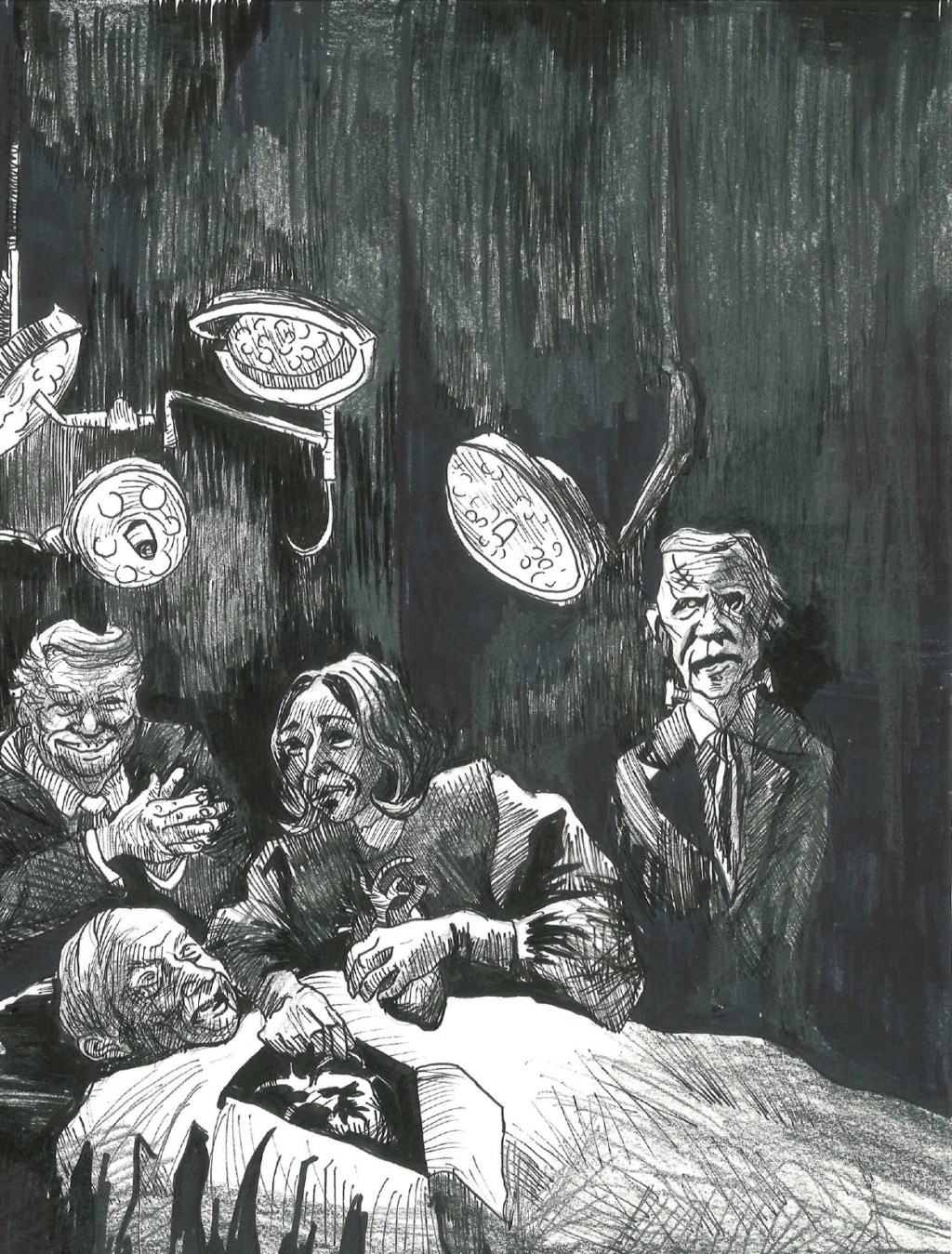
GATT editorial, November 2024
Every four years, the US bourgeoisie hosts a public referendum on which bourgeois program will be in the dominant political position for the next four years. These rituals, known as presidential elections, invite the people broadly to approve of—or acquiesce to—a set of policies shaped by the representatives of different segments of the bourgeoisie. They bring the popular classes into the fold of bourgeois politics, with pervasive media spectacles shaping their thinking and with individual members of the bourgeoisie using their wealth to tip the outcome in favor of their preferred candidate. Sometimes, the outcome of these contests is ambiguous or results in two contending programs locked in competition via who holds the legislative vs. executive branches. Occasionally, the outcome is outright contested and settled by arcane rules rooted in preserving the power of slave-owners (the Electoral College, as in 2016) or by fiat (the Supreme Court, as in 2000). This time around, however, there was no question that the restorationist program represented by Kamala Harris and the Democratic Party was firmly rejected by broad swathes of the US population, despite no shortage of bourgeois financial backing, media cheerleading, and firm support from a small social base. To understand that popular rejection, permit us to review what program Harris campaigned to restore and how various classes have come to resent it over the last several decades.
The delusional confidence of the Harris campaign was induced by decades of arrogant, out-of-touch triumphalism on the part of the Clintonian Democratic Party. Coming in on the coattails of US victory over Soviet imperialism in the Cold War, the Clinton administration of the 1990s consolidated the global capitalist order with the US bourgeoisie firmly on top. They furthered the elevation of finance capital into a dominant position of massive profit-making, enabled multinational corporations to profit from the superexploited labor of oppressed countries through outsourced production, and backed the rise of tech capital. Never mind the fact that letting finance capital run wild with speculation, free trade agreements (NAFTA, the WTO), and new, more flexible forms of exploitation undermined and even ruined the class position of large segments of the Democratic Party’s electoral base.
Clintonian triumphalism did not face its day of reckoning in the 2000s. Its true believers could fairly argue that the 2000 election was stolen, and the bourgeois program that entered after that election unquestionably proved to be a setback for US imperialism. The neocons at the helm of the Bush administration made an adventurist attempt to replace non-compliant regimes in Afghanistan and Iraq (with intentions for more of the same elsewhere), and were left with failed colonialesque governments in those two countries, popular discontent in the US over the costs of war and occupation (financially and in the lives of US soldiers), and rising rival imperialist and regional powers taking advantage of US troubles, with China and Iran as the chief beneficiaries. To top it off, finance capital’s profit through speculation—a continuity between the Clinton and Bush years— spectacularly collapsed, along with the housing market, in 2008, the last year of Bush’s presidency.
The entering Obama administration escaped any reckoning by virtue of being able to blame its immediate predecessors for the failures of the neocon program internationally and the wave of mass impoverishment and loss of home ownership domestically. What it offered was a Clintonian program with a few adjustments: more free trade agreements, rescuing and strengthening finance capital, and continuing to prop up tech capital and multinational outsourced exploitation. It adamantly refused to take action to reverse the downwardly mobile class position of many of its electoral constituents. Internationally, it practiced aggressive containment against imperial rivals and assertive regional powers, gleefully used the new technology of drone strikes for selective assassinations, and adopted a policy of supporting destabilization and civil war, sometimes including aerial bombardments by the US military, in North Africa and the Middle East to deal with regimes it could not control.
But the Obama administration had a thorn in its side from its first year in office: the revanchist petty-bourgeoisie. This ideological bloc, with small business owners at its core, refused accommodation within the established political rules, outright rejecting the legitimacy of Obama as president and questioning the constitutionality of his policies. Cohered politically into the Tea Party movement, with no shortage of funds and manipulation from reactionary members of the bourgeoisie and reared ideologically by addictive consumption to right-wing media, it was nonetheless a petty-bourgeois movement asserting its class interests, including against the Republican Party establishment. Its political representatives won Congressional seats and adopted a policy of wrecking existing bourgeois politics, programs, and procedures, embracing government shutdowns rather than ratifying federal budget deals. Not only did they untether themselves from the Bush years, but they also went on to discredit and push aside the old guard politicians of the conservative bourgeoisie, though a few remained as embattled stewards of a different ship than the one they boarded decades ago.
The wrath of the revanchist petty-bourgeoisie spearheaded the most successful movement “from below” during the Obama years, thoroughly repudiating the politics of the Clintonian Democratic Party, bending the Republican Party to its will, cohering an organized ideological bloc of tens of millions, and making its way inside the halls of power. But as the promise of “hope” that Obama offered proved empty, other classes erupted in struggle. At the end of the Obama years, Black proletarians broke out in rebellion, sparked by police killings but undoubtedly fueled by the fact that the first Black president had raised expectations for the Black masses and then failed to deliver any blows against the oppression of Black people.
Managing to sustain a more ongoing assertive presence, however, was a relatively new class, cohered as an ideological bloc over several decades and mounting the political stage decisively in 2011 with the Occupy Wall Street Movement: the postmodernist petty-bourgeoisie. While it joined, opportunistically got to the head of, and even sometimes started many just protest movements, it is a reactionary class seeking to secure and advance its class interests and privileged position within the reconfigured capitalist-imperialist order. Unlike the revanchist petty-bourgeoisie, it seeks to adjust the Clintonian Democratic Party program to its benefit, not tear it apart. The postmodernist petty-bourgeoisie’s college-educated ability to make sophisticated critiques of that program, and its mobilization in, and leadership over, oppositional protest movements obfuscates its reactionary class nature, which rests on its well-paid, professional, and highly parasitic positions in ideological state apparatuses and the nonprofit industry.
As two reactionary petty-bourgeoisies aggressively asserted their class interests during the Obama years, the legitimacy of Clintonian Democratic Party politics became increasingly undermined for broad swathes of the US populace facing downward class mobility and destabilizing effects as a consequence of post-1970s capitalism reconfigured with finance capital in command. Failing to recognize this fact, in 2016, the Democratic Party picked a presidential candidate who most arrogantly embodied the Clintonian program and legacy—Hillary Clinton—while sabotaging the candidate—Bernie Sanders—offering an alternative bourgeois program that sought to restore the class position of sections of its traditional electoral constituents.
Even before the Democratic Party had officially crowned Hillary Clinton, Donald Trump seized the opportunity, revealing himself to be uniquely able to understand and mobilize the class frustrations of the revanchist petty-bourgeoisie and wider sections of the population, including the dispossessed formerly well-paid working class, peeling away many of the Democratic Party’s longstanding electoral constituents. The mass appeal of reactionary, fascistic, revanchist ideology and politics in the most powerful imperialist empire in human history is no surprise, and is especially enticing when delivered by someone who is no mere apprentice in the art of spectacle and entertainment. But the conjunctural conditions for Trump’s success were the failures, for the popular classes, of the Clintonian political program—the way it propped up the profits of finance, real estate, tech, outsourced production, and other capital at the expense of the privileged class position of broad swathes of the US population (not to mention the exploited and dispossessed in the oppressed countries). It was chickens come home to roost, and the Clintonian crowd was only caught off guard because of their arrogant triumphalism and their delusional distance from all but the upper echelons of the petty-bourgeoisie.
Trump’s refusal to play by the rules—rules so cherished by the Clintonian Democratic Party establishment—endeared him to the revanchist petty-bourgeoisie and tapped into broader frustrations with the established order. But it was also cause for consternation among the bourgeoisie, especially as his first administration became a revolving door with no shortage of cranks, and as policy became unpredictable given Trump’s erratic and ego-driven decision-making (for the record, Obama arguably had a bigger ego1). Nevertheless, for all his railing against elites and isolationist anger, on matters sacred to the American imperialist bourgeoisie in the 21st century, including finance capital’s pre-eminence and the US military’s ubiquitous presence around the world, differences between Trump and his presidential predecessors were minor matters. Brazen rhetoric and outerborough uncoothness could be overlooked when the bourgeoisie, including tech capitalists who leaned Clintonian, saw their taxes decrease and profits increase under Trump.
It was the COVID pandemic that brought the instability of the Trump administration back into bourgeois anxiety, especially as the liberal petty-bourgeoisie, the primary social base of Clintonian politics, perceived Trump’s response to the pandemic as an existential threat to its existence. The widespread participation of the liberal and postmodernist petty-bourgeoisie in the Summer 2020 protests sparked by proletarian rebellions against police brutality in turn boosted the political energy to channel ire at Trump into the polls. Ultimately, most members of the bourgeoisie abandoned Trump by Summer 2020, resulting in a shortfall of donations and a lack of political operators in his camp that consigned his re-election campaign to defeat. For the top beneficiaries of capital accumulation, knowing the empire is being run smoothly and predictably, with minimal turbulence, is worth more than whatever short-term profit could be made with a Trump presidency. As Trump’s bourgeois backers jumped ship, the revanchist petty-bourgeoisie stayed on board the sinking vessel, with a younger, perhaps more reactionary cohort not only staying afloat but scoring electoral victories, especially in the House of Representatives. Nevertheless, the hardcore revanchists failed to win over the broader layers of support required to keep the presidency in their corner.
In the realm of bourgeois politics and from the perspective of bourgeois class interests in Fall 2020, Joe Biden was the perfect candidate to unseat Trump not only for his proven track record as a steward of bourgeois stability and centrism, but even more so because he may well be the last pre-Clintonian Democratic Party leader in existence. As such, Biden could undercut Trump’s appealing assault on the Clintonian establishment. Even with a long record of serving bourgeois interests in general and Delaware-based credit card companies in particular, Biden is a Democrat cut from a pre-1990s mold who could credibly claim he would be a pro-union president. The post-World War II, pre-1990s Democratic Party rested on an alliance with the union bureaucracy, with the latter bringing the well-paid working class into the Democratic fold as a reliable voting bloc. Biden’s political career got started when that alliance was still strong, and his pre-Clintonian credentials gave him the ability to win back sections of the well-paid and dispossessed working class whose class position had been undermined by the Clintonian program. That advantage, however, was never made good on programmatically. Some union-friendly personnel were appointed to the National Labor Relations Board, and there were some small attempts at regulation and job creation at the beginning of Biden’s term, but the benefits of a Biden presidency for the well-paid and dispossessed working class were never more than a pittance.
Towards the end of the Biden administration, an avalanche of destabilizing contradictions, from the burden of inflation on the homefront to Israel’s unhinged genocidal war on Gaza, together with Biden’s deteriorating mental faculties, delegitimized his presidency for different sections of the population and for different reasons, some righteous and some reactionary. Even before those centrifugal forces asserted themselves, there was little material basis or bourgeois support for a Bidenist radical reorientation away from the Clintonian legacy. Moreover, the Biden administration stopped short in efforts to discipline and punish Trump for his attempts to subvert his 2020 electoral loss, leaving him the freedom to mount a comeback. The Biden adminstration also failed to reverse key losses of bourgeois-democratic rights, such as the right to abortion, giving little confidence to even its remaining base of support that four more years would deliver them to a liberal bourgeois-democratic labor-friendly promised land.
The last minute panicked attempt to switch Biden with a more viable candidate proved worse, for the liberal bourgeoisie’s desired outcome, than what it sought to replace. The Harris campaign leaned hard into articulating a restorationist program, promising a return to Clintonian stability that only the liberal petty-bourgeoisie was buying. Aging out, lacking any dynamism, and morally bankrupt by its acquiescence to genocide, the liberal petty-bourgeoisie’s alarmist hysterics about the threat of fascism and Manchurian candidate conspiracy theories about Putin’s grandiose authoritarian ability to manipulate Trump only served to turn other classes off from Harris. The sacred bourgeois-democracy that the liberal petty-bourgeoisie imagines itself to be defending has already been profaned, among other things by the selective repression of the right to free speech in police crackdowns of anti-genocide protests on college campuses, most of which were carried out on the orders of representatives of the liberal bourgeoisie. But all Harris could offer was a defense of profaned liberal bourgeois-democratic principles to a shrinking congregation in a church that no longer cared for the poor, having (metaphorically) eliminated its soup kitchens in the 1990s with Bill Clinton’s promise to “end welfare as we know it.” Worse yet, Harris supplanted liberal bourgeois-democratic values with sops to the postmodernist petty-bourgeoisie’s out-of-touch identity politics, believing that oppressed people think like the privileged elites who speak in their name and alienating oppressed people in the process. As if all that was not enough to alienate everyone but a couple upper sections of the petty-bourgeoisie, the Harris campaign broadened and doubled down on its restorationist program by rehabilitating the neocons of the Bush administration, touting Dick Cheney’s endorsement and trotting out his daughter, Liz, as its cheerleader. Under Harris, the content of I’m-not-Trump restorationism was made worse than the Clintonian Democratic Party alone by encompassing the Bush Republican Party.
The electoral defeat of Harris was a reactionary repudiation of the Clintonian Democratic Party’s program, a program it has clung to for three decades. On a personal level, we are happy to see the horrific, imperialist legacies of Clinton, Obama, Biden, and all the bourgeois functionaries that served in their administrations burned and their namesakes die knowing few will mourn them. But we are under no illusion that the fire this time is paving the way for anything other than a different bourgeois program to come to the fore. Nor will capitalism-imperialism as it has been reconfigured since the 1970s transform in any ways that fundamentally benefit the masses. In any event, the die is cast, and it seems unlikely that the liberal bourgeoisie can successfully rehabilitate Clintonian politics in 2028, though they may well try to owing to their arrogance and lack of innovation. We shall have to see what is in store in the coming years and adapt our strategy and tactics as the contradictions unfold. What we can do now is understand how various classes in the US have been shaped by, and shaped, the unfolding of recent events and what that tells us about who are our friends and who are our enemies.
For communists, answering the question “who are our friends, who are our enemies?” means making a class analysis, examining the material class interests, aspirations, and motion and development of the different classes in society and how they stand in relation to each other. Too often, class analysis is understood, by people who claim the mantle of communism or Marxism, as a rather mechanical look at occupations, incomes, and direct relationship to the means of production to place percentages of a given population into static categories. While there is a point to looking at economic demographics, in what follows, we will be analyzing how classes are moving in relation to the unfolding contradictions of capitalism-imperialism, how new and established classes assert their class interests and aspirations, and how historically outmoded classes lose their position or fade from existence. We will also be analyzing classes—especially distinct sections of the petty-bourgeoisie—as ideological blocs that more or less correspond to economic positions, but with plenty of messiness. In doing so, our method of class analysis will be something like a synthesis of Karl Marx’s The Eighteenth Brumaire of Louis Bonaparte with the television series Deadloch and the observations of stand-up comedians. We will also be drawing from analysis by academics and journalists while keeping the citations light, and, most importantly, the experience of the communist movement in the US.2 That movement is exceedingly small at the moment, but it is punching well above its weight and learning, through its political work, where different classes are lining up in relation to the (potential) struggle for power between the two classes capable of running society: the bourgeoisie and the proletariat.
As we see it, the main social actors driving the political drama on stage after 2008 have been two reactionary classes: the postmodernist petty-bourgeoisie and the revanchist petty-bourgeoisie. In this political drama, the big bourgeoisie, concentrated as heads of finance capital and multinational corporations of a new type but including other kinds of capitalists, own the theater, and because their ownership of the theater is not really contested at present, they are okay with letting those two reactionary classes seize the spotlight during performances and even letting them influence the repertoire performed. Other classes, such as the liberal petty-bourgeoisie and the well-paid working class, are season ticket holders who have some say over, and differing opinions about, what plays out on stage. The proletariat, not invited into the theater, has been able to bum-rush the show a few times, but has yet to write the script or get more than a one-off production on stage. And that is what we seek to change.
Two reactionary petty-bourgeoisies get brazen and bold
In imperialist countries today, the petty-bourgeoisie is a large portion—perhaps a majority—of the population, but is divided into different sections based on their relationship to the means of production, such as small business owners of various types and college-educated professionals working in skilled mental labor occupations. In the US, to speak of “the petty-bourgeoisie” without specifying which section is a relatively worthless exercise, and specific sections are more easily, or more revealingly, broken down by ideological blocs than occupations.
Much of the time in imperialist countries, the petty-bourgeoisie as a whole is content to let the bourgeoisie rule, so long as it gets to register its approval or complaints in well-staged rituals (bourgeois elections). In revolutionary times, some segments of the petty-bourgeoisie may break out in revolt and stand with the masses (the student movements of the 1960s, for example), even if in contradictory ways. When capitalism-imperialism is undergoing, or has recently undergone, transformations that put petty-bourgeois class positions up for grabs, upper sections of the petty-bourgeoisie—old and new, established and aspiring—feel compelled to assert their agency to secure and advance their class position, and are often given wide latitude to do so. In asserting their agency, sections of the petty-bourgeoisie constitute themselves as distinct ideological blocs, defined by their worldview and political allegiances, which, over time, get consolidated into the functioning of bourgeois-democracy.
Other class fractions, of the lower petty-bourgeoisie and working class, are generally only permitted, and only desire, a more passive role in bourgeois politics, or are mobilized into a more active role by the bourgeoisie when it needs to (usually for war and/or fascism—Nazi Germany was both a brutal fascist dictatorship and a highly participatory society, as is Israel today). These class fractions will receive lesser attention in the following analysis given their more passive role, relative to two reactionary sections of the petty-bourgeoisie, in recent events. We will touch briefly on the ideological and political disposition of the well-paid working class and its now dispossessed segments, as well as what we might call the broad lower middle—members of the upper proletariat and lower petty-bourgeoisie working in semi-professional, clerical, and service occupations. Our point, with these class fractions, is not to present a comprehensive analysis of all classes in society, but to probe where the class-conscious proletariat can seek out allies and peel people away from bourgeois, or reactionary petty-bourgeois, hegemony. But the main focus in what follows are the two reactionary petty-bourgeoisies whom the class-conscious proletariat needs to sweep aside.
The postmodernist petty-bourgeoisie: an archaeology or a genealogy (whatever the fuck the right Foucauldian gibberish is) of a reactionary class
A source of tremendous confusion and demoralization over the past decade has been the assertive existence of a growing class that presents itself as a proponent of struggles for social justice but is bitterly hostile towards revolution and utterly contemptuous towards the masses. Here, we hope to clear up the confusion and combat the demoralization by outlining the formation of the postmodernist petty-bourgeoisie and explaining what makes it a reactionary class, despite its deceptive appearance. Its formation began in academia, so we start our story there.
The post-World War II expansion of the US university system broadened the ranks of college professors, a privileged upper petty-bourgeois class position. The new generation that entered that profession after the 1960s, especially in the humanities and social sciences, secured its class position by fighting a two-front battle. On the one hand, it displaced the bourgeois ideologues who had dominated the professoriate by critiquing them as outmoded and conservative—out of sync with the social movements and cultural transformations of the 1960s. On the other hand, it beat back the impact of the revolutionary movements of the 1960s on the universities by repudiating radical politics of all stripes, from Marxism to revolutionary nationalism to (eventually) second-wave feminism, with a new ideology: postmodernism. This move was crucial to its legitimacy, as many of those entering the ranks of the professoriate in the 1970s and 1980s were either former radicals turned sellouts or were culturally part of the 1960s but lacked the arrest records of real revolutionaries, so they had to prove themselves in the realm of discourse.
Conveniently, their new ideology came wrapped in obfuscation, propagated in academic writing drenched in obtuse jargon and stylistically obsessed with sounding profound while lacking in substance. Nevertheless, as Timothy Brennan explains in his book Wars of Position: The Cultural Politics of Left and Right (Columbia University Press, 2006), there was a clear turn towards an orthodoxy based on a “shared canon of venerated texts” among professors in the humanities and social sciences in the 1980s and 1990s, with the work of French philosopher Michel Foucault a foundational part of that canon. We have polemicized extensively against postmodernist ideology and politics from kites #1 through Going Against the Tide, and we suggest readers also study Brennan’s book for an intellectual history of postmodernism. What stands out about postmodernist ideology, from the perspective of class formation, is its obsession with endless but toothless critique of existing and historical power relations alongside a rejection of making demands on, let alone seeking to overthrow, the existing state power that defends those power relations. In addition, postmodernist ideology largely rejects analysis of exploited classes, oppressed nations, and (eventually) the subjugation of women to patriarchy in favor of the nebulous concept of “difference” in opposition to impositions of “normativity.” It displaced discussion of material relations of exploitation and oppression with an emphasis on identity and the realm of ideas—in its nomenclature, “discourse”—the precise realm in which the postmodernist petty-bourgeoisie makes its money.
Postmodernist ideology became orthodoxy in academia by virtue of the fact that its proponents secured dominance over many academic departments and disciplines, some entire universities, and numerous academic journals. Academic hiring committees and academic peer review became means for expanding its class and discursive dominance within the university system and intellectual life. If that was as far as the postmodernist petty-bourgeoisie advanced its class position, we probably would not be devoting so much time to understanding it as a class. But it did not stop there. From its position as university professors, the emerging postmodernist petty-bourgeoisie expanded its class power by applying a sort of tactical Leninism-Gonzaloism. It propagated its ideology in college classes and trained up new adherents who could then go on to secure class positions outside academia, transforming existing petty-bourgeois professions and populating new ones.
Key among those new professions was that of nonprofit-sector activist. As a preventive counterrevolutionary measure in the wake of the 1960s revolutionary movements, nonprofit organizations were bolstered with bourgeois philanthropic funding and propped up to displace radical and revolutionary organizations. They developed clientelistic relations with the masses, advocating for “social justice” on behalf of the masses while being unaccountable to them. The Democratic Party, in turn, developed clientistic relations with many nonprofit organizations. And, crucially for the expansion of the postmodernist petty-bourgeoisie as a class, nonprofits siphoned college-educated youth, from the petty-bourgeoisie and proletariat, into professional positions as activists, advocates, and organizers who could critique injustice and put band-aids on it while never mobilizing the masses in class struggle. Over the course of the 1980s and 1990s, nonprofit-sector activist became a viable petty-bourgeois career path, so long as one adhered to the postmodernist ideology and politics that came to dominate nonprofit activist organizations—in short, so long as you became part of the postmodernist petty-bourgeoisie as a class.
In addition to the burgeoning nonprofit activism industry, as an ideological bloc, from the 1990s up until today, the college-trained postmodernist petty-bourgeoisie gained significant or dominant positions within journalism, education, arts and culture institutions, the entertainment industry, and other mental-labor professions that produce culture and discourse. It also served the bourgeoisie in modes of capital accumulation that required large numbers of professional intellectual workers, such as tech capital. In some instances, the rise of the postmodernist petty-bourgeoisie was a generational and ideological displacement of the liberal petty-bourgeoisie that had previously dominated the professions in question. In other instances, such as in tech capital industries and nonprofit organizations, fractions of the postmodernist petty-bourgeoisie were created or grew dramatically as a consequence of transformations in the economic and political operations of capitalism-imperialism. For example, the Clinton administration pioneered a new approach of “governance” that was furthered under Obama, where the bourgeois state implements policies by way of partnerships with nonprofits, media and social media companies, and assorted private enterprises, even including banks.3 The postmodernist petty-bourgeoisie seized on opportunities created by the overall framework of governance to carve out well-paid bureaucratic positions that often serve the purpose of enforcing its ideology and politics. The most well-known among these positions are at Diversity, Equity, and Inclusion offices at colleges and their counterparts in private companies, which have largely proved to be performative entities that fail to transform the inequalities they were supposedly created to combat.
The postmodernist petty-bourgeoisie’s seizure of existing well-paid professional positions and securing of new ones took place as capitalism-imperialism increased cutthroat competition for jobs, with massive cuts to social spending throughout the 1980s and 1990s and the privatization of many functions previously carried out by the bourgeois state while production and trade were reorganized around the superexploitation of the labor and resources of the oppressed countries. In the 2000s, the postmodernist petty-bourgeoisie emerged as one the victors in that competition, whether that was by way of nonprofit organizations receiving funding to take over formerly government functions or tech capital sharing some of the profits of offshored exploitation with its intellectual workers.
While securing its class positions, the postmodernist petty-bourgeoisie had yet to assert itself politically except in the realm of intellectual and cultural critique and nonprofit-sector activism. In fact, one of the defining features of the postmodernist petty-bourgeoisie is its desired distance from bourgeois state power. It studiously avoided running candidates in its mold for office, happy to let the liberal bourgeoisie govern. It stayed largely on the sidelines of mass struggles through the early 2000s, at best taking part as passive participants, with its political cadre preferring nonprofit advocacy work to militant resistance. From the 1980s to the early 2000s, resistance movements in the US were led by ideologies ranging from anarchism, the remnants of 1960s revolutionary nationalism, revolutionary communism, Trotskyism and revisionism, to reformism of genuine and opportunist varieties. Postmodernist ideology and politics did start to encroach on resistance movements and began to degrade some of the aforementioned ideologies, but the postmodernist petty-bourgeoisie had yet to decisively mount the political stage, except by way of critique largely confined to academic discourse and entirely divorced from political struggle. The postmodernist petty-bourgeoisie waited until the 2010s to mount the political stage, by which point it had staked out its geographic territory and added to its ranks through a cultural movement drenched in decadent individualism and hostile to political and social commitment.
The hipster phenomenon of the 2000s placed recent graduates of upper-tier colleges—the new ranks of the postmodernist petty-bourgeoisie—as creative agents in a new wave of cultural production, ostensibly “bottom up” but in reality orchestrated by fashion, music, art, and media capitalists.4 The aesthetics of ironic detachment bound up with hipster culture, from fugly fashion to mediocre indie-rock to hedonistic parties, betrayed the fact that its participants gleefully looked the other way as photos of torture and news of massacres perpetrated by the US military in Afghanistan and Iraq circulated. Beyond its disgusting apathy in the face of imperialist horrors, hipster culture accomplished important advances for the class position of the postmodernist petty-bourgeoisie. It ideologically elevated parasitic lifestyles, even celebrating them as radical chic when drenched in subcultural capital. It trained the postmodernist petty-bourgeoisie in the art of faking expertise and asserting intellectual and cultural authority, using what they learned at college and through cultural consumption to pose as arbiters of art and style, a skill they later transferred to politics. That fake expertise included appropriating styles and symbols from previous rebellious cultures, from punk to rap to avant-garde jazz, a skill likewise later transferred to appropriating the aesthetics of past and geographically distant revolutionary political movements. It also taught the upper echelons of the petty-bourgeoisie to fake a lower class position, whether through donning the styles and beer preferences of lower classes or by hiding their access to family wealth while “slumming it.”
But perhaps the most important contribution of hipster culture to advancing the class position of the postmodernist petty-bourgeoisie was its crucial role in consolidating a transformation of social geography. Beginning in the 1990s, ramping up in the 2000s, and continuing thereafter, hipster twenty-somethings moved en masse into neighborhoods that had been laid to waste by the flight of industrial capital and the loss of jobs for their proletarian inhabitants. From Brooklyn to Oakland and virtually every city in between, proletarians were pushed out of their historic neighborhoods, with an initial wave of petty-bourgeois “slumming it” giving way to rising rents, condominium construction, and policing policies protecting the newcomers and repressing or kicking out the dispossessed. What is commonly called gentrification was a reactionary (geographic) movement by the postmodernist petty-bourgeoisie against the proletariat, in league with real estate capital and the bourgeois state. Ironically, the postmodernist petty-bourgeoisie later began railing against “settlers” despite being the closest thing to them in the present-day US.
In addition to evicting proletarians from their historic neighborhoods, the hipster transformation of social geography also set the postmodernist petty-bourgeoisie apart from its parents, the liberal petty-bourgeoisie, a class that had left cities for the suburbs as part of securing its class position decades earlier. Furthermore, it paved the way for a new postmodernist petty-bourgeois class position, namely small business owners and service providers setting up shop in the urban territory that its class compatriots had conquered. Unlike other petty-bourgeois shopkeepers in urban centers, postmodernist petty-bourgeois proprietors only serve their class brethren, with the cultural value of the products and services they sell, and their exorbitant prices, locking the proletariat out of their stores.
What provoked the postmodernist petty-bourgeoisie to get up from the armchair of critique in academia, to sober up from the Brooklyn warehouse party of ironic detachment, and mount the political stage in the 2010s? The 2008 financial collapse constricted job opportunities for recent college graduates across many sectors of the economy. Beyond that conjunctural event, the structural conditions of a reconfigured capitalism-imperialism both benefited and threatened the class position of the postmodernist petty-bourgeoisie. Some of its members advanced their careers in growth industries (tech, for example), did well navigating the flexible employment conditions of the gig economy, or secured grant funding for their cultural endeavors. Others, however, faced downward mobility as tenured professor positions were replaced with adjunct instructors, journalism job opportunities dried up when established companies struggled with the decline of print media, and publicly-funded institutions went broke under budget cuts. So, when the Occupy Wall Street movement tapped into mass anger at the bailout of banks amid widespread downward class mobility and took off in Fall 2011, among those drawn to it were young class aspirants of the postmodernist petty-bourgeoisie.
Myth has it that Occupy Wall Street was a decentralized, leaderless movement. Reality is that beyond the silly, performative consensus rituals, the leaders and decision-makers at Occupy encampments were, for the most part, graduates of elite colleges trained in postmodernist ideology and politics.5 They constituted themselves as a cadre of sorts to fight for the class interests of the postmodernist petty-bourgeoisie in Occupy Wall Street and many other subsequent mass movements, using their mastery in the art of critique to define the discourse and thereby exercise hegemony over other classes involved. A key part of their strategy, conscious or not, has been to studiously avoid making militant demands on the bourgeois state, even rejecting the just demands of the masses. Instead, they create spectacles of protest, a hallmark of which is obsession over identity questions, through which to build their social justice credentials, which they then use for cultural clout, funding for their ongoing “activism,” or to secure professional petty-bourgeois careers.
Whereas Occupy Wall Street provided the postmodernist petty-bourgeoisie with a crucial learning experience in asserting its class interests and aspirations over other class and political forces involved in the mass movement, a few years later it displayed its mastery of the art of hegemony. As Black proletarians rose in rebellion against police killings, first in Ferguson and then in Baltimore, social media savvy, nonprofit-sector trained members of the postmodernist petty-bourgeoisie articulate in the art of critique jumped to the head of the mass movement while their class compatriots more broadly overwhelmed proletarian rebellion with petty-bourgeois mass protest. To call Black Lives Matter the bourgeoisie’s co-optation of proletarian rebellion would be to miss the reactionary initiative of the postmodernist petty-bourgeoisie in hijacking the mass movement for its own narrow class interests. The success of the hijack is evident in the massive funds and plethora of privileged job positions created for the postmodernist petty-bourgeoisie over the last decade while Black proletarians continue to face unabated police brutality. The liberal bourgeoisie, via its politicians, media companies, philanthropic foundations, and corporate branding, certainly recognized the postmodernist petty-bourgeoisie as a class it could partner with, whose political representatives it could prop up as spokespeople for the broader movement against the masses who sparked that movement. Nevertheless, the reactionary initiative that diverted the mass movement away from revolution came not from the liberal bourgeoisie, but from the postmodernist petty-bourgeoisie.
Over the course of the 2010s, young, politically active members of the postmodernist petty-bourgeoisie took the theory they learned in college as critique and turned it into praxis. Foucauldian power relations became not a description of society but strategy and tactics for careerism and opportunism. Pierre Bourdieu’s concept of cultural capital became all too material in the most cynical way imaginable, with knowledge of postmodernist jargon used to seize the spotlight in discursive struggles and audition for well-paying professional occupations and grant funding. Kimberlé Crenshaw’s intersectionality went from a legal strategy for discrimination lawsuits to a way to credentialize, monetize, and rank identity. Whatever the intentions of the theorists (Bourdieu was not really a postmodernist), these and other concepts entered the petty-bourgeois professional world of cutthroat competition.
Based on its ideological work over decades from entrenched positions within ideological state apparatuses such as universities, training in nonprofit-sector activism, and class comfort in asserting its expertise and moral superiority, the postmodernist petty-bourgeoisie was able to fight for hegemony, consolidating its ranks and exerting discursive influence over other sections of people. In popular culture, this process is referred to as society becoming more “woke.” However, wokeness is simply a broader expression of the fact that the postmodernist petty-bourgeoisie’s political representatives have been able to seize the initiative, in a succession of mass protests and political, social, and cultural movements, though not without contention and collaboration with other class forces.
For a few months after Trump’s victory in the 2016 election, the liberal petty-bourgeoisie took the uncharacteristic step (for itself as a class) of mass political action outside the electoral arena when it perceived an existential threat to the bourgeois-democratic principles it lived by. Given the class proximity and overall convergence of interests between the liberal and postmodernist petty-bourgeoisie, the latter was okay letting the former take the reins for a bit while using the opportunity to bend the liberal petty-bourgeoisie towards the postmodernist world outlook. There was certainly some tension between these two adjacent and overlapping classes, but an overall non-antagonistic tension.
Whenever the proletariat broke out in rebellion, as it did most powerfully in Summer 2020 in response to the police murder of George Floyd, the postmodernist petty-bourgeoisie mobilized hot on its heels, seizing the media spotlight and using the opportunity to garner more funding and job opportunities from the liberal bourgeoisie. In fact, the postmodernist petty-bourgeoisie made its greatest gains as a class in the aftermath of Summer 2020, with hundreds of millions of dollars flowing into nonprofit activist organizations and postmodernist academic centers; postmodernist ideologues such as Robin DiAngelo and Ibram X Kendi becoming rich celebrity Rasputins whispering into the ears of the liberal bourgeoisie; new job opportunities opening up for the postmodernist petty-bourgeoisie in ideological state apparatuses, private companies, and government bureaucracies; and the postmodernist petty-bourgeoisie capturing positions within and even control over arts and culture institutions, corners of the entertainment industry, media, and elsewhere. The proletariat was only able to briefly seize the initiative in powerful but all too short rebellions, facing police repression, not invited to speak for itself in the mainstream media, lacking access to financial and organizational resources, and left politically unprepared to realize its potential power due to the lack of revolutionary forces over a period of decades.
This reactionary Foucauldian gibberish is a pain in the ass; we gotta liquidate the postmodernist petty-bourgeoisie as a class!
The postmodernist petty-bourgeoisie’s feeding frenzy for funds and professional occupations in the wake of Summer 2020 was something of a smash and grab operation, a specific opportunity that has since passed. The advances it made are often painted by right-wing ideologues as “diversity hires.” In truth, the postmodernist petty-bourgeoisie is a multinational but majority white class, which often uses people with the right “identity credentials” (i.e., people of oppressed nationalities, or, in postmodernist parlance, “BIPOC,” and people of non-normative genders and sexualities) as the public face of its quest for class advancement. Some members of the postmodernist petty-bourgeoisie from oppressed social groups have certainly done well for themselves over the last few years, without raising up proletarians from those oppressed social groups even an inch. But most of the beneficiaries of the postmodernist petty-bourgeoisie’s post-2020 feeding frenzy have been white members of its class.
Even as some of its more embarrassing behavior—its naked careerism and out-of-touch elitism—has been exposed, and its gains have been rolled back slightly, the postmodernist petty-bourgeoisie remains deeply entrenched and has been able to assert its reactionary class interests in mass movements after 2020. For example, when protests erupted against the Supreme Court’s move to overturn Roe v. Wade in 2022, the postmodernist petty-bourgeoisie tanked the short-lived mass movement by bizarrely insisting that it was wrong to make the oppression of women the central question in relation to the right to abortion.6 We could cite more examples of the reactionary actions of the postmodernist petty-bourgeoisie, and we suggest reading Musa al-Gharbi’s We Have Never Been Woke: The Cultural Conditions of a New Elite (Princeton University Press, 2024) for some damning exposure. But let us move on to summing up what about the class interests and ideological disposition of the postmodernist petty-bourgeoisie makes it a reactionary class.
The postmodernist petty-bourgeoisie is among the most parasitic classes in human history. It performs virtually no material production or physical labor, largely relegating itself to intellectual and cultural work in professions that are often highly individualized, and is for the most part on the upper end of income in the US. In its most coveted positions, the discourse and culture that it produces are more often than not of little intellectual or artistic value. Seriously, try reading a book by a postmodernist academic and more often than not you will find little of substance and not much in the way of research, but lots of gibberish and a circular and performative engagement with postmodernist theory.
The postmodernist petty-bourgeoisie’s parasitism rests on four broad categories of private appropriation. (1) Its privileged class positions are propped up by the superexploitation of the oppressed countries, directly in the case of the tech industry, where the divide between intellectual workers in the imperialist countries and the proletarians working in electronics manufacturing in Asia and mines in Africa is stark, but indirectly more generally by virtue of consumption habits and salaries fattened by the spoils of imperialism. (2) It secured and advanced its class position through the dispossession and displacement of other classes, particularly the urban proletariat, and by appropriating from the cultures and political movements of the oppressed for financial gain. (3) In some of its endeavors and occupations, its salaries come from grant funding and philanthropic donations from the bourgeoisie, thus getting a portion of the private wealth accumulated through the exploitation of the proletariat in order to produce substandard art and self-serving discourse or run orthodox cultural institutions and parasitic nonprofit organizations. (4) It advocates for and benefits from the gutting of public services and government agencies and the privatization of functions they were responsible for, most often via the burgeoning nonprofit sector. In this respect, “defund the police,” when presented as a practical, not just rhetorical, demand, always meant siphoning tax dollars away from police budgets and into the coffers of the nonprofit activist organizations. A truly radical slogan would be “defund and abolish the nonprofits!”
On the basis of and to protect its parasitism, the postmodernist petty-bourgeoisie has advanced a whole host of reactionary ideological and political positions against the masses while presenting them as virtuous and even liberatory. It has upheld the sexual exploitation of women and girls by discursively defending the sex trade, with the reactionary slogan “sex work is work.” It has used a nebulous notion of “abolitionism” to reject the just demands of the masses that killer cops be sent to prison. Indeed, it is more concerned about “carceral thinking,” which it considers a discursive sin of the most unholy variety, than the masses unjustly locked up in prison or the freedom of killer cops. It has constructed a relationship to the exploited and oppressed akin to “benevolent” colonialism, inventing idealized pictures of how oppressed people are supposed to think and act and then disciplining and punishing them when they step outside of the frame. For example, the postmodernist petty-bourgeoisie turned “white-passing,” a term originally used to describe light-skinned Black people who could sometimes get around the legalized segregation of the Jim Crow South, into an insult to question the validity and humanity of Black, Latino, and Arab people with a light complexion (in actuality, usually because the “white-passing” individuals disagree with or get in the way of postmodernist ideology and politics). The postmodernist petty-bourgeoisie often blames oppressed people for the oppression of other oppressed people, for example, using the term “anti-blackness” to blame Latinos and Asians, rather than the bourgeoisie, for the oppression of Black people. The postmodernist petty-bourgeoisie replaced the old liberal petty-bourgeois racist stereotype of Black proletarian men as criminal, predatory threats with a new racist stereotype of Black proletarian men as misogynistic, homophobic, and transphobic. In these and other ways, the postmodernist petty-bourgeoisie displays a hostile attitude towards the masses that ranges from lack of concern for their conditions to contempt for their existence, all while mastering ever more esoteric and performative discourse about oppression and identity.
In addition to its reactionary disdain for the masses, the postmodernist petty-bourgeoisie has reneged on the one progressive political role that sections of the petty-bourgeoisie have historically played, namely defending bourgeois-democratic principles and bourgeois-democratic rights. A telling example is the postmodernist petty-bourgeoisie’s failure to defend transgender people from attacks by the revanchist petty-bourgeoisie and its allies in government positions. Trans rights are fundamentally bourgeois-democratic rights, from equal treatment before the law to privacy and self-determination in healthcare to equal access to public services to being free from discrimination. The enactment of state laws against trans people are fundamentally attacks on trans people by way of attacks on their bourgeois-democratic rights. Trans people also face bigotry and bias, and trans proletarians—whether born into the proletariat or dispossessed into it as a result of fleeing from, or being kicked out by, reactionary parents, laws, and places—face the poverty and exploitation all proletarians do in addition to anti-trans bigotry, discrimination, and violence. Securing bourgeois-democratic rights for trans people will not, in and of itself, overcome anti-trans bigotry and bias among the people, nor end exploitation, but those rights are a necessary basis for doing so. However, instead of leading a mass movement for the bourgeois-democratic rights of trans people, the postmodernist petty-bourgeoisie has decided to make pronoun circles and other discursive questions the hill it is willing to diatribe on, leaving trans people in Florida, Texas, and elsewhere, especially the proletarians among them, to fend for themselves while facing the state-sanctioned, legalized anti-trans onslaught.
Beyond its performative stand with and practical abandonment of trans people, the postmodernist petty-bourgeoisie’s animosity towards bourgeois-democratic rights is used to exert its discursive dominance, push aside potential competitors with its class power, and throw the masses and revolutionaries under the bus. This takes shape most palpably around its rejection of free speech and constitutional protections. The postmodernist petty-bourgeoisie frequently wages campaigns to “cancel” viewpoints and people it perceives as a threat to its class interests and smug self-righteousness, whether through social ostracization, discursive mass campaigns, or direct calls for government agencies, universities, and private companies (such as streaming services) to censor aberrant ideas and those who articulate them. To be clear, us communists do not believe in free speech without any limits, and outright reactionaries and counterrevolutionaries will not be allowed freedom to spread their ideological poison via mass media and public forums in socialist society. But we certainly do not advocate, in the future socialist society, the level of groupthink and censorship that the postmodernist petty-bourgeoisie celebrates and seeks to impose today. Moreover, we find the bourgeois-democratic principle of free speech an overall strategically favorable condition for the proletariat within bourgeois society. We are not defenders of the right of fascists to free speech, but we are also not going to unite with the postmodernist petty-bourgeoisie’s attempts to censor viewpoints and people who defy its discursive domination. When it comes to depriving the present-day spokespeople of reactionary movements of their platforms, we prefer to do it the old fashioned way rather than by begging the bourgeoisie to censor them.
Unlike the liberal petty-bourgeoisie, the postmodernist petty-bourgeoisie cannot be an ally of the proletariat in struggles defending bourgeois-democratic rights. In addition to lacking bourgeois-democratic principles,the postmodernist petty-bourgeoisie is a reactionary class by way of the grotesque opportunism and careerism it uses to advance its class position. Not only does nepotism and corruption run rife in the institutions the postmodernist petty-bourgeoisie has captured, but this reactionary class has mastered the art of using the revolutionary energy of the masses and the legacy of past revolutionary movements for its own (financial) gain, as we have documented above. This makes it a dangerous class to the proletariat, full of hostility to revolutionary politics precisely because genuine revolutionary politics and practice expose the careerism and opportunism on which the class position of the postmodernist petty-bourgeoisie rests. Consequently, the postmodernist petty-bourgeoisie is the class most willing to snitch on revolutionaries and sabotage the development of a revolutionary mass movement.
In addition to its reactionary role in the present, we must also recognize that the postmodernist petty-bourgeoisie would be at best useless under socialism and at worst harmful to it. Given its entrenchment in cushy jobs and parasitic lifestyles, it would become a reactionary bulwark against the step-by-step overcoming of class divisions under socialism. Much of the postmodernist petty-bourgeoisie works in the ideological state apparatuses, and would have to be largely banned from doing so under socialism so as not to spread poisonous ideological weeds. Others work as dispensers of social welfare (via nonprofits), and given their condescending attitude and clientelistic relationship towards the masses, they would have to be barred from any similar role in socialist society. More dangerously, since the postmodernist petty-bourgeoisie is capable of organizing protest movements and has lots of experience asserting its class interests in radical-sounding political language, it is well positioned to undermine the dictatorship of the proletariat, even as it is unlikely to take up arms. At the same time, the postmodernist petty-bourgeoisie excels at using whatever political lingo is in vogue for careerist purposes, so some members of it could quickly change their outer discursive appearance after the revolution to integrate themselves into socialist government structures for careerist purposes, thereby becoming the seeds of a new bourgeoisie within socialist society.
Given these realities, after the revolution, the proletariat will have to exercise dictatorship over the postmodernist petty-bourgeoisie much like it does over the overthrown bourgeoisie, which could result in swelling the number of inmates in labor camps under socialism to unsustainable levels. This is a problem that the masses and the vanguard party will have to creatively solve, possibly by encouraging or forcing a mass exodus of the postmodernist petty-bourgeoisie from socialist territory, or perhaps by designating territory in New England and/or the Pacific Northwest as demilitarized autonomous zones for the postmodernist petty-bourgeoisie to live in and govern itself. One advantage of this scenario is that it would make for good “PR” for the dictatorship of the proletariat, as postmodernist autonomous zones would enact far more censorship than the proletariat in power ever has, and would likely ban stand-up comedy outright. Eventually, however, the socialist state might be morally obligated to deliver humanitarian aid to the postmodernist autonomous zones when they inevitably fail to produce necessities for themselves and keep basic infrastructure running (they are only capable of producing discourse, after all).
But all that is a question for the future. For now, the crucial thing for communist cadre and class-conscious proletarians to understand is that the postmodernist petty-bourgeoisie is a reactionary class that cannot be trusted, and our political efforts today should aim to undermine its political power and organizational strength and discredit its ideology. In short: repudiate postmodernism as a discursive formation and liquidate the postmodernist petty-bourgeoisie as a class.
Splits in the postmodernist petty-bourgeoisie
Fortunately for the proletariat, reactionary classes, especially the larger they become, are rarely monolithic. Splits within the postmodernist petty-bourgeoisie occur along generational and economic lines, and then impact the political actions different members of this class take. The conditions in which the postmodernist petty-bourgeoisie formed as a class include greater precarity of employment, with the reduction of privileged positions in many of its preferred occupations, competition for grant funding, and hustling in the gig economy. For example, the professoriate is now split between a smaller portion of tenured faculty and a larger mass of contingent instructors, and journalism as a profession more often than not now involves scraping together income as a freelancer published by different outlets rather than a regularized staff position at one media company. Precarity of employment has led to unionization efforts and labor struggles among some segments of the postmodernist petty-bourgeoisie, albeit ones seeking to restore lost privileged positions rather than overcome entrenched exploitation. Members of the postmodernist petty-bourgeoisie with established careers, either by virtue of getting hired before budget cuts and increased precarity or working in growth industries, stand in contrast, and sometimes even class antagonism, to younger and/or downwardly mobile members struggling to secure steady, high-income employment as opportunities dry up.
We should learn to take advantage of these contradictions to widen splits within the postmodernist petty-bourgeoisie in order to weaken it as a class, and get some individuals within it to betray their class. But we must be sober about the fact that accomplishing the latter will require a thorough ideological rupture with the postmodernist world outlook by people who have been trained and consolidated in it. The opportunities for doing so are less in the labor struggles of downwardly mobile and early career members of the postmodernist petty-bourgeoisie, but more likely in political movements they join outside their occupations. In those movements, younger class aspirants without established careers are more apt to take part in actions that their career-secure class brethren will studiously avoid, as has been the case in the movement against the US-Israel genocidal war on Gaza, which we shall explore below.
Has the progressive petty-bourgeoisie gone extinct?
The growth of a new and numerically sizable reactionary petty-bourgeoisie poses strategic and tactical challenges for the proletariat and its vanguard party, especially given that the postmodernist petty-bourgeoisie’s existence relies on performative involvement and practical opportunism in mass movements against real injustices. The liberal petty-bourgeoisie, by contrast, largely stays out of such movements, sometimes sympathizing with them, but other times indifferent or antagonistic towards them. It was mostly hostile to the 1992 Los Angeles Rebellion, whereas the postmodernist petty-bourgeoisie swooped in on the Summer 2020 rebellions for its own opportunistic purposes. In the former scenario, the proletariat faced isolation in the face of bourgeois state repression, whereas in the latter, the proletariat faced repression with a lighter touch but also a well-orchestrated encirclement and suppression campaign in the ideological, political, and organizational domains. We believe the former to be more favorable than the latter.
The liberal petty-bourgeoisie has historically and up to the present day been most activated when it worries that bourgeois-democracy is under threat, and looks to the liberal bourgeoisie to combat the threat. When the latter fails to do so, the liberal petty-bourgeoisie may take mass political action outside the electoral arena, as it did for several months after Trump’s 2016 election, but falls back under the wing of the liberal bourgeoisie quickly (strong rhetoric and a little action from a few prominent liberal bourgeois political representatives, such as Elizabeth Warren, was all it took in early 2017).7 The rare moments when the liberal petty-bourgeoisie steps out somewhat independently, along with any sympathy it has for the struggles of the masses, should be taken advantage of by the class-conscious proletariat. At best, and unlike the postmodernist petty-bourgeoisie, the liberal petty-bourgeoisie’s desire for class security under the rule of a class more powerful than itself can be used to tip sections of it over to friendly neutrality when the proletariat exerts itself on the political stage, especially during and after the conquest for proletarian state power.
Far smaller in numbers but a more reliable potential ally of the proletariat is a different ideological bloc: the progressive petty-bourgeoisie. Working in similar intellectual, cultural, and professional occupations as the liberal and postmodernist petty-bourgeoisies, the progressive petty-bourgeoisie is distinguished by its desire to stand with the masses rather than support the rule of the bourgeoisie. That makes it a firm defender of bourgeois-democratic rights and an important potential ally of the proletariat, though it does not always make it friendly towards communist ideology. At their best, members of the progressive petty-bourgeoisie have defended revolutionaries and the masses in court; produced favorable journalistic coverage of the masses and their struggles; created art that displays heart for the masses, contempt for the present system, and optimism for the future; and carried out intellectual work that provides exposure and analysis of the current system and raises thoughtful questions about the struggle to get beyond it.
One troubling effect of the rise of the postmodernist petty-bourgeoisie is that it has made the progressive petty-bourgeoisie go virtually extinct as a class. On an institutional level, the former has been taking the place of the latter. For example, the National Lawyers Guild, a creation of the communist-led Popular Front movement of the late 1930s and formerly the preserve of the progressive petty-bourgeoisie, has been taken over by the postmodernist petty-bourgeoisie, as evident by the fact that the Guild appointed a white woman as its first Latina president.8 Embarrassing virtue signaling aside, the National Lawyers Guild has went from an organization of lawyers with some fight in them to a performative part of protest culture, encouraging plea deals rather than treating the courtroom as an arena of struggle. Other examples of postmodernist capture or supplanting of progressive petty-bourgeois class positions include academic departments at universities, especially in Black Studies and Women’s Studies, arts institutions, and independent journalism and bookstores.
Losing institutional clout, remaining members of the progressive petty-bourgeoisie have become lone voices in the wilderness, sometimes speaking out against the postmodernist petty-bourgeoisie’s self-serving behavior and failure to defend bourgeois-democratic principles, but largely left out of “the discourse” or even disciplined and punished for voicing dissent. Some gave up and joined the postmodernists, while others have went silently into submission. Remaining progressive petty-bourgeois stalwarts are aging out of existence, as symbolized by Noam Chomsky recently losing the ability to speak and write. The last additions to the progressive petty-bourgeoisie, who came of age twenty years ago, must become mavericks to stick to their principles, as symbolized by Vincent Bevins—a John Reed without a Bolshevik Revolution—living outside the US while writing a book about recent resistance movements that bucks the trend of asinine optimism and collective celebratory self-congratulation.9
With respect to the progressive petty-bourgeoisie, communist cadre and class-conscious proletarians must play a role analogous to the scientists of Jurassic Park, rescuing its DNA from the amber and resurrecting it as a class. Doing so has great strategic import—we need lawyers, journalists, artists, and professional intellectuals in our corner, including to defeat repression—and will create a counterweight necessary for rolling back the reactionary advance of the postmodernist petty-bourgeoisie.
The revanchist petty-bourgeoisie and the Trumpist coalition
Whereas the reactionary nature of the postmodernist petty-bourgeoisie is obfuscated by its self-presentation and participation in mass movements against real injustices, the revanchist petty-bourgeoisie is open about its hostility towards the masses and more obviously a class enemy of the proletariat. Therefore, we will spend less time exposing its reactionary nature and more time explaining how and why, as an ideological bloc, it burst onto the political stage immediately after the 2008 election of Obama to the presidency, embraced wrecking as a political strategy, paved the way for Trump’s first presidency, and has remained an assertive force pushing US politics in a reactionary direction.
When (finance) capital runs amok and causes crisis, as in the 2008 collapse of the housing market, bourgeois government’s job is to clean up the mess and restore order to the process of capital accumulation. Doing so requires propping up failing blocs of capital integral to bourgeois class power (big banks, for example), imposing government regulation to rein in the anarchic motions of capital, and appeasing the masses and sections of the petty-bourgeoisie who face economic ruin and/or downward class mobility with state-funded economic rescue so that they do not break out in rebellion. The Obama administration did the first, some of the second, and virtually none of the third. Consequently, some classes in society, already confronting the dislocating effects of the reconfiguration of capitalism-imperialism over the previous three decades, perceived the 2008 crisis and the Obama administration’s response to it as posing existential threats to their class interests. Chief among them were sections of the petty-bourgeoisie, mostly white, concentrated as small business owners, as well as skilled-labor professionals adjacent to them, in (outer-ring) suburbs and exurbs, towns, small cities, and rural-ish parts of the country, outside the large cosmopolitan cities that the postmodernist petty-bourgeoisie favors. They were arguably among the least affected by the crisis but had more to potentially lose as home owners and petty proprietors, especially as they entered retirement and expected to be able to enjoy their privileged class position. In defense of their entrenched class interests, they constituted themselves as an ideological bloc: the revanchist petty-bourgeoisie.
That ideological bloc exerted itself onto the political stage as the Tea Party movement beginning in 2009, Obama’s first year in office. The social base of the Tea Party was not principally the white working class, a term often used in reductionist and analytically unproductive ways. As Theda Skopcol and Vanessa Williamson document, Tea Party participants were overwhelming, though not exclusively, white, but occupationally, “the plurality seemed to be small business owners in fields like construction, remolding, or repair.” In their entrepreneurial activities, they interacted little with the proletariat as employees or as customers, instead serving and working with people in social positions similar to themselves. In other words, they were fairly segregated from people not like them, and worked in small-scale private enterprise, with few public-sector employees among them. Besides its occupational proclivity and nationality, the other distinguishing demographic characteristic of Tea Partiers was their age: mostly over 45 years old, with many retirees among them, and few under 45. This was not an aspiring section of the petty-bourgeoisie, but one that had secured its position over the course of decades and sought to keep it that way into retirement.10
In the Obama administration, Tea Partiers saw a dire threat to their class interests. In their eyes, government bailouts of the banks portended coming handouts to sections of the population they deemed unworthy of government assistance—Black proletarians, immigrants, public-sector employees, lazy young people, and all those who, unlike themselves, had failed to secure employment or entrepreneurial success. Worse yet, the taxes they had spent their whole lives paying—on their hard-earned income, no less—would be footing the bill, and potentially bankrupting the government benefits they expected to be able to rely on in retirement, such as Social Security and Medicare. As its name suggests, the Tea Party was a movement of the reactionary taxpayer. To Tea Partiers, their taxes being spent on “freeloaders” rather than funding their idyllic retirement was the last chapter in the long saga of government regulation run amok they had been contending with throughout their careers. As petty proprietors, they had spent their whole adult lives up against “intrusive bureaucrats” enforcing “irritating business regulations or local zoning rules,” and the Obama administration was just a larger, more intrusive version of the same.11 The Affordable Care Act—so-called “Obamacare”—earned the ire of Tea Partiers more than any other government policy exactly because, from their worldview, it concentrated everything they considered a threat to their class interests: their taxes used to fund social welfare for lazy, undeserving freeloaders in a program overseen by intrusive government bureaucrats and regulatory agencies who were now going to dictate which doctors you see.
In President Obama himself, the Tea Party found the symbolic target of their petty-bourgeois rebellion, in a way analogous to how the proletariat, Black people, and the progressive petty-bourgeoisie had found in Ronald Reagan the symbol of everything they hated in the 1980s. For starters, Obama is Black, and the Tea Party movement was steeped in racism, albeit usually expressed as a persistent undertone without uttering the N word. Beyond his nationality, however, Obama’s path to the presidency symbolized two classes the revanchist petty-bourgeoisie hates with indignant passion. As a “community organizer” (yes, we know not to take that label seriously, but the the revanchist petty-bourgeoisie does not), Obama had ostensibly served the urban, mostly Black, proletariat. As a Harvard Law School graduate and subsequently a law school professor, Obama was part of the coastal liberal elite (in our terminology, the upper echelons of the liberal petty-bourgeoisie).12
The revanchist petty-bourgeoisie at the head of the Tea Party had generally spent their whole lives as a social base for the conservative side of the bourgeoisie, some having been involved in the 1964 Barry Goldwater presidential campaign, and the politics of the Tea Party draw on a longer inculcation, via right-wing media, in opposition to “big government” and animosity towards the masses.13 But the rabidly revanchist turn after 2008 was a response to the specific historical conjuncture and the product of conscious ideological work. Libertarianism, boosted by the 2008 Ron Paul presidential campaign, was part of the mix, as was virulent anti-immigrant sentiment. While they readily identified the Muslim world as an external and internal enemy to their country, Tea Partiers were not gunning for military intervention. The Bush years had soured them from imperialist adventurism, and from the mainstream of the Republican Party. Moreover, as a class, the revanchist petty-bourgeoisie operates economically in the home market, not directly profiting from imperialist exploitation even as its privileged class position rests on that exploitation. It embraces American patriotism and its members often proudly serve in the military, but it views its class interest rather narrowly and consequently fails to grasp how foreign wars will advance those class interests absent being won over to perceive an external enemy that poses a direct threat to its way of life.
The crankish outer appearance of the Tea Party movement, especially when its activists dressed up in colonial garb, can obfuscate the fact that through it, the reactionary initiative of the revanchist petty-bourgeoisie succeeded in constituting a politically mobilized ideological bloc that had wide-reaching, transformative impact on government personnel and functioning. As a voting bloc, the Tea Party movement likely soared to a fifth of voting age adults (46 million people), and at the core of that voting bloc were thousands of dedicated activists (including many retirees with plenty of free time) and tens of thousands of active participants.14 In an early example of “how boomers beat millenials at the internet,”15 Tea Partiers proved adept at using Facebook and internet mobilizing tools pioneered by MoveOn.org (to organize the liberal petty-bourgeoisie). Through a loose network of local organizations, the Tea Party movement created a politically engaged crowd that was willing to protest, campaign, and, most importantly, hold elected officials accountable. Tea Partiers studied how government functions, inserted themselves into the functioning of the Republican Party, unseated Republican incumbents in favor of their preferred candidates, and tracked legislation to ensure that their revanchist politics advanced in Congress and punished those that blocked their advance.16
On the basis of its political and organizational work, together with the support of Fox News and a few billionaires (more on this below), the Tea Party movement scored impressive victories in the 2010 election, with its preferred candidates constituting a bloc in Congress, and captured positions in state legislatures and a few governorships. Once in office, Tea Party-aligned politicians proceeded with a slash, burn, and block approach, seeking to cut social welfare and government regulation, along with the taxes that funded them. When they could not get their way, they preferred to prevent normal government functioning than compromise their position, with fights over the federal budget causing, or nearly causing, government shutdowns (with the Tea Party’s much hated public-sector employees being left without paychecks). Beyond specific legislative goals, the toddler-like, tantrum-laden behavior of the revanchist petty-bourgeoisie and its political representatives cemented a strategy of wrecking as a means to defeat opponents, including those belonging to the traditional Republican Party establishment, and celebrated the art of disruption. In this respect, the revanchist petty-bourgeoisie proved its power as a class to reshape the political landscape and bend government to its will. Indeed, efforts by the Reaganite Republican Party establishment to rein in this reactionary social base resulted in failure, from the rejection of Newt Gingrich’s restorationist attempt to bring back the 1990s, to the 2012 Mitt Romney campaign’s failure to inspire, to the incumbents unseated by Tea Party-aligned challengers.17 Since 2010, the revanchist petty-bourgeoisie has displayed a relentless and increasingly reactionary drive to champion its class interests inside and outside the halls of power, undaunted by setbacks and refusing to play fair or respect the established rules of bourgeois government and decorum. Given their attitude and efficacy, it is no surprise that they looked to Donald Trump as their champion.
Like all petty-bourgeois tirades against government regulation, the Tea Party’s was highly selective, with no criticism of police repression against the masses and zealous support for restrictions on immigration. On matters such as abortion rights and gay marriage, Tea Partiers leaned towards reactionary positions—approximately 40% of the movement identified as church-going evangelical Christians—but did not pursue them with the same zest as it did the issues at the core of its agenda, such as lowering taxes and reducing social welfare.18 In this respect, the Tea Party movement represented a change in emphasis in reactionary politics in the US, corresponding to the decline in church attendance in society more generally. Christian fundamentalist politics were present, but they were not the driving force in the movement. For the revanchist petty-bourgeoisie, government regulation was understood as an imposition of liberal (bourgeois) values on American culture and social life, at the expense of the honest, hardworking taxpayer, that it wanted to eliminate, not replace with a different form of government regulation. It viewed freedom as the right to pursue entrepreneurial activity unencumbered by government interference, and in that pursuit it found billionaire bourgeois allies.
Billionaires for a leaner, meaner capitalism-imperialism
To preserve its class power and keep its home base stable, during the twentieth century, on the basis of the spoils of imperialism, the US bourgeoisie constructed a substantial welfare state and education system; built transportation systems and an infrastructure that provided electricity, clean water, and sewage systems for most of the population; created government agencies to enforce safety standards and bourgeois-democratic rights; and propped up some sections of the population with opportunities for home ownership. These measures were always applied unequally, with the proletariat and many people of oppressed nationalities denied their benefits. But especially when industrial production in the US was crucial to the bourgeoisie’s capital accumulation and class power, these measures ensured a stable, skilled workforce, a steady, infrastructurally integrated economy, and significant consent to bourgeois rule.
The decline of US manufacturing and the rise of more flexible forms of accumulation and employment eroded the bourgeoisie’s need for such a high degree of infrastructural and social stability, and waves of tax cuts benefiting the bourgeoisie from the Reagan administration on have gutted the ability of the government to pay for it. Consequently, as Daniel Martinez HoSang and Joseph Lowndes put it,
The institutions that for much of the twentieth century served to guard against the upward redistribution of wealth—labor unions, progressive income and wealth taxation policies, social welfare programs, consumer protections, and civil rights and anti-discrimination laws—have faced sustained attacks and have become dramatically weakened.19
The bourgeoisie has benefited greatly from the attacks on these institutions, unburdened from paying for them and freed to exploit labor and resources with less regulation, which has contributed to inequality within the US reaching the level of the pre-regulation Gilded Age of the late nineteenth century. As present-day robber barons concentrate obscene sums of wealth in their hands, government funds for public services, infrastructure, social welfare, and regulation have dried up, leaving different sections of the population—not just the proletariat—to fight over access to what little remains.20
For the bourgeoisie, the question for over four decades has not been whether to slash government spending on services and institutions that materially benefit the people, but how much to and how fast to. Some members of the bourgeoisie have come to an extremist position on that question: that all government services and regulation, beyond what is absolutely essential (military and repressive state apparatuses included in what is considered essential), should be eliminated, along with the taxes that pay for them. Their bourgeois-libertarian vision is of a capitalist free market entirely unburdened by government regulation, with most currently public services privatized and only available to those who can pay for them. Rather than a particular bloc of capital, it is several longstanding bourgeois families, bearing names such as “Coors, Scaife, Okin, and, above all, Koch,”21 behind this vision. Over the years, they have been joined by maverick tech capitalists breaking their industry’s usual alignment with liberal bourgeois policies, with Elon Musk as the latest prominent example. Regardless of the ideological dispositions of its commanders, tech capital is increasing the material basis for the libertarian-capitalist vision, creating a workforce split between a small portion of privileged petty-bourgeois intellectual workers and a larger mass of workers who only need to be trained, and can be commanded, by an app, and creating the tools for outsourcing and privatizing every possible service.
These ultra-wealthy families and maverick tech capitalists represent a bourgeois political bloc we call billionaires for a leaner, meaner capitalism-imperialism free from government regulation and without obligation to provide the population with anything. They have founded and funded institutions and advocacy groups to formulate, popularize, and fight for their policies, and the political network they built rivals the Republican Party in financial resources and personnel. When the Tea Party movement burst onto the scene, these billionaires recognized a class ally in the revanchist petty-bourgeoisie based on mutual hatred for taxes, government regulation of the free market, and social welfare for those they deemed undeserving. Like all class alliances, that between billionaires for a leaner, meaner capitalism-imperialism and the revanchist petty-bourgeoisie has its contradictions—the latter value certain forms of social welfare, such as Social Security and Medicare, while the former would like to put it all on the chopping block—but those contradictions have been largely non-antagonistic.22
Since 2008, the revanchist petty-bourgeoisie has acted somewhat independently of the bourgeoisie, and been more willing than any other class to militantly challenge the rule and legitimacy of (liberal) sections of the bourgeoisie. But it has not acted alone. The billionaires for a leaner, meaner capitalism-imperialism financially backed the Tea Party, and their institutions and advocacy groups supplied speakers and political training to local Tea Party groups. To describe the relationship as members of the bourgeoisie manipulating and leading the revanchist petty-bourgeoisie would be incorrect and underestimate both the convergence of interests between the two and the independence of the latter. Nevertheless, there is clearly some utilitarianism involved, in truth both ways, but with the billionaires obviously in command of far greater resources and having built up their professional cadre and organizational apparatus over decades.
In addition to the support of a specific set of billionaires, the Tea Party movement also thrived through a symbiotic relationship with the right-wing media apparatus that has been built up over decades, with Fox News at the forefront. The revanchist petty-bourgeoisie was ideologically reared by that right-wing media for decades, and shares with the postmodernist petty-bourgeoisie an obsession with discourse discussed within its own class bubble. But the revanchist petty-bourgeoisie is not a passive consumer of right-wing media—it is a protagonist affecting its output. The Tea Party movement became a story for Fox News to cover, and its coverage in turn promoted the Tea Party movement and helped shape its politics. In a way, libertarian-capitalist billionaires and the political cadre they funded and right-wing media execs, producers, reporters, and talking heads applied their own version of the mass line in relation to the revanchist petty-bourgeoisie, embracing its “bottom-up” mobilization while also attempting to give it leadership. The triangular relationship between the three was ultimately what allowed the Tea Party movement to be a thorn in the Obama administration’s side, disrupt government functioning, and transform the Republican Party in a more reactionary direction. Nevertheless, we should be clear that the revanchist petty-bourgeoisie has specific class interests, has been aggressively asserting them, has gotten its taste of power, and is unlikely to let up or concede its specific interests, even if its bourgeois allies turn their backs on it—in short, the revanchist petty-bourgeoisie is a class with a lot of agency.
A coalition based on a revanchist attitude of no compromise
The 2015 tirade with which Trump announced his first run for president, singling out Mexican immigrants for racist rebuke and constructing a revanchist narrative advocating a return to America’s past glory by defeating its purported enemies from without and within, easily won the hearts and minds of the revanchist petty-bourgeoisie, who immediately saw him as their savior capable of delivering what they had been desiring since 2008. It played well on right-wing media as well, and whatever doubts or different allegiances right-wing media outlets may have had were soon assuaged by Trump’s unique ability to generate media spectacle in a way that no other candidate could. When it came to billionaires for a leaner, meaner capitalism-imperialism, Trump’s rhetoric was a mixed bag that included slash and burn fervor against taxes and government regulation, but also state support for infrastructure projects and reindustrialization. In any event, he seemed more amenable than most to their libertarian-capitalist agenda, reindustrialization was always more rhetoric than reality, and he carried the no compromise attitude they needed.
The revanchist petty-bourgeoisie, right-wing media, and a some politically determined billionaires would not be enough to deliver an electoral victory, however. To that end, Trump managed to covet the support of enough of the traditional Republican electoral coalition, including the church-going Christian fundamentalist element (by way of a tactical maneuver: his pick for vice president, Mike Pence) and swing over significant sections of formerly Democratic voters. In the latter category were the well-paid working class and the now dispossessed segments of them.
The well-paid working class is that section of the population who work in (more or less) manual labor occupations, employed by industrial and other materially “productive” capital (such as the construction industry23), who earn substantially above minimum wage, usually in unionized positions with formal contracts, guaranteed salaries, and health and retirement benefits. Beyond its higher wages, it is the beneficiary of the infrastructure building and social welfare provisions of the twentieth century. Both its wages and its access to home ownership and government-subsidized living rest on the US’s position as top imperialist power in the world, with the exploitation of the labor and resources of oppressed countries funding the well-paid working class’s paychecks and overall conditions of life. In a similar class position to the well-paid working class in the private sector are many public-sector employees, working in working-class and lower-petty-bourgeois occupations. Public-sector employees include more people of oppressed nationalities and women than the private-sector well-paid working class, which is majority white and male but by no means exclusively so.24
The ranks of the well-paid working class have substantially diminished since the 1970s as many lines of manufacturing have been moved to oppressed countries, where workers can be exploited more freely and fiercely, and with the creation of a global assembly line that can bring cheap goods to the imperialist countries. Some of its remaining ranks hold on to fairly secure, well-protected privileged class positions, while others face attacks—by capital and less union-friendly laws—on their wages and continued employment. In both cases, their class interests lie in fighting to preserve their class position and the imperialist system that props it up. Consequently, the well-paid working class is ideologically disposed to be a social base for imperialism and was quite content with bourgeois rule until it saw its ranks diminishing and its privileged lifestyle and paychecks threatened. Since it was the Clintonian Democratic Party that was principally to blame for policies that eased the flight of manufacturing to the oppressed nations (NAFTA, for example), the well-paid working class’s political allegiance has become up for grabs. Trump’s promise to reinvigorate American manufacturing and revanchist blame on foreign, especially Chinese, manufacturing for the well-paid working class’s predicament spoke to and manipulated its class interests—its desire to shore up and expand its ranks as a class—and furthered its move away from the Democratic Party’s electoral bloc.
Meanwhile, those dispossessed from the well-paid working class faced dire straits. Geographically, they are concentrated in towns and small cities, beyond the coasts, especially but not only in the Midwest, where the industries that employed them—often a singular industry in each town—shut their doors throughout the 1980s and 1990s. Their fall from grace was made more miserable by decaying infrastructure, especially pronounced in places distant from new growth industries, and cuts to social welfare resulting from decreased government funds that left them little safety net. Then the opioid addiction epidemic that exploded in the 2000s created hell in the heartland, to borrow a song title from Margo Price, an artist who articulates their plight with compassion and analytic insight.
As downwardly mobile, formerly well-paid members of a class propped up by the spoils of imperialism (including via government spending), dispossessed sections of the well-paid working class are ideologically receptive and even disposed to revanchism, blaming immigrants or foreign countries for their plight and presuming someone other than the imperialist bourgeoisie is responsible for their unemployment. Reactionary political and class forces have taken advantage of this fact, using dispossessed sections of the well-paid working class as a symbolic spearhead in their revanchist discourse, offering them reactionary explanations, via Fox News and Trump’s presidential campaign, for their downward class mobility, and succeeding in swinging large portions of them into Trump’s electoral bloc. White supremacy is part of the reactionary appeal, as this downwardly mobile class is majority white and its former privileged position was built on unequal access to government services, home ownership, and employment. In the first phases of its dispossession, there was probably limited opportunity for communist cadre to make inroads among them. Now that its downward mobility has reached an end point, with little potential for reversal despite promises from Trump and then Biden (and then Trump again), and it has been left to rot, we must start considering its potential as a social base for proletarian revolution, one that can be peeled away from the deceptive embrace of reactionary politics. In other words, after two or three decades have passed, a dispossessed formerly privileged class enters the ranks of the international proletariat, even if the ideological imprint of its prior privileged position haunts it. The 2024 Trump campaign seemed aware of this fact, with the choice of JD Vance for vice president as a tactical move to shore up the electoral support of the dispossessed sections of the well-paid working class.
By contrast with the well-paid working class and its dispossessed sections, public-sector employees in working-class and lower-petty-bourgeois occupations remained largely in the Democratic Party’s electoral bloc. There are historical reasons for this, including firmer anti-discrimination policies and protections in the public sector and the fact that many teachers and clerical workers are part of or in close proximity to the liberal petty-bourgeoisie, the proletariat, and oppressed nationalities. More recently, public-sector workers have faced aggressive assaults on their class position, championed by the revanchist petty-bourgeoisie and billionaires for a leaner, meaner capitalism-imperialism and taking shape through state bills cutting funds for their occupations and attacks on their unions. There was a strong discursive element to these assaults, with public-sector workers portrayed as lazy freeloaders doing little work while making good salaries with solid pensions and strong benefits. There was also a strong material basis for the assaults, as the fallout from the 2008 financial crisis and the longer trajectory of lower taxes and decreasing government budgets (from which public-sector workers’ paychecks are drawn) resulted in the elimination of 765,000 local and state government jobs from 2007 to 2011, many of which belonged to women and Black people. However, from their positions within unions and with the greater labor protections offered to government workers, public-sector workers fought back against assaults on their class position, with their resistance reaching a peak around 2012, spearheaded by teachers unions and reaching into “red states” such as West Virginia.25 Being a target of the revanchist petty-bourgeoisie and billionaires for a leaner, meaner capitalism-imperialism puts public-sector workers, as sections of the well-paid working class and lower petty-bourgeoisie, outside of the Trumpist electoral coalition. It does not turn them into a ready-made social base for revolution either, though certainly the communist movement should develop organized ties among them and consider where possibilities for entering into their mass struggles against dispossession, downward class mobility, and the imposition of reactionary politics in education and government agencies may open up and how they can be swung over to the side of the revolutionary proletariat in the future.
Trump won the 2016 presidential election against struggles of public-sector employees, the politically mobilized postmodernist petty-bourgeoisie, the liberal petty-bourgeoisie worriedly defending its holy temple of bourgeois-democracy, and the smug confidence of the liberal bourgeoisie. The core class force driving that victory was the revanchist petty-bourgeoisie, with the broader reliable Republican voting bloc (including church-going Christian fundamentalists) in his corner, and segments of the well-paid working class and its dispossessed sections especially important to tilting the election Trump’s way in swing states. As usual, the proletariat had no way to assert its class interests via the ballot box, and remained among the least electorally engaged of all classes, though its rebellions in Ferguson and Baltimore certainly contributed to a sharper political polarization.
The parachute opens up and different reactionary winds rush in
We will not attempt a comprehensive summation of Trump’s first presidency here, but instead briefly note how it affected the political terrain and the motion of different class and political forces on that terrain. First and foremost, Trump’s first term did not represent a radical change in policy but an increase in reactionary rhetoric. There were no major efforts to dramatically increase manufacturing in the US, and the “trade war” with China was a continuation of Obama-era containment policies by other means (and Trump-era tariffs were then continued under Biden). There was an outward and celebratory politics of cruelty towards immigrants, from separating children from their parents in detention centers to targeting Muslim countries with immigration bans, but less deportations than during the Obama years. The US military more or less continued its trajectory of maintaining a ubiquitous presence around the world, staking its claim to the seas around China, carrying out selective assassinations via drones and special forces, and largely working together with US allies against imperial rivals and assertive regional powers. The biggest change in foreign policy was ideological—adding NATO allies to the list of the “freeloaders” the revanchist petty-bourgeoisie hates—and stylistic and operational, with an openly transactional approach in contrast to following the “rules-based order.” We could go on, and certainly stacking the Supreme Court with more reactionary judges and pulling away from (meager) measures and treaties intended to curb climate change have and will continue to have longstanding effects, but the overall point here is that the first Trump administration was not a radical departure in policy from the trajectory bourgeois politics has been on for the last several decades, just a few adjustments here and there. Finance capital’s position at the top of global capitalist order and its free pass to speculate away was never called into question.
Nevertheless, the rhetoric and personnel of the Trump administration had the impact of inviting in and fanning various reactionary winds, not unified programmatically but swirling around in the same storm. The billionaires for a leaner, meaner capitalism-imperialism got some of their desired tax cuts, if not their full Mad Max libertarian-capitalist vision. The revanchist petty-bourgeoisie proceeded with puffed up conceit, and its political representatives continued to make trouble for those beholden to the old rules of government functioning, even as they were blocked from upending those rules and procedures by their Congressional and bureaucratic defenders. New and reconfigured fascist organizations, ranging from Neo-Nazis to fratboy brawler types to militias drawing their members from ex-military personnel and law enforcement, took to the streets and the internet, recruiting youth in considerable numbers and acting with bravado in street fights, usually against Leftist protesters. This fascist new breed made a strong showing with the “Unite the Right” 2017 rally in Charlottesville, Virginia, where one young fascist murdered antifascist protester Heather Heyer. Beyond the mainstream right-wing media, fascist and far-right subcultures emerged online and via podcasts, some with large followings, developing forums for ideological indoctrination and a cottage industry where the truly committed and an assortment of grifters could make a career.26
These various reactionary winds, together with the vanguardist role of the revanchist petty-bourgeoisie, amped up an ideological culture of revanchism writ large, boosted by and increasing the profits of social media companies. Revanchist masculinity took misogynist aim at women and LGBT people and reared young men as incels, fascist street brawlers, rape apologists, and mass shooters. Concerning the US’s imperialist role in the world, an ideological inversion was accomplished which painted the US as the victim being taken advantage of, by China, Mexico, Iran, Europe, etc., who must now all be made to pay up or face penalty through tariffs, building a border wall, sanctions, or higher contributions to NATO’s budget. Racism—against immigrants, Muslims, Asians, Black people, etc.—and hate crimes driven by it spiked, as one oppressed group or another became the scapegoat for real downward mobility and precarity and imagined loss of white supremacist status. But curiously, reactionary revanchism became a multinational affair, with some fascist organizations taking in nonwhite members and no shortage of lateral blame from members of one oppressed nationality to another. It is not that old school white supremacy went away, but a new breed of fascistic multinational American chauvinism crept up that had small numbers of dedicated adherents among oppressed nationalities and wider impact in cultivating revanchist attitudes beyond white people. Even before Trump’s 2016 electoral victory, there was a noticeable uptick in Black, Latino, and Asian Republican candidates (Tim Scott, Marco Rubio, Nikki Haley, etc.) winning office, albeit mostly via white voters, and positioning themselves on the most reactionary end of US politics. Inclusive and widespread revanchism has since become a significant challenge for the communist movement to contend with, including as it has seeped its way down to the proletariat.
For all the real dangers posed by revanchism writ large, the Trump administration was far more successful as a discursive project than it was as a practical one. Trump himself is a master of rhetorical flair, but the same skill that enables him to rattle off brilliant Tweets makes him erratic in pursuing policy. His transactional approach to politics upended the rules of the game, but also made his administration a revolving door and its accomplishments and alliances temporary and brittle. Trump was uniquely able to bring together various reactionary winds while winning over a significant voting bloc. However, the various reactionary winds that made their way into his first administration were not a stable stormfront, and were in contradiction and contention with each other and unable to unite programmatically. And that instability had ramifications for the Trumpist electoral coalition; for example, the billionaires for a leaner, meaner capitalism-imperialism are vociferous opponents of labor unions, while the well-paid working class is wedded to them. The reactionary winds themselves could also open up ideological cracks in the Trumpist coalition. For example, revanchism writ large has been extended to include blaming the dispossessed sections of the well-paid working class for their plight, with the narrative of lazy freeloaders living off welfare due to their cultural deficiencies rather than the motions of capital transposed from describing its longstanding target (Black proletarians) to poor, opioid-addicted white Midwesterners (read JD Vance’s book more closely).27
Consequently, by the end of Trump’s first term, his administration had few serious operators and was abandoned by most of the bourgeoisie, as evident by the lack of serious speakers at the 2020 RNC and meager campaign funds (the MyPillow fortune did not provide enough cushioning to offset wider bourgeois disaffection). When COVID hit, Trump could please no one, with the liberal and postmodernist petty-bourgeoisies having one more reason to view him as an existential threat despite the fast rollout of vaccines, and the revanchist petty-bourgeoisie losing some of their veneration for a president that fast-tracked and funded vaccines and failed to prevent business closures. Much as Trump’s denial of Biden’s electoral victory made rhetorical waves and reinvigorated the revanchist petty-bourgeoisie, attempts to reverse the results were more comical than coup. January 6th, 2021 was arguably the funniest day in American history—a spectacle of disruption whose participants, judging from even just their attire, could not in a million years take over and run government.28 The comedic “insurrection” showed several fascist organizations to be inept wannabees in comparison to their twentieth-century European predecessors. That the class at the center of the stage on January 6th was none other than the revanchist petty-bourgeoisie is indicated by the fact that the most common occupation among the “insurrectionists” was small business owners.29 Like all sections of the petty-bourgeoisie, the revanchist one is incapable of taking the reins of state power, asserting its class interests on January 6th much like a toddler throws a tantrum to get the attention of their parents and cry loud enough until they either tire out or get their way through parental intervention.
The revanchist petty-bourgeoisie’s next generation, more rabid than the first
The comedic failure of January 6th symbolized the (ultimately temporary) break-up of the Trumpist coalition. Not only did the “insurrectionists” advocate for the assassination of Mike Pence; they managed to upset “the law enforcement community,” a reliable reactionary electoral base, and forced the remaining Republican Party establishment to (reluctantly or relievedly) seek restoration of bourgeois-democratic norms. Coalition and compromise, however, have never been the revanchist petty-bourgeoisie’s strong suit or desire, and (again, like a toddler) just because they did not get their way with one tantrum did not mean they would change their behavior. In fact, in the twilight and aftermath of Trump’s first term, a new generation of the revanchist petty-bourgeoisie took the helm from the retirees who had constituted the cadre of the Tea Party movement and more rabidly displayed their class’s independence streak.
In COVID restrictions, the new generation of the revanchist petty-bourgeoisie found an existential material and ideological threat to its existence. As small business owners, now concentrated more in restaurants, gyms, and other stationary services for their class compatriots than as contractors owing to the outcome of the housing market collapse, they had the most to lose from COVID restrictions, with their businesses having to close their doors without the kind of financial cushion that bourgeois owners of large chains have. Besides hurting their bottom line and potentially shutting down their businesses for good, government-mandated closures to mitigate the spread of COVID were perceived as an even more draconian example of government regulation run amok. Adding insult to injury was the COVID vaccine, a product of Clintonian-style governance (even though they were made under Trump), with federal government agencies working in partnership with, and providing funding for, private pharmaceutical companies. Governance continued in the mass campaign, by government agencies, the liberal media, Hollywood celebrities, and numerous social and private institutions, to popularize getting the COVID shot. And requirements to get the vaccine as a prerequisite for participating in various forms of public life and economic activity took regulation into the realm of biopolitics. Therefore, from Spring 2020 through 2021 and beyond, restrictions on businesses and social life and then vaccines to slow the spread of COVID became the target of a protest movement led by the revanchist petty-bourgeoisie, with the support and sympathy of sections of and individuals from other classes, including the proletariat, for various reasons, especially due to the growing popularity of conspiracy theories.
In addition to COVID policies, the revanchist petty-bourgeoisie also targeted trans people and “wokeness,” especially in the education system, for basically three reasons. (1) They associate trans people and wokeness with the postmodernist petty-bourgeoisie, a class they despise and see themselves as in competition with, jealous of its gains in class power in the aftermath of 2020. (To be clear, trans people occupy a variety of class positions and have varying ideological viewpoints. Wokeness, by contrast, is definitely an outgrowth of postmodernist ideology and class interests.) (2) They perceive any trans-friendly government policies and any wokeness being promoted in schools and public institutions as examples of government regulation, funded by their tax dollars, imposing an ideological viewpoint on society (and their children) that they despise and believe to be undermining their class position and American society more generally. (3) They can make a lot of noise and exaggerated or bullshit claims about wokeness and trans people and their impact on society, use their experience taking over or disrupting local and state government functioning to advance their agenda on these questions, and rally other sections of the populace to their cause. On wokeness in education, for example, they can rally most of the Republican electoral bloc, as well as a lot of parents sick of performative but unproductive postmodernist petty-bourgeois pedagogy, behind them. On the trans question,30 they can unite with Christian fundamentalists of various stripes and reactionary winds among oppressed people. Since the new generation of the revanchist petty-bourgeoisie is more gun-toting than church-going, the trans question helps it unite with its generational predecessors.
On COVID, wokeness, the trans question, and other issues, the revanchist petty-bourgeoisie has waged a campaign of defiance, disruption, discursive aggression (in reactionary rhetoric and with book bans), and attempts to change government policy. A new, more rabid breed of revanchist petty-bourgeois politicians won seats in the House of Representatives in the 2020 election and rhetorically champion their class interests and a no compromise approach. Two stars of this class of 2020, Marjorie Taylor Greene and Lauren Boebert, were both small business owners irate about, and even defiant in the face of, COVID restrictions who have been more brazen with reactionary rhetoric than their Tea Party-aligned predecessors. At the state and local levels, from school boards to governorships, the revanchist petty-bourgeoisie has scored victories in its crusade against wokeness and trans people. Florida has emerged as its bastion, with Governor Ron DeSantis hitching his career to the revanchist petty-bourgeoisie’s tirades and enacting sweeping, reactionary changes in the state’s university and education system and criminalizing trans people.
With or without a coalition, unable to be more than a disruptive force in federal government, and even in the face of political and electoral setbacks, over the last four years the revanchist petty-bourgeoisie has remained an assertive class, with considerable agency and independence even as it is unable to rule society. It seeks to impose its will in regions and localities where it has numerical and ideological clout, through and outside of government structures, and in increasingly reactionary directions. The advances of the postmodernist petty-bourgeoisie only amped up the revanchist petty-bourgeoisie’s aggressive assaults on sections of people and government policies it perceives to be standing in its way. An important strategic and tactical challenge before us communists is to bring forward a class-conscious section of the proletariat that can repudiate the poisonous ideological weeds of the revanchist petty-bourgeoisie and defeat its political advances, with the larger aim of liquidating it as a class, not by way of an alliance with the postmodernist petty-bourgeoisie but in a two-front class war against both reactionary petty-bourgeoisies.
The center holds while crises unfold
This editorial (if something this long can be given that appellation) continues the work, carried out in kites journal, of analyzing the unfolding contradictions in US society as they manifest in contention over which bourgeois political program will reign and how various classes and political forces find their place within that contention.31 The opening section of this editorial did some civics lessons for communist cadre and class-conscious proletarians and provided a basic understanding of the meaning of Trump’s 2024 electoral victory. The preceding section demonstrated how two reactionary petty-bourgeoisies have been key protagonists in reactionary class struggles that have had considerable impact on the alignment of classes and the shape of bourgeois politics. Our (Gramscian?) class analysis of those two reactionary petty-bourgeoisies is a rejection of wooden analysis that treats bourgeois dictatorship as a mechanical, entirely top-down form of rule, showing how the agency of different classes affects the contours of class dictatorship. It also, hopefully, fills in some holes and rectifies some weaknesses in the editorials we wrote for kites by sharpening up our collective understanding of the class interests behind various political movements and discursive formations (and we hope astute readers can appreciate the irony of us calling the postmodernist petty-bourgeoisie a reactionary class while selectively appropriating some of its ideas and terminology).
In this section, we bring our series of editorials up to date on recent developments, further our class analysis, and zero in on bourgeois political machinations in the months preceding the latest election. In doing so, and in light of the preceding analysis, we must walk back two related claims made in previous editorials, especially “Kick ‘Em While They’re Down”: (1) that US imperialism is in a crisis of decline, and (2) that the US bourgeoisie has no political program for overcoming that crisis. Both claims are partially true, but the remarkable thing about the last sixteen years is the resilience of capitalism-imperialism and the adeptness of the US bourgeoisie in particular at finding or fumbling its way through crisis. As Adam Tooze’s Crashed: How a Decade of Financial Crises Changed the World (Penguin Books, 2018) demonstrates, in response to the 2008 crisis, the US bourgeoisie did strikingly well, and far better than its rivals and counterparts in other countries, at stabilizing the financial system, propping up the blocs of capital crucial to its class power, and laying the ground for finance capital to continue making obscene profits. Furthermore, despite misadventures in Afghanistan and Iraq, the US military remains by far the most powerful and far-reaching in the world, with no rival able to mount a serious challenge to its global domination. Rising regional powers and imperialist competitors have certainly made trouble for US imperialism and taken advantage of its weaknesses and missteps to carve out their own spheres of influence, but the US bourgeoisie remains militarily, financially, and politically at the commanding heights of global capitalism. And even with all the political chaos of the first Trump administration, the US bourgeoisie’s repressive state apparatuses, from the military to the intelligence agencies to local police departments, and its solidly constructed state bureaucracies that carry out the daily tasks of governing (what Trump calls “the deep state”) ran just fine. In short, as crises unfold, the center holds.
As for political programs, it is not so much that the US bourgeoisie has none. It has the stale but tried and tested one of the Clintonian Democratic Party that it has used to keep steering the ship, with minor adjustments. That program has lost significant popular legitimacy owing to the downward class mobility and increasing precarity it has wrought for growing sections of the population. And the liberal bourgeoisie has failed to make any substantial course corrections or innovations to that program, in part due to the failure of the Democratic Party to produce anything more than minimally competent statesmen in recent years (including because it has kneecapped rising statesmen who showed too much independence from the Clintonian establishment32). Not surprisingly, bourgeois challenges to the Clintonian program and its afterlife, from Bernie Sanders to Bidenite pre-Clintonianism to the reactionary winds in the Trump administration, have begun to gain traction, within the bourgeoisie and/or among various classes below them. Thus far, none of those challenges has exactly cohered programmatically, and part of our analytical work in the coming years is to see if they do and, if they do, to understand how that impacts the terrain on which we carry out our political work. That terrain is defined not just by the bourgeois program at the top, but also by how different classes are moving and asserting their class interests in relation to unfolding contradictions—the question we now turn to.
After 2020, where the proletari-at?
The Summer 2020 rebellions, by Black and other proletarians, against police brutality and the oppression of Black people were a mighty storm that shook up the political landscape and forced a response from all classes in society. But their kinetic energy was short-lived, as one class that responded—the postmodernist petty-bourgeoisie—channeled their electricity to seize the spotlight for itself. While the proletariat had learned its defiant power through its prior rebellions in Ferguson and Baltimore and was able to exert that defiant power on a massive scale when pent-up frustrations with ongoing police killings and the COVID pandemic exploded, it did not manage to constitute itself as an ideological bloc asserting its class interests. This left the proletariat vulnerable to a pessimistic assessment of its own agency, and even to nihilism and revanchism.
Unlike other classes in bourgeois society, the proletariat’s class interests cannot be advanced within the production relations of capitalism-imperialism. The proletariat can win occasional victories through struggle (for example, George Floyd’s murderer, police officer Derek Chauvin, being convicted and sent to prison). But those victories do not really advance the class position of the proletariat, at best temporarily ameliorating some of its worst conditions, for the class position of the proletariat can only be advanced by it ruling society in a radically different way than the bourgeoisie does. That is one prime reason why were are communists. We understand that the proletariat requires, and can lead, a revolution that overthrows bourgeois rule to realize its class interests, which are to end all exploitation and oppression and bring humanity into a new era: communism.
In the aftermath of Summer 2020, the proletariat was led to a different conclusion. The bourgeoisie consciously allowed proletarian on proletarian crime, from drug sales to gang rivalries to theft and violence, to run its course in proletarian neighborhoods and raised hysterical alarms about it in the media to blame the masses for their predicament. No meaningful reforms diminished the ongoing police brutality in proletarian neighborhoods, nor were any other maladies (unemployment, displacement, exploitation, etc.) affecting the proletariat abated in any substantial way. And the proletariat watched as one reactionary petty-bourgeoisie (the postmodernist one) opportunistically profited from its rebellion and spoke in the name of its plight, while another reactionary petty-bourgeoisie (the revanchist one) condemned its rebellion with racist outrage, blamed it for an uptick in crime (real or imagined), and called for vicious state repression against it. Both those reactionary petty-bourgeoisies had a decade of experience getting politically organized and discursively sophisticated, and had backing—financial, media, and otherwise—from sections of the bourgeoisie. We should not underestimate the negative weight cast by the assertive presence of two reactionary petty-bourgeoisies on the imagination and self-confidence of the proletariat as a class.
The proletariat was forced to conclude from this turn of events that its impressive nationwide rebellion, while righteous, was futile. It did not have its own collective organization, leadership, or discursive power to collectively sum up the course of events, let alone to find a path forward. Consequently, nihilism gripped many youth among the proletariat, manifest in an uptick in teenage gang violence but more generally present ideologically in the inability to dream of a way out of capitalist hell other than to individually scheme to find a way into the petty-bourgeoisie through entrepreneurial success. In addition, revanchism of various stripes gained traction, whether it was elders blaming the youth for their nihilism and its consequences, men adopting revanchist masculinity and blaming women and LGBT people for the plight of proletarian men, or, most prominently, many proletarians blaming the latest additions to their class—recent migrants—for taking jobs and government resources away from those already here.
The proletariat in the US is a multinational class, with large percentages of oppressed nationalities and immigrants. It includes sections who are exploited in low-wage jobs performing grueling labor, and sections who have been cast aside as surplus populations whom capital has no use for as laborers.33 The diverse social and cultural makeup of the proletariat and its occupational variety (including unemployment) are great potential strengths for the revolutionary struggle and the future socialist society, but they are also a material basis for the social war for survival among the masses in the present, capitalist society. In the context of decades of increasing precarity, decreases in available social welfare provisions, geographical dispersal through displacement, and the ideological growth of revanchism writ large, the recent arrival of large numbers of migrants joining the ranks of the proletariat in the US boosted the social war for survival side of the contradiction. As our pamphlet34 on the so-called migrant crisis argues, a proletarian identity crisis has emerged in which different sections of the proletariat are pit against each other, drawn into debates over who is deserving of what little government assistance remains, rather than identifying their collective interests as a class, here and around the world, in a common struggle against the bourgeoisie.
None of this is cause for despair. The proletariat in the US, numbering in the tens of millions, remains strategically positioned as the class that can overthrow bourgeois rule and collectively take hold of the means of production and move society towards communism. To realize its revolutionary potential, the proletariat must constitute itself as an ideological bloc fighting for its class interests. Becoming an ideological bloc—a class-conscious proletariat—will require casting off the discursive shackles of bourgeois ideology, such as revanchism, getting experience in sustained collective struggle, seeing its ability to exert its revolutionary agency against the reactionary agency and inertia of other classes, and visualizing a path forward for itself as a class and ultimately for all of humanity, not escape plans to earthly entrepreneurial success or a heavenly afterlife. Where there are communist cadre committed to bringing forward a class-conscious section of the proletariat, the potential for that ideological bloc to emerge has been proven, even as realizing that potential is full of challenges.35
Are centrifugal forces pulling the Black nation apart?
In addition to the revolutionary potential of the proletariat, the Summer 2020 rebellions also demonstrated that the oppression of Black people remains both the lynchpin and Achilles’ heel of US imperialism. The oppressed Black nation in the US was forged in the nineteenth century by way of a historical process of kidnap from Africa, slavery in the “New World,” and the Civil War that ended slavery but, after Reconstruction was aborted and defeated, left Black people denied bourgeois-democratic rights, tethered to semifeudal exploitation in the South, and subjected to discrimination, segregation, and wage-work exploitation up North. The material basis for a Black nation separate and distinct from the oppressor white nation lay in a common history, geographic concentration in the Black Belt South and in segregated neighborhoods in the North, and a common culture forged from a creative fusion of various African traditions with, and in, an American context. Even as class differentiation within the Black nation, which included sharecroppers, proletarians, and various petty-bourgeois and even a few bourgeois elements, increased, its commonalities, together with and forcibly maintained through legalized and de facto segregation and ongoing national oppression, gave it considerable internal cohesion as an oppressed nation.
Since the 1960s, however, the internal cohesion of the oppressed Black nation has substantially diminished. Class differentiation has increased, with more Black people making it into the ranks of the petty-bourgeoisie while others are locked into—literally in the case of incarceration—the lowest rungs of the proletariat. The end of legalized segregation gave members of the Black petty-bourgeoisie greater geographic mobility, and many moved into suburbs that formerly excluded oppressed nationalities, or, more recently, gentrified multinational cities. A Black petty-bourgeois strata tied to Black proletarians as business owners and service providers in Black proletarian neighborhoods still exists, and many petty-bourgeois Black people still have deep social ties to Black proletarians. But geographic and social separation of segments of the Black petty-bourgeoisie from Black proletarians has separated the former from the latter to a substantial degree. A very small number of Black people have made it into the US bourgeoisie, and a distinct Black national bourgeoisie accumulating capital exclusively from within a market produced by and for Black people is increasingly difficult to discern.36
In addition to increased class differentiation and separation, displacement and dispersal has broken up Black proletarian neighborhoods in many major cities and sent Black proletarians to proletarianized suburbs and sometimes down South. The South itself remains important culturally and geographically for the cohesion of the Black nation, but with the end of plantation agriculture and semifeudal exploitation decades ago, it does not create a common economic life as it did so centrally in the creation of the oppressed Black nation. Culture remains as an important marker of national distinction, but Black culture in recent decades has been pulled in various directions, from co-optation and incorporation into broader American culture, to separation from its longstanding role as the spiritual glue of Black freedom struggles, to cynical symbolic and profit-making uses, to unmooring from collective social life (including church). Furthermore, Black newspapers, an integral part of Black consciousness and politics throughout the twentieth century from the Chicago Defender to the Final Call, have little remaining presence with the decline of print media more generally, and in their place a more fragmented assortment of Black media platforms and social media consumption foster ideological divergence among Black people.
More recently, an antagonistic split has emerged within the Black nation between proletarians and those who have entered the ranks of the postmodernist petty-bourgeoisie. The latter, by nature of their class interests, are substantially alienated from and even antagonistic towards many Black social, cultural, and political traditions but are compelled to discursively lay claim to some of those traditions (excluding church) given the pathways for advancing their class interests within the identity-and-allyship-as-commodity world of the postmodernist petty-bourgeoisie as a whole. Unfortunately, a potentially revolutionary rebuke of the Black postmodernist petty-bourgeoisie by Black proletarians, evident in Ferguson in 2014, never developed politically and organizationally owing to outright repression (such as the assassination of Darren Seals) and the liberal bourgeoisie throwing its weight (financially and with media coverage) behind the Black postmodernist petty-bourgeoisie. Consequently, Black proletarian ire at the Black postmodernist petty-bourgeoisie is often expressed in reactionary ways, such as a backlash against postmodernist feminism and LGBT people through the prism of revanchist masculinity. That backlash itself is indicative of reactionary winds gaining traction among Black masses, from anti-migrant sentiment to conspiracy theories to decidedly “me first” strains of narrow nationalism, including assertive apathy for the Palestinian struggle among some.
The struggle to end the oppression of Black people and the revolutionary potential of the Black masses remain central to proletarian revolution in the US, but the centrifugal forces pulling the Black nation apart described above pose considerable strategic challenges for revolutionary strategy and practice. A deeper investigation into the contemporary conditions, from class stratification to social geography, of the Black nation is a necessary task for the communist movement to take up. In any event, Black proletarians remain a key social base for proletarian revolution, and Black people in other classes, particularly the lower petty-bourgeoisie, well-paid working class, and public-sector workers in both of those class categories, are a crucial potential reservoir of support for the revolutionary struggle. However, it would be illusory to imagine that the Black postmodernist petty-bourgeoisie or Black bourgeois individuals will be on the same side of the revolutionary struggle as Black proletarians.
The antiwar movement: moments of militancy, little strategy, no shortage of opportunism, and no electoral option
With the embers of proletarian rebellion mostly extinguished not long after Summer 2020 and the assertive presence of the Black postmodernist petty-bourgeoisie displacing and preventing Black proletarians from coming to the forefront of a Black liberation struggle, it was a national liberation struggle outside the US that had the most positive effects on class alignments and political developments inside the US over the last year. The October 7th, 2023 Al-Aqsa flood demonstrated not only the determination and creativity of the Palestinian people in their struggle for liberation, but also that the imperialist order was not impervious to insurgency, with Palestinian resistance fighters literally breaching its walls. Given US imperialism’s role, literal and metaphorical, in propping up those walls, the Al-Aqsa flood and Israel’s genocidal response objectively posed the question to people in the US: will you side with that imperialist order, or with the people trying to shatter it?
Israel is an essential part of that imperialist order, serving US imperialism as sentinel, forward-operating base, and attack dog in a region crucial to global capitalism given its oil reserves and centrality to trade routes (think of all that is transported on ships that pass through the Suez Canal). Therefore, the class interests of the US bourgeoisie as a whole lie in unconditional support for Israel no matter how vicious its suppression of the Palestinian people is. Consequently, there is no electoral option for opposing Israel’s genocide, and those classes in the US that tend to readily come under the wing of one section or another of the bourgeoisie, who lack much in the way of independent initiative, are quick to accept Israeli aggression, even if it makes them a little uncomfortable. Hence the liberal petty-bourgeoisie either backed Israel’s war or shrugged their shoulders as the genocide unfolded. Furthermore, Israel has no shortage of ardent reactionary supporters in the US, from reactionary Jews with family ties to Israel indoctrinated in Zionism, to Christian fundamentalists indoctrinated to believe the rapture will come through Israel’s existence, to diehard defenders of imperialism more generally.
Therefore, the antiwar movement that emerged had a lot to contend with, and could not count on either a split in the bourgeoisie bolstering it or moral sympathy from the liberal petty-bourgeoisie supporting it. It could count on considerable repression, from the bourgeois state and from organized reactionaries. And that repression came not only in the standard form of police crackdowns on protests, but also included vigilante assaults, social ostracization, smear campaigns, getting fired or blacklisted from jobs, and institutional measures suppressing free speech. The question we now turn to is how the mass movement did at contending with the bourgeois consensus, reactionary forces, and repression it confronted—how far it was willing to go in opposing the imperialist order and become a part of the people trying to shatter it. The answer to that question depended on both the class and political forces involved in the mass movement and the subjective decisions they made as the genocide in Gaza unfolded and the US bourgeoisie doubled down on its support for Israel.
The proletariat has been largely absent from the mass movement. Without a class-conscious section of the proletariat, that is no surprise, though we should note that there is no shortage of sympathy for the Palestinian struggle among the masses, just a shortage of communist cadre seeking to channel and organize that sympathy while contending with backwards sentiments among the masses.
One solid social base for the mass movement is Palestinian, Arab, and Muslim diaspora populations, whose national sentiments and experience with imperialism subjugating their home countries generally put their sympathies on the right side of anti-imperialist struggles. They came out in large numbers for the first wave of protests, have been a reliable source of political, financial, and moral support for the mass movement, and by and large rejected electoral allegiance to the liberal bourgeoisie (via the Democratic Party) given its firm support for Israel. Other than some of the youth among them, however, diaspora populations have not been the leading edge of militant protest actions, and the contemporary political situations in their home countries have not led to the creation of revolutionary intellectuals in the diaspora, in contrast to previous decades.
Another social base has been Jews who decided, or were raised, to reject Zionism and draw a line in the sand between moral decency, including as expressed in progressive Jewish traditions, and Israel’s brutal oppression of the Palestinian people. Besides refusing to be used as justifications for genocide, Jews opposed to Israel’s war have been on the frontlines of mass civil disobedience actions against it over the last year.
A more contradictory social base of the mass movement is youth and students, of different classes, waking up to the horrors of imperialism with daily pictures of Israel’s genocide in Gaza and learning that their government provided the weapons. On the one hand, their righteous moral outrage has propelled several waves of mass protest over the last year, and sometimes (not often enough, unfortunately) pushed up against the political forces that hold back militancy. On the other hand, they tend to grab what ideology and politics are most readily available to analyze and resist Israel’s genocidal war, which in this context means Leftist and postmodernist ideology and politics that will only hold back their defiance. Furthermore, after the initial burst of moral outrage takes shape in defiant action, the question is whether youth and students will stick around for the long haul and rise to the challenge of winning over others to their side and facing and overcoming repression, and today’s American culture of fickleness over social commitment has not helped answer this question in the affirmative.
The role of youth and students in the mass movement touches on another effect of the armed resistance in Gaza: it sparked a split in the postmodernist petty-bourgeoisie along generational and careerist lines. Older members of the postmodernist petty-bourgeoisie consolidated their position when their class avoided direct involvement in mass struggles, so they have largely sat out the movement against Israel’s genocidal war. Overlapping with age demographics was the fact that for anyone in the postmodernist petty-bourgeoisie with a well-established career, speaking out against Israel was a risk they were not willing to take when the liberal bourgeoisie, on whom they depend for their salaries and job security, is more than willing to fire dissidents on the Palestine question. Can the subaltern speak out against a US-backed and funded genocide? Apparently not if said subaltern has a tenured professorship at an Ivy League university.
For younger and aspiring members of the postmodernist petty-bourgeoisie as well as for those facing generational downward class mobility and precarity, the lack of an established career gave them less to lose from joining the mass movement. Moreover, as has been in the case with prior movements against injustice (Jim Crow segregation, the Vietnam War), being on the right side of history and acquiring some radical credentials may turn out well for their careers in future even if it is a career risk at present. That is not to say the moral outrage of the young and aspiring postmodernist petty-bourgeoisie is disingenuous, but that their discursive utterances and political actions are refracted through and shaped by their class interests.
In addition to material class interests is the ideological dimension. Students at elite universities being trained up as the postmodernist petty-bourgeoisie’s next generation have been hearing their professors—many of whom are now silent about Israel’s genocide—rail against settlers and colonialism. The liberal bourgeoisie was okay with that because in the US, settler-colonialism is a thing of the past, a foundation of US capitalism-imperialism but not its mode of operation today. Letting postmodernists pontificate their performative moral superiority and analytical insight in relation to past injustices while offering little protest against present ones posed no threat to bourgeois rule. It becomes a problem in relation to Israel, however, exactly because the old playbook of settler incursion and colonial territorial takeover is still very much in effect. It becomes even more of a problem when some students—postmodernist petty-bourgeois aspirants learning their class’s discourse and not yet able to decipher performance and realpolitik—took talk of decolonization, intended by their postmodernist professors as a purely discursive exercise, a little too seriously when confronted with an actual anticolonial struggle in the present.
On one hand, postmodernist petty-bourgeois discourse provided college students with analytical tools that could be applied to understand the specificities of Israel’s colonial relationship to Palestine, albeit not ones that could comprehend how that fits into the larger system of capitalism-imperialism. This explains why college students, especially at elite universities where postmodernism is the dominant ideology, quickly came to the forefront of the mass movement against Israel’s genocidal war on Gaza. On the other hand, postmodernist discourse held back those very same students, and the mass movement more generally, from consistently pushing forward in a more militant anti-imperialist direction. The key buzzword that demonstrates how that has been the case is “safety.” In a reversal of the broad acceptance in prior protest movements (and of common sense) that fighting injustice meant putting oneself at risk of repression, most of the mass movement against the Gaza genocide, on college campuses and beyond, made the safety of protesters the central parameter for evaluating what actions to take. Like other postmodernist mantras, saying the word “safety” to defend cowardice and capitulation had a hypnotic effect on the mass movement, eliciting sheepish approval anytime it was uttered. This was a practice transferred from postmodernist academia—which has used a series of buzzwords for groupthink nods of approval, from “dialogic” in the 1980s to “transnational” in the 2010s—to the mass movement, and it inculcated the movement in idiocy in addition to deflating its militancy. Since 2011, anytime the postmodernist petty-bourgeoisie has gotten involved in a mass movement, they have used a set of buzzwords and sayings to cultivate cultish adherence to their class hegemony and exorcise the heretics.
Another, closely related obstacle to the development of the mass movement in a revolutionary direction is the Left, especially the Leftist organizations and individuals who managed, through their mastery of opportunist methods, to get to the head of the mass movement. The US Left’s role as an obstacle in the way of revolution has been written about extensively in kites journal, so we will not belabor that fact here, except to give an update since 2020. Leading up to and in the wake of the Summer 2020 rebellions, there was an explosion in Leftist organizations. That explosion was of a mostly organizationally decentralized Left of local groups that nonetheless had broad unity around rejecting revolutionary politics while donning their aesthetics and claiming their legacy; condescension and contempt for the masses, as indicated by its favorite activity, “mutual aid”; and spending lots of time on social media. Since 2011, Leftists have been mostly drawn from the postmodernist petty-bourgeoisie, so all the reactionary qualities of that class also define the Left. Leftists also adopted a strong worship of spontaneity, having become Leftists through waves of mass protests that seemingly came out of nowhere and dissipated rapidly.
The largely decentralized Left that reached its height around 2020–21 petered out as its participants got bored of doing mutual aid, did not have a wave of spontaneous large protests to boost their faith in spontaneity, lost their short-lived social media spotlight, or moved on with their lives. Unfortunately, it has had an obnoxious afterlife. Small, mostly local or sometimes networked Leftist organizations continue to crop up with new adherents determined to dogmatically appropriate the legacy of past revolutionary movements and make fools of themselves on social media, somehow managing to look even more idiotic than their predecessors a few years prior. An insular self-righteous online Leftist subculture reels in youth looking for a sense of belonging and a performative edginess without any commitment to the masses. A few local Leftist organizations that were formed in, or grew out of, the 2010s, led by individuals with enough intelligence to become competent opportunists, have installed themselves as leaders in specific lanes of protest and political activity, usually along identity lines, and always looking to advance their own clout rather than the struggle of the masses. But the main beneficiaries of the 2010 Left’s afterlife have been a few longstanding revisionist37 and Trotskyite organizations, such as PSL and FRSO (which stand for Piece of Shit Leftists and Fucking Revisionists Should be Obliterated, respectively). Since they have a competent organizational apparatus, numerical presence in multiple cities, and leaders with years of training in opportunism, and since they are more than happy to pragmatically bend their principles to postmodernist politics if it can get them recruits, they have been able to scoop up hundreds or even thousands of young Leftists looking to join something that will not challenge them to do much more than go to tame protests and spend lots of time online.
It is these longstanding revisionist organizations, together with a few local or somewhat nationwide Leftist organizations that emerged in the last decade, that often functioned as the organizational leadership of mass protests against Israel’s genocidal war on Gaza. For the first three months of the mass movement, their protests were decidedly anti-militant, keeping crowds behind police barricades and marching in permit-approved routes, even supplying their own safety marshals to prevent anything from going beyond those limits. As others, mostly Leftists and postmodernists themselves, decided to organize mass civil disobedience and small-group militant actions, established Leftist organizations stepped up their game a bit so as not to look bad, taking some arrests for photo-ops and making their protests look more militant on social media than they were in real life. But their goal, even when they did not get permits for their protests, was always to boost their own clout and membership, and the Left as a whole made no attempt to debate out strategy and tactics from the perspective of what would it take to force the US bourgeoisie to worry about a legitimacy crisis at home if they continued to fund and fully support Israel’s genocidal war on Gaza.
Here, we have to reverse an overly optimistic statement in the Organization of Communist Revolutionaries’ summation of the 2010s. The OCR summed up that
inside the US, many of the better political organizations to come out the 2010s are based among what we might call “diaspora rebels”—youth whose family homelands are oppressed by imperialism and have decided to align themselves with the struggle of their homeland against imperialism—though they are still weighed down by postmodernist and Leftist politics. Generally speaking, the sharper the struggle in the homeland against imperialism (as in Palestine and the Philippines, for example), the more radical the diaspora rebel organizations are.38
Unfortunately, the mass movement of the last year has proven that Leftist organizations of diaspora rebels are no better than other Leftist organizations, as evident by the fact that many Leftists of Palestinian descent in the US have shown themselves to be clout-chasers (using the mass movement to build their brand) and collaborationists (working with city governments and the police to ensure protests do not step out of line). There are still genuine diaspora rebels out there who have not yet become Leftists, and they are often the ones at protests most frustrated with the Leftists leading them. One important task of the communist movement is reach these diaspora rebels with revolutionary politics before they either join the Left and lose their rebellious streak or become (understandably) too cynical and jaded to keep their rebellious streak going.
The cycle of Leftist protest that never pushed the envelope and some civil disobedience actions that did continued until April 18, when Columbia University students set up an unpermitted protest encampment on their campus and were quickly arrested en masse. The defiant ones sparked similar encampments and even building occupations on college campuses across the country, which were similarly met with heavy-handed police repression and even, in some cases, fascist vigilante violence. Beyond arrests and beatings, college administrations, seemingly in lock step, enacted draconian policies to crack down on pro-Palestine protest and free speech, resulting in disciplinary measures, including suspensions, expulsions, and firing, for students and faculty. On the one hand, the student encampment movement was a defiant attempt to push the mass movement in a militant direction and a breath of fresh air in the face of the safety politics and permitted protests that had stifled resistance. On the other hand, safety politics and other postmodernist nonsense were very much present at the encampments and even hegemonic in many of them. Moreover, while some encampments remained defiant and refused to make pathetic compromises with their college administrations, others capitulated without much of a fight, often celebrating a few paltry reforms and appointing a few sellout Palestinian or Black student leaders to accept them. A telling difference between the antiwar movement of the late 1960s and the one today is that in 1968, there was an organization called Students for a Democratic Society that led building occupations and other forms of militant campus protest and refused to back down in the face of repression. Today, there is an organization called Students for a Democratic Society—no lineage with the original—that opportunistically attached itself to the encampment movement and took it in a capitulationist direction every chance it could.
Despite all its problems, the student encampment movement did succeed in polarizing society around the question of: whose side are you on, Israel carrying out a genocidal war and its US imperialist backers, or the Palestinian people struggling for liberation? That bourgeois media mouthpieces and politicians, all the way up to the White House, felt compelled to condemn it so vociferously, and that Democrat and Republican state and local governments as well as college administrations universally ordered police crackdowns, proves the student movement’s defiant power. Unfortunately, like Summer 2020, this storm was short-lived. The combination of repression with the bankruptcy of Leftist and postmodernist politics paved the way for capitulation, and the defiant ones were hamstrung by a lack of strategy or ability to sustain the level of militancy or get prepared for the next round. When college campuses opened for the Fall semester with new, draconian measures in place restricting the right to protest, there were some small, valiant attempts to refuse them but no mass rejection of the new normalcy. As the genocide in Gaza has taken more lives, as Israeli bombardment has reduced Gaza to rubble, as survivors in Gaza starve due to Israel preventing humanitarian aid from reaching them, and as Israel has expanded its war to Lebanon, the protest movement in the US has lost its initiative.
That is not to say some have not made serious efforts to retake the initiative, including attempts to bring the proletariat into the struggle and spark militancy with a mass character. However, the main trend among the remaining defiant ones, often called “actionists,” has been to turn to what we have called small-group militancy, wherein small groups of dedicated activists take disruptive actions, often involving property damage, targeting institutions and companies implicated in Israel’s genocide. The moral righteousness of these actions is unquestionable, and anyone who condemns them for stepping outside of bounds of bourgeois legality does not deserve the time of day. And revolutionary movements will certainly require these types of actions in the run up to revolutionary civil war, even as the most important action is bringing forward the masses. However, the actionist trend, justifiably frustrated with the Leftist organizations who hold back the militancy of the mass movement, evades the key strategic question of how to bring the masses into the struggle and only breaks with Leftist and postmodernist politics at best tactically, not ideologically. That latter point highlights the biggest weakness of the mass movement against Israel’s genocidal war on Gaza, the main problem holding it back: the failure of a significant section of it to decisively and consciously reject the Left and postmodernism.
Netanyahu, a Hitler without a Stalin blocking him (but with a Biden backing him)
Nevertheless, the mass movement against Israel’s genocidal war on Gaza was objectively the most positive political development in the US over the last year, and we have the steadfast resistance of the Palestinian people to thank for that. It goes to show that events outside the US can have a decisive impact within the US, bringing different classes into motion objectively against bourgeois interests and shifting the political terrain. As the Declaration of the Revolutionary Internationalist Movement put it forty years ago,
Since imperialism has integrated the world into a single global system (and is increasingly doing so) the world situation increasingly influences the developments in each country; thus revolutionary forces all over the world must base themselves on a correct evaluation of the overall world situation. This does not negate the crucial task they face of evaluating the specific conditions in each country, formulating specific strategy and tactics and developing revolutionary practice. Unless this dialectical relationship between the overall situation at the global level and the concrete conditions in each country is grasped correctly by Marxist-Leninist-Maoists they will not be able to utilise the extremely favourable situation at the global level in favour of revolution in each country.39
Besides breaking through an apartheid wall, the resistance fighters in Gaza also punctured the political legitimacy, especially the progressive, humanitarian, and liberal bourgeois-democratic credentials, of the Biden administration. As long as that administration stood firmly behind Israel and its prosecution of a genocidal war on Gaza, its hypocrisy would be exposed for all to see. While the mass movement against that war in the US did not unite firmly around a rejection of Biden and Harris as morally legitimate presidential candidates, many within the movement made clear they would refuse to vote for them. The Democratic Party felt compelled to make half-hearted attempts to win back voters it had lost over the Palestine question (“we’re working tirelessly for a ceasefire”), from Arab and Muslim diaspora populations to youth and students losing faith in an electoral process in which genocide could not be rejected at the polls. They even sent Alexandria Ocasio-Cortez on the campaign trail, only proving that the few elected representatives of the postmodernist petty-bourgeoisie have no moral principles and will adopt the liberal bourgeoisie’s political positions to advance their careers. (Again, part of the reason the postmodernist petty-bourgeoisie, unlike the revanchist one, avoids becoming elected officials is because its hates accountability and wants to avoid its hypocrisy becoming apparent.)
Behind the Democrats’ failure to win over sections of their electoral bloc who refused to vote for genocide was the deeper failure of the Clintonian program to facilitate the peaceful acceptance of the Palestinian people to imperialist subjugation. The Oslo Accords that began in 1993 were predicated on Yasser Arafat selling out the Palestinian people so that the Palestine Liberation Organization could have limited governing powers over the West Bank and the Gaza Strip while giving up on the goal of defeating Israel and the dream of taking back all, or even a little more of, historic Palestine. The capitulationist peace was short-lived, with the Second Intifada breaking out in 2000 and Israel failing to quell the resistance of stone-throwing Palestinian youth. Israel likewise failed in its 2006 invasion of Lebanon, suffering defeat at the hands of Hezbollah. These events paved the way for Hamas, which refused to accept the capitulationist peace that Arafat had negotiated, to come to power in the Gaza Strip in 2007 on the basis of a popular electoral mandate.
Beyond the failure of Clintonian capitulationist peace in Palestine, US imperialism’s control over the balance of forces in the Middle East and North Africa has slipped to a significant degree over the last couple decades. The Bush and Obama governments managed to topple non-compliant governments in Afghanistan, Iraq, and Libya, but the regimes they tried to create in those countries all fell apart or failed to come together in the first place. Furthermore, US imperialism’s regime change operation in Syria, proxy war in Yemen, and attempts to restrain Iran also failed in their strategic objectives. In the wake of these failures, a new balance of power has taken shape in the region. Hezbollah’s proven military prowess, the Iranian-led resistance to ISIS, and the persistence of Palestinian resistance all point to the emergence of an array of forces opposed to US imperialism: bourgeois governments alongside popular movements and Islamic and (to a lesser extent) secular national liberation struggles.
In response to the failure of US regime change operations and the array of forces opposed to US imperialism, the US bourgeoisie doubled down on its support for, and reliance on, its firm allies in the region. Chief among those allies is Israel, which has continued to receive a political and financial blank check from the US to maintain and extend its occupation and domination of the Palestinian people. Under the Trump administration, the US worked to formalize an alliance among its faithful allies by pursuing a policy of normalization of diplomatic relations between reactionary Gulf state monarchies and Israel, strengthening Saudi Arabia as a second pillar in that alliance. While Donald Trump did not send his best to pursue the Abraham accords, what really disrupted the policy of normalization was the Palestinian resistance and the Al-Aqsa flood jailbreak of October 7th, 2023. As Israel has relentlessly pursued its policy of genocidal collective punishment against Gaza since then, the Gulf monarchies the US bourgeoisie was trying to get to cozy up to Israel have felt the need to back out of normalization and start making a public show of criticizing Israel.
But it is not just Israel’s actions over the last year that have upended US attempts at a smooth alliance of reactionary governments under its leadership that could easily subjugate the people of the Middle East. As successive US administrations (going back to George W Bush) have insisted that US policy is in favor of a two-state solution (keeping Israel intact and creating a separate Palestinian state), the US has permitted the Israeli government to make that purported policy goal impossible. Indeed, by moving the most vicious settlers into the West Bank and backing them up with the well-armed IDF, Israel has ruled out even the kind of rump state Bantustan envisioned by the Oslo sellout. As Israeli society has become increasingly and openly reactionary with Benjamin Netanyahu in firm command, without even much in the way of a liberal bourgeois opposition, the Israeli ruling class has decided to pursue a final solution to its Palestinian problem, in the form of genocide in Gaza and stepped up attacks and land seizures in the West Bank. This is the logical outgrowth of Israel’s ever more fascistic policies over the last two decades or more.
Netanyahu and the Israeli ruling class stand on the world stage as the second coming of Nazi Germany. But unlike Nazi Germany, Israel today is a genocidal force without any nearby proletarian state power decisively reversing its forward march (more than anything else, the Nazi holocaust was ended by the sacrifice of millions of fighters of the Soviet Union, including Stalin’s own son). Israel’s genocide in Gaza has been orchestrated, day in and day out, with the weapons, funds, and political support of the United States. In the contradiction between the funding and arming of Israel and the occasional expressions of concern for the loss of Palestinian lives by the Biden administration, it is clear that (excuse the cliche) actions speak louder than words. Despite the real problems it provokes for US imperialism—such as the possibility of a wider regional war involving Iran and the loss of alliances the US had been seeking to cement—the genocide carried out by Israel is serving the interests of the US bourgeoisie, and they are content to allow a freehand to Netanyahu.
Greenlighting genocide and propping up Netanyahu’s government, however, does not make the US bourgeoisie a puppetmaster able to stage manage the unfolding of events. Relying on regional allies, even firm ones like Israel, brings the particular class interests of other bourgeoisies into the equation, which overlap with but are not one and the same as those of the US bourgeoisie. Consequently, the Biden administration, while entirely responsible for unleashing and arming the genocide, is also forced to deal with how the Israeli bourgeoisie decides to pursue its class interests, even as it might prefer a more muted military operation and a diplomatic solution. In short, Biden was stuck with a genocide on his watch, an unpopular dispersal of billions of US tax dollars to pay for it, strategic and diplomatic losses for US imperialism in the Middle East, and the specter of more instability in the region that could have ramifications in the US.
Trump gets more coherent in policy and regains some bourgeois backing
While there is no evidence that Trump would do anything qualitatively different than Biden did with respect to Israel’s genocidal war on Gaza, that it started on Biden’s watch did give Trump the rhetorical ability to claim that he could bring the war to a quick end, albeit a brutal end for the Palestinian people. Whether or not that claim is pure bullshit remains to be seen, but it certainly sounds better than repeating ad nauseam “we’re working tirelessly for a ceasefire” while doing everything to block one. Regardless, it points to a larger crisis of legitimacy for the Clintonian Democratic Party (even when pre-Clintonian Biden was at the helm). They have become the bourgeois party of foreign intervention, whether through aerial bombardment or by shipping weapons and sending funds to Ukraine and Israel. And as suggested towards the beginning of this editorial, with the Obamas getting friendly with the Bushes and the Harris campaign welcoming the endorsements of Dick and Liz Cheney, Clintonian restorationism embraced the 2000s neocon program and its failures in Afghanistan in Iraq. In short, the Democratic Party now owns US imperialism’s failures in the Middle East, military misadventures, and dispersal of arms abroad.
Consequently, Trump’s transactional approach to international diplomacy, strongman bravado, and anti-interventionism start to look more like sane and rational bourgeois foreign policy and certainly garner more popular appeal at the ballot box. In part this is because Trump openly, if through an ideologically distorted prism, deals with the new realities facing US imperialism. By contrast, the Clintonian Democratic Party continues to be surprised and outraged when rivals, and some allies, of the US don’t play by their “rules-based international order” or fall in line with their vision of a post-Cold War global capitalist order that has long passed from view. The Clinton administration had hoped, on the basis of US victory in the Cold War, to build compliant junior partners on the ruins of the Soviet empire, keep the Chinese ruling class in the position of a subordinate manufacturing bourgeoisie serving world trade under US hegemony, and maintain an alliance with its European imperialist counterparts in which any economic competition with them ultimately benefited US bourgeois power. Instead, Putin led Russia in an aggressive attempt to carve out spheres of influence for itself and rekindle its imperial glory days, the US’s European allies failed to roll back Russia’s imperial ambitions and asserted their own economic independence, and the Chinese bourgeoisie asserted itself on the world stage, carving out its own spheres of influence and refusing the role of mere subordinate manufacturing bourgeoisie in the free trade imperialism global supply chain. These developments first took shape under the Bush administration and as a consequence its misadventures in Afghanistan and Iraq. But they were not reversed under Obama, and now the Clintonian Democratic Party owns them, whoever is running the store. Hence Trump’s belligerent rhetoric towards China projects a programmatic intent to prevent the Chinese bourgeoisie from using its manufacturing prowess to undercut US imperial hegemony. His aggressive posture towards Iran, and the assassination of Qasem Soleimani on his watch, pinpoint the government in that region that has upended the balance of forces desired by the US bourgeoisie. And Trump’s rejection of the “rules-based international order” that the Clintonian Democratic Party treats as the New Testament of diplomatic relations, in favor of a nakedly transactional approach and a refusal of long-term commitments, could perhaps steer US imperialism out of stale and outdated approaches to maintaining global dominance.
Besides embodying (rhetorically at least) Ezra Pound’s avant-garde imperative to “make it new” in the realm of foreign policy, Trump also spoke to realities on the domestic front in a way that the Clintonian Democratic Party could not. For the well-paid working class and its dispossessed sections, promises to reinvigorate American manufacturing, draped in anti-China revanchism, obviously spoke to their class interests. Even more broadly appealing was Trump’s targeting of immigrants, and especially the latest wave of migrants—he had his finger on the pulse of the popularity of anti-migrant revanchism, while the Democrats profoundly underestimated it. And, of course, he had the revanchist petty-bourgeoisie firmly in his pocket and could selectively amplify those of their reactionary concerns with the greatest popular appeal—anti-trans policies and bigotry rather than restrictions on abortion rights, for example. The broader appeal of Trump’s chosen revanchist points of emphasis, in the context of inflation hurting the spending power of wide swathes of the population on top of decades of growing precarity and downward mobility, enabled the Trump campaign to win over segments of what we might call the broad lower middle to its voting bloc. By broad lower middle, we mean people in a variety of positions, from upper proletarian to lower-petty-bourgeois, and of different nationalities, including many immigrants, whose life conditions are relatively stable, but without much financial cushioning and with no elite education as a basis for upward class mobility. They tend to work in semi-professional, clerical, and service occupations, though their ranks also include small business owners, especially in proletarian neighborhoods. The broad lower middle is likely to go with the flow politically so long as that flow does not get turbulent and detrimental to its class position, and whereas Trump portended turbulence in 2020, he offered them relief (rhetorically at least) from perceived economic and political stress in 2024.
In the realm of bourgeois politics, there is a murky line between rhetoric and the reality of policy. But this time around, Trump’s campaign rhetoric was more grounded in programmatic thinking, both his own and that of sections of the bourgeoisie. The Trump campaign team included less cranks than last time, or at least did better at reining in the cranks. Susie Wiles, Trump’s campaign strategist who will serve as his White House chief of staff, had previously played a pivotal role in Ron DeSantis’s successful 2018 run for governor of Florida, and proved adept at making revanchist petty-bourgeois politics seem more sane and become more popularly appealing. She also functioned (and will likely continue functioning) as a bridge between the Trumpist turn in the Republican Party and its old Reaganite establishment, with her lengthy career that stretches back to the Reagan administration. Beyond Wiles, that bridge from present to past reactionary politics can be seen in Project 2025’s comprehensive policy paper, which is essentially a fusion of conservative bourgeois values with Trumpist politics written by institutions with roots in the Reaganite Republican establishment (the Heritage Foundation, for example). Among other things, it advocates for the restoration of that pivotal and patriarchal institution of capitalism, the bourgeois family, with no small tinge of Christian fundamentalism and as a counterweight to perceived centrifugal forces tearing it apart (trans people, the right to abortion, etc.). It imagines salvation in unfettered entrepreneurship, ideologically bringing together the revanchist petty-bourgeoisie with the billionaires for a leaner, meaner capitalism-imperialism. And it is steeped in bourgeois patriotism free of interventionist obligations.
However much the Trump administration decides to adopt the policy proposals of Project 2025, the larger point is that broader sections of the bourgeoisie, especially those that historically backed the Reaganite Republican establishment, have, since Trump’s first term, acknowledged that the game done changed and the calculus of class interests and electoral politics has shifted. Along with a number of tech capitalists, they have embraced, begrudgingly or enthusiastically, Trump as the horse on which to ride in their programmatic concerns and desires. Unlike in 2020, the Trump campaign in 2024 secured substantial bourgeois backing and patched together a broad electoral coalition—one that went beyond either of its previous presidential bids.
The 18th Brumaire of…the New York Times Editorial Board?
Under the smog of three decades of smug arrogance, the liberal bourgeoisie more or less convinced itself after 2020 that Trump was discredited beyond his diehard supporters. They remained alert to challenges to bourgeois-democratic norms and legitimacy within the US, and worriedly watched their rivals abroad make strategic strides against their coveted “rules-based” imperialist order. The Trump campaign’s rapid gains in bourgeois backing and electoral support over the first half of 2024 took the liberal bourgeoisie by surprise, as did broad discontent with rising costs of living by way of inflation and more determined disaffection from the Democratic Party over the genocide in Gaza among youth and students and diaspora populations. To the extent they were still living in lala land when Spring turned to Summer, the liberal bourgeoisie’s illusions were shattered by Joe Biden’s disastrous performance during his June 27 debate with Donald Trump. Not only did a Trump in top form trounce Biden while avoiding rhetorical excess; Biden’s bumbling debate performance revealed he was mentally unfit, due to the toll of old age, to hold the top executive office for the most powerful empire in human history, a fact hidden from public view by White House staffers for months, if not longer. Despite this massive embarrassment, some sections of the liberal bourgeoisie and their political representatives pretended, at least publicly, that it was just a fluke and everything was fine. Most of the liberal petty-bourgeoisie dutifully followed their example, got their talking points from MSNBC, and engaged in a mass denialism far more cultish than the revanchist petty-bourgeoisie’s denialism of COVID in 2020.
Yet some in the Clintonian Democratic Party camp, alarmed at polls showing the Trump campaign’s increasing traction, recognized their ship was sinking with Biden as captain, and took decisive action to install a new steward. The New York Times, the liberal bourgeoisie’s longstanding principal print mouthpiece, which has spent the last year coveting a Pulitzer Prize for most contorted use of the passive voice in its headlines on the war on Gaza, spearheaded the charge for a change in presidential candidate. After the Biden-Trump debate, the New York Times Editorial Board made “create public opinion, replace Biden with a nominee who could beat Trump” its central task, hammering on this liberal bourgeois strategic necessity in one editorial after another. Denialism gave way to a sober assessment of reality, Biden begrudgingly agreed to step aside, and then the Clintonian Democratic Party had a negation of the negation problem on their hands: they did not have another candidate in the wings who was guaranteed to beat Trump. So they settled on a lackluster but logical choice—Kamala Harris—for little more reason than that she was presently vice president, and perhaps hoping to score some identity politics points. Harris, and the lack of inspiring candidates and innovative statesmen, and kneecapping of potential ones who do not fit into the Clintonian establishment, is a symptom of the Democratic Party’s out-of-touch arrogance and lack of programmatic innovation, as we described above.
Little did the liberal bourgeoisie realize, the Harris campaign’s decision to go full throttle with a restorationist program was a fait accompli, a guarantee not to win over the electoral coalition needed to win the White House for reasons we have already explained. No amount of bourgeois backing—and, judging by their largesse of campaign donations, Harris had more of it than Trump—or spectacle of celebrity endorsement could change the fact that Trump had his finger on the pulse of the revanchist petty-bourgeoisie, the well-paid working class and its dispossessed sections, and the broad lower middle and could garner enough votes from them to deliver a decisive defeat to Harris at the ballot box.
The 2024 remastered edition of the Use Your Illusion double album
The dual character of bourgeois elections is that while their inner essence is a contest over which bourgeois program and representatives will be dominant, their outward appearance invites various classes—most of all upper echelons of the petty-bourgeoisie, least of all the proletariat—to imagine their class interests will be advanced, or even championed, by one or another candidate. The more there is contention within the bourgeoisie over which program will prevail, the more that subordinate classes are drawn into the fray. Beyond the revanchist petty-bourgeoisie, however, most of Trump’s electoral coalition is unlikely to find class salvation in his second coming. The dispossessed sections of the well-paid working class will continue to languish, the broad lower middle probably will not find more than maybe a little temporary economic relief, and the well-paid working class will see little self-expansion as a class.
On the losing side, imagined salvation, or prayers for rescue from a coming apocalypse, was even more absurd. The illusions projected onto a future Harris presidency ran so deep that the liberal petty-bourgeoisie used the threat of fascism (under Trump) to engage in genocide denial (under Biden and Harris), going from anti-fascists in 2017 to Good Germans in 2024.40 The real shift indicated by the 2024 election is that whole classes, on both sides of the electoral divide, have chosen to use their illusion rather than come to grips with reality.
Harris’s loss, however, came about just as much by voters traditionally in the Democrats’ camp choosing to sit this one as it did from some of them switching electoral allegiance. For some, this was a principled stand against the Party of genocide, while for others it was a realistic if pessimistic calculation that nothing would change for the better either way, so why bother to take part. If use your illusion was a double album, many elected not to listen to either side.
Beyond the illusions we must contend with, bourgeois elections tell us something about the alignment of classes in society—alignments presently stacked against the proletariat that we must transform. And they tell us about the contradictions and struggles in the enemy camp(s), which we can take advantage of. But, of course, bourgeois elections are not the vehicle through which the proletariat can assert itself as a class, affect a realignment of classes, and gain its strength while weakening its enemies. So let us conclude with some thoughts on how to bring forward a class-conscious section of the proletariat up to those challenges, in light of the strategic implications of the preceding analysis.
Sober and cold but with strategic confidence
Our ruthless critique of the existing order may suggest a bleak picture of revolutionary possibilities, but we believe the opposite to be the case. By clearly and unsparingly identifying our enemies, by clearing away the obfuscation with which they mystify their class interests, we pave the way for the proletariat to know its enemies and defeat them on the battlefield. If it seems like we have come up with a long list of enemies, well, we are living in the center of the most powerful and extensive empire in human history. It should come as no surprise that the plunder and exploitation of much of the world’s people and resources affords the US bourgeoisie the ability to buttress its class dictatorship not just with a strong state apparatus, but also with the aspirations and material interests of petty-bourgeois classes as well as the inertia of others, such as the well-paid working class.
That the proletariat has not been able to assert itself as a revolutionary class, except for in brief but powerful moments of rebellion, is indicative more of subjective failings—the lack of a communist vanguard party for decades—than of obstacles presented by the objective situation. There are no shortage of class antagonisms between the proletariat in the US and the bourgeoisie, which provide ample opportunities through which communists can bring the proletariat forward as a revolutionary force. These class antagonisms and how to seize on them have been written about extensively in our journal and in kites before it. In this editorial, we focused our attention on an important peculiar twist in the circumstances in which we must bring forward the proletariat’s revolutionary potential: the existence of two reactionary petty-bourgeoisies in its way.
That twist in the plot requires our strategic attention and creative solutions. One thing we can learn from the formation of the revanchist and postmodernist petty-bourgeoisies as ideological blocs is the importance of class-consciousness and the role of ideological work in developing class-consciousness. Both the revanchist and postmodernist petty-bourgeoisies are, in their own sense, class-conscious, albeit not in the communist sense of the term. They understand, on a very instinctual level, how to advance their position in society against other classes and will ruthlessly fight to advance their position. That understanding came from decades of ideological work—by Fox News, by postmodernist professors—that preceded these two reactionary classes’ political mobilizations after 2008. We need not enshrine the temporal dimension of ideological work preceding political mobilization, but we would be fools if our study of the rise of two reactionary petty-bourgeoisies did not lead us to give greater emphasis to all-around communist ideological work among the proletariat. If we are good agitators but not also skilled propagandists, if we are adept organizers but spend little time consolidating the masses we are organizing around communist ideology, then our efforts will never get beyond a few good political battles and mass mobilizations. In short, we would be developing the fighting capacity and organization of the masses, but not their class-consciousness, and the latter tends to be more permanent than particular organizations and struggles.
We need a variety of tools for carrying out that all-around ideological work. The pamphlet series that our journal just initiated is one such tool, and we call on readers of our journal to contribute new pamphlets to this series based on the questions that come up from the masses, and to distribute these pamphlets far and wide. We also call on our readers to develop new tools for developing proletarian class-consciousness, learning from the rise of the revanchist and postmodernist petty-bourgeoisies and selectively appropriating and transforming their discursive forms for our own purposes (without any of their ideological content, of course). Furthermore, it is also worth considering the role of culture in all-around ideological work, given that ideology does not develop purely as ideas in one’s head, but through social interaction, rituals, and structures of feeling.41 The revolutionary songs and art that are part of our journal are initial attempts to begin constructing a proletarian revolutionary culture that we encourage our readers to make broad use of, while also developing other cultural forms.
In addition to using and developing tools for all-around ideological work, we need clarity on the content of proletarian class-consciousness. In What Is To Be Done?, Lenin polemicized against a narrow view of proletarian class-consciousness that restricted the proletariat’s horizons to its class antagonisms with the bourgeoisie. Lenin insisted that to realize its revolutionary potential, the proletariat must become conscious of all the different classes in society and their relations with each other. In the contemporary US, one of the main reasons the proletariat has not yet found firm political footing, even after a decade of powerful rebellions, is that it does not yet know how to break out of the encirclement and suppression campaigns that have come at it from multiple sides. The proletariat will have to fight battles on multiple fronts—against the bourgeoisie, against its state apparatus, and against the postmodernist and revanchist petty-bourgeoisies—and it needs the strategic vision and tactical sense to do so.
A Third Periodist/Senderista strategic approach with some Nepalese tactics
Given that there are three broad categories of class enemies the proletariat faces today in the US—the bourgeoisie, the revanchist petty-bourgeoisie, and the postmodernist petty-bourgeoisie—as well as an array of hostile organized political forces, from fascists to the Left, the subjective forces for revolution will require a strategic approach akin to the Comintern’s Third Period or Sendero Luminoso’s belligerence towards the Peruvian Left, NGOs, and reformist elected officials. There is ample practical proof that trying to ameliorate the contradiction between the masses and the postmodernist petty-bourgeoisie, or between revolutionary politics and the Left, will only result in betrayal and demoralization. Instead of trying to finesse these contradictions, we need to crack them wide open for all to see and put our enemies on the defensive. The reactionary nature of the postmodernist and revanchist petty-bourgeoisies needs to be exposed, through agitation and propaganda and through practical experience in class struggle (including directly against those two reactionary petty-bourgeoisies). In addition, there must be a strong ideological component to our class struggles against the two reactionary petty-bourgeoisies, seeing as reactionary winds, revanchism writ large, and postmodernism as a discursive formation have all impacted, or even won over people from, various classes throughout society, including the proletariat.
We must be clear that overall, our principal enemy remains the bourgeoisie. However, to sharpen the speartip of the revolutionary struggle at that enemy, the proletariat will likely have to first deliver political defeats to and diminish the class power of the revanchist and postmodernist petty-bourgeoisies, especially since these classes are not simply compliant junior-partners of the bourgeoisie but classes with substantial independence and initiative. The proletariat will have to fight a three-front class war, or, more precisely, fight enemies on its flanks while laying siege to its principal and most powerful enemy.
In fighting that three-front class war, we can take some tactical lessons from the revolutionary people’s war in Nepal initiated in 1996 and making rapid gains up until the mid-2000s, when some of its leaders sold out and betrayed the revolution’s advance. In leading that people’s war, the Communist Party of Nepal (Maoist) aimed its fire at the political forces in power at any given time and place (usually either the Nepali Congress party or the revisionist UML (Unified Marxist-Leninist party). In other words, if the Nepali Congress party held political power in one locale, the revolutionaries there exposed its reactionary role and focused revolutionary violence against it, but then if the UML won the next election, they became the principal target. Furthermore, the revolutionary forces avoided direct battles with the Royal Nepalese Army, instead fighting various police forces, until they had built up the strength to do so and a royal palace massacre brought the monarchy decisively into the fray.
In the context of the contemporary US, applying this Nepalese tactical lesson will mean that where the revanchist petty-bourgeoisie is an assertive class force shaping local or regional politics, institutionally and discursively, communist cadre and class-conscious proletarians should give more weight to fighting that class and its policies, politics, and ideology, from book bans to anti-trans laws and bigotry to anti-immigrant crackdowns. Conversely, where the postmodernist petty-bourgeoisie has greater class power (in coastal big cities, for example), the revolutionary movement should aim to expose its parasitism and animosity towards the masses and discredit its claim of being a champion of social justice. In contrast to the revanchist petty-bourgeoisie, class struggles with the postmodernist petty-bourgeoisie are battles more likely to be fought at close quarters—vying for leadership of mass movements, for example.
Anytime the subjective forces for revolution come directly up against either of the two reactionary petty-bourgeoisies, we need to be ready to face their wrath, as these two classes have ample experience asserting their interests and quickly unite against perceived threats to their interests. Strategically, this can be a favorable situation if we know how to handle it well. The biggest danger is of trying to avoid the class antagonism and political struggle when it comes out into the open—in other words, not responding quickly, forcefully, and confidently to the direct attacks of reactionary petty-bourgeoisies. The postmodernist petty-bourgeoisie will drape its hostility to revolutionary politics and the masses in smug moral superiority and identity politics, using social ostracization and a discursive “discipline and punish” approach side-by-side with bourgeois state repression to defeat a revolutionary challenge to its legitimacy and class power. We should be confident that its discursive campaigns lack intellectual substance and moral high ground, and can be defeated by well-reasoned and level-headed argumentation, exposure of postmodernist petty-bourgeois hypocrisy, and some biting humor. The loud tantrums the postmodernist petty-bourgeoisie throws when the subjective forces for revolution challenge its political hegemony are in truth expressions of opportunist fragility (to borrow a concept from Robin DiAngelo), and it is when their tantrums are loudest that they are on the cusp of political defeat.
Can’t we just ignore these reactionary petty-bourgeoisies and the Left and focus on the proletariat?
Faced with the reactionary nature of the postmodernist petty-bourgeoisie and the Left that it populates, some comrades have developed an incorrect line, of the “left in form, right in essence” variety, that we should just ignore them and focus our efforts on the proletariat. We certainly understand where they are coming from and their frustrations with having to deal with these people, and we can unite with the sentiment on an emotional level. But it is a wrong line for a few reasons. (1) We don’t have the luxury, ever, of ignoring our enemies. We have to defeat them, politically and ultimately on the battlefield. Vis-a-vis the Left and the postmodernist petty-bourgeoisie, in current conditions, that mainly means exposure of their ideology, politics, and actions, taking opportunities where they can be made to look like fools and class enemies and going hard, in a Third Periodist way, without that becoming the principal focus of our political work. Our exposure in combination with the strength of our overall political work should peel away some individuals from the postmodernist petty-bourgeoisie who are willing to betray their class, and when our political work brings us into close proximity with the Left and/or the postmodernist petty-bourgeoisie, we should have the tactical finesse to foment splits in the enemy camp.
(2) The proletariat is our social base, but the cadre to turn that social base into a revolutionary people come, historically, mainly from youth of both proletarian and petty-bourgeois origin. Any youth today—including proletarian youth—who are questioning the system we live under and looking for ways to fight it inevitably run into Leftist and postmodernist ideology and politics. Consequently, we have to actively contend with Leftist and postmodernist ideas in order to win potential cadre among the youth away from them, and this has proven to be an ongoing process even after youth have been become part of the subjective forces for revolution.
(3) While the Left and the postmodernist petty-bourgeoisie do little political work, and do not have any following to speak of, among the proletariat, they do impact it in a few ways. They cast a negative shadow over the proletariat, giving our class one more obstacle to taking history into its hands, including by way of making political action look silly and ineffectual. Many proletarians have a gut instinct that the postmodernist petty-bourgeoisie is an enemy class, especially given its arrogance, elitism, and condescension. But if the only opposition to the postmodernist petty-bourgeoisie is coming from a reactionary revanchist direction, then some proletarians will take their gut instinct and embrace reactionary stands, such as anti-trans tirades or voting for Trump, as we have seen countless examples of, if we are not pulling those gut instincts in a revolutionary direction.
(4) We absolutely should focus most of our political work on the proletariat, but with the aim of bringing forward a class-conscious section of the proletariat in the WITBDist sense.42 As stated above, that means the revolutionary proletariat needs an understanding of all classes in society and the relations and struggles between those classes, not just an understanding of themselves as a class. In the contemporary US, that must mean an understanding of the reactionary role of the postmodernist petty-bourgeoisie—the proletariat needs to know its enemy so it can defeat it.
Class alignments are temporary, and real revolutionary optimism comes from grasping the contradictions in society
The assertive presence of two reactionary petty-bourgeoisies, the reactionary winds that will enter a second Trump administration, and the popular attraction to revanchism writ large among different classes are all indicative of deepening contradictions, in the operations of capitalism-imperialism internationally and inside the US. The US bourgeoisie faces challenges to its top imperialist position around the world, and the necessity to come up with new programmatic responses to those challenges as the old Clintonian playbook proves outdated. That very program, by increasing precarity and downward class mobility inside the US, has also weakened the popular legitimacy of bourgeois rule, albeit giving more reactionary programs greater legitimacy. The point here is that what manifests outwardly in revanchism and reactionary politics is in fact a sign of underlying contradictions that present real opportunities for a revolutionary proletariat to seize on.
For starters, our enemies are quite divided among themselves, from sharp programmatic differences among the bourgeoisie and its political representatives to the fact that the revanchist and postmodernist bourgeoisies hate each other and see each other as class competitors. There are no indications that these differences will be smoothed over anytime soon.
Other classes that are not in the enemy camp but have considerable material interests in maintaining imperialism, such as the liberal petty-bourgeoisie and the well-paid working class, lack independent initiative. The force they exert is more one of inertia than reactionary initiative, and they are happy to come under the wing of whatever section of the bourgeoisie seems most likely to give them stability and preserve their class position. The liberal petty-bourgeoisie is unlikely to take mass political action against a second Trump administration, preferring to resign itself to defeat and blame other classes, including the proletariat, for that defeat. Despite all its hysterics about coming fascism, it will be largely unaffected by the reactionary winds of a second Trump administration, just as it was the first time around. Consequently, there is little point in the immediate period to putting effort into swinging sections of the liberal petty-bourgeoisie over to the side of the proletariat. On the other side of the electoral divide, the well-paid working class is likewise unlikely to do anything more than cheerlead from the sidelines in the next few years, and will perhaps feel deflated as its class fails to expand its ranks despite promises of reindustrialization. Here, too, communists need not put in much effort to political work among this class in the coming years, other than where there are opportunities for turning advanced individuals within it into organized ties.
The dispossessed sections of the well-paid working class are a different story, and in the coming years, the communist movement must at minimum probe its potential as a social base for revolution, and hopefully begin to develop mass organizing efforts to start tapping into that potential. Fierce ideological struggle against revanchism among the dispossessed sections of the well-paid working class, done with real empathy for their plight, will be necessary to make any advances among this class.
There are other sections of people shaken loose by recent events, especially Israel’s genocidal war on Gaza, that communists should be paying attention to and finding the ways to develop organized ties and carry out broad agitation and propaganda work among them. Specific diaspora populations stand out in this respect, as do young aspirants into the postmodernist petty-bourgeoisie. And we should be paying attention to where the program and actions of the incoming Trump administration may threaten the class interests of some sections of people, such as public-sector workers, and propel them into mass struggle. It is impossible to predict with any certainty which reactionary winds in the incoming Trump administration and which antagonistic contradictions in society may intensify and provoke a righteous rebellious response from sections of the people, and communists must always be ready to intervene in such scenarios.
The overall point here is that the class alignments that the US bourgeoisie has counted on for decades are shifting, in response to structural changes in the capitalist-imperialist system and conjunctural contradictions. We should develop keen analytical minds for understanding those shifts and be ready to seize on what opportunities they create. But such opportunities can only be seized if there is a class-conscious section of the proletariat to do so, and bringing forward a class-conscious proletariat must remain the center of gravity of our all-around political work. Where that political work has established footholds, the task is to consolidate and expand those footholds, including, in the coming years, scaling them up to have nationwide impact. Beyond those footholds, it is time for the communist movement to begin expanding its reach, gain a broader understanding of our class, and develop new footholds among our class. To that end, we finish this editorial with a call for social investigation to broaden our class analysis and, on the basis of that social investigation, open up new lines of communist political work and mass organizing efforts.
A final word on revolutionary optimism is in order, considering the long list of class enemies we have made in this editorial, the coming reactionary winds, and the broad appeal of revanchism in US society today. Real revolutionary optimism is not a matter of simply plucking up our courage in the face of obstacles and unfavorable circumstances. We certainly need courage and determination, but those crucial ideological qualities of communists are not enough to win on the battlefield, political and literal. In addition to revolutionary resolve, we need a clear and comprehensive grasp of the contradictions in society, the contradictions which, even when their principal aspect is overwhelmingly negative, are the basis for transformation. The more thoroughly dialectical our materialism is, the more that the material conditions we confront appear fluid and flowing in potentially different directions depending on our actions. We might be going against the tide for some time, but tides can be turned.
A call for social investigation to broaden our class analysis and open up new lines of communist political work and mass organizing efforts
The reach of the tiny but tenacious communist movement in the US is quite limited at present, with ongoing political work in a few cities and among several specific sections of the proletariat around the class antagonisms they face, and with some broader agitation work and involvement in mass struggles. Consequently, the picture we have of different sections of the proletariat and other sections of the people is rather partial. As a step towards broadening our understanding of the different classes and sections of the proletariat who are, or can become, the social base for revolution in the US, Going Against the Tide is calling for a round of social investigation forays from now through the Summer of 2025 pinpointing segments of the masses among whom communists are not currently carrying out consistent political work. Here are the sections of people we would like to reach:
- The dispossessed formerly well-paid working class, living in towns, small cities, and rural-ish areas across the country outside of major cities on the coasts, who have faced economic ruin, the opioid addiction epidemic, and crumbling infrastructure and declining public services, often falling under the wing of the revanchist petty-bourgeoisie in response.
- Black and other proletarians left to fend for themselves in deindustrialized and neglected cities with crumbling infrastructure, where even clean drinking water has become hard to come by, such as Flint, Michigan or Jackson, Mississippi.
- Proletarians exploited in new lines of manufacturing, mainly in “right to work” states, who have not yet been pacified by union bureaucrats or bought off with the spoils of imperialism.
- Workers in warehouse, transportation, delivery, and logistics jobs who produce the flow of goods, amassed from outsourced production, to home consumption, and whose labor enables the privileged lifestyles of the upper classes (especially the postmodernist petty-bourgeoisie). While not making the lowest of wages, they work in grueling conditions dictated by computer-controlled efficiency in a growth industry intent on suppressing unionization and struggles for higher wages and better work conditions.
- Proletarians, disproportionately women, exploited in the lower-rung occupations of the healthcare industry, whether in hospitals and other healthcare facilities or as home health aids, as well as in service industries with similar conditions of exploitation and similarly majority women.
- Proletarians and those in the lower ranks of the petty-bourgeoisie who are exploited by tech capital in new spheres of “gig work.” Whether delivering food, ferrying passengers around town, cleaning houses, or performing other services, these are people working for an app rather than a boss, producing the privileged lifestyles of the upper ranks of the petty-bourgeoisie. Their mode of exploitation militates against collective organization and denies them the stability of steady pay and benefits—they are often officially “self-employed.” Social investigation among these workers will have to navigate the fact that they are not concentrated in a single workplace or neighborhood, instead working in individualized and mobile settings.
- Immigrant agricultural and food production proletarians, slaving away in the fields of California, meatpacking plants in the Midwest, tobacco plantations in North Carolina, dairy farms in Massachusetts, fruit agribusinesses in Florida, and elsewhere to fill the stomachs of American gluttony while earning a pittance for their back-breaking labor.
- The new migrants of recent years thrown into tents and hotels converted into shelters or camping out on the streets, hustling to get by delivering food on e-bikes or selling candy on the subway, and facing revanchist vitriol and repressive immigration policies.
- Indigenous proletarians on the reservations and in rural areas, towns, and cities of the Southwest, and proletarians of other nationalities who live alongside them, cast aside as surplus populations, lacking access to resources, public services, and employment, and facing police brutality and other forms of violence at epidemic proportions.
- LGBT people, women, immigrants, and others facing the wrath of the revanchist petty-bourgeoisie in “red states” where fascistic laws criminalize their existence and vigilantes and reactionary political movements target them for purge and punishment.
Comrades taking up social investigation projects among these and other sections of the people should proceed in the following way:
- Based on the above list and the analysis of GATT‘s post-election editorial, figure out where, within driving distance, and among whom a social investigation project could be carried out. Do some initial research, drawing on news reports, information available online, and existing political or social contacts, to get a basic idea of the place, people, and contradictions.
- Unite a crew to take responsibility for the specific social investigation project, at minimum two people and preferably around half a dozen, as a focused effort with a specified timeline and the end goal of a social investigation report that can be published in GATT. Be sure the crew can accomplish this project without significantly disrupting or diminishing existing political work. Designate one or two people to lead the crew politically and to handle organizational matters (scheduling, materials, etc.).
- Make a plan for a first social investigation foray and perspective follow-ups. If necessary, make a short flyer to give to the masses, explaining what you’re doing and why you’re doing it. More importantly, prepare a short “intro rap” to explain to the masses what you’re doing, and come up with some questions to get conversations started. On your social investigation forays, get data from the masses, but be sure you’re not just asking the masses “survey” questions—get to know them as three-dimensional human beings, including what they think. Take good notes on your conversations with the masses, recording interviews if appropriate, and get contact information from the advanced masses for follow-up conversations. Be sure to have GATT materials (especially our pamphlets) with you anytime you’re out talking to the masses, never missing an opportunity to get people reading revolutionary literature. Use what you learn from the masses to do some more research into things like employment and demographic data as well as class enemies and the workings of bourgeois institutions in the area. Hold summation meetings with your crew after each significant social investigation foray to synthesize what you’re learning, delegate follow-up tasks, and make new plans.
- After the initial social investigation experience(s), sum up what else your crew needs to do to gather enough information to write a report for publication in GATT. Make a plan to carry out that additional work in a timely fashion, and then make a plan for writing the report.
- Communicate with GATT, either through the channels you have or through our public email address, to figure out how to write your report, submit a draft, and work through the editing process. Reports should paint a picture of the life conditions of the masses and pinpoint the class antagonisms they have with the bourgeoisie. Analyzing the motions of capital behind their exploitation and oppression is certainly important, but not at the expense of giving a vivid sense of the masses, their struggles, their aspirations, their thinking, and their contradictions. In short, we need to get to know the masses, not pontificate our great knowledge of communist theory.
- Sum up with your crew and your political and organizational leadership what possibilities and opportunities exist for ongoing political work and mass organizing efforts off of your social investigation project and make the appropriate plans and assignments. If your social investigation project winds up being a one-off effort with a good report published in GATT, that’s fine, but it would obviously be better if our social investigation forays led to consolidating new contacts, building organization among the masses, and beginning new waves of class struggle.
We are confident that the small number of existing communist cadre can carry out social investigation projects among a few of the sections of people listed above. But covering the whole list will take a broader readership of our journal stepping up to make it happen, with some readers “going to the masses” in the Maoist sense for the first time. So if you’re new to our journal, or if you’ve been reading it, and kites before it, for a while but sitting on the fence, now is the time to get in touch and become part of a small but growing revolutionary movement. And there is no better way to do that than getting to know the masses under the guidance of communist leadership and a strategic plan.
Discussion questions
What is the content of the Clintonian Democratic Party’s political program? How did it address the conjunctural conditions of the 1990s? Why has it ran out of steam? Why has it become discredited and delegitimized for broad swathes of the US population? Why did the Biden administration fail to restore its popular legitimacy?
Is it correct to call the Harris campaign’s platform a restorationist program? Why or why not?
How did the Trump campaigns (in 2016 and 2024) speak to the failures of the Clintonian Democratic Party’s program?
What does it mean to analyze the motion and development of different classes in relation to one another? How do classes constitute themselves as ideological blocs? Why is it important to analyze classes in these ways rather than just by their relation to the means of production? What do stand-up comedians or television shows like Deadloch tell us about the relation of classes in society?
What makes the postmodernist petty-bourgeoisie a reactionary class? What are its class interests, and how has it been pursuing those class interests? What was the ideological, material, cultural, and political (in more or less that order) development of the postmodernist petty-bourgeoisie as a class? What have your interactions, political and social, been with the postmodernist petty-bourgeoisie, and what do those interactions tell you about this class? Is calling these obnoxious articulators of Foucauldian gibberish reactionary going too far? How can a class that partakes in protests against real injustices be a reactionary class?
Why do bourgeois-democratic rights matter to the proletariat and to the revolutionary struggle? Why are trans rights bourgeois-democratic rights? Why and how is the postmodernist petty-bourgeoisie opposed to bourgeois-democratic rights? How and why does the liberal petty-bourgeoisie’s belief in bourgeois-democracy make it a more likely ally of the proletariat than the postmodernist petty-bourgeoisie?
What economic and political factors can foment splits in the postmodernist petty-bourgeoisie and how should communists take advantage of those splits?
What distinguishes the progressive petty-bourgeoisie from the liberal and postmodernist petty-bourgeoisies? Why must the proletariat rescue the progressive petty-bourgeoisie from extinction?
What makes the revanchist petty-bourgeoisie a reactionary class? How and why did it constitute itself as an ideological bloc after 2008? What are its class interests, and how has it been pursuing those class interests? What effects has it had on government functioning? Why is wrecking part of its strategy?
How do the class interests of the revanchist petty-bourgeoisie line up with the political program of billionaires for a leaner, meaner capitalism-imperialism? How do they diverge?
Why is there increasing precarity and downward mobility for wide swathes of the US population and less government funds for social welfare, infrastructure, and regulation? How is that affecting different classes?
What distinguishes the well-paid working class from the proletariat? What are its class interests? How do those class interests shape its ideological and political outlook?
What are the life conditions of the dispossessed sections of the well-paid working class? Are these dispossessed sections of the well-paid working class now part of the international proletariat? Are there any concentrations of this class in your area, and if so, what opportunities do you see for communist political work among them?
How and why is the class position of public-sector workers being undermined? Why do billionaires for a leaner, meaner capitalism-imperialism and the revanchist petty-bourgeoisie hate them so much? Have there been class and/or political struggles by public-sector workers in your area, and if so, what do those struggles tell you about them and the larger contradictions in society?
How did Trump’s 2016 campaign bring together a successful electoral coalition?
What different reactionary winds came into and flourished during Trump’s first presidency? Why didn’t those reactionary winds constitute a stable stormfront?
Why has revanchism become such a strong trend throughout US society? How and why do different classes get swept up in revanchism? What is revanchist masculinity?
Why did Trump lose the election in 2020? Was January 6th, 2021 truly more comedic than coup? What were the class forces behind, or prominent in, January 6th?
Why wasn’t the revanchist petty-bourgeoisie set back, in initiative and political strength, by Trump’s 2020 loss? How is its new generation different than Tea Party retirees? Why did COVID policies and vaccines, “wokeness,” and trans people become the target of the revanchist petty-bourgeoisie’s revanchism and political mobilizations? Why is Florida a bastion of the revanchist petty-bourgeoisie?
What specific political initiatives is the revanchist petty-bourgeoisie taking in your area? How can those initiatives be combated in ways that bring forward the proletariat as a revolutionary force?
How does this editorial build on the analysis of editorials in kites journal, and what adjustments does it make to that analysis?
What happened to the proletariat, ideologically and politically, after the Summer 2020 rebellions, and why? How come the proletariat hasn’t been able to constitute itself as an ideological bloc like the postmodernist and revanchist petty-bourgeoisies have?
Are centrifugal forces pulling apart the Black nation? If so, what challenges and what opportunities does that pose for revolutionary strategy?
Why is the mass movement against Israel’s genocidal war on Gaza objectively going up against the class interests of the US bourgeoisie, regardless of the subjective beliefs of participants in that mass movement?
Who are the different class and political forces involved in the mass movement against Israel’s genocidal war on Gaza? How do you assess the strengths and weaknesses, positives and negatives, of those different forces?
How and why did Israel’s genocidal war on Gaza and US bourgeois support for it affect a split in the postmodernist petty-bourgeoisie? What are the contours of that split?
How have postmodernist and Leftist politics held back the mass movement against Israel’s genocidal war on Gaza?
How has the Left changed and not changed since 2020? Why is it (still) an obstacle in the way of revolution?
What were the strengths and weaknesses of the student encampment movement?
What are the strengths and weaknesses of the actionist trend?
Has the mass movement against Israel’s genocidal war on Gaza lost the initiative? Why? And how might the mass movement regain the initiative?
Is the RIM Declaration correct about the relationship between the world situation and the specific conditions in each country? What are the implications of that for revolutionary strategy in the US?
How have the US bourgeoisie’s plans for the Middle East and adjacent regions failed over the last three decades? What is the present balance of forces in the region?
What is the relationship between the Israeli ruling class and the US ruling class? What contradictions are there in this relationship?
How do Trump’s international policies and posture address contradictions facing the US bourgeoisie?
How does Trump’s rhetoric concerning domestic problems, real or imagined, resonate with different classes?
Why did Trump get more bourgeois backing in this recent election than he did previously? In what ways did the 2024 Trump campaign, and Project 2025, merge “make it new” Trumpist politics with old Reaganite politics?
Why was the Biden administration so widely discredited, or at least uninspiring, by 2024? Why did the move to replace Biden with Harris as presidential candidate fail so miserably?
How did different classes project their illusions and their class interests onto either Trump or Harris?
What does it mean to take a Senderista or Third Periodist strategic approach and use some Nepalese tactics in the context of the US today, and in your specific circumstances? Is it correct to take that approach?
What is the “left in form, right in essence” line on ignoring the postmodernist petty-bourgeoisie and the Left? Have there been manifestations of this line among you and your comrades?
How can we be revolutionary optimists in the face of two reactionary petty-bourgeoisies, a bourgeois center that has held amid many crises, and revanchism writ large in society? How can we create favorable new conditions through struggle? How can we bring forward the revolutionary potential of the proletariat?
Finally, the most important question: how can you and your comrades take up the call for social investigation that concludes this editorial?
1 If you want evidence for this claim, see Norman Finkelstein, I’ll Burn That Bridge When I Get To It! Heretical Thoughts on Identity Politics, Cancel Culture, and Academic Freedom (Sublation Press, 2023), chapter 6.
2 We have a very narrow definition of the communist movement, which does not include the organized Left, the various opportunist organizations that call themselves communist or socialist, or the online subculture that uses communist as an identity.
3 Analysis of the shift to “governance” comes mostly from right-wing commentators, who view it as obtrusive governmental and nongovernmental regulation. See Jacob Siegel, “Learn this term: ‘whole of society’,” Tablet, 7/25/2024 and Nathan Pinkoski, “Actually existing postliberalism,” First Things, November 2024. Banks were incorporated into imperialist governance by their voluntary involvement in economic sanctions against countries and entities that defy US imperialism.
4 Gavin McInnes was among the orchestrators of hipster cultural production as a founder of Vice magazine. He later switched ideological blocs, moving from the postmodernist to the revanchist petty-bourgeoisie and starting the Proud Boys. We are not sure which of McInnes’s creations was worse, hipster culture or fratboy fascist culture—this probably falls under the category “both are worse.”
5 Musa al-Gharbi, We Have Never Been Woke: The Cultural Conditions of a New Elite (Princeton University Press, 2024), 50–51.
6 This was done in the name of trans inclusivity, as if it is not possible to recognize that the legal right to abortion is most of all a question of the status of women in society that also directly affects trans men and people who identify as nonbinary who can give birth. The postmodernist petty-bourgeoisie took its capitulationist political position on abortion rights to absurd lengths, sometimes insisting that the word “women” not be uttered at protests and in discourse for abortion rights, and coming up with dehumanizing terminology such as “people with uteruses.” (Previously, the postmodernist petty-bourgeoisie started calling Black people “black bodies,” another act of discursive dehumanization.)
7 Before 2016, the last time the liberal petty-bourgeoisie stepped into non-electoral political action and attended protests in substantial numbers was, with lots of ups and downs, from late 2002 to 2004, when it worried that the Iraq War would have disastrous consequences for US imperial power and bourgeois-democracy. Liberal bourgeois politicians, including Obama, were part of that mass movement alongside the liberal petty-bourgeoisie, and the latter’s actions were easily funneled into the 2004 Kerry presidential campaign, the defeat of which completely demobilized the liberal petty-bourgeoisie. A more ongoing example of liberal petty-bourgeois political action would be the abortion rights movement of the 1990s and 2000s, where its political actions were always tethered to the Democratic Party via mainstream feminist and abortion rights organizations.
8 Incidences of white people faking their nationality are the more extreme examples of a common modus operandus of the postmodernist petty-bourgeoisie: using identity credentials, real, exaggerated, or made up, as well as “allyship” with credentialized identities, to advance their careers. See al-Gharbi, We Have Never Been Woke, chapter 5 for examples of this trend.
9 If We Burn: The Mass Protest Decade and the Missing Revolution (Public Affairs, 2023).
10 Theda Skopcol and Vanessa Williamson, The Tea Party and the Remaking of Republican Conservatism (Oxford University Press, 2016), 23–25.
11 Ibid., 57–74, 116 (quote).
12 Ibid., 78–81.
13 Ibid., 81–82.
14 Ibid., 22.
15 To borrow from the analysis of “War in the Enemy Camp: An Investigation of the ‘Freedom Convoy’ Movement,” kites #7 (2022).
16 Skopcol and Williamson, The Tea Party, chapter 1. The revanchist petty-bourgeoisie’s no compromise, in it to win it or wreck it, approach to electoral politics is notably in stark contrast to that of the postmodernist petty-bourgeoisie, which either kept its hands clean of government responsibility or pitifully accepted all manner of compromises that its elected officials made with the dictates of the liberal bourgeoisie, as is evident from the practice of the Democratic Socialists of America and the careers of politicians such as Alexandria Ocasio-Cortez or Brandon Johnson.
17 Ibid., chapter 5.
18 Ibid., 35, 57–59.
19 Producers, Parasites, Patriots: Race and the New Right-Wing Politics of Precarity (University of Minnesota Press, 2019), 6.
20 Ibid., 6, 10–12.
21 Skopcol and Williamson, The Tea Party, 102.
22Ibid., 103, 209, 210.
23 The construction industry provides an example of the split in the working class you can easily observe at construction sites around the country. At construction sites staffed by the well-paid working class, you will see almost all male laborers, mostly but not exclusively white, mostly milling around while a few do actual labor, with safety standards in place, and expensive pickup trucks parked nearby. At construction sites staffed by the proletariat, you will see almost exclusively immigrant laborers all performing backbreaking work at a rapid pace with questionable safety standards that result in frequent, and sometimes life-ending, accidents. Those immigrant proletarians got to work in the back of someone else’s pickup truck, via public transportation, or in beat-up cars they likely fixed up themselves.
24 To those familiar with (debates over) communist theory, we are putting forward the well-paid working class as a category that includes what Lenin called the labor aristocracy and bourgeoisified workers. In Lenin’s time, those categories were relatively small portions of the population in imperialist countries (except for maybe in Britain), even as imperialist parasitism affected people below them in class position as well. We find the broader category of well-paid working class more helpful for describing the post-World War II imperialist order, and this term purposely avoids silly debates about the size of the labor aristocracy (debates in which both sides tend to be idiotic and dogmatic).
25 Daniel Martinez HoSang and Joseph Lowndes, Producers, Parasites, Patriots, chapter 1.
26 Journalist Elle Reeve provides an account of the growth and (online) culture of these fascist forces in her book Black Pill: How I Witnessed the Darkest Corners of the Internet Come to Life, Poison Society, and Capture American Politics (Atria Books, 2024).
27 Chapter 2 of HoSang and Lowndes’s Producers, Parasites, Patriots examines this discursive move in detail.
28 Arguably the best analysis of January 6th is found in the episode of It’s Always Sunny In Philadelphia parodying it.
29 Mark Denbeux and Donna Crawley’s report, “The January 6 Insurrectionists: Who They Are and What They Did,” published by the Center for Policy & Research at Seton Hall University, verified employment data on 60.1% of January 6th defendants. Of those, business owners (current or former) were the largest group, at nearly 25%. It is safe to assume that these were small business owners, as any member of the big bourgeoisie taking the frontlines that day would have been a unicorn.
30 By “the trans question,” here we mean the social and legal status of trans people in bourgeois society and struggles over that status.
31 The series of editorials in which we situate this one is available in the library section of kites material on goingagainstthetide.org, and will be published in the coming year as part of Going Against the Tide‘s reprints series under the title Unraveling Empire.
32 Andrew Cuomo is one such example, which is not to say he was not guilty of sexual misconduct, but that dragging him down had less to do with that sexual misconduct and more to do with the Clintonian establishment keeping Democratic Party politicians in line or tanking their careers if they get too out of line, in this case via Letitia James.
33 For a fuller description of the proletariat in the US, see the Manifesto of the Organization of Communist Revolutionaries. For a theoretical and analytical exposition of the proletariat as a class, see Kenny Lake’s The Specter That Still Haunts: Locating a Revolutionary Class within Contemporary Capitalism-Imperialism. Both are available in the library section of goingagainstthetide.org.
34 “Proletarian identity crisis: Blame the migrants or blame the bourgeoisie?,” published in Going Against the Tide #2 (2024) and available for download and distribution as a PDF on goingagainstthetide.org.
35 For a deeper look at the where the proletariat is at ideologically and how our class can become a revolutionary force, read the Organization of Communist Revolutionaries’ “Notes on Our Work Among the Proletariat,” published in Going Against the Tide #1 (2024).
36 Consider billionaire Jay-Z, for example, whose capital accumulation certainly rested significantly on a Black consumer base, but whose bourgeois ascendance depended substantially on entrepreneurial activity that crossed over into a wider American market. His contradictory class position is evident by the fact that even though he was a partial owner of the Brooklyn Nets basketball team, he had to sneak in “I Can’t Breathe” shirts for players to wear as an act of protest against police brutality and the oppression of Black people.
37 In communist parlance, revisionists are those who claim the mantle of communism, socialism, Marxism, Leninism, Maoism, etc. but betray their revolutionary principles.
38 From “The Crying Need for a Communist Vanguard Party Today,” kites #8 (2023), 545.
39 The Declaration of the Revolutionary Internationalist Movement is available in the library section of goingagainstthetide.org, and will see print for the first time in over 25 years in a volume in our reprints series titled The Legacy of the Revolutionary Internationalist Movement, slated for publication in the coming months.
40 Our ruthless critique of the liberal petty-bourgeoisie should not be confused with Leftist ranting about liberals—ranting that principally serves the self-serving purpose of proving the purported political superiority of the Leftists ranting. We still believe that, under the right circumstances, the revolutionary proletariat may be able to swing sections of the liberal petty-bourgeoisie over to nervous support or friendly neutrality, and that for the most part, we can live with and transform the liberal petty-bourgeoisie under socialism until it (peacefully) goes out of existence as a class. The Left and the postmodernist petty-bourgeoisie, by contrast, are obstacles in the way of the revolutionary proletariat, and both are virtually guaranteed to join the enemy camp when it comes time for the revolutionary proletariat’s all-out struggle for power.
41 French Maoist philosopher Louis Althusser’s 1970 essay on this question, “Ideology and Ideological State Apparatuses,” is well worth studying, as is Raymond Williams’ Marxism and Literature (1977) and the work of Antonio Gramsci.
42 By WITBDist, we mean the quality of proletarian class-consciousness advocated by Lenin in his seminal work What Is To Be Done?
 Going Against the Tide: A journal charting a path for communist revolution in the US