
This article by Clyde Young with Steven Anders was published was published in Revolution #55 (1987).
By: Clyde Young with Steven Anders
I. Introduction
In A Horrible End, or An End to the Horror?, Bob Avakian, the Chairman of our party’s Central Committee, addressed the sharpening class polarization among Black people, situating his presentation in the larger context of the necessity of making a radical rupture with the whole bourgeois- democratic framework:
There is, especially among Black people but also among the basic masses (and others) more generally, a certain disorientation and in some cases even conservatism right now, not only because (as it is often put) the struggle of the ’60s did not succeed or accomplish anything real, but because in another way it did achieve something, including some of the things that were being aimed for in that period. There are today, in a way there were not 15-20 years ago, many Black elected officials, a fair number of Black people in the media, etc., and there has been a building up of some Black business (and this continues today, despite the fact that some are being allowed, or even pushed in some cases, to go under)…
It is of course not the case that basic equality has been won for Black people and other oppressed peoples in the U.S. But certain things have changed and certain things have been gained, in particular for the more privileged and elite strata among them, and especially in today’s “hard times” and with the approaching showdown with the Soviet bloc, a significant mood exists among these strata of scuffling to preserve what they have got, including by “going along with the program” of the U.S. imperialists. Further, even among those who have not benefited from the concessions and co-optations by the ruling class and whose situation has grown worse since the ’60s, there is significant disorientation: not just disorientation at the fact that after so much struggle things are worse – and this is the situation for the basic masses generally – but also to some degree the disorientation of not knowing exactly what should be struggled for after all, since many of the specific things demanded in the ’60s have been granted, at least up to a point.
This is linked not only with the sharpened class polarization among Black people which we have been emphasizing, but it is also another sharp illustration of the need for that radical rupture with the whole bourgeois-democratic framework – and on the other hand how crucial and liberating for the basic proletarian masses that rupture is. It is only as such a rupture is made that the fundamental class interests of these proletarians and of the proletariat as a whole can be really fought for uncompromisingly (and as a vital part of this, that the oppression of Black people as a people, which does victimize them across class lines – though in significantly different ways and to different degrees for different classes – can be attacked at its roots). (Avakian, 1984, pp. 139-40)
Avakian’s writings on class polarization within the Black nation in the U.S. provide the analytical framework for this study. (See Avakian, Bob, “Class Polarization Among Black People,” Revolution magazine, Winter/Spring, 1985).
The phenomenon of class polarization among Black people has given rise to much controversy and debate in this country, especially among Black intellectuals. Some attempt to deny the phenomenon’s significance; others argue that the oppression of Black people has been mitigated or eliminated as a result of the recent build-up of significant sections of bourgeois and petty-bourgeois strata and forces among Black people. Neither position is correct. The phenomenon of class polarization is very significant, while at the same time, as Bob Avakian suggests in A Horrible End, or An End to the Horror?, Black people as a people continue to be “victimized across class lines – though in significantly different ways and to different degrees for different classes” (Avakian, 1984, p. 140).
Indeed, the subjugation of whole nations and peoples – including Black people within the U.S. – is a basic and fundamental pillar of the imperialist system the world over. Imperialism derives huge superprofits from the plunder of whole nations and regions of the world, superprofits which are indispensable to the reproduction of all capital under imperialism.
Within the U.S. itself, the imperialists reap superprofits from the subjugation of Black people and other minority nationalities. What has emerged from that oppression is a superstructure which not only justifies, reinforces, and perpetuates national oppression but is also a “crucial political weapon, wielded directly against the oppressed people but also, fundamentally, at the entire working class” (New Programme and New Constitution of the Revolutionary Communist Party, USA, 1981, p. 33).
Black people’s labor has played a crucial role at each stage of the development and expansion of capitalism in the U.S. The net effect of the savage and brutal suppression of Black people and their distinctive economic role is that they have been kept at the bottom of U.S. society. Moreover, the oppression of the masses of Black people (and other oppressed peoples) has been (and remains) integral and vital to the historical evolution of U.S. imperialism and its requirements today. In other words, Black people’s oppression is due in part to their historical past as slaves, followed by a period of semifeudal exploitation as peasants and continuing down to today with the caste-like oppression of Black people, concentrated in the lowest strata of the proletariat and trapped, for the most part, in the ghettos of rotting and decaying urban centers. And all of this is reinforced by a “structure of political, economic, and social oppression which affects all classes of Black people, a structure of white supremacy that is rooted in the development of the capitalist system in this country, beginning with slavery, and remains an integral part of it in the U.S. today” (Red Papers 6, 1974, p. 106). The position of Black people within the overall division of labor and the superexploitation of Black labor have been essential features and important props of the U.S. economy. The oppression of Black people has been a major source of strength of U.S. imperialism in the post-World War 2 period.1
The material basis and forms of expression of national oppression have undergone changes. Indeed, the national question in the U.S. has been peculiar and extremely complex in its development. A crucial aspect of the RCP’s position on the national question in the U.S. has been precisely the recognition that while national oppression is indispensable to U.S. imperialism, its material bais and forms of expression have often undergone radical changes and transformation. This understanding distinguished the party’s line both from those who have seized on real transformations in the character and form of national oppression in order to deny the existence of the national question, reducing it to merely a question of “racism” and “racial oppression,” and from others who clung to an analysis of Black people as a peasant nation in the Black Belt South (and who then argued that secession was at the heart of Black people’s struggle for emancipation) even after the masses of Black people had been transformed from peasants into proletarians concentrated in the urban cores of the North and South.
The nature and character of the oppression of Black people profoundly changed in the years after World War 2 when, on the basis of an unprecedentedly dominant position coming out of that war, the U.S. imperialists carried out the large scale proletarianization and urbanization of millions of Black people, the overwhelming majority of whom were previously sharecroppers. These changes do not argue for the “progressive” nature of imperialism but instead were instrumental to the profitable accumulation of capital. Even more important, this historic shift had fundamental implications for the revolutionary process in the U.S.
Numbering in the tens of millions and suffering discrimination and other forms of oppression as peoples, while at the same time in their great majority part of the single proletariat in the U.S., concentrated in its most exploited sections, the oppressed peoples in the U.S. are a tremendously powerful force for revolution. Their fight for equality and emancipation is bound by a thousand links with the struggle of the working class for socialism and lends it great strength. Large numbers of people of these oppressed nationalities will, together with class conscious white proletarians, fight consciously and directly under the proletarian revolutionary banner; others will fight under various revolutionary nationalist banners. The forging of the alliance between these two forces, around a program only realizable through and serving the proletarian revolution, will be key to the victory of the socialist revolution in this country. (RCP, New Programme, 1981, р. 34)
Our analysis of class polarization will be presented in two installments in Revolution. In the first installment, we will address in some detail two major issues: (1) the underlying contradictions giving rise to the upheaval of the ’60s and the bourgeoisie’s response to that turmoil: concessions, cooptation, building up a buffer strata among Black people, and vicious repression: and (2) the intensifying class polarization within the Black nation with the build-up of certain significant sections of the Black bourgeoisie and petty bourgeoisie and the deteriorating situation facing the masses of Black people. A second, future article will explore the political and strategic implications of our analysis of class polarization among Black people.
II. The ’60s and the Aftermath
The apostles of violence, with their ugly drumbeat of hatred, must know that they are now heading for disaster. And every man who really wants progress or justice or equality must stand against them and their miserable virus of hate. (Report of the National Advisory Committee on Civil Disorders (Kerner Report), 1968, р. 540)
Not even the sternest police action, nor the most effective Federal troops, can ever create lasting peace in our cities. The only genuine, long-range solution for what has happened lies in an attack – mounted at every level – upon the conditions that breed despair and violence. All of us know what those conditions are: ignorance, discrimination, slums, poverty, disease, not enough jobs. We should attack these conditions – not because we are frightened by conflict, but because we are fired by conscience. We should attack them because there is simply no other way to achieve a decent and orderly society in America. (Kerner Report, 1968, р. 539)
The statements quoted above are from a report authorized by then-President Lyndon Johnson and quoted by him in an “Address to the Nation on Civil Disorders.” They were made in the wake of powerful rebellions in Detroit, Newark, Cleveland, and more than a hundred other cities during the summer of 1967. It was the 1960s: a decade of great turmoil and struggle, including revolutionary struggles in the oppressed countries and regions of the world, and even in various imperialist countries. In the U.S. the Black liberation struggle shook this country at its foundations, inspiring millions upon millions of people here and throughout the world. Indeed, Mao Tsetung referred to the Black liberation struggle as “a new clarion call to all the exploited and oppressed people of the United States to fight against the barbarous rule of the monopoly capitalist class” (Mao, 1968, р. 2).
This was the context in which Johnson talked about the bourgeoisie’s “conscience being fired” and “the apostles of violence, with their drumbeat of hatred.” If anything “fired the conscience” of the bourgeoisie in the ’60s, it was the flames of rebellion and liberation in this country and the blaze of revolution in the Third World.2
In the above excerpts from his “Address to the Nation on Civil Disorders,” Johnson expressed in a concentrated way the counterrevolutionary dual tactics to which the imperialists resorted in dealing with the upheaval of the 1960s: on the one hand, making concessions and promoting bourgeois reformism, and, on the other hand, brutally suppressing revolutionary forces and rebellious sections of the masses. The Kennedys, above all, personified that approach. During a period of tremendous turmoil and upheaval, the Kennedys provided a certain kind of leadership on behalf of the ruling class as a whole, concealing the mailed fist of capitalist reaction inside the velvet glove of bourgeois reformism. However, before delving further into the bourgeoisie’s response to the social unrest of the ’60s, we ought to turn our attention to the underlying contradictions which gave rise to that upheaval.
In order to grasp what gave rise to the revolutionary initiatives of the Black masses in that period, it is not enough to focus on the contradictions inside the U.S. On the contrary, one must look first and foremost to the world arena and analyze the contradictions expressing themselves on a world scale during the ’60s and their interpenetration with the transformations and contradictions within U.S. society.3 This is the method that Bob Avakian applies in analyzing the material underpinnings of the revolutionary turmoil throughout the world and in this country in the ’60s:
Overall, the character of the ’60s was determined by tremendous changes taking place in world economics and politics, on a basis largely laid through the fighting and outcome of WW2. Most significant on a world scale in the ’60s was the intensifying contradiction between the oppressed nations of the “third world” and imperialism, headed by the U.S., giving rise to a tide of national liberation struggle against imperialism, with the focal point in Vietnam. And there was then in China a powerful revolutionary base area. In this overall context, profound changes took place within the U.S. itself, in the economy and the political and ideological-cultural superstructure, especially affecting the masses of Black people and interacting with the storm of protest and rebellion that began as a civil rights movement and developed into a Black liberation struggle. (Avakian, 1983, p. 3)
What were the specific conditions within the U.S. giving rise to the revolutionary struggle of the Black masses during the decade of the 1960s? In Bob Avakian Replies to a Letter from: “Black Nationalist with Communistic Inclinations,” Avakian pointed out that millions
of Black people had been driven off the southern farmlands, out of the conditions of sharecropping (or other forms of bare subsistence farming), into the urban ghettos of the North (and South) and, in larger numbers than ever before, into the ranks of the working class – specifically its most exploited ranks. This was not merely a geographic change but a basic change in their position in the overall economy and society as a whole, a change which put them in a much more powerful position not only to strike back against their oppression (including in its new forms) but to influence even broader masses of people and the whole society, including by sparking protest and rebellion among millions of other people in society and raising profound questions about the whole nature of the system among these and even millions more. (Avakian, 1980, p. 10)
From Peasant to Worker
Prior to World War 2 the southern portion of the U.S., with its semifeudal survivals, lagged behind the rest of the country in developing capitalism in agriculture. However, on the basis of its dominant world position coming out of that war, the U.S. succeeded in bridging the gap between the level of agriculture in the South and the remainder of the country. With mechanization in the South, agriculture became capital intensive as opposed to labor intensive. The transformation of Southern agriculture began in earnest in the late 1940s, accelerated during the latter half of the 1950s, and continued throughout the 1960s. Between 1945 and 1959 the percentage of Southern farms which had tractors increased from 14.3 percent to 54.9 percent. In absolute figures, the number of tractors on those farms rose from 400,000 in 1945 to 900,000 in 1959- an increase of more than 100 percent. In contrast, the number of tractors in the North grew from 1.4 million to just over 1.5 million during the same years (Red Papers 5, 1972, p. 28).
With the profound changes in production relations in the South during the 1940s and continuing into the 1960s, millions of Black people who had previously been engaged in sharecropping and subsistence farming were driven off the land and into the factories within the urban areas of the North, the South, and the West. Millions were transformed from peasants into proletarians. Similar processes occurred in other imperialist countries after World War 2, especially Japan and Italy. But the proletarianization and urbanization of millions of Black people helped unleash much more profound political upheaval. This was one of the most remarkable transformations in the history of U.S. society and sent shock waves through every institution.
With the mechanization of agriculture in the South, the impoverished condition of tenant farmers, which had previously been severe, found even more acute expression as their labor became superfluous. Between 1950 and 1965 alone, farm output in the U.S. increased by 45 percent and farm employment declined by 45 percent as the result of mechanization and new methods in farming (Piven and Cloward, 1971, p. 201). Millions of Blacks, therefore, were forced to leave the South in search of a livelihood.
During the Second World War tens of thousands of Blacks migrated to the North to fill positions in industry created by the needs of war production. Approximately 1,000,000 Blacks joined the industrial work force during the war, 60 percent of whom were women, including many former domestics. One historian has pointed out that “Rosie the Riveter” was as likely to be Black as white (Harris, 1982, p. 122). The Black labor force became considerably more diversified during the war years. For example, the number of Black workers employed as skilled craftsmen and semiskilled operatives doubled between 1940 and 1944. Nevertheless, Black proletarians found themselves disproportionately represented in the unskilled jobs – 80 percent of Black proletarians were unskilled laborers in 1945, the same proportion as in 1940. And when the war ended and the white soldiers returned home, many Blacks were pushed out of the factory jobs that they had held during the war [Harris, 1982, p. 122].
Over 20 million people, including 4 million Blacks, left the land after 1940. This massive population shift prompted one bourgeois historian to comment that the United States “grew up in the country and moved to town” (Harris, 1982, p. 123). Over time, millions of the whites who had migrated from the rural areas to the cities were to a large degree absorbed into high-paying jobs in industry, but, as we have indicated, Blacks were overwhelmingly excluded from this process. Instead, Blacks were in large part forced into ghettos and into the lowest and most exploited sections of the proletariat as a kind of caste.4
Table 1 illustrates the pattern of out-migration of Black people from the South during a 56-year period: 1910-1966.
Table 1: Out-migration of Blacks from the South, 1910-1966
Source: Kerner Report, 1968, p. 240
| Period | Net Black Out-Migration From the South | Annual Average |
| 1910-1920 | 454,000 | 45,400 |
| 1920-1930 | 749,000 | 74,900 |
| 1930-1940 | 348,000 | 34,800 |
| 1940-1950 | 1,597,000 | 159,700 |
| 1950-1960 | 1,457,000 | 145,700 |
| 1960-1966 | 613,000 | 102,000 |
While there was significant out-migration of Blacks from the South throughout the entire period on which Table 1 focuses, the years 1940 to 1960 witnessed the most dramatic shift in the Black population. The pattern of Black migration from the South continued up through the 1960s. Beginning in the ’70s the longstanding Black exodus from the South seemed to end. Between 1975 and 1980 approximately 415,000 Blacks moved to the South, compared to only about 220,000 who left; and by 1980, 53 percent of the Black population resided in the South, the same percentage as in 1970 (Matney, 1983, p. 1).
To return to and focus on the decisive point: the migration of millions of Blacks from rural areas in the South to urban areas in the North and West (and the South as well) was not just a geographical change but was also a fundamental change in the class position of Black people, whose overwhelming concentration in the lowest sector of the proletariat placed them in a position not only to strike powerfully at their oppression but also to influence broader sections of the working class and other popular strata (in this country and indeed throughout the world).
The Struggle Erupts
The transformation of the production relations in the South after World War 2, along with the concomitant vast expansion of the Black section of the proletariat and the concentration of Black people in the urban cores, was the underlying material basis for the struggle of Black people in the late 1950s and throughout the 1960s. The plantation system in the South was the economic foundation of segregation, which in turn served the purpose of keeping the sharecropper confined to the land under the domination of the plantation owner. This was enforced by open terror directed not only against the poorest section of Black peasants but also those Blacks who managed to acquire land, i.e., elements of a nascent Black bourgeoisie. When the plantation system began to undergo radical transformation, the superstructure of which Jim Crow segregation was a basic part became increasingly racked with crisis and finally untenable. The changes in the superstructure and the social relations in the South, however, did not flow “automatically” from changes in the underlying economic conditions. Jim Crow segregation did not fall down simply as a result of the profound changes in the production relations in the southern region of the U.S. Indeed, the ruling class initially hoped to maintain most of the institutions of segregation in the South. However, as the struggle of Black people erupted and developed into a mass movement in the latter part of the 1950s and the early 1960s, and as the U.S. ran up against the powerful tide of national liberation in the Third World, the bourgeoisie was forced to make a few small concessions. For example, after the rebellion in Birmingham, Alabama in 1963 President Kennedy sought the enactment of a “major” rights bill In an address to the nation in June 1963 Kennedy made clear for all those who wanted to hear the underlying motivation for this “concession”:
One hundred years of delay have passed since President Lincoln freed the slaves, yet their heirs, their grandsons, are not fully free. They are not yet freed from the bonds of injustice. They are not yet freed from social and economic oppression. And this nation, for all its hopes and all its boasts, will not be fully free until all its citizens are free.
We preach freedom around the world, and we mean it, and we cherish our freedom here at home, but are we to say to the world…that this is a land of the free except for the Negroes.. .? Now the time has come for this nation to fulfill its promise. The events in Birmingham and elsewhere have so increased the cries for equality that no city or state or legislative body can prudently choose to ignore them. (Lewis, 1978, pp. 208-09)
Masquerading under a banner of “anticolonialism,” the U.S. largely edged out Britain and France and other traditional colonial powers in various Third World countries during the years after World War 2, implementing instead its own brand of neocolonialism. Indeed, the ability of the U.S. imperialists to export capital to the Third World was crucial to their postwar economic expansion. But when Black people rose up against Jim Crow segregation in the South and were attacked with water hoses and dogs, and were frequently murdered outright, this did not befit the “anticolonial” image desired by the U.S. in the Third World. In short, the struggle of Black people, interacting with the world situation and especially the rising tide of revolution in the colonial world, profoundly influenced the policies of the U.S. government in the 1950s and the 1960s, forcing concessions from the ruling class. This was especially true when the struggle of Black people became more conscious and developed into a Black liberation struggle.
While there were contradictory trends within it from the beginning, the Black movement in the U.S. in the 1950s and early 1960s was dominated by nonradical sections of the Black bourgeoisie and petty bourgeoisie who sought to confine and restrict the goals of that movement to reforming the imperialist system.5 The RCP pamphlet summing up the legacy of Martin Luther King, Jr. provides a useful analysis of the role of the Black bourgeoisie in the mass movement of Black people in the late 1950s and early 1960s:
Especially in the ’50s and early ’60s, the Black bourgeoisie saw its own interests very much tied up with the developing mass movement, since many aspects of the oppression of Black people make life hard for them as well, and in this movement they saw a golden opportunity to advance their own economic and political power. But their outlook towards the masses was exactly that of King: they saw the mass movement as something to pressure the white capitalists into giving the Black bourgeoisie a better deal. (RCP, 1978, p. 20)
In the mid-to late-1960s a revolutionary trend emerged as the tendency which, if not dominant, at least had the initiative within the Black movement. The involvement of many proletarian Black masses played a crucial role in giving the movement of the ’60s such a powerful revolutionary thrust.6 Moreover, the Black liberation struggle was more consciously aimed at the imperialist system and viewed itself as part of a worldwide struggle of the oppressed against the oppressor (or, as Malcolm X put it, the “haves against the have nots”). Malcolm X powerfully challenged the mainstream reformism of King and others with a fiery and anti-imperialist revolutionary nationalism; later in the decade the Black Panther Party, an openly revolutionary organization, emerged as the leading force in the Black liberation movement. In a speech in Cleveland in 1979, Bob Avakian addressed the impact of the Black Panthers in the 1960s:
[T]he Black Panther Party in this country, despite weaknesses in its understanding and political program, turned thousands, even tens of thousands, perhaps even hundreds of thousands of people toward revolution in this country. Thousands and thousands of young people in particular – Black, white, Chicano, Puerto Rican, and others – were turned toward revolution and even some toward Marxism by the work, by the political activity, and by the propaganda and the agitation carried out by the Black Panther Party. (Avakian, 1980, p. 2)
In addition to, and underlying, the role of revolutionary forces such as the Black Panthers, there were four basic factors contributing to the development of a revolutionary trend in the Black movement of the ’60s: (1) the international situation – more specifically the rising tide of revolution throughout the Third World; (2) the failure of reformism in the U.S.; (3) the general climate of expansion and rising expectations in this country (and on a world scale); and (4) the stark conditions of life confronting the masses of Black people in the urban ghettos.
Concession, Repression, and Rebellion
As the struggle of Black people erupted into a mass movement, and particularly as it went over to a struggle for liberation, the bourgeoisie resorted to counterrevolutionary dual tactics: promoting bourgeois reformism and engaging in concessionary pacification on the one hand while brutally suppressing the revolutionary leaders and revolutionary forces on the other. While the U.S. bourgeoisie was not about to eliminate the oppression of Black people, the resources and reserves that they did have in the 1960s, a period of relative expansion, enabled them to make certain concessions to the struggle of Black people. And that struggle, together with the struggle of other strata in U.S. society and the revolutionary movements and struggles in the Third World, compelled the ruling class to make those concessions. We have shown how President Kennedy sought the enactment of a “major’ civil rights bill after the rebellion in Birmingham, Alabama in 1963. After John Kennedy was assassinated, Lyndon B. Johnson, who was himself no paragon of “liberalism,”7 called for the building of the “Great Society.” “The Great Society,” said Johnson, “rests on abundance and liberty for all. It demands an end to poverty and racial injustice, to which we are totally committed in our time” (Gettleman and Mermelstein, 1967, p. 16). At the beginning of 1964, in his State of the Union Address, Johnson called for a “national war on poverty”:
We are citizens of the richest and most fortunate nation in the history of the world. One hundred and eighty years ago we were a small country struggling for survival on the margin of a hostile land. Today we have established a civilization of free men which spans an entire continent…The path forward has not been an easy one. But we have never lost sight of our goal – an America in which every citizen shares all the opportunities of his society, in which every man has a chance to advance his welfare to the limit of his capacities…We have come a long way toward this goal. We still have a long way to go. The distance which remains is the measure of the great unfinished work of our society. To finish that work I have called for a national war on poverty. Our objective: total victory, There are millions of Americans – one-fifth of our people – who have not shared in the abundance which has been granted to most of us, and on whom the gates of opportunity have been closed. (Gettleman and Mermelstein, 1967, p. 181)
Only a few years before that speech the ruling class hardly acknowledged that poverty even existed in the US.; yet in 1964 Lyndon Johnson declared “war” on it. These concessions were not a reflection of the “benevolence” or “generosity’ of old LBJ; they were an expression of the exigencies of the U.S. empire. This was the impetus for LBJ’s “lofty” and demagogic rhetoric about the “Great Society” and a “war” on poverty.
The War on Poverty was officially launched with the creation of the Office of Economic Opportunity (OEO). The programs which were administered by the OEO ranged from Vista and the Job Corps to Legal Services and Upward Bound. The Community Action Program (CAP) was the heart of the OEO programs. CAP called for the “maximum feasible participation of residents of the areas and members of the groups served” (Piven and Cloward, 1971, p. 2651). Through that program, the bourgeoisie, assisted by an assortment of “poverty pimps,” sought to channel the discontent and rebellion of the Black masses onto a “safe” and reformist path. In The Choice: The Issue of Black Survival in America, Samuel Yette points out that CAP also “became a nametaking web that helped identify and isolate the natural leaders of every black community in America, each leader’s name ultimately fixed to a massive pickup list at the Pentagon, awaiting the moment when the order is given” (Yette, 1971, pp. 39-40). (CAP was later abolished, however, when even the “militant” reformism of those who participated in the program proved to be more than the bourgeoisie had bargained for.)
This author also points out that as part of these preparations some police departments armed white civilians and trained them in the use of weapons. For example, the police in Kansas City, Missouri held a six-week course to train private citizens in the use of firearms. Clarence Kelly, the Kansas City police chief (and later head of the FBI), argued that civilians were already arming themselves “for protection”; therefore, the police might as well teach them how to use the weapons most effectively. In Dearborn, a segregated suburb of Detroit which is virtually owned by the Ford family, “the city sponsored a six-hour course in the use of pistols for local housewives.” And in Highland Park. another suburb of Detroit, police “provided gun training to local merchants.” In Detroit itself “an all-white group called ‘Breakthrough’ set up a gun club to train its members” (Allen, 1970, p. 200).
The bourgeoisie also waged a concerted offensive in the cultural arena aimed at disorienting and derailing the militance of Black youth in particular. In discussing that offensive, Bob Avakian says:
They gave some room for “Black expression” in the cultural sphere, which wasn’t really something coming from out of the uprising of the masses, nor certainly an expression of it; it was in fact aimed directly against the section that they were especially concerned about which was the extremely volatile Black youth, the basic proletarian Black youth. A lot of that was aimed specifically at confusing, disorienting them, and… derailing and misdirecting that militancy and rebelliousness into harmless individualistic channels, and at promoting this whole line that goes along with the material promotion of the Black petty bourgeoisie that the way to get back at the system is to beat the man at his own game, to be slicker than he is at his own thing.
In all of this, both in the ideological sphere and culturally in particular, as well as in the material sphere, there were…real steps taken to steer the offensive back at the masses, including by misdirecting their upsurge and rebelliousness and their volatility and channeling it into highly individualistic directions – making “me” the message. (Avakian, 1985, pp. 20-21)
What Avakian is referring to specifically is the wave of Black-oriented movies, characterized aptly by some as “blaxploitation films,” that appeared in the early 1970s. Prior to the 1970s Blacks were seldom given a major role in a motion picture, and when they did appear on screen they were more often than not depicted in subservient roles. However, beginning in the late 1960s and early 1970s Blacks were given major roles, including in many cases lead roles, in scores of films. In January 1974 Variety (the entertainment industry newspaper) listed over 100 Black-oriented films which were produced in a four-year period, beginning in 1970. And in 1974 alone, Black movies grossed $175,000,000. Black films, and particularly the blaxpioitation variety (euphemistically called “fantasy action films’ by Variety), are credited by many reviewers and publications with having been instrumental in lifting Hollywood out of a serious slump that it had fallen into in the late 1960s. But while these movies were highly profitable, the bourgeoisie had larger and more compelling reasons, as indicated by Avakian above, for allowing them to flourish for a time.
Among the blaxploitation films that were made in the 1970s were Shaft, Melinda, Trouble Man, and Superfly. Writing about these films, Daniel Leab says:
Among the most controversial of these films (as well as one of the largest grossers) was Superfly, a 1972 Warner Brothers release, directed by Gordon Parks, Jr. It earned over $5 million in one year on an investment of less than a million. The title refers to the ghetto name for cocaine and the film is about Youngblood Priest, a black dealer who is looking to make one last big sale and retire. He succeeds despite the attempts to relieve him of his loot and his life by high-ranking white police officials, one of whom is described as New York City’s biggest cocaine supplier. At the film’s end the cocaine sniffing Priest drives off in his magnificent Rolls Royce, a rich and happy man. In the process of achieving his goal, moreover, he has not only beaten up black thugs and white policemen but has enjoyed his loyal black mistress and an eager white girl. (Leab, 1976, p. 255)
“Cocaine-sniffing” drug pushers like Priest were promoted as role models by the bourgeoisie. In fact, the glorification of the drug scene was a big part of the “blaxploitation films.” This was no accident but part of the bourgeoisie’s strategy for diffusing and misdirecting the anger of especially the youth among the Black masses and the oppressed. For example, after the Detroit rebellion in 1967 there was a notable increase in the accessibility of drugs, particularly heroin. Politically conscious Black masses (and others) correctly saw this as a ploy of the ruling class to pacify the Black masses.8
Revolutionary nationalists, on the other hand, were depicted in these films as leeches who talked “tough” but who, when “push came to shove,” were not ready or willing to get it on with the “Man” as Priest was. For example, in one scene in Superfly, Priest is confronted by a group of nationalists who demand that he contribute a portion of his dope revenue to the revolution. Clutching his pistol, Priest dismisses them rudely: “When you brothers get some guns and get ready to get it on with the man, I’ll be right there on the front line – until then, get the hell out of my face!” (Warner Brothers, 1972)
Richard Lederer, former vice-president of Warner Brothers in charge of advertising and publicity, answered the critics of Superfly in this fashion: “Blacks who know tell us that in the ghetto, the pusher is a hero to the kids. Street Blacks and non-bleeding-heart blacks say this is the only reasonable goal that black youth can aspire to… We sneaked [previewed] it in several cities. Audiences loved it. Only a loud minority protested it, the glory seekers who want the headlines. We try to be sensitive to what people think of the movies…we won’t do anything that we think is offensive” (Williams, 1974, p. 102).
One gets a sense of the line and outlook being promoted by films like Superfly through reviewing the dialogue from the movie. What follows is some of the dialogue from a scene in the film where Priest is telling his crime-partner, Eddie, that he is getting out of the dope business:
Priest: “I’m getting out, Eddie.”
Eddie: “Getting out of what?”
Priest: “The coke business.”
Eddie: “You gonna give all this up – eight track stereo, color TV in every room and you can snort a half a piece of coke every day. That’s the American Dream, nigger…I know it’s a rotten game, but it’s the only one the man left us to play.”
And in another scene there is this exchange between Priest and Eddie:
Priest: ” . . .that man owns us, you understand, Eddie? To him we’re not real, he’ll just use us and then kill us.”
Eddie: “Man, people been using me all my life. Yeah. That honkie’s using me – so what? I’m glad he’s using me because I’m gonna make me a piss pot full of money and I’m gonna live like a prince, a fucking Black prince. Yeah, this is the life and 1 could be nothing nowhere else. And about him killing me, I don’t care – shit, I don’t care, as long as he lets me live to be an old motherfucka. And I ain’t gonna do nothing to make him kill me now, (Warner Brothers, 1972)
What is clearly illustrated here is the view that if you cannot make it into the system through “legitimate” channels, then you can still get a piece of the American Dream and find a niche and “become somebody” through illegitimate means. The underlying ideology expressed, although from lumpen elements, is that of the petty bourgeoisie.9
The Promotion of Male Chauvinism
In concluding this point, we should discuss briefly another feature of the “blaxploitation films”: the demeaning and degrading portrayal of women in general and Black women in particular. As Daniel Leab says:
There can be no question about the black superhero’s capabilities, but his humanity is another matter. For Superspade was no less a caricature than the earlier ones that so grossly insulted black people. And this was even more true of the typical black woman who was presented in these films. Take the nightclub singer in the 1972 Twentieth Century-Fox release Trouble Man about a fancy black detective known as Mr. T. The movie makes it seem as though she spends all of her time waiting for “Mr. T” to call; she even refuses a chance to perform out-of-town lest she be absent when he needs her. As one critic said, “no matter that her hair is cut Afro, nor the objets d’art surrounding her are African, she’s still a house slave.” At a time when women’s lib had become increasingly militant, these films served as splendid examples of male chauvinism. (Leah, 1976, p. 256)
This reflected, of course, the dominance of male supremacy and male chauvinism in bourgeois society (and, indeed, in class society generally). But one of the significant things the bourgeoisie was specifically exploiting in these “blaxploitation films” was the line current in the Black movement of the 1960s, including even among the more revolutionary elements in that movement, that women’s oppression did not apply to Black women. Underlying this view was the notion that Black men had been politically and psychologically “emasculated” as a result of their oppression in this country and that the oppression of Black women would not and should not be fought against until Black men had achieved their manhood.
Those holding this line often argued that to raise the issue of inequality between Black men and women divided the Black nation. One gets a sense of some of this from an interview with Tamara Dodson, the star of Cleopatra Jones. In that interview, Dodson explains that she does not see her character as a women’s libber. “I don’t believe in that for black people,” she says. “We’re trying to free our men. I believe in equal pay, but the rest just doesn’t involve me. I don’t want to talk about it, because I don’t think of Cleopatra Jones as being a women’s libber. I see her as a very positive, strong lady who knows what she has to do, she’s defending an important freedom for her people, the freedom to exist without drugs” (Elemesrud, 1973, p. 11). The character Cleopatra Jones was a CIA agent a la James Bond!
For many people in the Black movement of the 1960s, “achieving Black manhood” was the essence of Black liberation. In A Horrible End, or An End to the Horror?, Bob Avakian discusses this line in the context of a larger presentation of the necessity of people who rebel against imperialism and reaction to “make a leap to thoroughgoing opposition to the whole system and its ideology, ways of thinking, and values” (Avakian, 1984, p. 120). In particular, he stresses the centrality of the struggle against women’s oppression to the revolutionary process as a whole: “In many ways, and particularly for men, the woman question and whether you seek to completely abolish or to preserve the existing property and social relations and corresponding ideology that enslave women (or maybe just a little bit of them) is a touchstone question among the oppressed themselves. It is a dividing line between ‘wanting in’ and really ‘wanting out’: between fighting to end all oppression and exploitation -and the very division of society into classes – and seeking in the final analysis to get your part in this” (Avakian, 1984, pp. 140-41).
In summary, the imperialists resorted to suppression, concession, cooptation, and building up buffers among Black people in the 1960s as a means to cool out the Black liberation movement. But these tactics, particularly the brutal suppression, did not by themselves cause the demise of that movement. Ultimately, the shift in the contradictions on a world scale – particularly the shift from the oppressed-nations-versus-imperialism contradiction to the interimperialism contradiction as the principal contradiction in the world – interacting with the situation in the U.S., including both the severe (and varied) repression and the contradictory tendencies and limitations of the Black liberation struggle, led to the ebbing of the revolutionary movement in the U.S. (On a world scale there was also in the 1970s, especially by the latter half of that decade, a “relative ebb” in the revolutionary struggle. We say “relative ebb” because revolutionary struggle and revolutions have continued in the Third World even during the 1970s and into the 1980s – and have experienced a beginning hut very significant resurgence as the 1980s have progressed, even while the interimperialist conflict and the danger of world war have continued to intensify.
With all this as a backdrop, we turn now to the primary focus of this article: an analysis of the sharpening class polarization within the Black nation over the past couple of decades.
The bourgeoisie adopted a multifaceted approach in its use of concessions. For one, more jobs were opened up for Blacks in higher-paying industries like auto and steel (a point to be returned to later). Another very important concession was the “welfare explosion” that the bourgeoisie implemented in the U.S. in the 1960s. From December 1960 to February 1969 approximately 800,000 families were added to the welfare rolls, an increase of 107 percent. The greatest increase in the welfare rolls during the 1960s occurred after 1964. The “welfare explosion” occurred in all regions and in urban and rural counties, but the greatest increase (217 percent) was in the five most populous urban areas outside the South: New York, Philadelphia, Chicago, Detroit, and Los Angeles. In Regulating the Poor, Frances Piven and Richard Cloward analyze why the “welfare explosion” took place:
[T]he contemporary relief explosion was a response to the civil disorder caused by rapid economic change – in this case, the modernization of Southern agriculture. The impact of modernization on blacks was much greater than on whites: it was they who were the chief victims of the convulsion in Southern agriculture, and it was they who were more likely to encounter barriers to employment once relocated in the cities, a combination of circumstances which led to a substantial weakening of social controls and widespread outbreaks of disorder. For if unemployment and forced migration altered the geography of black poverty, it also created a measure of black power. In the 1960s, the growing mass of black poor in cities emerged as a political force for the first time, both in the voting booths and in the streets. And the relief system was, we believe, one of the main local institutions to respond to that force, even though the reaction was greatly delayed. (Piven and Cloward, 1971, p. 196)10
But these concessions took place in a context of what some bourgeois commentators have referred to as a “revolution of rising expectations”: the fact is, as Bob Avakian has noted, that a “significant part of the movement [of the 1960] was an expression of the frustration…[of the Black petty bourgeoisie] at their basic conditions as part of an oppressed nation and their resulting concrete position in society.” He points out that, in the context of the transformation of the Black nation after World War 2, there were rising expectations the part of the Black masses generally and among the Black petty bourgeoisie in particular (Avakian, 1985. pp 19-20). Those expectations, however, were largely frustrated. In further addressing this point, Avakian says:
Relatively speaking for the society as a whole, including even for the Black masses, the ’60s was not a period where from the strictly economic standpoint their position and their conditions were more backward and more difficult than they had been previously. If anything, somewhat the opposite was true. But precisely in the society as a whole the changes were better than for the oppressed nationalities, including Black people.
In other words, in society as a whole, the ’60s was a period of expansion in the economy, not very much unemployment, wages going up, earnings going up, and in a certain sense because of that the lower level, the depressed level, and the discriminated situation of the Black people stood out. This was true for Black people in general, and particularly in certain ways it was very sharply expressed among the Black petty bourgeoisie. A lot of the movement at that time sprang from that and was an expression of it. (Avakian, 1985, p. 20)
In sum, millions of Blacks had been forced off the land by the mechanization of agriculture in the South. They fled to the urban areas of the North in search of a “better life” only to be forced into the most exploited section of the proletariat and concentrated in urban ghettos where they were preyed upon and where they faced the worst of bad living conditions, social services, and health care. In a word, Black people continued to be subjected to national oppression when they got to the “promised land.” Further, the national oppression of Black people and other oppressed nationalities stood out all the more in the context of the overall expansion of the economy, and this stark reality was an important factor in the development of the movement of the 1960s.
By the late 1960s/early 1970s, based on developments both domestic and international – particularly the historic defeat that the U.S. suffered in Vietnam, combined with the economic and political crisis in this country and the failure of concessionary pacification – the ruling class was forced to shift its strategies, giving much more emphasis to suppression and building up buffers and role models among Black people (a subject to which we will return in depth in the next section of this article). The U.S. imperialists were faced with a multidimensional crisis – one of their most serious political crises ever. The contradiction for the bourgeoisie was how to maintain the oppression of the masses of Black people while building up a buffer stratum among them – how to pacify and demobilize the Black masses while viciously attacking revolutionary nationalists. In 1967 alone, violent rebellion erupted in more than one hundred cities, including Detroit, Newark, and Cleveland. And in April 1968, 70,000 National Guard and federal troops were called to duty in response to widespread rebellions in some 125 cities after the assassination of Martin Luther King, Jr. These uprisings graphically illustrated the ineffectiveness of the bourgeoisie’s concessionary pacification.
In commenting on those rebellions the Kerner Commission Report stated that “a spirit of carefree nihilism was taking hold. To riot and destroy appeared more and more to become ends in themselves. Late Sunday afternoon it appeared to one observer that the young people were ‘dancing amidst the flames‘ ” (Kerner Report, 1968, p. 4, emphasis added). This situation was combined with the existence of powerful revolutionary currents within this country which strongly identified with the enemies of U.S. imperialism in the Third World.
The Kerner Report echoed the concerns of the bourgeoisie:
If the Negro population as a whole developed even stronger feelings of being wrongly “penned in” and discriminated against, many of its members might come to support not only riots, but the rebellion now being preached by only a handful.
If large-scale violence resulted, white retaliation would follow. This spiral could quite conceivably lead to a kind of urban apartheid with semi-martial law in many major cities, enforced residence of Negroes in segregated areas, and a drastic reduction in personal freedom for all Americans, particularly Negroes. (Kerner Report, 1968, p. 397)
This was not just idle chatter or empty threats: the bourgeoisie – both through direct military force and active mobilization of its social base – were bloodily suppressing any and all uprisings of the Black masses, even as they continued various social programs and began to build up a buffer strata among Black people. As one writer has revealed:
At the end of 1968, a major manufacturer of anti-riot equipment boasted that 1968 had been a good year for his industry, and he expected 1969 to be even better. Cities across the country were stockpiling arms, buying tank-like armored vehicles, building up huge caches of ammunition and tear gas, and arming their policemen with helmets and high-powered rifles and shotguns, Newark spent three hundred thousand dollars for bulletproof helmets, armored cars, anti-sniper rifles, and large quantities of tear gas. Chicago spent a little more than half that amount on three helicopters designed to serve as airborne command posts during riots. State police in Virginia got themselves six armored cars at a hefty thirty thousand dollars each. The Los Angeles sheriff’s department showed a little Yankee ingenuity and built its own armored vehicle…Equipment like this was not intended for routine police work. These were preparations for warfare.
And this is exactly the way many law enforcement and military officials viewed the riots. A National Guard officer in Maryland pulled no punches. To him the riots were guerrilla warfare. “These people [black rioters] have been learning the lesson of Vietnam,” complained Maryland’s Adjutant General Gelston. In an article entitled “Second Civil War” (Esquire, March 1968) author Carry Wills quoted Detroit’s police commissioner as saying: “This is revolution, and people have not become aware of that . . . This is not just mob or gang fights. It is a question of the survival of our cities.” As though to emphasize that he wasn’t kidding, the commissioner asked Detroit’s Common Council for nine million dollars’ worth of anti-riot equipment, including battle cars and machine guns. (Allen, 1970, pp. 197.98)
III. The Sharpening Class Polarization in the Black Nation
Under the Kennedy and Johnson administrations, the bourgeois state pumped tens of millions of dollars into a variety of social programs- with the period 1965-68 being the banner years. While mainly designed to contain the most impoverished and disruptive sections of the masses, these concessions also (and importantly) served to maintain a cheap labor force, tiding over the impoverished masses during financially difficult times. There was no fundamental development of the ghetto either during the 1960s or since then, nor was there intended to be. The Black masses continue to be trapped in the ghetto and the ghetto was and is still…the ghetto.
But the bourgeoisie began to shift their strategies in the late 60s and early 70s, emphasizing the build-up of Black bourgeois and petty-bourgeois forces as role models, as opposed to large-scale concessionary spending. In early 1968 President Johnson urged Howard Samuels, the head of the Small Business Administration (SBA) and a wealthy businessman and politician, to expand the use of SBA loans to minorities. Samuels, however, had his work cut out for him: the SBA was not previously known for its assistance to “minority businessmen,” and for good reason. In fact, between 1953 and 1963 the SBA made only seven loans to Black businessmen! The program that Samuels initiated to make SBA loans more accessible to Black businessmen was known as “Project Own,” which later, under the Nixon administration, became “Operation Mainstream.” The stated goal of “Project Own” was to increase the volume of loans to minority businessmen from 1,700 in fiscal year 1968 to 10,000 in fiscal 1969 and 20,000 by June 1970. In addition, the procedure for obtaining loans was simplified and the waiting period for approval of assistance was shortened. And, in fiscal year 1969, the number of loans to minority businessmen did increase to 4,120.
It was, however, Nixon who came to personify the bourgeoisie’s strategy of building up buffer strata within the Black nation. In his presidential campaign in 1968 Richard Nixon vowed to stop the war in Vietnam, establish “law and order” in the U.S., fight “welfare chiselers,” and develop a plan for “Black Capitalism.” Stokely Carmichael once commented, after LBJ sang “We Shall Overcome,” that the bourgeoisie would never try to co-opt the slogan “Black Power.” But in a CBS broadcast in April 1968 during his campaign for the presidency, Nixon refuted Carmichael’s prediction:
Our task – our challenge – is to break this cycle of dependency, and the time to begin is now. The way to do it is not with more of the same but by helping to bring to the ghetto the light of hope, and pride and self-respect. We have reached a point at which more of the same will only result in more of the same frustration, more of the same explosive violence, more of the same despair. The fiscal crisis now confronting America is so great, and so urgent, that only by cutting the federal budget can we avert an economic disaster in which the poor themselves would be caught calamitously in the undertow…Black extremists are guaranteed headlines when they shout “Burn!” or “Get a gun!” But much of the black militant talk these days is actually in terms far closer to the doctrines of free enterprise than to those of the welfarist ’30s – terms of pride, ownership, private enterprise, capital – the same qualities, the same characteristics, the same ideals, the same methods that for two centuries have been at the heart of American success. What most of the militants are asking for is not separation but to be included in, to have a share of the wealth and a piece of the action. And this is precisely what the central target of the new approach ought to be. It ought to be oriented toward more black ownership, for from this can flow the rest; black pride, black jobs, and yes, Black Power – in the best sense of that often misapplied term. (Time, 1968, p. 21, emphasis added)
Nixon’s speech, characteristic of the demagogic rhetoric of the bourgeoisie in that period (and now!), was an open appeal to the less radical petty-bourgeois elements within the Black Power movement. Those forces saw Black Power as a vehicle to get into the system. On the other hand, the radical elements within that movement sought to “change the whole system.” The contradictory trends within the Black Power movement were apparent at the Newark Black Power Conference, which was convened only days after the Newark rebellion in July 1967. A manual distributed by conference organizers said: “Ethnic groups in America have developed their own solidarity as a basic approach toward entry into the American mainstream” (Allen, 1970, p. 158). But a youthful delegate took that approach to task: “We don’t want to enter America’s polluted, dirty mainstream but to carve out an altogether new river” (Alien, 1970, p. 158). And another delegate pointed out: “I don’t want to be exploited by a black man any more than I want to be exploited by a white man. You’ve got to change the whole system” (Allen, 1970, p. 158). The debate continued in the workshops with some delegates talking about “filling the gaps in the present system” and “pumping the system for all it’s worth” while other delegates denounced capitalism and advocated “burning it all down and creating something new” (Allen, 1970, p. 159).
“The Star-Spangled Hustle”
William F. Buckley supported Nixon’s “Black Capitalism,” calling it the “universal hope” for the masses of Black people. And other commentators, perhaps inebriated by Nixon’s bombastic oratory about giving Black people “a share of the wealth and a piece of the action” believed (or pretended to believe!) that the Black businesses would eventually achieve parity with the major corporations in the U.S. as a result of the “Black Capitalism” initiatives of the bourgeoisie. However, Maurice Stans – of Watergate fame – punctured that idealist view in an intragovernmental speech after Nixon took office in 1969. Stans was then the head of the Commerce Department and in that capacity presided over Nixon’s “minority enterprise” programs, Blausteinand Faux present a synopsis of Stans’s speech on the objective of those programs in their book, The Star Spangled Hustle:
Stans stated that the most important objective of the programs was to create “success stories.” These success stories would “create pride among the minority which, in turn, creates aspirations of those down the line… What the black people, the minority people, need more than anything else today is a modern Horatio Alger, the kind of guy who will tell the story of how he succeeded and let everyone else believe that they can accomplish the same result. As time goes on, we are going to do everything we can to publicize the stories, not only like Johnson (John Johnson, publisher of Ebony magazine and other ‘black’ periodicals) in these magazines, and so forth, and the sausage maker, Parks, what he has done, but we want to talk about the little fellow down in North Carolina or somewhere who got the idea of a delivery service two years ago and how he has seventeen branches and forty-seven people working for him. This is the way we will build the pride of these people, and this is the way we will convince the young fellows coming up that they have a chance to do the same thing.” (Blaustein and Faux, 1972, p. 155)
In a word, the primary purpose of “Black Capitalism” and, in general, “minority enterprise programs” was to create “role models” for the oppressed masses.
Nixon’s minority enterprise initiatives generated a variety of programs: Operation Business Mainstream; loans and loan guarantees for minority business: Minority Enterprise, Small Business Investment Corporation (MESBICs); and the 8(a) program, which provided government contracts to minority businessmen. The year 1970 was a banner year for Nixon’s minority business programs. In that year 6,300 minority firms received loans amounting to $160 million, which was 23 percent of all loans approved by the SBA in 1970. Indeed, 23 percent was the largest percentage share of government loans to minority businesses for any one year (Black Enterprise, 1983, p. 63). At the same time, the number of minority firms in the 8(a) program increased from nine in fiscal year 1968 to 1,477 in fiscal year 1972. And, as Table 2 illustrates, this growth continued into the ’80s.
Development of the Black Bourgeoisie
What is the status and what has been the development of the Black bourgeoisie and petty bourgeoisie over the past fifteen years?
Prior to the 1960s – particularly during the period of semifeudal relations in the southern region of this country – the bourgeoisie virtually smothered the development of the Black bourgeoisie. In his pamphlet, Capitalism in Agriculture, Lenin points out that the “typical white farmer in America is an owner, the typical Negro farmer is a tenant” (Lenin, 1974, p. 25). He comments further in that work that “it turns out that there is a startling similarity in the economic status of the Negroes in America and the peasants in the heart of agricultural Russia who ‘were formerly landowners’ serfs‘ ” (Lenin, 1974, p. 27). Lenin’s pamphlet was first published in 1915 at the start of World War 1. In a recent hook an historian, William Harris, described how Blacks were, in the main, prevented from acquiring land and capital and generally kept in a state of impoverishment under the sharecropping system:
Even if situations in which workers lived in conditions approaching slavery, forced to live on plantations because of debt, were unusual, the lives of southern farm workers were bleak at best. Few black farmers owned the land they worked, a situation that was to worsen during the Depression and war years, and whether they worked as sharecroppers or as day laborers, they remained in the same position as their ancestors after the Civil War. The South was still basically a cashless economy, with many black families receiving less than $100 annually in real money. Lack of land and capital, and the systematic oppression of the region, continued to lock blacks in an ever-widening cycle of perpetual poverty from which there seemed little hope of escape. (Harris. 1982. p. 97)
And it must also be noted that many Black lynching victims were small farmers who had acquired their own land. Following their lynching (or in some cases forced flight), the white gentry would divide up the holdings of the victimized farmer.
Thus, a series of legal and extralegal measures protected and upheld the semifeudal relations under which Blacks labored and worked to suppress the nascent Black bourgeoisie. Previous to the 1960s the Black bourgeoisie’s accumulation of capital was based almost entirely on the Black market. Today, while not as overwhelmingly dependent on the market among Black people for financing, the Black bourgeoisie’s base is still strategically in the Black market. It now occupies a more contradictory position too – the imperialists today in certain ways actually prop up this class (or sections of it), even as they continue, in other ways, to suppress it. The leash, as it were, is kept very, very short.
Table 2
Number of Firms in the 8(a) Program By Fiscal Year Ending
| Year | Number |
| FY 68 | 9 |
| FY 72 | 1,477 |
| FY 76 | 1,605 |
| FY 80 | 2,111 |
| FY 84 a | 2,663 |
Source: Lenneal J. Henderson, Jr,, “Black Business Development and Public Policy.” The State of Black America. 1983
a Small Business Administration, unpublished data
In his famous work Black Bourgeoisie, the noted Black sociologist E. Franklin Frazier undertakes an analysis of the Black middle class. Frazier’s Black bourgeoisie included “those Negroes who derived their incomes principally from the services which they render as white-collar workers” (Frazier, 1962, p. 42). What Frazier describes, then, is not the “Black bourgeoisie” but instead a section of the Black petty bourgeoisie which derives its income largely from its own labor. In our view, the Black bourgeoisie is that stratum of the Black nation which controls social means of production, depends for its income on the labor of their employees (and/or financial speculation with accumulated capital), and accumulates significant sums of money in the process. This class, the Black bourgeoisie, is tenuous (and was even more marginal in Frazier’s time), but it is substantial enough to make an impact within the Black nation; and, on the basis of the influence that they command among Black people, the Black bourgeoisie can (and does) barter with the imperialists.
According to Frazier, at the time he wrote Black Bourgeoisie (the 1950s) nearly half of all Black businesses were service. These businesses had “grown up to serve the needs of Blacks primarily because of discrimination and segregation – whites refusal to provide personal services for Blacks” (Frazier, 1962, p. 51). Over 80 percent of Black businesses consisted of beauty shops, barber shops, cleaning and pressing places, undertakers, and shoe repair shops. The remainder were “auto repair and services and various other types of repair services” (Frazier, 1962, p. 51). These businesses were in almost all cases operated by their owners and generated a small volume of business; their owners were in fact part of the Black petty bourgeoisie.
In the 1950s the core of the Black bourgeoisie actually consisted of the owners and operators of Black insurance companies and financial institutions. The Black bourgeoisie, like the Black petty-bourgeois strata that we discussed above, was at that time overwhelmingly dependent upon the Black nation for its economic sustenance.
Black insurance companies were the “largest enterprises owned and operated by Blacks.” In 1945 there were forty-four Black insurance companies which had been in business an average of twenty-four years. These companies had a total of 4 million insurance policies in force, employed an average of 24.4 persons in branch offices, and earned $42 million in 1945 (Frazier, 1962, pp. 54-55). The twenty-five Black-owned and-operated savings and loan associations had total assets of $16 million in 1949. Black banks, on the other hand, had assets amounting to $32 million and total deposits of $29 million in 1951. These fourteen Black banks “employed three persons in the smallest to fifteen in the largest institutions” (Frazier, 1962, p. 53). One begins to grasp how marginal were these Black banks, and indeed the Black bourgeoisie as a whole, when one considers that “the total assets of all Negro banks in the United States were less than those of a single small white bank in a small town in the state of New York” (Frazier, 1962, p. 8). We must reemphasize, however, that the Black bourgeoisie was substantial enough, even in Frazier’s time, to exert influence and to make an impact within the Black nation.
Table 3
Number for Black-owned Firms, Percent of Total Firms and Percent of Total Sales by Industry: Adjusted Data for 19821
| No. of Firms | Percentage of Total Firms | Percentage of Total Sales | |
|---|---|---|---|
| Total, all industry | 333,239 | ||
| Construction | 23,061 | 6.8 | 8.0 |
| Manufacturing | 4,171 | 1.2 | 7.9 |
| Transportation and public utilities | 24,397 | 7.2 | 6.4 |
| Wholesale Trade | 3,651 | 1.1 | 6.9 |
| Retail Trade | 84,053 | 24,8 | 33.1 |
| Finance, insurance and real estate | 14,829 | 4.4 | 6.0 |
| Selected Services | 147,263 | 43.4 | 26.1 |
| Not Classified | 32,709 | 9.6 | 4.2 |
1This is the last year that Census data are available relative to Black businesses.
Source: U.S. Department of Commerce, Bureau of the Census. 1962 Survey of Minority-Owned Business Enterprises – Black, August 1985, pp. 4-6.
Table 4
Selected Characteristics of Black Business, 1969, 1972, 1977, and 1982
| All Black-owned Firms | Firms Without Paid Employees | Firms With Paid Employees | |||||
|---|---|---|---|---|---|---|---|
| Year | Firms (number) | Gross Receipts ($1,000s) | % of Total Number of Firms | % of Gross Receipts | Av. Gross Rcpts. Per Firm ($1,000s) | Av. Gross Rcpts. Per Firm ($1,000s) | Av. Number of Employees |
| 1969 | 163,073 | 4,474,191 | 77 | 18 | 7 | 95 | 4 |
| 1972a | 187,602 | 5,534,109 | 87 | 37 | 13 | 141 | 6 |
| 1977b | 209,259 | 8,161,931 | 83 | 26 | 12 | 169 | 4 |
| 1982 | 339,239 | 12,443,572 | 89 | 31 | 13 | 221 | 4 |
a Data for 1972 has been adjusted to account for a “systematic overstatement.”
b Data tor 1977 has been adjusted to make them comprable with 1972 figures.
Sources: Bureau of Census, Minority-Owned Businesses, 1969. MB-1 (Washington. D.C.: U.S. Government Printing Office, 1971). Table 1: Minority-Owned Businesses- Black, MB 77-1 (Washington, D.C.: U.S. Government Printing Office, 19791, Table 1; Minority-Owned Businesses – Black, MB 82-1 (Washington, D.C.: U.S. Government Printing Office, 19851, Table 1.
Relative to when E. Franklin Frazier wrote Black Bourgeoisie, Black businesses today are far more numerous and diversified, and they generate a larger volume of business. This growth, quantitatively and qualitatively, has been tremendously influenced by initiatives of the bourgeois state.
Examining recent government publications concerning Black businesses, one can discern a sizeable classical Black petty bourgeoisie. The most comprehensive survey of those businesses that is currently available was conducted by the U.S. Census Bureau in 1982. In that year Black-owned firms11 were primarily concentrated in selected services and retail trade as opposed to manufacturing. These two categories comprised 68.2 percent of all Black-owned firms and accounted for 59.2 percent of the total sales of those businesses. (See Table 3.)
The selected services category primarily consisted of personal services, auto repair services, and hotel and other lodging places, while the retail trade firms were mainly “eating and drinking places,” food stores, and automobile dealers and service stations.
The attrition rate of small Black businesses is quite high: 85 percent of these businesses fail in the first year! However, as Table 4 indicates, Black businesses are constantly regenerated. For example, the number of Black firms increased from 163,073 in 1969 to 339,329 in 1982. Over 95 percent of all enterprises owned by Blacks were sole proprietorships in 1982 as opposed to partnerships or corporations; moreover, most of these firms had no full-time paid employees except the owner. Indeed, only 11 percent of all Black businesses had paid employees when the last government survey was conducted; and the firms with employees averaged only four workers per firm! (See Table 4.)
Less than 1 percent – 0.3 percent – of Black businesses had gross receipts of 1 million dollars or more in 1982. At the other end of the size spectrum, there were 158,672 firms (about half the total) with sales of less than $5,000 per year! These small firms had total sales of only $291 million. The marginality of Black business to the overall economy is more fully revealed in the fact that while the receipts of U.S. businesses came to $4.7 trillion in 1977, Black-owned firms accounted only for an estimated $8.6 billion of that total, or about 0.2 percent of total business receipts (source: US. Bureau of the Census, Statistical Abstract of the United States: 1982-83 (Washington, D.C.: 1982], Table 875, p. 528: Table 882, p. 530).
What section of Black business today comprises the Black bourgeoisie? Our contention is that the core of the Black bourgeoisie is the Black Enterprise 10012 along with the major Black insurance companies and financial institutions. Many of these firms have gained niches within the overall economy and, as we will demonstrate later in this article, rely on governmental assistance of various sorts.
Graph 1
B.E. 100 Companies by Industry
Source: Black Enterprise, June 1985, p. 87
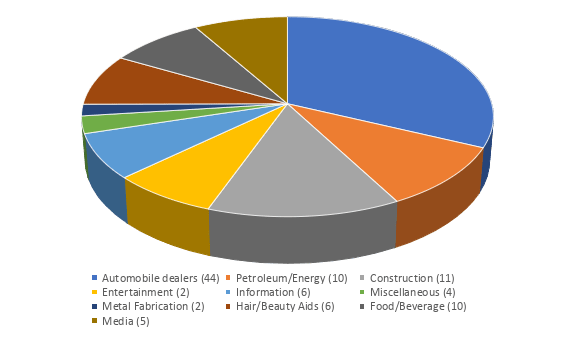
A recent survey by Black Enterprise magazine (BE) of the top 100 Black businesses reports that those companies had gross sales of $2.94 billion in 1985, up from $2.56 billion in 1984. On the other hand, the total number of persons employed by these firms was only 20,970 in 1985 (Hicks, 1986, p. 29). Automobile dealerships accounted for the largest percentage of the sales of the BE 100 in 1984, with total sales for all the dealerships amounting to over $819 million. Forty-four of the BE 100 were automobile dealerships in that year. (See Graph 1.) As Black Enterprise itself points out, many of these dealerships had their beginnings in the period of social turmoil in the 1960s: “When the idea of a minority-owned automobile dealership graduated from the dream stage to reality with the appointment in 1967 of Al Johnson of St. Louis to an Oldsmobile franchise on South Halsted Street in Chicago, the American automobile industry still had some of its best years ahead, it seemed. Opportunities for Blacks to cash in on such opportunities also were expanding, as civil unrest during the 1960s spurred Detroit into action. Ford Motor Company and the Chrysler corporation soon followed General Motors’ lead, and within a few years minority dealerships became the hallmark of black capitalism in America” (Stuart, 1982, p. 104). Black auto dealerships are dependent on the major auto industry for their very existence and are keenly sensitive to the vicissitudes of that industry.
Behind automobile dealerships, construction firms and petroleum/energy companies had the largest gross sales of the BE 100 in 1984, with more than $343 million and $260 million respectively. (See Graph 1.) In general, the energy sector of the Black bourgeoisie has a symbiotic relationship with the large monopolies and is heavily reliant on government contracts.
Hair care and beauty aids manufacturers are among those BE 100 firms catering primarily to Blacks. In 1984 these hair care and beauty aids businesses were 8.3 percent of the BE 100 companies, with total sales of more than $213 million. (See Graph 1.)
It is important to note that the overwhelming majority of the BE 100 were started after 1968 when the imperialists began emphasizing “Black Capitalism.” This is a reflection of the policy that the government has had over the past decade or more to prop up and hold many of these firms afloat.
In 1984 the forty-seven Black banks employed a total of 2,090 persons and had total assets of more than $1.6 billion. The top Black banks on that BE 100 list in 1984 had assets totaling over $103 million dollars and employed 167 persons (Black Enterprise, 1985, pp. 122, 125-126). The overwhelming majority of Black banks were started during and after the 1960% largely as a result of government intervention. As Black Enterprise points out:
During the “black capitalism” years of the Johnson and Nixon Administrations, the Federal Reserve Board was permitting newly founded black banks to open their doors with a rock-bottom level of assets at $1 million. The government sent its own employees in to provide technical assistance and amended federal regulations so that executives of white banks could be loaned to the black banks.
Thus, the development of government “black capitalism” policies in response to the civil rights movement (in this article we have shown that there was a good deal more than this) of the 1960% was directly responsible for the establishment of many black-controlled banks.
Large white-owned banks were often reluctant to finance black businesses in the inner cities. So the new black-owned banks – 48 of them chartered during the 1960s and 1970s – began to service the black business community, often with an enthusiasm that was beyond their financial means. (Petrie, 1982, p. 138)
Unlike Black banks, Black savings and loan associations and insurance companies are older and more established enterprises. The majority of Black savings and loan associations were established before the 1960s; and virtually all of the Black insurance companies were started prior to 1960, with the oldest, Southern Aid Life Insurance Co., being started in 1893. In fact, the Black insurance companies form the heart of the Old Guard Black bourgeoisie.
In 1984 there were thirty-five Black savings and loan associations, which had total assets of over $1.2 billion and employed a total of 654 persons (Fulwood, 1985, D. 138). In the same year the thirty-six Black insurance companies had combined assets of more than $811 million and employed 6,931 persons (Millinder, 1985, p. 156).
Having reviewed some of the important characteristics of the Black bourgeoisie, it is important to stress again that this class is in no way pivotal to the U.S. economy. There is no large manufacturing sector of the Black bourgeoisie. The forty-four Black banks with combined assets in 1982 of over $1.3 billion (Bradford, 1984, p. 1201 compare quite unfavorably to the 14,763 large commercial banks which had combined assets of more than $1.8 trillion in the same year. In addition, there are no Black firms on the Fortune 500 list. Moreover, the total gross sales of the BE 100 was only 2.6 percent of the net income of the No. 1 company on the Fortune 500 list in 1983 – Exxon. Exxon’s net income in that year was $88.6 billion (Fortune, 1984, p. 292), while the BE 100 had combined gross sales of $2.3 billion. What we are dealing with, then, is an oppressed bourgeoisie whose existence is real, even as it is tenuous and feeble. We must, however, reemphasize that the Black bourgeoisie is substantial enough as a class to make an impact within the Black nation.
Another expression of the position and role of the Black bourgeoisie is its dependence on aid from the large monopolies and the government. Over the past fifteen years or more, beginning with Nixon’s “Black Capitalism” campaign, the bourgeois state has provided a broad range of assistance to Black and other “minority-owned enterprises,” including government contracts, loans, and technical assistance. Large monopolies have also aided Black businesses in various ways, particularly through providing franchises.
As indicated earlier, the SBA awarded loans in the amount of $160 million to minority firms in 1970, a “banner year” for government loans to those businesses. The volume of loans “continued to increase until 1973, then dipped for 3 years before starting a new upswing in 1977” (Black Enterprise, 1982, p. 71). The “dip” for three years after 1973 was, of course, a result of the 1974-75 recession. After 1977 the volume of loans increased again, reaching a high of $470 million in 1980. However, by the end of 1983, during the Reagan austerity years, direct government loans to minority firms were, in effect, eliminated and loan guarantees through the SBA reduced. The ruling bourgeoisie, however, has not snatched away all the lifelines to Black-and minority-owned businesses – and is not likely to do so – but instead continues to prop some up and keep them afloat. There are compelling political reasons why the ruling class continues to build up and support sectors of the Black bourgeoisie (and petty bourgeoisie) -a subject to which we will return shortly.
The 8(a) program is one of the significant remaining “lifelines” that the bourgeoisie continues to throw to the larger Black businesses. The program began in 1968 to assist minority firms in winning government contracts. SBA serves as a “prime contractor awarding contracts for goods and services from federal agencies to eligible companies” and providing management, technical, and bonding assistance to these businesses. In 1968 there were nine firms in the 8(a) program, a number which grew to 2,663 in 1983. A total of 5,754 businesses participated in the program between 1968 and 1984; those firms received government contracts amounting to $14.7 billion over that 16-year period. One area of government contracting that is of particular interest is contracts that the Defense Department has made to minority businesses over the past four or five years, enlisting those firms directly into the war machinery of the U.S.-led bloc.
Over the past five years the Booker T. Washington Foundation has assisted more than 150 minority firms in obtaining defense contracts amounting to approximately $313.7 million. Sonicraft, Inc. of Chicago, G&M Oil of Baltimore, and J.W. Micro Electronics are a few of the many firms that have received multi-million dollar defense contracts. And one author points out that “more vigorous efforts are underway at the Foundation to expand black business participation in contracting and subcontracting in advanced weapons systems, installation development and management, construction and electronics” (Henderson, 1983, p. 185, fn. 51). Indeed, by 1981 Systems and Applied Sciences (SAS) of Riverdale, Maryland had a $50 million “Defense Department contract to design a tactical communications system for use by the military in combat environments” (Logan, 1983, p. 224)
Originally firms were allowed to remain in the 8(a) program until they were “competitively viable.” But in recent years the SBA has established a “fixed time period” that minority businesses can participate in the program. Also, in February 1983 nineteen of the largest minority firms were eliminated from the program because they were no longer considered small businesses by new SBA standards. Five of the Black data-management companies on the BE 100 List were adversely affected by that SBA action. The utter dependence of these firms on government assistance was revealed in a Black Enterprise article entitled “Harnessing the Information Explosion”: “The five firms have relied on the 8(a) program…for between half and three-quarters of their revenue, and now face the sudden prospect of either going up against the giant companies in bidding for the government work that previously they had been awarded non-competitively or else going after contracts in the private sector” (Logan, 1983, p. 223, emphasis added).
Franchising is another area in which the bourgeoisie has built up and assisted minority businesses. While 85 percent of all new small businesses fail in the first year, more than 95 percent of franchises are successful. Prior to the late 1960s and early 1970s, Blacks were practically locked out of franchising (the first Black-owned McDonald’s franchise wasn’t established until 1968). But over the last decade, franchising opportunities for Black entrepreneurs have opened up. Numerically, the leading franchising activities for Blacks are gasoline service stations, automotive products and services, restaurants, and food retailing. The total number of Black-owned franchises in 1982 was estimated to be about 5,500, up over previous years but still a drop in the bucket relative to the more than 440,000 franchise outlets in the U.S. (Trammer, 1982, p. 88).
In an article entitled “Going for the Gold,” Black Enterprise reports on Black companies that were preparing to make millions as licensees at the highly patriotic twenty-third Olympiad. According to Black Enterprise, about twenty Black companies had been licensed by 1983 to sell a variety of products at the 1984 Olympics. These companies were expected to receive combined profits of more than $50 million (Clayton, 1983, p. 65). The Los Angeles Olympic Organizing Committee (LAOOC) required some “sponsors and suppliers to employ minority subcontractors.” For example, “the committee required both Levi Strauss and Co., a sponsor, and Adidas, an equipment supplier, to subcontract with two minority firms. And, in fact, Adidas… struck deals with two black-owned Los Angeles companies – Panama Glove and Action Headwear” (Black Enterprise, 1983, p. 66). One is asleep if he or she believes that political considerations did not play a role in Black businesses being given a “piece of the Olympic action.”
Black Mayors: A Section of the Black Bourgeoisie or Part of the Imperialist State Apparatus?
Table 5 Black Elected Officials, by Office, 1970 to 1984
| Year | Total | U.S. and State Legislatures1 | City and County Officials2 | Law Enforcement3 | Education4 |
|---|---|---|---|---|---|
| 1970 (Feb.) | 1472 | 182 | 715 | 213 | 362 |
| 1975 (Apr.) | 3503 | 299 | 1878 | 387 | 939 |
| 1980 (July) | 4890 | 326 | 2832 | 526 | 1206 |
| 1984 (Jan.) | 5654 | 396 | 3259 | 636 | 1363 |
1 Includes elected state administrators and directors of state agencies.
2 County commissioners and councilmen, mayors, vice mayors, aldermen, regional officials, and other.
3 Judges, magistrates, constables, marshals, sheriffs, justices of the peace and other.
4 College boards, school boards, and other
Source: U.S. Bureau of Census, Statistical Abstract of the United States (Washington, D.C.: U.S. Government Printing Office, 19821, p. 250.
Black elected officials increased more than 300 percent between 1970 to 1982, and their numbers have continued to grow. (See Table 5.) Black mayors have increased from forty-eight in 1973 to 223 in 1983; ten of the eighteen largest cities in the U.S. now have Black mayors – such cities as Detroit, Atlanta, Oakland, Philadelphia, Chicago, and Washington, D.C. Despite what many would argue, the election of these Black mayors has meant no real change for the basic Black masses. Blacks in city government are for the most part presiding over deteriorating urban centers which have millions of impoverished Black masses trapped within them – basic proletarian masses whose situation has continued to grow worse and is in many cases quite desperate. For some who have become intoxicated with the rhetoric of electing Black officials as the road to “empowerment” and “liberation” for the Black masses, it might be sobering to peruse what was written in the Revolutionary Worker nearly four years ago in the wake of the cowardly murders of more than twenty-eight13 Black youths in Atlanta:
While between the years 1900 and 1960 fewer than 300 Blacks had ever been elected to any political office, by 1975 there were over 3,000 Black elected officials, including the mayors of such key cities as Washington, D.C., Newark, Detroit, Los Angeles and Atlanta.
In Atlanta the bourgeoisie even bragged of “sharing power” with Blacks.. . . As the “good times” of the early ’70s rapidly gave way to the deepening crisis of the late ’70s the ground was steadily eroded from under these people and they have been increasingly put in the position of proving their loyalty to the ruling class to save their hides. What was loudly proclaimed as a “new day” for Blacks has increasingly been shown to be merely a new stage in the nightmare, only this time the Black bourgeois forces are more and more openly “partners” in the clampdown.
The Black youth murders represented the sharpest crisis so far in that stratum. While part of the bourgeoisie’s line was that there couldn’t be any racism involved since the city administration was Black, (Atlanta Mayor Maynard) Jackson showed himself to be perfectly capable of, and willing to directly carry out, repression against “his own people’ and to even cover up for and protect the reactionaries who were murdering them. He was even so brazen as to justify the curfew as a means to keep “unruly youth” off the streets. To say the least, this has poked dents in the facade of his (and others’ like him) “Black politicians are the road to freedom” bandwagon. (Revolutionary Worker, No. 141, 5 Feb. 1982, p. 12)14
Although the main social base of the Black mayors is the Black bourgeoisie and petty bourgeoisie, which receive important sops from Black city administrations, including contracts and jobs, these big-city mayors are not part of the Black bourgeoisie; they are part of the bourgeois state apparatus, which exists for the suppression of one class by another. Today they play their role mainly by taking measures to cool out the anger of the basic masses and build up the buffer strata, keeping alive the illusion of upward mobility for the proletarian masses. Tomorrow, in the context of overall global turmoil, it will be the Black mayor and Black city government, presiding over decaying ghettos, who will call on other authorities in the bourgeois state to send in the National Guard and even U.S. troops to contain the suppressed anger of the basic Black masses or to put down a rebellion or an uprising. In that context, Black mayors will not only serve as firemen; those who act in that way (and we can basically expect they will – or be rendered irrelevant in bourgeois in-fighting) will be playing an important role in violently suppressing the Black masses, as they have already shown they are more than willing to do. Exhibit A is Mayor Wilson Goode in Philadelphia, who outdid his openly racist predecessor Rizzo by acting as commander in chief during the 1985 “Philly Massacre” and ordering the bombing of the MOVE house and the murder of at least eleven people in it, including five children! If Atlanta put a “dent in the facade” of Black mayors, Philadelphia has even more vividly shown “what time it is.” To some degree, Maynard Jackson could hide behind the mask of “doing all that we can to find the murderers”; Wilson Goode’s role, on the other hand, is right out there “on front street.” As Carl Dix, a spokesperson for the RCP, has pointed out: “This reliance on Black faces in high places is a dead-end road that can’t end the oppression of Black people (or anybody else for that matter) and, even worse, it is a deadly trap. Time and again, the rulers have demonstrated that terror unleashed against the masses and a Black official to front for it is an effective and deadly mix. After all, what would have been the response of the masses if a white mayor had been the one bragging about taking ‘full responsibility’ for the MOVE massacre?” (Dix, 1986, pp. 10-11)
To reiterate: the Black politicians (and here we are talking particularly about the big city mayors and the congressmen, etc.) do not form a detachment of the Black bourgeoisie (or still less the Black petty bourgeoisie). They serve and enforce the dominant position (and dictates) of the big (i.e.. white American) bourgeoisie. But this is not to say that the relationship between these mayors and the bourgeois strata within the Black nation is not complex and intimate. In the concentrated instance of the Philly Massacre, Goode was able to draw on a not insubstantial social base that swallowed their displeasure (and in some cases revulsion) at the bombing because Goode had channeled a few more contracts, a few more goodies, and a few more patronage plums their way – and at times this argument was put in quite frank and unvarnished terms. At the same time, in the end Goode has found it quite difficult to ride the two horses of terroristic national oppression and acting as a buffer, and no small part of this has been his difficulties in maintaining order even among the more entrenched petty-bourgeois sections of his social base.
The Build-up of the Black Petty Bourgeoisie
In his book Where Do We Go From Here, Martin Luther King, Jr. talked about the goals of the civil rights movement of the 1960s:
The American racial revolution has been a revolution to “get in” rather than to overthrow. We want a share in the American economy, the housing market. the educational system and the social opportunities. This goal itself indicates that a social change in America must be nonviolent. If one is in search of a better lob, it does not help to burn down the factory. If one needs more adequate education, shooting the principal will not help. If housing is the goal, only building and construction will produce that end. To destroy anything, person or property, cannot bring us closer to the goal that we seek. (King, 1968, p. 130)
What King describes in his book can hardly be considered a “revolution” of any sort; instead, he expresses the aspirations of the Black bourgeoisie and petty bourgeoisie. And it is undeniably true that lo an extent the aspirations of the more privileged and elite strata among Black people have been realized. By this statement we do not imply that these strata no longer suffer discrimination and national oppression but rather that they have made some “progress” along the lines that King talks about in his 1968 book. In fact, the past twenty years have witnessed the build-up of certain significant sections of the Black petty bourgeoisie. Today lacks are far more visible than they have ever been in U.S. society, including in various “white collar” positions, the media, political office, etc.
What has been the specific character of the “progress” that the Black middle class has made over the past couple of decades?And in what ways do they continue to be held down and oppressed?
The “movement of Blacks up the occupational scale” progressed steadily in the 1960% slowed in the 1970s as the result of economic disruption, and has continued into the 1980s, although not in a straight line. Blacks have made significant gains in the three highest-paying job categories over the past couple of decades: the professional and technical, managerial and administrative, and craft positions. For example, 11 percent of Black workers were employed in professional and technical and craft positions in 1960; by 1980 their proportion had almost doubled to 21 percent (Westcott, 1982, p. 29). In addition, the percentage of all persons employed as managers and administrators who were Black increased from 1.6 percent to 2.6 percent between 1960 and 1970 (Levitan, 1975, p. 48). As Table 6 shows, the growth of Blacks in two of the highest-paying job categories has continued. Between 1972 and 1982 the percentage of employed Blacks working in professional and technical positions increased from 8.2 percent to 11.8 percent. And during the same period Black managers and administrators increased from 3.2 percent to 4.8 percent. And, at “the other end of the scale,” the previous two decades have also witnessed substantial declines in the percentage of Blacks employed as private household workers. (See Table 6.)
Table 6
Percent of Distribution of Employed Blacks By Occupation, 19721, 19762, 19802, 19822, 19853,
| 1972 | 1976 | 1980 | 1982 | 1985* | |
| Total Employed | 7,753 | 8,231 | 9,313 | 9,189 | – |
| Professional and Technical | 8.2 | 9.8 | 10.9 | 11.8 | 11 |
| Managers and Administrators | 3.2 | 3.8 | 4.5 | 4.8 | 6.2 |
| Sales | 2 | 2.2 | 2.7 | 2.8 | 6.6 |
| Clerical | 14.2 | 15.9 | 18.5 | 18.9 | 17.1 |
| Craft and Kindred | 8.7 | 8.9 | 9.7 | 9 | 9 |
| Operatives except Transport | 16.3 | 16.2 | 14.7 | 13.8 | 10.7 |
| Transport Equip. Operatives | 5.9 | 5.4 | 5.4 | 4.8 | 5.9 |
| Nonfarm Laborers | 10.1 | 8.8 | 7.4 | 7.4 | 6.9 |
| Farm and Farm Managers | 0.6 | 0.4 | 0.2 | 0.2 | – |
| Farm Laborers and Foremen | 2.4 | 1.9 | 1.5 | 1.4 | – |
| Private Household Workers | 7.4 | 5 | 3.7 | 3.2 | 2.8 |
| Other Service Workers | 21 | 21.6 | 20.7 | 21.8 | 21.3 |
*There is a technical break in the series from 1982 to 1983; therefore, the data for 1985 is not directly comparable with earlier data, but the trend lines do seem to indicate developments since 1982.
1Derived from Diane-Nilsen Westcott, “Blacks in the ’70s: Did They Scale the Job Ladder?” Monthly Labor Review, June 1982, Table 2., p.30
2Handbook of Labor Statistics, Bulletin 2175, December 1983, Table 16, p. 48
3U.S. Department of Labor, Buereau of Labor Statistics, Employment and Earnings
Another phenomenon during the ’70s was the increase in Black women as professional workers relative to their white counterparts. Black women professionals, accounting for almost 11 percent of all employed Black women in 1972, were nearly 14 percent of the total in 1980, a proportion approximating that for white women (Westcott, 1982, p. 30). These data have prompted some observers to argue that Black women have achieved parity with white women. A couple of observations must be made about these conclusions. First, what is often obscured in the data pertaining to the median income of Black women and white women is that women generally are at the bottom of the income scale. It is the reality today that men have a position of privilege (indeed dominance) relative to women – this is something that is measurable not only in terms of income but also in terms of the basic social relations in U,S, society, a phenomenon that is also observable globally. Moreover, Black women suffer oppression not only as women but also as Blacks. Second, the income “parity” between Black women and white women is no doubt also partially attributable to the fact that many white women are employed part-time or seasonally.
While Blacks have made significant gains in higher-paying jobs in the private sector over the past couple of decades, the public sector of the job market is, however, the backbone of the Black petty bourgeoisie. While all government jobs are certainly not petty-bourgeois positions, many are. Approximately one-fourth of Black workers employed in the public sector have federal government jobs, half work for city and county government, and the remaining one-fourth are employed in state government (Hill, 1986, p. 50). In fact, concomitant with the rise and installment of Black mayors in major urban areas has been a substantial increase in Black city and county employees. For example, between 1975 and 1984 Blacks employed full-time by city government expanded from 260,254 to 302,726; and their median annual income rose from $9,342 in 1975 to $17,144 in 1984. The total number of full-time Black county employees was 95,727 in 1975and 131,793 by 1984. During that period the median annual income of Black county workers grew from $8,260 to $15,004.One-third (34 percent) of Black male managers and half (51 percent) of Black male professionals work for the government. Similarly, two-fifths (41 percent) of Black female managers and two-thirds (69 percent) of Black female professionals have jobs in the public sector (Hill, 1986, p. 50). This has gone along with a big increase generally in Black public sector employment for all classes, which rose from 1.6 million in 1970 to 2.5 million in 1980.
Apart from government jobs, state intervention has played an important and initiating role in the build-up of the Black petty bourgeoisie, particularly as reflected in initiatives like affirmative action. The affirmative-action pro- gram was aimed against discrimination against women and minorities in education, employment, and in various other areas, including housing and military service.
To cite just one example of the effects of the program, affirmative action played an important role in removing some of the barriers to higher education for Blacks. Prior to the 1960s many major colleges and universities did not admit Black students. In 1970 only 260 Black high school graduates for every 1.000 were enrolled in college. By 1975 that figure had climbed to 320 Black graduates per 1,000 – almost comparable to that for whites. Since 1975 the number of Black college enrollees has decreased, but by 1981 the figure was still higher than it had been in 1970 (CSSP, 1983, p. 13). It should be noted, however, that a substantial proportion of Blacks in post_secondary education are in junior colleges.
Through the years, “ratio hiring” and “quota relief” to “overcome the effects of past discrimination and to compel fairness in employment” became features of many affirmative-action programs, often as the result of court actions (Pickney, 1984, pp. 157-58). In recent years, however, affirmative action has come under considerable attack and has been subject to reversals, specifically as relates to “ratio hiring” and “quotas,” which some observers – including the – current Justice Department – have characterized as “reverse discrimination.”
The gains of the Black middle class that we have been pointing to, while real, are only part of the picture. Although they have made “progress” over the past couple of decades, . – the Black middle class is still concentrated in the lower rungs of the higher-paying jobs. As a recent study points out: “In most cases, black workers were concentrated in the same jobs in which they were employed in 1972. In other words, although a higher proportion of blacks could be found among the professional and technical occupations in 1980 than in 1972, they were still concentrated in jobs at the lower end of the professional pay scale, such as nursing, technical trades, and vocational and educational counseling. And even though their numbers have expanded in some of the more desirable and better paid jobs, there are few examples where black men and women have been able to significantly increase their representation in a particular job” (Westcott, 1982, p. 31). In 1980, 8.2 percent of Black men were employed as professional compared to 16.1 percent of white men; and in the same year 5.6 percent of all Black men were managers and administrators, as opposed to 15.3 percent of white men (Westcott, 1982, p. 30). Black men were more likely to be school administrators and managers of restaurants, cafeterias and bars, and school administrators in both 1972 and 1980 (Westcott, 1982, p. 31). In addition, Blacks were less than 5 percent of all accountants, computer specialists. engineers, physicians, and dentists in 1980, and more than 13 percent of all nurses, dietitians, therapists, social and recreation workers, and vocational and educational counselors (Westcott, 1982, p. 32). In short, the “better paid the job the less likely that Blacks are well represented in it” (Levitan, 1975, p. 53).
It should also be kept in mind that an important section of the Black petty bourgeoisie continues to consist of small owner-operators based in the Black community, as well as vendors and small-time hustlers, some of whom operate on the borders of legitimacy but are not actually criminals. For them there has been little if any progress, as the conditions generally in the ghetto have been devastating for such petty entrepreneurs. They have not, generally, been the beneficiaries of the imperialists’ strategy of building up a buffer.
Table 7
Median Family Income by Race
Data adjusted to 1983 dollars.
| Median Family Income (in constant 1983 dollars) | ||||
| Year | All Races | White | Black | Black Family Income as percent of White Family Income |
| 1983 | 24,580 | 25,757 | 14,506 | 56.3 |
| 1975 | 25,395 | 26,412 | 16,251 | 61.5 |
| 1970 | 25,317 | 26,263 | 16,111 | 61.3 |
| 1965 | 21,968 | 22,896 | 12,607* | 55.1 |
| 1960 | 14,907 | 19,630 | 10,864* | 55.3 |
* A Dream Deferred: The Economic Status of Black Americans, A Working Paper (Washington, D.C.: Center for the Study of Social Policy, 1983), p.4. Data adjusted to 1983 dollars.
Source: U.S. Department of Commerce, Bureau of the Census, Money Income of Households, Families, and Persons in the United States: 1983, Table 15, pp. 41-42.
Table 8
Percentage Share of Aggregate Income Received in Selected Years by Each Fifth and Top 5 Percent of Families (by Race of Householders) – in current dollars
| Families | ||||||
|---|---|---|---|---|---|---|
| Black and other races | White | |||||
| 1960 | 1970 | 1983 | 1960 | 1970 | 1983 | |
| Lowest fifth | 3.7 | 4.5 | 3.6 | 5.2 | 5.8 | 5.2 |
| Second fifth | 9.7 | 10.6 | 8.8 | 12.7 | 12.5 | 11.5 |
| Middle fifth | 16.5 | 16.8 | 15.6 | 17.8 | 17.7 | 17.2 |
| Fourth fifth | 25.2 | 24..8 | 25.3 | 23.7 | 23.6 | 24.2 |
| Highest fifth | 44.9 | 43.4 | 46.8 | 40.7 | 40.5 | 42 |
| Top 5% | 16.2 | 15.4 | 17 | 15.7 | 15.5 | 15.6 |
Sources: U.S Bureau of Commerce, Bureau of Census, Money Income of Households, Families and Persons in the United States: 1983 (Washington, D.C.: U.S. Government Printing Office, 1985) pp.49-50
While not the most clear-cut indicator of the economic status of Blacks, median family-income data demonstrate improvement in the income level of Black families over the past twenty or more years. Table 7 shows that between 1960 and 1983 the median annual income (in constant 1983 dollars) of Black families increased from $10,864 to $14,506. The period of most rapid improvement of Black family income relative to whites was between 1965 and 1970. The median income of Black families as a percentage of white family income peaked in 1975 at 61.5 percent and has since declined. (See Table 7) Black families in which both the husband and wife work recorded the most impressive gains. The median income of these families increased from 73.2 percent of comparable white families’ income in 1968 to 84.3 percent in 1981 (CSSP, 1983, p. 81.
These data, however, need to he put into perspective; that is to say, the female-headed household is the most rapidly increasing household among the Black population. Black female-headed households, unlike Black married-couple households in which both husband and wife work, made no progress between 1968 and 1981!
Table 8 illustrates the percentage share of aggregate in- come of Black families over the past twenty years or more. If the income of Black families was equally distributed, each level would receive 20 percent of the aggregate income. However, this has not been the trend over the last two decades. In fact, the top 40 percent of Black families are the only ones that receive 20 percent or more of the aggregate income. Furthermore, these data suggest that since 1970 there have been at least two observable trends: (1) the shrinking of the percentage share of income received by the bottom two-fifths of Black families; and (2) an increase in the proportion received by the top two-fifths. In other words, there has been a sharpening income polarity among Black families since 1960; and this polarization has increased at a faster rate among Black families than among white. (See Table 8.)
Education is another area where the gains of Blacks over the past couple of decades are apparent. Indeed, the median educational level has increased more rapidly for Blacks than for whites over the last twenty years (CSSP, 1983, p. 11). Between 1960 and 1981 Black males gained 4.4 years of education compared to 1.9 years for white males. Black females made similar gains in schooling during the same period, showing a gain of 3.5 years as opposed to 1.3 for white females, By 1981 the median level of education attainment for Blacks was twelve years, reflecting a disparity of only six months between Blacks and whites (CSSP, 1983, p. 11). The official illiteracy rate for Blacks has also dropped.15 For example, in 1959 the illiteracy rate for Blacks between the age of fourteen and forty-five was 63 persons per 1,000 and 13 persons per 1,000 for whites. But by 1979 that rate had declined to 7 persons per 1,000 for Black and 4 persons per 1,000 for whites.
Graph 2
Black Families by Type 1970 and 1985
Source: Bureau of the Census. America’s Black Population, 1970 to 1982: A Statistical View, 1983, p 19.
*U.S. Department of Commerce, Bureau of the Census, unpublished data.
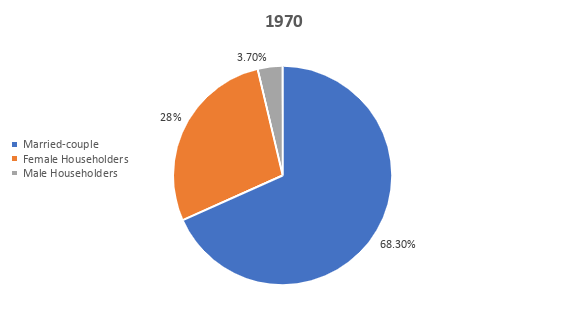
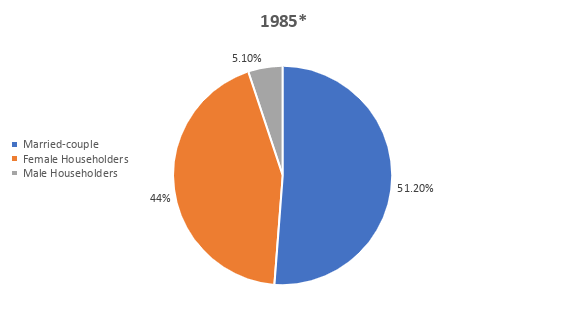
The educational “achievements” of Blacks, however, have not been enough to bridge the gap in the annual income of Blacks and whites. The yearly earnings of Black families headed by a college graduate compared to the earnings of white families headed by a high school graduate are perhaps the most dramatic statistical evidence of a gap between Black and white earnings. In 1980, 23.7 percent of all Black families headed by persons with at least four years of college earned less than $15,000 annually, while 26.1 percent of householders in white families who only had four years of high school received a comparable annual salary. As observed in the study, “A Dream Deferred: The Economic Status of Black Americans”: “Overall, the income distribution of black families whose heads have completed four years of college parallels the income distribution for white families headed by high school graduates more closely than it does white families headed by college graduates” (CSSP, 1983, p. 14).
In thinking about the build-up (and role) of the Black petty bourgeoisie in recent years, it is useful again to draw a distinction between those who have made it into a relatively solidly entrenched position and the majority of the Black petty bourgeoisie who continue to scrape along, barely surviving. This latter section continues to include everyone from those many owner-operators of beauty parlors, barber shops, and auto repair operations, to aspiring Black artists, and on to the many street vendors and small-time, semi-legitimate hustlers. These forces have not benefited from the push of the last two decades, and their conditions of life do not approximate those of the middle class. They are a politically volatile and quite significant section of the Black nation, a big part of the social base for revolutionary nationalism, and an important element of the solid core of the united front against imperialism.
To conclude this section of our study, the last couple of decades have witnessed the build-up of the professional and technical, managerial, and craft sectors of the Black population. State intervention has played an important and initiating role in the build-up of these strata, particularly as reflected in initiatives such as affirmative action – a pro- gram which itself has been subjected to curtailment in recent years. But again, while it is an incontrovertible fact that the Black petty bourgeoisie has made gains along the lines of what Martin Luther King, Jr. talked about in his 1968 book Where Do We Go From Here?, the Black middle class is still confined to the lower rungs of the socio-economic ladder. Our position, therefore, is at odds with two other trends of analysis that can be found in the literature on Black “progress”: (1) a position which tends to exaggerate the gains that the Black petty bourgeoisie has made since the 1960s; and (2) a trend which denies those gains and argues instead that there is a “commonality’ of interests – or a lack of any significant class contradiction – in the Black nation. Both of these analyses marshal evidence to show that the system is reformable – that resources can be redistributed to compensate for imbalances. Neither argument is correct. Neither is able to situate phenomena within the framework of national oppression, capitalist accumulation, and the international exigencies of imperialism; nor does either argument comprehend that national oppression has been pivotal in the post-World War 2 period and is overall integral and vital to imperialism. (See Wilson, 1980: Pickney, 1984: and McGhee, 1983.)
Skilled and Bourgeoisified Workers
In the 1960s high-income jobs in basic industry were the road to upward mobility for many Black workers. Detroit – “auto capital of the world” – affords an interesting and important case study 0f the employment “opportunities” for Blacks in that decade and the years following. After a slump in the late 1950s the auto industry experienced a sales boom in the 1960s. Employment at the Big Three grew tremendously between 1960 and 1968 – from 723,556 employees in 1960 to 1,020,783 in 1968 (Geschwender, 1977, p. 42). The proportion of Blacks who were employed in the auto industry increased from 9.1 percent to 13.4 percent during that decade (Geschwender, 1977, p. 42). Indeed, by 1970 over 33 percent of employed Black male residents of Detroit were commuting to manufacturing jobs in the suburbs (Fusfeld and Bates. 1984, p. 120).
But while the employment pains of Detroit ghetto residents were impressive, Blacks continued to be concentrated in the lower-ranking. less desirable jobs in the auto industry, in the late ’60s. They were more often than not employed in the “worst and most dangerous jobs: the foundry, the body shop, and engine assembly – jobs requiring the greatest physical exertion and jobs which were the noisiest, dirtiest, and most dangerous in the plant. Blacks were further abused by the 90-day rule, under which workers could be dismissed at will before coming under full contract protection. The companies made it a practice to fire hundreds of workers per week, creating a rotating and permanent pool of insecure job seekers” (Georgakas and Surkin, 1975, p. 35).
Detroit was the scene of one of the most powerful uprisings of the decade during the summer of 1967. More than thirty other cities ignited in the week that the Detroit rebellion erupted. The cover of the August 7, 1967 edition of Newsweek was entitled “Battlefield, U.S.A.” and featured pictures of Detroit going up in flames. That issue of Newsweek conveyed the deep concern and panic of the bourgeoisie over what bad happened in Detroit, following just three weeks after the explosion of violence in Newark, New Jersey:
The trouble burst on Detroit like a firestorm and turned the nation’s fifth biggest city into a theater of war. Whole streets lay ravaged by looters, whole blocks immolated by flames. Federal troops – the first sent into racial battle outside the South in a quarter of a century – occupied American streets at bayonet point. Patton tanks – machine guns ablaze – and Huey helicopters patrolled a cityscape of blackened brick chimneys poking out of gutted basements. And suddenly Harlem 1964 and Watts 1965 and Newark only three weeks ago fell back into the shadows of memory. Detroit was the new benchmark, its rubble a monument to the most devastating race riot in U.S. history – and a symbol of a domestic crisis grown graver than any since the Civil War. (Newsweek, 1967, p. 18)
It is no exaggeration to say that Detroit – and the heating climate in the country overall, including the existence of revolutionary leadership and organization – “freaked” the ruling class.
Table 9
Occupational Distribution of Employed Black Worker, 1960-70
| (number in thousands) 1960 | 1970 | |||
| Number | Blacks as % of all | Number | Blacks as % of all | |
| Total | 6,087.5 | 9.4 | 7,403.1 | 9.6 |
| Professional and technical | 319* | 3.7 | 61.3 | 5.4 |
| Managers, administrators and proprietors | 115* | 1.6 | 166.2 | 2.6 |
| Sales workers | 96.8* | 1.8 | 165.8 | 3.1 |
| Clerical and kindred workers | 426.4* | 4 | 1021.6 | 7.4 |
| Craftsmen and kindred workers | 418.6* | 4.3 | 674.8 | 6.3 |
| Operatives | 1,309.8* | 10.1 | 1,749.2 | 12.7 |
| Laborers, except farm | 816.1* | 24.7 | 688.2 | 20.1 |
| Service workers, except private household | 1,128.6* | 18.9 | 1,484 | 17.1 |
| Private household workers | 947.5* | 52.7 | 613.4 | 52.5 |
| Farmers and farmworkers | 509.6* | 12.4 | 223.5 | 9.4 |
* Categories adjusted to match 1970 definitions.
Sources: Sar A. Levitan, et at., Still A Dream: The Changing Status of Blacks Since 1960 (Cambridge, Mass.: Harvard University Press, 19751, pp. 48-52, Table 3-4
In the wake of the Detroit rebellion, the bourgeoisie initiated a program to train the “hard-core” unemployed, many of whom were eventually hired in the auto industry. Welfare recipients and former prisoners, among others, were given jobs in the industry. Ford Motor Company set up hiring offices in the ghetto, and they waived “normal job requirements if the requirements were not found to be directly related to job performance” (Geschwender, 1977, p. 74). And in early 1968 the bourgeoisie on a national level intervened in this process, launching thr “Job Opportunities in the Business Sector” program. The program was initiated under the Johnson administration and was later embraced by Nixon. More than 300,000 “hard-core” unemployed were hired under this program.
Detroit, however, was not the only city that witnessed gains for Blacks in manufacturing industry in the 1960s. Data on five major U.S. cities with large Black populations – Chicago, Baltimore, Cleveland, Detroit, and Philadelphia – reveal upward mobility for Black “blue-collar” workers between 1950 and 1970. In these five cities, Black males made impressive gains in the manufacturing industry, especially as operatives, a sector concentrating the largest proportion of Black male workers. Black men also made gains in the “craftsmen, foremen, and kindred” category. The employment of Black women in these cities, however, declined in the operative category and rose only slightly in the craft sector. The growth of Black women clerical employment was quite impressive, expanding from 7.5 percent of employed Blacks in 1950 to 30.8 percent in 1970! Two things must be noted about these data: (1) the employment gains of Black women are not as impressive when one considers that clerical jobs are the lowest paid of the “white-collar” positions, with an annual income in 1980 of only $11,717 for full-time workers: and (2) in general, Blacks were concentrated, as we have indicated previously in discussing national trends, in the lower rungs of the employment ladder, as well as at the bottom of operative and craft positions.
Nationwide statistics pertaining to the U.S. labor force paint a similar picture as those for the five major cities that we have discussed. Between 1960 and 1970 the proportion of all employed “craftsmen and kindred workers” who were Black increased from 4.3 percent to 6.3 percent. By 1970, however, most skilled Black workers were employed as cement and concrete finishers as opposed to electricians or plumbers, which were higher-income positions. On the other hand, the proportion of all operatives who were Black expanded during the same years – from 10.1 percent to 12.7 percent. (See Table 9.)
Black workers made significant inroads into high-paid jobs in basic industry in the 1960s, including in skilled positions. Those gains have been seriously undermined in recent years, however, through several recessions – the weight of which has fallen disproportionately on Black workers – and continuing structural changes in the U.S. economy which have dried up many of these better-paying production jobs. For example, 11.5 million workers lost jobs in basic industry between 1979 and 1984 as a result of “plant closings or relocation, abolition of a position or a shift, or slack work. Of these, 5.1 million had had the job at least 3 years and were considered displaced.” By January 1984, 1.3 million of the 5.1 million displaced workers were still without jobs and almost one-third of those who found jobs had taken wage reductions of 20 percent or more, while more than one-tenth of those workers who had formerly been employed full-time had taken part-time jobs. Although the majority of these “displaced” workers were white males, Blacks accounted for 12 percent of them (U.S. Congress, Office of Technology Assessment, 1986, p. 7).
Some observers on the left, notably Manning Marable, argue that the bourgeoisie (and/or the “white masses”) want to “roll back the clock,” specifically on the “progress” that the Black masses have made over the past couple of decades. Others argue that the imperialists find it necessary to “roll hack the clock” specifically in order to create the conditions that are more conducive to economic expansion. Our views are at odds with both of these positions. While the crisis will erode more privileged bastions – and is already doing so – among the Black masses, we do not believe there will be an across-the-board leveling of the positions of various strata among the Black masses. Indeed, class polarization will continue, even intensify in some ways. And it will continue to have important political expression. The phenomenon of “last hired and first fired” among the proletariat will assume even more monstrous proportions; and the bourgeoisie will continue to build up some sections of the Black bourgeoisie and petty bourgeoisie even while other sectors are driven under, as many have been since the decade of the ’60s. We have shown how the state continues to provide a “lifeline” for elements of the Black bourgeoisie, despite certain cutbacks in aid. This is based on the political situation that the U.S. bourgeoisie faces in preparing its bloc for a showdown 4th the Soviet-led bloc. The needs of the U.S. empire provide compelling political reasons to continue to prop up and support buffer strata among Black people as a base for reformism and even American patriotism.
Beyond all that, “rolling back the clock” is not enough to create better conditions for economic expansion. What is required is that the whole framework of global economic, political, and military relations be recast. What is required to get over the profound crisis of the imperialist system worldwide is the restructuring of world capital. In order for that to happen, a rival bloc must be defeated and the whole world redivided. This is the concrete situation at this point in the spiral development of imperialism; this is why we say world imperialism is rapidly approaching a conjuncture (Lotta, 1984).
The Basic Black Masses: Increasingly Desperate Circumstances
So far we have dealt with only one side of the class polarization equation: the build-up of significant sections of the Black bourgeoisie and petty bourgeoisie and the motion of some lacks into the better-paid sections of the working class But what are the conditions of the basic Black masses? How has their situation grown worse since the decade of the ’60s?
As a result of a long history of oppression, in various forms and continuing until today, the majority of the masses of Black people (and other oppressed nationalities) are concentrated in low-wage, dead-end jobs. One writer has estimated that between 66 percent and 75 percent of all employed Black ghetto workers hold jobs in the low-wage sector of the economy (Fusfeld and Bates, 1984, p. 158). The ruling class in the U.S. utilizes Black labor as a superexploited section critical to the accumulation process and as a key segment of a permanent reserve army of the unemployed. As Fusfeld and Bates have observed in the Political Economy of the Urban Ghetto: “The presence of these cadres of unemployed workers tends to keep wages low in those sectors of the labor market in which they compete. These are the low-wage industries and menial occupations for which racial minorities are eligible” (Fusfeld and Bates, 1984, p. 161).
In fact, the unemployment rate for Blacks has been consistently more than twice that for whites since the end of the last world war. For teenagers between the ages of 16 and 19, the unemployment rate for Blacks is also substantially higher than for whites. In 1985, 38.4 percent of Black teenage males were unemployed – and these are the official unemployment figures – compared to 16.5 percent of white teenagers. And for Black females, the unemployment picture was just as serious – more than 35 percent of them were unemployed, as opposed to 14.8 percent of white teenage females. (See Table 10.)
Table 10
Unemployment by Race 1690, 1970, 1982, and 1985*
| Unemployment Rate (Percent) | |||||||
| White | Black and other non-white1 | ||||||
| Year | All Civilian Workers | Total | Males Age 16-19 | Females Age 16-19 | Total | Males Age 16-19 | Females Age 16-19 |
| 1985 | 7.2 | 6.2 | 16.5 | 14.8 | 13.7 | 38.4 | 35.8 |
| 1982 | 9.7 | 8.6 | 21.7 | 19 | 17.3 | 44 | 43.8 |
| 1970 | 4.9 | 4.5 | 13.7 | 13.4 | 8.2 | 25 | 34.5 |
| 1960 | 5.5 | 5 | 14 | 12.7 | 10.2 | 24 | 24.8 |
1Black and other non-white. “Other non-white” are about 10 percent of the Black total.
Source: A Dream Deferred: The Economic Status of Black America, A Working Paper (Washington, D.C.: Center for the Study of Social Policy, 1983), p. 18.
*Bureau of Labor Statistics, Employment and Earnings, January 1986, Table 1, p. 152: Table 3, p. 155; and Table 4. 157.
In recent years, the U.S. military has appealed to Black youth (and others) to “be all that you can be.” The idea is that unemployable Black youth can enter the armed forces, be trained in a skill, and return to civilian life far more employable than they were when they went into the military. Large numbers of Black youth have gone into the military to escape the pervasive poverty in the ghetto. By 1981 Blacks constituted more than 30 percent of the U.S. Army, This development generated much concern in ruling circles, where there was speculation about the potential fallout if Blacks suffered a third or as much as a half of the combat fatalities in the initial stages of conflict, a real likelihood given the large percentage of Black combat troops. But the bourgeoisie is even more concerned that Black troops will not “be all that they can be” in confronting the enemies of U.S. imperialism, especially when confronting revolutionary struggles in the Third World. In a 1982 study, Blacks in the Military, the Brookings Institution explored the issue of the viability of a military machine consisting of large numbers of Blacks. One consideration was how reliable Black troops would be in a domestic military conflict or in an attack on a Third World country. The Brookings report, in fact, reviewed the history of the appeals of Third World peoples (and imperialist enemies of the U.S.) to Black soldiers:
Potential adversaries might also view the changing racial balance as an opportunity to exploit racial problems where they exist and to create them where they do not. There is a long record of the nation’s perceived vulnerability to such propaganda measures; virtually every recent adversary has used them. At the turn of the century, Filipino guerrillas exhorted U.S. black soldiers to desert and not be “instruments of their white masters’ ambitions to oppress another ‘people of color.’” In World War I the Germans circulated among members of the black 92nd Division leaflets pointing out the contradiction of fighting for democracy abroad while being denied rights at home. In World War II the Japanese made radio appeals specifically to black troops serving in the Pacific theater. During the Korean War the Chinese reportedly used ‘divide and conquer’ techniques on black prisoners of war. In Vietnam the National Liberation Front announced that ‘liberation forces have a special attitude toward American soldiers who happen to be Negroes.’ Rebel forces in the Dominican Republic, as already indicated, appealed to racial differences. And more recently, the Khomeini government released thirteen U.S. hostages after three weeks of captivity, eight of whom were black males and five white women. The release was staged as a major media event at which Khomeini’s professed respect for women and oppressed blacks was highlighted. (Binkin, et al., 1982, pp. 117-118)
This problem has historically posed a contradiction for the U.S. imperialists, especially during the Vietnam War when large numbers of Black soldiers (and others) opposed the war, including by turning their guns on their commanders. This is a grave concern for the U.S. imperialists in the context of the global war that is shaping up between the imperialist blocs, East and West. If the approach to that war includes U.S. military action against liberation movements, or even moderately nationalist governments in the Third World – as it well might – such “concerns” will sharpen greatly. An equally serious consideration for the ruling class is the basis for many of these troops to be won over to the side of the proletariat in circumstances of a serious revolutionary initiative in this country in the context of overall global crisis.
The incidence of poverty is another indicator of the bleak situation confronting the Black masses in the ’80s. There is a vast and growing proportion of the Black population that is living in depressed conditions. In 1983, 9.9 million Blacks – approximately 36 percent of the Black population – lived in poverty, the highest Black poverty rate since the government began reporting data on Black poverty in 1968 (Center on Budget and Policy Priorities [CBPP], 1984, p. 4). And, since the 1981 budget cuts, the incidence of poverty among Blacks has grown.
A report by the Center on Budget and Policy Priorities suggests that Blacks were “disproportionately affected” by the Reagan budget cuts. According to the Center, the cuts cost the average Black family three times as much in lost income and benefits as they cost the average white family (CBPP, 1984, p. 12). This occurred primarily because the “deepest cuts were made in programs in which blacks participate in the largest numbers” (CBPP, 1984, p. 12). Moreover, the poverty rate for Blacks has grown at a faster pace than for whites over the past few years. Between 1980 and 1983 the incidence of poverty for whites increased from 10.2 percent to 12.1 percent, meaning an additional 1.9 percent of whites became impoverished during that period. During the same period the poverty rate for Blacks rose from 32.5 percent to 35.7 percent. As a recent report points out: “The proportion of the Black population added to the poverty ranks since 1980 (3.2 percent) is almost twice as large as the proportion for the white population added to the ranks of the poor (1.9 percent)” (CBPP, 1984, p. 5).
The report of the Center on Budget and Policy Priorities attributes the deteriorating economic situation of the Black masses primarily to Reaganomics. This is the height of liberal hypocrisy. The cuts in social programs actually began under Carter’s administration and are primarily a function of the exigencies of the U.S. empire, and are being made even though they undercut the political purpose which these social programs have served for the bourgeoisie. As Raymond Lotta observed recently:
Nevertheless, the cuts are but an expression of, and an imperative reaction to a real crisis of accumulation and a real necessity to ‘shift priorities.’ These social programs mainly represent a form of concessionary spending designed to politically demobilize and contain some of the more volatile sections of the masses. They are funded largely via deductions from surplus value. These programs were functional and sustainable up until a point. But in a constricting environment of global crisis, in which capital must, on the one hand, profitably concentrate surplus value, and, on the other, parlay its efforts into the military struggle for global supremacy, such expenditure becomes more of a dead weight. And these cuts are functional not only in the sense of cost savings but in their effect on profitability, as the increase in unemployment and poverty exert greater downward pressure on wages – even, and especially, in the lowest, most superexploited sectors of the working class. The budgetary reorientation actually began in the later years of the Carter administration: increases in social expenditure relative to military outlays were braked, and new weapons programs initiated. A restricted budget will not in and of itself solve the deficit crisis or really propel accumulation; but this reprioritizing and tightening is an integral part of the only solution to the multi-dimensional crisis that the imperialists can embark on. (Lotta, 1985, p. 12)
Table 11
Persons Below Selected Proportions of the Poverty Level, By Race, 1981
| Percent | ||||
| Race and Status | Total (in 1,000’s) | Below Poverty Level | Below 75% of Poverty Level | Below 50% of Poverty Level |
| White in families with female householders | 194,504 | 11.1 | 6.7 | 3.7 |
| Total | 18,795 | 29.8 | 20.8 | 10.9 |
| Children under 18 | 7,299 | 42.8 | 31.3 | 17.1 |
| Children under 6 | 1,867 | 59.1 | 45.7 | 25.5 |
| Black in families with female householders | 26,834 | 34.2 | 25.2 | 13.8 |
| Total | 9,214 | 56.7 | 45.4 | 26.5 |
| Children under 18 | 4,507 | 67.7 | 56 | 34.2 |
| Children under 6 | 1,490 | 74.2 | 62.3 | 38.8 |
Source: A Dream Deferred: The Economic Status of Black Americans, A Working Paper (Washington, D.C.: Center for the Study of Social Policy. 1983), p. 26.
Given the worldwide crisis of imperialism and accelerating war preparation of the imperialist blocs, East and West, the U.S. bourgeoisie has been forced to “shift priorities ” But it must be said for the benefit of those who are enamored with reformisim that it is the underlying structural features of the economy which preclude any fundamental changes in Black labor-force participation, ghettoization, and so forth. In other words, the ruling class can make concessions, but it cannot concede away the structure of national oppression.
While the data on Black impoverishment generally is very stark, the incidence of poverty among Black women is particularly pervasive. As Table 11 shows, 56.7 percent of all Black families headed by women are below the poverty level, as compared with 29.8 percent of similarly situated white families. When the children of female-headed Black families are considered the data are even more striking: 67.7 percent of all Black children under 18 years of age who live in households headed by women are impoverished, while 74.2 percent of children under 6 living in such families are similarly situated. Moreover, Black children are three times more likely to live in poverty than white children.
Over the past three decades, the percentage of Black female-headed families with children has increased more than five-fold, growing from 8.3 percent in 1950 to 49.9 percent in 1985. As Table 12 shows, the percentage of similarly situated white families has also expanded, but the phenomenon of Black female-headed households is more pronounced. What this trend suggests is that “hearth and home” has been undermined with the material changes occurring in the U.S. and the international imperialist system after World War 2, and, as the data indicates this has not just been a development among oppressed nationalities. This is not to say that male supremacy and its ideological trap- pings have been eliminated but rather that the material basis for it has undergone transformation.
Class polarization within the Black nation – that is to say, the build-up of significant sections of the Black bourgeoisie and petty bourgeoisie concomitant with the increasing immiseration of the basic Black masses – must be situated in the larger context of the political economy and social relations of U.S. society as a whole, and significant changes within them.
An interesting study released in 1983 suggested that “[d]espite the fact that black Americans have made some gains since the civil rights movement of the last two or three decades, the economic gap between blacks and whites remains wide and is not diminishing.” Since 1960 the economic disparities between Blacks and whites have worsened (CSSP, 1983, p. 1). While the incomes of Black and white families reflect gains over the past two decades, Black families remain concentrated at the lower end of the income scale. For example, the proportion of white families with income below $5,000 decreased by 45 percent between 1960 and 1981 – from 8.2 percent to 4.5 percent. The proportion of Black families in this income range declined by only 35 percent, from 26 percent to 16.7 percent. On the other hand, in the $5,000 to $9,999 income range the number of white families dropped by 22 percent, while the proportion of Black families fell by only 12 percent. In 1981, 54.8 percent of Black families had annual incomes of less than $15,000, while only 27.9 percent of while families were similarly situated. Income disparities can also he found at the other end of the income spectrum: 46.5 percent of white families earned more than $25,000 in 1981, as compared to only 23.1 percent of Black families. Indeed, there were four times more white families at the highest level of the income scale than Blacks in 1981: 9.7 percent to 2.1 percent. (See Graph 3.) It should be noted that these figures tend to paint an even rosier picture of the income disparity between Black families and white families because Black families generally have more dependents and, in Black married-couple families, both husband and wife are frequently employed. In fact, such families have made the greatest “progress” relative to whites.
Table 12
Female-Headed Families with Children, By Race, 1950-1985
| Female-Headed Families with No Spouse Present and with Own Children Under Age 18 | ||
| Year | As Percent of All Black Families | As Percent of All White Families |
| 1950 | 8.3 | 2.8 |
| 1960 | 20.7 | 6 |
| 1970 | 30.6 | 7.8 |
| 1980 | 46.9 | 13.4 |
| 1985 | 49.9 | 15 |
*Bureau of Census, unpublished data.
Source: A Dream Deferred: The Economic Status of Black Americans, A Working Paper (Washington, D.C.: Center for the Study of Social Policy. 1983)
Table 13
Infant Deaths1 by Race 1960, 1970, 1983
| (Death per 1000 live births) | |||
| 1960 | 1970 | 1983* | |
| White | 22.9 | 17.8 | 9.7 |
| Black | 44.3 | 32.6 | 19.2 |
1Represents deaths of infants under 1 year old, exclusive of fetal deaths.
Source: U.S. Bureau of Census, Statistical Abstract of the United States (Washington, D.C.: U.S. Government Printing Office, 1986)
*U.S. National Center for Health Statistics, Vital Statistics for the U.S., 1983.
Labor-force participation rates are also worse for Blacks than for whites. Nonparticipation in the labor force is rising for Blacks and whites, but it is increasing more rapidly for Blacks. Over the past couple of decades, between 1960 and 1982, the proportion of Black men not participating in the labor force rose from 17.0 percent to 28.1 percent, compared to an increase from 15.8 percent to 22.2 percent for white men (CSSP, 1983, p. 20). The data is even starker when the ratio of employed population to the total population is com- pared. For instance, in 1960, 74.1 percent of the “noninstitutionalized, civilian black male population over age 15 was employed.” However, by 1982 only 55.3 percent of that population had jobs (CSSP 1983, p. 20). On the other hand, the similar ratio for white males declined from 75.7 percent to 69.1 percent (CSSP, 1983, p, 20).
Graph 3
Distribution of Black and White Families by Income Levels
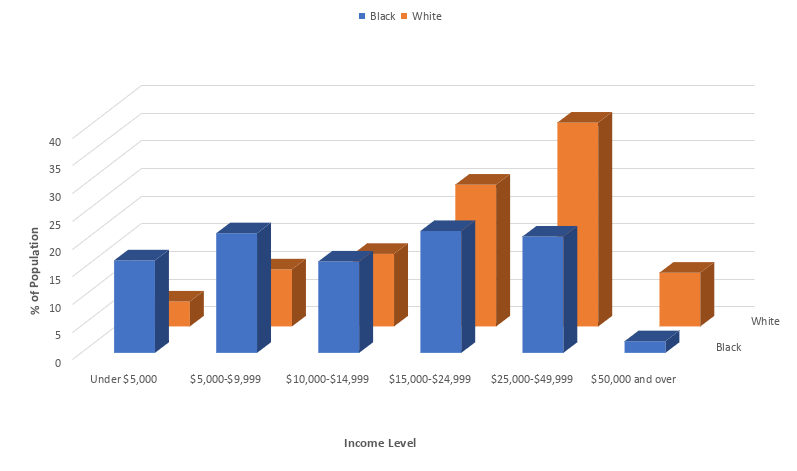
Source: The Center for the Study of Social Policy (CSSP). 1983. A Dream Deferred: The Economic Status of Black American, Washington, D.C. CSSP.
The disparity between Blacks and whites is also reflected in the data on infant mortality. The infant mortality rate among Blacks is nearly twice that of whites, even though the rates have declined for whites and Blacks since 1960. In 1983 the rate of infant deaths was 9.7 per 1,000 live births for whites, while in the same year the number of Black infant deaths was 19.2 per 1,000 live births. (See Table 12.) To state the matter in its starkest terms, a Black infant in Chicago in 1983 was more likely to die in the first year of life than a baby born in Costa Rica! (Children’s Defense Fund, 1986, p. xiii)
Finally, the growing number of incarcerated Blacks is a stark manifestation of national oppression. In conjunction with the increasing number of Black elected officials and the build-up of a buffer strata among Black people during the 1970s and early 1980s, there has been an expansion of the jails and prisons in this country. Between 1972 and 1981 the U.S. prison population grew from 200,000 to 412,000, with Black prisoners comprising 50 percent of that total (Revolutionary Worker, No. 236, p. 6). As the Revolutionary Worker has pointed out, Illinois is a good example of this trend: “The number of inmates has increased 122.5 percent since 1974. Of more than 14,000 prisoners in state facilities, 61 percent are Black (including 62 percent of death row), and maximum security prisons like Statesville and Pontiac are 80 percent Black. This figure does not include local jails, like Cook County Jail in Chicago, or juveniles” (Revolutionary Worker, No. 236, p. 6). For many Black youth, we can say without exaggeration that their future under imperialism holds a life of low-wage, dead-end jobs, high unemployment, pervasive poverty, the army, prison, drug addiction, gangs, and an early grave.
The outlines of a general periodization of developments in the national question in the post-World War 2 period can now be sketched. The 1950s witnesses the eruption of major “social dislocation,” with the transformation of productive relations in the South and the proletarianization and urbanization of the Black masses. The 1960s were an expansionary period of imperialism worldwide. A powerful revolutionary movement erupted in the U.S. (and in other imperialist citadels) during that decade, which was overall characterized by revolutionary struggle in the Third World, including in China where the proletarian leadership launched the Great Proletarian Cultural Revolution in the late ’60s. The U.S. bourgeoisie responded to the revolutionary movement in this country and, in general, to the “fighting mood” of the masses with brutal suppression and concessionary pacification. Tens of millions of dollars were pumped into various social programs. Generally, the three categories of concessions were: cash payments, such as AFDC and SSI; in-kind programs, like Food Stamps and Medicaid; and increased opportunities for employment, especially in high-paying jobs in industry. These concessions, however, did not alter the political economy of the ghetto, nor were they intended to do so. Bogged down in Vietnam and confronted with a multifaceted political crisis in the U.S., one of the most serious ever, the bourgeoisie was forced to shift gears in the late ’60s, giving more emphasis to the building up a buffer stratum within the Black nation. To underscore just how serious the situation was in the country, it should be noted that the Black Panther Party commanded the respect of large sections of Black youth in the late 1960s, including large numbers inside the U.S. military!
In the early ’70s elite strata of the Black masses continued to be built up while, on the other hand, the situation for the basic proletarian masses among Black people grew . – more desperate. Indeed, the bourgeoisie shifted gears and placed the main emphasis on building up a buffer stratum within the Black nation. As a result of state intervention in the form of affirmative action and other programs, there was not only impressive occupational upgrading for many in the Black petty bourgeoisie – in conjunction with the expansion of the Black bourgeoisie – but there were also significant gains in education for Blacks generally. In addition, Black politicians were significantly bolstered, while some sections of Black politicians were integrated into the state apparatus, particularly Black mayors. These Black politicians, though subject to control by the “big” bourgeoisie, did cultivate a social base precisely among those Blacks who had “made it” somewhat since the ’60s.
The devastating back-to-back recessions of the late ’70s and early ’80s were followed by the mid-’80s “recovery,” with the expansion of military spending and the acceleration of capital in flows from other imperialist countries in the U.S. bloc and the growth of the high-tech industry in the U.S. This meant an increase in high-paying jobs in the professional, managerial. and entrepreneurial sectors of the economy concomitant with the explosion of low-wage, dead-end jobs, particularly in producer services. In the context of overall global economic crisis and the accelerating war preparations of the imperialist blocs, West and East, the bourgeoisie has been forced to reorient federal spending away from social programs. At the same time the bourgeoisie has continued to build up certain elite, buffer strata among Black people as the situation confronting the basic Black masses has rapidly deteriorated. In addition to the expansion of these elite strata, the ruling class further bolstered Black participation in at least parts of the political structure in the late ’70s and early ’80s, with the rapidly multiplying number of Black elected officials. Meanwhile the country as a whole has witnessed an ideological offensive against women, immigrants, and oppressed nationalities as well as others. Such things as the Goetz shootings, the Philly massacre, and the ideological offensive that situates the cause of Black oppression within the Black community or the Black family, have played no small role in this quasifascist wave. This has been mixed with pervasive promotion of patriotism and a call for a Resurgent America – all of which is crucial for the bourgeoisie in rallying its social base for the showdown with the Soviets, a social base that is being prepared to fight and to die to make America No. 1 again in the world. Within the Black nation, people like Jesse Jackson have played a crucial role, as part of a loyal opposition, in attempting to rally large sections of Black masses, especially among the elite strata, to line up behind the war moves of the ruling class. While Jackson issues calls for reform, these are solidly in the context of “America Number One.” It is no exaggeration to say that for a certain section of its social base the bourgeoisie offers the likes of Jerry Falwell and for others they offer Jesse Jackson, the country preacher.
Over the past couple of decades there has undeniably been an intensification of class polarization among Black people. The important thing to stress about this development, however, is not simply that the proletarian masses are now more impoverished. While desperate circumstances are certainly part of the stuff of which revolutionary situations consist, it must be emphasized that proletarian revolution requires the leadership of the advanced class, armed with the most advanced theory, which it must translate into strategies and tactics and a battle plan for victory. The proletarian revolution is a conscious revolution, led by the class-conscious proletariat and its vanguard party – although spontaneous outbursts on the part of the masses do play an important role. The significance of class polarization in the Black nation, therefore, is that the class contradictions are now intensified. This is not to suggest that the Black bourgeoisie and pettv bourgeoisie should be identified as the enemy and a target of the proletarian revolution. Indeed, there are conservative influences among those classes – and among many a strong pull to go along with the bourgeoisie in order to maintain their privileged positions. But this is not something absolute or static. In the context of overall global crisis and the emergence of revolution in various countries throughout the world and in the U.S., many among the Black bourgeoisie and petty bourgeoisie will be able to be won over or neutralized. Nonetheless, it must be said that there is more of a basis now, as opposed to previous historical periods, for a reformist and even patriotic trend within the privileged strata among Black people. On the other hand, there is much more of a basis now, given class polarization within the Black nation, to bring forward broad sections of the proletarian masses of Black people, on the basis of their class interests, around a proletarian internationalist line. There is more of a basis for proletarian Black masses to grasp and act on what Bob Avakian has written:
One of the forms of class struggle is “What is the arena?” Is the arena the nation or is the arena the international situation…and the world struggle? And if the arena is presented as just the oppressed nation – that is, Black people – or just the U.S. society, then that’s ultimately favorable to the bourgeoisie. It is precisely a point of class struggle to fight for people to grasp that the arena objectively is, and must be reflected in their consciousness as being, first of all and fundamentally the world arena and that the basic contradiction that they are involved in, in class terms, is between the proletariat and its allies against the imperialists and their allies on a world scale through all its various different processes and streams and currents. Without doing that it’s not possible to win people to and continue to lead them on the basis of the proletarian line and proletarian politics. And also importantly, if secondarily, it is the only way in which the possible allies among, for example, Black petty-bourgeois forces or even some Black bourgeois strata and forces can be won over or at least neutralized with the development of a strong proletarian revolutionary current, and especially with the development of an overall revolutionary situation, revolutionary movement, and the actual struggle for the seizure of power and the transformation of society. So even as we stress the importance of the deepened and sharpened class polarization that has gone on within the Black nation, among the Black people, yet this can only be correctly understood, and the understanding only correctly utilized and turned into a strong weapon for the proletariat and for its struggle, if in an overall sense it is presented in this light and in this framework and with this kind of orientation and those kinds of horizons are what people’s sights are directed toward. (Avakian, 1985, p. 23)
While Black proletarians can be attracted to various non-proletarian ideologies, like nationalism, to a certain extent and to a certain degree, their real interests lie in fighting in unity with proletarians the world over for the communist future. And, given the class polarization addressed in this article, there is more of a basis now to win large numbers of them to that position. This is the real significance of polarization within the Black nation. And this has political and strategic implications – an issue that will be explored in a future article.
BIBLIOGRAPHY
Allen, Robert L., Black Awakening in Capitalist America; An Analytic History (New York: Anchor Books, 1970).
Avakian, Bob, Bob Avkian Replies to a Letter from: “Black Nationalist with Communistic Inclinations” (Chicago: RCP Publications, 1981). Originally published in Revolutionary Worker, No. 75, 10 October 1980.
Avakian, Bob, Summing Up the Black Panther Party (Chicago: RCP Publications, 1980).
Avakian, Bob, “Conquer the World? The International Proletariat Must and Will,” Revolution, No. 50 (Chicago: RCP Publications, December 1981).
Avakian, Bob, If There Is to Be Revolution, There Must Be a Revolutionary Party (Chicago: RCP Publications, 1982).
Avakian, Bob, “The ’60s Weren’t Always ‘The ’60s,’ and the ’80s Will Be Far Heavier,” Revolutionary Worker, 1 May 1983.
Avakian, Bob, A Horrible End, or An End to the Horror? (Chicago: RCP Publications, 1984).
Avakian, Bob, Revolution, No. 53 (Chicago: RCP Publications, Winter/Spring 1985).
Avakian, Bob, “Questions for These Times: An Interview with Bob Avakian,” Revolution, No. 54 (Chicago: RCP Publications, Winter/Spring 1986).
Binkin, et al, Blacks and the Military (Washington, D.C.: The Brookings Institution, 1982).
Black Enterprise, June 1982, “A Decade of Steady Progress.”
Black Enterprise, June 1983, “Federal Government Loans to Small Businesses and to Minority-Operated Small Businesses: 1970 to 1982.”
Blaustein, Arthur I. and Faux, Geoffrey, The Star Spangled Hustle (Garden City, N.Y.: Doubleday and Company, Inc., 1972).
Bradford, William D., “Growth in Store for ’84,” Black Enterprise, June 1984.
Carson, Clayborne, In Struggle: SNCC and the Black Awakening of the 1960’s (Cambridge, Massachusetts: Harvard University Press, 1981).
The Center for the Study of Social Policy (CSSP), A Dream Deferred: The Economic Status of Black Americans (Washington, D.C.: CSSP, 1983).
Center on Budget and Policy Priorities (CBPP), Falling Behind: A Report on How Blacks Have Fared Under the Reagan Policies (Washington, D.C.: CBPP, 1984).
Children’s Defense Fund, Maternal and Child Health Data Book (Washington, D.C.: Children’s Defense Fund, 1986).
Clayton, Janet, “Going for the Gold,” Black Enterprise, April 1983.
Dix, Carl, Jesse Jackson: The “Right Stuff” for U.S. Imperialism (Chicago: RCP Publications, 1984).
Dix, Carl, “Statement by Carl Dix, RCP, USA on the MOVE Massacre,” Revolutionary Worker, No. 337, 6 January 1986.
Dugger, Ronnie, The Politician (New York: W.W. Norton & Co., 1982).
Elemesrud, Judy, “Tamara Dobson – Not Super Fly, but Super Woman,” New York Times, 19 August 1973.
Fortune, 30 April 1984.
Frazier, E. Franklin, Black Bourgeoisie (New York: Collier Books, 1962).
Fulwood, Sam, “Savings and Loans Face That Rainy Day,” Black Enterprise, June 1985.
Fusfeld, Daniel R. and Bates, Timothy, The Political Economy of the Urban Ghetto (Carbondale and Edwardsville: Southern Illinois University Press, 1984).
Georgakas, Dan and Surkin, Marvin, Detroit: I Do Mind Dying (New York: St. Martin’s Press, 1975).
Geschwender, James A., Class, Race, and Worker Insurgency (Cambridge: Cambridge University Press, 1977).
Gettleman, Marvin E. and Mermelstein, David, eds., The Great Society Reader: The Failure of American Liberalism (New York: Vintage Books, 1967).
Harris, William H., The Harder We Run: Black Workers Since the Civil War (New York: Oxford University Press, 1982).
Henderson, Lenneal J., “Black Business Development and Public Policy,” State of Black America 1983 (New York: National Urban League, 1983)
Hicks, Jonathan, “Black-owned Concerns Reflected ’85 Economy,” New York Times, 7 May 1986.
Hill, Robert B., “The Black Middle Class: Past, Present and Future,” State of Black America 1986 (New York: National Urban League).
King, Martin Luther, Jr., Where Do We Go From Here: Chaos or Community? (Boston: Beacon Press, 1968).
Kozol, Jonathan, Illiterate America (New York: New American Library, 1985).
Leah, Daniel J., From Sambo to Superspade: The Black Experience in Motion Pictures (Boston: Houghton Mifflin Company, 1976).
Lenin, V.I., The Collected Works of Lenin (Moscow: Progress Publishers, 19741, Vol. 22.
Levitan, Sar A., et al., Still a Dream: The Changing Status of Blacks Since 1960 (Cambridge: Harvard University Press, 19751.
Lewis, David L., King: A Biography (Urbana: University of Illinois Press, 1978).
Logan, Hal J. “Harnessing the Information Explosion,” Black Enterprise, June 1983.
Lotta Raymond with Shannon, Frank, America in Decline: An Analysis of the Developments Toward War and Revolution, in The US and Worldwide, in the 1980s (Chicago: Banner Press 1984).
Lotta Raymond. “Notes on Political Economy: A Perverse Recovery in Strategic Context,” Revolutionary Worker, 4 January 1985.
Mao Tsetung, “Statement by Comrade Mao Tse-tung, Chairman of the Central Committee of the Communist Party of China, in Support of the Afro-American Struggle Against Violent Repression” (Peking: Foreign Languages Press, 1968).
Matney, William C., Americas Black Population: 1970 to 1982, A Statistical View (Washington, D.C.: Department Commerce Bureau of Census, 1983).
McGhee, James D., Black Solidarity: The Tie That Binds New York, National Urban League, Inc., 1983).
Millinder, Lucius, “Insuring Against the Odds,” Black Enterprise, June 1985.
Newsweek, “Battlefield, USA,” 7 August 1967.
Nixon Richard M. “Highlights of CBS Broadcast to the Nation Nation” Time. 3 May 1968.
Petrie, Phil W. “Dividends of Experience,” Black Enterprise June 1982.
Pinkney Alphonso, The Myth of Black Progress (Cambridge: Harvard University Press, 1984).
Piven Frances Fox and Cloward, Richard, Regulating the Poor The Functions of Public Welfare (New York: Vintage Books. 1971).
Revolutionary Communist Party, USA, King Legacy: Reformism and Capitulation, Revolution Reprint No. 7 (Chicago: RCP Publications. 1970).
Revolutionary Communist Party, USA, New Programme and New Constitution oi the Revolutionary Communist Party, USA (Chicago: RCP Publications, 1981).
Revolutionary Union, Red Papers 5: National Liberation and Proletarian Revolution in the U.S. (Chicago: Revolutionary Union, 1972).
Revolutionary Union, Red Papers 6: Build the Leadership of the Proletariat and lts Party (Chicago: Revolutionary Union, 1974).
Revolutionary Worker, No. 141, “Atlanta: The Hand at the End of the Chains,” 5 February 1982.
Revolutionary Worker, No. 236, “A Nation of Prisonhouses,” 30 December 1983.
Sheriell, Robert, The Accidental President (New York: Grossman Publishers, 1967).
Stuart, Reginald, “Motor City Blues,” Black Enterprise, June 1982.
Trammer, Monte, “Franchising: The Low Risk American Dream,” Black Enterprise, June 1982.
U.S. Congress, Office of Technology Assessment, Technology and Structural Unemployment: Reemploying Displaced Adults, DTA-ITE.250 (Washington, D.C.: U.S. Government Printing Office, 1986).
U.S. Department of Commerce, Bureau of Census, 1982 Survey of Minority-Owned Business Enterprises – Black (August 198.5) (Washington, D.C.: U.S. Government Printing Office, 1985).
U.S. Riot Commission, Report of the National Advisory Commission on Civil Disorders (Kemer Report) (New York: Bantam Books, 1968).
Westcott, Diane Nilsen, “Blacks in the 1970’s: Did They Scale the Job Ladder?”, Monthly Labor Review, June 1982.
Williams, Barbara Morrow, “Filth vs. Lucre: The Black Community’s Tough Choice,” Psychology Today, February 1974.
Wilson, William Julius, The Declining Significance of Race: Blacks and Changing American Institutions (Second Edition) (Chicago: The University of Chicago Press, 1980).
Yette, Samuel F., The Choice: The Issue of Black Survival in America (Silver Spring, Md.: Cottage Books, 1971).
FOOTNOTES
- While the question of superexploitation cannot be explored in any depth in this article, our discussion would be incomplete if we did not indicate the outlines of a Marxist approach to this question. Such an approach would take as a point of departure the caste-like oppression of Black people and then explore a highly important and complex dynamic: the channeling into, and the concentration and overrepresentation of Black workers within, the lowest paid sectors of the workforce; the exceptionally high rates of unemployment among Black proletarians; and the economic, social, and political processes specific to the ghetto which influence the conditions of existence of this labor power, that is, its costs of reproduction, availability, and supply. Thus, a scientific approach to the question of superexploitation would demonstrate that there are downward pressures on the wages of Black labor, stemming from its oversupply, and mechanisms specific to the ghetto which lower the cost of this labor to capital. ↩︎
- We use the term “Third World” throughout this article because it has become widely accepted as a kind of shorthand for the peoples and countries of Asia, Africa, and Latin America. But its use in this article has no connection with the reactionary “Three Worlds” theory advanced by the revisionist rulers of China. ↩︎
- For a fuller explanation of the necessity for this approach, see Avakian, Bob, Conquer the World. ↩︎
- Historically, two main incorrect explanations have been advanced for this phenomenon. The first is the stagnation theory, which was championed in particular by the Comintern; the Comintern theorists argued that stagnation was imperialism’s normal state – that capitalism had entered into an irreversible systemic crisis in which periods of revival and boom were exceptional and bound to be short lived. Consequently, imperialism lacked the dynamism with which to expand and to absorb the millions of Blacks driven off the land after World War 2. (In fact, based on the general crisis theory, the Comintern argued that imperialism could not alter the production relations in the South as occurred during and after the war.)
The second dominant explanation rests on the presumption of an ideal, free labor market. According to this notion, because Blacks lacked training and skills they found themselves at a competitive disadvantage in the scramble for jobs with the millions of whites who had also left the land after 1940. This explanation fails to comprehend and even denies the integrality and profitability of national oppression to the imperialist system. ↩︎ - In A Horrible End, or An End to the Horror?, Bob Avakian exposes how today certain forces among Black people want to bury the legacy of the more revolutionary currents of the ’60s: “The focus on this is ‘the ’60s’ that bourgeois elements and lackeys among Black people and other oppressed peoples in the U.S. want to ‘replay’ – and in the present situation this can only be a retrograde trend, especially to the extent (and it is to a large extent the case) that this is a conscious attempt to negate the revolutionary currents of the late ’60s and a conscious effort to lead the oppressed masses more firmly into the deadly embrace of the imperialist ruling class” (Avakian, 1984, p. 139). ↩︎
- For a more thorough discussion of this point see Avakian, 1982, pp. 70-72. ↩︎
- Prior to becoming president – specifically, between the years 1937 and 1960 – Lyndon Johnson distinguished himself as a staunch opponent of civil rights for Black people in the U.S. In a speech in Austin, Texas in 1948 he said: “This civil rights program is a farce and a sham – an effort to set up a police state in the guise of liberty” (Sheriell, 1967, p. 190). Moreover, in 1949 Johnson opposed an anti-lynching law because it “would indict as killers men and women who never held a gun in their hands” (Dugger, 1982, p. 345). ↩︎
- Ironically, the U.S. imperialists – ever the ones to “skin the ox twice” – are now pointing to the drug scene as a justification for a major tightening up of their state apparatus, including more repression against the Black masses. ↩︎
- The 1960s also witnessed a flowering, and suppression, of progressive and revolutionary Black culture in many different spheres and arenas. The ruling class attempted to prevent this culture from getting out to the masses through denial of venues and exposure, refusal of funding, and bourgeois-oriented criticism, and where it did get out attempted to overwhelm it with trash like the “blaxploitation films,” or pallid rip-offs. They also, however, resorted to outright police suppression of artists such as Charlie Mingus and Jimi Hendrix (with the political police perhaps implicated in the latter’s death), while other popular Black artists (e.g., Sam Cooke, Otis Redding) died under what were at least suspicious circumstances. It was the early ’70s before a few hugely popular artists like Marvin Gaye and Stevie Wonder were able to win any measure of artistic control over their work and broach themes of even a progressive (if not revolutionary), explicitly political character. This flowering and its suppression, while extremely significant, are beyond the scope of the current article, however. ↩︎
- While the above quote (and Piven’s and Cloward’s work as a whole) provides many useful insights – including their central thesis that the relief system does not increase “simply because economic deprivation spreads” but instead is used to “regulate labor” – it is marred by a reformist line. Specifically, their analysis that the “welfare explosion” of the 1960s was in any way a response to the “voting power of Black people” is wrong and quite reformist, to say the least. The ruling class was forced to make concessions to Black people in the 1960s in response to the tremendous, explosive struggle that the Black masses were engaged in at that time – Piven and Cloward do acknowledge this fact – and the overall world situation, which was largely characterized by the rising tide of the national liberation struggle in the colonial world directed at U.S. imperialism, with the focal point in Vietnam. But contrary to what Piven and Cloward have said, the bourgeoisie itself promoted voter registration drives and voting at critical stages during the movement of the 1960s in opposition to and as a diversion from mass rebellion and revolutionary activity. For example, in 1961 Robert Kennedy, who was Attorney General at that time, met with SNCC and other civil rights organizations in Washington. At that meeting, he suggested that these organizations direct their energies toward voter registration as opposed to mass protest actions like the freedom rides. Kennedy assured all those who attended the meeting that private foundations would provide financial support for voter registration projects (Carson, 1981, p. 39). Another example that is worthy of note: in the late 1960s the bourgeoisie, in league with Black bourgeois and petty-bourgeois elements, championed the view that electing Black mayors was the road to liberation for Black people. A sharp and intense struggle over this issue broke out in the Black liberation movement and revolutionary forces won the day for a time, exposing the electoral road for the dead-end that it was (and is). (Many nationalists and leftists forgot or refused to remember that important lesson from the movement of the 1960s as they rushed to support the presidential candidacy of Jesse Jackson in 1984. The goal of Jackson’s campaign, despite his rhetoric to the contrary, was precisely to help channel anger and rebellion (and potential rebellion) into a “loyal opposition” and line up ever larger numbers of Blacks [and others] on the side of the U.S. imperialists and their bloc in preparation for the showdown that is rapidly approaching between the West and the Soviet bloc. For a fuller discussion of Jesse Jackson’s presidential campaign, see Dix, 1984, pp. 3-10.) ↩︎
- A firm is considered Black-owned if it has 51 percent Black ownership. However, Blacks could own 51 percent of a business and still not control it. ↩︎
- “To be eligible for the Black Enterprise 100 List, a company must have been fully operational in the previous calendar year and be at least 51 percent Black-owned. It must manufacture or own the products it sells, or provide industrial or consumer services. And in 1984, it must meet the $11 million minimum gross sales to qualify. Brokerages, real estate firms and firms that provide professional services (accountants, lawyers, etc.), are not eligible” [Black Enterprise, 1986, p. 92). ↩︎
- Twenty-eight is the official figure of Atlanta youth murders. Several people who did independent investigations during the course of the murders put the number of murdered youth at more than fifty. ↩︎
The Atlanta youth murders are indeed an odious example of the real role of Black mayors. Maynard Jackson and his staff were less concerned with finding the perpetrators of those heinous crimes than they were with playing the role of “firemen” in relation to the Black masses in Atlanta and, for that matter, nationwide. In fact, Atlanta city officials virtually ignored the murders until an explosion at the day-care center at Bowen Homes housing project catapulted the Atlanta youth murders into a national and international issue. It was only then that the Atlanta city government took action – against the people! The weekend searches for the bodies of missing and murdered youth began, which were a ploy to cool out the anger of the masses. Scores of police began flooding the Black neighborhoods. A curfew was ordered against the youth, and more than 1,500 youth were cited for curfew violations. Roadblocks were set up, and 100 state troopers were brought in to bolster the city police force. Meanwhile, efforts on the part of the Black masses to patrol the street were discouraged, and when the residents of one housing project organized a “Bat Patrol” to protect Black youth, the city administration suppressed it, arresting the leaders. And in one of his more disgusting moves, Maynard Jackson held a press conference as he sat behind stacks of money totaling $100,000 which was raised as a reward fund. “Money talks,” Jackson said at the press conference. Finally, thousands of dollars were earmarked for police helicopters like the ones used in Miami and Chattanooga, Tennessee.
Maynard Jackson’s handling of the Black youth murders – including the jailing of Wayne Williams, whose guilt or innocence was (and is) only a part of the picture, for two of the murders and then closing the book on all the others – has indeed “poked dents in the facade” of the electoral road to Black “liberation.” While it is not altogether clear who the killers were, their motives, or their links to the bourgeoisie – though such links very likely existed – there is tremendous evidence which points to the role of the state in protecting and encouraging the murderers. Jackson and his ilk played a very important role in those events, playing the role of firemen whose duty was to put out any potential or actual fires among the Black masses. In fact, despite all the reformist rhetoric to the contrary, this is the primary responsibility of Black mayors and political officials more broadly; they are instruments of the bourgeoisie for maintaining the oppression of the masses of Black people. ↩︎- A recently published book provides another perspective and some startling statistics on literacy in the U.S.: “Twenty- five million American adults cannot read the poison warnings on a can of pesticide, a letter from their child’s teacher, or the front page of a daily paper. An additional 35 million read only at a level which is less than equal to the full survival needs of our society… Together these 60 million people represent more than one third of the entire adult population… The largest numbers of illiterate adults are white, native-born Americans. In proportion to population, however, the figures are higher for blacks and Hispanics than for whites. Sixteen percent of white adults, 44 percent of blacks, and 56 percent of Hispanic citizens are functional or marginal illiterates. Figures for the younger generation of black adults are increasing. Forty-seven percent of all black seventeen-year-olds are functionally illiterate. That figure is expected to climb to 50 percent by 1990… Fifteen percent of recent graduates of urban high schools read at less than sixth grade level . Half the heads of households classified below the poverty line by federal standards cannot read an eighth-grade book. Over one third of mothers who receive support from welfare are functionally illiterate.” (See Jonathan Kozol, Illiterate America, [New York: New American Library, 19851, pp. 4-5.) ↩︎
 Going Against the Tide: A journal charting a path for communist revolution in the US